




Abstract
The current study extended previous work by further examining the psychometric properties of the Mistake Rumination Scale and its associations with depression and evaluative fears, as well as the cognitive experience of perfectionism and procrastination. Most notably, this study also uniquely examined a possible link between mistake rumination and a perfectionistic self-presentational style in line with our view that needing to outwardly seem perfect reflects internal insecurities and ruminative brooding about mistakes. The Mistake Rumination Scale is a seven-item inventory measuring the tendency to ruminate about a past personal mistake. In a sample of 132 university students, the Mistake Rumination Scale had good psychometric properties, including acceptable internal consistency and concurrent validity in terms of its links with perfectionistic self-presentation and ruminative thoughts related to being perfect and procrastination. Mistake rumination was positively associated with all facets of perfectionistic self-presentation. The measures of mistake rumination and automatic thoughts related to perfectionism and procrastination were all positively linked with depression and social anxiety. Regression analyses showed that mistake rumination was the only significant predictor of depression, while mistake rumination and perfectionistic cognitions were both significant predictors of fear of negative evaluation. Our findings attest to the further use of the Mistake Rumination Scale, highlighting the need for interventions that promote a more positive orientation toward making mistakes and an explicit emphasis on reducing the tendency to ruminate about mistakes.
There has now been extensive research on the cognitive elements of the perfectionism construct as a supplement to the primary focus on trait perfectionism. The current article adds to recent research that focuses on the Mistake Rumination Scale and its ability to assess individual differences in mistake rumination. The core theme guiding this research is that much vulnerability and distress is rooted in a tendency that many people have to brood about personal mistakes. This tendency to reflect obsessively on past mistakes can foster a preoccupation with self-doubt while also continuing to highlight ways in which the person has been discrepant from the all-consuming goal of being perfect. Mistake rumination is also a clear indicator of failing to accept the past.
Our interest in mistake rumination has been fuelled by the observations of researchers who study psychopathology in general and researchers who focus specifically on perfectionism. At a broad level, McLaughlin and colleagues (2007) discussed worry and rumination and they concluded that “Global rumination about past mistakes and failures is likely involved in the generation of the negative mood states that are a prerequisite for engagement in depressive rumination” (p. 25). Earlier, the seminal article by Watson and Clark (1984) on positive affect versus negative affect included their sage observation that a tendency to ruminate about their mistakes is a core feature of those people who are prone to negative affect.
A cognitive preoccupation with past mistakes is also a highly relevant theme in social anxiety (for a discussion, see Flett & Hewitt, 2014, 2026). It is believed that many people who are vulnerable to the experience of social anxiety anticipate future mistakes and they are cognitively preoccupied with past mistakes, especially previous social blunders. A cognitive hypersensitivity to mistakes in interpersonal situations is suggested by Hofmann’s (2007) psychological maintenance model of social anxiety disorder.
Mistake rumination became a focus of the initial work on multidimensional perfectionism when Frost and Henderson (1991) incorporated a focus on mistake rumination as part of their study of perfectionistic athletes. They found that elevated levels of trait perfectionism in terms of the concern over mistakes dimension introduced by Frost and colleagues (1990) was associated with thinking about mistakes made in athletic competition. Perfectionistic athletes were more prone to report that they frequently thought about their mistakes more often and they could not forget about them to the point that it impaired their performance during competition.
Frost et al. (1997) conducted a subsequent study that involved having participants keep a daily diary. This investigation included a focus on the daily experience of mistakes. One salient finding that emerged from this study is that it matters whether the mistakes are viewed as important versus less important. Participants with a high trait level of concern over mistakes reported more thoughts about an important mistake, but they did not indicate more rumination about less important mistakes. An experimental investigation further established an association between trait perfectionism dimensions and reported rumination about mistakes made during performance (Besser et al., 2004).
Flett and associates (2020) advanced this line of investigation by developing the seven-item Mistake Rumination Scale. Mistake rumination was conceptualized as a form of self-recrimination, as described by Hewitt et al. (2017). This preoccupation with past mistakes and not being perfect is a cognitive tendency that perpetuates and prolongs self-doubt, a negative self-view, and associated forms of psychological distress. Flett et al. (2020) evaluated the Mistake Rumination Scale by conducting three studies with four samples of university students. This research showed that the Mistake Rumination Scale is single-factor instrument with adequate internal consistency. Mistake rumination was associated significantly with other measures of rumination and predicted a range of distress measures. In addition, mistake rumination was linked with indices of trait perfectionism and predicted unique variance in distress beyond trait perfectionism and other measures of rumination.
Other work on the Mistake Rumination Scale is beginning to emerge. For instance, one team of investigators evaluated the Turkish modification of this scale and confirmed that it is unifactorial and has sound psychometric properties (see Kabadayi & Mercan, 2021). They also showed that elevated levels of mistake rumination were associated positively with a ruminative style and associated negatively with a measure of cognitive control and flexibility. Another team of investigators adapted some items from the Mistake Rumination Scale to assess rumination about mistakes with respect to failures to lose weight. This research showed the close ties between mistake rumination and regret (see Liu & Ling, 2021). More recent research found that mistake rumination mediated the association between socially prescribed perfectionism and language learning anxiety (Barabadi et al., 2024).
Another investigation compared levels of mistake rumination among musicians who did or did not have focal dystonia, the neurological movement disorder that can afflict highly skilled musicians. Detari and Egermann (2022) showed that musicians with focal dystonia, relative to those without dystonia, had higher mean levels of mistake rumination. Analyses confirmed in this context that the Mistake Rumination Scale consisted of one factor composed of items with a high degree of internal consistency (alpha of .897). The measure was completed by musicians to tap their rumination about performance mistakes. Correlational analyses with data from the total sample of 175 musicians showed that mistake rumination was linked significantly with elevations in reported levels of trauma frequency and life events frequency, greater anxiety in interactions with a music tutor, and higher exposure to demanding teaching. Most recently, the Mistake Rumination Scale was used in an adapted form to assess rumination in response to a big mistake versus a little mistake (Gaudreau et al., 2025). As might be expected, this work illustrated that mistake rumination is more aligned with needing to be perfect than with needing to be excellent.
The Mistake Rumination Scale can still be regarded as a new scale and, as such, several key issues remain to be investigated. Accordingly, we featured it in the current study to revisit some of these issues in university students. This work focused jointly on psychometric issues and substantive issues. Regarding the more substantive issues, we went beyond initial research linking mistake rumination and needing to be perfect as assessed by trait perfectionism by examining the possible association between mistake rumination and needing to seem perfect. It is likely that the outward expression of perfectionism is due, at least in part, to seeking to hide internal ruminations about previous mistakes and associated distress. This would fit with a general view that the perfectionistic self-presentation style is an expressive style that is motivated by not wanting people to know about the inner turmoil and insecurities that can haunt vulnerable perfectionists.
At present, links have been established between mistake rumination and trait perfectionism (also see Philpot & Donachie, 2025; Rahman et al., 2025), but the self-presentational elements of mistake rumination have not been evaluated. Hewitt et al. (2003) illustrated the need to distinguish between needing to be perfect and needing to seem perfect by developing the Perfectionistic Self-Presentation Scale and showing that it has three discernible facets (i.e., perfectionistic self-promotion, nondisplay of imperfection, and nondisclosure of imperfection). Mistake rumination and self-presentational perfectionism should be linked if the Mistake Rumination Scale has concurrent validity. In the current context, it was anticipated that perfectionistic self-presentation is used defensively to hide from other people the experience of brooding about past mistakes and the distress associated with this mistake rumination.
Specifically, in the present study, we examined how scores on this inventory relate to facets of perfectionistic self-presentation. It has been suggested that individuals higher in perfectionism often hide significant distress behind a façade (see Flett, Hewitt, Nepon, & Zaki-Azat, 2018). Perfectionistic self-presentation has a focus on needing to seem perfect and it is distinguishable from trait perfectionism (see Hewitt et al., 2003). Evidence has accumulated and clearly attests to the link between perfectionistic self-presentation and distress (Casale et al., 2024), but more needs to be known about the internal tendencies and vulnerabilities of individuals high on perfectionistic self-presentation. In the current work, it is our contention that it is conceivable, if not likely, that an external façade also covers up ruminations about mistakes so that external displays do not accurately reflect the internal insecurities of those people who are plagued by past mistakes.
The second focus of this investigation was to examine the extent to which mistake rumination relates to other measures of cognitive rumination, but has predictive utility beyond these measures. Our undergraduate student participants completed the Perfectionism Cognitions Inventory (Flett et al., 1998) and the Procrastinatory Cognitions Inventory (Stainton et al., 2000). Past research has shown that there are measurable individual differences in the frequency of thoughts about perfectionism and procrastination, and more frequent thoughts of both types are associated with various indices of distress. Moreover, these cognitive aspects have a shared focus on a sensitivity to failure (see Yosopov et al., 2024).
When it comes to perfectionistic thoughts, more frequent perfectionistic thoughts tend to predict unique variance in depression beyond trait perfectionism (see Flett et al., 1998). Evidence that mistake rumination can also predict unique variance would further attest to the potential usefulness of this measure as well as the incremental validity of the Mistake Rumination Scale. We evaluated this possibility in a sample of undergraduate students by also administering measures of depression and evaluative fear and then conducting analyses focused on the unique properties of mistake rumination.
This study also included a measure of procrastination-related automatic thoughts developed by Stainton et al. (2000). There is considerable research linking perfectionistic tendencies with procrastination in students (see Flett et al., 2004; Sirois et al., 2017; Smith et al., 2017). In the current study, we sought to replicate initial research linking mistake rumination with frequent thoughts related to procrastination (see Flett et al., 2020) to further underscore that students suffering from procrastination tend to experience frequent mistake rumination and this likely fuels their doubts and defensiveness.
In summary, the current study revisited the psychometric properties of the Mistake Rumination in a sample of university students. Another aim was to evaluate the extent to which this measure related to fear of negative evaluation and depression. Finally, we examined how mistake rumination relates to perfectionistic self-presentation and we further evaluated how mistake rumination relates to automatic thoughts involving themes tapping perfectionism and procrastination.
Method
Participants and Procedure
Our sample consisted of 132 university students (97 women, 34 men, and 1 person who did not report gender). Their mean age was 20.1 years (SD = 2.8). The majority of the students (59.8%) were in their first year of university, with 18.9% in their second year, 11.4% in their third year, and 3.8% in their fourth year or higher. The most commonly reported intended major was psychology, which was listed by 31.1% of the participants.
This study was reviewed and approved for compliance to research ethics protocols by the Human Participants in Research Committee at the institution where the research was conducted. Participants were recruited through the Undergraduate Research Participant Pool at a large Canadian university. The link to the study was posted on the participant pool website and participants needed to verify their status as students at this university by providing their unique username and password in order to proceed. No participant names or contact information were tied to their participation in this study, which ensures that their participation was anonymous and strictly confidential. They received credit toward their final grades in their introductory psychology courses in exchange for their participation.
After providing their consent, participants completed the following self-report questionnaires in an online study:
Mistake Rumination Scale (MRS; Flett et al., 2020): This scale is composed of seven items measuring rumination over an important mistake. The instructions for this scale are as follows: Some people can’t seem to stop thinking about mistakes they have made, whereas some people stop thinking about it soon after the mistake has happened. Please think about the last time you made an important mistake. Please briefly describe the mistake in the space provided. Regarding this mistake, please indicate your response for each statement below by selecting an answer for each one.
Items are then rated on a scale ranging from 0 (not at all) to 4 (very much). A representative item is “To what extent do you still think about the mistake and wish it had gone better?” Psychometric analyses have demonstrated that this is a unidimensional measure with good reliability and validity (Flett et al., 2020).
Perfectionistic Self-Presentation Scale (PSPS; Hewitt et al., 2003): The PSPS is a 27-item measure assessing three facets: perfectionistic self-promotion (e.g., “I strive to look perfect to others”); nondisplay of imperfection (e.g., “Errors are much worse if they are made in public rather than in private”); and nondisclosure of imperfection (e.g., “I should solve my own problems rather than admit them to others”). Items are rated on a scale ranging from 1 (Strongly Disagree) to 7 (Strongly Agree). This scale possesses good reliability and validity (Hewitt et al., 2003).
Perfectionism Cognitions Inventory (PCI; Flett et al., 1998): This scale is composed of 25 items measuring the frequency of negative automatic thoughts relating to the need to be perfect over the past week (e.g., “I expect to be perfect”). Items are rated on a scale ranging from 0 (not at all) to 4 (all of the time). The psychometric properties of this measure have been well established in student and clinical samples (Flett et al., 1998, 2007). We utilized the full 25-item version rather than a 10-item short form (Hill & Donachie, 2020) due to our wish to fully assess the range of themes addressed in the original 25-item version.
Procrastinatory Cognitions Inventory (Stainton et al., 2000): This inventory consists of 18 items measuring the frequency of thoughts related to procrastination over the last week (e.g., “Why didn’t I start earlier?”). Items are rated on a scale from 0 (not at all) to 4 (all of the time). This measure possesses good reliability and validity (Flett et al., 2012, 2016; Stainton et al., 2000).
Center for Epidemiological Studies-Depression Scale (CES-D; Radloff, 1977): The CES-D consists of 20 items measuring symptoms of depression over the past week. Sample items include “I felt depressed” and “I had crying spells.” Items are rated on a Likert scale, with 0 representing rarely or none of the time (less than one day) and 3 representing most or all of the time (5-7 days). This scale possesses good psychometric properties (Radloff, 1977).
Brief Fear of Negative Evaluation Straightforward Items (BFNE-S): The BFNE-S consists of eight items taken from the original 12-item Brief Fear of Negative Evaluation scale assessing how afraid someone is of being evaluated in a negative manner (Leary, 1983). These eight items are positively worded such that higher scores indicate higher fear of negative evaluation and all of the reverse-scored items were removed. A sample item is “I am afraid that people will find fault with me.” Item response options range from 1 (Not at all) to 5 (Extremely). Research has shown that the straightforwardly worded items comprising the BFNE-S possess better psychometric properties than the original items (Rodebaugh et al., 2004; Weeks et al., 2005).
Results
Data Analytic Plan
Prior to performing statistical analyses, we conducted a missing values analysis. Across participants, there was barely any missing data on the variables of interest. Little’s MCAR test was not significant and, thus, the values are likely to be missing in a random way. Missing values were imputed using the expectation-maximization method in SPSS. Descriptive statistics were calculated for the total sample, as well as a content analysis for the mistakes that were reported for the Mistake Rumination Scale. A Confirmatory Factor Analysis was conducted with AMOS using maximum likelihood estimation procedures to validate the one-factor Mistake Rumination Scale that has already been established (see Flett et al., 2020). Next, correlational analyses were performed to explore the links among mistake rumination, perfectionistic self-presentation, perfectionistic cognitions, procrastinatory cognitions, depression, and fear of negative evaluation. Lastly, multiple regression analyses were performed to examine which variables (i.e., mistake rumination, perfectionistic cognitions, and procrastinatory cognitions) are important in predicting depression and fear of negative evaluation. Before conducting these regression analyses, we checked for normality of the outcome variables (i.e., depression and fear of negative evaluation) and the distributions both differed from normal. As a result, the robust bootstrapping procedure was used since it does not impose the assumption of normality. We generated 2000 bootstrap samples in order to provide estimates, standard errors, and 95% bias-corrected confidence intervals. It is important to note that the sample size for this study of 132 is enough to conduct these multiple regression analyses. According to Green (1991), only 73 participants are needed to detect a medium effect size with three different predictors.
Content Analysis
Initially, we conducted a content analysis of the mistakes reported when participants were asked to list their most recent mistake of importance prior to completing the Mistake Rumination Scale. Examples of reported mistakes are included below. However, in certain cases where mistakes were highly specific, they were paraphrased to protect the anonymity of the participants.
The most commonly reported mistakes were in the area of academics, with 63 participants reporting a mistake related to academics. Some recurring themes with mistakes in the academic domain were about achievement and failure (e.g., “when I failed an important exam”) as well as procrastination (e.g., “Started working on my 10 page essay late”). Other academic-related mistakes included making specific errors on tests or assignments (e.g., “changing the right answer to a wrong one on a major test”) and not attending class at all (e.g., “skipped economics lecture”).
Many other commonly reported mistakes were in the interpersonal domain, with 33 participants listing a mistake with a social basis. These individuals reported mistakes related to family (e.g., “I recently spoke to my parents rudely, and was being unreasonable…”), romantic relationships (e.g., “Cheated on my boyfriend”), and friendships (e.g., having the opportunity to repair a friendship but not taking it). There were also general or unspecified interpersonal transgressions reported (e.g., “disrespecting people I care about”).
Additionally, eight participants reported a careless mistake ranging from minor circumstances (e.g., forgetting paperwork when renewing a health card) to potentially dangerous or life-threatening circumstances (e.g., getting into a car accident). Another eight participants reported a job-related mistake (e.g., “almost made someone pay twice for their bill”). There was one participant who reported a mistake related to their health and another who reported a mistake related to an extracurricular activity. Moreover, 12 participants chose to leave the space blank, which could be because they could not recall a specific mistake or preferred not to disclose any mistake. Lastly, six participants were not specific when reporting their mistakes and made quite general comments instead.
Confirmatory Factor Analysis
Factor Loadings for the Items of the Mistake Rumination Scale
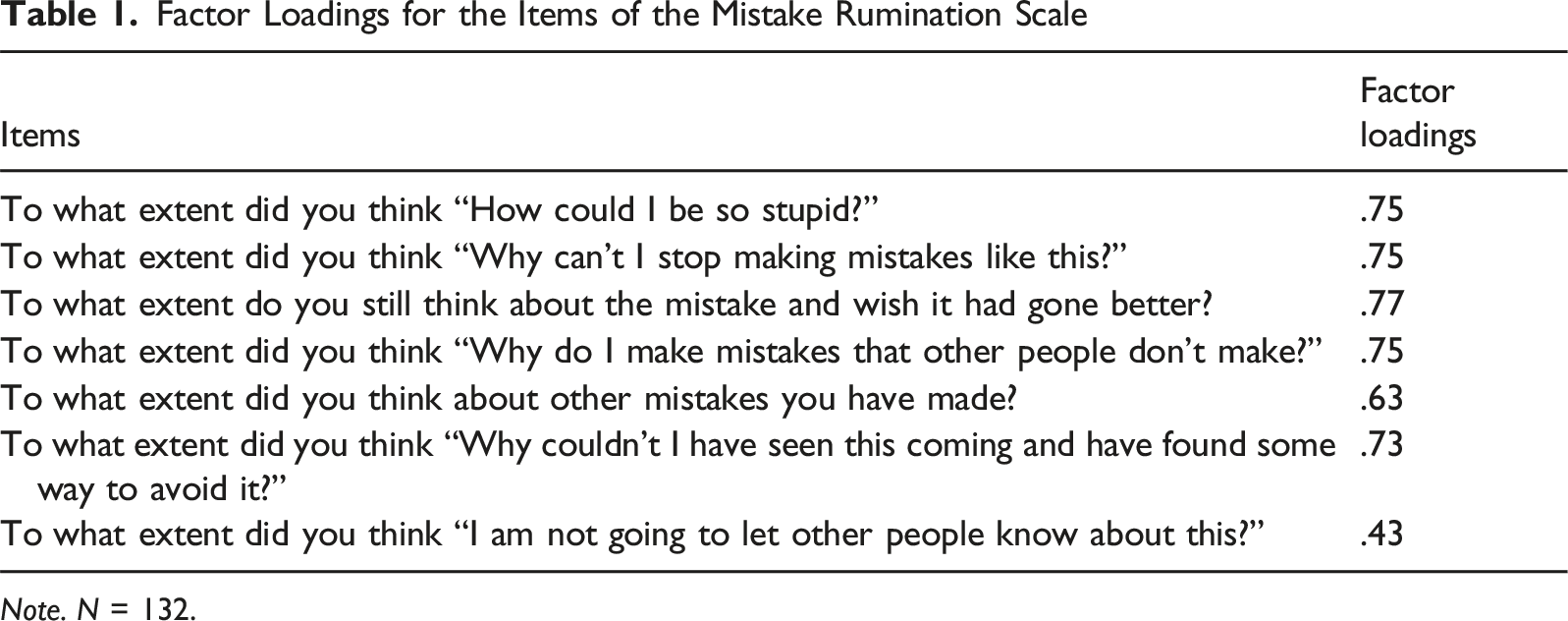
Note. N = 132.
Descriptive Statistics
Descriptive Statistics and Correlations Among Mistake Rumination, Perfectionistic Self-Presentation, Perfectionistic Cognitions, Procrastinatory Cognitions, Depression, and Fear of Negative Evaluation
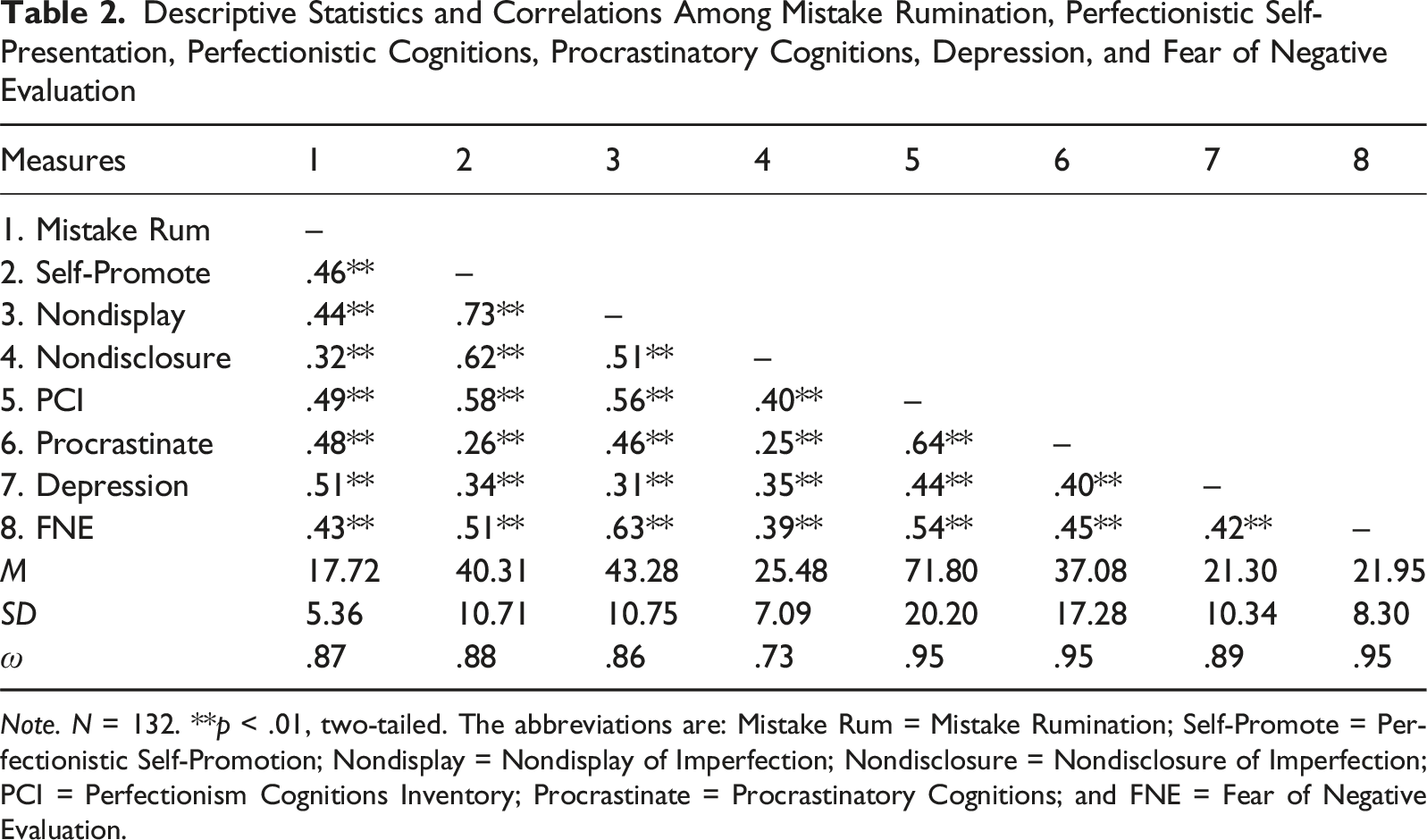
Note. N = 132. **p < .01, two-tailed. The abbreviations are: Mistake Rum = Mistake Rumination; Self-Promote = Perfectionistic Self-Promotion; Nondisplay = Nondisplay of Imperfection; Nondisclosure = Nondisclosure of Imperfection; PCI = Perfectionism Cognitions Inventory; Procrastinate = Procrastinatory Cognitions; and FNE = Fear of Negative Evaluation.
Correlational Analyses
Table 2 presents the correlations among mistake rumination, perfectionistic self-presentation, perfectionistic cognitions, procrastinatory cognitions, depression, and fear of negative evaluation. To interpret the magnitude of these correlations, we took into account both the conventional guidelines by Cohen (1992) and the revised recommendations for personality researchers by Gignac and Szodorai (2016). According to Cohen (1992), .10 is a small correlation, .30 is a medium correlation, and .50 is a large correlation. In contrast, Gignac and Szodorai (2016) contend that correlations of .10 are relatively small, .20 are typical, and .30 are relatively large. Mistake rumination was positively correlated with all three facets of perfectionistic self-presentation, as well as with perfectionistic cognitions. Mistake rumination was further positively correlated with procrastinatory cognitions, depression, and fear of negative evaluation. The magnitude of the correlations involving mistake rumination described above and presented in Table 2 are medium-to-large according to Cohen (1992), while all correlations are considered to be relatively large by Gignac and Szodorai (2016).
Perfectionistic self-presentation and perfectionistic cognitions were also associated with greater procrastinatory cognitions. According to Gignac and Szodorai (2016), the magnitude of these correlations range from typical to relatively large; according to Cohen (1992), the correlations range from medium-to-large. In addition, all facets of perfectionistic self-presentation, perfectionistic and procrastinatory cognitions were all associated with higher levels of depression and fear of negative evaluation. Lastly, depression was associated with greater fear of negative evaluation. The magnitude of these correlations are considered to be medium-to-large by Cohen (1992) and relatively large by Gignac and Szodorai (2016).
Regression Analyses
Summary of Multiple Regressions for Variables Predicting Depression and Fear of Negative Evaluation
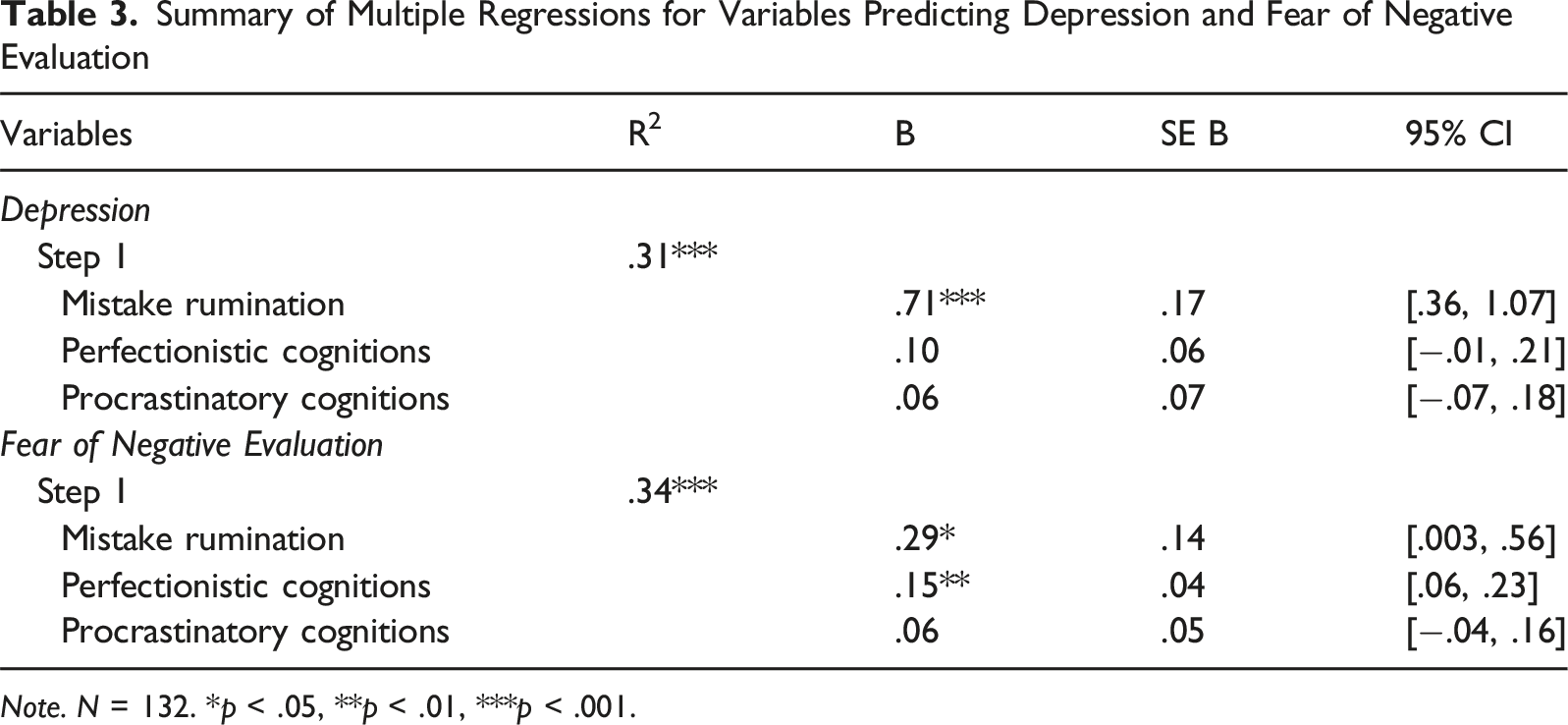
Note. N = 132. *p < .05, **p < .01, ***p < .001.
For the regression predicting fear of negative evaluation, mistake rumination, perfectionistic cognitions, and procrastinatory cognitions were again entered into the predictor block, and fear of negative evaluation was entered as the outcome (see Table 3). This model significantly predicted 33.8% of the variance in fear of negative evaluation scores, F (3, 128) = 21.80, p < .001. Mistake rumination was once again a significant individual predictor of fear of negative evaluation and so was perfectionistic cognitions.
Discussion
The current study examined mistake rumination in a sample of university students, and the results indicated that the scale developed to assess mistake rumination appears to have sound psychometric properties in this sample. Indeed, the Mistake Rumination Scale has adequate internal consistency and concurrent validity in terms of its associations with measures that tap frequent automatic thoughts.
The results of analyses of the specific mistakes reported by our participants fit with past indications that students tend to focus on achievement-based mistakes (47.7% of respondents) or interpersonally based mistakes (25% of respondents). However, more than 25% of our sample listed another type of mistake. In the current instance, we asked participants to identify and describe their most recent important mistake. However, there is no obvious reason why the Mistake Rumination Scale cannot be amended slightly so that respondents are asked to report on their biggest mistake in life or a mistake in a specific context (e.g., the biggest mistake made at work) or perhaps made in public. This scale could also be applied to the area of sport and dance where athletes and dancers report their most important mistake that occurred during a performance situation.
The findings from our correlational analyses confirmed past results indicating that students with elevated levels of mistake rumination also tend to experience more frequent thoughts about having to be perfect as well as procrastination-related thoughts related to dilatory behavior (see Flett et al., 2020). It now seems clear that conceptual accounts of the link between perfectionism and procrastination need to incorporate a cognitive perspective that includes the tendency among perfectionistic students who procrastinate on their tendency to ruminate about mistakes. Future research needs to examine how mistake rumination underscores the self-doubt and fear of failure that is common to procrastination and maladaptive perfectionism.
The current results showed that mistake rumination was associated robustly with scores on a multi-faceted measure of perfectionistic self-presentation. The significant links found here imply that students who may be plagued with an internal dialogue focused on one or more mistakes they have made will nonetheless project outwardly that they are doing perfectly well, and it is clear that there is a self-presentational side to having made a mistake. While many people will never admit that they have made a mistake (for a discussion, see Tavris & Aronson, 2007), a portion of these people are not simply engaging in self-deception because they are reflecting and ruminating on this mistake as part of their internal dialogue. We can infer from our findings that it is likely that people who are higher in perfectionistic self-presentation may be quite focused inwardly on a public mistake that led to feeling ashamed and humiliated and perfectionistic self-presentation may reflect a desire to minimize and manage these feelings of distress.
Collectively, when our results are viewed from a person-centered perspective, it seems that some perfectionistic students have multiple tendencies that should combine to substantially undermine their ability to concentrate and learn new material or perform well when needing to do well on a test. It is known that students who are higher in frequent thoughts about needing to be perfect tend to report cognitive difficulties (see Flett et al., 1998). Our results suggest that some students also have frequent troubling thoughts about earlier mistakes and these thoughts persist in their minds. These tendencies fit well with observed pathways to underachievement among perfectionistic students (see Flett & Hewitt, 2022).
Other results from the current study replicated earlier findings that link elevated mistake rumination scores with elevated distress in the form of depression and social anxiety (see Flett et al., 2020); however, in this instance, we focused on the fear of negative evaluation as one element of social anxiety. Given this further evidence of a consistent link between mistake rumination and depression, it will be important in future research to begin to explore mechanisms and processes that may help account for why mistake rumination is linked with depression. The most likely explanation is that mistake rumination is associated with harsh self-criticism and a paucity of mistake-related self-compassion and self-forgiveness, but other possibilities are quite plausible. For instance, given the association with dilatory tendencies and related thoughts, it could be that mistake rumination has an avoidant coping and problem-solving orientation because mistakes are cognitively salient and there is increased level of concern about making more mistakes and simply making things worse.
Perhaps the most revealing analyses in the current study were the regression analyses that pitted mistake rumination against the automatic thoughts measures. Correlational analyses indicated that all three cognitively based measures were associated significantly with both depression and fear of negative evaluation. These associations further attest to the potential role of excessively thinking about mistakes, needing to be perfect, and procrastination in depression and social anxiety. Our regression analyses demonstrated that when the individual difference measures were pitted against each other when predicting depression, the block was significant, but only mistake rumination was a significant predictor. The ability of mistake rumination to seemingly supersede the predictive utility of perfectionistic automatic thoughts is remarkable, given the extensive prior evidence that attests to the association between depression and perfectionistic automatic thoughts (e.g., Flett et al., 1998). Perhaps our current results signify the salience and degree of emotional upset that can accompany making significant mistakes that they become the subject of constant, if not chronic, rumination.
The regression analysis predicting levels of fear of negative evaluation showed that both mistake rumination and perfectionistic automatic thoughts were significant predictors. We regard this as evidence that attests further to the uniqueness of mistake rumination but also, the results likely signify that mistake rumination occurs, in part, in an attempt to avoid making future mistakes and being evaluated harshly by those people who are aware of the mistake or the behavior leading up to it.
Although procrastination-related thoughts did not emerge as a variable that predicted unique variance in the regression analyses, this cognitive tendency continues to be an important part of the experience of distressed university students. We found in the current study that procrastination-related thoughts were linked with mistake rumination, and these thoughts were also linked with depression and fear of negative evaluation. If we consider our findings from a person-focused perspective, it should be evident that certain students are very much in need of cognitively focused interventions. Some students are preoccupied with past mistakes and thoughts and feelings of being imperfect, but they also have thoughts about their dilatory behavior. The cognitive preoccupations of these distressed students will likely impair their ability to learn new material and it seems like a cognitively exhausting existence for these students, especially if they must also be vigilant about not revealing imperfections in public.
Returning to our main results, the current findings involving mistake rumination are significant in terms of their implications at the applied and conceptual levels. The results signify that certain students are plagued by ruminative thoughts about mistakes and this is a source of distress for them. Clearly, prevention and intervention efforts designed to alleviate perfectionism need to include an explicit focus on controlling and perhaps removing mistake rumination. Ideally, this is part of a broader approach that is implemented with the goal of creating a healthy orientation toward making mistakes. Moreover, at a conceptual level, the current results represent more evidence of the need for an explicit emphasis on mistake rumination in models of perfectionism from a cognitive perspective. Flett, Hewitt, Nepon, and Besser (2018) outlined an initial version of perfectionism cognition theory that included an emphasis on cognitive products that include ruminations; our findings and earlier findings on mistake rumination support an explicit emphasis on mistake rumination when conceptually considering cognitive perfectionism at the product level. Further support for an explicit emphasis on mistake rumination at the conceptual level is provided by a new study, which suggests that mistake rumination acts as a mediator of the links between trait perfectionism (i.e., self-oriented and socially prescribed perfectionism) and other personality tendencies (e.g., procrastination) and consequential outcomes (e.g., performance) (see Bellam et al., 2025).
Directions for Future Research
As noted earlier, research on mistake rumination is still in its early stages, and there are many key issues that remain to be examined. First, and foremost, the characteristics and correlates of the Mistake Rumination Scale need to be evaluated to determine its suitability when adapted for respondents from various parts of the world. We feel this work is essential given our sense that mistake rumination is a universal tendency that is problematic in most, if not all, instances.
What strikes us as particularly urgent is research that examines mistake rumination and its origins in children and adolescents. It is likely that the results of the current study would also have been detected if the focus had been on younger participants, but first research is needed to establish that mistake rumination plagues young people.
Additionally, we believe it is important to take a cue from previous research such as the study by Smith et al. (2017) and examine mistake rumination in other contexts. A study of the daily experience of mistake rumination through the use of daily diaries would provide important information that would be valuable from a practical and a conceptual perspective. Additionally, it should be revealing to consider levels of mistake rumination and correlates of mistake rumination among people in training professions in which mistakes are not permitted (e.g., medical and law students). Recent research attests to the merit of conducting research on medical and law students (e.g., Chen et al., 2024).
Finally, with respect to the link between mistake rumination and perfectionistic self-presentation, this finding needs to be replicated in other samples to test its generalizability. It will also be important to examine mistake rumination in terms of other self-presentational tendencies. This work should consider motivational orientations and other personality factors (e.g., excessive self-consciousness) that may be contributing to the link between mistake rumination and perfectionistic self-presentation.
Limitations of the Current Study
The results of this study must be viewed within the context of certain limitations. First, our sample was relatively small and this precluded a meaningful evaluation of certain issues such as the presence of gender differences. Second, as is frequently the case, cross-sectional research of this nature cannot suggest causal associations and it is important that mistake rumination and the other constructs in this study are examined from a multidimensional perspective. Our findings are also limited in their generalizability. As suggested above, we are hopeful that mistake rumination will be examined in students from various countries so that there is greater documentation of the potential destructiveness that accompanies mistake rumination.
In summary, the current study yielded findings that support the continued use of the Mistake Rumination Scale. This scale had sound psychometric features in terms of both reliability and validity. Most notably, the current study established uniquely that mistake rumination is often hidden behind a façade of having a perfect life and people who are highly focused on not making a mistake in public tend to ruminate excessively about mistakes they have made. Finally, it is clear from our results that mistake rumination may have a unique role to play in predicting distress and this role is not redundant with other cognitive measures that tap other forms of brooding and rumination that arise when things are not perfect.
Footnotes

Funding
The authors disclosed receipt of the following financial support for the research, authorship, and/or publication of this article: The first author was supported by a Canada Research Chair in Personality and Health.
Declaration of Conflicting Interests
The authors declared no potential conflicts of interest with respect to the research, authorship, and/or publication of this article.