




Abstract
Although the original long version of the Hewitt Multidimensional Perfectionism Scale (HMPS) has been translated and validated in a Spanish population, no study to date has examined the psychometric properties of a short version of the HMPS with a Spanish-speaking sample. For this reason, the aim of this study is to analyze the psychometric properties and factorial invariance of Cox and colleagues’ short form of the HMPS in a Spanish-speaking population. A sample of 496 undergraduate and graduate students (69.4% females; M age = 19.89, SD = 2.28, range 18–25 years) was used. After removing items 1, 3, 6, 8, 9, and 12, a confirmatory factor analysis was found to support the three-factor structure proposed by Cox and colleagues: Socially Prescribed Perfectionism (SPP), Self-Oriented Perfectionism (SOP), and Other-Oriented Perfectionism (OOP). Acceptable reliability values were obtained for total HMPS-sf and its subscales. Regarding between-factor correlations of the HMPS-sf, SOP and SPP obtained the lowest correlation coefficient. SPP reported the most maladaptive correlational pattern of the three dimensions, whereas SOP displayed the less maladaptive pattern. In addition, results evidenced configural, metric, and scalar invariance. As for strict invariance, one of the three parameters did not meet the requirements. In conclusion, the Spanish version of the HMPS-sf was found to be a reliable and valid instrument. Therefore, this study offers the first short, easy-to-use tool for the evaluation of perfectionism in a Spanish population.
Introduction
Perfectionism is a multidimensional personality trait characterized by excessively high standards of self-demand and self-criticism toward both oneself and others, accompanied by beliefs about environmental demands and criticism (Vicent et al., 2019). According to Flett and Hewitt (2020), over the last three decades, the study of this construct has increased exponentially. It is mainly studied in the field of clinical psychology, given its close relationship with psychopathology (Lunn et al., 2023). However, it continues to be essential to research and the development of new ways to evaluate perfectionism (Flett & Hewitt, 2020).
Although many instruments are available to assess this personality trait, Hewitt’s Multidimensional Perfectionism Scale (HMPS; Hewitt et al., 1991) is one of the most frequently used. This is probably because it has been found to offer adequate internal consistency for most of its subscales in both clinical and nonclinical samples (Stoeber, 2016), while also receiving empirical and theoretical support for its three-dimensional structure (Flett & Hewitt, 2020). This scale consists of 45 items, assessed with a 7-point Likert scale, measuring three perfectionist dimensions proposed by Hewitt and Flett (1991): Self-Oriented Perfectionism (SOP, i.e., unrealistic demands and perfectionistic for the self), Other-Oriented Perfectionism (OOP, i.e., unrealistic demands and perfectionistic motivation for others), and Socially Prescribed Perfectionism (SPP, i.e., unrealistic beliefs about other’s expectations for oneself to be perfect). The HMPS has been translated into different languages, offering support for its original three-factor structure and adequate internal consistency (e.g., De Cuyper et al., 2015; Mansur-Alves et al., 2023; Rodríguez-Campayo et al., 2009; Soares et al., 2003). However, not all of these validations have maintained the original 45 items. For example, in the study by Soares et al. (2003), items 29, 37, 38, and 45 were excluded, and Mansur-Alves et al. (2023) did not include items 29 and 37.
Despite the empirical and theoretical soundness of the HMPS, applying such a lengthy instrument (i.e., 45 items) may be unfeasible in certain contexts, such as educational settings, where in addition to a lack of time available, it could decrease the participants’ motivation to respond appropriately (Stoeber, 2016; Worthington & Whittaker, 2006). Thus, there is currently great interest in developing and validating shortened scales that allow a construct to be assessed in a short period of time to improve participant adherence, especially when numerous self-reporting batteries must be completed (Bento et al., 2019). Moreover, in psychological assessment, it is common to use shortened versions of complex and lengthy measures of intelligence, personality, and conative factors (Feher et al., 2020). Some authors also believe that the HMPS contains certain redundant items (Stoeber, 2016) as well as others that are worded negatively, potentially creating confusion when responding using a Likert-type scale (De Cuyper et al., 2015).
A Short Form of the HMPS
Cox et al. (2002) developed a brief version of the HMPS (i.e., HMPS-sf). Firstly, the authors tested the 45 items and three-factor model proposed by Hewitt and Flett (1991) in a college sample (N = 288) and clinical sample (N = 241) using confirmatory factor analysis (CFA). Unsatisfactory goodness-of-fit levels were obtained for all of the indices analyzed. Secondly, an exploratory factor analysis (EFA) with the college sample and subsequent CFA provided support for a 15-item brief version of the scale that maintained the original three-dimensional structure: SPP (items 13, 31, 33, 35, and 39); SOP (items 6, 14, 28, 40, and 42); and OOP (items 10, 19, 24, and 43). Reliability coefficients were acceptable (>α = .80) for SPP and SOP. However, they were not acceptable for OOP in either the college (α = .66) or clinical sample (α = .52). Convergent and discriminant validity was also examined by analyzing the relationship between SOP and SPP and other measures of perfectionism as well as Neuroticism, Conscientiousness, Depression, and Academic achievement. Results suggested convergent validity for the dimensions of the HMPS-sf when correlations with Frost’s Multidimensional Scale (Frost et al., 1990) factors were analyzed. SOP was positively and significantly associated with the measures of personality, Depression, and Academic achievement considered in the study, in both the clinical and college samples, with the exception of Depression (which only revealed a significant correlation for the clinical sample). On the other hand, SPP correlated positively and significantly with Neuroticism, Depression, and anticipated Academic achievement. Non-significant correlations were obtained for recent Academic achievement and Conscientiousness.
Cox’s brief version of the HMPS (i.e., HMPS-sf) has been widely used to measure perfectionism in clinical and nonclinical samples, including studies performed with participants from different domains such as sport (e.g., Hill et al., 2020; Longbottom et al., 2012), educational settings (e.g., Loscalzo et al., 2019; Simon & Salanga, 2021), or even in cross-cultural studies (e.g., Rice et al., 2020). However, further research on its psychometric properties (structure, validity, and reliability) and subsequent validations of the scale in cultures other than the original North American one are scarce. Specifically, Juwono et al. (2023) obtained an adequate fit model in Hungarian population and, after allowing the error covariance between items 10 and 11 and between items 12 and 13, the model fit rose to an acceptable level, reporting good internal consistency for the three dimensions (SPP, α = 0.81; SOP, α = .84; OOP, α = .79). In the Italian context, Lombardo et al. (2022) also provided data on the psychometric properties of the Italian translation of Cox et al.’s (2002) HMPS-sf using clinical (N = 102) and nonclinical (N = 58) participants. Specifically, the HMPS-sf showed good fit indices and acceptable internal consistency in both samples for SOP and SPP (α = .75−.84), but not for the OOP (α = .46 for students and α = .54 for patients), as well as good temporal stability (tr = .80–.53). Finally, evidence of concurrent validity was stronger for SOP than for SPP or OOP.
Stoeber (2016) compared the pattern of correlations of Cox et al.’s (2002) HMPS-sf with the full 45-item original version to examine the degree to which the short form would replicate the original version’s correlations with different personality variables. Results showed that the HMPS-sf performed well with regard to SOP and SPP since all of the correlations of the short form were within the 95% CI of the original version’s correlations. However, for OOP, the HMPS-sf had some difficulty replicating the pattern of correlations of the full-length HMPS. On the other hand, Rice et al. (2020) examined the cross-cultural invariance of the original English version of the scale and its Italian translation using two samples of undergraduates from the US and Italy, concluding functional equivalence between cultures.
This Study
Although the original long version of the HMPS has been translated and validated in a Spanish population (Rodríguez-Campayo et al., 2009), to the best of the authors’ knowledge, no study to date has examined the psychometric properties of a short version of the HMPS with a Spanish-speaking sample. Given the growing need for brief self-reports, this instrument should be as parsimonious as possible while still being psychometrically sound. Therefore, the aim of this study is to validate a Spanish version of the HMPS-sf developed by Cox et al. (2002). Specifically, the purposes are to (1) analyze the factorial validity of the Spanish version of the HMPS-sf; (2) perform a classic item analysis; (3) calculate the internal consistency of the scale; (4) test the discriminant validity by examining correlations between the total score and subscales of the HMPS with Affect, Emotional stability, and Satisfaction with life; and (5) analyze the factorial invariance of the Spanish version of the HMPS-sf across females and males.
Method
Participants and Procedure
Individual meetings were arranged with teachers attached to the Faculty of Education of the University of Alicante to explain the objectives of the research and the participation of their students was requested. After the acceptance of each teacher, the students were invited to participate in the research voluntarily. Consequently, all participants turned in an informed consent form and freely agreed to participate in the study. The total sample consisted of 496 undergraduate and graduate students (69.4% female; M age = 19.89, SD = 2.28, range 18–25 years). The distribution of the current academic stage was as follows: 439 (88.5%) undergraduates and 57 (11.5%) master’s degree students. All data were collected online in class, with the collaboration of teachers, and under the supervision of a research team member. Students were allowed to use their smartphone, tablet, or PC. Moreover, the completion was carried out anonymously by generating a personal and non-transferable code that the students had to keep in case they wished to retrieve or delete their data.
Instruments
The Hewitt Multidimensional Perfectionism Scale-short form (HMPS-sf) published by Cox et al. (2002) consisted of 15 items measuring three subscales: Socially Prescribed Perfectionism (e.g., “The better I do, the better I am expected to do”), Self-Oriented Perfectionism (e.g., “One of my goals is to be perfect at everything I do”), and Other-Oriented Perfectionism (e.g., “Everything that others do must be of top-notch quality”) rated on a 7-point Likert scale. The HMPS-sf was translated into Spanish using the direct and back-translation methodology following the ITC Guidelines for Translation and Adapting Tests proposed by International Test Commission (2017). Two bilingual Spanish experts in Educational Sciences and Psychology translated the terminology of the original HMPS-sf into Spanish. The original and back-translated versions were comparatively and meticulously analyzed with a third expert. Lately, a fourth translator conducted a back-translation from Spanish to English. Finally, the entire team discussed the results of the back translation and resolved the few issues identified during this process. As a final step, to ensure not only linguistic correction but also the practical suitability of the items (Muñiz et al., 2013), two undergraduate students were asked to evaluate their comprehensibility. No changes were recommended in the wording of the items.
The Positive and Negative Affect Schedule (PANAS; Watson et al., 1988). The Spanish validation of the PANAS performed by López-Gómez et al. (2015) was used in this study. Having a 5-point Likert scale, the scale assesses the extent to which the individual has felt 20 different descriptors over recent weeks. The 20 descriptors are divided into two dimensions: Positive affect (e.g., “interested,” “exited,” and “strong”) and Negative affect (e.g., “irritable,” “distressed,” and “upset”). The reliability coefficients of the scale for Positive affect were α = .86 and ω = .86, while for Negative affect were α = .87 and ω = .87.
The Ten-Item Personality Measure—Emotional Stability subscale (TIPI-Emotional stability; Gosling et al., 2003). Participants completed the Spanish version of the TIPI’s Emotional stability subscale performed by Renau et al. (2013). The Emotional stability subscale includes two items, using a 7-point response scale, with each item consisting of two adjectives having similar but not identical meanings (e.g., “Anxious, easily upset” and “calm, emotionally stable”). Higher scores on the subscale suggest higher levels of emotional stability and mental wellness. The Cronbach’s alpha coefficient for the data at hand was acceptable (α = .67, ω = .65).
The Satisfaction with Life Survey (SWLS; Diener et al., 1985). The Spanish version of the SWLS validated by Atienza et al. (2000) was used. The scale is a 5-item measure of self-perceived well-being (e.g., “I am satisfied with my life”). Items are evaluated using a 7-point Likert-type scale. The reliability coefficient for this study was acceptable (α = .84, ω = .85).
Data Analysis
Two confirmatory factor analyses (CFA) were conducted to examine the factorial validity of the Spanish version of the HMPS-sf (the original model and a distinct model). Since the pre-analysis revealed multivariate normality (Mardia’s coefficient), maximum likelihood estimation (MLE) was used. Model fit was examined using the Chi-square (χ2) index and other comparative fit indices (CFI), the Tucker–Lewis index (TLI), root mean square error of approximation (RMSEA), and root mean square residual (RMR). Values above .95 for CFI and TLI, below .06 for RMSEA, and below .08 for RMR suggested a good fit (Brown, 2015).
A classical item analysis was also performed by examining the mean, standard deviation, kurtosis, skewness, contribution of each item to the reliability of the scale and subscale (alpha if the item was deleted), item-test correlation, corrected item-test correlation, item-factor correlation, and corrected item-factor correlation. Items were eliminated according to the following criteria: having a low standard deviation (<.5), a correlation <.40 with the subscale, or those whose removal resulted in an increase of more than .3 points of the total reliability of the subscale.
To test the internal consistency of the HMPS-sf, Cronbach’s alpha and omega coefficients, as well as composite reliability, were calculated for the total scale and subscales, with values ≥.70 being considered acceptable (Nunnally, 1978). According to Dos Santos and Cirillo (2021), average variance extracted (AVE) was calculated to measure the amount of variance captured by the test excluding the measurement error, with AVE scores ≥.50 being considered adequate.
Associations between the factors of the HMPS-sf, the total score of the scale, and other variables (i.e., Affect, Emotional stability, and Satisfaction) were calculated using Pearson product-moment correlation coefficients. According to Cohen (1988), a Pearson’s r ≥ .1 was considered small, ≥.3 moderate, and ≥.5 was considered to be large.
Finally, to examine the factorial invariance of the Spanish version of the HMPS-sf across sexes, we tested the model separately for each group using a multi-group confirmatory factor analysis (MCFA) with the MLE method. Mardia’s coefficients for boys and girls revealed multivariate normality. This procedure assesses the fit of a series of nested models to which constraints are progressively added. Subsequently, the configural invariance (Model 0: equal structure) was followed by increasingly more stringent factorial invariance tests: metric invariance (Model 1 = equal factor loadings), scalar invariance (Model 2 = equal intercepts), and strict invariance (Model 3 = equal residual variances). Goodness-of-fit models were tested using the above-mentioned indices and criteria (TLI, CFI, RMSEA, and RMR), as well as the non-significant level of probability associated with Δχ2 (p > .05), and ΔRMSEA, and ΔCFI (≤.01) (Cheung & Rensvold, 2002).
Statistical analyses were carried out using the IBM SPSS 22.0 program and the AMOS software package.
Results
Factor Structure and Average Variance Extracted
Confirmatory Factor Analysis: Goodness-of-Fit Indices for the Original Model and Spanish HMPS-sf Model.
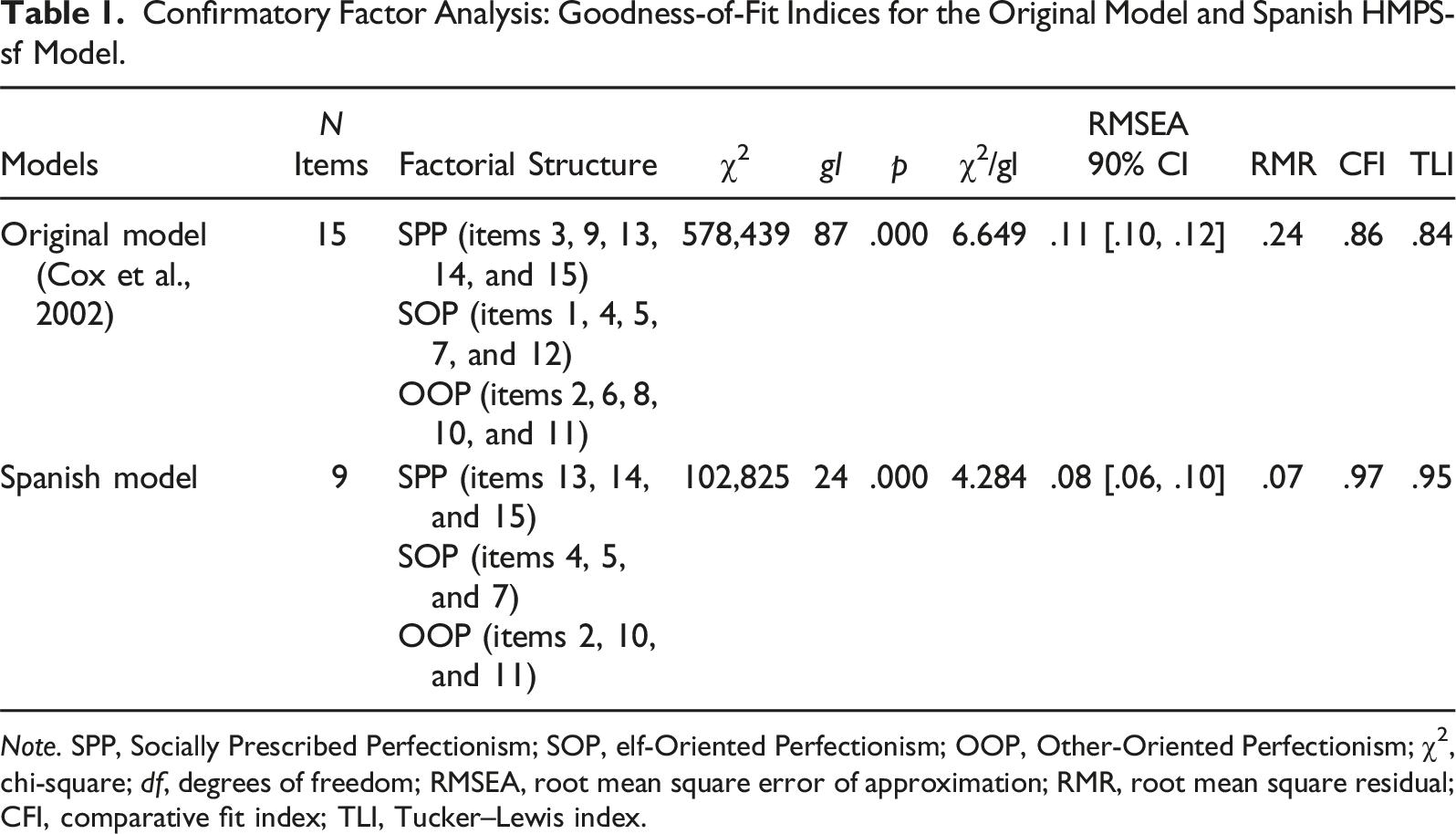
Note. SPP, Socially Prescribed Perfectionism; SOP, elf-Oriented Perfectionism; OOP, Other-Oriented Perfectionism; χ2, chi-square; df, degrees of freedom; RMSEA, root mean square error of approximation; RMR, root mean square residual; CFI, comparative fit index; TLI, Tucker–Lewis index.
Classical Item Analysis of the HMPS-sf and Reliability.
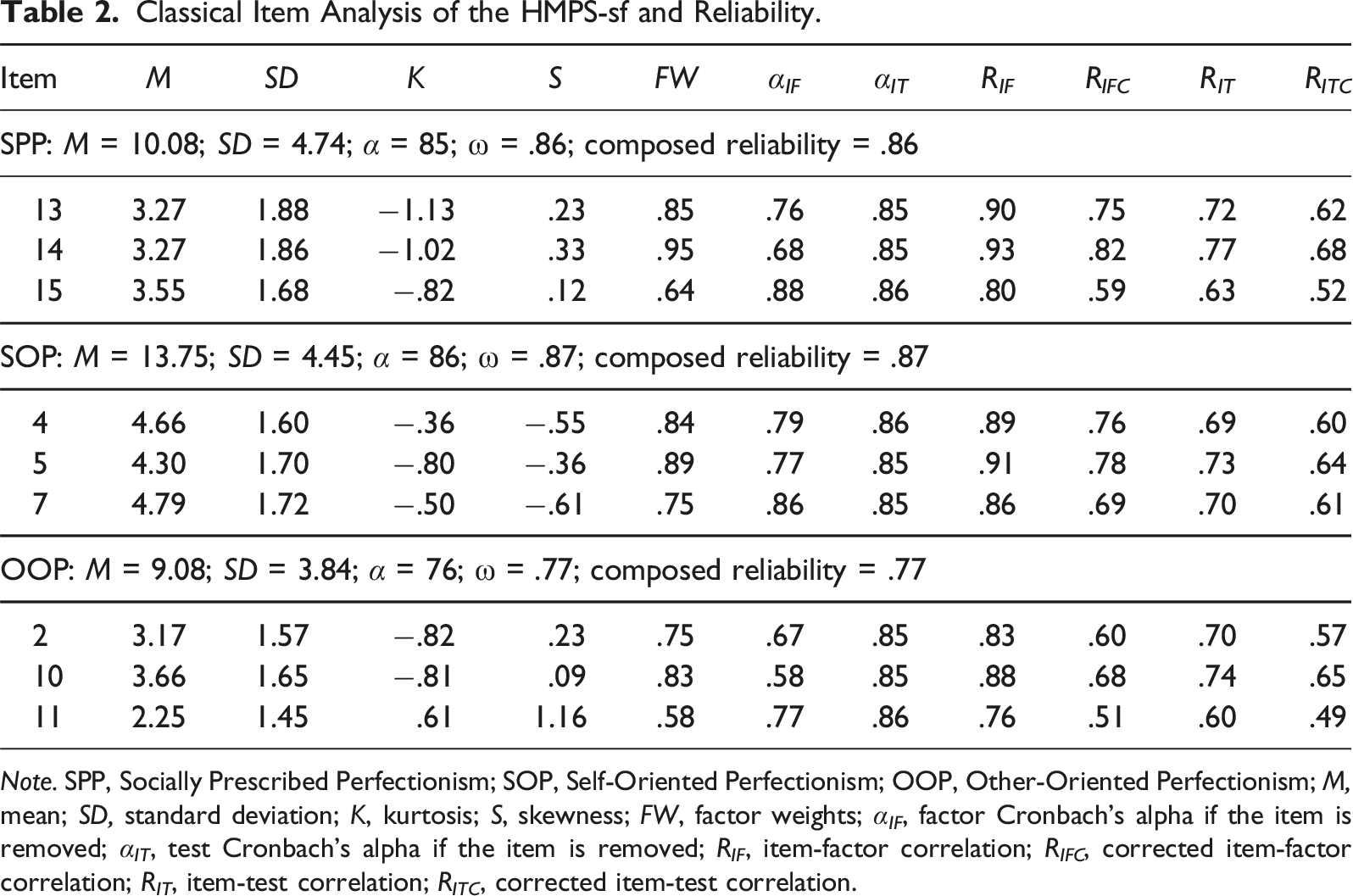
Note. SPP, Socially Prescribed Perfectionism; SOP, Self-Oriented Perfectionism; OOP, Other-Oriented Perfectionism; M, mean; SD, standard deviation; K, kurtosis; S, skewness; FW, factor weights; α IF , factor Cronbach’s alpha if the item is removed; α IT , test Cronbach’s alpha if the item is removed; R IF , item-factor correlation; R IFC , corrected item-factor correlation; R IT , item-test correlation; R ITC , corrected item-test correlation.
Internal Consistency and Classical Item Analysis
The HMPS-sf subscales revealed acceptable internal reliabilities of α = .76–.86, ω = .77–.87 and composed reliability = .77–.87 (see Table 2). Similarly, reliability coefficients for the total score of the scale were good and excellent (α = .87, ω = .94, and composed reliability = .94). Regarding the classical item analysis (see Table 2), item means ranged from 4.79 (item 7) to 2.25 (item 11), and standard deviation ranged from 1.88 (item 13) to 1.45 (item 11). The highest item-test correlation was .69 (item 13) and the lowest was .30 (item 9) (see Table 2). Internal consistency of the subscale with one item removed ranged from .81 to .84. Item-subscale correlations were <.70 in all cases and no elimination of any item resulted in an increase of more than .3 points of the subscale’s total reliability.
Between-Factor Correlations and Associations With Other Measures
Bivariate Correlations Between the Factors of the HMPS-sf and the Total Score of the Scale, Positive and Negative Affect, Emotional Stability, and Satisfaction With Life.
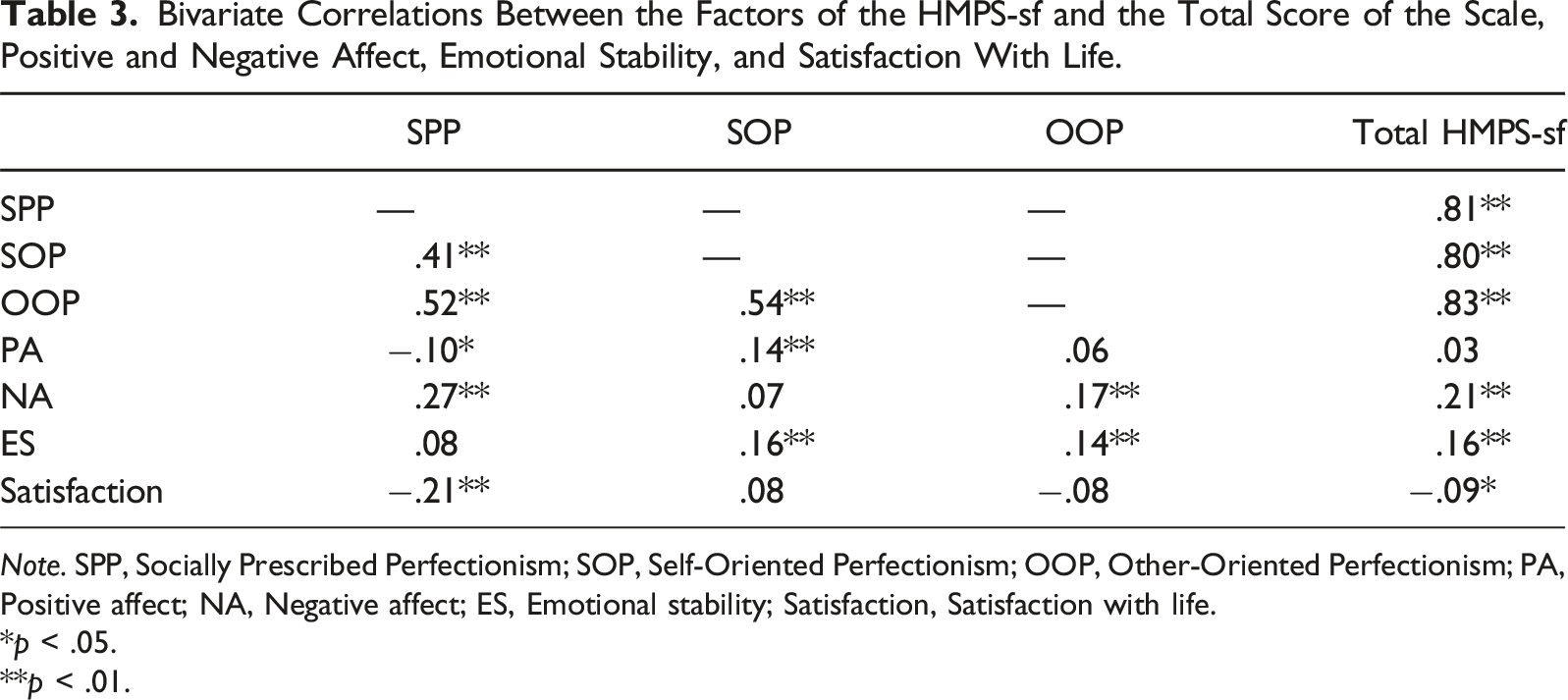
Note. SPP, Socially Prescribed Perfectionism; SOP, Self-Oriented Perfectionism; OOP, Other-Oriented Perfectionism; PA, Positive affect; NA, Negative affect; ES, Emotional stability; Satisfaction, Satisfaction with life.
*p < .05.
**p < .01.
Factorial Invariance
Factor Invariance and Fit Indices for the Spanish HMPS-sf Model as a Function of Gender.
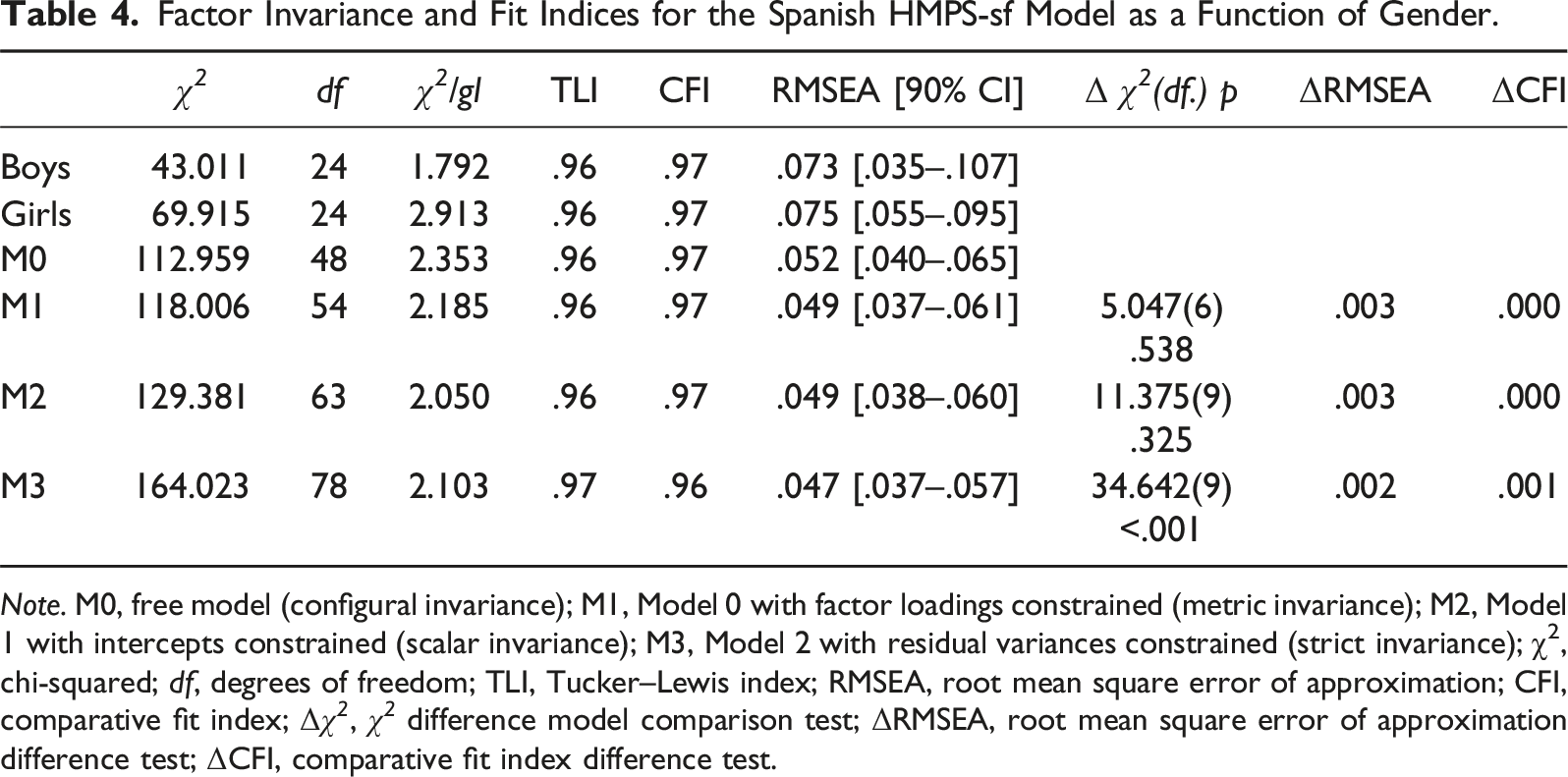
Note. M0, free model (configural invariance); M1, Model 0 with factor loadings constrained (metric invariance); M2, Model 1 with intercepts constrained (scalar invariance); M3, Model 2 with residual variances constrained (strict invariance); χ2, chi-squared; df, degrees of freedom; TLI, Tucker–Lewis index; RMSEA, root mean square error of approximation; CFI, comparative fit index; Δχ 2 , χ 2 difference model comparison test; ΔRMSEA, root mean square error of approximation difference test; ΔCFI, comparative fit index difference test.
Discussion
The aim of this study was to validate the Spanish version of the HMPS-sf developed by Cox et al. (2002). CFAs provided support for the three-factor solution in line with the HMPS-sf proposed by Cox et al. (2002) and the original full version developed by Hewitt et al. (1991). However, to achieve a good fit of the model, items 1, 3, 6, 8, 9, and 12 were removed. Thus, the Spanish version of the HMPS-sf consisted of nine items, three for each factor (SPP: items 13, 14, and 15; SOP: items 4, 5, and 7; OOP: items 2, 10, and 11), in compliance with the recommendation of having at least 3 items to evaluate each subscale (Welch & Comer, 1988). The results are also partially consistent with the Hungarian (Juwono et al., 2023) and Italian versions of Cox et al.’s HMPS-sf (Lombardo et al., 2022), which obtained a good fit for the original 15-item model. However, results from Lombardo et al. (2022) reported that the item referring to “I do not have very high expectations for those around me” obtained loading levels that were lower (.20) than the acceptable values (≤.40) (Nunnally, 1978). Thus, for statistical reasons, these items were removed.
With respect to reliability, for all of the subscales, the Spanish HMPS-sf reported better levels than the version of Cox et al. According to Nunnally and Bernstein (1994), for exploratory research, the alpha coefficient must be greater than .70, whereas, for general research purposes, this coefficient must be higher than .80. Consequently, reliability levels associated with the SOP and SPP subscales showed that the test would be suitable for general research purposes, whereas the OOP subscale would only be suitable for exploratory research. Specifically, the SOP and OOP dimensions obtained the highest and lowest internal reliability, respectively. Although in our study the internal reliability of the OOP was acceptable, this tendency of the OOP to report lower and even unacceptable levels of reliability as compared to the SOP and SPP is a common result (e.g., Cox et al., 2002; Juwono et al., 2023; Lombardo et al., 2022; Rice et al., 2020). This may be due to the problems caused by the amount of negatively worded items in the OOP (see Lombardo et al., 2022, for a review).
Regarding between-factors correlations of the HMPS-sf, the SOP and SPP obtained the lowest correlation coefficient (r = .41), similar to the findings of Stoeber (2016) and Juwono et al. (2023). This may be because both dimensions have been found to be indicators of distinct second-order perfectionist traits (Perfectionistic strivings and Perfectionistic concerns) sometimes having different correlational patterns (e.g., Hill et al., 2020; Loscalzo et al., 2019).
Discriminant validity was verified by correlations of the three factors of the HMPS-sf (SPP, SOP, and OOP) and the total score of the scale with other measures (i.e., Affect, Emotional stability, and Satisfaction with life). Overall, SPP reported the most maladaptive correlational pattern of the three dimensions, while SOP demonstrated the least maladaptive results (Stoeber & Otto, 2006). Although correlations for Positive and Negative affect and Satisfaction with life were in line with previous research, unexpected results were obtained for Emotional stability. Thus, the positive (although non-significant) relationship in the case of SPP, found between the three perfectionism dimensions and Emotional stability, contrasts with past literature that reported a positive and statistically significant correlation between SPP and Neuroticism (e.g., see Smith et al., 2019, for a meta-analytic review). While most of the existing studies have been performed using North American samples, this study was carried out with a sample of Spanish undergraduates. The discrepancies found may be attributed to cultural factors, such as collectivism/individualism or parental style (see DiBartolo & Rendón, 2012, for a review) influencing the perfectionism outcomes. However, these discrepancies may also be due to the different measurement tools used to assess Emotional stability or Neuroticism. In fact, considering the limited number of items and reliability obtained in this study for the TIPI-Emotional stability subscale, future research should replicate these correlations using other measures of Neuroticism or Emotional stability, distinct from the TIPI (Renau et al., 2013).
Regarding the analysis of the factorial invariance of the Spanish version of the HMPS-sf across sex, the results evidenced configural, metric, and scalar invariance. In contrast, because only one (p associated with Δχ 2 ) of the three parameters considered for strict invariance did not meet the requirements, partial measurement invariance was established (Dimitrov, 2010). Overall, the results of measurement invariance suggest that the scores obtained through the use of the HMPS-sf are comparable between males and females and a change of one unit would be comparable between them.
Limitations and Future Research Lines
This study has several limitations. First, caution should be taken when generalizing these results to other Spanish-speaking samples distinct from the Spanish population. Future studies should consider whether the Spanish version of the HMPS-sf developed by Cox et al. (2002) would have suitable psychometric properties for use in Latin American countries. Moreover, causal relationships cannot be established since it is a cross-sectional study. Therefore, future research should include longitudinal data to analyze the variation of perfectionist traits over time. Finally, limitations derived from the use of self-reports could be overcome with the use of multisource and multimethod assessment.
Conclusions and Practical Implications
Despite these limitations, the Spanish version of the HMPS-sf developed by Cox et al. (2002) presented in this study is a reliable and valid instrument to assess perfectionism in a Spanish population. The novelty of this study lies in the fact that it is the first and only validation of a brief perfectionism scale that allows Spanish-speaking psychologists, counselors, and teachers to assess this construct in a shorter period of time. Thus, considering the increased prevalence of perfectionism (Curran & Hill, 2019) and its potential relationship with the development of psychopathologies (Lunn et al., 2023), quickly identifying perfectionist traits in a communitarian population may serve as a preventive measure to ensure mental health.
Footnotes
Acknowledgments
We thank the involvement of students of the faculty of Education of the University of Alicante who participated voluntarily in this research.
Declaration of Conflicting Interests
The author(s) declared no potential conflicts of interest with respect to the research, authorship, and/or publication of this article.
Funding
The author(s) disclosed receipt of the following financial support for the research, authorship, and/or publication of this article: This study was financed, on the one hand, by the Government of Valencia Ministry of Innovation, Universities, Science, and Digital Society for the project CIGE/2023/184, granted to MPAF, and with the predoctoral assistance [CIACIF/2022/252]‚ granted to AF. On the other hand, it was financed by the Spain Ministry of Science, Innovation, and Universities with the predoctoral assistance [FPU22/ 03428] granted to MPM.
Ethical Statement

Data Availability Statement
The data that support the findings of this study are available from the corresponding author upon request.