




Abstract
The aim of the present study was to evaluate the measurement invariance of the School Connectedness Scale for Chinese, Canadian, and Tanzanian adolescents, and to explore the inter association between school connectedness and cyberbullying/cybervictimization. Participants included 3872 adolescents from urban settings in China (N= 2053, M age =16.36 years, SD = 1.14 years; 44.6% boys), Canada (N = 642, M age = 12.13 years, SD = 0.77 years; 50.1% boys), and Tanzania (N = 1056, M age =15.87 years, SD = 2.03 years; 52.8% boys). Adolescents self-reported their cybervictimization and cyberbullying experiences, as well as their perceived school connectedness. Multigroup Confirmatory Factor Analysis revealed an approximate measurement invariance of the scale across the three countries. Chinese students showed the lowest levels of school connectedness while Tanzanian students showed the highest. The findings of the multivariate multigroup regression analyses across the three countries revealed similar relationships between school connectedness and cyberbullying/cybervictimization, thus broadening our understanding of school connectedness and its relationship to cyberbullying/cybervictimization across these three different countries.
Introduction
Adolescents spend an increasing amount of time at school. Importantly, feeling connected to one’s school has been found to be significant for their well-being and social emotional development (Davis et al., 2019; Kim et al., 2020). Indeed, accumulating and converging evidence indicate that school connectedness is concurrently and predictively associated with a wide range of internalizing and externalizing behaviors, including increased sense of well-being, reduced instances of substance use and risky sexual behavior, as well as decreased aggression in the classroom (Davis et al., 2019; Eccles et al., 1997; Kim et al., 2020; McNeely et al., 2002; Resnick et al., 1997; Schochet et al., 2006). Moreover, feelings of school connectedness and school belonging have been shown to be protective factors for victims of cyberbullying (Davis et al., 2019). For example, recent research has found that school connectedness mediates the relationship between cyberbullying victimization and suicidal behavior (Davis et al., 2019; Kim, et al., 2020).
School connectedness is typically measured with the School Connectedness scale (SCS; Sieving et al., 2001). Although this measure has been used in many countries, to our knowledge, no study has established measurement invariance of the SCS across versions used in Canada, China, and Tanzania—three countries that vary significantly in culture and socio-economic positioning. Furthermore, while feeling connected to one’s school and engagement in cyberbullying or experiencing cybervictimization in western/individualistic cultures has been well-documented in North America, Europe, and Australia (Davis, et al., 2019; Kim, et al., 2020; Schochet et al., 2006), little to no work has compared these relationships with Chinese or Tanzanian cultures. The current study attempts to do just this, and in doing so, enhance our understanding about the nuanced nature of these variables across cultures and contexts. Accordingly, the aim of the present study was to evaluate the measurement invariance of the School Connectedness Scale, as well as to explore the inter association between school connectedness, cyberbullying/cybervictimization across samples of Chinese, Canadian, and Tanzanian adolescents.
School Connectedness
School connectedness (SC), also referred to as school engagement, school belonging, school attachment, and school bonding (Libbey, 2004), is defined as the perceived sense of belonging one has to one’s school environment, including feelings of acceptance, support, and respect (Goodenow, 1993). According to Attachment Theory (Bowlby, 1969), social connection is a fundamental and intrinsic human need. Meeting these needs has been found to result in better adjustment outcomes, including increased sense of competence, respect, and confidence, as well as protecting individuals from internalizing problems (Hamm & Faircloth, 2005). Since adolescents spend a significant amount of time at school (Eccles et al., 1997), school connectedness facilitates social and emotional connection with peers, providing a secure foundation for psychological well-being and social emotional development (Klinck et al., 2019).
Indeed, previous research has consistently found that adolescents who struggle to establish school connectedness are more likely to experience a variety of negative outcomes, such as internalizing problems (e.g., depression, anxiety, loneliness), aggression, peer difficulties, poor academic performance, and substance use (Marsh et al., 2019; Pate et al., 2017; Klinck et al., 2020; Matteau-Pelletier et al. 2020; Carney et al., 2017; Hurd et al., 2018). For example, Gerra et al. (2020) found that school connectedness was associated with lower levels of drug use among adolescents. Similarly, He et al. (2019) reported that greater school connectedness was related to lower levels of self-reported depressive symptoms among Chinese adolescents.
As mentioned, the School Connectedness Scale (SCS) has been widely used to assess school connectedness (Sieving et al., 2001). SCS has been found to have high reliability (greater than α = .82; Furlong et al., 2003), and studies support its predictive validity with self-esteem, academic performance, and mental health (McNeely et al., 2002; Furlong et al., 2003; Waters et al., 2010; Loukas et al., 2013). For example, Waters et al. (2010) found good reliability (α = .80) for a sample of Australian adolescents, and Furlong et al. (2003) reported acceptable reliability (α = .82 to .88) and concurrent validity (r = .44 to .55) across different sociocultural groups in America (e.g., Alaskan Native/Native American, Asian/Pacific Islander, African American/Black, and White/Not Hispanic, and Hispanic). This being said, to make meaningful cross-cultural comparisons, it is first important to ensure that the same phenomenon is being assessed across groups in the same way (i.e., measurement invariance must be established). Therefore, the first goal of the present study was to evaluate the measurement invariance of the School Connectedness Scale in three cultures (e.g., Canada, China, and Tanzania)
Cross-Cultural Differences in School Connectedness
Although previous research have shown that school connectedness benefits adolescents worldwide, the degree to which one feels connected to school may differ across countries. Specifically, it is possible that environmental and cultural contexts play a significant role in the development of adolescents’ school connectedness (Chiu et al., 2016; Cortina et al., 2017). Western culture emphasizes self-reliance, independence and personal goals (Greenfield et al., 2006). In these cultures, adolescents are expected to be autonomous and confident during social interaction (Greenfield et al., 2006; Rubin et al., 2015). Conversely, China and Tanzania are collectivist societies, with cultural norms centered on group interests, interpersonal relationships, and conformity to group norms (Chiu et al., 2016). Adolescents in these cultures are therefore more likely to be attentive and vigilant to social conformity to gain peer approval and acceptance (Chen et al., 2003); consequently, it is likely that adolescents living in collectivist cultures (e.g., China and Tanzania) would tend toward reporting higher school connectedness than adolescents living in individualistic cultures (e.g., Canada).
Adolescents’ feelings of school connectedness are also impacted by their educational context (Cortina et al., 2017). Indeed, education in Western countries is student centered (Cortina et al., 2017) and teachers typically strive to create a classroom environment where students’ perspectives are valued, resulting in a more positive school climate (Vieno et al., 2005). As a result, these students have been found to have a higher level of liking school which is associated with higher levels of school belonging (Leung, 1996). In China, however, academic performance is highly valued and is regarded as the primary route to social success (Li, 2007; Zhao et al., 2009). Thus, secondary school education focuses heavily on exam preparation, in particular for the National College Entrance Examination (Ang et al., 2007; Crystal et al., 1994). Moreover, in China, teaching is teacher centered, with little student involvement during class (Fry & Bi, 2013). In such a school environment, Chinese students typically face a heavy academic burden, which may be associated with a greater dislike for their school and, as a result, reduce their sense of school connectedness (Lee et al., 2001). For example, Sun et al. (2013) found that educational stress was related to less school connectedness among Chinese adolescents. Thus, despite the overall emphasis on collective values, it is possible that the higher academic pressure in Chinese schools could yield lower school connectedness compared to Western countries.
While research on school connectedness is scarce in Tanzania, there are a few factors that may contribute to students’ feelings of school connectedness: the academic system, corporal punishment, language used for teaching and learning, and socio-economic issues. As in the Chinese context, academic achievement is linked with both social and economic success in Tanzania. The education system, here, largely employs teacher-centered approaches and focuses heavily on tests and examinations (Byabato & Kisamo, 2014; Salema, 2017), which are used by policy makers to assess the accountability of teachers and schools in implementing curriculum (Matete, 2021). This method of maintaining accountability has led some teachers or schools to teach to the test, especially for the candidate classes—grade 10 and 12 (Miller et al., 2009). With this in mind, students who feel positive about examinations and conform to the societal education expectations are likely to feel connected to school. On the other hand, given the negative impact of testing on students’ increased level of anxiety, categorizing or labeling students, and damaging students’ self-concept (Miller et al., 2009), it is possible that the heavy use of tests and examinations may contribute to less school connectedness among some adolescents.
Corporal punishment is another factor that may contribute to less feelings of school connectedness in Tanzania. Recent studies have found that 99% and 97% of teachers in Tanzanian schools use forms of emotional and physical violence, respectively, to discipline students (Hecker et al., 2018; Steinberg, 1996). Studies in Tanzania have associated corporal punishment with both externalizing and internalizing problem behaviors in children (Hecker et al., 2014), lower levels of academic performance (Steinberg, 1996), increased levels of mistrust toward teachers and the school, increased fear of attending school, and increased levels of dropping out of school (Kaltenbach, et al., 2018); all of which likely influence the level to which Tanzanian adolescents feel connected to their school.
Furthermore, the Tanzanian education system involves a transition from primary to secondary school where there is a significant shift in the medium of instruction from Kiswahili—the national language and medium of instruction in Primary schools to English—the medium of instruction in secondary schools (Joyce-Gibsson et al., 2018). Specifically, the degree to which Tanzanian students’ feel connected to their school varies according to their English language skills. For example, those who are less proficient in the English language may be at greater risk for bullying, thus contributing to lower levels of school connectedness. This said, the shift in language may also inspire other students to aspire to be more connected to school to master the language and meet societal education expectations.
Another contributing factor to decreased feelings of school connectedness among Tanzanian students could be motivated by the desire to avoid engagement in social and economic activities in the community during the school season (Joyce-Gibsson et al., 2018). Due to the high rates of poverty, some communities in Tanzania prioritize economic activities (sending their children to work) or in domestic chores instead of sending their children to school (Joyce-Gibsson et al., 2018). Conversely, some Tanzanian adolescents choose to avoid involvement in economic activities at the family or community level by attending school. Others, especially female adolescents, are more likely to go to school to avoid early marriage and other forms of gender-based violence including female genital mutilation. Whether this group of students who go to school to avoid family and cultural demands will feel connected to school remains open for future studies.
School Connectedness and Cyberbullying/Cybervictimization
Cyberbullying and its associated negative impacts continue to be an area of concern worldwide (Kowalski et al., 2014; Tokunaga, 2010). Cyberbullying has also been referred to as cyber aggression, electronic aggression, or Internet harassment, and is commonly defined as aggression that occurs over the Internet via technologies such as mobile phones/devices and computers (Corcoran et al., 2015; Englander et al., 2018). Research on the prevalence of Cyberbullying among adolescents vary, with the rate of Cyberbullying ranging between 3 and 44% across studies (Kowalski et al., 2014; Patchin & Hinduja, 2012; Rachoene Oyedemi, 2015; Smith, 2015; Tokunaga, 2010) and the rate of Cybervictimization ranging between 20% and 40% depending on how the constructs are measured (Tokunaga, 2010). There is also growing evidence to demonstrate that cyberbullying/cybervictimization during adolescence is predictively associated with adjustment difficulties (e.g., disconnection from school and supportive peers, poorer academic achievement) and mental health problems (e.g., depression, anxiety, and suicidal ideation) (Williams & Guerra, 2007; Li, 2007; Reed et al., 2016; Tynes et al., 2010; Bonanno & Hymel, 2013; Hinduja & Patchin, 2010).
As noted earlier, feelings of school connectedness and belonging may reduce cyberbullying behavior and feelings of victimization among adolescents. In particular, a safe and supportive school environment where adolescents feel respected, accepted, and valued may promote positive peer relationships and prosocial behavior while decreasing cyberbullying (Cohen, 2014; Espelege et al., 2014; O’Brennan & Furlong, 2010). Indeed, previous studies indicated that school connectedness was related to less cyberbullying/victimization (Goldbaum et al., 2003; Lester et al., 2013; Holfeld & Leadbeater, 2017). For example, Holfeld and Leadbeater (2017) found that positive experiences of school climate predicted less cybervictimization among early adolescents. Similarly, Goldbaum et al. (2003) found that adolescents who had lower levels of school connectedness were more likely to report that they were being bullied by their peers. Unfortunately, the research that has explored the relationship between school connectedness and cyberbullying/victimization has not been done cross-culturally. The current study fills this important gap, which will allow us to have a better, more generalized understanding about this relationship.
Purpose of this study
Although there has been an increased focus on adolescents’ sense of school connectedness in recent years, few across cultures are available. The primary goal of the present study was to evaluate the measurement invariance of the School Connectedness Scale and explore the inter association between school connectedness and cyberbullying/cybervictimization across samples of Chinese, Canadian, and Tanzanian adolescents. We explored potential gender differences, given that boys appear to feel less connected to school compared to girls (e.g., Lohmeier & Lee, 2010; Furlong et al., 2011), and are more likely to report being a victim of cyberbullying (Sun & Fan, 2016; Wright et al., 2015). We further tested ethnic differences within the Canadian sample since roughly half of our Canadian sample identified as being of East Asian descent. This allowed us to examine whether any differences were due to culture or to the school environment (Furlong & O’Brennan, 2014).
Method
Participants
Participants included N = 3872 students form Fujian, People’s Republic of China (N= 2053, Mage= 16.36 years, SD = 1.14 years; 44.6% boys), the Lower Mainland of British Columbia, Canada (N= 642, M age = 12.13 years, SD = 0.77 years; 50.1% boys), and Dar es Salaam, Tanzanian (N= 1056, M age = 15.87 years, SD = 2.03 years; 52.8% boys). For all three countries, both higher and lower SES schools from more urban and more rural locations were selected to increase generalizability of the findings. Almost all participants in the Chinese sample were of Han nationality, which is the dominant nationality in China. For the Chinese sample, 85.2% of the adolescents reported having their own cell phone. In the Canadian sample, approximately 75.3% of the adolescents were born in Canada and 50.2 % identified as Asian descent. In addition, 76.2% of the adolescents reported having their own cell phone. For a Tanzanian sample, only 37.3% reported owning their own cell phone or owning a SIM card and sharing a device with someone else (e.g., a sibling or a friend). A series of independent t-tests were used to explore the demographic variables on all study variables. The results indicated that all demographic variables had no statistically significant effects on the variables or relations of interest in this study (p > .05).
Procedures
The present study received ethical approval from all relevant institutional review boards in Canada, China, and Tanzania. Written consent was obtained from all participants and active (Canada) or passive (China, Tanzania) consent was obtained from parents through the schools. Personal contact information was also collected. In Canada, graduate research assistants administered the self-report measure for adolescents during school hours. Adolescents rated their school connectedness, cyberbullying, and cybervictimization via iPads that were supplied by the researchers. In Tanzania, participants also completed the self-report questionnaire during school hours by both Canadian and Tanzanian research assistants, however, the data were collected via pen and paper. In China, all self-report questionnaires were completed online through WeChat Applet when students were at home on the weekend. The method through which participants completed the questionnaires was determined primarily by ease of access to participants. In Canada, students are well familiar with iPads and completing online questionnaires during school time; thus, this method was chosen for this population. In Tanzania, iPads and electronic forms of data collection were not available; as such, the questionnaire was delivered via paper and pencil. To account for the difference in data collection, the researchers who delivered the questionnaire in Canada were present for data collection in person in the Tanzanian schools to respond to questions as they arose. In China, permission to administer the questionnaire in person during school hours was not attained; as a result, participants were asked to respond to the questionnaire on WeChat Applet which is universally used in China.
With respect to the questionnaire, in China, whole items were translated from English into Mandarin and back-translated into English, with discrepancies between versions resolved by bilingual faculties and graduate students from the psychology department at East China Normal University. In Tanzania, whole items were translated from English into Tanzania’s national language, Kiswahili and back-translated into English. The translation was done by bilingual faculty from the University of Dar es Salaam who collaborated on the project.
Measures
School Connectedness
The School Connectedness Scale (Sieving et al., 2001) is a 5-item measure aimed at assessing adolescents’ feeling of connection to school. Students rated the statements (“I feel part of this school,” “I feel close to people at this school,” “I am happy to be at this school,” “teachers treat students fairly,” and “I feel safe at this school”) on a 5-point Likert type scale (0 = “strongly disagree,” 1 = “disagree,” 2 = “neither disagree or agree,” 3 = “agree,” and 4 = “strongly agree”). This measure has been shown to have sound psychometric properties (Waters, Cross, & Shaw, 2010). The scale demonstrated good reliability estimates in the total sample (α = .88) and in each cultural group (αs = .88, .89, .79, in Tanzanian, China, Canada, respectively).
Cyberbullying and Cybervictimization
The Cyberbullying and Cybervictimization Scale (Shapka & Law, 2013) is a 22-item measure of cyberbullying (11 items; e.g., “posted or re-posted something embarrassing or mean about another person online?”, “sent or forwarded a hurtful message electronically to someone (by email, text, on Facebook, etc.?”) and cybervictimization (11 items; e.g., “had something embarrassing or mean posted or re-posted about you online?”) that uses a 5-point Likert type scale (0 = “has never happened,” 1 = “has happened rarely,” 2 = “happens every month,” 3 = “happens every week,” and 4 = “happens every day”). This measure has been successfully used in previous work in Canada (Shapka & Law, 2013) and Tanzania (Shapka, Onditi, Collie, and Lapidot, 2018), and has been shown to have sound psychometric properties (Shapka et al., 2017). The scale demonstrated good reliability estimates in the total sample for cyberbullying and cybervictimization (α = .95 and .92, respectively) and for each cultural group (for cyberbullying, αs = .95, .96, .83; for cybervictimization, αs = .90, .94, .89 in Tanzanian, China, Canada, respectively).
Data Analytic Approach
Classic multigroup confirmatory factor analysis (CFA) was used to analyze culture and gender invariance of the scale for the overall sample, with the purpose of testing the configural, metric, and scalar invariances. The models were evaluated using several model fit indices including the comparative-fit-index (CFI), Tucker–Lewis Index (TLI), root mean square error of approximation (RMSEA), and standardized root mean square residual (SRMR) values. CFI and TLI values >0.90 indicate a good fit. In addition, a close fit is indicated by RMSEA values <0.06 and SRMR values <0.08 (Hu & Bentler, 1999). Configural invariance was evaluated with the same model fit indices noted above (i.e., χ2, CFI, TLI, RMSEA). Metric invariance was supported if the model fit did not degrade significantly relative to the configural model (ΔCFI <.01 and ΔRMSEA <.015), and scalar invariance was supported if the model fit did not change significantly relative to the metric model (ΔCFI <.01 and ΔRMSEA <.015) (Chen et al., 2003). For all the variables, missing data rates ranged from 4.3% to 6.5%. The missing data pattern for this study was not systematic (χ2 (8) = 13.26, p = .10); thus, we used the Full information maximum likelihood to estimate missing data in Mplus 7.4 (Muthen & Muthen, 1998–2012).
Finally, a multivariate multigroup regression analysis was performed to better understand the relationships between cyberbullying, cybervictimization, and school connectedness. For both models, the fit of the unconstrained model (i.e., all paths were freely estimated across the groups) was compared to the fit of the constrained model (i.e., all paths were constrained to be equal across the groups) through the delta chi-square test for nested models (Δχ2) to test possible differences in the paths across the cultural groups. Given the multiple tests, we used a restricted level of significance at p < .01.
Results
Fit Statistics for the Multigroup Confirmatory Factor Analysis Across Three Countries.
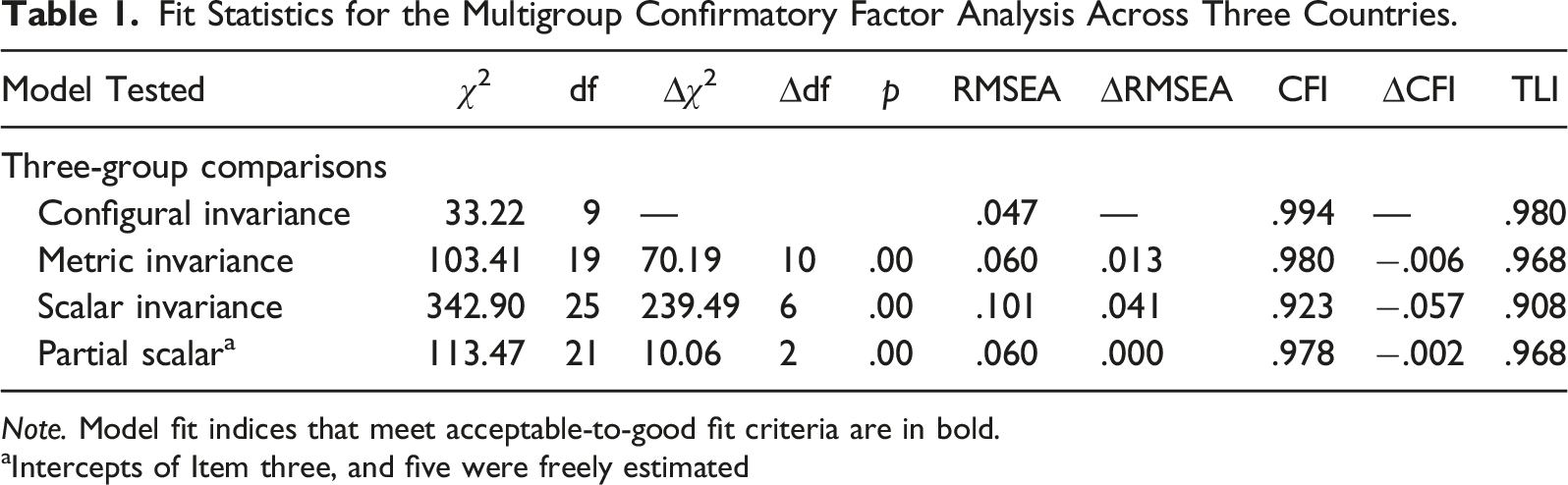
Note. Model fit indices that meet acceptable-to-good fit criteria are in bold.
aIntercepts of Item three, and five were freely estimated
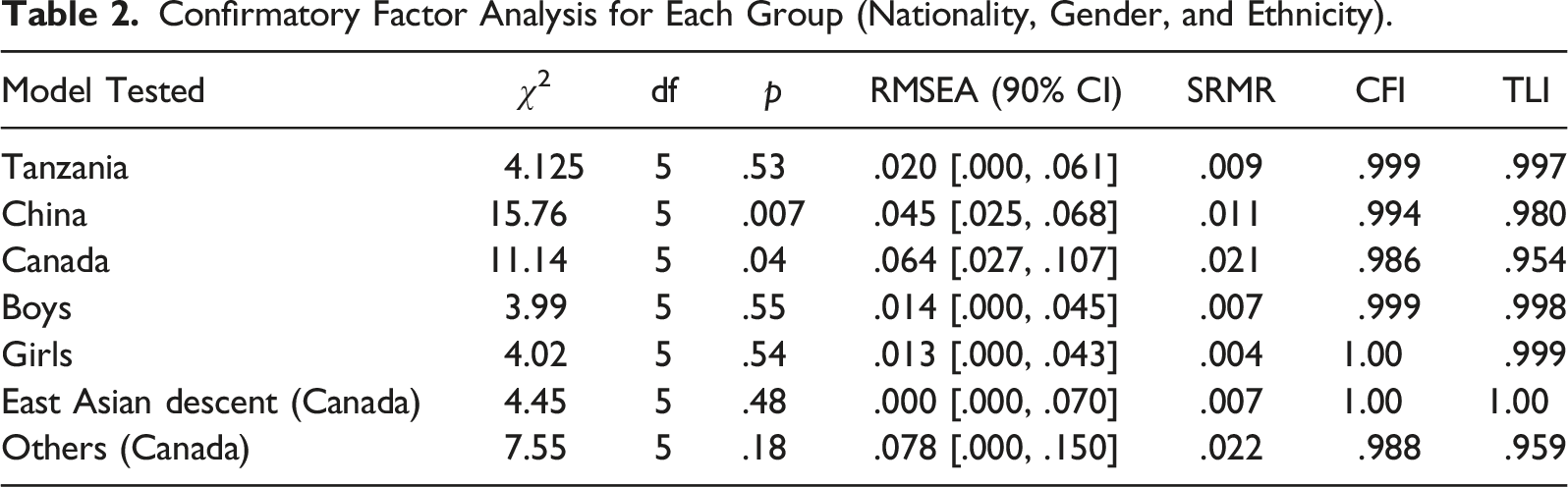
Confirmatory Factor Analysis for Each Group (Nationality, Gender, and Ethnicity).
Descriptive Statistics and item factor loadings for School Connectedness scale.
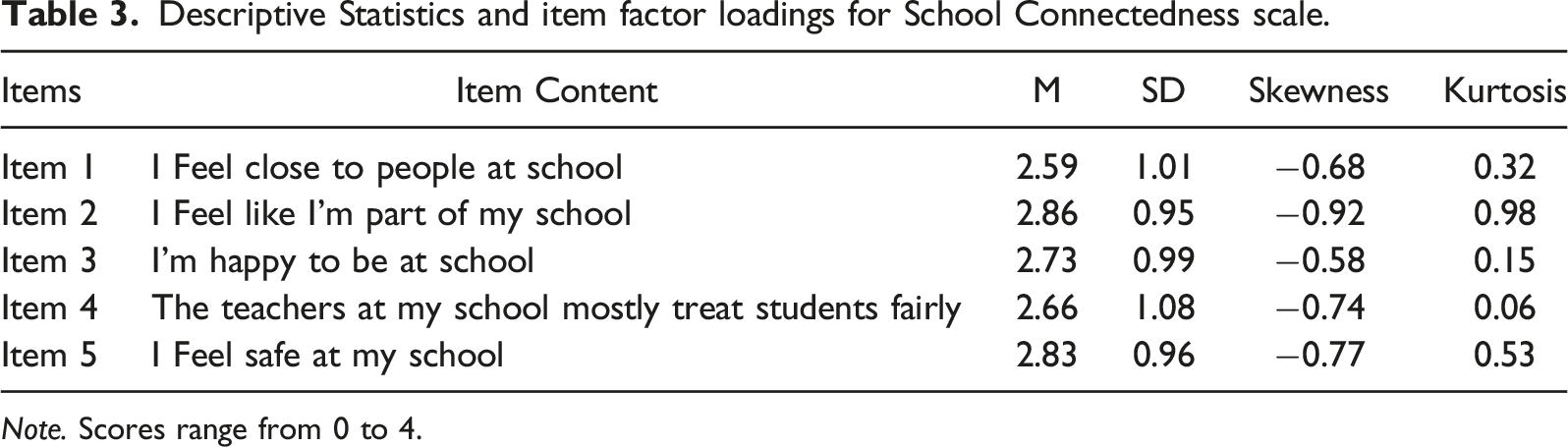
Note. Scores range from 0 to 4.
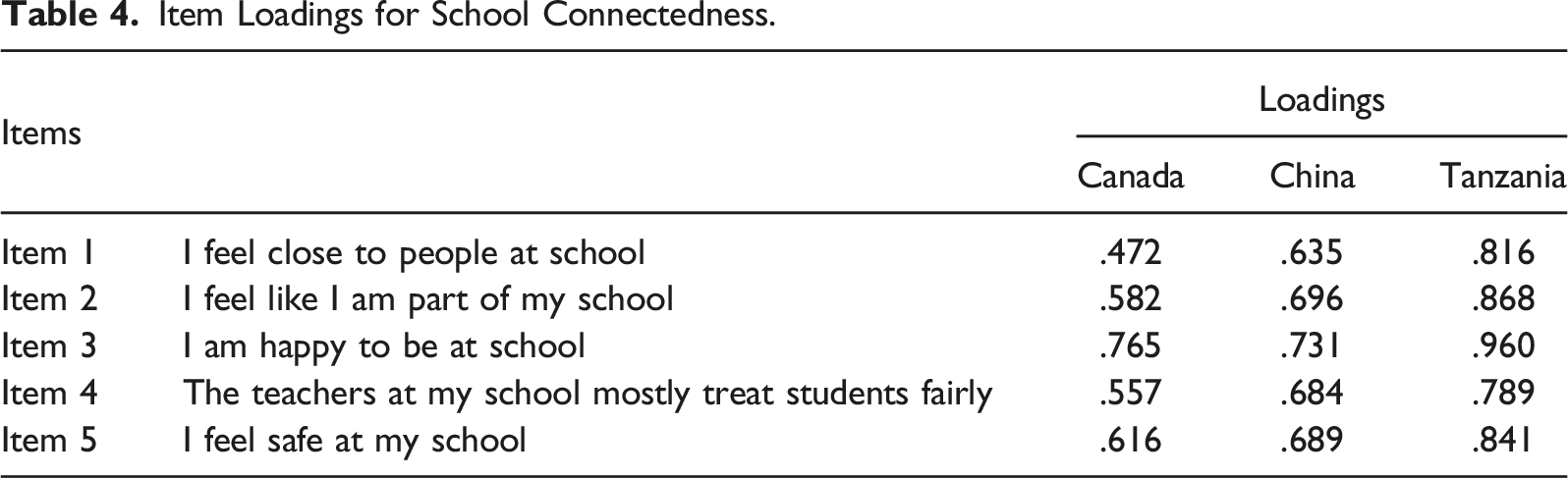
Item Loadings for School Connectedness.
Means and Standard Deviations for the School Connectedness, Cyberbullying, and Cybervictimization by Country.
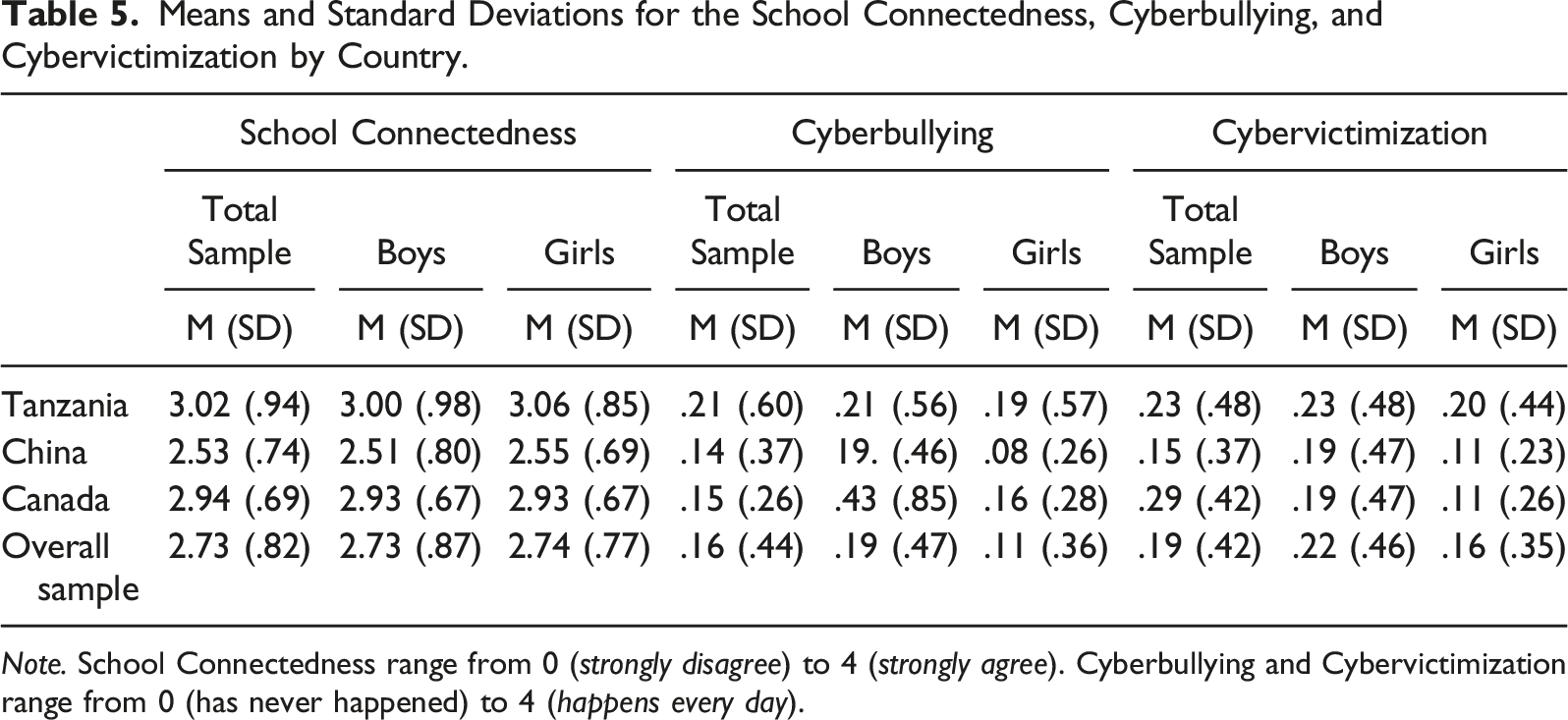
Note. School Connectedness range from 0 (strongly disagree) to 4 (strongly agree). Cyberbullying and Cybervictimization range from 0 (has never happened) to 4 (happens every day).
Parameter Estimates for the Final Multigroup Regression Analysis.

Note. Regression coefficients (→) (both unstandardized [b] and standardized [β]) coefficients (↔) with their standard errors (SE) are reported. The model has been controlled for gender, age and cell phone access.
The multigroup CFAs confirmed the strong factor consistency of the School Connectedness Scale across girls and boys. All means and standard deviations are presented in Table 5. As indicated by the differences in CFI (Cheung & Rensvold, 2002), results supported configural invariance, χ2 (6) = 6.48, p = .37, CFI = 1.00, TLI = 1.00, RMSEA = .007 [90% CI: .00, .032], SRMR = .005, metric invariance, χ2 (11) = 33.46, p < .001, CFI = .996, TLI = .990, RMSEA = .033 [90% CI: .021, .047], SRMR = .04, and scalar invariance, χ2 (14) = 45.09, p < .001, CFI = .992, TLI = .989, RMSEA = .035 [90% CI: .024, .046], SRMR = .034, of the School Connectedness Scale across gender groups. In summary, our results indicate that the School Connectedness Scale was comparable across girls and boys.
Next, a two-way ANCOVA was conducted to test for gender differences across countries with respect to school connectedness. Levene’s test and normality checks were employed and the assumptions were met. Results indicated a statistically significant main effect for country,F(2, 3659) = 164.88, p < .001, but no gender differences were found (F(2, 3659) = 1.97, p = .14). A two-way interaction between gender and country was not found to be statistically significant (F(2, 3659) = 0.77, p =.93). Simple effects testing revealed that Tanzania adolescents (M = 3.02, SD = 0.94) reported higher levels of school connectedness compared to Canadian adolescents (M = 2.94, SD = .069; p =.02) and Chinese participants (M = 2.53, SD = .074; p < .001). Moreover, Canadian adolescents reported higher levels of school connectedness compared to Chinese adolescents (p < .001).
Factor Invariance Across Ethnic within Canadian Adolescents
The multigroup CFAs confirmed the strong factor consistency of the School Connectedness Scale across students of East Asian descent versus others. As indicated by the differences in CFI (Cheung & Rensvold, 2002), results supported configural invariance, χ2 (4) = 5.83, p = .21, CFI = .997, TLI = .984, RMSEA = .040 [90% CI: [.00, .104], SRMR = .015, metric invariance, χ2 (9) = 9.347, p = .41, CFI = .999, TLI = .999, RMSEA = .042 [90% CI: .003, .068], SRMR = .029, and scalar invariance, χ2 (12) = 21.48, p =.044, CFI = .994, TLI = .983, RMSEA = .052 [90% CI: .009, .088], SRMR = .048, of the School Connectedness Scale across ethnic groups. Results showed that participants of East Asian descent (M = 2.92, SD = .70) reported slightly lower scores compared to others (M = 2.98, SD = .68).
Multivariate Multigroup Regression Analysis
After controlling for gender, age, and cell phone access (included as an indicator for technology access), the unconstrained model, with cybervictimization predicting school connectedness, was found to be a good fit, χ2 (450) = 1649.01, p < .001, CFI = .92, TLI = .91, RMSEA = .047, 90% CI [.044, .049], and was not statistically different, Δχ2 (2) = 4.3, p =.11, from the constrained model, χ2 (452) = 1653.31, p < .001, CFI = .92, TLI = .91, RMSEA = .047, 90% CI [.044, .049], suggesting no cultural differences in the estimated parameters. Similarly, the unconstrained model for cyberbullying predicting school connectedness was a good fit, χ2 (450) = 1409.47, p < .001, CFI = .93, TLI = .92, RMSEA = .042, 90% CI [.039, .044], and was not statistically different, Δχ2 (2) = 3.69, p =.16, from the constrained model, χ2 (452) = 1413.16, p < .001, CFI = .93, TLI = .92, RMSEA = .042, 90% CI [.039, .044], suggesting no cultural differences in the parameters estimated (Table 6).
Discussion
The overarching purpose of this study was to (a) evaluate the measurement invariance of the School Connectedness Scale; (b) examine gender differences in school connectedness; (c) explore ethnic differences within the Canadian sample; and (d) look at the inter association between school connectedness and cyberbullying/cybervictimization among Chinese, Canadian, and Tanzanian adolescents. In summary, multiple-group factor analyses revealed an approximate measurement invariance of the scale across all three countries. Interestingly, students from Tanzania had the highest levels of school connectedness and Chinese students had the lowest levels of school connectedness.
With respect to gender differences, the School Connectedness Scale was comparable across both males and females, with males demonstrating lower levels of school connectedness than girls. With the Canadian sample, students of East Asian descent reported less school connectedness compared to other groups and the results from the multivariate multigroup regression analyses revealed that school connectedness were negatively related to cyberbullying/victimization for all three cultural groups.
Measurement Invariance in School Connectedness Scale and Gender (In) Differences
Multigroup factor analysis revealed approximate measurement invariance of the single-factor model across all three countries. Moreover, the approximate measurement invariance (non-invariance) results identified non-invariant countries based on the intercepts of items three and 5. These findings suggest that adolescents from different cultural backgrounds may understand these two items differently, emphasizing the need for future research with this measure and consideration for the cultural circumstances that may influence individuals’ understanding of school connectedness. That being said, factor loadings revealed no non-invariance across all nation groups; thus, the associations between the items and the latent score were not culturally different.
Finally, results from this work show that students from Tanzania have the highest levels of school connectedness while Chinese students have the lowest levels. The high level of school connectedness in Tanzania may be linked to several factors. Specifically, the likelihood is high that children have conformed to the societal expectations on education (Stein et al., 2019) and have a positive attitude toward heavy testing and examinations in schools (Byabato & Kisamo, 2014; Salema, 2017). Furthermore, although Tanzanian teachers use authoritarian and harsh disciplinary approaches (Hecker et al., 2018; Stein et al., 2019), there is emerging evidence to suggest that Tanzanian teachers use guidance and counseling to maintain positive teacher student relationships (Paschal & Mkulu, 2020). Additionally, the shift in language of instruction from Kiswahili to English is unique in a Tanzanian context and may motivate some students to connect with teachers and peers for mastering the English language, while isolating some students who struggle with the English language (Joyce-Gibson et al., 2018). Finally, some students are likely to connect to school to avoid being involved in social and economic activities on school days (Joyce-Gibson et al., 2018), and/or use school as a buffer to avoid early marriages and harmful cultural practices such as Female Genital Mutilation (CDF, 2010; Galukande et al., 2015).
The lower levels of school connectedness for Chinese students, however, can be explained by the high emphasis Chinese students place on academic achievement and the resulting competition they have with their classmates (Lei et al., 2007; Zhao et al., 2009), which could offset the importance they and their school place on school connectedness. Indeed, while our findings also indicated lower school connectedness among Chinese students in Canada, coming from an individualistic culture could also be detrimental to a sense of school connectedness when students come from a collectivist culture where exclusive focus on academic achievement erodes one’s sense of connection to schools.
Ethnic differences within the Canadian sample
Within the Canadian sample, participants of East Asian descent reported lower school connectedness compared to other groups. While previous research has found that adolescents from collectivist groups, like East Asia, tend to be more vigilant to social conformity and connection to the group (Chen, 2012), our findings corroborate with that of other research indicating that Chinese students, who tend to place a large emphasis on academic achievement, experience less school connectedness (Lee & Larson, 2000; Sun et al., 2013). Indeed, while an emphasis is placed on collectivist values, our findings seem to confirm that the high academic pressures experienced by East Asian students, even in Canada, was associated with lower school connectedness compared to other groups.
School Connectedness and Cyberbullying/Victimization Among Chinese, Canadian, and Tanzanian Adolescents
Results from the multivariate multigroup regression analyses revealed that school connectedness were negatively related to cyberbullying/victimization in all the cultural groups and that there were no cultural differences between being less connected to school and identifying as a cyberbully/victim. Indeed, increased school connectedness predicted lower experiences of cyberbullying/victimization; thus, these connections appear to be universal, at least for the countries examined in this study. Overall, these findings align with previous work which has found that school connectedness moderates the relationship between cybervictimization and suicidal behavior in both North America and South Korea (Kim, et al., 2020; Lee et al., 2021).
Contributions, Limitations, and Future Directions
This work examined the measurement invariance of the School Connectedness Scale across three countries and gender. Specifically, we found evidence of measurement invariance of the 5-item School Connectedness Scale across three countries (e.g., Canada, China, and Tanzania) and provided support for the gender invariance across three counties and ethnic invariance across Canada. Results from the multivariate multigroup regression analyses revealed that school connectedness was negatively related to cyberbullying/victimization for all three cultural groups. While this work contributes to the field as a whole and addresses a gap in the literature, some limitations are important to note. Although the three countries in this study varied significantly in terms of culture, the data did not include countries in Europe, the Middle East, South America, South Asia, or other areas; as such, the results cannot be generalized to countries in those areas. Importantly, future researchers ought to replicate this study to include samples from those regions. Similarly, another limitation is that non-nationally representative samples were used in all three countries; therefore, results may not generalize to other regions of China, Canada, and Tanzania. Future work in measurement development and validation should obtain national representation across different school structures and countries.
Finally, for practical reasons, online surveys were used in China and Canada, but paper–pencil surveys were used in Tanzania, thus increasing the likelihood of measurement error. Moreover, the cross-sectional design limits our ability to control for cohort effects, as well as the investigation of test–retest reliability and longitudinal measurement invariance. Therefore, it is recommended that future studies adopt a longitudinal design to explore measurement invariance over time.
Despite these limitations, results from this work provide valuable information for future studies on school connectedness across different cultural contexts. Moreover, the findings of multivariate multigroup regression analyses in three countries revealed similar relationships between school connectedness and cyberbullying/victimization, thus, broadening our understanding of school connectedness and its relationship to cyberbullying/victimization across countries.
Footnotes
Declaration of Conflicting Interests
The author(s) declared no potential conflicts of interest with respect to the research, authorship, and/or publication of this article.
Funding
The author disclosed receipt of the following financial support for the research, authorship, and/or publication of this article: This work was supported by the Institute of Human Development, Child and Youth Health (125937).
