




Abstract
In contrast to traditional word spans with verbal recall, recently developed automated tasks employ a visuospatial response format (RF). This RF involves additional cognitive processes such as recoding and visual search, which develop across childhood. The aim of the present study was to extend previous findings on age-dependent RF effects, examining the role of recoding and visual search as underlying mechanisms. Groups of primary school children, secondary school children, and adults performed analogous word spans with visuospatial and verbal RF. Additionally, two tasks assessing recoding and visual search skills were conducted. Results show that primary school children performed poorer under visuospatial than verbal RF, whereas secondary school children and adults showed no performance differences. The analyses further suggest that search skills contribute to age-differential RF effects. Recoding seems less decisive, but its role could not be conclusively clarified. Developmental mechanisms and the necessity to disentangle the role of recoding from search are discussed.
Working memory (WM) is a capacity-limited system for the temporary storage and active manipulation of currently available information (Baddeley, 2000). A vast body of literature has shown that WM is key for higher-order cognition and academic success (Alloway & Alloway, 2010; Dehn, 2008). Working memory deficits are associated with learning difficulties (Fischbach et al., 2014; Klesczewski et al., 2015; Peng & Fuchs, 2016) and several clinical disorders such as attention-deficit/hyperactivity disorder (Maehler & Schuchardt, 2016), autism (Wang et al., 2017), down syndrome (Lanfranchi et al., 2012), intellectual disabilities (van der Molen et al., 2007), and specific language impairments (Vugs et al., 2016). Working memory deficits need to be identified at an early age to reduce impairments in future learning and achievement. Therefore, standardized WM assessment is needed for research and practice alike.
In the past, WM assessment has been time-consuming and costly as instruments could be used in one-to-one settings only. Recently, automated and group-administrable WM tasks have been developed to make WM assessment more economic (Obradović et al., 2018; St Clair-Thompson, 2013; van de Weijer-Bergsma et al., 2016). Such tasks require a minimum of experimenter input and can be performed self-reliantly by the participants. In addition to computerized tools, there are some online measures as well as tablet-based instruments. Just as traditional one-to-one instruments, most of these tools include simple and complex spans.
Concerning phonological spans, some adaptations became necessary to allow for self-reliant and group administration. Phonological spans consist of the auditory presentation of series of stimuli that must be reproduced in the correct order, traditionally by verbal recall. As a verbal response format (RF) is difficult to realize in self-reliant or group settings, automated measures employ a visuospatial RF, in which the answer is given by a motoric response (tapping on a touch screen or clicking) to corresponding visual input (drawings, written words, or Arabic numerals). This change of RF is linked with a set of additional requirements on the level of cognitive processing. Above the encoding, storage, and recall of information as involved in traditional tasks, the visuospatial RF requires recoding (translating auditory information visually or vice versa) and visual search (looking for a target, e.g., a picture, among distractors in a visual display, e.g., a 3 × 3 matrix).
As long as these processes are not yet automated, executive functions such as inhibitory control (e.g., inhibition of task-irrelevant information such as irrelevant pictures in the response matrix) and shifting between mental requirements (e.g., maintaining and searching) may also be relevant. For all of these requirements, decisive developmental improvements across childhood and adolescence (and in parts into young adulthood) are well-documented (Diamond, 2013; Gathercole, 1998; Hommel et al., 2004; Michalczyk et al., 2013; Palmer, 2000; Tam et al., 2010; Trick & Enns, 1998; Woods et al., 2013).
It is therefore conceivable that different RFs lead to different performance scores, at least in certain age-groups. Initial empirical evidence for age-dependent effects of RF is provided by Oesterlen and Seitz-Stein (2019). In their study with N = 105 participants, they systematically compared performance on word and digit spans with verbal RF of the WM Test Battery for Children aged 5–12 years (AGTB5-12; Hasselhorn et al., 2012) to corresponding automated tasks with visuospatial RF of the Eichstätt WM Assessment (EI-MAG; Oesterlen et al., 2016) in different age-groups. Whereas first- and second-graders (M = 7.6 years, SD = 0.6) as well as third- and fourth-graders (M = 9.4 years, SD = 0.6) performed poorer under visuospatial than verbal RF, adults (M = 22.5 years, SD = 3.2) did not show any performance differences. As potential underlying mechanisms, the authors discuss developmental changes in recoding and visual search abilities (Hommel et al., 2004; Trick & Enns, 1998; Woods et al., 2013). They hypothesize that recoding and visual search are still immature in children, leading to higher load. Against the background of a resource-limited memory system (Baddeley, 1986; Cowan, 2010; Fougnie & Marois, 2011), this should result in higher competition for resources between processing and maintenance demands (Barrouillet et al., 2009; Klingberg, 1998), hence poorer recall under visuospatial RF. With increasing age, visual search and recoding processes should become automated, freeing up resources for maintenance (Hasher & Zacks, 1979) and leading to comparable performance scores for both RFs. It is important to note here that recoding—when automated—can even be advantageous for recall. The level of automaticity depends on the direction of recoding. In adults, nameable visual input is labeled automatically by the ventral stream of vision which passes through the temporal lobes (Milner & Goodale, 2006; Paivio, 2013). This kind of recoding (or dual coding) can support memory. The reverse process, that is, building images to auditory input, is also possible, but it is likely to be less constrained and less automated, hence less beneficial for recall, even in adults.
Potential effects of group administration in general were ruled out in a previous study by the Oesterlen and Seitz-Stein (2020). Comparing performance on EI-MAG span tasks obtained in individual and group setting in a group of primary school children, no systematic setting effects were found.
All in all, the current study aims to answer three main research questions: First, can age-dependent effects of RF in phonological spans be replicated? In the current study, we control for potential confounders by varying only RF (verbal and visuospatial). Thus, we respond to a limitation of the previous study (Oesterlen and Seitz-Stein (2019)) which included variation in instruments (AGTB 5–12 and EI-MAG), hence differences in stimuli, algorithm, etc., besides variation in RF. Second, how does RF affect WM performance in secondary school children? To complete the picture of age effects, we include children and adolescents who fill the gap between primary school age and young adulthood. Third, what role do recoding and visual search play in explaining age-dependent effects of RF? To examine this question, recoding and visual search abilities as required under visuospatial RF are assessed directly.
Method
Participants
A group of N = 157 children, adolescents, and adults between 6 and 46 years (M = 12.9, SD = 5.1; 79 female) from one primary school, one secondary school, and one university in the south of Germany took part in this study. Eight participants (all secondary school students) were excluded from the analyses due to missing values at the level of single subtests. Another 11 participants were excluded because they were identified as outliers with noticeable problems during the assessment (three primary and three secondary school students due to tapping problems, two secondary school students, and one adult due to external disturbances, one adult due to a lack of task understanding, and one primary school student due to 35% missing in visual search). The 19 excluded participants were between 6.8 and 20.0 years old (M = 12.8, SD = 4.0, 9 female). The final sample thus consisted of N = 138 participants and was divided into three groups to examine potential age effects: n = 51 primary school children between 6.6 and 11.1 years (M = 8.5, SD = 1.3; 26 female; Grades 1–4), n = 64 secondary school children between 10.6 and 17.1 years (M = 13.2, SD = 1.7; 25 female; Grades 5–9), and n = 23 adults between 19.3 and 46.1 years (M = 21.9, SD = 5.6; 19 female). Please note that in Bavaria, Germany, primary school refers to Grades 1 to 4, and secondary school ranges from Grades 5 to 12.
In terms of language, 69.6% of the participants spoke only German at home (primary school: 90.2%, secondary school: 43.8%, and adults: 95.7%), 21.7% spoke German and another language (primary school: 8% and secondary school: 40.8%), and 8.7% spoke only another language at home (primary school: 2%, secondary school: 15.9%, and adults: 4.3%). In 55.1% of the cases, the participants’ parents were born in Germany (primary school: 72.5%, secondary school: 28.1%, and adults: 91.3%) and in 39.1%, at least one parent was not born in Germany (primary school: 11.8%, secondary school: 71.9%, and adults: 8.7%), and in 5.8% statements were missing.
Informed written (parental) consent was obtained for all participants. University students received course credit or a small present for their participation.
Materials
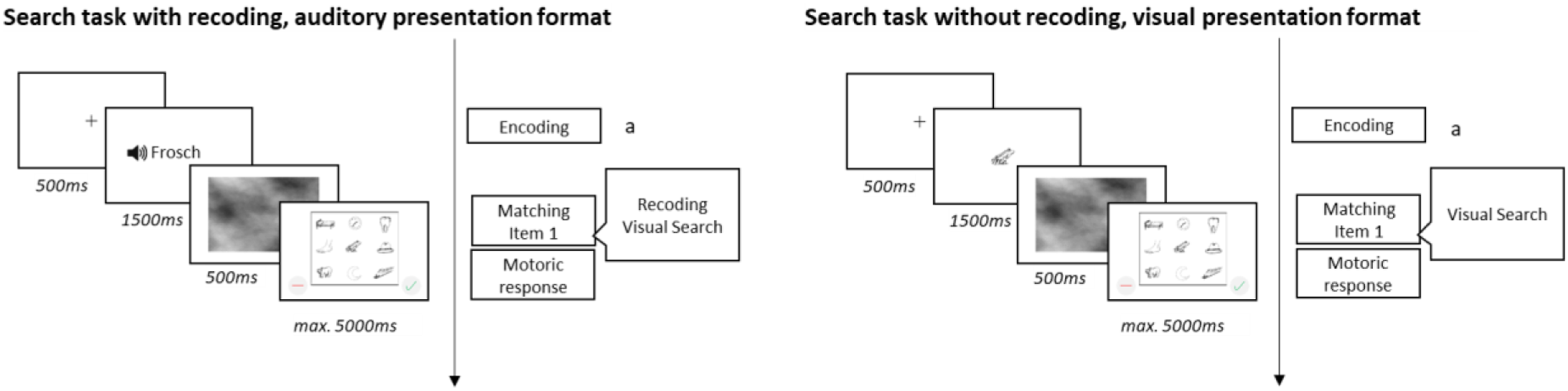
The word span of EI-MAG (Oesterlen et al., 2016, 2018), a group-administrable, tablet-based Android application for the assessment of WM, forms the basis of this study. All other tasks were created as variations of this task by the reduction of task requirements (see Figures 1 and 2). Identical stimulus material (12 × 15 cm matrix with 4 × 5 cm pictures and audios) was used throughout the variations. Sample pictures are provided in Appendix A (Figure A1). Example trials and task requirements for word spans with visuospatial and verbal response format. Example trials and task requirements for search tasks with auditory and visual presentation format.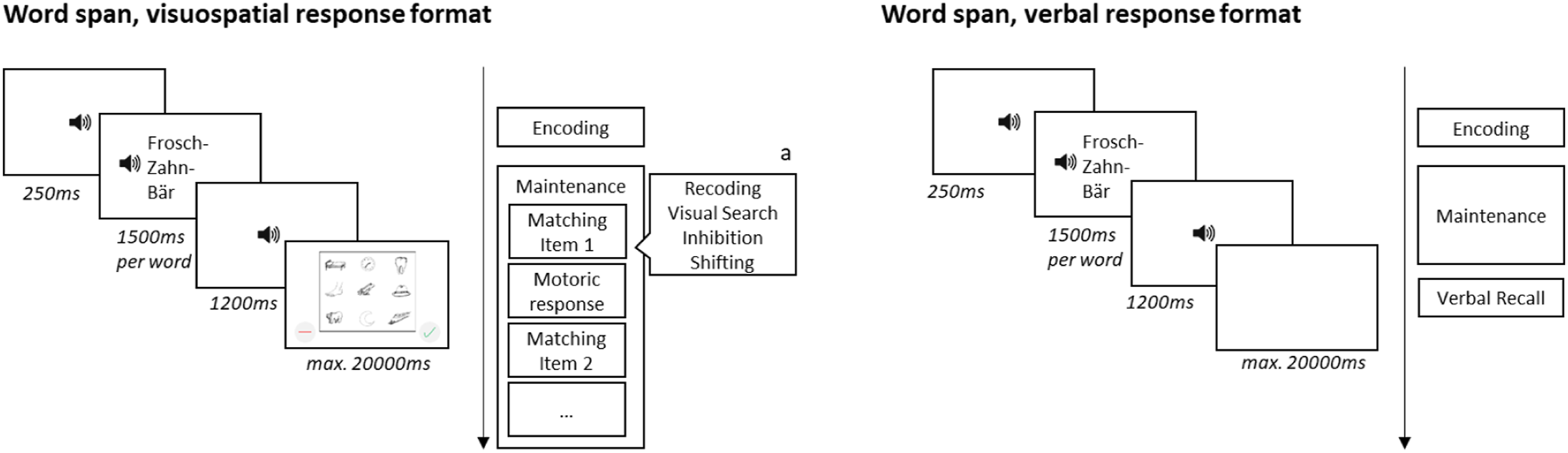
In the original EI-MAG word span with visuospatial RF, a series of monosyllabic words is presented auditorily (German words for bear, foot, glass, hat, cookie, moon, table, clock, and tooth) which needs to be reproduced in the same serial order. Stimuli are presented in 1.5 second intervals. The beginning of a new series is signaled by a short high-pitched tone and the end by a long low-pitched tone. Participants indicate their response by tapping the corresponding pictures in a 3 × 3 picture matrix on a touch screen (pictures change position from trial to trial). In the practice phase, two out of four two-item-series in a row must be reproduced correctly. In the test phase, beginning with series of two items, participants are required to reproduce correctly two out of three series of the same sequence length to proceed to the next level. Consecutive levels are characterized by an increase in sequence length by one item. When participants fail to reproduce two out of three series of the same length, testing is stopped.
The word span with verbal RF is equivalent (i.e., stimuli, sequences, and algorithm) to the original EI-MAG word span except that participants have to reproduce the word sequences by repeating them verbally. The experimenter types in the responses on a separate tablet device.
To isolate recoding and search requirements as involved in the original EI-MAG word span, a search task with auditory presentation format was designed. Participants must decide as fast and accurately as possible whether an auditorily presented target (e.g., bear) is present or not in a 3 × 3 picture matrix. Target presence is indicated by tapping on a tick mark (lower right corner of the touch display) and target absence by tapping on a cross (lower left corner of the touch display). Thus, recoding and visual search are assessed without maintenance effort. It is important to note that in the current study, recoding is not assessed as a separate process but only in combination with visual search.
To further reduce recoding requirements, a search task with visual presentation format was realized. It differs from the search task with auditory presentation format only in the presentation mode, with the target being presented visually (i.e., as a picture) in the center of the tablet screen. Hence, this task serves to assess basic visual search skills without recoding requirements.
Both search tasks were programmed in OpenSesame (version 3.2.7; Mathôt et al., 2012) and consist of two instructional trials, four practice trials, and 54 test trials each. Each trial is introduced by a fixation cross (500 ms), followed by the test stimulus (auditory or visual, 1500 ms), a noise picture (500 ms), and finally the response matrix (5000 ms max.). Once participants respond, the next fixation cross is presented, followed by the next test stimulus. The nine words used in the test phase of the EI-MAG word span serve as targets as well as distractors in the 3 × 3 picture matrix. To fill the picture matrix in target-absent trials, three additional stimuli are used as distractors only (bed, frog, and train obtained from the practice phase of the EI-MAG word span). In 50% of the trials, the target is present, and in the remaining trials, it is absent. Trials were randomized but fixed, so that each participant was presented with the same trial order.
Apparatus
Tasks were presented on two Samsung Galaxy Tab 4 tablets with a 10.1-inch screen and a screen resolution of 1280 × 800 pixels. The experimenter and the participant sat diagonally opposite to each other at a table. One tablet device was placed in front of the experimenter for registering the participants’ responses in the word span with verbal RF. The second tablet device was used for all other tasks and was operated by the participants themselves, who were seated approximately 25 cm in front of it. Participants were instructed to respond with the index finger of their dominant hand and to rest their hand on a mat in front of the tablet device after each tap.
Procedure
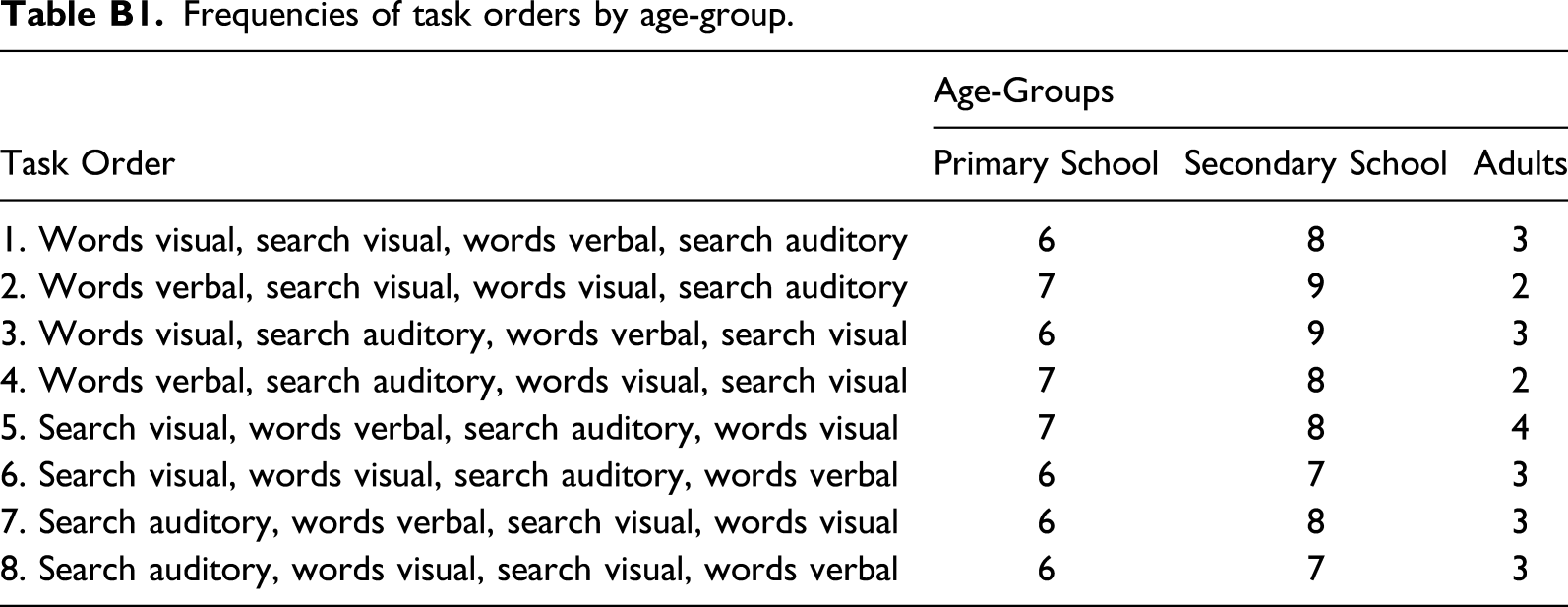
Each participant was tested individually in a single session of approximately 30 minutes (M = 29 minutes, SD = 4 minutes). After receiving general instructions by the experimenter and answering some biographical questions, participants completed the four tablet-based tasks (word span, visuospatial RF; word span, verbal RF; search task, auditory presentation format; and search task, visual presentation format). Task order was counterbalanced across participants and within each age-group. Word spans were not presented successively, neither were search tasks. This resulted in eight different task orders (Appendix B, Table B1). For the word span with verbal RF and the search tasks, task-specific instructions were given verbally by the experimenter, supported by corresponding pictures of the task on the participants’ tablet device. The EI-MAG word span with visuospatial RF was used in its original conception; thus, instructions were presented as audio files accompanied by pictures on the tablet screen. Task understanding was indicated by successful practice trials. Short rest periods (approximately 5 minutes) were provided after two tasks.
Data Analysis
The dependent variables for the word spans were the means of the longest two correctly reproduced series, for the search task accuracy scores (percentage of correctly answered trials) and mean reaction times (RTs). Only RTs for correct responses were considered. RTs <300 ms (no cases) and RTs exceeding or falling below the intraindividual mean by more than three SDs (auditory presentation format: 1.2% and visual presentation format: 1.6%) were considered as outliers and excluded. Missing RTs on trial level (auditory presentation format: 0.4% cases and visual presentation format: 1.2%) and trials with responses outside the valid display range (auditory presentation format: 0.01% and visual presentation format: 0.1%) were not considered. Data trimming resulted in the exclusion of 1.7% of trials for the search task with auditory presentation format and 2.9% of trials for the visual presentation format. There is no trade-off between accuracy and RTs for either presentation format (auditory: r = −.36, p < .001; visual: r = −.52, p < .001). All statistical analyses were run using IBM SPSS Statistics (version 25.0).
Results
RF in span tasks
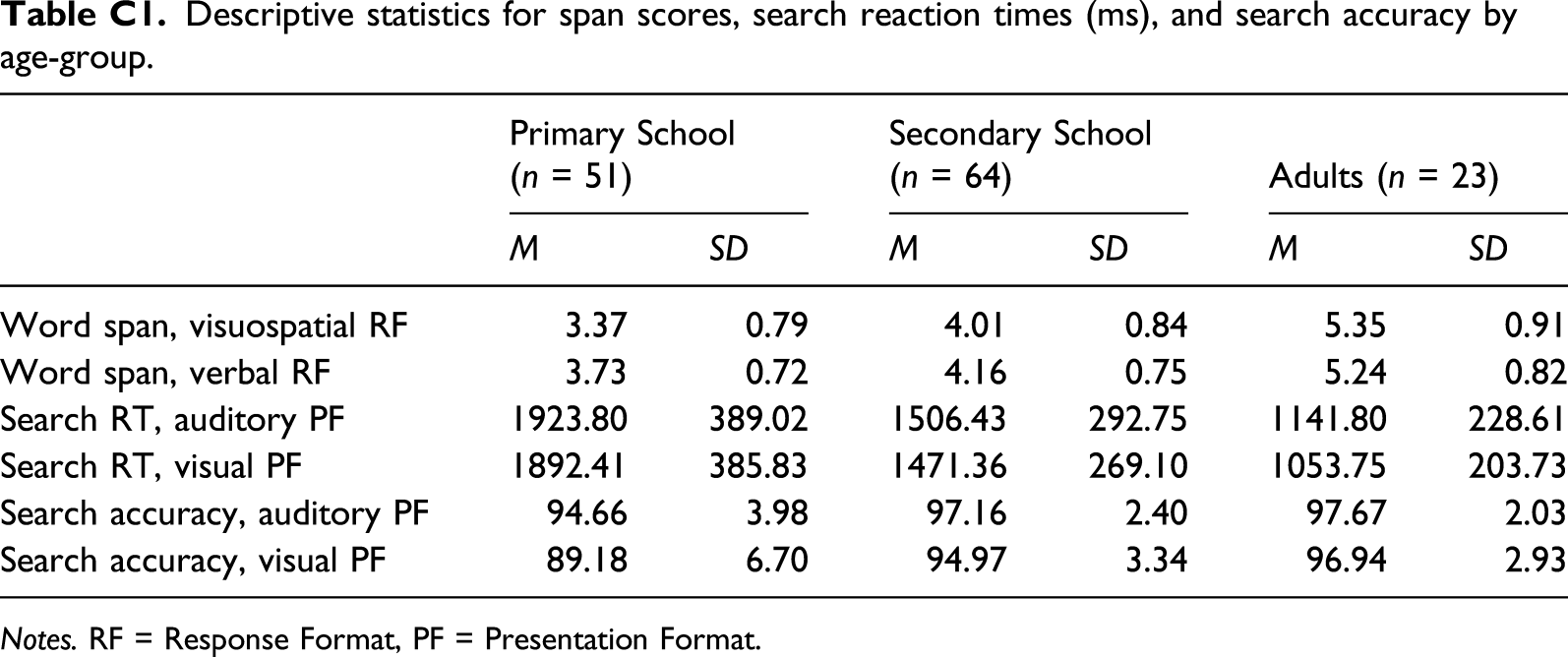
To examine age-dependent effects of RF in span tasks, a two-way repeated measures ANOVA with RF (verbal and visuospatial) as within-subjects factor and age-group (primary school, secondary school, and adults) as between-subjects factor was run. Figure 3 displays the mean span scores and standard errors for each age-group. Descriptive data are also provided in table format in Appendix C (Table C1). The main effect of age-group was significant, F(2, 135) = 49.18, p < .001, η
p
2 = .42, showing that span scores increased with age. The main effect of RF was not significant, F(1, 135) = 3.44, p = .066, η
p
2 = .03. The significant interaction of RF and age-group, F(2, 135) = 3.08, p = .049, η
p
2 = .04, indicates that effects of RF were more pronounced in primary school children than in secondary school children and adults. This was confirmed by subsequent ANOVAs run separately for each age-group. Primary school children achieved significantly lower spans under visuospatial than verbal RF, F(1, 50) = 15.39, p < .001, η
p
2 = .24. Secondary school children, F(1, 63) = 2.23, p = .140, η
p
2 = .03, and adults, F(1, 22) = 0.36, p = .553, η
p
2 = .02, were not influenced by the type of RF. Coming back to the age effect, performance gains were found for both RFs, verbal: F(2, 135) = 32.08, p < .001, η
p
2 = .32 and visuospatial: F(2, 135) = 44.24, p < .001, η
p
2 = .40, with Bonferroni-adjusted post hoc tests showing substantial differences in span scores between all age-groups (ps < .008). Means and standard errors for word span scores under verbal and visuospatial response format separated by age-group. Note. RF = Response Format.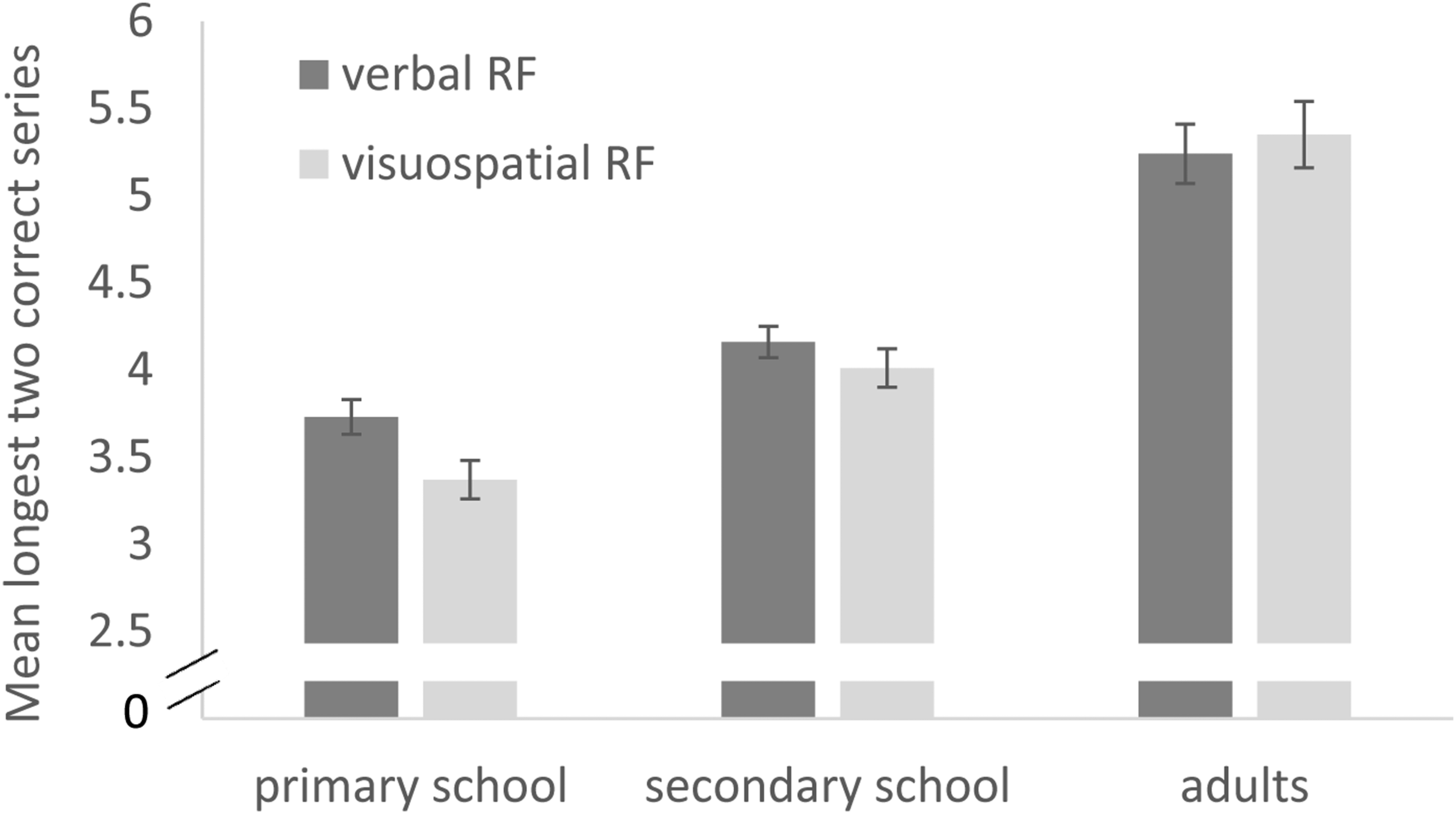
All in all, spans increase with age under both RFs, but primary school children show lower spans under visuospatial RF than under verbal RF.
Presentation format and age effects in search tasks
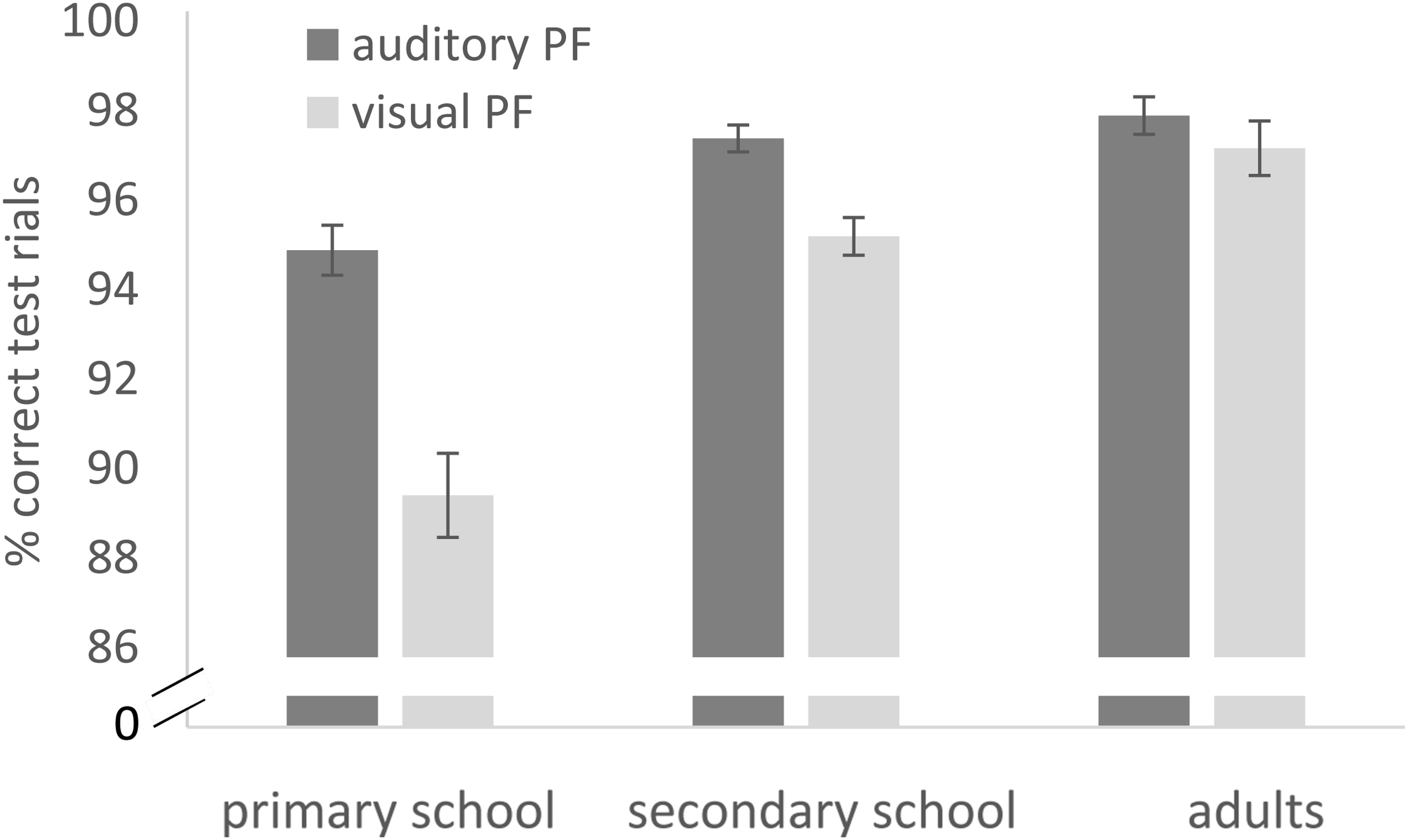
To investigate the role of recoding and visual search, effects of presentation format and age in search tasks were analyzed. Means and standard errors for RT and accuracy data are provided in Figures 4 and 5, respectively. Reaction times (means and standard errors) for search tasks with auditory and visual presentation format by age-group. Note. PF = Presentation Format. Accuracy scores (means and standard errors) for search tasks with auditory and visual presentation format separated by age-group. Note. PF = Presentation Format.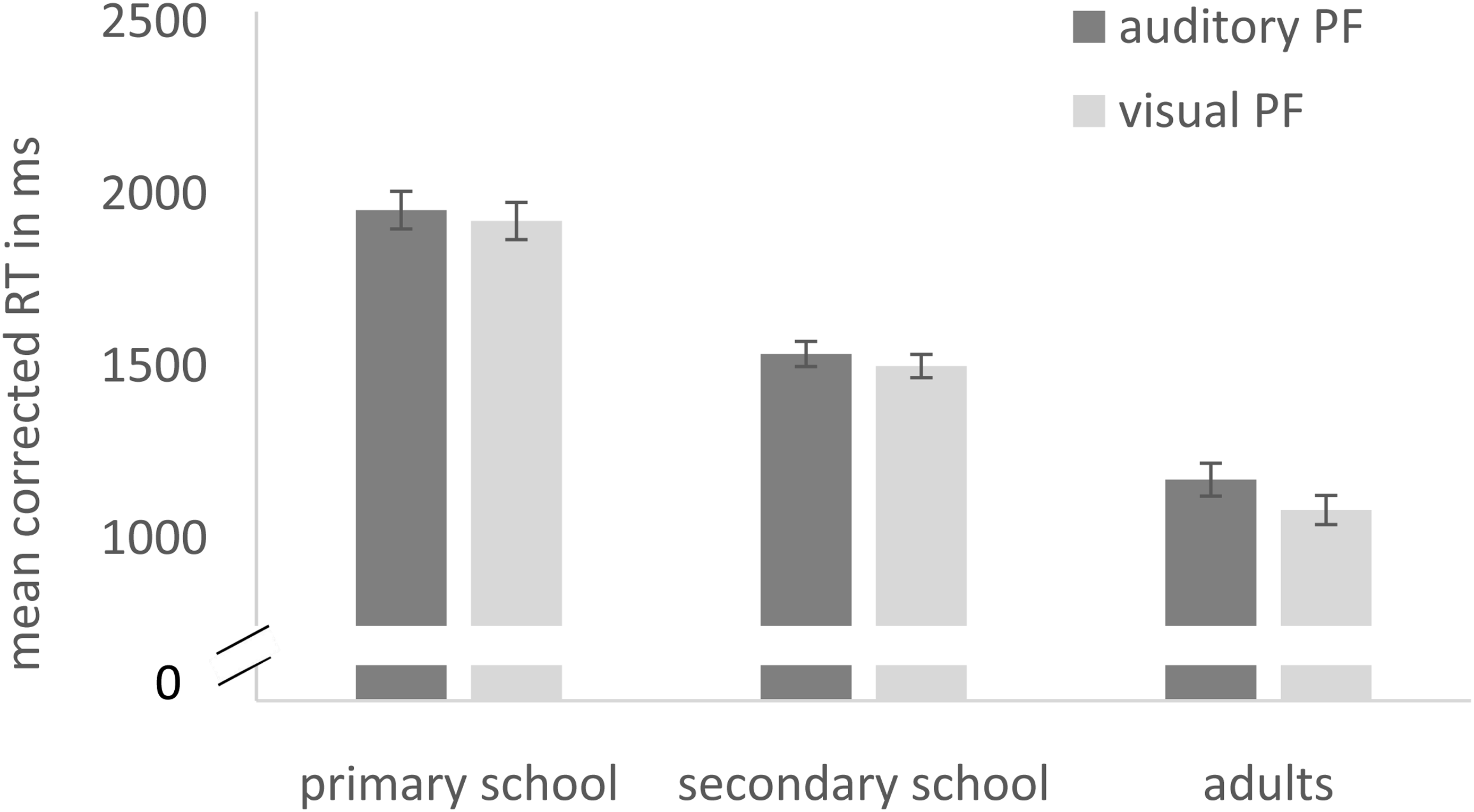
A two-way repeated measures ANOVA on search RTs with presentation format as within-subjects factor and age-group as between-subjects factor revealed a significant main effect of age-group, F(2, 135) = 63.29, p < .001, η p 2 = .48. Games-Howell post hoc tests showed that RTs were significantly higher in primary school children than secondary school children, who responded slower than adults (ps < .001). Additionally, the main effect of presentation format was significant, F(1, 135) = 7.36, p = .008, η p 2 = .05, with higher RTs under auditory presentation format than visual presentation format. The presentation format x age-group interaction did not reach significance, F(2, 135) = 0.70, p = .500, η p 2 = .01.
Analyses of accuracy scores revealed a slightly different and somewhat unexpected pattern. Again, there was a significant main effect of age-group, F(2, 135) = 34.78, p < .001, η p 2 = .34. Additionally, the main effect of presentation format, F(1, 135) = 33.88, p < .001, η p 2 = .20, and the age-group x presentation format interaction, F(2, 135) = 8.88, p < .001, η p 2 = .12, became significant. Subsequent ANOVAs for each age-group revealed that when there was an additional recoding requirement, children responded more accurately (auditory presentation format) than in simple search (visual presentation format), primary school: F(1, 50) = 32.97, p < .001, η p 2 = .40 and secondary school: F(1, 63) = 17.45, p < .001, η p 2 = .22. Adults’ accuracy scores were not influenced by presentation format, F(1, 22) = 1.96, p = .175, η p 2 = .08. Further analyses showed substantial age-related performance gains for both search tasks, auditory presentation format: F(2, 135) = 12.31, p < .001, η p 2 = .15 and visual presentation format: F(2, 135) = 28.95, p < .001, η p 2 = .30. For search with recoding (auditory presentation format), Games-Howell post hoc tests revealed that primary school children were significantly less accurate than both other groups (ps < .001), while secondary school children and adults did not show performance differences (p = .603). For simple search (visual presentation format), accuracy differed significantly between all groups (ps < .028).
Search performance and span
To further specify the role of search skills in RF effects, we repeated the 2 × 3 ANOVA on span tasks with search performance as a covariate. If search performance is crucial, the interaction between age and RF should disappear. In accordance with the findings of the original ANOVA, an ANCOVA with RT of the auditory search task as a covariate yielded no significant main effect of RF, F(1, 134) = 0.36, p = .550, η p 2 < .01, and a significant main effect of age, F(2, 134) = 19.28, p < .001, η p 2 = .22. The RF x age interaction, by contrast, lost significance, F(2, 134) = 0.73, p = .483, η p 2 = .01. The same pattern was found for an ANCOVA with RT of the visual search task as the covariate, RF: F(1, 134) = 0.02, p = .877, η p 2 < .01, age: F(2, 134) = 17.80, p < .001, η p 2 = .21, and RF x age: F(2, 134) = 0.96, p = .386, η p 2 = .01. These results let us cautiously assume that visual search may be relevant for age-dependent RF effects in phonological spans.
We would like to note that we are aware that cognitive tasks are not necessarily as closely tied to schooling as academic tests, for instance. Therefore, it would also be conceivable to group participants by age instead of grade. Reanalyzing the data accordingly (6- to 8-year-olds, 9- to 12-year-olds, and above 12-year-olds) did not produce systematic differences in the results.
Correlations between WM and search performance
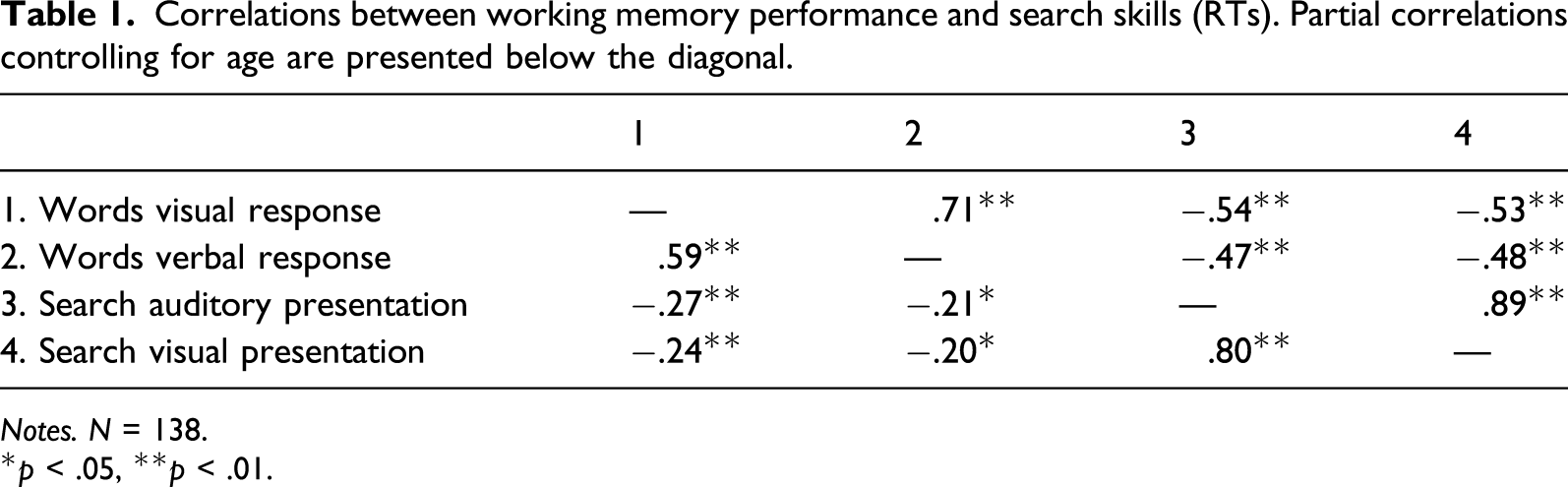
Correlations between working memory performance and search skills (RTs). Partial correlations controlling for age are presented below the diagonal.
Notes. N = 138.
*p < .05, **p < .01.
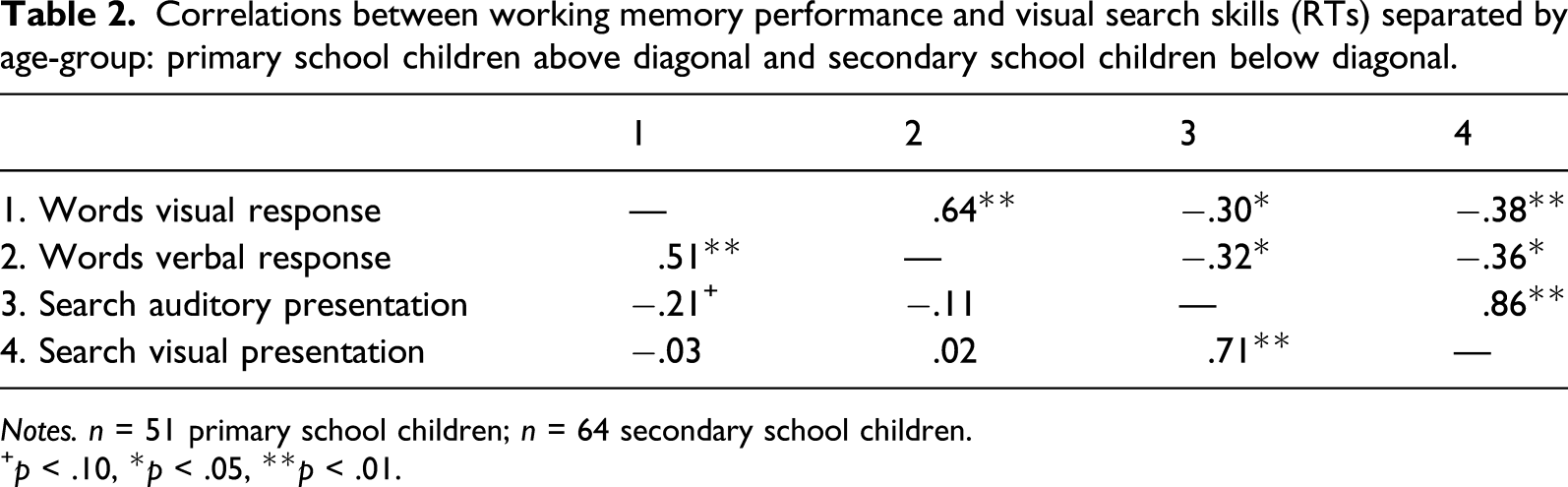
Correlations between working memory performance and visual search skills (RTs) separated by age-group: primary school children above diagonal and secondary school children below diagonal.
Notes. n = 51 primary school children; n = 64 secondary school children.
+p < .10, *p < .05, **p < .01.
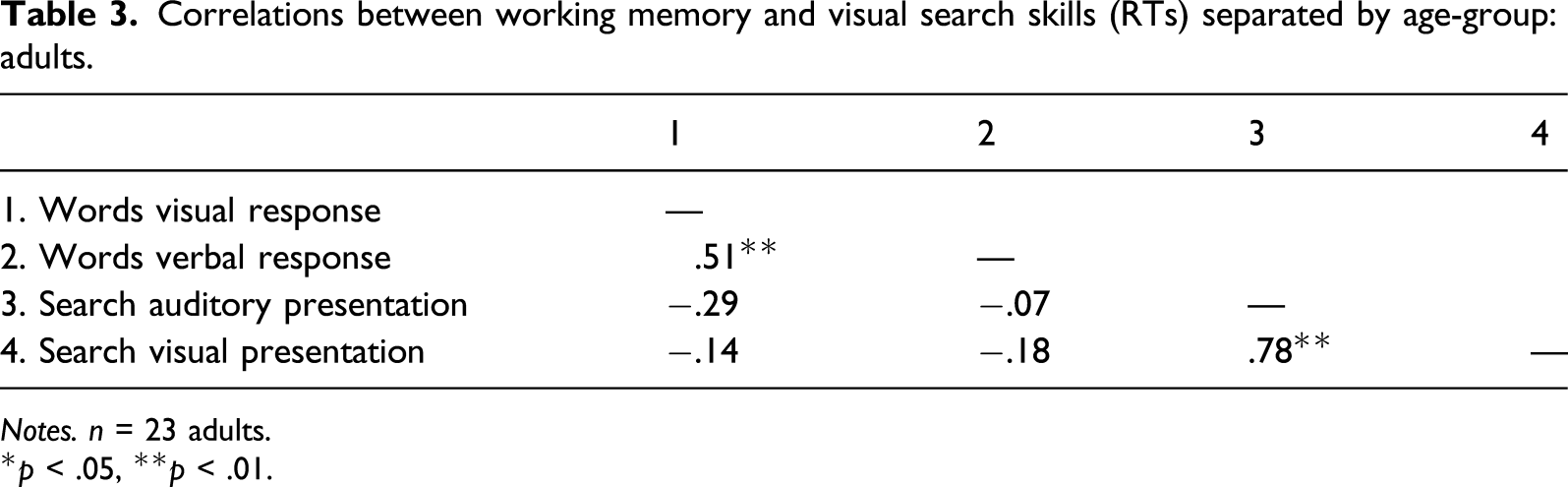
Correlations between working memory and visual search skills (RTs) separated by age-group: adults.
Notes. n = 23 adults.
*p < .05, **p < .01.
Discussion
Based on previous findings by Oesterlen and Seitz-Stein (2019), the present study compared performance on word spans with visuospatial and verbal RF in different age-groups (primary school, secondary school, and adults). Three aims were followed: First, to replicate age-related RF effects in phonological spans with identical material, thus eliminating potential confounders; second, to include a group of secondary school students to fill the gap between primary school age and young adulthood; and third, to specify the extent to which recoding and visual search contribute to age-related RF effects by directly assessing these skills.
Consistent with previous research, we could demonstrate general improvements in WM performance across age-groups (Dempster, 1981; Gathercole, 1998; Michalczyk et al., 2013). Additionally, age-related RF effects as reported by Oesterlen and Seitz-Stein (2019) were replicated and extended. Given that the verbal RF resembles a recall and the visual RF a recognition task, we have to state that the well-documented recognition advantage (Badinlou et al., 2017; Perlmutter & Lange, 1978) is not present in the tasks investigated here. Primary school children showed lower span scores under visuospatial RF than under the traditional verbal RF, whereas adults were not influenced. Secondary school students, who were examined as an additional age-group in the present study, did not show performance differences depending on RF. The results of the ANOVA indicate that age-differential RF effects are robust and, using identical task material, were not only due to variations in instruments in the former study. They clearly show that only the youngest age-group is affected by RF in terms of span scores. The implications of the correlational analyses are less clear-cut. The correlations between visual and verbal RF are moderate to high (see Tables 1–3; Cohen, 1988) and in fact could be higher if we assume that both RFs measure entirely the same cognitive processes.
To prove whether developmental changes in recoding and visual search skills—specific requirements associated with the visuospatial RF—contribute to age-differential RF effects, two search tasks were realized: search with recoding (auditory presentation format) and simple search (visual presentation format). Consistent with the visual search literature (Hommel et al., 2004; Trick & Enns, 1998; Woods et al., 2013), younger age-groups responded less accurately and more slowly than older age-groups in both search tasks. Transferred to word spans with visuospatial RF, lower search accuracy in younger children indicates more search errors in the recall phase (tapping the wrong picture), hence lower span scores (one single search error leads to incorrect span reproduction). At the same time, higher search RTs lead to additional delay to output. As children are usually less efficient in rehearsal (Barrouillet et al., 2009; Gathercole et al., 1994; Henry & Millar, 1991), this time-related aspect of visual search produces a more rapid decay of the to-be-remembered information. It can explain why younger children, but not secondary school children and adults, show performance impairments under visuospatial compared to verbal RF. Moreover, age-differential switch costs may account for the reported RF effects. Against the background of a resource-limited cognitive system (Baddeley, 1986; Cowan, 2010; Fougnie & Marois, 2011), processes which draw on common resources interfere with each other and lead to performance losses (Klingberg, 1998). When processes are automated, resources are freed up for the engagement in other, concurrently performed processes (Hasher & Zacks, 1979). Compared to the verbal RF, several processes have to be performed concurrently under visuospatial RF. As for the additional search requirement, the current findings show that these processes are still under development in children. It is therefore likely that they require more attention and resources to be performed than in adulthood. The findings thus provide evidence that children experience switch costs (hence lower span scores) which are not encountered by adults. The results of two ANCOVAs point in the same direction. After controlling for search performance, the interaction between age and RF disappeared. This allows the cautious assumption that visual search may contribute to age-differential effects of RF in phonological spans.
The recoding requirement, by contrast, seems to be less relevant for explaining age-dependent RF effects, at least in the examined age-groups. A direct comparison between search with and without recoding shows that children make more errors when the target is presented visually (no recoding necessary) than when the target is presented auditorily (recoding necessary) and also do not have a speed advantage in the visual presentation format. This is surprising, given that previous research found decisive improvements in recoding strategies across childhood, from modality-dependent coding to representational flexibility (Gathercole, 1998; Palmer, 2000; Schumann-Hengsteler, 1995; Tam et al., 2010). Consequently, we expected that the translation of auditory information into a visual code (or vice versa) as required under auditory presentation format (and also under word spans with visuospatial RF) would put extra loads on children. Apparently, with comparable RTs for both presentation formats and higher accuracy scores for auditory presentation format, this was not the case in the present study. One explanation is that children are more familiar with the kind of search required in the auditory presentation format from their everyday experience than with the visual matching process needed in visual presentation format. From an early age, children train their ability to use spoken words to make sense of visual information, beginning with reading picture books with their parents (Henry, 1991), to following verbal instructions at school. This indicates that recoding, at least in this direction, is already automated in the examined sample and consequently does not influence span performance beyond simple search. Assuming that the direction of recoding is crucial for the degree of automation, it is possible that under visual presentation format, children do not label the incoming visual information spontaneously, but solely rely on the visual modality to match the information from input and output phase. In case of black and white drawings, this may increase the probability of visual similarity errors. It is also possible that the search task with visual presentation format involved some recoding, which had different forms and different effects on search performance in different age-groups. Thus, the perception of pictures may be less constrained in younger children than in older children and adults. In other words, the visual targets may have elicited several verbal labels in younger children, whereas older children and adults were more likely to have only one verbal label in mind. Consequently, older children and adults could benefit from recoding as they could perform search by visual matching or by matching the elicited verbal label to its corresponding picture. Younger children, in contrast, needed to rely on visual matching. Including a task with visual search for typed words instead of pictures would reduce the possibility of such unintended recoding in younger children. If the same pattern of results held, this would be further indication for the relevance of visual search. Coming back to our primary research question, the comparison between search with and without recoding suggests that the translation process may be less decisive for age-dependent RF effects. This is also supported by the correlative findings, which show comparable relationships between phonological WM and search with and without recoding. Still, future studies are needed to further disentangle the role of recoding from search by directly measuring recoding skills and considering different directions as well as unintended forms of recoding.
Some limitations of the current study should be noted as well. The group of adults was mainly female. In fact, findings regarding gender differences in WM performance are inconsistent (Pauls et al., 2013; Robert & Savoie, 2006). So far, we have not observed any gender differences for EI-MAG tasks. Therefore, we did not address gender questions here. Based on the German school system, it is likely that the examined age-groups were not completely comparable with regard to general ability level. In Germany, Bavaria, students of all ability levels are educated together in primary schools (Grades 1–4). After that, they are streamed into different types of secondary schools depending on their school achievements. The secondary school students of the present study all attended “middle school”, the lowest level of the German three-tier system of secondary schools. Hence, they probably represent a less diverse and lower ability group than the primary school students. The adult group was relatively small and rather high ability, comprising only university students. These assumed differences in general ability level may explain why span score differences between secondary school students and adults are larger than the WM literature would suggest (Dempster, 1981; Gathercole, 1998). Despite these sampling issues, we could replicate previous findings on age-dependent RF effects, what underlines the robustness of these effects. That we could not find RF effects even in a group of rather low-achieving secondary school students supports our assumption that primarily younger children are impaired by the visuospatial RF. For a more reliable description of general ability levels of each age-group, future studies will benefit from age norms which are currently generated for EI-MAG. Concerning the search tasks that were realized very carefully as variations of word spans with visuospatial RF, the search and recoding requirements were not completely identical across tasks. In contrast to the word span with visuospatial RF, the search tasks represent speeded forced-choice tasks and contain an additional decision requirement (tapping on the target picture directly vs. tapping on a tick mark for “target present” or cross for “target absent”). In view of developmental gains in decision-making or inhibitory control which may be taxed by this additional requirement (Davidson et al., 2006; Diamond, 2013; Erb et al., 2018), this could have influenced search performance in certain age-groups. Moreover, recoding was examined rather indirectly by comparing performance on search tasks with auditory and visual PF, the first supposed to assess search with recoding and the latter without. The role of recoding could not be conclusively clarified in the present study. We cannot exclude that the search task with visual PF involved some unintended recoding or dual coding and whether these processes were age differential. Future studies could involve tasks which directly measure recoding skills without invoking visual search processes. For instance, a naming speed task or an auditory visual matching task could be administered. Finally, the current study addressed only recoding and visual search as specific subprocesses involved in the visuospatial RF. However, it cannot be fully excluded that executive functions such as inhibitory control and shifting are required as well, for example, to inhibit irrelevant pictures in the response matrix or to coordinate different task requirements. In addition, manual responses as required under the visuospatial RF can be influenced by the participants’ experience with touchscreen devices and their motor skills (Woods et al., 2013). Children may show lower performance under visuospatial RF because they are less experienced and more challenged by the motor requirements of tablet-based tasks. The extent to which executive and motor processes contribute to age-differential RF effects should be directly evaluated in future research.
All in all, the current study shows that seemingly small adjustments in task format (e.g., RF) can influence WM assessment, at least in certain age-groups. Previous findings on age-dependent RF effects were replicated and extended. Additionally, there is now evidence that age-related improvements in visual search contribute to these effects. The role of recoding is less clear-cut and has to be further examined in future research. In light of the increasing use of touch technology for data collection, the present results underline the importance of systematic comparison studies of established and new instruments before equivalence is assumed. The isolation and examination of processes that make up a task is particularly relevant in developmental research as overall performance scores may obscure age-dependent changes of interest (Erb et al., 2018). Regarding phonological WM performance, this approach could reveal that—depending on developmental status—seemingly simple automated phonological spans measure not only storage but also manipulation of information.
Footnotes
Acknowledgments
Eva Oesterlen, Department of Psychology, Catholic University of Eichstätt-Ingolstadt, Ostenstraße 25, 85072 Eichstätt, Germany, e-mail:
Declaration of Conflicting Interests
The author(s) declared no potential conflicts of interest with respect to the research, authorship, and/or publication of this article.
Funding
The author(s) received no financial support for the research, authorship, and/or publication of this article.

Appendix A Sample Pictures
Appendix B Frequencies of Task Orders
Frequencies of task orders by age-group.
| Age-Groups | |||
|---|---|---|---|
| Task Order | Primary School | Secondary School | Adults |
| 1. Words visual, search visual, words verbal, search auditory | 6 | 8 | 3 |
| 2. Words verbal, search visual, words visual, search auditory | 7 | 9 | 2 |
| 3. Words visual, search auditory, words verbal, search visual | 6 | 9 | 3 |
| 4. Words verbal, search auditory, words visual, search visual | 7 | 8 | 2 |
| 5. Search visual, words verbal, search auditory, words visual | 7 | 8 | 4 |
| 6. Search visual, words visual, search auditory, words verbal | 6 | 7 | 3 |
| 7. Search auditory, words verbal, search visual, words visual | 6 | 8 | 3 |
| 8. Search auditory, words visual, search visual, words verbal | 6 | 7 | 3 |
Appendix C Descriptive Statistics
Descriptive statistics for span scores, search reaction times (ms), and search accuracy by age-group.
| Primary School (n = 51) | Secondary School (n = 64) | Adults (n = 23) | ||||
|---|---|---|---|---|---|---|
| M | SD | M | SD | M | SD | |
| Word span, visuospatial RF | 3.37 | 0.79 | 4.01 | 0.84 | 5.35 | 0.91 |
| Word span, verbal RF | 3.73 | 0.72 | 4.16 | 0.75 | 5.24 | 0.82 |
| Search RT, auditory PF | 1923.80 | 389.02 | 1506.43 | 292.75 | 1141.80 | 228.61 |
| Search RT, visual PF | 1892.41 | 385.83 | 1471.36 | 269.10 | 1053.75 | 203.73 |
| Search accuracy, auditory PF | 94.66 | 3.98 | 97.16 | 2.40 | 97.67 | 2.03 |
| Search accuracy, visual PF | 89.18 | 6.70 | 94.97 | 3.34 | 96.94 | 2.93 |
Notes. RF = Response Format, PF = Presentation Format.