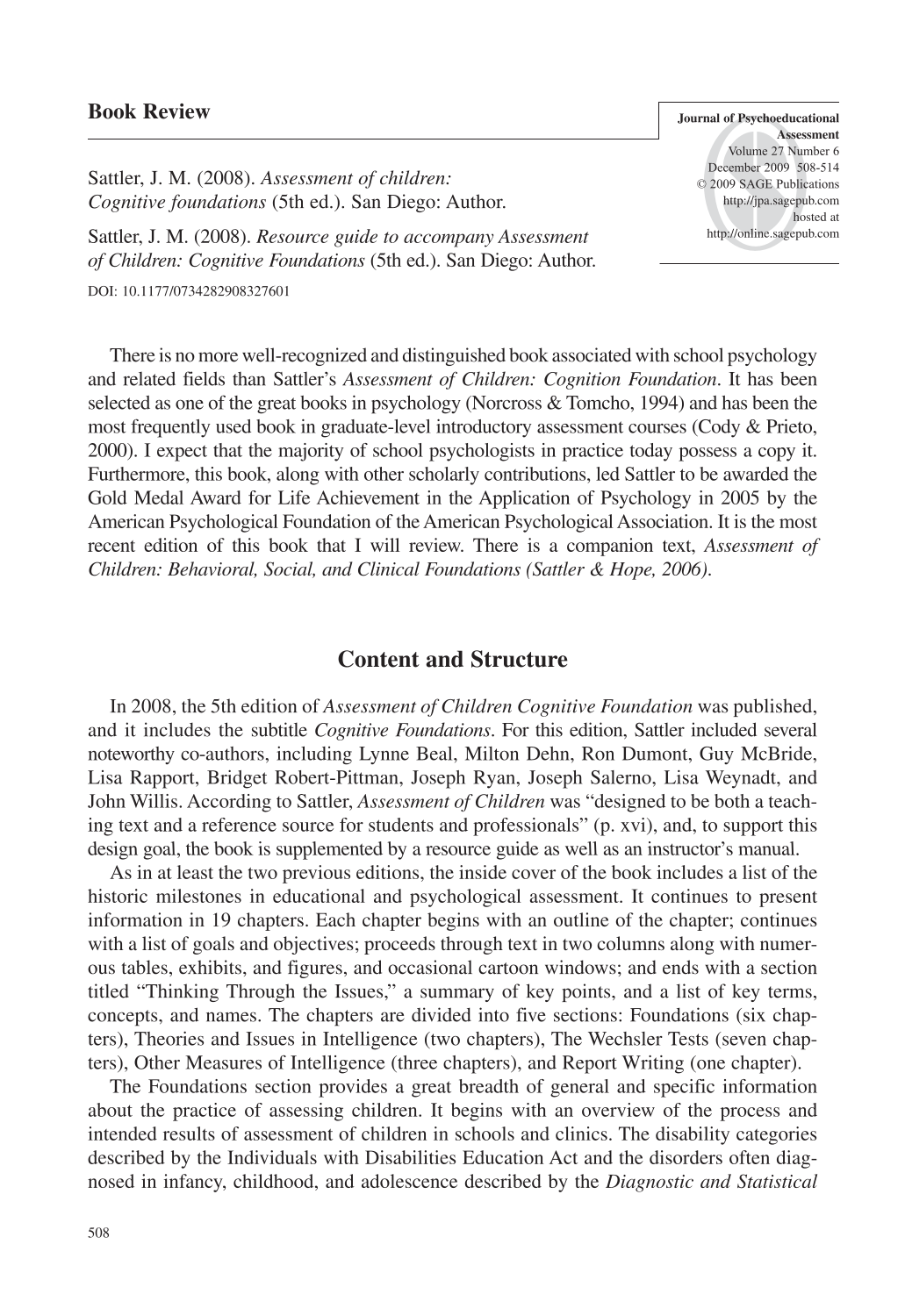
Book Review: Sattler,J. M. (2008). Assessment of children: Cognitive foundations (5th ed.). San Diego: Author. Sattler,J. M. (2008). Resource guide to accompany Assessment of Children: Cognitive Foundations (5th ed.). San Diego: Author
Restricted accessReview articleFirst published online December, 2009
Book Review: Sattler,J. M. (2008). Assessment of children: Cognitive foundations (5th ed.). San Diego: Author. Sattler,J. M. (2008). Resource guide to accompany Assessment of Children: Cognitive Foundations (5th ed.). San Diego: Author
Flanagan, D. P., & Harrison, P. (Eds.). (2005). Contemporary intellectual assessment (2nd ed.). New York : Guilford Press.
9.
Flanagan, D.P., Ortiz, S., & Alfonso, V.C. ( 2007). Essentials of cross-battery assessment (2nd ed.). New York: Wiley.
10.
Goldstein, G., & Beers, S.R. ( 2004). The comprehensive handbook of psychological assessment (Vol. 1): Intellectual and neuropsychological assessment. New York: Wiley.
11.
Gutkin, T.B., & Reynolds, C.R. (2008). The handbook of school psychology (4th ed.). New York : Wiley. Jensen, A. R. (1998). The g factor: The science of mental ability. Westport, CT: Preager.
12.
Kamphaus, R.W. ( 2001). Clinical assessment of child and adolescent intelligence (2nd ed.). Boston: Allyn & Bacon.
13.
Kaufman, A.S., & Kaufman, N.L. ( 2004). Kaufman Assessment Battery for Children, 2nd Edition. Circle Pines, MN: American Guidance Service.
14.
Kaufman, A.S., & Lichenberger, E.O. (2003). Assessing adolescent and adult intelligence (2nd ed.). New York: Wiley.
15.
Kaufman, J.C., & Kaufman, A.S. ( 2001). Time for the changing of the guard: A farewell to short forms of intelligence tests. Journal of Psychoeducational Assessment, 19, 245-267.
16.
Mather, N., & Jaffe, L.E. ( 2002). Woodcock-Johnson III: Reports, recommendations, and strategies . New York: John Wiley & Sons .
17.
Mather, N., Wendling, B., & Woodcock, R.W. (2001). Essentials of Woodcock-Johnson III Tests of Achievement assessment. New York: John Wiley & Sons.
Sattler, J.M., and Hoge, R.D. ( 2006). Assessment of children: Behavioral, social, and clinical foundations. San Diego: Authors .
25.
Shapiro, E.S. ( 2005). Academic skills problems: Direct assessment and intervention (3rd ed.). New York: Guilford Press.
26.
Teglasi, H. ( 2004). Clinical assessment: The advantage of multiple perspectives . [Review of Assessment of Children: Behavioral and Clinical Applications, 4th Edition]. School Psychology Quarterly, 19, 179-185.
27.
Thomas, A., & Grimes, J. (Eds.). (2007). Best practices in school psychology V. Bethesda, MD: National Association of School Psychologists.
28.
Watkins, M.W., Glutting, J.J., & Youngstrom, E.A. (2005). Issues in subtest profile analysis. In D. P. Flanagan & P. L. Harrison (Eds.), Contemporary intellectual assessment: Theories, tests, and issues (2nd ed., pp. 251-268). New York: Guilford Press.
29.
Wechsler, D. ( 1981). Wechsler Adult Intelligence Scale-Revised. San Antonio, TX: Psychological Corporation.
30.
Wechsler, D. ( 1997). Wechsler Adult Intelligence Scale, 3rd Edition. San Antonio, TX: Psychological Corporation.
31.
Wechsler, D. ( 2002a). Wechsler Individual Achievement Test, 2nd edition. San Antonio, TX: Harcourt.
32.
Wechsler, D. ( 2002b). Wechsler Preschool and Primary Scale of Intelligence , 3rd Edition. San Antonio, TX : Psychological Corporation.
33.
Wechsler, D. ( 2003). The Wechsler Intelligence Scale for Children, 4th Edition. Antonio, TX: Psychological Corporation .
34.
Woodcock, R.W., McGrew, K.S., & Mather, N. ( 2001). Woodcock-Johnson III. Itasca, IL: Riverside Publishing.