



Abstract
Women comprise the majority of workers in Indonesia’s informal waste sector. To support and empower them, the U.S. Agency for International Development’s Clean Cities, Blue Ocean (CCBO) programme launched the Women in Waste’s Economic Empowerment Activity in 2021. This initiative featured an adapted personal agency-based empowerment and business training programme, known as Basic Business and Empowerment Skills Training and also included the opportunity to obtain seed funding, mentorship, advanced business training and access to business networks. The 6-day training included modules on solid waste and business management skills, developed through a gender lens by CCBO, as well as modules and activities to develop women’s personal agency. A total of 202 women solid waste actors, including landfill and traveling informal waste collectors, waste bank managers and scrap dealers, completed this programme, of which data from 182 were available for analysis. Quantitative pre- and 6-month post-surveys assessed past-month income, amount of waste collected and psychometric measures of agency. Qualitative interviews were used to develop case studies. Post-training results showed significant increases in the amount of waste collected, self-efficacy, environmental mastery and self-esteem, suggesting improvements in personal agency. Case studies suggested that the increased agency may also contribute to diverse livelihood outcomes for women in the sector.
Keywords
Introduction
Plastic pollution has emerged as a critical concern due to its detrimental impacts on planetary health. The estimated 19–23 million tonnes of plastic waste entering global water systems annually overwhelm lakes, seas and rivers, leading to an increase in the frequency and severity of floods, destroying ecosystems and forcing toxins into our agricultural systems (UNEP, 2022). Indonesia processes 3.2 million tonnes of unmanaged plastic each year, both from domestic production and imports from high-income countries. Much of this imported waste is labelled as ‘recycled’, and the waste is counted under the exported country’s totals, obscuring Indonesia’s actual waste burden (Environment UN, 2017; Idris et al, 2024; Ministry of Environment and Forestry, 2020). Although Indonesia’s overarching ‘Act on Environment’ is actively developing specific regulations on air, water and waste management, the specifics of solid waste management (SWM) vary across regions and cities and are managed by both formal and informal sectors (Environment UN, 2017; World Bank Group, 2019). Prior initiatives to address issues of plastic waste have operated at individual, societal and political levels and include recycling education programmes, plastic pyrolysis, waste incineration and banning single use plastics (Idris et al., 2024; Park and Berry, 2013). More recent efforts have focused on understanding the SWM ecosystem and informal waste sector in order to better address global challenges in waste management (Huang et al., 2022).
Waste mismanagement remains underrepresented in climate discussions despite its substantial contributions to greenhouse gas emissions, pollution, biodiversity loss and risks to environmental and human health (Environment UN, 2017; Gutberlet et al., 2021). These impacts disproportionately affect marginalized and low-income populations, especially those working in the informal waste sector, where women play a central role. It is estimated that in many countries in Asia and Latin America, women make up a large majority of informal waste collectors and in some cities and facilities, studies report females comprise from two-thirds to over 80%–90% of the informal recycling workforce (GRID-Arendal, 2022; Ocean Conservancy, 2019).
Despite this contribution, women face systemic barriers that limit their economic agency, including hazardous working conditions, lack of access to finance, equipment and market information and few leadership opportunities, as well as exposure to gender-based violence and harassment (Dias and Sampson, 2016; Faircircularity, 2025; GRID-Arendal, 2022). Efforts to address gender inequality have been limited and have declined further in recent years due to shifts in global funding priorities, however, local efforts persist (Social Alpha, 2024). Women in Informal Employment: Globalizing and Organizing’s (WIEGO) efforts with women waste pickers in Brazil and Latin America, for example, have continued to identify practical and strategic needs, develop gender–waste workshops and strengthen women’s autonomy and leadership within cooperatives (WIEGO, 2024). Prior to the dismantling of USAID in 2025, the Women in Waste’s Economic Empowerment (WWEE) activity, implemented through the Clean Cities, Blue Ocean (CCBO) programme under the agency’s flagship programme, the Save our Seas Initiative, attempted to address these challenges through integrated empowerment and social entrepreneurship approaches. This paper examines efforts to strengthen the informal circular economy in Semarang, Indonesia. The data presented here on the informal waste sector are drawn from USAID’s WWEE activity, in Semarang, Indonesia, through their local partner, Yayasan Kesejahteraan Keluarga Soegijapranata (YKKS).
Plastic waste sector in Semarang
Semarang City produces 1229 tonnes of waste every day, 13% of which is plastic (Samadikun, et al., 2020). Approximately 80% of the daily waste is sent to the city’s only landfill (referred to as TPA) based in Jatibarang, which processes waste from 16 sub-districts throughout Semarang and handles final scrapping of compost, use of methane capture for energy use (biogas), waste reduction by herding cattle and a methane canteen programme (Harjanti and Anggraini, 2020). The remaining waste is processed by informal waste collectors (IWC), waste bank managers (WBM) and scrap dealers (SDs) (Samadikun, et al., 2020). Women constitute the majority of Indonesia’s informal waste sector, representing both landfill and traveling IWC, WBM and SD (Agamuthu, 2010.; Environment UN, 2017; Kristanto et al., 2021; Yang et al., 2018). Despite their critical role, these women face social stigma and gender discrimination, unsafe working conditions and limited access to training, equipment, business networks or upward mobility within the SWM value chain. However, these roles in the initial states of waste collection uniquely position these women to improve waste management systems, address plastic pollution and improve the health and well-being of their communities (Rokis et al., 2022; Clean Cities, Blue Ocean Gender Equality & Women’s Economic Empowerment Fact Sheet, 2019).
The vast majority of studies on informal waste collectors have focused on occupational hazards and health impacts. A recent systematic review (Zolnikov et al., 2021) identified a range of physical, social and ergonomic hazards and numerous negative health outcomes including communicable diseases and musculoskeletal problems. Indeed, previous interventions for women in SWM have predominantly focused on the ergonomics of waste management, mainly targeting the reduction of work-related musculoskeletal disorders (Asante et al., 2019). Although Zolnikov and authors mention that awareness of social and economic concerns is increasing, there is a clear gap regarding research focused explicitly on behavioural interventions focusing on empowerment or agency within these vulnerable populations.
The term empowerment is the process by which individuals or groups gain power or resources; agency, which is considered a component of empowerment, is defined as the capacity and willingness to take purposeful action and pursue goals (Kabeer, 1999). Although efforts to strengthen collective agency have been an emerging area of research among the informal sector, usually through unionization and group advocacy (Gutberlet et al., 2021; Ibelli-Bianco et al., 2022; Parra, 2020, 2022), interventions that focus on building individual agency, such as WWEE, remain rare. WWEE is unique in its inclusion of an adapted open-source personal agency curriculum previously tested in resource poor-settings (Kalra et al., 2024; Self-Empowerment and Equity for Change Initiative (SEE Change), 2021; Shankar et al., 2015). We refer to personal agency as the internal psychological capability to move towards important goals. Interventions that prioritize personal agency have the potential to improve personal coping resources, such as self-esteem, gratitude, perceived social support and sense of purpose, thereby better preparing individuals to handle high-stress and decision-making situations (Thoits, 2006). Strengthening personal agency may also better equip informal waste entrepreneurs to manage stress, make decisions and build sustainable livelihoods. This research explores the impacts of a personal agency-focused business approach within the context of the WWEE activity in Semarang.
Informal waste sector stakeholders
Figure 1 presents a flow diagram of the various stakeholders within the Semarang SWM system. Waste banks are community-based social waste enterprises that collect waste from nearby residents, record quantities and compensate contributors through an annual savings programme to promote long-term savings practices. Typically staffed by a leader, secretary, treasurer and field team members, waste banks handle collection, weighing and sorting of waste on a weekly or monthly basis. Formed and managed by the community, with oversight from business entities and/or the local government, these banks use the 3R principles (reduce, reuse, recycle) to educate, foster behaviour change and contribute to the circular economy (Budiyarto et al., 2025).
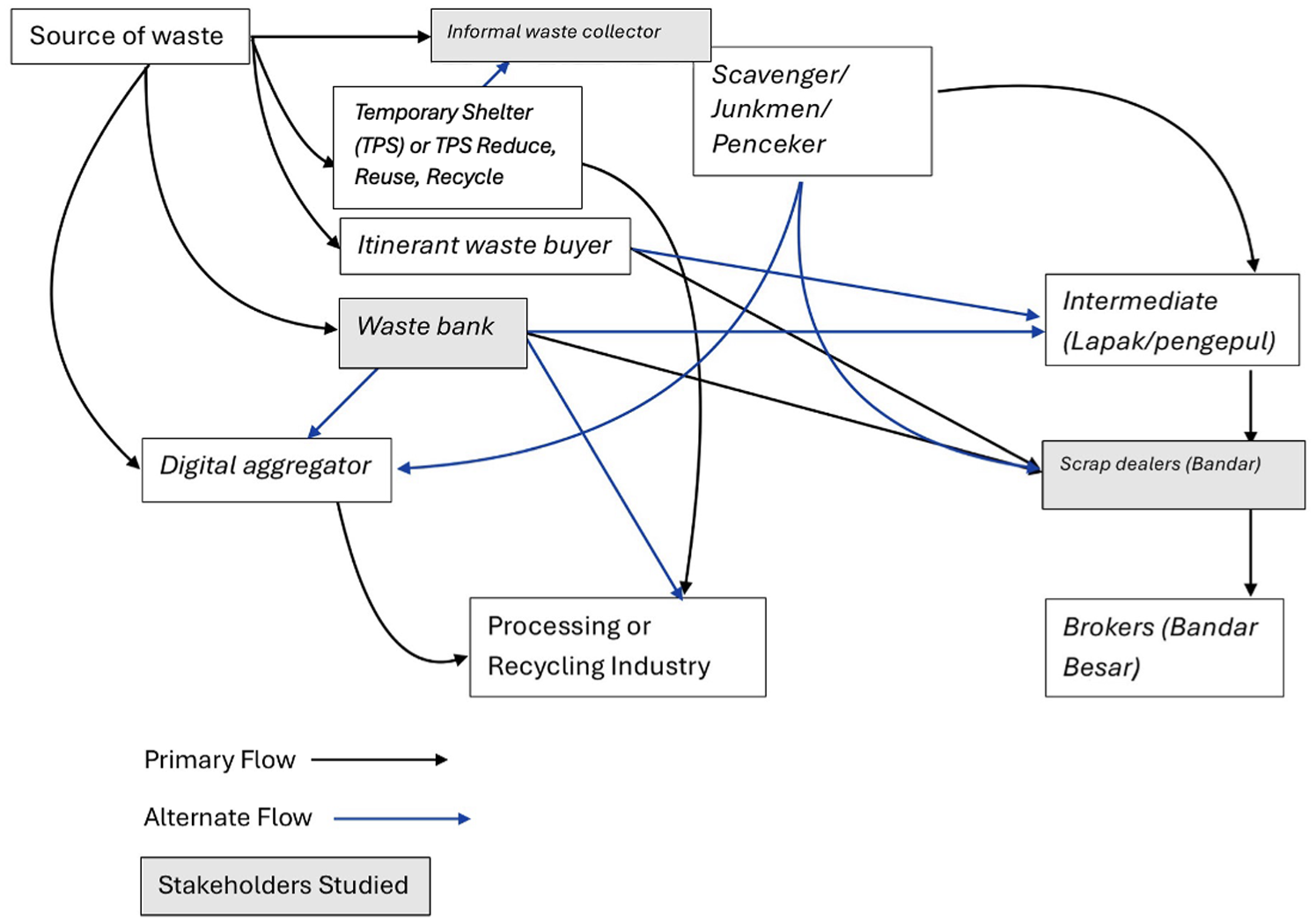
Flow diagram of waste management sector in Semarang.
Two types of informal waste collectors participated in the WWEE activity: landfill and traveling. Landfill IWCs physically collect sellable waste from the sites. Traveling IWCs combine physical labour with negotiation skills, sourcing waste from the streets and purchasing waste during their rounds. All IWCs manage their own working hours, some working in the mornings to collect waste, then using the afternoons to sort and sell their waste, whereas others choose to use the whole day to collect waste, sorting and selling on the weekend.
SDs operate individual enterprises that purchase waste from waste banks or IWCs, accepting almost all types of waste except for low value plastic waste, such as sachets. These businesses typically operate from permanent or semi-permanent stalls or warehouses, where they receive and store collected waste. Some possess formal business permits, such as NIB (Nomor Induk Berusaha/Single Business Number), UD (Usaha Dagang/Sole Proprietorship) or CV (Commanditaire Vennootschap/Limited Partnership) and employ staff to sort waste and handle transactions.
Programme design and study methods
WWEE offered the Basic Business and Empowerment Skills Training (BBEST), followed by mentorship for select graduates, an opportunity to receive grants for graduates to establish or expand their waste businesses and advanced business training. BBEST graduates also received support to access higher-value markets for their collected waste. Data for this study were collected through intake and 6-month post-training surveys, structured observations during training and mentorship and site visits. Data were collected by YKKS between November 2022 and December 2023 as part of their monitoring, evaluation and learning (MEL) activities.
BBEST training
The BBEST curriculum was developed and adapted following a training needs assessment with women in Semarang’s informal waste sector. This information allowed for the curriculum to be adapted to the local context and ensured the usefulness of the materials to the participants. The BBEST training materials were adapted from the Empowered Entrepreneur Training (EET) Handbook (SEE Change, 2021), where business and leadership content is paired with activities designed to build personal agency, all through a gender lens. CCBO contributed to the business modules, including the business model canvas and social enterprise sessions for waste bank cohorts, with supplemental training for waste banks managers on business ideation. Modules on SWM also addressed occupational safety, health and gender-based violence (GBV), including information on local laws and processes, filling a known gap in the training of informal waste collectors. Training was delivered over 6 days to 10 stakeholder-specific cohorts of women (average cohort size of 20) to minimize hierarchical social dynamics and tailor content to the needs of the IWC, WBM and SD. The training was composed of four sections: (a) SWM (including modules on occupational safety and health and gender-based violence), (b) introduction to business, (c) personal empowerment and (d) leadership.
Business plan development, mentorship and grants
Following BBEST, participants underwent a ‘mentee readiness’ assessment, evaluating their business plans, entrepreneurial vision and commitment to growth. Selected participants were matched with experienced business mentors to refine business plans, develop income projections and integrate strategies for the proposed grant opportunities. Overall, 40 enterprises received grants for personal protective equipment (masks, gloves, etc.), digital/manual scales, large sacks, three-wheeled motorbikes, pick-up trucks and machines to compress plastics. Those funded were also provided continued mentorship and advanced business training.
Data collection
Intake surveys were conducted in-person approximately 2 weeks before the BBEST training for each cohort, gathering information on demographics, education, income, business operations and relationships (both work and family). The specific questions varied between each group of women to cater to the differences between each stakeholder’s role in the SWM value chain. In accordance with international ethical research practices, prior to conducting interviews participants were informed that their participation was voluntary, they could refuse to answer any question and they could withdraw at any time; written informed consent was obtained, with a copy provided to each participant. Intake visits were conducted with a total of 209 participants; of these, 202 attended the BBEST training and included 102 waste bank managers, 80 informal waste collectors (two cohorts included landfill IWC and two cohorts were traveling IWC) and 20 SDs.
Six-months post-training, YKKS’ MEL team conducted follow-up surveys with 183 graduates to assess changes in economic situations, relationships, income sources and amounts and broader impacts on work and personal lives, although one IWC’s data was removed due to incompleteness, leaving a total of 182 for analysis. Of the 19 women lost to follow-up, one woman passed away between completion of the programme and the scheduled 6-month follow-up visit, and the remaining 18 graduates could not be contacted. Table 1 provides the breakdown of the number of individuals who participated in each activity as well as data collection stage.
Number of participants in each WWEE stage.
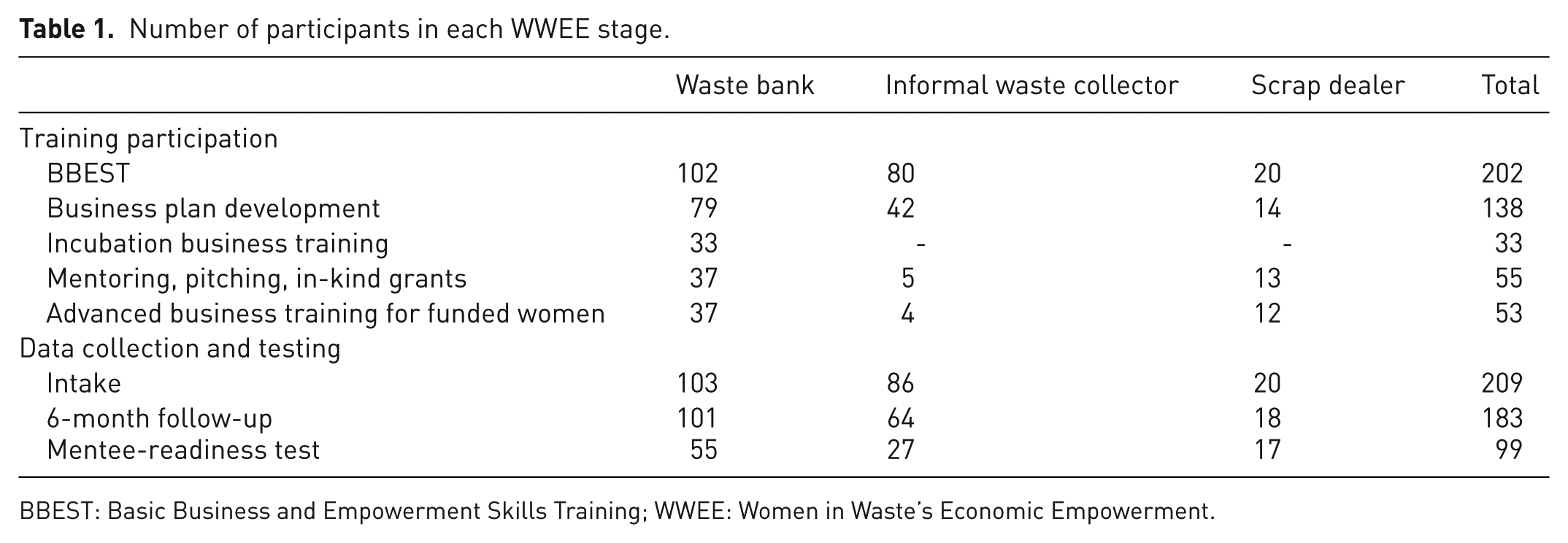
BBEST: Basic Business and Empowerment Skills Training; WWEE: Women in Waste’s Economic Empowerment.
Data analysis
This study used validated psychometric scales as proxies for personal agency. Given the absence of a standardized agency measure, two shortened subscales from the Ryff social agency scales were used, including self-esteem (perceived self-worth) and environmental mastery (ability to manage one’s environment) (Ryff, 1989) along with self-efficacy, an important precursor of agency, particularly within vulnerable populations (Chen et al., 2001). These measures were used to assess changes in personal agency and well-being pre- and post-BBEST training. Quantitative analyses were conducted in R (R Core Team, 2021). Overall and stratified analyses of agency measures were performed as well as correlations between agency measures, waste collection volume and income data. Paired t-tests and linear mixed models were used to determine the statistical significance of the data. The difference-in-differences method was used to compare the change between pre- and post-survey results. This quasi-experimental approach allows us to compare the changes in outcomes over time for these populations, which were adjusted for potential confounders or stratified by type of stakeholder. However, due to the absence of a control group, we cannot make any causal inference regarding the effects of the intervention.
Results and discussion
Table 2 presents difference-in-differences estimates for the primary outcome variables, adjusting for age and type of stakeholder, as well as the stratified analyses by stakeholder.
Difference-in-differences analysis at 6-month follow-up of overall and stratified agency measure by type of solid-waste management actor.
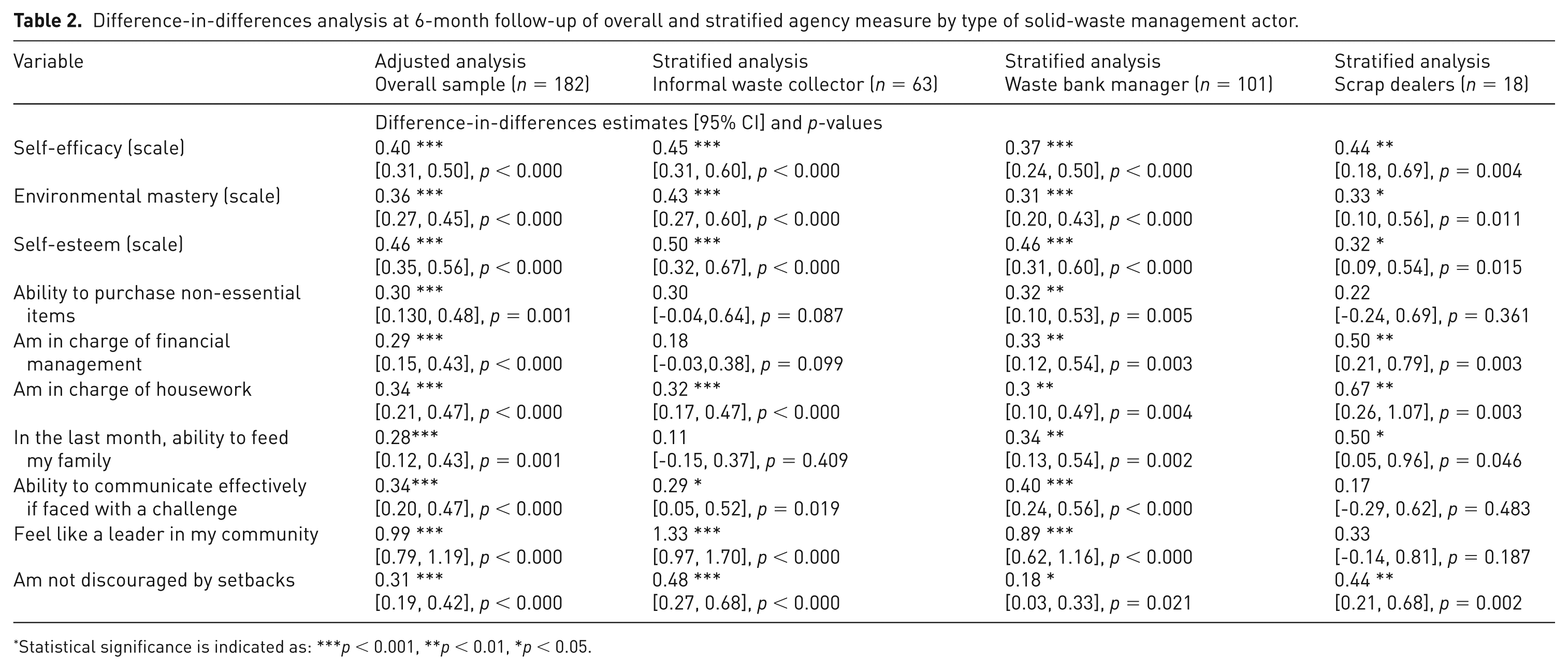
Statistical significance is indicated as: ***p < 0.001, **p < 0.01, *p < 0.05.
Across the overall sample (n = 182), significant positive changes were observed in self-efficacy, environmental mastery and self-esteem at 6-month post-training. Preliminary analysis (not reported) to assess the impact of age showed no differences on any of the three scales. However, higher age was significantly associated with: (a) being in charge of financial management (p < 0.05); (b) ability to feed family (p < \0.05) and (c) feeling like a leader (p < \0.05).
All stakeholder groups reported gains in self-efficacy, environmental mastery, self-esteem and responsibility for housework, although the level of significance varied, likely due to small sample sizes. Single-item outcomes showed variation by stakeholder type. For example, WBM reported significant improvement in being able to have money for non-essential goods. The feeling of being in charge of financial management increased among WBM and SD; however, the change among IWC did not appear to be significant. WBM and SD reported improvements in their ability to feed their families, whereas IWC showed mixed results. Feeling like a leader increased for IWC and WBM, with no change for SD. IWC and SD reported increased capacity in overcoming setbacks, with WBM also showing improvement, but at a lower significance level.
To understand whether these positive shifts across outcomes were due to exposure to the BBEST programme and not driven primarily by the subsequent coaching and mentoring, a subset analysis was conducted with only the 163 individuals who did not receive any coaching, mentoring or in-kind grant before the follow-up interviews. Again, the model resulted in a positive increase overall for each of the measures. When stratified by stakeholder groups, there were non-significant increases among SD (n = 5) and significant increases across most outcomes for IWC and WBM (n = 59; n = 79; data not presented). Certainly, the additional coaching and resources continued to positively support these women in their businesses.
Changes in income and waste collected
Table 3 summarizes change in past-month income and waste processed for the sample of 143 participants where plastic waste collection and income data were confirmed. Data for the SDs were not reported separately due to the small sample size. Waste collected increased overall, with positive, non-significant increases for both IWC and WBM. More IWCs (68%) reported an increase compared to 48% of WBM. In contrast, from the stratified analyses, it appears that the IWC faced significant losses of income, whereas WBM appeared to see significant gains. Only 5% of IWCs reported an increase in past-month income compared with baseline, whereas 56% of WBM reported improvements. A correlation analysis of income and reported waste collected showed a negative relationship due to falling global market prices for plastics and recyclables during the study period, as highlighted by several news and global sources (Fair Planet, 2025; Ecoton, 2024; Park et al., 2024; RRI, 2025). Unfortunately, the initial price was not documented, and data collection was limited to sales volumes and prices reported by participants who received in-kind grants. Based on available reports, it appears that the volume of imported waste during the study period influenced plastic supply and, together with declining costs of virgin plastic production, reduced the competitiveness of recycled plastics, potentially leading to reduced prices experienced by the IWC in our sample (Fair Planet, 2025; Xu et al., 2024). In addition, the limited pricing transparency and high price volatility along recycled plastics value chains makes it difficult to ascertain the specific causes of falling prices (The Circulate Initiative, 2023).
Change in past-month income and waste (in kg) processed, overall and by stakeholder presented as difference-in-differences analysis estimates, 95% CI and p values, documented as ***p < 0.001, **p < 0.01, *p < 0.05; IDR to US conversion rate: IDR 16,382= $1.00.
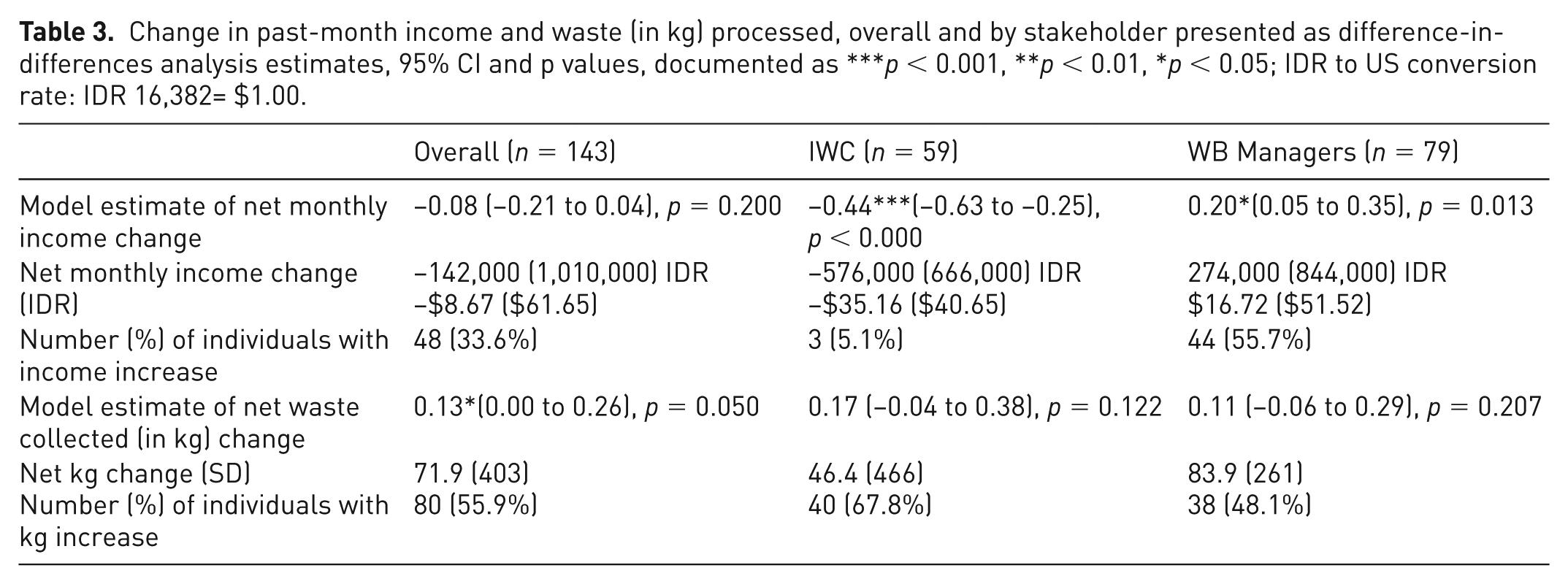
The findings suggest WWEE participation may have improved efficiency of the number of waste collected, despite adverse market conditions. However, a comprehensive assessment of income and efficiency cannot be made without data on changes in working hours and broader economic contextual factors.
Qualitative follow-up
A key component of personal agency is decision-making and providing individuals with the skill set to think through their decisions and act accordingly. This means allowing individuals to ask themselves questions such as ‘what is the best thing for me to do?’ and ‘what is the safest and most impactful way for me to proceed in this situation?’ Consequently, this sometimes leads to individuals making decisions that may not be aligned with the overall project goals. In this study, there were two areas where this was observed. The first was with respect to confronting gender-based violence and second was in choosing to stay in SWM as a business.
Addressing gender-based violence
Confidence to try to avert or report GBV increased significantly post-training (p < \0.001). Of the 52 women initially not confident, 35 of the 46 who were followed up expressed confidence at 6 months. Notably, three participants who reported confidence at intake later chose not to intervene in GBV cases in the future. This decision reflected a heightened awareness of their vulnerability with the social environment, where any intervention could have exposed them to safety risks and social stigma. In such cases and aligned with their values, participants judged that responsibility lay more appropriately with the village head – an outcome consistent with the programme’s goal of fostering informed, self-determined decision-making.
Although increased confidence to address GBV is a positive outcome, it is equally important to consider the ethical implications of individual action in contexts with limited structural support. Some participants chose not to intervene due to safety concerns, demonstrating agency in risk navigation in ways that prioritized personal safety. It is acknowledged that promoting personal action without institutional protections risks shifting responsibility onto individuals. In most settings, and specifically within resource-poor settings, it is untenable to regard women’s agency as valuable only when robust structural systems are in place. For many, the capacity to decide whether or not to act constituted meaningful empowerment within constrained realities. We therefore argue that individual agency is both inherently valuable and complementary to systemic reform; structural accountability is essential but should not be a precondition for recognizing women’s choices in responding to GBV.
Expanding livelihood choices
The 6-month follow-up revealed that most graduates (80%, n = 161) remained in SWM, with two transitioning between stakeholder roles. Moreover, market access has expanded as 13 enterprises began to sell plastic material directly to the factory, allowing them to secure higher prices. Another 13 (6%) added a new business along with SWM. Five women (3%) left SWM entirely and seven were on hiatus.
Several cases highlight these trajectories. One former IWC left SWM to open grocery stalls, using her BBEST stipend to relocate to her hometown. She reported that the programme led to her finding the courage and confidence to pursue more stable income opportunities and improved living conditions for her family. Another IWC applied the BBEST programme learning that the economic value of waste can be increased by segregation. This led her to identify a new scrap dealer who was willing to give her a higher price for segregated waste and now she works to educate other IWCs to do the same.
Outcomes also varied among waste bank managers. One graduate opened a fried chicken business to support an orphanage she leads. Drawing on the BBEST curriculum, she reported that by applying SMART (specific, measurable, achievable, relevant, time-bound) goals, she was able to secure funding and manage her businesses. She described balancing entrepreneurship, community leadership and motherhood by drawing on BBEST activities, such as being proactive, instead of reactive, when faced with stressful situations. Another waste bank manager improved her waste bank’s efficiency by introducing door-to-door waste collection, which increased membership from 11 to 35 and cited improved negotiation skills and waste segregation practices learned from BBEST.
Strengths and limitations
Strengths of this work include the use of locally led data collection conducted by a team with strong cultural and contextual knowledge, which likely enhanced the relevance and accuracy of the information gathered. Another strength is the iterative adaptation of the curriculum to Semarang’s environment between cohorts, ensuring that the intervention remained responsive to the local realities.
However, several limitations should be noted. Data were collected outside of a formal research setting which may introduce bias despite measures taken to mitigate it. In addition, outcomes rely on self-reported measures, raising the possibility of social desirability bias that could inflate perceived programme effectiveness. Moreover, the field teams were not always able to independently validate reported income or amount of waste sold, further adding sources of bias in these data. The research was based on analysis on secondary data, rather than systematically collected research data; and whereas these are valuable for understanding programme delivery, they are not designed to establish causal inferences. Furthermore, the absence of a control group limits insight into the true magnitude of the effects and limits any causal inference regarding the effects of the intervention.
Conclusion
Over the past decades, Indonesia has advanced numerous community-led waste management initiatives, such as the development of waste banks, which serve both as hubs for sustainable waste management practices and as platforms for women’s economic participation (Asteria and Herdiansyah, 2022). Similar to findings from India and other countries, women in Indonesia’s SWM sector face gendered barriers such as hazardous working conditions, lack of social protection and discrimination (Dutta, 2021; Thodukayil et al., 2024). As previously noted, collective organizing and unionization have gained traction globally as a strategy for empowerment, yet interventions fostering individual agency remain sparse. The WWEE activity, delivered through the BBEST programme, represents an important advancement in this area, with a programme that integrates psycho-social agency within technical business training and access to resources and opportunity structures. Within 6 months of training, participants demonstrated statistically significant gains in self-efficacy, environmental mastery and self-esteem, as well as improved confidence to address GBV. These findings align with evidence from empowerment frameworks (Kabeer, 1999; Thoits, 2006) showing enhanced personal agency can strengthen coping resources, decision-making capacity and economic participation. The programme’s differential impacts, such as greater income gains among waste bank managers compared to informal waste collectors, underscore the need to address market access and structural inequalities within the SWM value chain.
WWEE reflects principles emphasized in social enterprise and circular economy research (Huang et al., 2022 Park and Berry, 2013), particularly the role of localized, community-led solutions in driving waste reduction and income generation. Although 80% of the participants remained solely in SWM, some transitioning into more profitable roles or expanded operations, 9% launched new non-SWM businesses and a small number exited the sector entirely. Rather than indicating attrition, such shifts mirror Parra’s (2020) findings from Latin America that empowerment interventions can lead individuals to pursue livelihoods that better align with their aspirations.
The integration of personal agency content into SWM technical training programmes appears promising as it has contributed to overall enhanced self-efficacy, increased confidence to address GBV and a positive increase in plastic waste collection. These results suggest that SWM interventions can benefit from combining technical training with psycho-social supports and gender-transformative approaches to engage women and address entrenched inequalities (Thodukayil et al., 2024).
Based on follow-up stakeholder consultations, the Ministry of Environment (MOE) subsequently applied the BBEST approach through the implementation of a Training of Trainers programme and knowledge sharing sessions delivered to representatives of the Environmental Agency which coordinates with the MOE (Dinas Lingkungan Hidup Kabupaten Jembrana, 2024). As a result, the BBEST training has been integrated into Indonesia’s national waste management strategy. MOE staff regarded these tools as both novel and relevant, particularly for enhancing Waste Banks’ operational strategies. The training also motivated Waste Banks to expand their role beyond social service provision to include entrepreneurial and business development activities. This demonstrates a viable pathway for scaling empowerment-oriented SWM interventions through public-sector Training of Trainers systems. In addition, there are recent efforts to expand this programme across Indonesia and broaden the focus to include men. Wastepreneur.id, an incubator within the waste value chain, has emerged since the completion of the BBEST training (Quaade, 2025; Wastepreneur.id, 2025). Partnering with the Indonesian MOE and the Danish Environmental Protection Agency, wastepreneur.id continues to apply the lessons from BBEST to both male and female actors in the informal waste sector to improve overall efficiency and sustainability of the Indonesian circular economy. Similar agency-based empowerment models have been implemented in the Philippines, indicating the potential for adaptation across diverse socio-economic and institutional contexts (Clean Cities, Blue Ocean, 2019). Indeed, such personal agency interventions have been implemented in livelihood and health programmes globally, as its human-centred design allows tailoring to local contexts and structural systems (Shankar and Spurzem, 2025).
This study reinforces the notion that women can increase their social capital in the community with the ability to mobilize the community through their active role in waste management activities and can serve as role models, having an important impact on waste management. Given the observed psycho-social and operational gains, further research should explore the scalability and adaptation of such integrated models across diverse socio-cultural and economic contexts, with particular attention to long-term livelihood stability and household well-being within informal waste networks.
Footnotes
Acknowledgements
We would like to thank all the women from Semarang, Indonesia working in waste that contributed their time and efforts to this programme. This article was developed through an analysis of data collected through the U.S. Agency for International Development’s (USAID) Clean Cities, Blue Ocean programme and its WWEE Activity. This article was authored by staff from Yayasan Kesejahteraan Keluarga Soegijapranata, a Clean Cities, Blue Ocean grantee and implementing partner and Johns Hopkins Bloomberg School of Public Health, subcontracted by Clean Cities, Blue Ocean to support components of the WWEE Activity. The development of this article was not funded by USAID. The contents are the responsibility of the authors alone and do not necessarily reflect the views of USAID or the United States Government.

Ethical considerations
This study is classified as a secondary data analysis with de-identified data; therefore, the Johns Hopkins Bloomberg School of Public Health Institutional Review Board determined that the proposed programme does not qualify as human subjects’ research as defined by DHHS regulations 45 CFR 46.102 and therefore is exempt from IRB oversight.
Author contributions
RHDA: Contributed to study design, was responsible for overall coordination of the study and data collection and revised the manuscript. UUH: Contributed to study design, supported field activities and assisted with data review and revised the manuscript. CR: Wrote the initial manuscript draft, interpreted results and revised the manuscript. SAF: Contributed to study design and was engaged in data collection and contributed to manuscript. IPP: Contributed to study design and was engaged in data collection and contributed to manuscript. CP: Developed analysis plan, performed analysis, interpreted the results and reviewed manuscript. HF: Interpreted results and revised the manuscript. AS: Developed overall study design and analysis plan, interpreted results and revised the manuscript.
Funding
The authors disclosed receipt of the following financial support for the research, authorship, and/or publication of this article: The WWEE programme was funded by USAID through the CCBO programme; however, the authors received no financial support for the research, authorship and/or publication of this secondary data analysis and article.
Declaration of conflicting interests
The authors declared no potential conflicts of interest with respect to the research, authorship, and/or publication of this article.
Data availability statement
These data are available on special request to YKKS and requires permission by local stakeholders