



Abstract
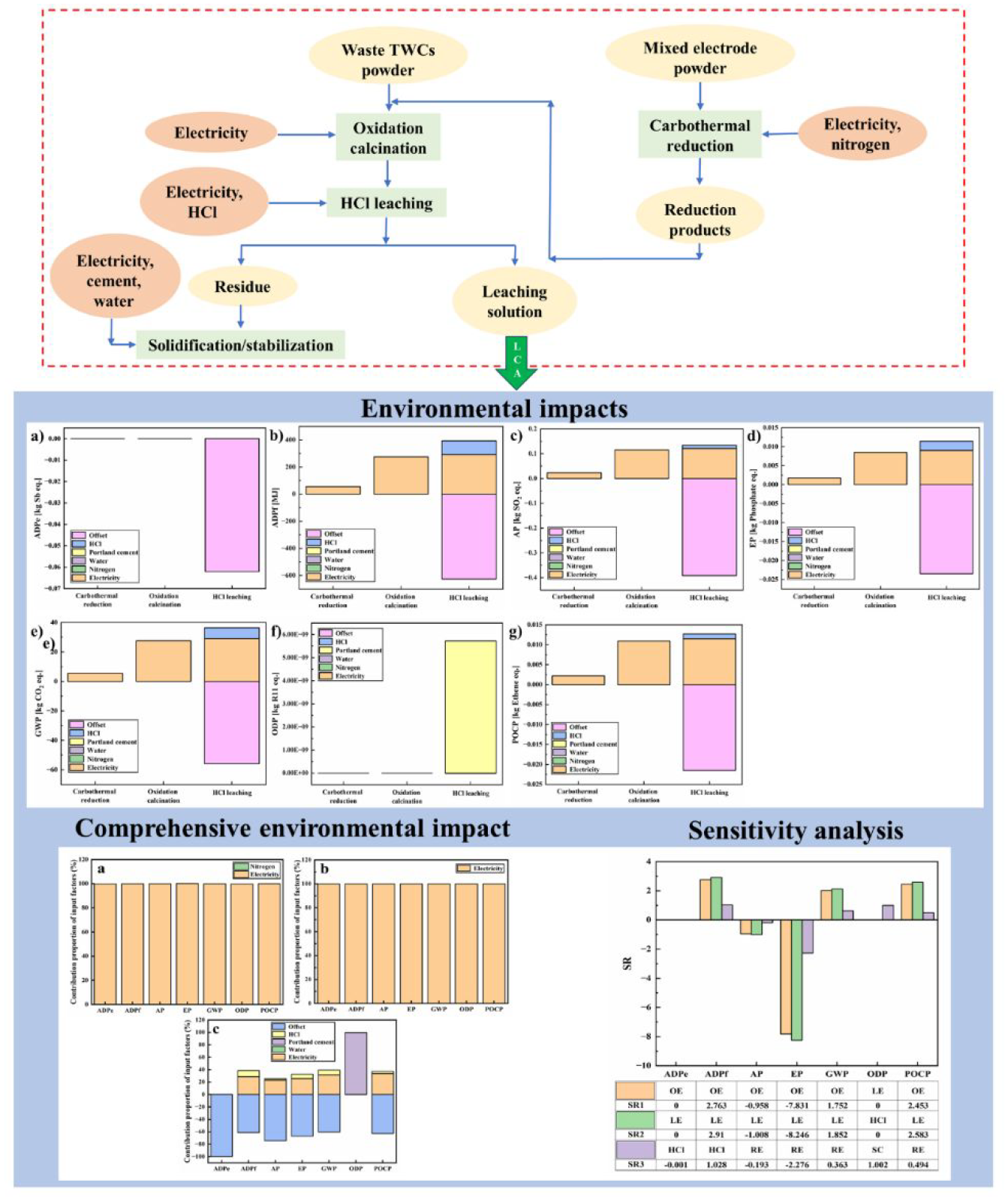
Waste three-way catalysts (TWCs) and waste LiCoO2 batteries represent critical environmental challenges due to hazardous components yet contain high-value resources, and their recycling has garnered widespread attention. We propose a novel ‘waste-to-waste’ synergistic recycling where spent LiCoO2 batteries reconstruct mineral phases of waste TWCs, enabling co-recovery of platinum group metals and Li/Co without traditional oxidants. However, the environmental performance of this process still requires further analysis. A comprehensive life cycle assessment using the CML2001 framework evaluated seven impact categories across three core phases: carbothermal reduction, oxidation calcination and HCl leaching. The process achieves net-negative environmental impact with significant benefits in abiotic depletion potential elements (−0.062 kg Sb eq.), acidification potential (−120 g SO2 eq.) and eutrophication potential (−1.09 g phosphate eq.). Compared to the individual recycling of lithium-ion batteries, this synergistic recycling process can reduce CO2 emissions by approximately 75% or more. Oxidation calcination and HCl leaching are the main phases contributing to environmental burdens. Specifically, electricity consumption, the input of HCl and silicate cement are key factors generating environmental load. Therefore, exploring methods to improve heating efficiency in the oxidation calcination and HCl leaching phases, increasing the proportion of renewable energy in power generation, reducing the use of HCl and seeking environmentally friendly alternatives to silicate cement are crucial to mitigating the environmental impact of this process. Overall, the synergistic recycling process proposed in this study is environmentally friendly and aligns with the goals of a circular economy.
Keywords
Get full access to this article
View all access options for this article.
References
Supplementary Material
Please find the following supplemental material available below.
For Open Access articles published under a Creative Commons License, all supplemental material carries the same license as the article it is associated with.
For non-Open Access articles published, all supplemental material carries a non-exclusive license, and permission requests for re-use of supplemental material or any part of supplemental material shall be sent directly to the copyright owner as specified in the copyright notice associated with the article.
