



Abstract
The method based on machine learning and laser-induced breakdown spectroscopy (LIBS) is effective for rapid characterization of waste organic polymers (WOP). However, the lack of mechanistic interpretability leads to raises concerns regarding its reliability in practical applications. This study systematically investigated the fundamental chemical correlations between WOP fuel properties and LIBS spectral features through feature selection and machine learning interpretability analysis. Thirteen radical-associated key peaks were selected and strategically categorized into two groups for model construction. Under optimal conditions, the prediction accuracy for carbon, hydrogen, oxygen content and lower heating value (LHV) reach 97.74%, 91.22%, 91.28% and 97.02%, respectively. Notably, models utilizing 10 selected key peaks demonstrated superior performance compared to those employing raw LIBS spectra or principal components, especially with the absolute difference reaching 14.57% for O content prediction. Interpretability analysis showed that C2 swan bands had highest effects impacts on carbon, oxygen content and LHV prediction, whereas H I line was essential for hydrogen content prediction. This mechanistic investigation provided theoretical validation for LIBS-based rapid characterization systems, facilitating their practical implementation in downstream energy recovery processes. The established methodology offers a scientific foundation for advancing sustainable waste management and promoting circular economy development through efficient resource utilization.
This is a visual representation of the abstract.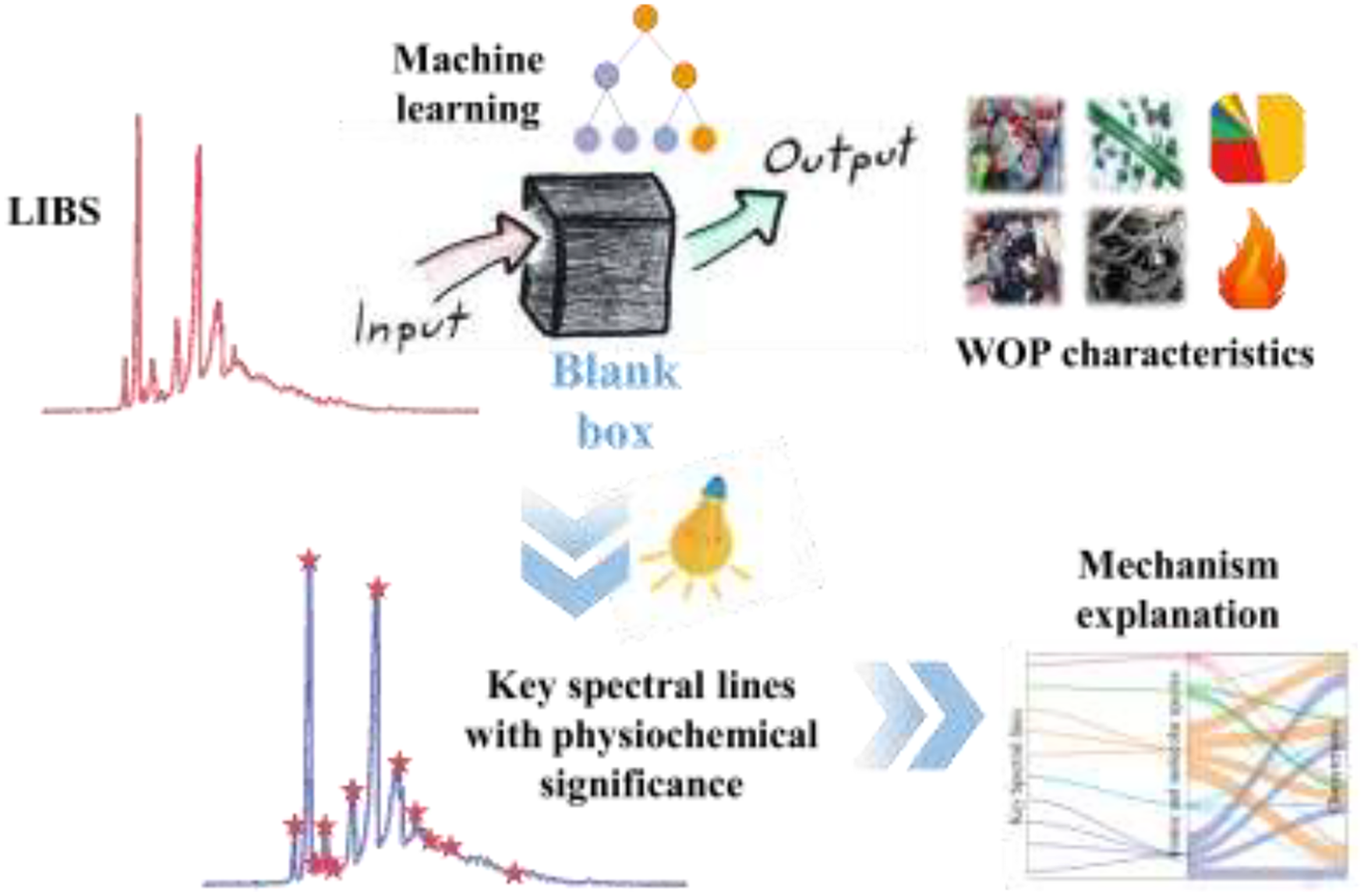
Keywords
Get full access to this article
View all access options for this article.
References
Supplementary Material
Please find the following supplemental material available below.
For Open Access articles published under a Creative Commons License, all supplemental material carries the same license as the article it is associated with.
For non-Open Access articles published, all supplemental material carries a non-exclusive license, and permission requests for re-use of supplemental material or any part of supplemental material shall be sent directly to the copyright owner as specified in the copyright notice associated with the article.
