



Abstract
This study evaluates the use of carbon-encapsulated zero-valent iron nanoparticles for biogas upgrading in wet systems. The nanoparticles were produced by hydrothermal carbonization, using olive mill waste (OMW) or microalgae as carbon sources. The solids were characterized to investigate the specific surface area, total and zero-valent iron content, pHPZC and chemical and crystalline composition. Their adsorption performance towards hydrogen sulphide (H2S) was tested by treating two types of synthetic biogas with and without CO2. In both cases, the starting H2S concentration was approximately 60 ppm and the experiments lasted until the complete saturation of the nanoparticles. Optimal Fe/C ratios of 0.05 for OMW nanoparticles and 0.2 for microalgae nanoparticles demonstrated H2S-specific adsorption capacities of 9.66 and 9.55
This is a visual representation of the abstract.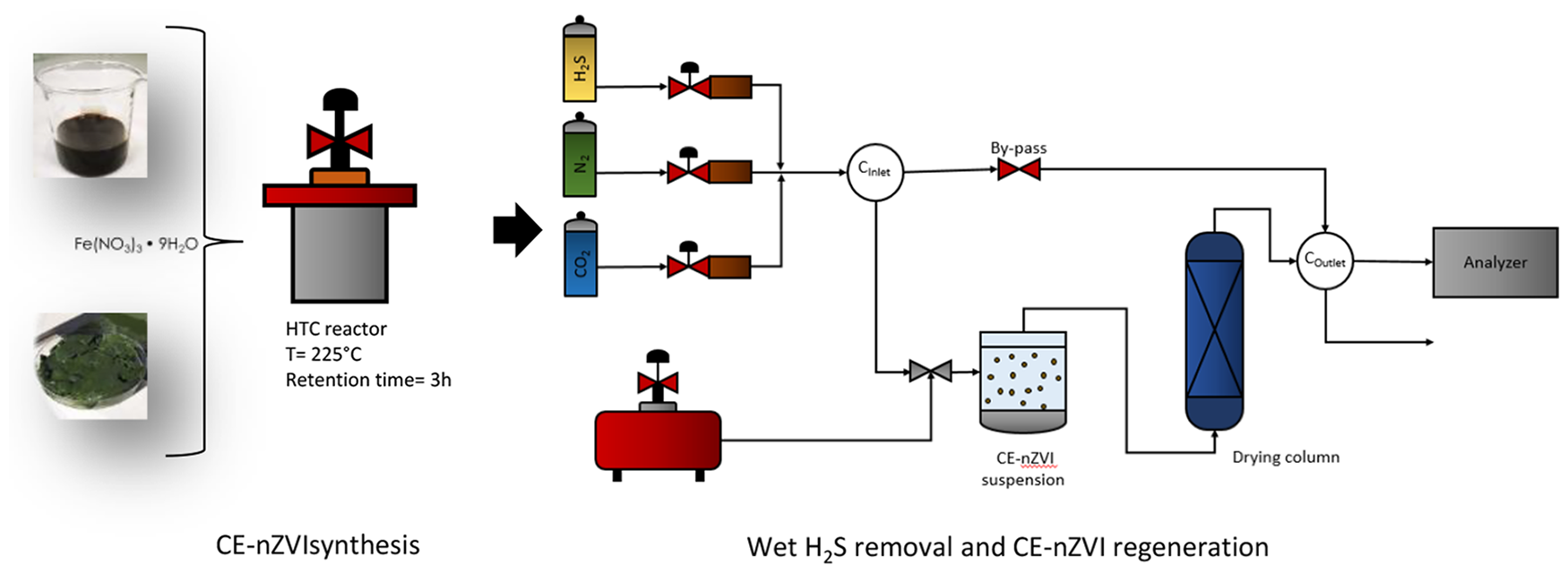
Keywords
Get full access to this article
View all access options for this article.