



Abstract
This study collected data on waste generation and management in China between 1979 and 2020 from government statistics and literature and reviewed the development of municipal solid waste (MSW) management in China. The extended stochastic impact by regression on population, affluence and technology (STIRPAT) model was employed to identify the driving forces of MSW generation, and the cointegration analysis showed that economy (0.35, t = −3.47), industrial structure (3.34, t = −20.77) and urbanization (−1.5, t = 5.678) were the significant socioeconomic driving forces in the long run. By employing the framework of evolutionary economics, this study then investigated the internal rules of long-term interaction between socioeconomic factors and MSW management. The results indicate that, in the long run, MSW management development can be viewed as an evolutionary process that includes a continuous adaptation to external socioeconomic factors and the co-evolution of internal institutions and technologies. Adaptation and diversity of institutions and technologies play an important role in achieving sustainable waste management and circular economy (CE). This study offers a novel evolutionary perspective for explaining dynamic changes of MSW management in China, as well as recommendations for emerging economies to achieve sustainable waste management and CE goals.
This is a visual representation of the abstract.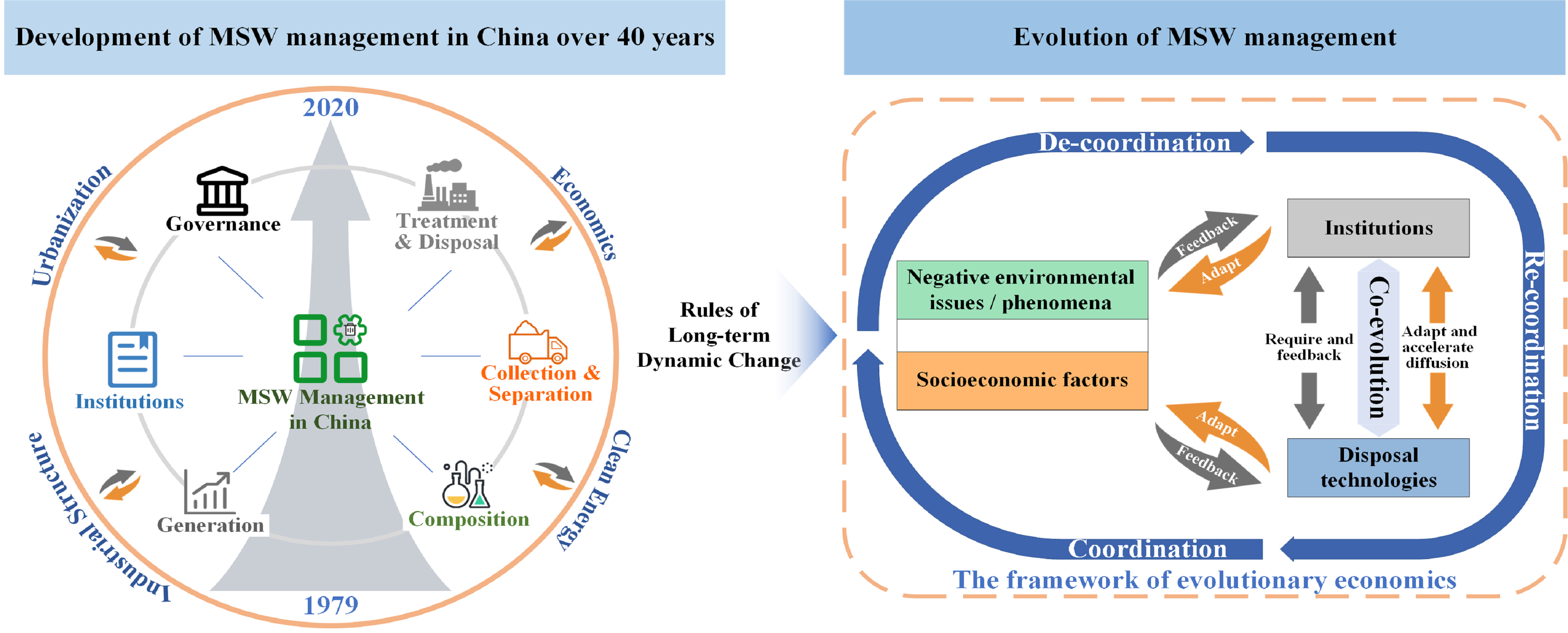
Keywords
Get full access to this article
View all access options for this article.
References
Supplementary Material
Please find the following supplemental material available below.
For Open Access articles published under a Creative Commons License, all supplemental material carries the same license as the article it is associated with.
For non-Open Access articles published, all supplemental material carries a non-exclusive license, and permission requests for re-use of supplemental material or any part of supplemental material shall be sent directly to the copyright owner as specified in the copyright notice associated with the article.
