



Abstract
In winter season, the burning of crop residues for ease of sowing the next crop, along with industrial emissions and vehicular pollution leads to settling of a thick layer of smog in northern part of India. Therefore, to understand the opinion of farmers regarding sustainable management of organic waste, the present study was conducted in Ludhiana district of Indian state of Punjab. An ex post facto research design was used and a total of 800 dairy farmers having significant crop area were selected randomly for the study, grouped equally as small and large dairy farmers. Results revealed that majority of farmers had a highly favourable opinion regarding organic waste management due to the fact that they were aware of the ill-effects of undesirable practices like crop residue burning. Further, to predict the farmers’ opinion and the effect of independent variables on farmers’ opinion, a multi-layer perceptron feed-forward deep neural network was developed with mean squared error of 0.036 and 0.137 for validation and training data sets respectively, marking a novel approach of analysing farmers’ behaviour. The neural network highlighted that with increase in the magnitude of input variables, namely, education, experience in dairying, information source utilisation, knowledge regarding organic waste management, etc., the farmers’ opinion regarding sustainable waste management increases. The study concluded with the impression that cognitive processes like education, information and knowledge play a significant role in forming the opinion of the farmers. Therefore, efforts focusing on enhancing cognition should be made for sustainable management of organic waste.
Introduction
According to United Nations Revision on World Population Prospects (2017), the world population stands at 7.6 billion and is expected to reach 8.6 billion in 2030. The total waste generation in the world stands at 2.12 billion tonnes per year and if all this waste was put on trucks, they would go around the world 24 times (Singh, 2019a). The amount of waste produced today needs 1.7 Earths to provide resources and an area to absorb the waste (Hayden, 2023). According to Bentsen et al. (2014), the global agricultural residue production from the 27 major crops grown worldwide is estimated to be 3.7 billion tonnes. The global food waste amounts to 1.3 billion tonnes (Durán-Sandoval et al., 2023). Moharana (2012) and Kimothi et al. (2020) reported that on the basis of crop production levels, ten major crops (rice, wheat, sorghum, pearl millet, barley, finger millet, sugarcane, potato tubers and pluses) of India generate about 312.5 and 350 MT of crop residues respectively that have nutrient potential of about 6.46 MT of plant nutrient. Out of various crops grown, rice, wheat and sugarcane are prone to crop residue burning. These crops are preferred by farmers since they provide higher economic return, as compared to other crops (National Policy for Management of Crop Residues, 2014; Singh et al., 2021a, 2021b). The world livestock population stood at 1.49 billion cattle, 1.17 billion sheep, 1.00 billion goats, 0.97 billion pigs, 0.19 billion buffaloes and 19 billion poultry (Food and Agriculture Organization of the United Nations, 2015). In any livestock farm, organic waste can amount up to 80% of the total solid waste generated of which manure production can amount up to 5.27 kg/day/1000 kg live weight, on a wet weight basis (Brown and Root Environmental Consultancy Group, 1997). The livestock heads in India according to 20th Livestock Census (2019) are 535.78 million, which shares about 11.6% of the world’s livestock population. The current dung production from bovines is estimated to be 550.66 MT (Brown and Root Environmental Consultancy Group, 1997; Kaur et al., 2014; Singh et al., 2020a, 2021a, 2023). It is estimated that in India the share of organic waste will go up from 40% to 60% between 2000 and 2025 (Keisham and Paul, 2015). Looking at such a huge potential in rural areas for waste generation, there is a strong need to convert this waste into a resource by suitable interventions. Rural wastes are largely organic in nature, so they can be easily converted into compost, vermicompost and biogas. Vermicompost and biogas serve as an excellent source of manure and green energy that can be scaled up for income generation along with ensuring reduced environmental impact (Singh et al., 2020a, 2020b). In rural parts of India, the organic household waste is largely managed through composting. However, in the state of Punjab, the rural households have established biogas plants for management of organic waste. The Government of India has come up with bioenergy policies and programmes like National Policy on Biofuels, New National Biogas and Manure Management Programme, Galvanizing Organic Bio-Agro Resources Dhan Scheme, etc. (Singh et al., 2022).
Taking into consideration the behavioural dynamics of a person, the opinion forms a major part of it. The opinion of a person is a shadow of his thoughts and acceptability of a particular phenomenon (Singh, 2019a). As per the Merriam-Webster dictionary, opinion means a view, judgement or appraisal formed in the mind about a particular matter. In the context of present study, the opinion of the dairy farmers regarding organic waste management which include management of agricultural, household and dairy waste was studied so as to predict their future opinion using deep neural network. An acceptable and agreeable opinion leads to adoption of the recommended practices and interventions required at a particular point of time. Keeping in mind the amount of organic waste generated in rural setups, there was a strong need to study the opinion of the farmers for managing such waste in a sustainable and eco-friendly way. Therefore, for understanding a clear picture of waste disposal at field level, it was mandatory to appraise the opinion of the farmers regarding organic waste management (Singh et al., 2016; Singh and Rashid, 2017; Hasan et al., 2021).
Artificial intelligence (AI) has brought a new paradigm to contemporary society. Neural networks or artificial neural networks (ANN) form a subset of AI and tend to works like human neurons with much increased power of operability and precision (dell’Olio et al., 2018). Similar to human neurons, human behaviour is a complex science to understand and predict. But with the advent of machine learning (ML) and deep learning (DL), the cumbersome process has been simplified (Gupta et al., 2021). As per Anjali (2018), ML works as principle of AI and DL serves as the engine which propels it. DL has been used for assessing strategic human behaviour but none of the studies provide evidence for behavioural assessment using DL in non-strategic or conventional environment (Anjali, 2018). DL has many potential benefits like prediction accuracy, handling bulk data, the system can work on its own after training, etc.; however, challenges like requirement of large data sets, high computing knowledge, lack of understanding, etc. are also associated with the same (Sarker, 2021). In the context of the present study, the fusion of ML and DL were used to form a deep neural network (DNN) for predicting one of the psychological domains of human behaviour that is, opinion, based on their cognitive and social attributes. Globally, many studies as reported by Elahi et al. (2019) were using neural networks regarding agriculture and livestock production aspects but in this work, we present a DL approach based on social aspects of the farmers that automatically performs cognitive modelling. The current study will aid in the development of an intelligent model for forecasting the behaviour of the farmers which can be helpful in making need-based and time-bound changes in the methodologies adopted for management of organic waste. Further, the major variables affecting the behaviour can be identified which can be tapped for bringing the desirable changes in the behaviour of the farmers. Furthermore, the current study is an interdisciplinary study covering various aspects of waste management, agriculture, livestock, behavioural sciences and DL. The beauty of the study is the interconnectedness between variables. The waste produced and managed by the farmers depends on their behavioural attributes which were analysed using the methods of DL.
Research methodology
Experimental design and locale of study
The study was designed with the objective to understand the opinion of the dairy farmers regarding organic waste management. Organic waste may be defined as the waste which is biodegradable and can be of plant or animal origin. In the context of the present study, organic waste was operationally defined as agricultural waste, household waste and livestock waste. Keeping in view the objective of the study, an ex post facto research design was used to investigate the opinion of the dairy farmers pertaining to organic waste management. The study was conducted purposively in the Indian state of Punjab, as agriculture and bovine productivity is the highest in the state and is constantly increasing since the last 2 decades (Singh, 2019a). The contribution of agriculture and allied sectors in the Net State Domestic Product (NSDP) is one of the highest in India. The contribution of agriculture and allied sectors to total NSDP of Punjab is 30.26% which is way higher than the national average of 20% (Singh, 2019a). Further, Ludhiana district was selected because the net sown area in Ludhiana is 0.30 lakh hectares which is third highest after district Ferozepur (0.47 lakh ha) and Sangrur (0.31 lakh ha). Furthermore, Ludhiana district has highest number of bovine animals (6.68 lakh), highest number of buffaloes (5.12 lakh), highest milk productivity (9.494 L/day) and highest milk production in the state (10.50 lakh tonnes) (Singh et al., 2020a). Moreover, the district has highest dung production in Punjab (Singh et al., 2020a). According to 15th Population Census (2011), Ludhiana district has the highest population density of 975 persons per sq.km, which was also a reason to select Ludhiana for the current study.
Sample and sampling
The sample of the study was dairy farmers (farmers rearing cattle and buffalo only) of Ludhiana District of Punjab. Dairy farmers were categorized into two groups that is, small dairy farmers and large dairy farmers having herd size of 5–25 animals and more than 25 animals respectively with at least 2 acres (0.8 hectare) of land. The basis of this categorisation is the earlier studies which reported an average herd size of 9.4 among small dairy farmers and 27.8 among the large dairy farmers (Kashish et al., 2016; Singh et al., 2019b, 2020a). A total of 800 respondents, 400 from each group of dairy farmers were selected for the study.
Multistage random sampling was done for selecting the dairy farmers. The state of Punjab and district Ludhiana was purposively selected based on their organic waste production attributes, namely, land holding, human population and bovine population which leads to generation of organic waste. The state of Punjab has the highest per-capita availability of milk in India and District Ludhiana has the largest herd of dairy animals in Punjab. Further, Ludhiana is the largest district of Punjab as far as the human and livestock population is concerned (Singh, 2020a). District Ludhiana comprises of 13 blocks, out of which two blocks, that is, Ludhiana-I and Sidhwan Bet were randomly selected for the study using the method of simple random sampling. For each selected block, the list of villages was obtained from the official website of the district (https://ludhiana.nic.in/administration/villages/). From each selected block, randomly four villages were selected from the list, thus totalling to eight villages. The local officials belonging to rural institutions and departments, namely, Department of Agriculture and Department of Animal Husbandry were contacted for obtaining the list of farmers. Further, from each village, 100 dairy farmers based on their land and livestock holding were selected randomly using the provided lists, thus making a sample size of 800.
Opinion mining
For the present study, opinion was the view of dairy farmers about different waste management practices and their utilisation for effective management of organic waste. The opinion of the respondents regarding management of organic waste was estimated by development of opinion statements for three major practices, namely, composting, vermicomposting and biogas production. The opinion was measured by assigning different scores for the responses given by respondents pertaining to opinion statement. A score of 2 was given if respondents agreed to a statement, 1 for their undecided response and zero if they disagreed. Total score obtained by the respondents for all the opinion statements was calculated and based on total score, the opinions of the farmers were categorised into highly favourable, favourable and less favourable for sustainable management of organic waste. A maximum score of 2 was earmarked as threshold and termed ‘highly favourable’ for predicting the opinion of the farmers. Further, mean score for each opinion statement was calculated and Mann–Whitney U Test (equation (1)) was employed as a test of significance. Further, to understand the relationship of opinion of the farmers with independent variables, correlation and regression analysis was done.

Where,
Development of MLP feed-forward DNN
A robust predictive model, namely, MLP feed-forward DNN was developed to study the effect of various demographic and socio-economic variables on the opinion of the dairy farmers. The network had nine input features namely age, education, land holding, experience, herd size, income, info source, knowledge and organic waste management (OWM) score for which the primary data was collected. The input layer was followed by eight hidden layers (consisting of Dense and Dropout layers) and an output layer. The dense layer h1 has 256 neurons, h2 has 128 neurons, h3 has 64 neurons and the last dense layer h4 has 32 neurons. Unlike human neurons, the neurons in a neural network are a set of mathematical functions or algorithms which regulates the flow and analysis of data. The output of each neuron is defined by equation (2).

where
Output layer used a linear activation function whereas hidden layers h1, h2, h3 and h4 used Rectified Linear Unit activation defined by equation (3).

Each dense layer was followed by a dropout layer, which randomly sets input units to 0 with a frequency of rate 0.2 at each step during training, to prevent overfitting.
The final output layer consisted of a single neuron that is responsible for predicting the opinion value.

In the present study, MSE (equation (3)) is used as the loss function for training the network using Adam Optimization algorithm, which is an adaptive learning rate optimization algorithm that finds individual learning rates for each parameter given in the equations below.


mt and vt are estimates of the first moment (the mean) and the second moment (the uncentered variance) of the gradients respectively, hence the name of the method. As mt and vt are initialised as vectors of 0’s, the authors of Adam observe that they are biased towards zero, especially during the initial time steps, and especially when the decay rates are small (i.e. β1 and β2 are close to 1).
The authors counteracted these biases by computing bias-corrected first and second moment estimates which were calculated by the equations below:


Further, to update the parameters similar to those present in Adadelta and RMSprop, which yields the Adam update rule, the following equation was used:

The authors propose default values of 0.9 for β1, 0.999 for β2, and 10−8 for ε. It was seen empirically that Adam works well in practice and compares favourably to other adaptive learning-method algorithms.
Further, the accuracy of the developed model was estimated using the evaluation metrics viz. MSE, MAE, Root Mean Squared Error (RMSE), Mean Absolute Percentage Error (MAPE) and coefficient of determination (R-square). The equations for these evaluation metrics are provided hereunder:


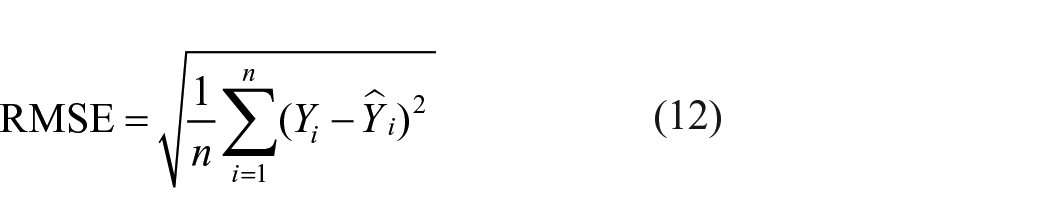

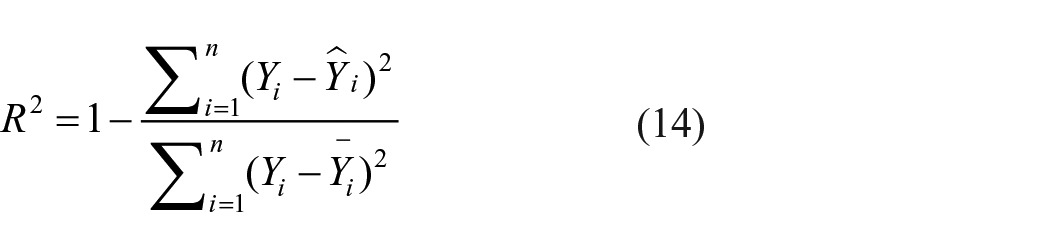
where
Results and discussion
Opinion of dairy farmers about OWM
In the present study, the respondents were asked about their opinion regarding various aspects of OWM whose results are presented in the following subheadings.
Opinion about agriculture waste management
The results given in Table A (provided in the Supplemental File) show that among eight statements regarding opinion about agricultural waste management, most of the farmers agreed with four statements and had undecided opinion regarding the rest of the four statements. The opinion statements with which the majority of respondents agreed were enhancing the nutritional value of agriculture residues can serve as excellent fodder for livestock (52.50%), crop residue burning is most economical of all the methods for their management but causes environmental pollution and diseases (85.00%), burning of crop refuse can be stopped by provision of financial aid by government in the form of subsidies and honorariums to individual farmers (83.75%) and provision of agriculture machinery for managing crop residues at village level by the government (75%). Majority of the respondents were having undecided opinion on four statements, namely, management of agricultural waste by composting (43.75%), mulching of crop residues for entailing easy management and increasing soil’s organic content (62.50%), composting of crop residue for reduction of cost of fertiliser (50.00%) and enhancing soil health and awareness among the farmers related to crop residue management can reduce the extent of burning (63.75%). The results of the study are in concurrence with Satyendra et al. (2013) in which they reported that crop residue burning was a cheap and easy method for disposing crop residues. Further, the results are in line with those reported by Yadav et al. (2017) wherein it was reported that smoke emanating from crop residue burning leads to ill-effects on public health, road safety and environment and the farmers should be educated for the same. The results are in concurrence with Roy et al. (2018) wherein they reported that farmers in Punjab, irrespective of environmental consequences of straw burning, burn the residues as they think that it is most economical to do so and clears their land early for sowing the next crop that is, wheat.
Opinion about household waste management
Table B (provided in the Supplemental File) show that among six statements on household waste management, most of the farmers agreed with five statement viz., garden sweepings and paper waste can be easily managed by composting (55.00%), the safe way to manage foods of animal origin, spoiled fruits, vegetables and grains is composting (65.00%), kitchen waste composting machine is the best way for managing kitchen waste (51.25%), food waste can be reduced by adopting well-measured and balanced cooking plan (77.50%), kitchen waste should not be littered as littering increases the menace of rodents, insects and birds which may lead to diseases (77.50%), whereas majority of the farmers (46.25%) had undecided opinion on feeding fresh vegetable and fruit peels to livestock is a good practice. The results conform with Longe et al. (2009) who reported that in Nigeria, the people are willing to pay for the household waste management and had favourable opinion towards eco-friendly ways of managing household waste. Similar results were reported by Kumar and Nandini (2013) in Bangalore where they reported that people were having favourable opinion towards daily segregation of household waste, daily collection of household waste, usage of recyclable products and eco-friendly methods of waste disposal.
Opinion about livestock waste management
From the results shown in Table C (provided in the Supplemental File), it is quite evident that among 10 opinion statements about livestock waste management, most of the farmers agreed with nine statements, namely, livestock dung contains essential elements required by the soil and should be used as a manure (60.00%), use of dung manure cut costs on fertiliser use, enhances soil health and boosts crop productivity (46.25%), dung from livestock is a resource and should not be burned in the form of dung cakes (70.00%), production of farmyard manure is the most economical method of livestock waste management (90.00%), utilisation of dung manure leads to organic way of farming which is beneficial for human health (91.25%), the health risks related with handling of livestock waste can be overcome by proper handling and composting (81.25%), use of earthworms enhances the nutrient composition of the manure; therefore vermicomposting is better than traditional composting (88.75%), biogas is a safe, easy to produce and eco-friendly form of energy (87.50%) and higher percentage of subsidies should be given on biogas plants and stoves (82.50%). The only statement for which majority of the farmers (61.25%) were having undecided opinion was incorporating kitchen waste into dung for biogas production is good for its management. The results of the study are in agreement with the following studies. Hajong (2014) opined that green manuring and vermicomposting has increased agricultural productivity. Enos (2015) reported that with the usage of manure management practices, the farmers are able to cut cost on fertiliser use. Mittal et al. (2018) opined that biogas has emerged as a promising renewable technology to convert agricultural, animal, municipal as well as industrial waste into energy and it can be used to reduce the level of greenhouse gases.
Overall opinion about OWM
As per results indicated in Table 1, majority of the farmers (78.75%) had highly favourable opinion on managing organic waste, followed by 18.75% who had favourable opinion and only 2.50% were having less favourable opinion. For small and large farmers, majority of the farmers (80.00% and 77.50% respectively) were having highly favourable opinion about OWM followed by 20% and 17.50% with favourable opinion respectively. The difference in the opinion of small and large farmers was found to be non-significant. Majority of the farmers were having highly favourable opinion about agriculture waste management practices due to fact that they were aware of the ill-effects of undesirable practices like crop residue burning. However, due to high cost of management of crop residues, they were not employing proper measures for managing them. Regarding household and dairy waste management, the farmers were having highly favourable opinion about composting and biogas production as they were pursuing the practices since a long time. Most of the farmers were found to be having undecided opinion about vermicomposting as they were not aware about the practice.
Distribution of respondents according to their opinion about OWM.
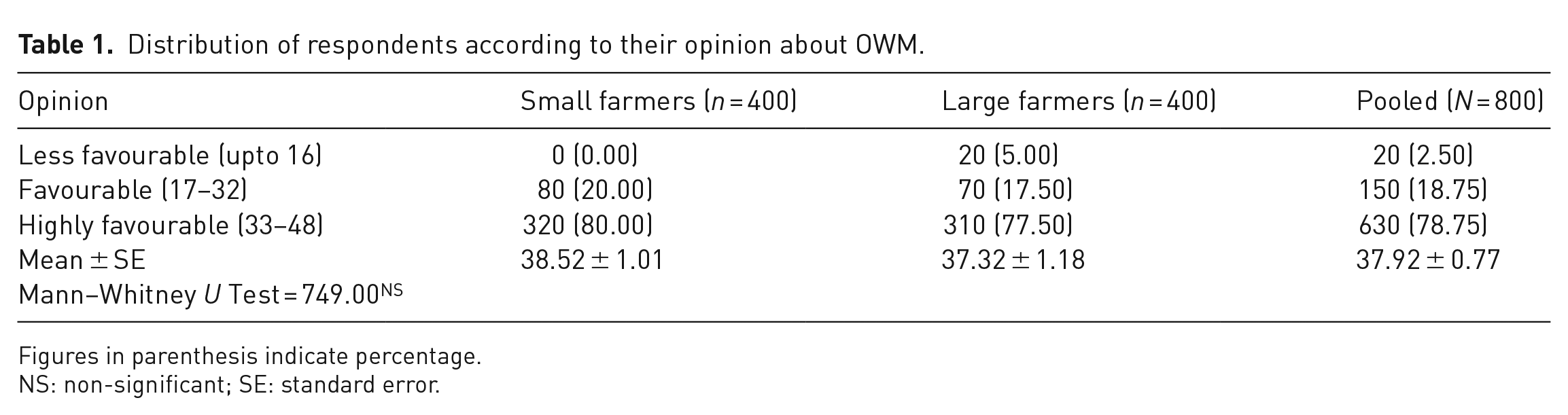
Figures in parenthesis indicate percentage.
NS: non-significant; SE: standard error.
Relational analysis between opinion on OWM and other variables
When the correlation and regression analysis was conducted between opinion on OWM and other independent variables, it was evident from Table 2 that except age and herd size, all other variables were positively associated with the opinion score. The results also revealed that among the various independent factors, education and experience in dairy farming had a highly significant effect (p < 0.01) on opinion whereas age, land holding, total income, information source utilisation and organic waste utilisation score had a significant effect (p < 0.05) on opinion of farmers regarding OWM. The results of the current study are partially in line with Mamady (2016) who reported that respondents with no education, and low income were lacking the proper knowledge regarding waste management and were less likely to adopt safety behaviour pertaining to handling of waste.
Relational analysis between opinion on OWM and other variables.
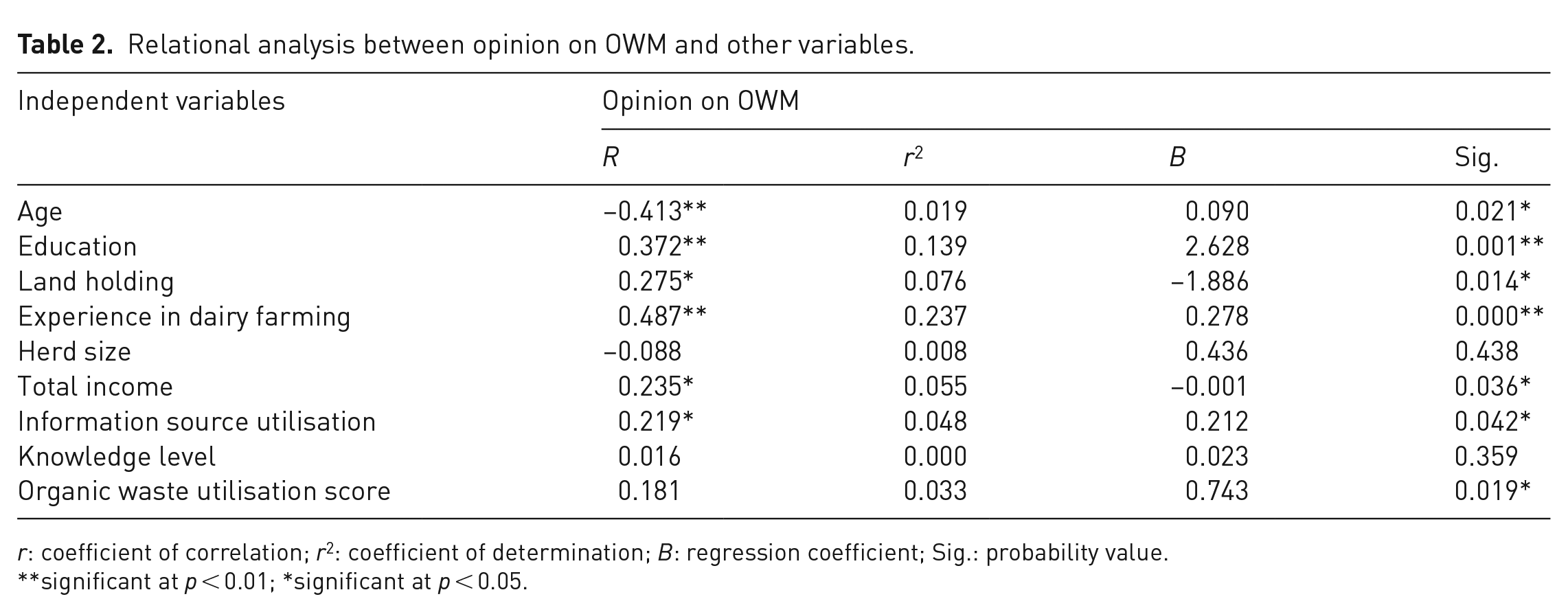
r: coefficient of correlation; r2: coefficient of determination; B: regression coefficient; Sig.: probability value.
significant at p < 0.01; *significant at p < 0.05.
Evaluation of MLP feed-forward DNN
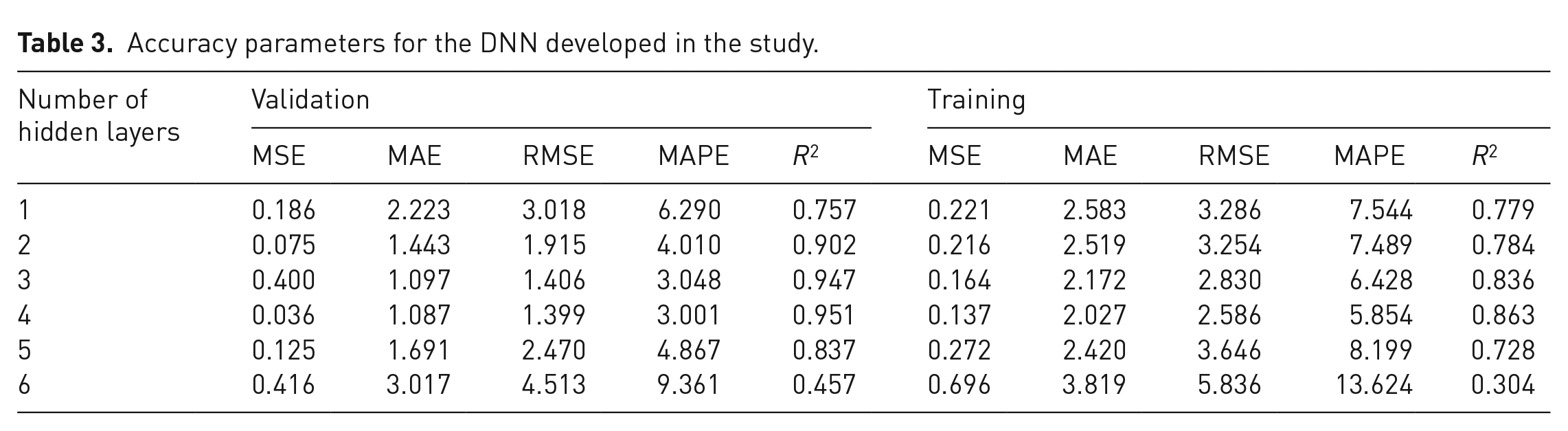
The evaluation of MLP feed-forward DNN was done through accuracy parameters viz. MSE, MAE, RMSE, MAPE and R2 for training and validation data sets. Accuracy parameters were suggestive of best fit DNN with four hidden layers. The values for MSE, MAE, RMSE, MAPE and R2 for training data set were 0.036, 1.087, 1.399, 3.001 and 0.951 respectively whereas the values for the same parameters for training data set were 0.137, 2.027, 2.586, 5.854 and 0.863 respectively for the DNN with four hidden layers (Table 3). Figure 1 was plotted for the values of R2 and MSE of various layers of neurons in DNN. The lowest MSE and highest R2 was obtained for DNN with four hidden layers, therefore, the same was selected for development and analysis of data.
Accuracy parameters for the DNN developed in the study.
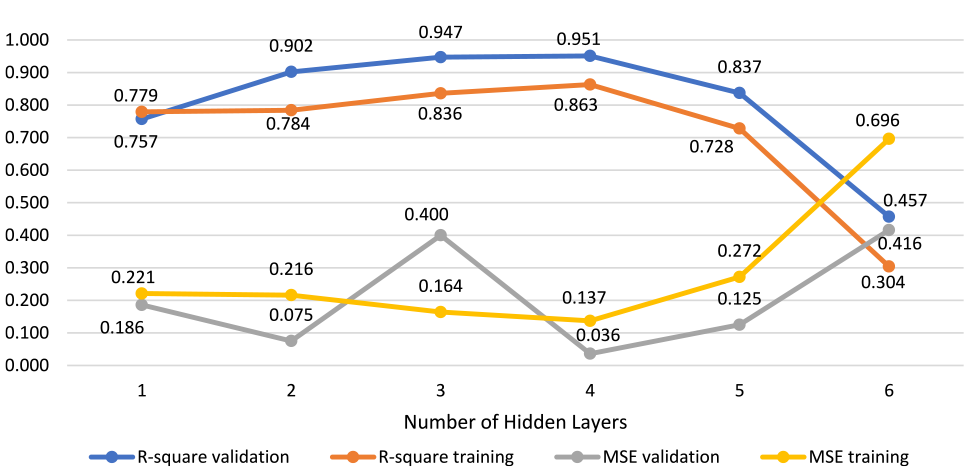
R2 and MSE of various layers of neurons in DNN.
The coefficient of determination (R2) was taken as a measure of accuracy with which the DNN predicts the outcome. For understanding the variability at every epoch, Figure A (provided in the Supplemental File) was plotted for R2. It can be seen from the figure that highest R2 is attributed to DNN with four hidden layers (depicted by number 4) which was selected for further development and opinion analysis. The architecture of four layered DNN is provided in Figure 2 with MSE as loss function. The input layer shows the input variables which are basically independent variables, upon analysis provide us with opinion of the farmers.
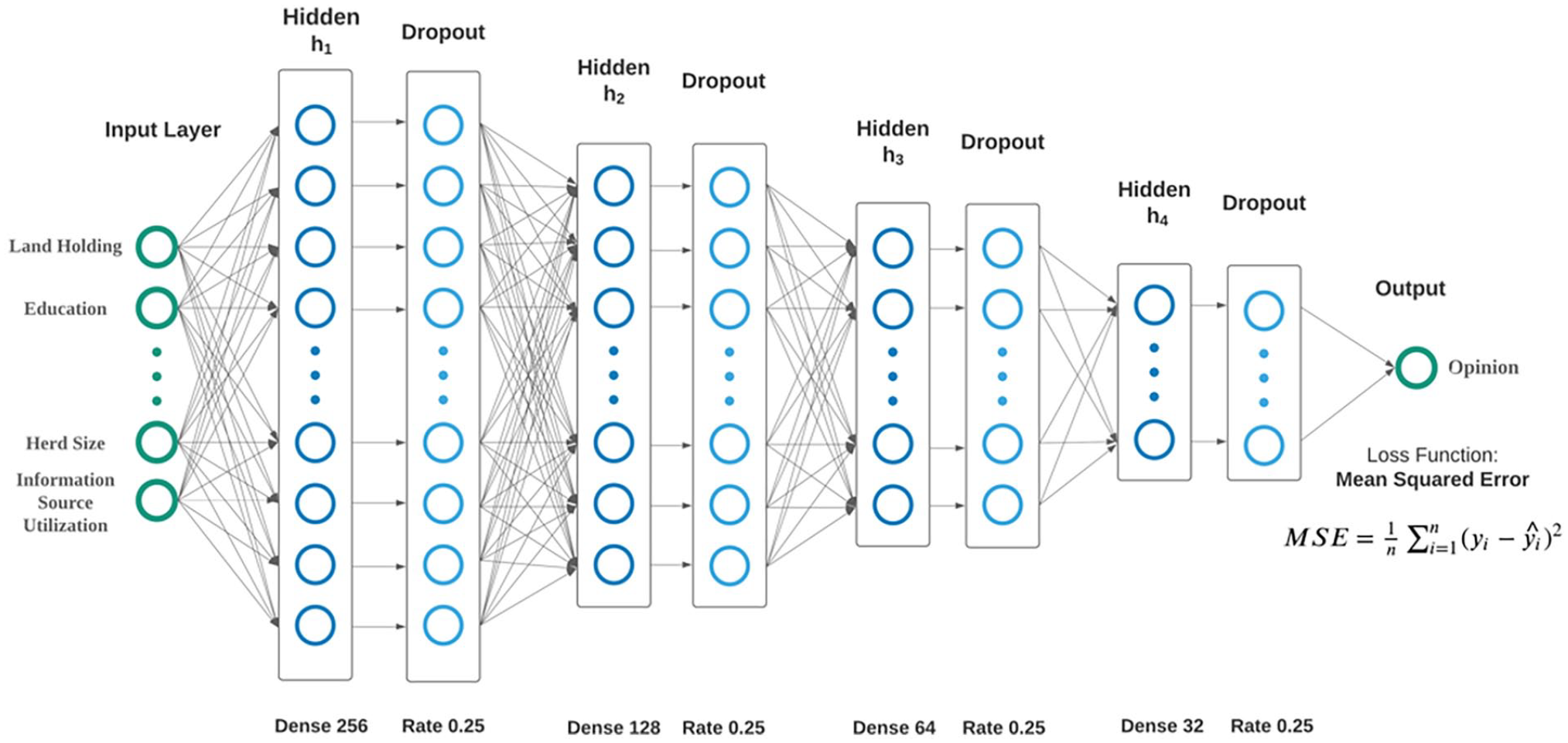
Architecture of the MLP feed-forward DNN with four hidden layers for predicting the opinion of farmers regarding sustainable management of organic waste.
While consulting the literature on development of neural networks, it was seen that much of the literature has been available on prediction of waste generation, but when it comes to behavioural analysis be it opinion mining or sentiment analysis or modelling of factors responsible for waste generation, very scant literature is available. Coskuner et al. (2021) developed MLP-ANN based models for prediction of municipal solid waste in which R2 and MSE were taken as measures of accuracy. The models exhibited substantial accuracy in prediction with high R2 and low MSE which is in accordance with the results of the current study. Similar results regarding prediction of solid waste generation were reported by Shahabi et al. (2012), Abbasi and El Hanandeh (2016), Azarmi et al. (2018), Soni et al. (2019), Lin et al. (2022) and Jassim et al. (2023).
The substantial evidence regarding prediction of human behaviour using DL is provided by Hartford et al. (2016) in which layers and units were introduced for reaching the output through construction of matrices. Similarly, in the context of present study the hidden layers were created to train the model to the best of its abilities for prediction of opinion. Stuart and Majewski (2015), however provided an evidence of opinion mining and sentiment analysis using conceptual model of natural language processing which is another application of AI not in concordance with the present study. Almeida and Azkune (2018) developed a similar kind of model developed in present study in which recurrent neural network was constructed for analysing the semantics, namely, actions, activities and activity behaviours which was a conceptual model based on DL approach.
However, a lot of research has been focused on prediction of consumer opinion using DL for marketing intelligence which include consumer preference for certain free marketing goods. To cite a few, Hajek et al. (2020) developed a DL model for identification of fake reviews in which emotion mining was practiced. Chaudhuri et al. (2021) constructed a DL model in which analysis of consumer purchasing behaviour was done. Norinder and Norinder (2022) developed a DL model for ascertaining the consumer behaviour using test set sentiment estimates for Amazon product reviews. Olmedilla et al. (2022) in a similar kind of study developed a DL model for helpfulness of online reviews, Oh et al. (2022) developed a model for customer satisfaction in hospitality industry, Balakrishnan et al. (2022) for prediction of products’ sentiment ratings and Mensouri et al. (2023) for customer review analysis.
Gains in opinion regarding sustainable OWM after fixed increase in independent variables
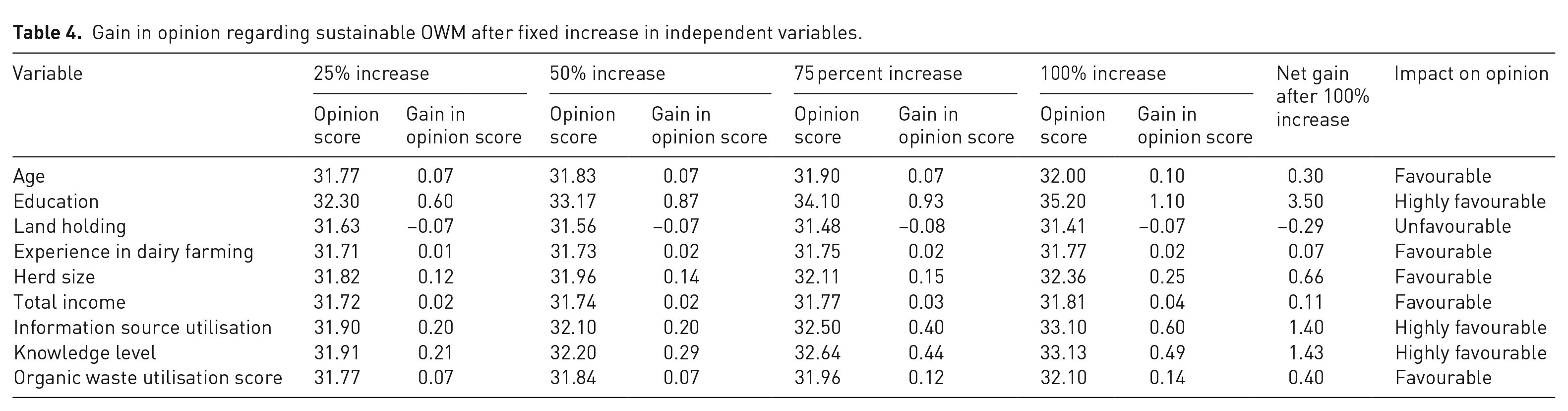
The developed DNN was used to predict the gain the opinion from fixed gain in the independent variables. From Table 4, it is clear that except land holding, fixed increase in all other independent variables had favourable effect on the gain in opinion regarding sustainable OWM among the respondents. Among the various independent variables some variables, namely, education, information source utilisation and knowledge level had highly favourable effect on the gain in opinion whereas age, experience in dairy farming, herd size, total income and organic waste utilization score showed favourable effect. It is evident from Table 4 that to stop the burning crop residues and for sustainable management of organic waste, the scientists and the policy makers have to work and give major thrust on improving the education, information source utilization and knowledge level of the farmers. Education may be increased by increasing the literacy rate of the farmers by establishment of night schools, working groups, literacy camps, field days, mobile schools, etc.; information source utilisation can be improved by need-based tools in vernacular languages and knowledge level can be increased by providing them hands-on trainings, organizing awareness campaigns, etc. for sustainable management of organic waste. Furthermore, Figure B (provided in Supplemental File) signifies that all the independent variables must be raised from 75% to 100% above their present level for obtaining highly favourable opinion of the farmers except land holding. Hence, maximum gain in opinion can be obtained if the independent variables are increased by 75%–100% with major emphasis on education, information source utilization and knowledge level of the farmers.
Gain in opinion regarding sustainable OWM after fixed increase in independent variables.
The gain in opinion due to change in independent variables was added to calculate overall gain in opinion of the dairy farmers towards sustainable utilization of organic waste. The threshold score of 2 was kept for favourable opinion and Figure C (provided in the Supplemental File) suggests that the threshold value of opinion can be reached once there is 75% increase in the current value of independent variables. At 100% increase, the opinion will become more favourable and attain a value of 2.67. Further, Figure 3 was plotted to see how opinion varies with 100% increase in independent variables independently. It is evident from Figure 3 that maximum increase in opinion towards sustainable management of organic waste is attributed to 100% increase in education, information source utilisation and knowledge. Whereas with an increase in land holding, the opinion level is reducing or becoming unfavourable.
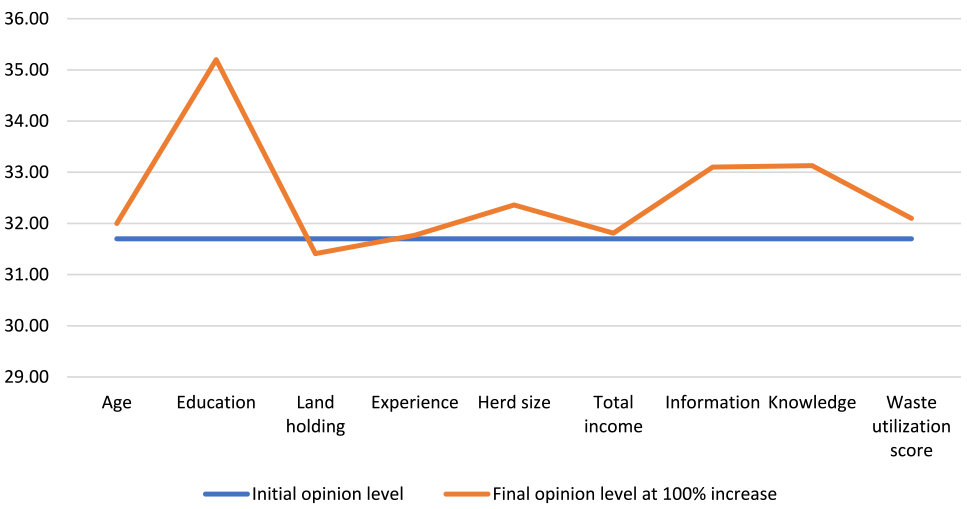
Change in the opinion of farmers after 100% increase in independent variables.
Conclusion
The present study is novel in a way that it is a fusion of behavioural sciences in which farmers’ perspectives are documented through opinion mining along with making predictions for the same using the application of AI, that is, DNN. Opinion reflects the outlook and the forward-looking perspective of the farmers which were predicted using DNN. From the above analysis, it can be concluded that significant increase of about 75% to 100% is specifically required in education, information source utilisation and knowledge regarding OWM among farmers along with other independent variables like waste utilisation, income, herd size and experience. Specific policies can be made for sustainable utilisation of organic waste which may include, providing land-based and livestock-based incentives, organising massive campaigns during the seasons when crop residues are generated, installation of eco-friendly plants and boilers for conversion of waste to energy, conversion of biomass into biofuel, providing agricultural machinery at local or cooperative level for management of waste, etc. at national level. At individual level, the farmers should be provided with formal education and hands-on training integrated with technological solutions and other sustainable alternatives for crop residue management. New need-based and user-friendly digital information sources can be developed and popularised among the farmers which may act as information and training tools to provide credible information to the farmers in an effective way. Though, there is need to check the accessibility and feasibility of such technologies in rural or resource-constrained areas. Knowledge regarding waste management techniques must be imparted which will aid in preventing the crop residue burning and press them for sustainable management of organic waste. Moreover, the applications of AI like neural networks can be used for behavioural analysis and this study is one of the very first of its kind in case of livestock and allied sciences.
Supplemental Material
sj-docx-1-wmr-10.1177_0734242X231219627 – Supplemental material for Predicting opinion using deep learning: From burning to sustainable management of organic waste in Indian State of Punjab
Supplemental material, sj-docx-1-wmr-10.1177_0734242X231219627 for Predicting opinion using deep learning: From burning to sustainable management of organic waste in Indian State of Punjab by Amandeep Singh, Rupasi Tiwari, Pardeep Singh Nagra, Pratikshya Panda, Gurpreet Kour, Bilawal Singh, Pranav Kumar and Triveni Dutt in Waste Management & Research
Footnotes
Acknowledgements
The financial help in the form of fellowship provided to the corresponding author by the ICAR-Indian Veterinary Research Institute, Izatnagar during the course of this study is highly acknowledged.
Declaration of conflicting interests
The authors declared no potential conflicts of interest with respect to the research, authorship, and/or publication of this article.
Funding
The authors received no financial support for the research, authorship, and/or publication of this article.
Supplemental material
Supplemental material for this article is available online.

References
Supplementary Material
Please find the following supplemental material available below.
For Open Access articles published under a Creative Commons License, all supplemental material carries the same license as the article it is associated with.
For non-Open Access articles published, all supplemental material carries a non-exclusive license, and permission requests for re-use of supplemental material or any part of supplemental material shall be sent directly to the copyright owner as specified in the copyright notice associated with the article.
