




Abstract
We are currently experiencing a critical period for the prevention and control of the COVID-19 pandemic. COVID-19 related waste is a threat to global public environmental health. Medical waste management during this pandemic is one of the major issues facing public service organizations such as municipalities, which is of great importance in terms of logistics, environment and social aspects. The discussion of logistics operations is related to the collection, transportation and disposal of waste, which imposes high expenses. Many methods have been applied to develop and improve waste management policies in the literature. Apart from these studies, very few researchers have improved vehicle operations in waste management considering environmental aspects and the possibility of outsourcing. In this paper, by examining the gaps in the field, we try to explain and formulate the sustainable medical waste management problem for pandemics. Finally, by designing several practical examples with different scales, we solve the problem using CPLEX solver, compare different conditions and discuss the practical implications using the sensitivity analysis of demand parameter.
Introduction
Waste materials should be disposed of in a suitable place after production in accordance with hygienic conditions and observance of hygienic points during the operational steps in the fastest possible time for collection, transportation and disposal processes. The recent pandemic arising from the outbreak of COVID-19 has increased the demand for establishing a timely and efficient waste management system. Pandemics boost the generation rate of infectious medical waste at hospitals and clinics. Designing an efficient and reliable collection, transportation and disposal system in this situation can help to provide on-time services and control the disease.
In the literature, there are various vehicle routing problems (VRPs) and transportation planning problems related to waste collection. Waste management is a costly task as it requires the collection, transportation and, finally, disposal of waste material. Moreover, the pandemic has increased the necessity for an efficient medical waste management (MWM) system more than ever. For these reasons, organizations such as municipalities, particularly in major cities, may have to outsource these processes (i.e. collection, transportation and disposal) to fulfil a timely service in all or some of their districts. The important question is, however, whether outsourcing really can help reduce costs during a pandemic, or whether outsourcing should be considered in all districts rather than a subset of them as far as the cost-effectiveness is concerned.
In addition, better transportation planning for MWM is essential for protecting the environment from the pollution caused by greenhouse gas emissions. The aim is to produce the least amount of pollution during the collection and transportation of waste from the collection site to the disposal centres. Certainly, municipalities should pay special attention to this factor as one of the main requirements while selecting contractors. Finally, the particular risks of transporting medical waste during pandemics should not be neglected. Since the medical waste may be infectious or hazardous, the risk imposed by the collection, transportation and disposal should be tackled with utmost care.
The dimension of the problem defined in this study can vary according to the size of the cities. In fact, in densely populated cities, different areas of the city are classified and MWM of each area is specific to the municipality and relevant organizations. In small and sparsely populated cities, this responsibility is usually delegated to the municipality or a single relevant department. Municipalities and municipal service organizations take on the task of waste management using transportation planning. One of the problems facing these organizations is controlling costs and providing a timely service, which has led municipalities to outsource some of their activities.
Therefore, in this study, we develop a bi-objective mixed-integer linear programming (MILP) model to solve the problem of transportation planning and outsourcing of MWM services during pandemics and with a sustainability viewpoint, which is basically defined as a capacitated vehicle routing problem (CVRP). In fact, due to the demand (amount of waste collected) in the hospitals, each of which is defined in specific regions of the city, the model is to concurrently reduce costs, and take into account the reduction of environmental pollution and risk exposure during the processes of collection, transportation and disposal. Finally, the best management policy and decision aids can be made under various operational conditions.
The organization of the remainder of the article is as follows. The next section reviews the most relevant studies and highlights the main novelties. This is followed by a definition of the main problem and presentation of the proposed MILP model. Experimental results are then provided, and finally, the concluding remarks and outlook of the study.
Related work
We review the related literature under two groups. The first part covers the studies related to the solid waste management in general. The second part comprises studies that focus on MWM in particular.
For the first group, Beltrami and Bodin (1974) addressed the issue of waste collection as a classic VRP for the municipalities of New York and Washington considering a variety of vehicles (e.g. trucks, tugboats, mechanical sweepers), improving Clark and Wright’s heuristic algorithm in determining the optimal routes (1964). Tung and Pinnoi (2000) investigated a waste collection VRP by studying its operational techniques in Hanoi, Vietnam. They formulated the problem as a MILP model. Aringhieri et al. (2004) studied the waste collection VRP for collection and disposal of recyclable waste such as paper, metal and wood. Kim et al. (2006) tackled the multi-trip vehicle routing problem with time windows (VRPTW) for municipal waste collection considering the rest programmes for drivers. Their goal was to minimize the number of vehicles required and the total travel time so that all demands could be met. Hemmelmayr et al. (2009) suggested some meta-heuristic algorithms to deal with the problem of waste collection. Buhrkal et al. (2012) investigated the VRPTW related to municipal waste collection and worked on how to collect and transport waste efficiently so that the optimal travelling costs were achieved for vehicles. Kulcar (1996) illustrated how waste transportation costs could be minimized in a major urban area, namely, Brussels, using a model that accommodated several means of transportation including by vehicle, rail and canal. Son and Louati (2016) proposed a generalized multi-objective vehicle routing model including multiple transfer stations, gather sites and inhomogeneous vehicles, with a case study in the city of Da Nang, Vietnam. Das and Bhattacharyya (2015) proposed an optimal municipal solid waste (MSW) collection and transportation model that aimed to minimize the length of each waste collection and transportation route using a mixed-integer program, as well as a heuristic solution algorithm. Their model was able to shorten the waste collection route length by more than 30%, as authors claimed. Karadimas et al. (2007) used the Ant Colony System (ACS) algorithm as a heuristic method to identify optimal routes in the case of MSW collection with an application to the city of Athens, Greece. Or and Curi (1993) used a mixed integer programming model with a view to minimizing the total solid waste collection and transportation costs by considering various transfer site, disposal site, fleet size and transportation options.
Furthermore, Angelelli and Speranza (2002) proposed a model for the estimation of the operational costs in three different waste collection systems and, using two case studies, showed the criticality of operational costs in decision making for waste collection. Nuortio et al. (2006) focused on the optimization of vehicle routes and schedules in MSW collection using a meta-heuristic (called ‘guided variable neighbourhood thresholding’) with an application to eastern Finland and reported significant cost reductions. Moon et al. (2012) extended the concept of VRPTW to the VRPTW with overtime and outsourcing vehicles (or VRPTWOV), which incorporated overtime for drivers and the possibility of outsourcing vehicles. In particular, they developed a mixed integer programming model, a genetic algorithm (GA) and a hybrid algorithm based on simulated annealing and demonstrated their efficiency. Tirkolaee et al. (2019a) proposed a novel robust bi-objective multi-trip periodic capacitated arc routing problem (CARP) for the urban waste collection problem which featured demand uncertainty. They developed a multi-objective invasive weed optimization algorithm to adapt the model to large problems. An improved simulated annealing (SA) algorithm was proposed by Tirkolaee et al. (2019b) to tackle the multi-trip VRPTW in urban waste collection. In a separate work, Goli et al. (2019) incorporated the outsourcing option into a machine scheduling problem using a Robust Mixed-Integer Linear Programming (RMILP) model. Ruiz et al. (2004) presented a new two-stage exact approach for solving a real VRP with outsourcing option. In the first stage, they generated all the feasible routes by means of an implicit enumeration algorithm and, in the second stage, an integer programming model is used to identify the optimum routes. Moustafa et al. (2013) solved a large-scale VRP with time windows (VRPTW) for waste collection in Alexandria, Egypt.
For the second group, Alumur and Kara (2007) addressed the issue of hazardous waste routing as a location-routing problem (LRP) and investigated it in a region of Turkey. The objectives were to concurrently minimize the total cost (locational costs of facilities and transportation costs) and minimize the risk of transporting harmful and hazardous waste. Shi et al. (2009) again proposed a MILP model with the objective of minimizing costs related to medical waste reverse logistics. An improved GA method featuring a hybrid encoding rule was employed to solve the proposed model. Wu et al. (2020) introduced a green vehicle routing problem (PCGVRP) model with a particular focus on medical waste collection. The optimal solution was reached by a local search hybrid algorithm (LSHA) which included an initial optimal solution based on particle swarm optimization (PSO) and a final optimal solution through a local search on the initial optimal solution that was optimized through an SA algorithm. Shi (2009) applied reverse logistics principles to improve the MWM system by presenting a MILP model of reverse logistics networks. Shi et al. (2017) considered VRPs with stochastic demands and travel times along with a pure GA for the solution. The model was claimed to provide significant solutions to a real-life MWM problem. Kargar et al. (2020) developed a multi-objective linear programming model to minimize the total costs, the risk related to the transfer and handling of infectious medical waste (IMW), and the maximum amount of uncollected medical waste. They employed a revised version of multi-choice goal programming to solve the model, with a case study from Iran. Mantzaras and Voudrias (2017) aimed to develop an optimization model to minimize the cost of a system for the collection, transportation, handling and disposal of IMW and employed GA and Monte Carlo simulation to approach the problem. Shih and Lin (2003) extended the previous single-criterion routing and scheduling approaches on IMW management by considering a multiple-criteria optimization approach. They integrated three criteria by employing a compromise programming method as part of the decision analysis and employed dynamic programming and integer linear programming for modelling the problem. Yu et al. (2020) introduced a multi-objective multi-period mixed integer program for reverse logistics network design for epidemics, with an application on Wuhan, China, as the primary COVID-19 epicentre. The study sought to determine the best locations for temporary facilities and the transportation strategies for effective management of medical waste within a considerably short time frame. Ahlaqqach et al. (2019) proposed a model for the management of medical waste collectors, with an application to Casablanca, Morocco. The complexity of the multi-objective model, as part of a heterogeneous fleet VRP, was managed through a Ruin and Recreate heuristic. Alshraideh and Qdais (2016) suggested a route scheduling model to minimize the total travel distance between hospitals and medical waste treatment facilities. Chen et al. (2020) proposed a VRP of contactless joint distribution service during the COVID-19 outbreak. They designed a hybrid meta-heuristic algorithm to tackle the problem using several numerical simulation cases. A fuzzy inventory-routing problem (IRP) was introduced by Göçmen (2020) to manage the distribution of personal protective equipment (PPE) during the COVID-19 pandemic. They applied Jimenez’s method and clustering heuristic techniques to evaluate the performance of their model using a real case study problem in Turkey. Recently, Tirkolaee et al. (2021) developed a novel multi-objective MILP model to formulate a sustainable LRP for MWM during the COVID-19 pandemic. They employed the weighted goal programming (WGP) methods to investigate the applicability of the proposed model on a real case study in Iran.
Problem description
The proposed problem of the study is based on the CVRP considering the capacity limitation of vehicles as the main limitation. However, real-world assumptions are incorporated into the problem to make it relevant to the MWM during pandemics. Consider a graph network representing an urban area, defined as G(N, A), with N representing the number of nodes (demand, parking and disposal nodes) and A as the set of arcs defining the connections between network nodes (hospitals). In each defined urban network, there are several regions, which include the nodes of demand for waste collection. These nodes show the hospitals or clinics where the amount of produced waste is considered as a demand parameter. Moreover, in order to collect waste in different regions, the possibility of servicing will be done directly by the municipality itself or indirectly by contractors. The 1st objective is to minimize the total cost with respect to the travelling costs, vehicles usage costs, outsourcing costs and pollution costs. The 2nd objective is to minimize the number of people who are exposed to the risk of infection as the total risk exposure value.
Among the most important assumptions of the model are the following:
– Each hospital is served by only one vehicle.
– Vehicles are available in the organization. These collection vehicles have different capacities.
– Each specific region can be serviced by the municipality or a contractor.
– The number of available contractors is known and each has its own cost according to the amount of services and facilities available.
– After collecting waste at hospitals, vehicles empty the waste on the disposal site.
– Each vehicle has a maximum service time.
– The distance between two nodes in the network is considered as Euclidean distance.
– The time and cost of travelling a route are the same for all vehicles.
– Environmental pollution is caused by the transportation of vehicles.
– Risk exposure is caused by the collection, transportation and disposal of waste.
– Vehicles start their trip from a parking node and after collecting waste and completing the capacity, they move to the disposal site which is represented by node ‘1’.
– All demand nodes must be covered at all costs.
Now, the proposed mathematical model is given as follows:
Indices and sets
Parameters
Variables
Mathematical model













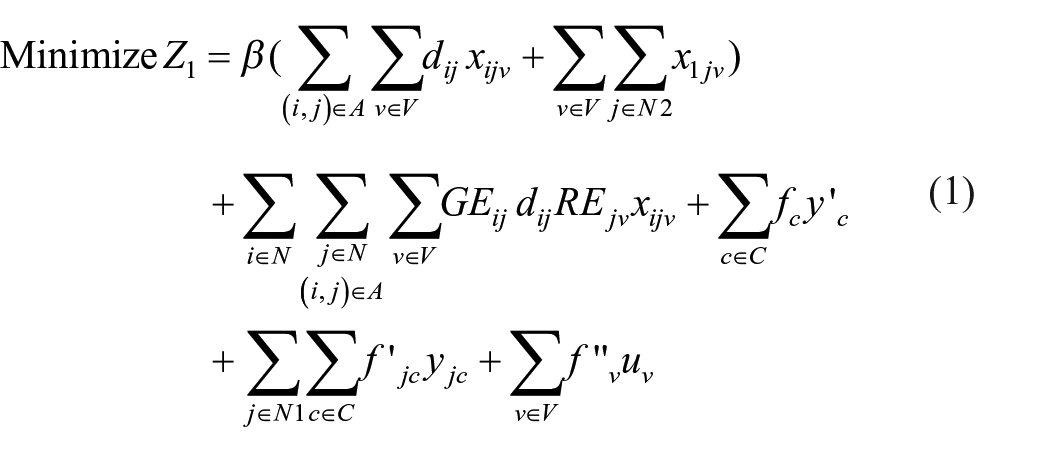
The 1st objective of the problem (1) is to minimize the total cost imposed on the relevant organization, including travelling costs, pollution emission costs, fixed and variable outsourcing costs and usage costs of vehicles. The 2nd objective of the problem (2) is to minimize the total risk exposure imposed by the collection, transportation and disposal of the waste during pandemics. It tries to minimize the number of people exposed to infection by the waste.
Constraint (3) provides the balance of input and output flows. In other words, if a vehicle enters a node, then it should exit that node too. Constraint (4) guarantees that all demand nodes are served by the municipality or contractors. Constraint (5) states that a vehicle can be used when needed. In fact, this constraint makes the routing variable (
Linearization
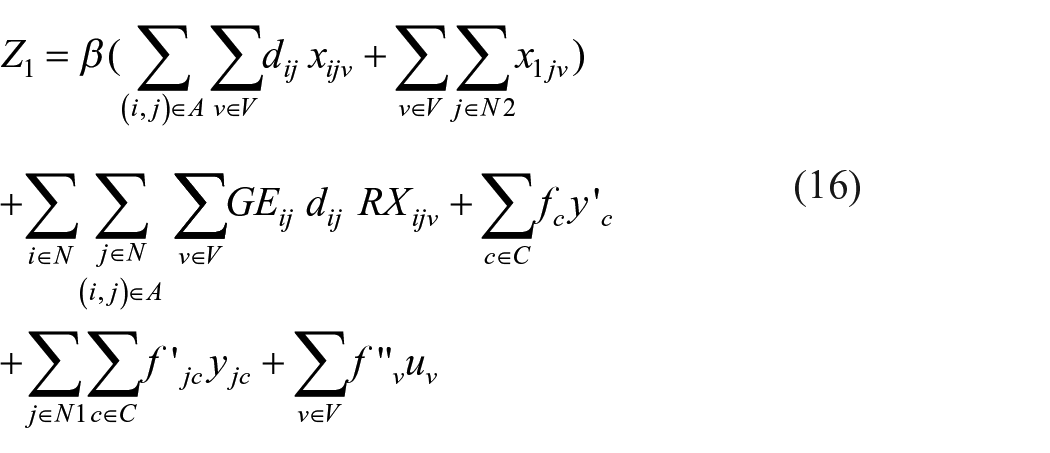
The model proposed in the previous section is a non-linear programming (NLP) model since a continuous variable (
The following formulas help us linearize equations (1), (2) and (11)







Similarly, the following formulas are used to linearize equations (6) to (8)








Now, equations (1), (2) and (11) are replaced with equations (16) to (22), and equations (6) to (8) are replaced with equations (24) to (30) and to provide a linear model.
Meta-goal programming approach
Goal Programming (GP) is known as one of the efficient tools to solve multi-objective problems (Charnes and Cooper, 1957; Tirkolaee et al., 2020, 2021). According to this method, a set of potential decisions and criteria are taken into account to attain several concurrent goals. In other words, a desire level is set by decision-maker(s) for each objective function to deal with the multi-objectiveness. This method tries to minimize the total deviation from these desire levels. Here, an extension of the GP, namely, Meta-Goal Programming (MGP) is applied to our proposed bi-objective mathematical model which was first introduced by Urı́a et al. (2002). Similarly, this technique transforms the bi-objective model into a single-objective one by considering the sum of deviations (total deviation) and maximum deviation at the same time. In MGP, a preference weight is defined by decision-maker(s) as well as a goal for each objective function. Moreover, positive and the negative deviations from goals are calculated for objective functions, and then, deviations from the weights are determined. Therefore, the total deviation, maximum deviations from goals and the number of unattained goals are minimized.
The following formulas define the structure of the MGP model:

subject to












Here,
Now, the final single-objective MILP model is given as follows

subject to: equations (3) to (5), equations (9) and (10), equations (12) to (14), equations (16) to (22), equations (24) to (30) and equations (32) to (43).
Results
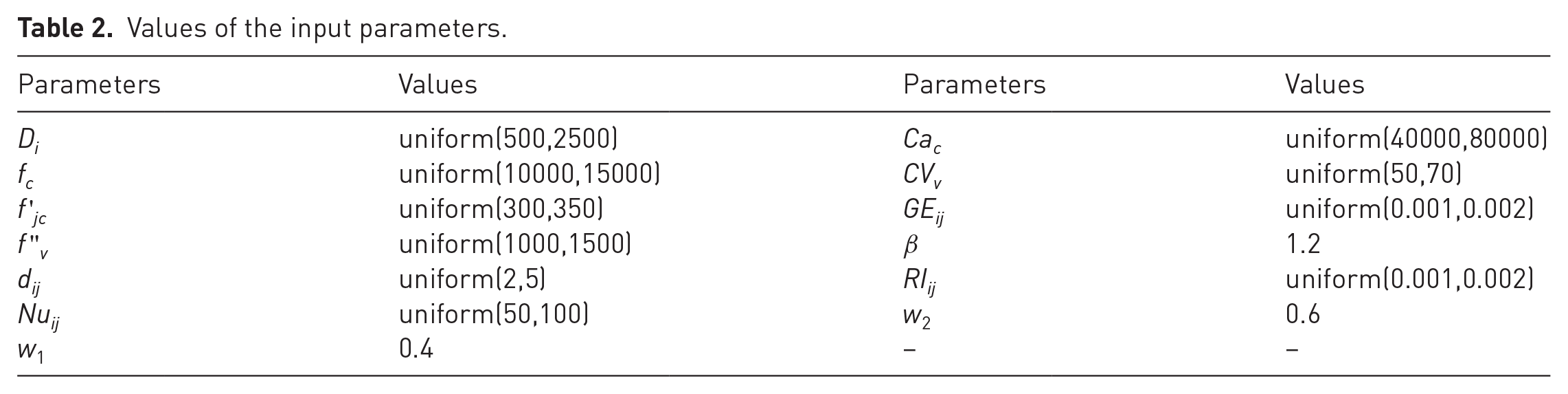
To validate the proposed mathematical model, we generate random samples of data in small, medium and large dimensions. This is partly due to the poor accessibility of real data related to transportation of medical waste, particularly under the pandemic conditions. The parameters are also assigned random values coming from uniform distribution. The model is then run on a laptop with Intel Core i7 specifications (12 GB RAM) using GAMS/CPLEX solver. It should be noted that a run time limitation of 3600 seconds is applied to test the efficiency of the proposed methodology. Tables 1 and 2 represent the information of examples and parameters, respectively.
Information about the randomly generated problems.
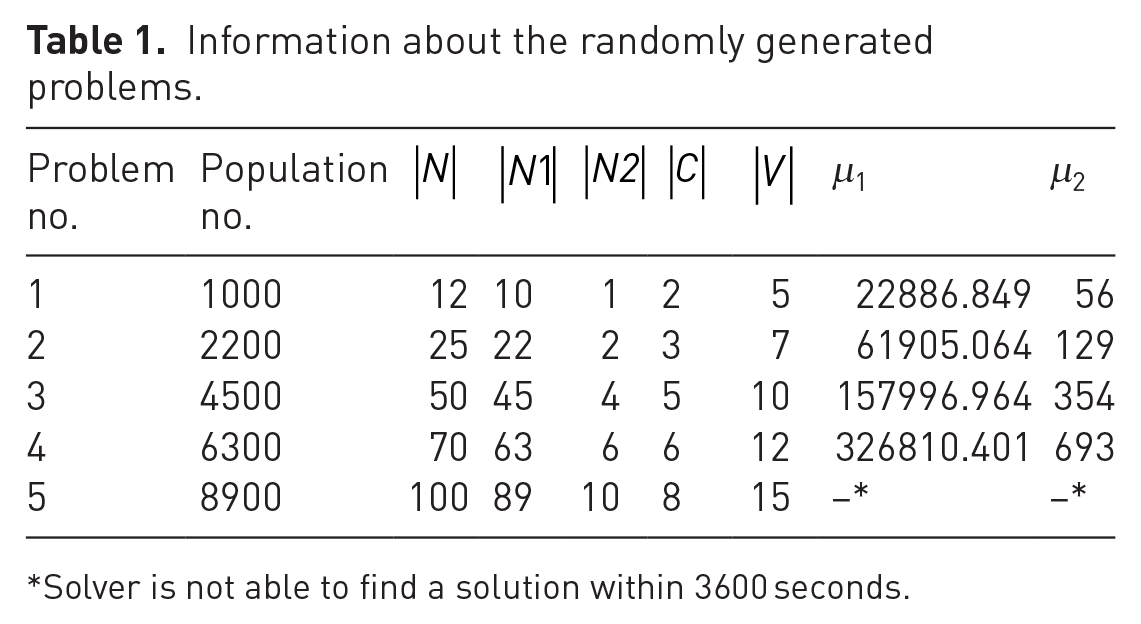
Solver is not able to find a solution within 3600 seconds.
Values of the input parameters.
In fact, these examples are designed with respect to the real-world situation. For this purpose, it is assumed that for each demand node, a population of 100 people is considered. The justification for this can be attributed to considering an alley or street where 100 people live in buildings. Therefore, in Table 1, a population of 100 people is regarded for each demand node such that each example is designed for a city.
In Table 1, the first and second columns show the number of examples and the considered urban population, the third column displays the total number of network nodes, the fourth column indicates the total number of demand nodes. The fifth, sixth and seventh columns represent the total number of parking sites, the total number of potential contractors and the total number of vehicles available to the municipality, respectively.
According to Table 2, the required parameters for this problem were randomly generated using a uniform distribution at appropriate intervals. Furthermore, the values of
Computational results
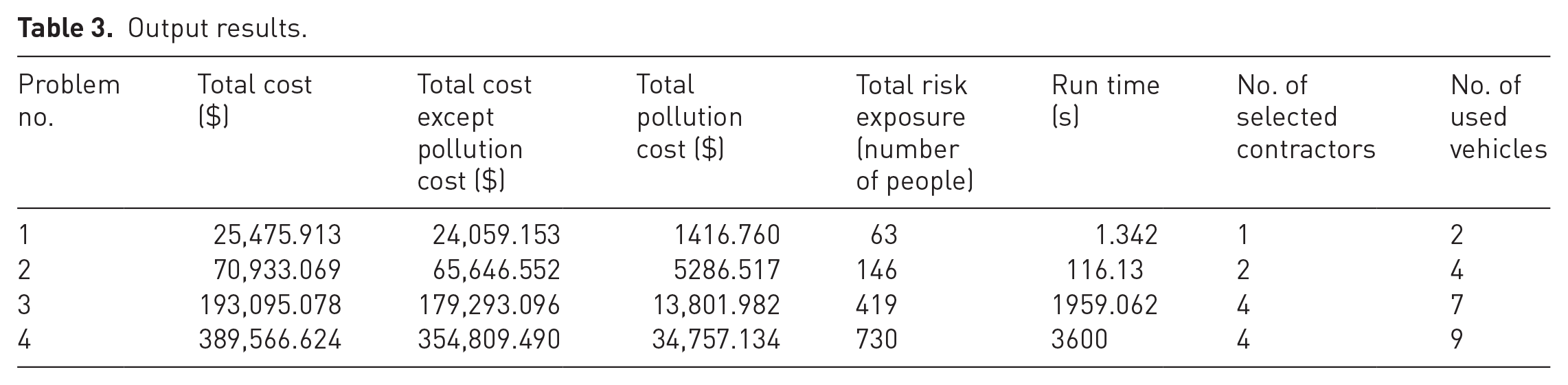
After executing different examples, the output results for the values of the total cost, pollution cost, travelling cost, run time, number of contractors selected and number of vehicles used in the municipality are reported in Table 3. As shown in Table 3, for increasing urban population and problem dimensions, the values of the variables increase. The rate of increase in the variables is presented in Table 4.
Output results.
Comparison results between different problems.
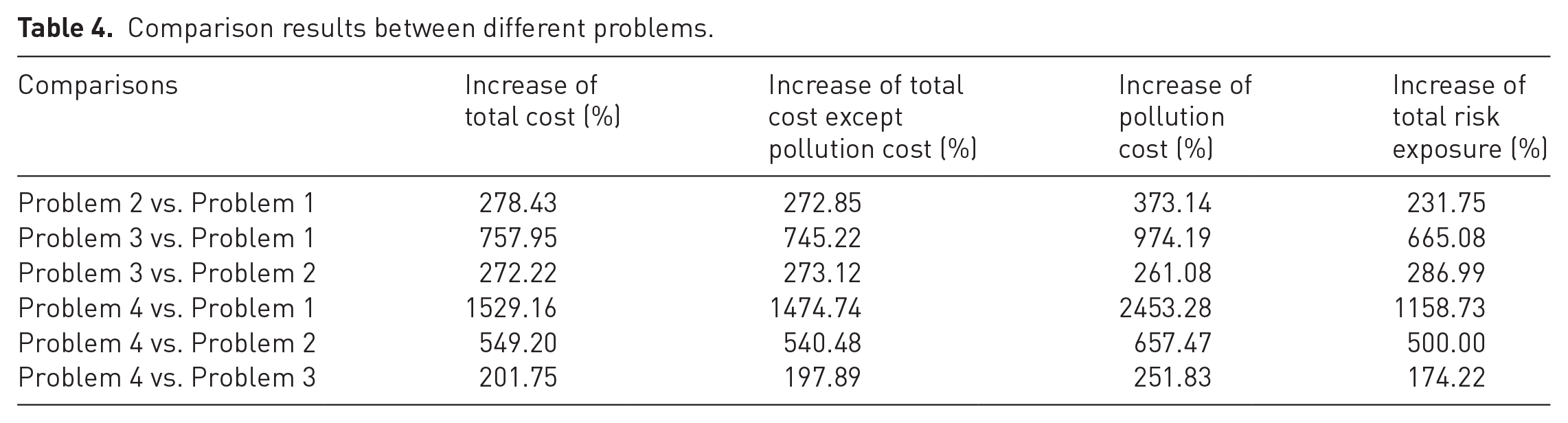
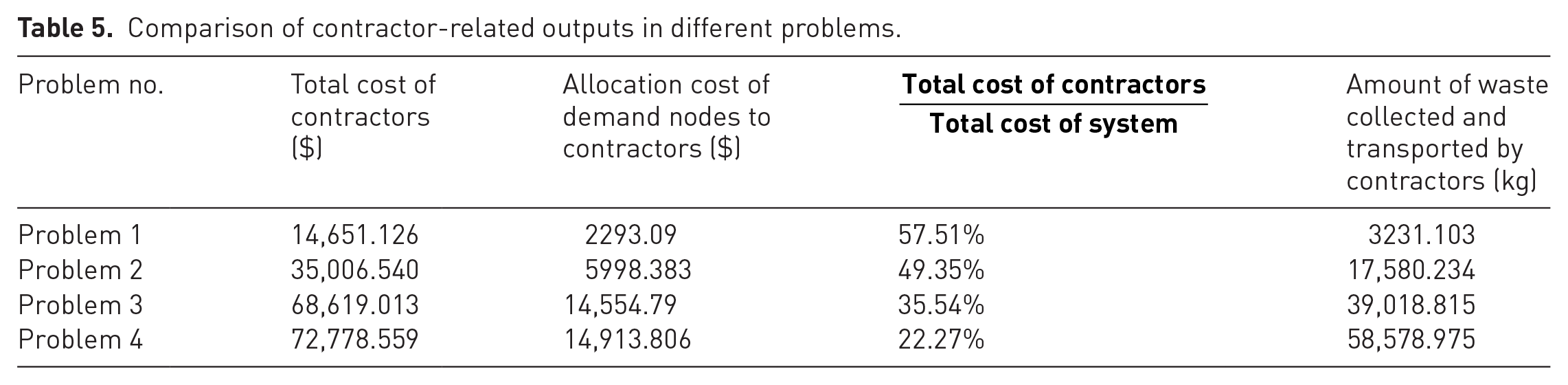
As shown in Table 4, the extent to which the objective functions increase in relation to each other is specified. The effect of population growth on total cost and pollution cost is different. On the other hand, based on the costs associated with the contractors, we can also make comparisons, to determine what part of the total cost is related to the contractors and how much is the proportion of contractors’ total cost to the system’s total cost. These comparisons are performed in Table 5.
Comparison of contractor-related outputs in different problems.
To better understand the results, the output of the solution of Problem 1 is schematically described in Figure 1.
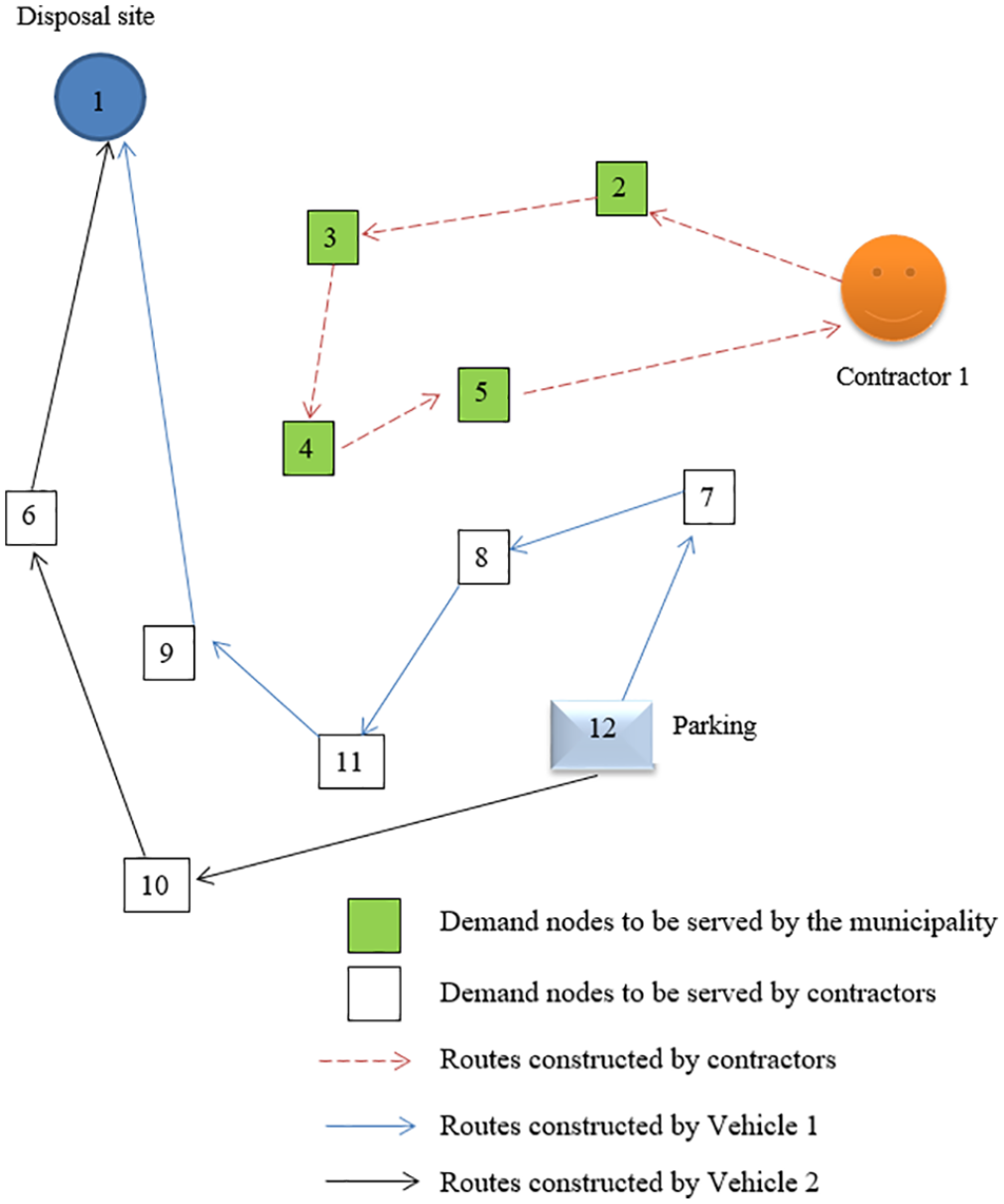
Schematic view of the solution of Problem 1.
According to Figure 1, 12 nodes are defined in the network, node 1 shows the disposal site and node 12 displays the parking site. The other 10 nodes also represent the demand nodes. As can be seen, it is determined that one contractor should be selected for the contract and planning for waste collection at various demand nodes in the city. The number of selected demand nodes is four, to be served by the contractor. Furthermore, the remaining six demand points must be serviced by the municipality itself, which includes the use of two vehicles. The servicing of the demand nodes 7, 8, 9 and 11 is fulfilled by Vehicle 1, and the servicing of the demand nodes 6 and 10 is done by Vehicle 2.
Figure 2 illustrates the trend of run time values for different examples. Accordingly, the run time value increases significantly with the increase of problem dimension, which is due to the high complexity of the problem.
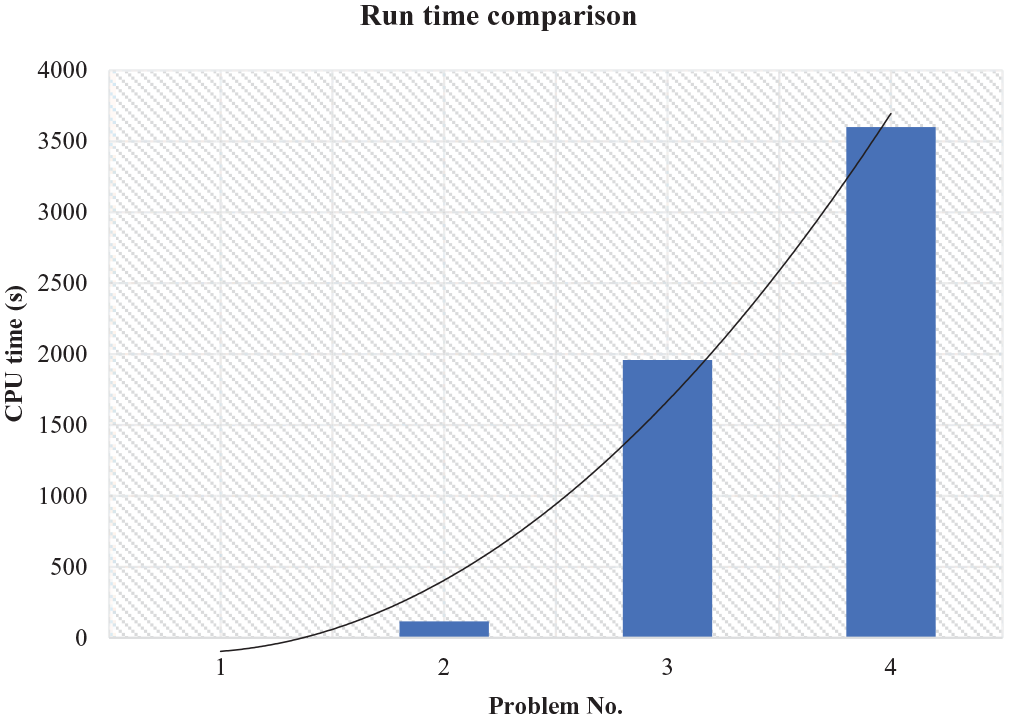
Run time comparison of different problems.
Sensitivity analysis
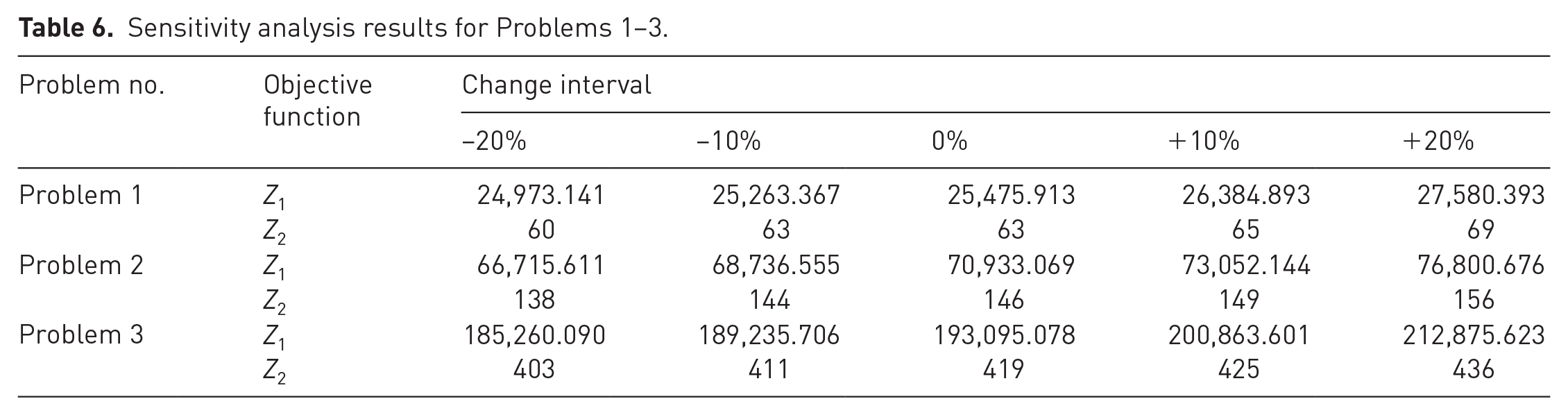
In this section, the behaviours of the objective functions are evaluated against the potential changes of the most important parameter; that is, demand. To this end, a sensitivity analysis is conducted considering the change intervals of −20%, −10%, +10% and +20%. Our model is implemented for each change interval of demand parameter and then the obtained results including the optimal values of the objective functions are reported in Table 6 and Figure 3.
Sensitivity analysis results for Problems 1–3.
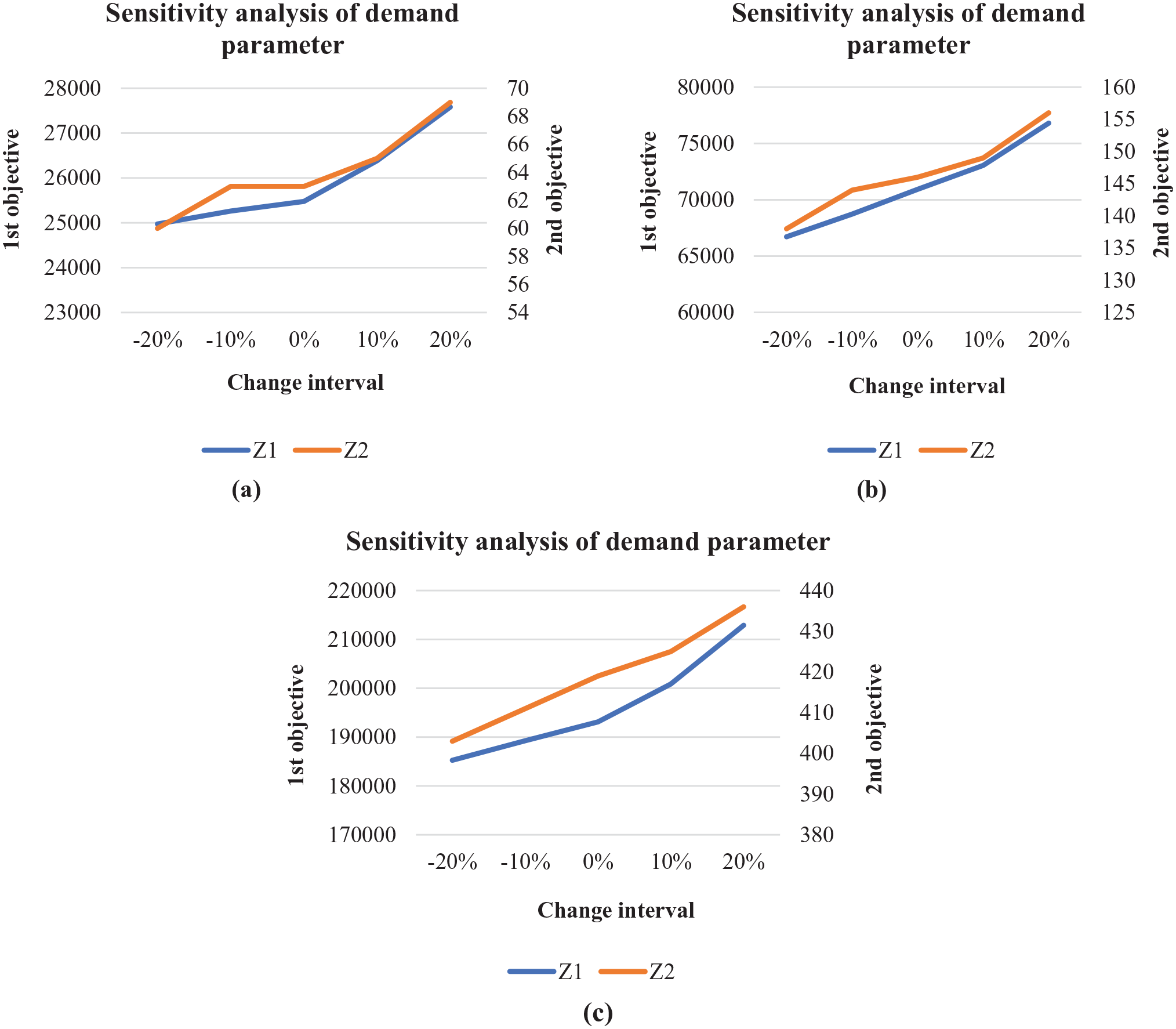
Sensitivity analysis of demand parameter: (a) Problem 1, (b) Problem 2, (c) Problem 3.
As can be seen in Figure 3, there is in general a positive relation between the objective functions values and changes in the demand parameter. However, the sensitivity values are different for different change intervals. The steepest increase occurs with a +20% change in the demand parameter of Problem 3, and the steepest reduction occurs with a −20% change in the demand parameter of Problem 2. All in all, the managers can study the effects of demand parameter on the objective functions and determine the optimal policy on providing the required resources.
Discussion and conclusion
MWM remains a significant issue both financially and environmentally as it requires a timely as well as integrated approach for the collection, transportation and disposal of infectious and/or hazardous material. The recent pandemic has no doubt rendered MWM an even more important component of public services, as the efficient and timely management of rapidly increasing medical waste is of significant importance. Due to this fact, organizations such as municipalities are faced with the task of tackling the economic, environmental and social side-impacts of pandemics. In this regard, this present study proposed a bi-objective MILP model to formulate the problem considering the sustainability aspect. Accordingly, an extended version of the CVRP was introduced considering the real-world assumptions related to MWM. The objective was to minimize the total costs due to transportation, emissions-related pollution, outsourcing and use of vehicles. To validate the proposed model, several illustrative examples are generated randomly and then solved using the CPLEX solver. Finally, some comparisons and analytical evaluations were provided to discuss the practical implications of the results. As an outlook, the following recommendations can be considered for future research:
Use of the heuristic and meta-heuristic algorithms to efficiently solve the problem in large dimensions. For more information, please see Karadimas et al. (2007), Goli et al. (2021) and Tirkolaee et al. (2019a).
Consideration of ‘planning cycles’ in the model (e.g. a model with weekly planning cycles) such that the planning can be done periodically. For more information, please see Yu et al. (2020) and Khalilpourazari et al. (2020b).
Application of uncertainty and forecasting techniques such as robust optimization (Golpîra and Tirkolaee, 2019; Kara et al., 2019; Khalilpourazari et al., 2020a; Lotfi et al., 2020; Özmen et al., 2017), fuzzy programming (Goli et al., 2021; Maity et al., 2019; Roy et al., 2019; Tirkolaee et al., 2021), stochastic optimal control (Kalaycı et al., 2020; Kropat et al., 2020; Savku and Weber, 2018), time series (Weber et al., 2011), regression models (Kuter et al., 2018), and grey systems (Ergün et al., 2020) to address the uncertain nature of the problem.
Integration of emerging technologies such as the internet of things into MWM to leverage real-time data for the prediction of the amount of waste collected and/or route optimization. For more information, please see Pardini et al. (2019), Graczyk-Kucharska et al. (2020) and Golpîra et al. (2021).
Footnotes
Declaration of conflicting interests
The authors declared no potential conflicts of interest with respect to the research, authorship, and/or publication of this article.
Funding
The authors received no financial support for the research, authorship, and/or publication of this article.
