



Abstract
In this work, the pyrolysis behavior of plastic waste—TV plastic shell—was investigated, based on thermogravimetric analysis and using a combination of model-fitting and model-free methods. The possible reaction mechanism and kinetic compensation effects were also examined. Thermogravimetric analysis indicated that the decomposition of plastic waste in a helium atmosphere can be divided into three stages: the minor loss stage (20–300°C), the major loss stage (300–500°C) and the stable loss stage (500–1000°C). The corresponding weight loss at three different heating rates of 15, 25 and 35 K/min were determined to be 2.80–3.02%, 94.45–95.11% and 0.04–0.16%, respectively. The activation energy (Ea) and correlation coefficient (R2) profiles revealed that the kinetic parameters calculated using the Friedman and Kissinger–Akahira–Sunose method displayed a similar trend. The values from the Flynn–Wall–Ozawa and Starink methods were comparable, although the former gave higher R2 values. The Eα values gradually decreased from 269.75 kJ/mol to 184.18 kJ/mol as the degree of conversion (α) increased from 0.1 to 0.8. Beyond this range, the Eα slightly increased to 211.31 kJ/mol. The model-fitting method of Coats–Redfern was used to predict the possible reaction mechanism, for which the first-order model resulted in higher R2 values than and comparable Eα values to those obtained from the Flynn–Wall–Ozawa method. The pre-exponential factors (lnA) were calculated based on the F1 reaction model and the Flynn–Wall–Ozawa method, and fell in the range 59.34–48.05. The study of the kinetic compensation effect confirmed that a compensation effect existed between Ea and lnA during the plastic waste pyrolysis.
Keywords
Introduction
Once touted as a ‘material of a thousand uses’, plastic meets our demand across various sectors and has become an essential part of daily life (Rahimi and García, 2017). Production and consumption of plastic has increased exponentially since the early 1950s. It is estimated that approximately 400 million tonnes (Mt) of plastic is produced globally each year and a whopping 8300 Mt of plastics was produced between 1950 and 2015 (Geyer et al., 2017). Concomitant with usage, the worldwide generation of plastic waste is rapidly increasing and the amount produced since 2015 is estimated to be 6300 Mt. However, only 9% of this waste has been recycled and 79% has ultimately accumulated in landfill sites or has been dumped in the natural environment (Geyer et al., 2017). It is well known that traditional plastics are difficult to decompose and thus the disposal of plastic waste poses a long-term threat to the natural environment. In order to tackle the plastic disposal problem, the development of alternative recycling or treatment technologies for them is mandatory. Traditional landfilling offers an inexpensive solution for the solid waste, but it will take up land resources and waste the energy intrinsic in plastics (Li et al., 2014). There are drawbacks to recent recycling methods, such as mechanical separation, pelleting and regeneration, attributed to their high labor cost and water contamination (Datta and Kopczyńska, 2016; Deng et al., 2017; Hamad et al., 2013).
Advanced thermal treatments are gaining interest, as these have the advantage of drastic volume reduction and energy recovery (Aguado et al., 2008; Cheng et al., 2019; Yu et al., 2019). Among these, pyrolysis is regarded as one potentially useful method, due to its lower emissions, reasonable cost and simple operation (Qi et al., 2019; Sharuddin et al., 2016). Understanding the process of pyrolysis of plastic waste and its kinetics is important for reactor design and the selection of optimization parameters in practice. Jung et al. (2013) studied the pyrolysis characteristics of waste high impact polystyrene (HIPS) and acrylonitrile-butadiene-styrene (ABS) using a fluidized bed reactor. Szabo et al. (2011) investigated the pyrolysis behavior of a waste polymethylmethacrylate-ABS blend. Liu et al. (2017) investigated the thermal degradation of polymer blends (ABS/polyvinyl chloride (PVC), ABS/nylon 6 (PA6) and ABS/polycarbonate (PC) and analyzed pyrolysis kinetics using the Coats–Redfern (CR) and the Starink methods. Balart et al.(2006) determined the thermal properties of PC-ABS mixtures and studied the kinetics using an autocatalytic model. It is worth noting that reports on the pyrolysis of plastic waste in the form of TV plastic shell are sparse. In addition, it is difficult to precisely describe the pyrolysis kinetics using several methods. Therefore, in this work, a series of thermogravimetric (TG) experiments on plastic waste was conducted using a simultaneous thermal analyzer with different heating rates of 15, 25 and 35 K/min. Based on the TG analysis, the activation energies (Eα) were then determined using four model-free methods, including Friedman, Kissinger–Akahira–Sunose (KAS), Flynn–Wall–Ozawa (FWO) and Starink methods. Finally, the pre-exponential factors (lnA) were analyzed using a combination of the model-fitting method (CR) and model-free methods. The probable mechanism and kinetic compensation effect were investigated as well.
Experimental
Materials
The waste TV plastic shell was collected from a large-scale electrical and electronic equipment recycling plant located in Shandong province, China. It was mainly composed of ABS. It is difficult to crush this plastic using traditional mechanical methods. Therefore, it was ground using a LD-450 cryogenic grinder (Jiangyin Yifang Machinery Co. Ltd., China) with a grinding temperature of −33.1°C.
Experimental procedure
TG analysis is the most widely used technique for studying the thermal decomposition of solids (Ashraf et al., 2019; Bach and Chen, 2017). During the test, approximately 2 mg of the plastic sample was placed on the ceramic crucibles and heated from 20°C to 1000°C under a helium gas flow of 50 mL/min. The tests were repeated at different heating rates of 15, 25 and 35 K/min. The sample weight and temperature changes during the thermal process were recorded to obtain the TG and derivative thermogravimetric (DTG) profiles. The schematic diagram of this study is illustrated in Figure 1.
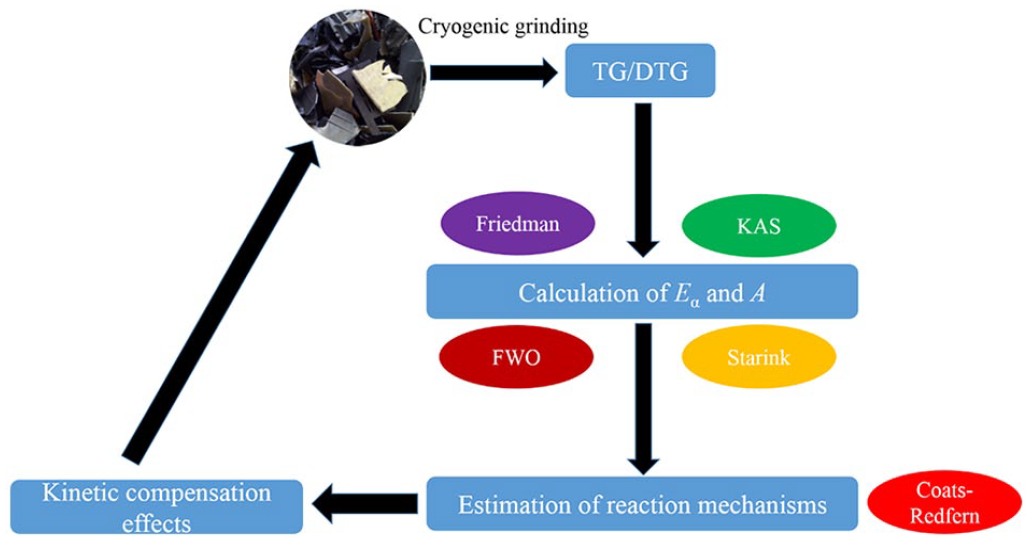
The schematic diagram of this work.
Kinetic modeling
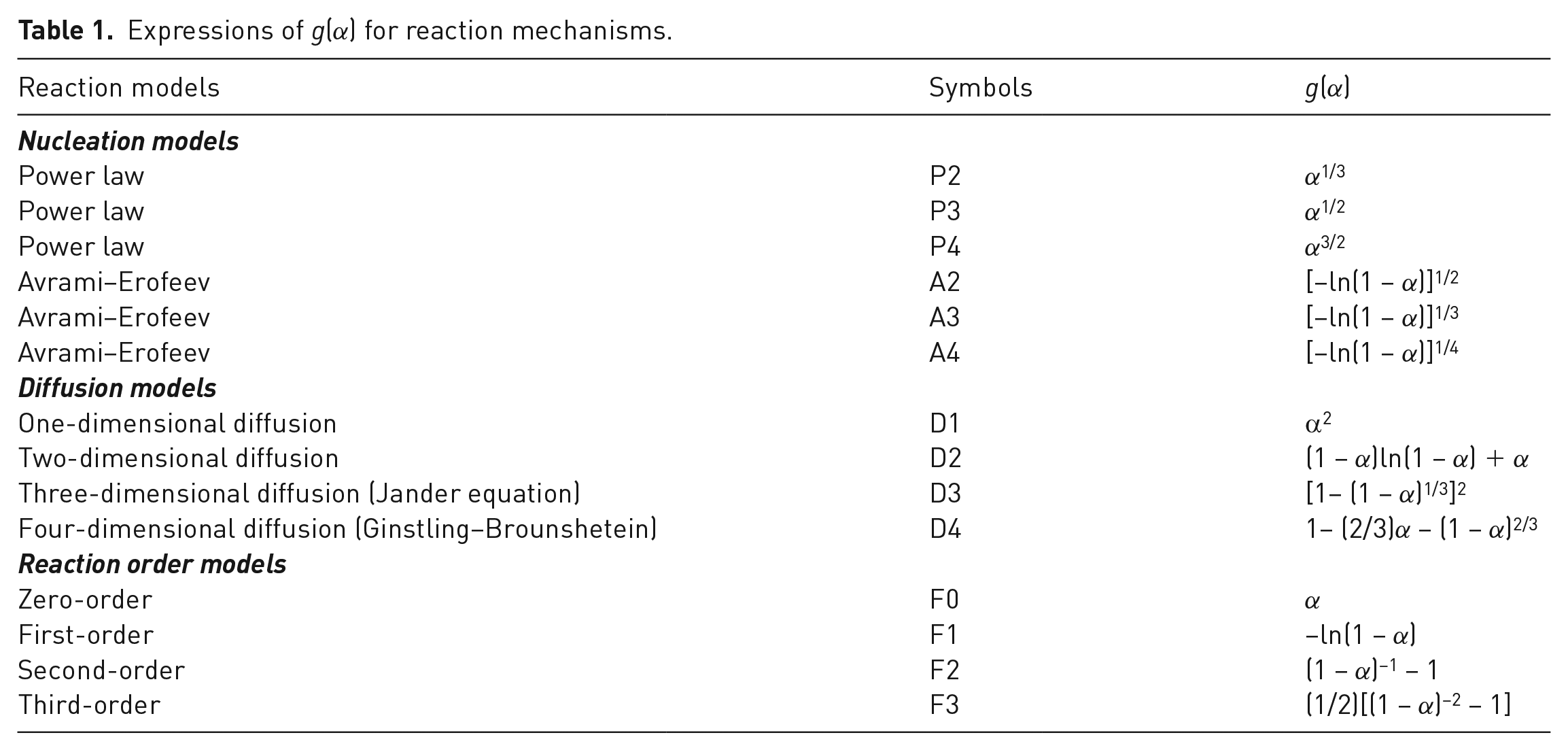
The basic theory of kinetic modeling for solid fuels is presented here; more details can be found elsewhere (Papari and Hawboldt, 2015, Tanaka, 2005, Yao et al., 2019a, Yao et al., 2019b). There are two major methods, the model-fitting and the model-free method, which are employed for the study of the decomposition of solids (Khawam and Flanagan, 2005; Vyazovkin et al., 2011). Model-fitting methods are commonly applied because of their ability to determine the kinetic parameters directly and to offer information about possible reaction mechanisms. Different reaction models have been proposed (Aboulkas and El Bouadili, 2010; Chong et al., 2017; Khawam and Flanagan, 2006; Ma et al., 2018) and kinetic parameters can be determined based on these models. The expressions of g(α) for the different reaction mechanisms used in this work are listed in Table 1. The model-free method does not have any previous assumptions about the reaction model and allows the kinetic parameters to be calculated as a function of the conversion degree. Different model-free methods, such as the Friedman, the FWO, the KAS and the Tang method (Hardi et al., 2018; Srivastava et al., 2017) have been proposed and used for the kinetic study of solid materials. In this work, the model-fitting CR method and the Friedman, FWO, KAS and Starink model-free methods were employed.
Expressions of g(α) for reaction mechanisms.
The TG results can be expressed as a function of degree of conversion (α), which is defined in terms of mass change for solids as

where m0 and mf refer to the initial and final sample weight, and mt represents the instantaneous mass at time t.
The solid conversion rate (dα/dt) can be expressed as

where β is the heating rate or the rate of temperature change (dT/dt, K/min), κ(T) refers to the reaction rate constant depending on the temperature and f(α) represents the kinetic model function.
The κ(T) can be described according to the Arrhenius equation

where A refers to the pre-exponential factor (min−1), E is the apparent activation energy (kJ/mol) and T and R represent the absolute temperature (K) and universal gas constant (8.314 J/(mol·K)), respectively.
Under constant temperature ramp conditions, combining equation (2) and equation (3) yields

CR method
The CR method is an integral model-fitting method developed by Coats and Redfern (1964), which uses an asymptotic series expansion for estimation of the temperature integral. The integral form of the reaction model can be obtained by integrating equation (4) as (Çepelioğullar et al., 2016; Özveren and Özdoğan, 2013)
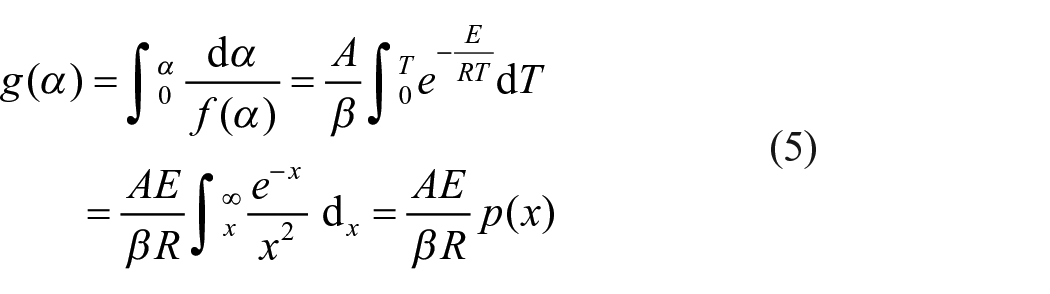
where x is equal to
By introducing an approximation

Taking the natural logarithm of both sides of equation (6) yields

Since 2RT/E << 1, the equation can be converted into

For a fixed β and proposed reaction mechanism g(α), plotting
Friedman method
Both differential and integral isoconversional methods were used for determination of the activation energy. The Friedman method (Friedman, 1964) is the most common differential isoconversional method for evaluating the activation energy as a function of α. It is based on the assumption that the decomposition of the solids depends only on the rate of mass loss and is independent of the temperature. Therefore, the f(α) can be considered constant and taking the natural logarithms of both sides of equation (4) yields

A series of TG experiments at different heating rates enables the extraction of data for the same α value at different temperatures (Özveren and Özdoğan, 2013). Because ln[Af(α)] is a constant, for given α and β values, the activation energy can be determined from the slope of the straight line by plotting
KAS method
The integral term p(x) in equation (5) has no analytical solution. All the integral isoconversional methods are based on different mathematical assumptions of p(x). The KAS method (Akahira and Sunose, 1971) is based on the CR approximation

For a constant value of α, the activation energy can be obtained from the plot of
FWO method
The FWO method is a model-free method developed by Flynn and Wall (1966) as well as Ozawa (1965). It uses Doyle’s equation for the approximation of the temperature integral (Doyle, 1965). Taking into account the approximation

For a fixed value of α, plotting lnβ versus 1/T gives a straight line. The activation energy can be determined from the slope −1.052Eα/R over a series of α. The A values can be obtained from the intercept,
Starink method
By integrating the approximation

For a series of α, numerous pairs of
Results and discussion
TG analysis
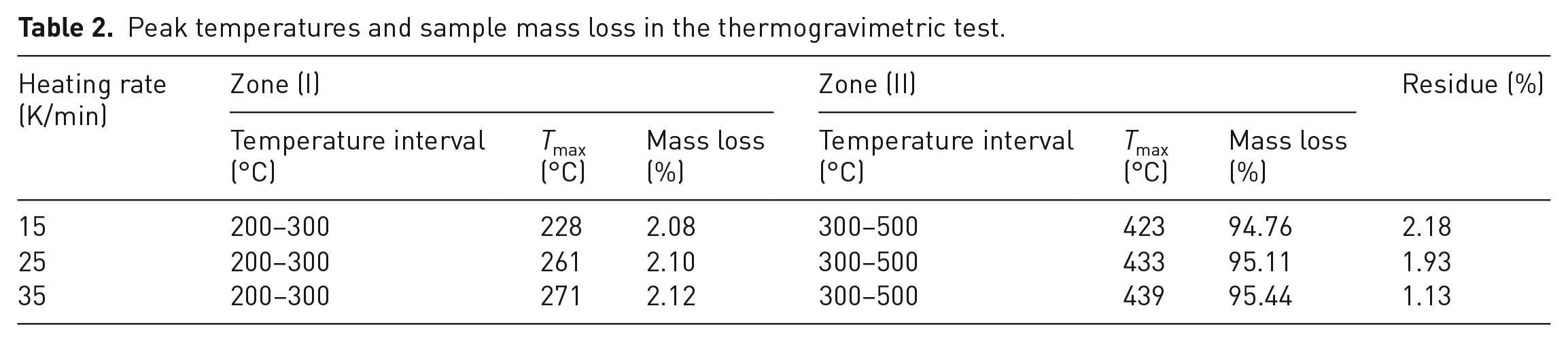
The conversion rate and DTG curves of plastic waste at different heating rates are displayed in Figure 2. From Figure 2(a), it can be seen that the conversion displayed a similar trend for samples at different heating rates. The whole thermal process can be divided into three stages: the minor loss stage (20–300°C), the major loss stage (300–500°C) and the stable loss stage (500–1000°C). The weight loss at three heating rate were determined to be 2.80–3.02%, 94.45–95.11% and 0.04–0.16% for these stages, respectively, which was consistent with the decomposition of ABS polymer (Ma and Pang, 2015; Polli et al., 2009). As for the thermal degradation of pure ABS, some researchers observed one or two steps. The discrepancy mainly derives from the sample molecular weight, sample mass, heating rate, etc. From the DTG profiles in Figure 2(b), it was found that the DTG curve can be divided into three zones. Among them, zone I is the initiation of pyrolysis, during which the backbone of the polymer ruptured into monomers, such as styrene, acrylonitrile and polybutadiene (Yang et al., 2004, Yu et al., 2019). Suzuki and Wilkie (1995) investigated the degradation of pure ABS and found that the evolution of butadiene commenced at 340°C and styrene at 350°C, while the evolution of monomeric acrylonitrile initiated at 400°C. Zone II is the major conversion stage, where a significant mass loss of approximately 95% was observed. The decomposition rates elevated from 0.12 to 0.28 %•s−1 with the heating rate increasing from 15 to 35 K/min. In this stage, monomers resulting from zone I decomposed to form small molecules, such as HBr, CO2, CO and CH4 (Yu et al., 2019). In zone III, the degradation rate significantly decreased to 2.13E−5–55.05E−5 %•s−1 and a minor weight loss of 0.04–0.40% was observed. Larger brominated derivatives decomposed and smaller molecules dominated the major gaseous products (Yu et al., 2019). This indicated that the decomposition of TV plastic shell was mainly occurred at less than 500°C, namely, in zone I and zone II. From Figure 2 and Table 2, the maximum peak temperatures were observed at 228, 261 and 271°C for three heating rates in zone I and 423, 433 and 439 °C in zone II, respectively. The obvious shift toward higher peak decomposition temperatures with increasing heating rate has been reported in the literature for coal (Song et al., 2016) and biomass (Cortés and Bridgwater, 2015). This may be attributed to the increasing effect of heat transfer limitations, which cause temperature gradients within the sample and inside each particle. At a lower heating rate, the heating of plastic particles occurs gradually leading to an improved heat transfer to the inner portions and among the particles. However, an increase of Tmax is also observed if there is no limitation of heat transfer (Kissinger, 1956). The increase of Tmax upon increasing heating rate can be seen from equations (8) to (12), which all assume ideal heat transfer (without any temperature gradients in the interior of the particles or the sample). Therefore, zone II was selected to study the pyrolysis kinetics of plastic waste in the following section.
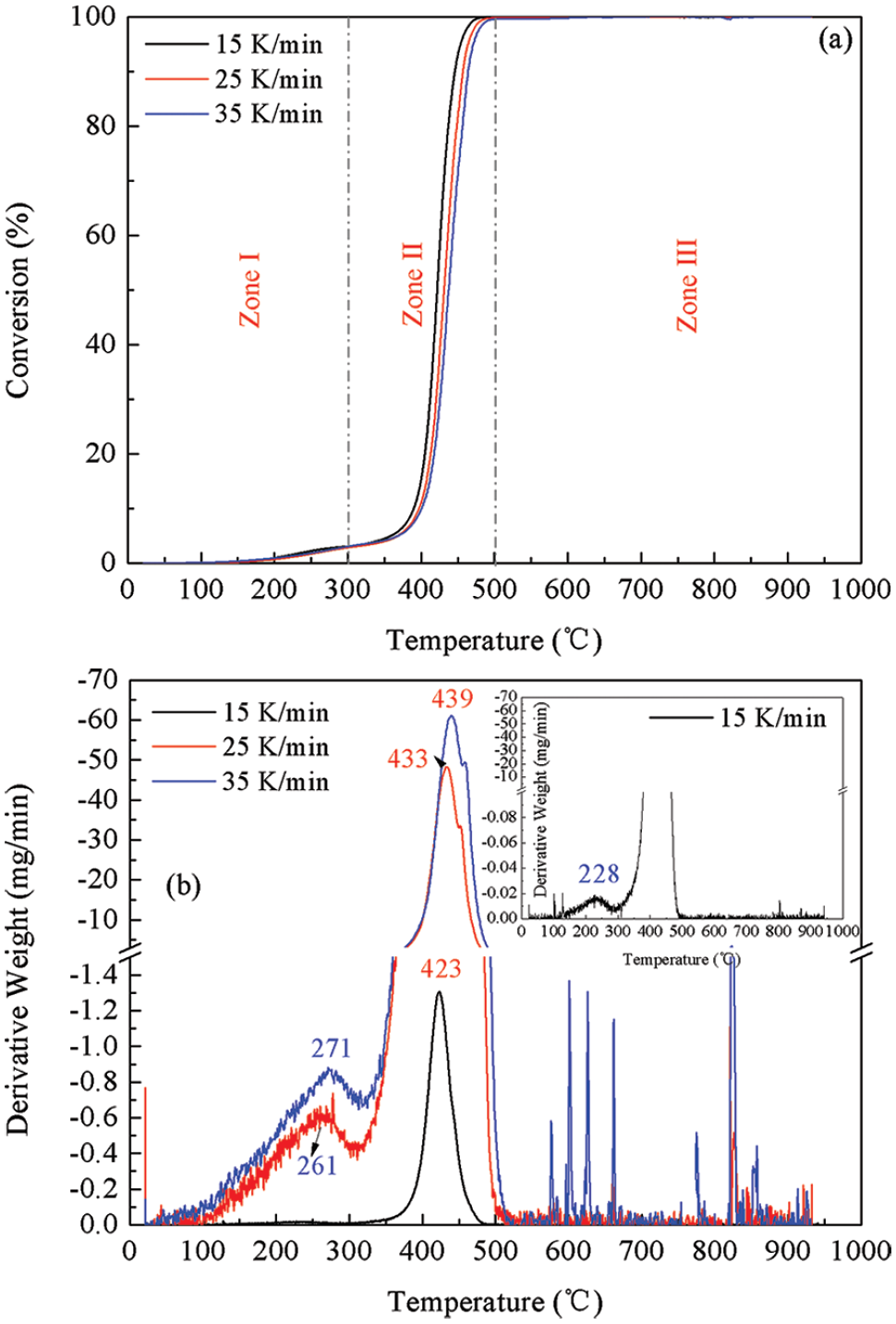
(a) Conversion rate and (b) derivative thermogravimetric (DTG) curves of plastic waste at different heating rates.
Peak temperatures and sample mass loss in the thermogravimetric test.
Calculation of activation energy
In this section, the activation energy (Eα) and linear correlation coefficient (R2) at various conversion rates of 0.1–0.9 were calculated using the Friedman, KAS, FWO and Starink methods. For the Friedman method, the plots of
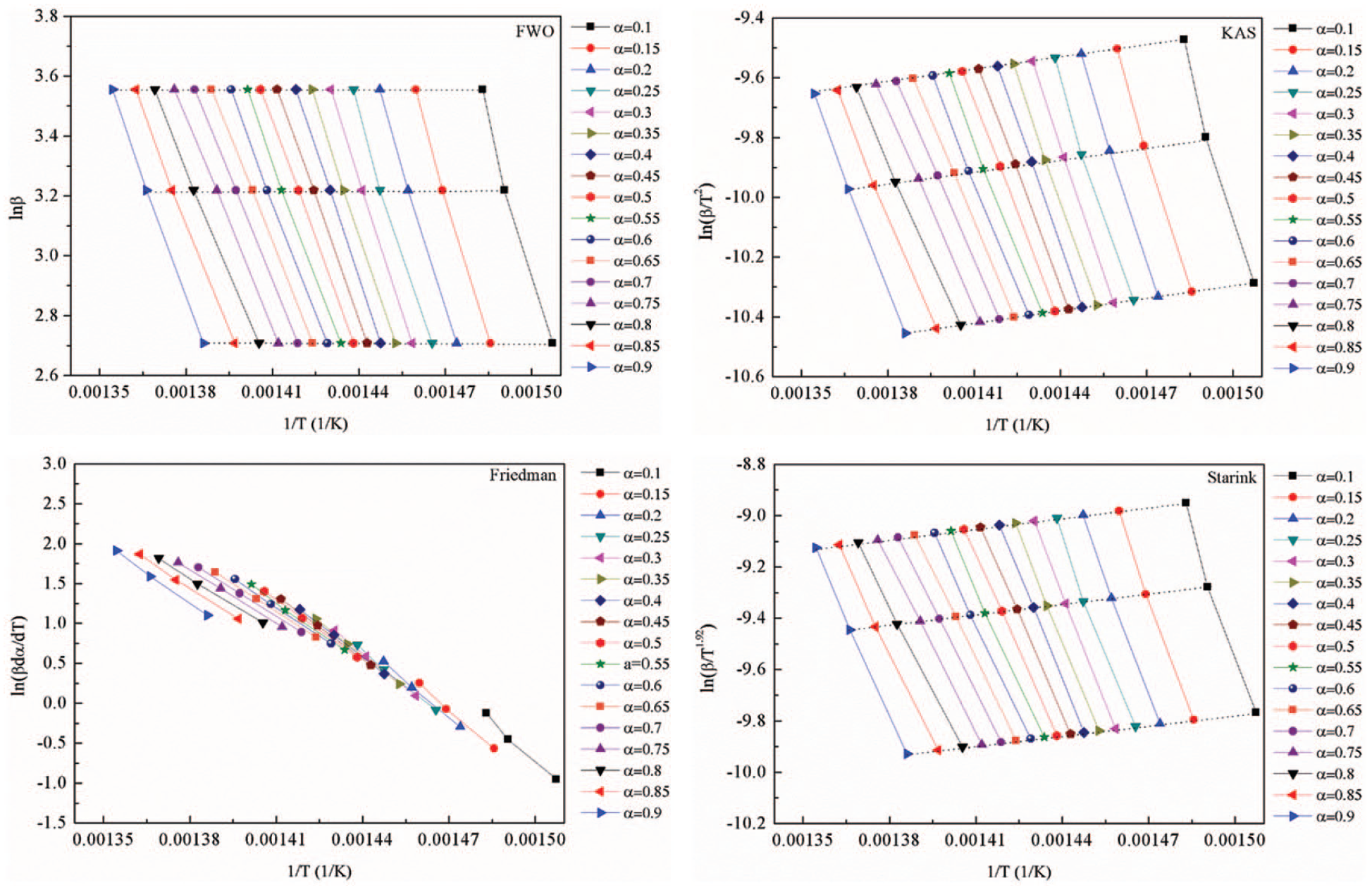
The linear fitting curves under different conversions for model-free methods.
The kinetic parameters determined using the model-free methods.
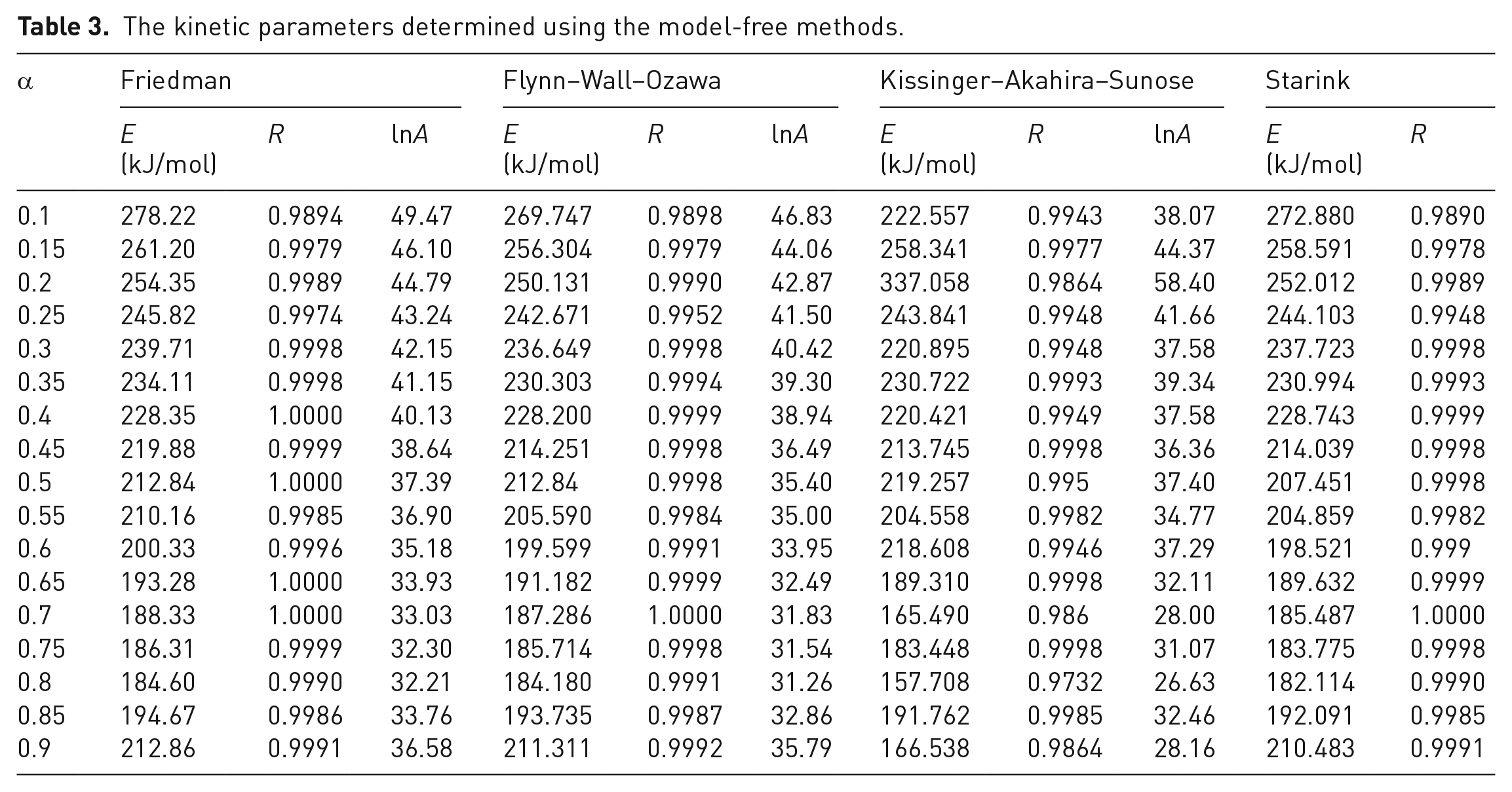
The kinetic parameters calculated using the KAS method displayed a similar trend to those from the Friedman method, although they were smaller than the latter (Figure 4). This was consistent with the literature (Yuan et al., 2017), although an increasing tendency with an increase of α was displayed. Pérez et al. (2012), reported that Eα values from the KAS method became larger than those from the Friedman method for α >0.65. In other literature (Sokoto and Bhaskar, 2018), the activation energy calculated using the Friedman method decreased with increasing α in the range 0.1–0.6, while the values derived from the KAS method were stable for α values of 0.1–0.15 and 0.2–0.4. A decrease in Eα values was observed for α values of 0.4–0.6.
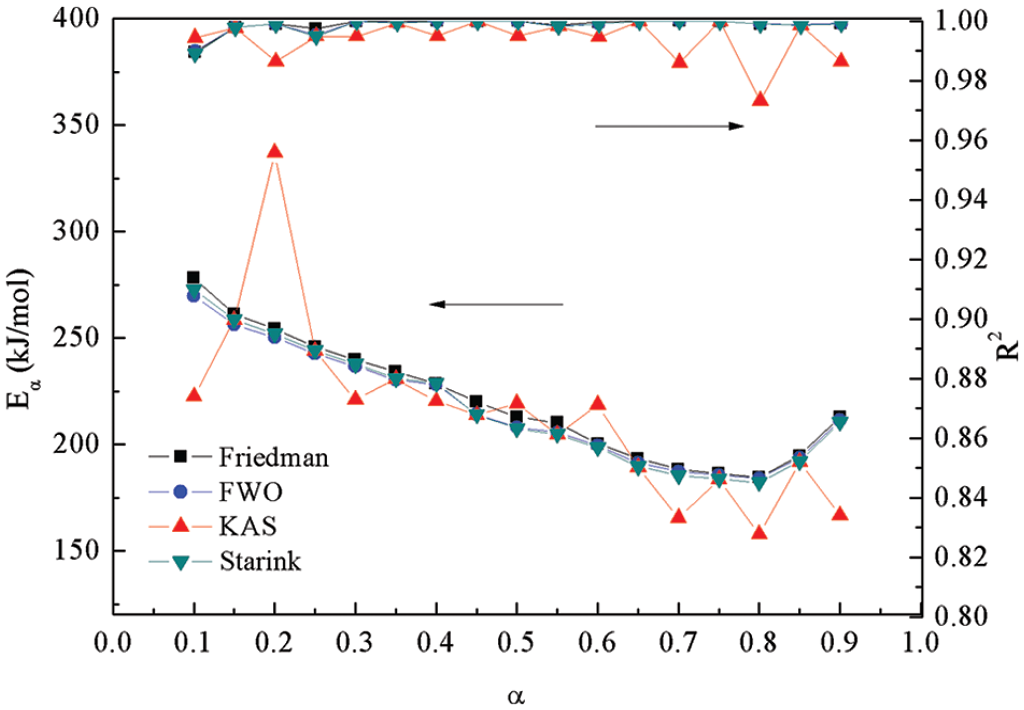
Comparison of kinetic parameters derived from model-free methods.
The FWO method is an integral method, which is also independent of the degradation mechanism. According to equation (11), numerous pairs of lnβ and 1/T data at various α values of 0.1–0.9 were plotted and displayed in Figure 3. The activation energies were then calculated by the slopes (−1.052Eα/R) and listed in Table 3. Unlike the above two methods, this manifested a noticeable decreasing trend. The Eα values gradually decreased from 269.75 kJ/mol to 184.180 kJ/mol with an increase in α from 0.1 to 0.8. Beyond this range (α > 0.8), the Eα values increased slightly to 193.74 kJ/mol and 211.31 kJ/mol for α values of 0.85 and 0.9, respectively. Therefore, the entire variation of Eα can be divided into region I (< 0.8) and region II (> 0.8) according to the conversion rate. The average values of Eα were determined to be 219.32 kJ/mol and 202.52 kJ/mol for regions I and II, respectively.
The kinetic parameters calculated using the Starink method displayed the same trend as those derived from the FWO method. This was consistent with the literature (Wu et al., 2018), although the activation energy displayed three stages for the entire α range of 0.05–0.95.
When the four model-fitting methods are compared, similar activation energies and correlation coefficients were observed for the Friedman and KAS methods. The profiles are displayed for these and for the other two methods in Figure 4. However, the Eα and R2 values determined from Friedman and KAS fluctuated significantly, so the FWO and Starink methods were shown to be more accurate for probing the pyrolysis kinetics. Comparing the two methods, higher R2 values were derived from the FWO method for an α range of 0.1–0.9. Therefore, the FWO was the most reliable method and this was used for the reaction mechanism study in the following section.
Estimation of reaction mechanisms
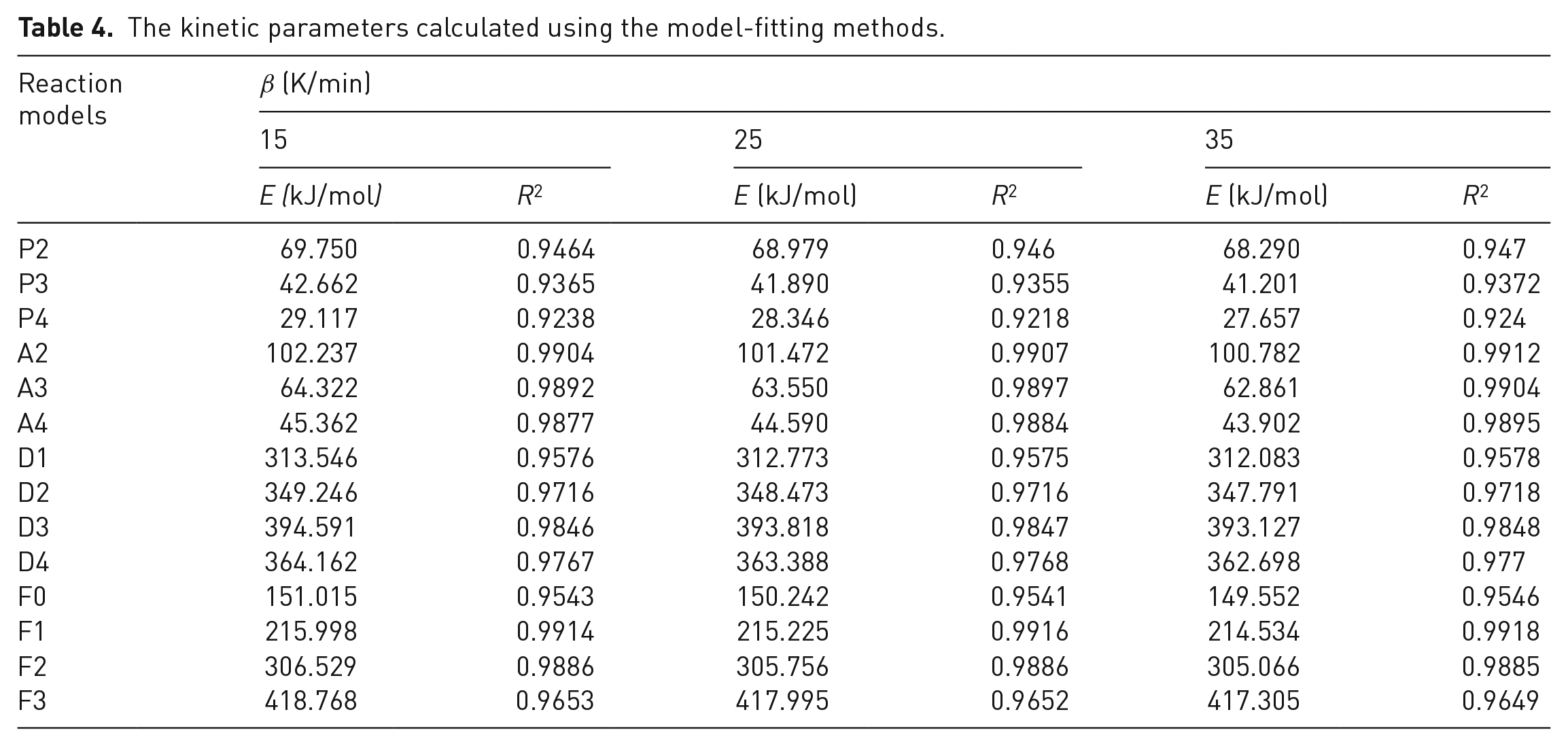
Employment of the CR method for TG data can determine the most probable mechanism function and enable the pre-exponential factor (lnA) to be calculated (Aboulkas and El Bouadili, 2010; Ding et al., 2017). If the average Eα values for three heating rates based on a certain mechanism are comparable to the values from the FWO method, then this mechanism could be responsible for the reaction. From equation (8), the activation energy for all g(α) functions listed in Table 1 can be obtained. The resulting kinetic parameters are listed in Table 4 and displayed in Figure 5. For each model, the Eα values decreased with the increase of heating rate. The Eα and R2 values can be used as criteria for determining the most reliable reaction models. It was obvious that the Eα and R2 values fell into the range of 25.24–418.77 kJ/mol and 0.9238–0.9969, respectively. In addition, the three groups of reaction models displayed distinct profiles. The diffusion models gave larger Eα values, while the nucleation models gave lower values. The F1 model resulted in higher R2 values and the calculated Eα values were 216.00, 204.60 and 194.66 kJ/mol at the three heating rates; these were close to the average Eα values of 219.32 kJ/mol and 202.52 kJ/mol for regions I and II derived from the FWO method. Therefore, the most appropriate mechanism for plastic waste pyrolysis can be regarded to be the first-order reaction model (Dou et al., 2007).
The kinetic parameters calculated using the model-fitting methods.
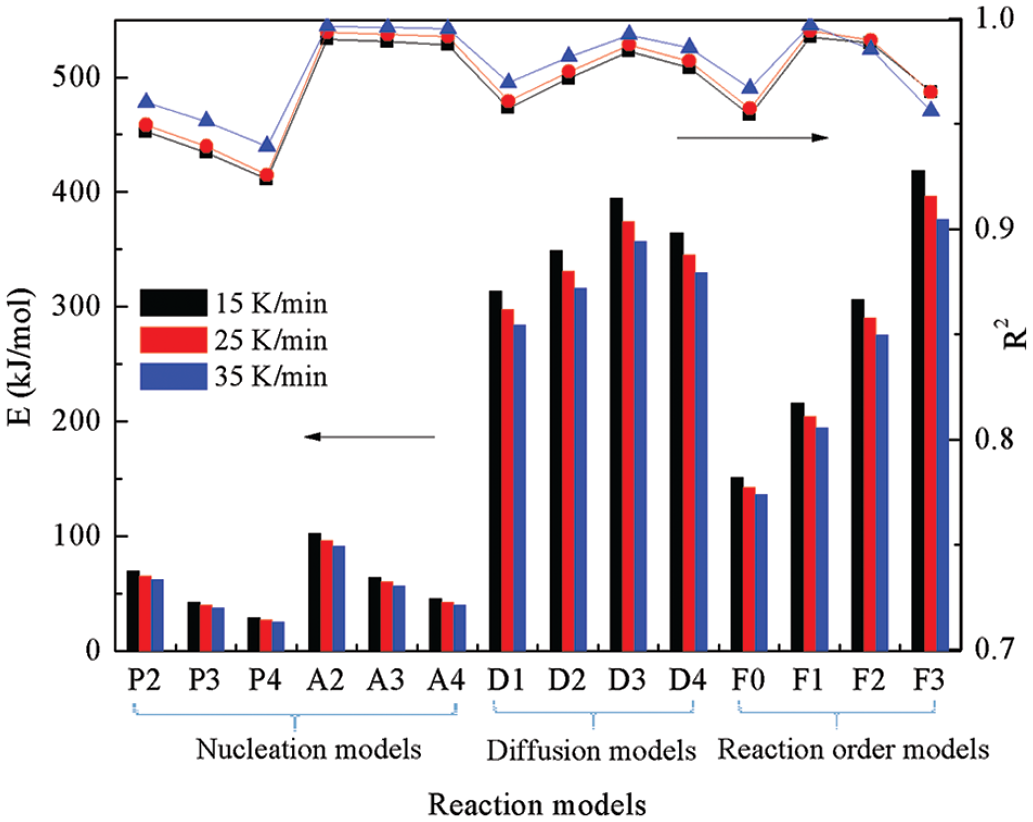
Comparison of kinetic parameters calculated from model-fitting methods.
Kinetic compensation effects
The kinetic compensation effect is usually used to characterize the dependence of E and A on the conversion degree according to the following linear relationship (Wang et al., 2012; Zhu et al., 2015)

where a and b are constants and refer to the compensation coefficients.
The F1 mechanism was selected for determining the pre-exponential factors as a function of conversion to validate the kinetic parameter. The activation energy calculated using the FWO method was more reliable and was used in this section. Substituting

From the Eα values determined using the FWO method in Table 3, the lnA values can be calculated according to equation (14). An excellent linear relationship, lnA = 0.1832E + 9.551 (R2 = 0.9993), can be found through plotting lnA against E, as shown in Figure 6. It indicated that compensation effect existed between the apparent Eα and lnA during the pyrolysis of plastic waste. The lnA fell into the range of 59.34–48.05 with α increasing from 0.1 to 0.9, which can be confirmed by Table 3. Therefore, the kinetic compensation effect was a valid alternative to demonstrating the interrelationship between the kinetic parameters lnA and E due to the impact of the experimental conditions on the determination of kinetic parameter.
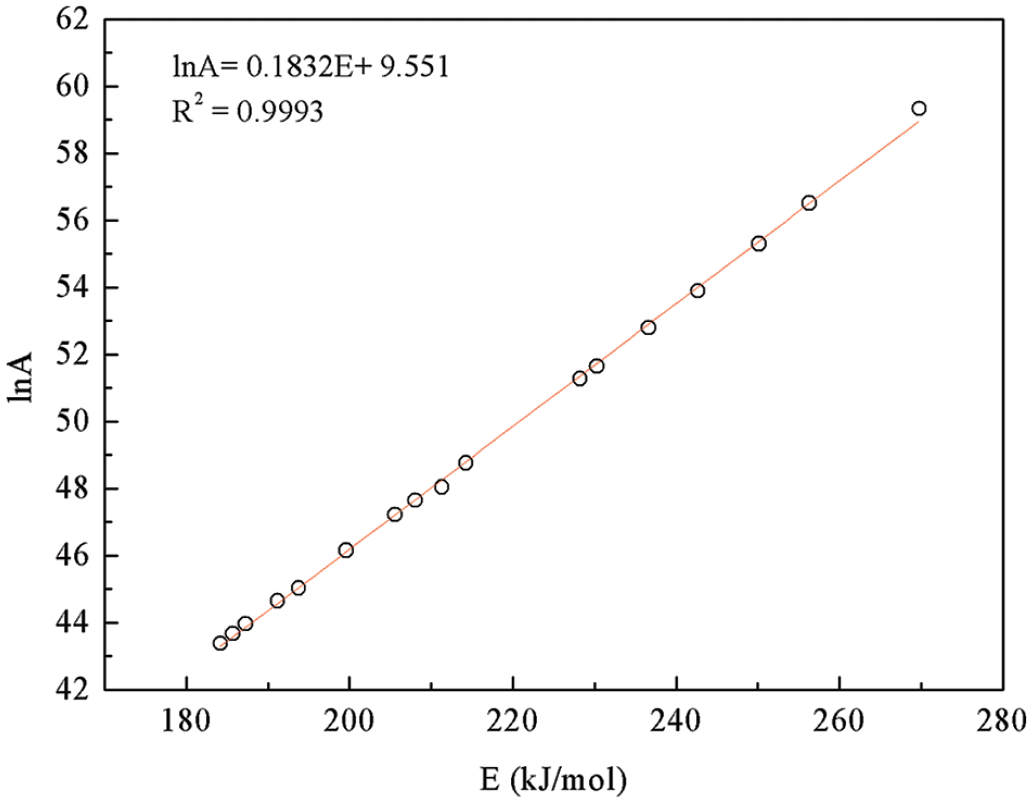
Compensation plot of lnA versus E.
Conclusions
In this work, a series of TG experiments was conducted to investigate the pyrolysis kinetics of plastic waste. The TG analysis revealed that the decomposition process can be divided into three stages with corresponding weight losses of 2.80–3.02%, 94.45–95.11% and 0.04–0.16%, respectively. The maximum peak temperatures were observed at 423, 433 and 439°C for three heating rates in the second stage. Based on the TG analysis, the activation energy and linear correlation coefficient were determined at different conversion rates using four model-free methods. The kinetic parameters calculated using the Friedman method displayed a similar trend to those determined by the KAS method. The same profiles were also observed for the FWO and Starink methods. However, the Eα and R2 values determined from the Friedman and KAS methods fluctuated significantly. As a comparison, higher R2 values were derived from the FWO method, which was the most reliable method used for the study of the reaction mechanism. Out of the CR methods, the F1 model gave higher R2 values and the calculated E values were comparable to the average values from the FWO method. The value of lnA was calculated based on the F1 model and the FWO method and fell into the range 59.34–48.05 with α increasing from 0.1 to 0.9. Study of the kinetic compensation effect indicated that a compensation effect existed between the apparent activation energy and the pre-exponential factor during the pyrolysis of plastic waste.
Footnotes
Funding
The authors disclosed receipt of the following financial support for the research, authorship, and/or publication of this article: This work was financially supported by the Zhejiang Provincial Natural Science Foundation of China (Grant no. LY19B070008) and the National Natural Science Foundation of China (Grant no. 51911530460 and 51606055).
Declaration of conflicting interests
The authors declared no potential conflicts of interest with respect to the research, authorship, and/or publication of this article.
