




Abstract
This study examined the influence of crime type and crime representation in survey design on perceptions of crime severity using one-line crime descriptions and crime vignettes. A unique feature of the study was the use of hate crime as an offence category. A sample of 917 university students completed an online questionnaire measuring perceptions of crime severity for one-line crime descriptions as well as crime scenarios based on actual court cases. Consistent with past research, the results showed that both perceptions of wrongfulness and harmfulness are strong predictors of perceived crime seriousness. Violent crimes ranked highest on measures of wrongfulness, harmfulness, and seriousness, while property crimes like break and enter tended to be ranked lowest in perceived severity. Hate crime was viewed as quite serious by respondents and was rated equivalent to high-scale fraud embezzlement in terms of severity. Comparisons between responses to one-line crime descriptions and crime scenarios revealed that scenarios elicited significantly stronger severity ratings, although hierarchical rankings for crime type remained similar. The representation of crime in academic research may affect participant responses. It is recommended that researchers consider the impact the choice of crime representation in survey tools has on measures of perceived crime severity.
Introduction
Public perceptions of crime seriousness are important to study because, ultimately, they influence policy and the law. Perceived crime seriousness is informed by social and moral norms about harm and wrongfulness and dictated by our knowledge and beliefs about crime, and this influences policy decisions made around crime and criminals (Adriaenssen et al., 2020; Warr, 1989). Prior research on social views on crime seriousness has pointed to the importance on understanding how the public perceives crime and the implications these perceptions have on the creation of criminal justice policy and sentencing decisions (Adriaenssen et al., 2020; Doob & Roberts, 1984; Roberts et al., 2007). Sentencing and criminal justice policies in multiple countries, including Canada are based on the presumed seriousness of crime—a seriousness that, in some cases, is based at least in part on measurements of public perceptions of severity (Adriaenssen et al., 2020). In the Canadian context, a good example of this is the Police-Reported Crime Severity Index, a weighted volume measure of crime severity that draws on the most recent 5 years of courts sentencing incarceration data as an objective way of measuring relative severity (Babyak et al., 2009). These results are used to inform policy decisions on criminal justice issues. Furthermore, police perceptions of crime seriousness have also been shown to impact police discretion toward young offenders (Department of Justice, 2015). For researchers, given the potential impact of perceptions of crime severity on policy design, it becomes critical to examining crime severity, the influence of crime type, and the role of crime representation in forming as well as influencing changes in public perceptions of crime.
This study will look at respondent perceptions of crime seriousness depending on the nature of the criminal act as well as the influence of wrongfulness and harmfulness on perceived levels of seriousness for different acts, extending prior work in the field. This study also attempts to address a gap in the literature by assessing the impact of representations of crime on severity ratings by comparing the use of more detailed crime scenarios or vignettes versus more brief, generic crime descriptions. Traditional crimes considered in this study include violent, property, and white-collar violations, but we also attempt to add to the literature by examining hate crime, an offence less frequently studied by severity scholars. Hate crime merits attention, given its emergence as a serious problem for already marginalized populations.
Literature Review
Crime Severity and Perceptions of Harm and Wrongfulness
The crime seriousness literature has evolved over time from considering just severity to evaluating the impact of perceptions of harm and wrongfulness. Since the 1960s, scholars have appraised public ratings of crime seriousness through survey research (Rossi et al., 1974; Sellin & Wolfgang, 1964). However, these early efforts were criticized for neglecting to adequately conceptualize seriousness. Recognizing the need to understand what respondents used to conceptualize the abstract concept of seriousness in perceptions of crime, Warr (1989) set out to define seriousness and determined that judgments of severity reflected a balance between perceived wrongfulness and harmfulness. The influence of each dimensional factor further depended on the nature of the crime (e.g., violent, property, and fraud; Warr, 1989). Replicating Warr's research on seriousness, other researchers also concluded that both wrongfulness and harmfulness were significant predictors of crime severity, albeit with differences in the strength of the relationship across offense types (Adriaenssen et al., 2020; Rosenmerkel, 2001; Stylianou, 2003).
Stylianou's (2003) literature review found that actual harm associated with an offence was the most important characteristic in determining severity rankings, but that so-called “victimless” crimes (e.g., drug use and sex trade) could be ranked as serious dependent on the degree to which they violated moral standards. In a similar study, Adriaenssen et al. (2020) used vignettes in a public survey to have respondents rate moral norm violation; harm; frequency of occurrence; and frequency of harm on violent, property, and organized/corporate crime. Unlike Stylianou (2003), they found that the public based its severity assessments mostly on the moral wrongfulness of the act, with harm severity also showing influence. Overall, however, there is consensus that both wrongfulness and harmfulness are significant predictors of seriousness.
Over the years, research shows consistent trends in what types of crimes are considered serious by the public. Not surprisingly, crimes against the person, particularly violent crimes such as murder, are ranked the most severe (Adriaenssen et al., 2020; Einat & Herzog, 2011; Michel, 2016; Rossi et al., 1974; Sellin & Wolfgang, 1964; Stylianou, 2003; Warr, 1989). Furthermore, research done by O’Connell and Whelan (1996) as well as Stylianou (2003) indicate that there is a cross-cultural consensus with respect to crimes ranking high in seriousness, which are typically those involving violence and bodily harm. Both offenses against the person as well as property offenses are considered slightly more morally wrong than harmful, although crimes against the person are still perceived to be much more harmful than property offenses (Warr, 1989). In addition, research by Einat and Herzog (2011) indicated that both property and violent crimes were considered more serious compared to the so-called victimless offenses (e.g., sex trade and nuisance) and the self-use of illegal drugs. Comparisons with perceptions of white-collar crime indicated that corporate crimes were considered less serious than violent and property crimes (Adriaenssen et al., 2020; Michel, 2016; Stylianou, 2003). However, it must be noted that when considering perceived harmfulness, property crimes and corporate crimes switch in ranking, with property crime being viewed as less harmful than violent and white-collar crime. Researchers have suggested that this rating may reflect a sense of awareness as to the potential large-scale harm corporate and environmental crime may have due to their impact on multiple victims (Adriaenssen et al., 2020; Rosenmerkel, 2001).
Representations of Crime in Academic Research
Research on seriousness and punitive attitudes has adopted a variety of methods in representing crime ranging from brief generic one-line crime descriptions (Adriaenssen et al., 2020; Rosenmerkel, 2001; Rossi et al., 1974; Warr, 1989) to full crime scenarios (Baird et al., 2016; Einat & Herzog, 2011; Michel, 2016; O’Connell & Whelan, 1996; Rossi et al., 1985) and even actual criminal cases (Roberts et al., 2007). However, crime scenarios or generic crime descriptions used to measure the levels of seriousness are themselves representations of crime. As such, it is important to consider the impact of the various ways research has represented crime to elicit the ratings of seriousness from respondents. Each of these methods offers strengths and weaknesses.
As Finch (1987) pointed out, the use of scenarios provides a better method of capturing the complexity of social issues such as crime in a more realistic way. The use of crime scenarios also allows researchers to avoid the ambiguity of one-line depictions and standardizes “the social stimulus across respondents” (Alexander & Becker, 1978, p. 103). Schoenberg and Ravdal (2000) noted that the “vignette approach is an enlightening and mutually creative process for researcher and informant” (p. 71). However, scenarios run the risk of adding researcher bias to the more general problem of finding a representative sample of crime events (Lynch & Danner, 1993). A factorial design has been adopted by some researchers to develop crime scenarios that would capture all possible combinations of a criminal event (Rossi et al., 1985). However, this approach has been critiqued for creating unrealistic scenarios and failing to develop a representative sample of crime vignettes (Durham, 1986).
Roberts et al. (2007) used the synopses of actual court cases to measure public attitudes toward sentencing, minimizing the risk of eliciting opinions on unrealistic scenarios produced by factorial designs. On the one hand, actual cases including real-world sentences stand to gain a much more accurate assessment of public opinion on crime and punishment. On the other hand, the specifics provided in this approach then makes it more difficult to generalize findings to public perspectives on crime overall. As Adriaenssen et al. (2020) pointed out, the use of more detailed scenarios affects the generalizability of the results to a general crime category. Descriptive scenarios also introduce the possibility of adding confounding variables. Perpetrator and victim descriptions and knowledge of crime circumstances can influence findings. For example, research has found younger perpetrators were perceived differently by some respondents (Vogel & Meeker, 2001), while others were influenced by both age of the victim and offender in crime severity rankings (Bensimon & Bodner, 2012). Offender ethnicity can also increase severity for respondents with a different ethnic background (Herzog, 2003).
Despite these drawbacks, the exclusion of characteristics and the use of generic one-line crime descriptions are by no means more ideal. Indeed, Lynch and Danner (1993) noted that the use of generic crime descriptions encourages a “fill in the blanks” behavior by respondents who will formulate their own ideas about offence and offender and victim characteristics, using that to guide their decisions on severity. Rather than controlling for these confounding variables by standardizing them, the one-line crime descriptions allow for greater in-group variability on crime severity interpretation. Some researchers have acknowledged this problem and sought to find a middle ground by creating sentence length crime statements that are still devoid of situational characteristics. Adriaenssen et al. (2020), recognizing the risk of letting respondents “fill in the blanks” but wanting to avoid creating scenarios that would be too specific in nature, provided brief descriptions of crimes. For example, their scenario for theft was described as “a person intentionally steals another person's properties” (Adriaenssen et al., 2020, p. 8). Although this approach offers participants more than just the word “theft,” it is difficult to see how much different this is than just asking participants to rate theft.
One-line crime descriptions and crime scenarios are representations of crime and influence participant responses either through the emotions, personal experience and knowledge they draw on, or through the knowledge they provide respondents, in the case of crime scenarios. Nevertheless, little consideration has been given to the possible impact of these differing designs on seriousness ratings. These issues and findings emphasize the need to consider representations of crime when conducting attitudinal research.
The Problem of Hate Crime
In Canada, where this study was conducted, between 2019 and 2020 crimes motivated by hate increased 37%, including offences directed at race, religion, disability, and sexual orientation (Wang & Moreau, 2022). Researchers have practical limits on the number of crime types that can be assessed in a single study, but it is surprising that hate crime has not been examined more in past surveys despite being a serious issue around the world. Lyons (2008) summarized the research around three rationales for the greater harm incurred by hate crimes: they are more psychologically hurtful, they impact the related social group as well as the individual victim, and they contribute to legacies of oppression for historically oppressed groups. The limited research that has occurred has found that crimes involving hate by race, religions, or sexual orientation are indeed considered more serious than the same offences without that type of motivation (Lyons, 2008; Vogel, 2000). Vogel (2000) found in her racially diverse, university student survey that crimes that occurred due to sexual orientation, religion, and race as factors increased the overall severity offence rating by the respondents. Lyons found that undergraduate student perceptions and rationales for ranking hate crime severity were highly consistent with political constructions of hate crimes to support anti-hate crime legislation.
Research Questions
This study seeks to contribute to the crime seriousness literature attending to four research questions: (RQ1) What is the influence of perceived moral wrongfulness and harmfulness on seriousness ratings across four different crime types? (RQ2) Are there differences in the severity of crime ratings when comparing one-line descriptions versus more detailed vignettes while controlling for wrongfulness and harmfulness across four different crime types? (RQ3) How do perceived seriousness, wrongfulness, and harmfulness rank for each of four crime types and how does this ranking compare across two different representations? (RQ4) What are respondent perceptions of the seriousness of hate crimes?
The relative influence of moral wrongfulness and harmfulness on seriousness ratings has been a matter of debate, with some studies showing that harmfulness has a greater impact (Stylianou, 2003), while other researchers claim wrongfulness is key (Adriaenssen et al., 2020), and still others suggest that the degree of influence is determined by the type of crime (Warr, 1989). We will examine the influence of moral wrongfulness and perceived harmfulness on crime seriousness rankings, and it is expected that both will be strong predictors of seriousness ratings, dependent on the type crime. Studies examining perceptions of crime seriousness have employed both generic one-line crime descriptions (Adriaenssen et al., 2020; Rosenmerkel, 2001; Rossi et al., 1974; Warr, 1989) as well as detailed crime scenarios (Baird et al., 2016; Einat & Herzog, 2011; Michel, 2016; O’Connell & Whelan, 1996; Rossi et al., 1985) and even actual criminal cases (Roberts et al., 2007). However, in most instances, the choice of using one-line depictions of crime or crime scenarios is made without thoroughly considering the impact of each approach on seriousness ratings and the generalizability of the findings to other studies. We posit that the method of crime representation does significantly impact participant ratings, and that mean ratings of seriousness will differ between one-line and scenario descriptions. The studies on perceptions of seriousness have primarily compared the measures of wrongfulness and harmfulness for violent, property, and white-collar crimes (Adriaenssen et al., 2020; O’Connell & Whelan, 1996; Rosenmerkel, 2001; Stylianou, 2003; Warr, 1989). This study will add to the literature on crime seriousness attitudes by examining perceptions of seriousness for hate crime, an offense category that has rarely studied. It is predicted that violent crimes will be ranked most serious, while nonviolent hate crimes and white-collar crimes will be considered more serious than property crimes.
Methodology
A student sample was surveyed on crime severity by crime type, with controls for the influence of representation in the questionnaire. A quantitative cross-sectional within-subjects survey design was used, recruiting students from a medium-sized urban university in a Canadian prairie province to complete an online survey using Qualtrics software. Online surveys provide an economical means to reach a large, anonymous sample. Anonymous surveys provide an opportunity for individuals to give feedback they might hesitate to discuss openly or in a group administration situation (Ulmer & Wilson, 2003). Qualtrics also allowed for the respondent being required to complete an entire section prior to moving to the next, limiting the amount of missing data that often plague surveys. In addition, it also offers an option that prevents participants from completing the survey multiple times, which reduces the issue of ballot stuffing.
Sample Selection, Recruitment, and Procedure
The university enrolled approximately 9,700 graduate and undergraduate students at the time of the survey. The target population for the survey included full time, part-time, and international students. Students had to be enrolled in at least one class and were recruited through departmental student email lists, promotional posters, and notices on student group social media sights, similar to strategies employed by Petersen and Ford (2018). An invitation email was sent with a link to the online survey, with the university's office of institutional analysis as intermediary. A draw for a $100 Amazon gift card was used to incentivize the study. The study ran for 3 weeks in March 2020, with two reminder emails sent, one after a week had passed and the second after the second week passed. A total of 917 survey responses were usable, about a 10% response rate taking into account the total student population. The study design was approved by the local university research and ethics board.
Comparisons between the study sample and the university population on several key characteristics suggested the sample was quite representative (University of Winnipeg, 2019). Approximately three-quarter (76.51%) of the participants fell between the ages of 18 and 24 years, which is quite consistent with the average age of 24 years for the entire university student population. More than half (67.78%) of the participants were female, comparing closely to the university population average of 62%. Gender diverse, two-spirit, trans man, and trans woman participants made up approximately 3.5% of the sample size. In terms of ethnicity, the study sample matched quite closely to the student population on indigenous identity. About 12% students enrolled at the university reported themselves as indigenous, a rank quite close to the 10.2% of the survey participants who identified as indigenous. The proportion of sample majors was compared to those reported by the university, and again, the percentages were quite similar (too many majors to report, results available on request). Despite only about a 10% response rate, a comparison of several demographic features and the majors distribution of the online sample with the University student population found the study group fairly representative. Thus, it was felt valid to use multivariate analysis and report tests for statistical significance in this article. 1
Measuring Crime Severity
Four generic crime descriptions and four more detailed crime scenarios were provided to respondents. One-line descriptions asked participants to rate the perceived seriousness, wrongfulness, and harmfulness of a crime. The scenarios were then also followed by the same questions of seriousness ratings. Following the approach by Roberts et al. (2007), actual court cases were incorporated into crime scenarios. Court cases are easy to access and have the added advantage of limiting researcher bias in the creation of simulations. Using both one-line descriptions as well as complete crime scenarios allowed, to some extent, for the quantification of the impact of scenario characteristics while accounting for the “filling in the blanks” behavior. Generic crime descriptions result in severity ratings that are informed by the participant's own mental image of the crime, the victim, the perpetrator, and the circumstances. A more detailed scenario seeks to reduce variation in seriousness ratings by controlling for these factors.
Drawing on this, the placement of the scenarios in relation to the generic crime descriptions became important. Exposing participants to a more descriptive version of the crime type could result in a carryover effect on the way participants reacted to the generic crime descriptions. This would impact any comparisons made between the two methods of crime representation. To avoid a carryover effect, the questionnaire presented participants with the generic crime descriptions prior to exposing them to the crime scenarios. Furthermore, to avoid order effect in which exposure to the previous description or scenario may influence perceptions of the following description or scenario, the order in which offences were presented varied across participants.
Offences used were serious, and the details in scenarios were harsh. Aggravated assault with robbery was used for the violent category, the white-collar fraud offence involved millions in losses, and hate crime propaganda involved religious persecution of a minority. Break and enter details were perhaps least serious but involved two break-ins including a daytime theft of a wallet and jewelry from a residence with some property damage. For more details, please refer to the Appendix.
The use of actual cases in questionnaire design has strengths but is open to criticism. The use of more serious crimes means the ratings may not reflect actual public attitudes toward more typical assaults, frauds, or even hate crimes. The severity of the sentences at the end of the scenarios may have influenced rankings. While some of these weaknesses are acknowledged, we believe that this was a tradeoff for avoiding researcher bias in questionnaire construction and getting feedback directly on real cases.
The study would have been strengthened with the use of a stimulus sampling strategy incorporating a greater number of offence examples (Windschitl & Weber, 1999). A variety of violent crimes, white collar, property, and even hate crimes would have strengthened construct validity and confidence in findings. However, given limited funding for the study and student sampling strategy, it was felt that a larger number of crimes would have been too taxing for respondents in an email survey and reduced sample size. It was felt use of a variety of offences and inclusion of hate crimes allowed for this research to still make a meaningful contribution to the literature.
Dependent Variables
Severity
Perceptions were assessed using a 10-point Likert scale. A 1 was rated not serious, all the way to 10 being very serious Consistent with past research on measuring severity (Adriaenssen et al., 2020; Rosenmerkel, 2001; Stylianou, 2003; Warr, 1989), perceived seriousness was defined by moral wrongfulness and harmfulness of the act.
Independent/Dependent Variables
The perceptions of wrongfulness and harmfulness were used as predictors for severity but then later as dependent variables when considering the influence of one-line versus scenario representations. To appraise wrongfulness, the participants had to rank the moral wrongfulness of a crime (i.e., 1 = not wrong to 10 = very wrong). Likewise, for harm, participants rated the level of harm resulting from the crime (1 = not harmful to 10 = very harmful).
Independent Variables
Crime types include violent (aggravated assault), property (break and enter), nonviolent hate (hate propaganda), and white-collar (fraud exceeding one million).
Representation: Generic one-line crime description, and more detailed crime scenario. Details are provided in the Appendix.
Analysis Plan
Multivariate analyses were first applied to research questions on seriousness and levels of wrongfulness and harmfulness, and then toward the main research question, associations between seriousness, moral wrongfulness and harmfulness, and crime representations by generic one-line or scenario descriptions. Efforts are made to emphasize effect size, but statistical significance is also reported (Cumming et al., 2012). In each instance, tests for multicollinearity were conducted, and results indicated that the variance inflation factors were low, the highest value being 1.53. Since none of the variance inflation factors exceeded 5, multicollinearity was not an issue in this study (Shrestha, 2020). Subsequent regression results were compared between crime types as well as between crime representation type.
To examine the effect of crime type, offence categories were ranked by mean levels of seriousness, wrongfulness, and harmfulness for both the one-line and scenario representations. Adopting the approach taken by Adriaenssen et al. (2020), paired t tests were run for consecutive crimes in rank order, examining the difference from one rank to the next. Comparisons were then made among the rankings of seriousness, wrongfulness, and harmfulness for the one-line description compared to the scenario.
Results
Ordinary Least Squares (OLS) Regressions for Seriousness Rankings by Crime Type and by Wrongfulness and Harmfulness for One-Line Depictions and Scenarios
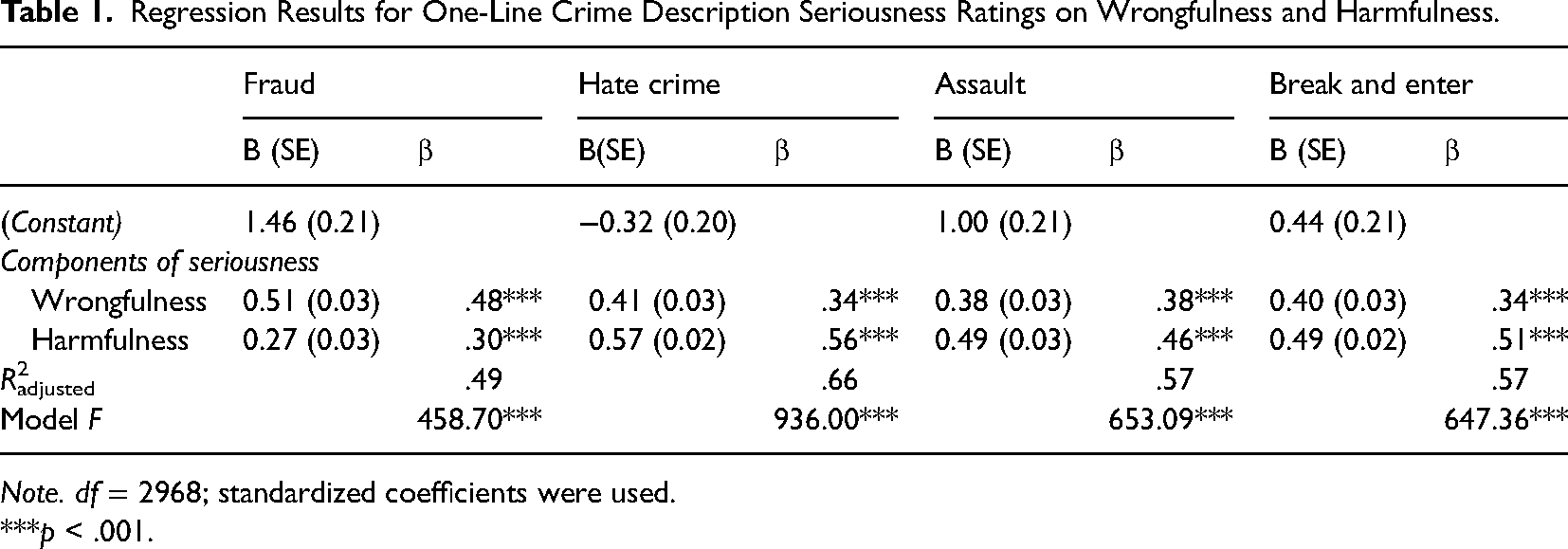
Seriousness rankings were regressed on all four crime types, fraud, hate crime, assault, and break and enter, first for the one-line depictions (Table 1) and then scenarios (Table 2). All models presented in Table 1 were statistically significant and saw wrongfulness and harmfulness explain substantial amounts of variance. In Table 1, the largest observed impact for an equation was for the hate crime (R2adjusted = .66), equivalent amounts of variance explained were seen for assault and break and enter (R2adjusted = .57), and the lowest (but still substantial) was for fraud (R2adjusted = .49). Variance explained by predictor for fraud was higher for wrongfulness (
Regression Results for One-Line Crime Description Seriousness Ratings on Wrongfulness and Harmfulness.
Note. df = 2968; standardized coefficients were used.
***p < .001.
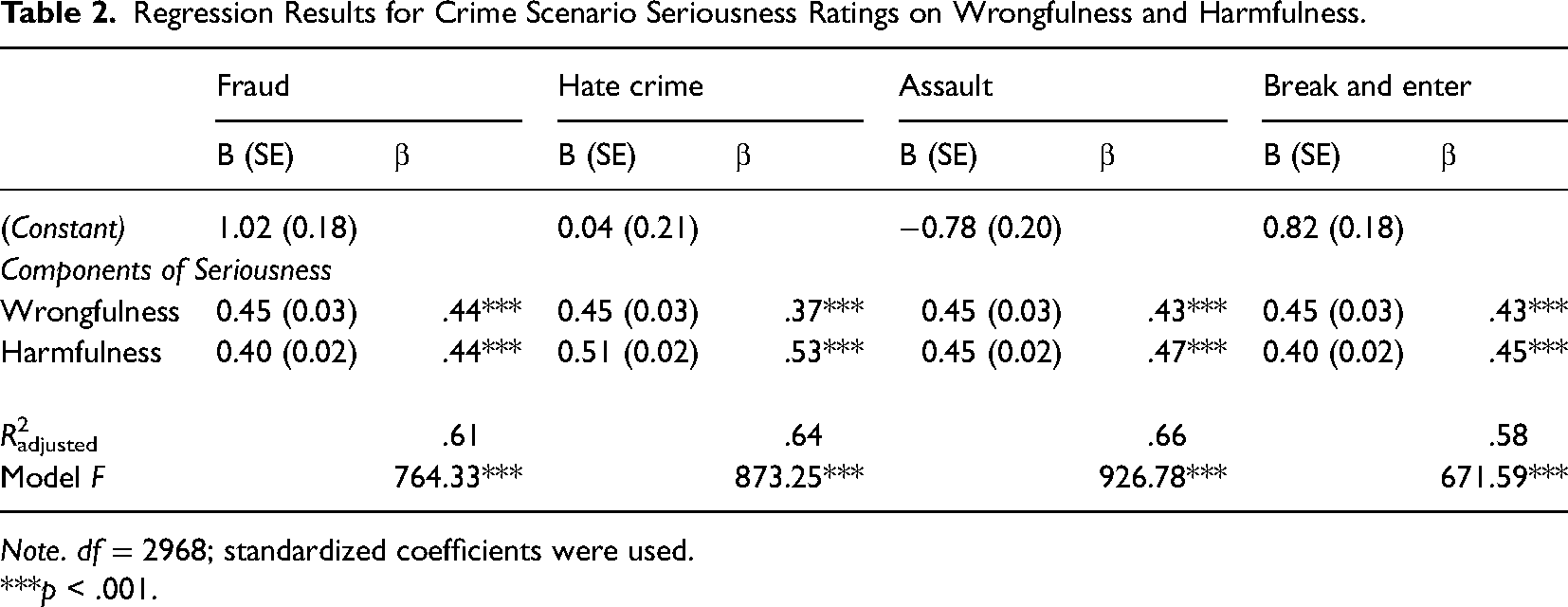
Regression Results for Crime Scenario Seriousness Ratings on Wrongfulness and Harmfulness.
Note. df = 2968; standardized coefficients were used.
***p < .001.
In Table 2, each of the four models explained a substantive amount of variation and were again statistically significant . Variance explained for fraud increased by 12% and for assault 9%. Hate and break and enter crimes only changed 1% or 2%. This time, assault ranked highest (R2adjusted =.66), followed by hate crime (R2adjusted = .64), fraud (R2adjusted = .61), and break and enter (R2adjusted = .58). For scenarios, β weights for wrongfulness and harmfulness were quite similar for fraud, assault, and break and enter. With the exception of fraud, where the amount of variance predicted by wrongfulness and harmfulness was identical (
Severity by Crime Type
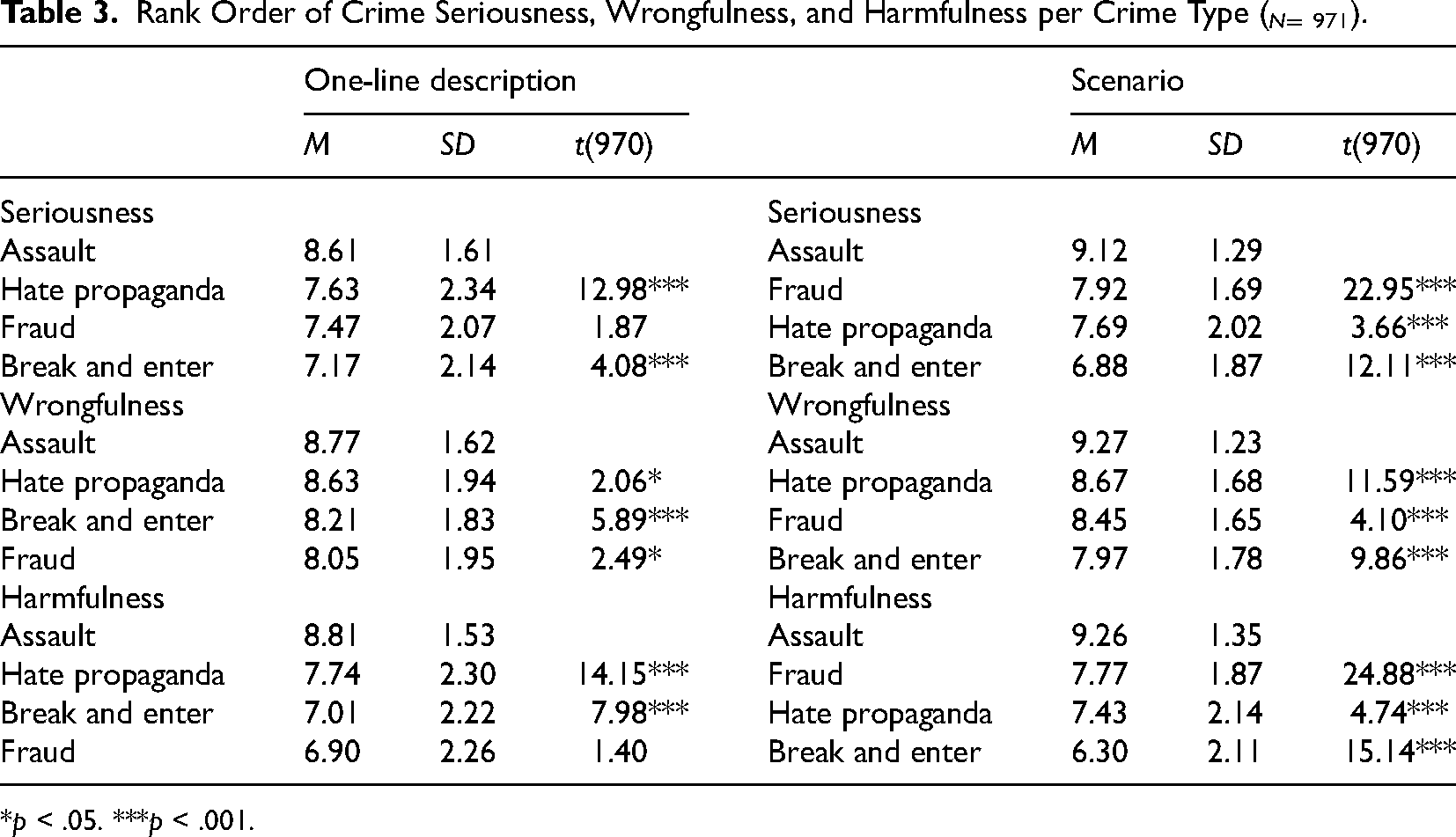
In Table 3, seriousness, wrongfulness, and harmfulness mean scores by crime type are displayed in ranked order from highest to lowest. For example, in the one-line section, the mean severity score for assault is ranked first at 8.61 for severity, and hate propaganda is ranked the next highest at 7.63, fraud is 7.47, and break and enter is lowest at 7.17. The mean score of each offence category is compared to the one preceding it by a paired t test for statistical significance. For example, for perceived seriousness, the difference between assault and hate propaganda is 0.88, or 12.8%, and this is statistically significant, t(970) = 12.98, p<.001. Next, the mean difference of 2.1% between fraud and hate propaganda is compared, but this score is not statistically significant, given a t statistic of only 1.87. The difference of 4.2% between fraud and break and enter does, however, attain a statistically significant difference, t(970) = 4.08, p<.001.
Rank Order of Crime Seriousness, Wrongfulness, and Harmfulness per Crime Type ( N = 971).
*p < .05. ***p < .001.
Participants ranked all four offence types as quite serious, morally wrong and harmful for both one-line depictions and crime scenarios. As expected, the violent crime of assault was ranked highest for severity, wrongfulness, and harmfulness in both one-line descriptions and scenarios. For the one-line descriptions, assault seriousness rating of 8.61 was ranked 12.8% higher than the hate propaganda mean of 7.63, which was only 2.1% higher than fraud and was 4.2% greater than break and enter. For moral wrongfulness, assault was only rated 1.6% higher than hate propaganda, which was 5.1% larger than break and enter and was 2% greater than fraud. Harmfulness rankings saw assault 13.8% higher than hate propaganda, which was 10.4% larger than break and enter and was only 1.6% higher than fraud. Overall, most differences were small, even though they were statistically significant.
In comparison, the differences between ranked crimes showed greater substantive and stable differences for responses to crime scenarios as opposed to responses to the one-line crime descriptions. Contrary to the one-line crime descriptions, mean scores were consistently more extreme, particularly for higher rankings, and all differences were statistically significant. In addition, variance scores were lower than in the one-line crime description model. For seriousness, assault was 23.7% higher than fraud, which in turn was 16.3% larger than hate propaganda and was 8.0%, greater than break and enter. In wrongfulness rankings, assault was 26.8% higher than the hate crime, which was only 1.8% larger than fraud and was 7.3% greater than break and enter. Harmfulness ratings again saw a moderate difference of 27.8% between assault and fraud, which was 12.6% larger than hate propaganda and was ranked only 1.4% greater than the break and enter crime.
There were other differences between the one-line and scenario rankings. In the one-line depictions, assault and hate propaganda were consistently one to two in rankings. Fraud was ranked as third most serious but was fourth most in wrongful and harmful categories. Fraud and break and enter tended to display scores fairly close to each other. In the scenarios, assault and fraud were one to two on severity and harmfulness, while hate crime ranked second on moral wrongfulness but third in seriousness and harmfulness. Break and enter ranked third for severity and wrongfulness and last for harm in the one-line descriptions but was consistently last in all three scenario rating categories.
The added detail in the scenarios also appeared to generate higher ratings for all crimes in all three categories, except for break and enter, which was noticeably lower. For example, on the 10-point scale assault ranked between 8.61 and 8.81 in the one-line depictions but was 9.12 and 9.17 in the scenarios. This pattern of higher scores for scenarios is also evident for fraud and hate propaganda. In contrast, break and enter ran from 6.90 to 7.17 in the one-line and went 6.30 to 7.97, with scores lower in each side-by-side comparison.
Severity by Crime Representation
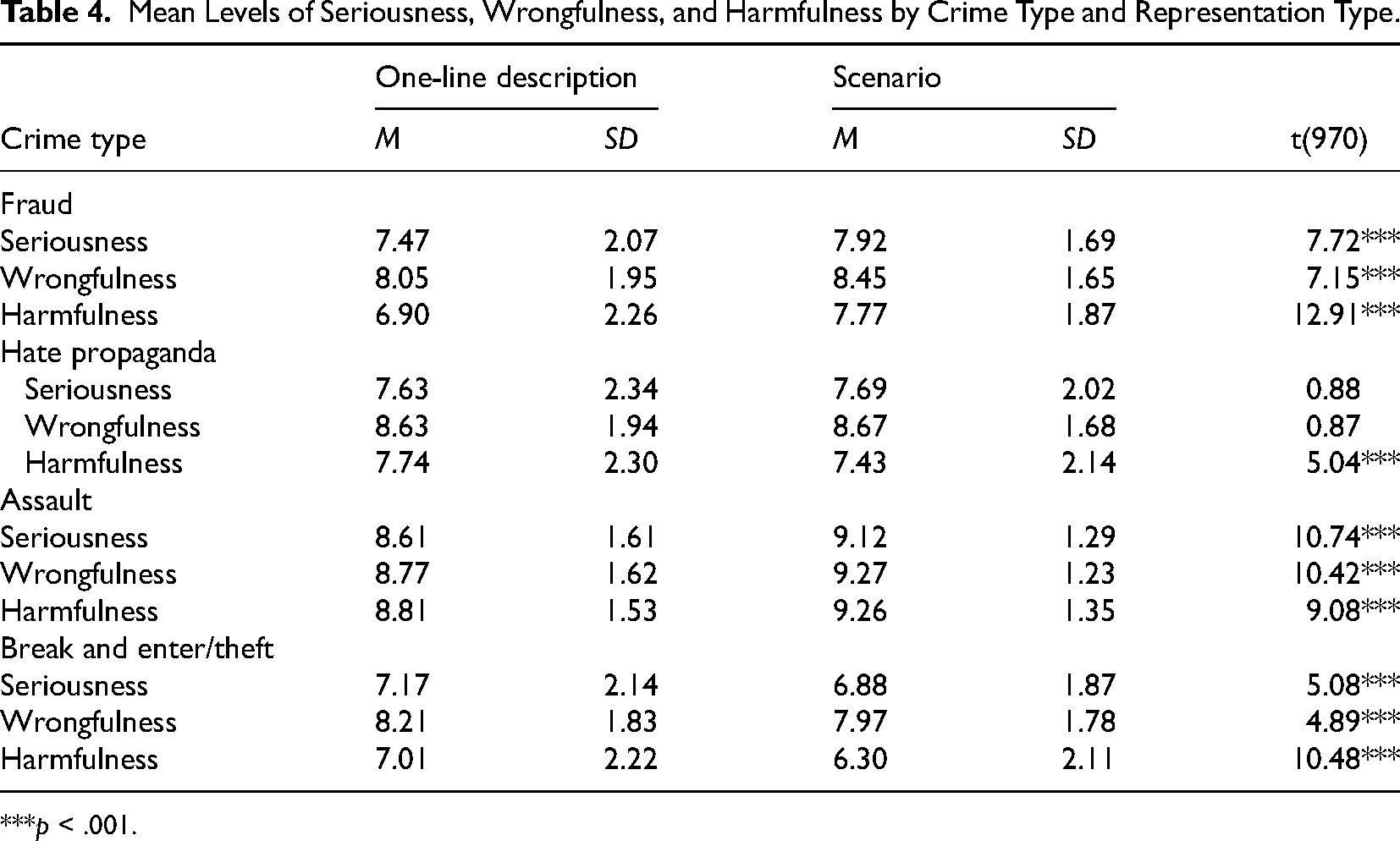
In Table 4, mean levels of seriousness, wrongfulness, and harmfulness are compared for each crime type across different crime representations using a paired sample t test. With the exception of two comparisons, mean levels of severity, wrongfulness, and harmfulness were significantly different between one-line crime descriptions and scenarios.
Mean Levels of Seriousness, Wrongfulness, and Harmfulness by Crime Type and Representation Type.
***p < .001.
In general, participants seemed to rate fraud significantly more serious, wrong, and harmful when confronted with the scenario description as opposed to the one-line description. The mean rating for fraud seriousness was significantly higher for the scenario description compared to the one-line description, t(970) = 7.72, p < .001. The same phenomenon is observed with measures of wrongfulness where a mean increase of 4.97% was statistically significant, t(970) = 7.15, p < .001, as well as for harmfulness with a mean increase of 12.6%, t(970) = 12.91, p < .001.
The same trend can be observed in the ratings for assault. Seriousness ratings for the one-line description are significantly different from those given for the scenario, t(970) = 10.74, p < .001. A mean increase of 5.7% on ratings of wrongfulness for the assault scenario was also statistically significant, t(970) = 10.42, p <.001. Furthermore, although the increase between ratings of harmfulness for the one-line description and the scenario was slightly smaller than that of wrongfulness and seriousness, a mean increase of 5.1% was nevertheless also significant, t(970) = 9.08, p <.001.
In general, hate crimes ratings saw the least amount of difference between one-line crime descriptions and the crime scenarios. The difference in ratings for seriousness was not statistically significant, t(970) = 0.88, p = .38. Similarly, the ratings of wrongfulness also did not show any significant difference, t(970) = 0.87, p = .38. However, interestingly enough, a mean decrease in harmfulness by 4.2% for the scenario did prove to be statistically significant, t(970) = 5.04, p <.001. The difference in responses to break and enter, although significant, are different from those of the other crime types in that participants gave lower ratings in response to the scenario as opposed to the one-line description. The mean seriousness rating in response to the scenario was significantly lower than the response to the one-line description, t(970) = 5.08, p < .001. In addition, the 3% decrease in wrongfulness ratings for the crime scenario was also statistically significant, t(970) = 4.89, p < .001. Finally, responses to ratings of harmfulness indicated again the most significant difference, t(970) = 10.48, p < .001, with a 11.3% decrease in mean ratings of harmfulness after reading the crime scenario.
Discussion
In considering RQ1, it was found that consistent with the literature, perceived wrongfulness and harmfulness were substantial predictors of crime severity (see Adriaenssen et al., 2020; Rosenmerkel, 2001; Stylianou, 2003; Warr, 1989), with variance explained ranging from 49% (fraud) to 66% (hate crime) in one-line depictions, and a slightly stronger range of 58% to 66% for the crime scenarios. In both Tables 1 and 2, there was a tendency for harmfulness to be a stronger predictor of seriousness than wrongfulness, but it is acknowledged that the differences were often small and did not vary much by crime type. In following up on RQ2, it can be observed that one-line depictions of hate crimes, assault, and break and enter were impacted more by perceived harmfulness, and this was also true when using scenarios. Contrary to findings by Adriaenssen et al. (2020), seriousness ratings were higher for harmfulness than moral wrongfulness, although the differences were not large.
As others found (Adriaenssen et al., 2020; Rosenmerkel, 2001; Stylianou, 2003; Warr, 1989), this study confirmed the influence of perceived wrongfulness and harmfulness as significant predictors of perceptions of crime seriousness. Although the degree of influence varied by crime type, perceptions of harmfulness tended to be more predictive of severity ratings than perceived moral wrongfulness, especially in the context of the crime scenarios. For RQ3, it is noted that similar to the results of other studies (Adriaenssen et al., 2020; Einat & Herzog, 2011; Michel, 2016; O’Connell & Whelan, 1996; Rosenmerkel, 2001; Stylianou, 2003), participants rated violent crime as significantly and consistently more serious, wrong, and harmful than other crimes. However, there is a notable increase in variability among crime types other than assault, in particular for the one-line crime descriptions, indicating some ambiguity regarding the perceived seriousness of these crimes. This finding is similar to that of Einat and Herzog (2011), who reported higher seriousness scores were accompanied by lower standard deviations.
Fraud rankings changed the most from one-line to scenarios, with the white-collar offence ranked lowest for wrongfulness and harmfulness in one-line, but then ranked higher in the scenarios. It was quite close to severity to hate propaganda in the scenarios, suggesting both of these “nonviolent” crimes were considered quite serious. The seriousness ratings for fraud contradict findings by Stylianou (2003) and Adriaenssen et al. (2020) who reported that after violence, property crimes were ranked second and corporate offences lowest. However, Adriaenssen et al. (2020) note that while wrongfulness scores match seriousness, the severity of harmfulness assessment saw property and corporate offences switch in ranking, with property crime being viewed as less harmful than violent and corporate crime. Adriaenssen et al. (2020) as well as Rosenmerkel (2001) suggest that this rating may reflect a sense of awareness as to the potential large-scale harm corporate and environmental crime may have due to their impact on multiple victims. Furthermore, the significant rise of internet use and subsequent online scams and instances of identity theft in Canada may also play a role in the increased severity ratings for fraud (Cotter, 2021).
The striking changes in perceived levels of seriousness, wrongfulness, and harmfulness of fraud in the crime scenario versus the one-line description support the idea that awareness may be key in judging perceived seriousness. Fraud ratings for overall seriousness and harmfulness moved from being judged similar to those for break and enter in the one-line description up to being second highest to assault for the crime scenario. While this change may be due to the scenario used to depict fraud, it may, however, also be illustrative of a general lack of knowledge among the population regarding the actual wrongfulness and harmfulness of fraud. Without a specific and concrete example that illustrates the potential harmfulness and moral wrongfulness of fraud, there may be a tendency to rate fraud crimes as less morally reprehensible and harmful, even while the severity of fraud is still somewhat acknowledged.
Comparisons between ratings across crime representation indicated that participants seemed to rate crimes as more serious, wrong, and harmful when confronted with the scenario description as opposed to the one-line description. The exceptions to this are the measures of harmfulness for the hate crime scenario and all severity measures for the break and enter crime scenario, where participants were less severe in their ratings for the scenario than for the one-line description. With the exception of assault, the largest significant difference in ratings was observed for perceived levels of harmfulness. One possible explanation for this could be that harm is more tangible and real within the scenario descriptions as opposed to the one-line descriptions, where participants relied more on their own ideas of potential harm. Since harmfulness has also been shown to be the stronger predictor of perceived seriousness for all crimes, with the exception of fraud, this could also explain the increased seriousness levels for the scenarios.
Variability between ratings decreased for scenarios compared to one-line descriptions. This may indicate that “fill in the blank” behavior mentioned by Lynch and Danner (1993) as well as within-group differences on the exact nature of each crime type does indeed pose a problem to the internal validity of the research. However, considering the influence of harm on perceptions of seriousness, the actual description of harm through the scenario description reduces the ambiguity surrounding the actual harm of the crime, resulting in more consistent perceptions of harm that, in turn, influence the variability of severity scores.
RQ4 outlined an interest in the impact of hate crime on severity rankings. Interestingly enough, severity ratings for hate propaganda were second to assault in the one-line descriptions. Indeed, the small difference in wrongfulness ratings for hate crime compared to assault suggests that respondents viewed this offence almost as morally reprehensible as assault. This trend persists in wrongfulness ratings for the crime scenarios, where hate crime replaces fraud in wrongfulness ranking. The high severity ratings of hate crime suggest that respondents may reflect on the possible psychological harm caused by hate crime as well as the potential physical violence that can arise out of hate crime in making severity judgments (Lyons, 2008). This approach would correspond with the argument that violent crimes will be ranked higher in perceived seriousness than other nonviolent crimes.
There are several limitations to this study. The results from comparisons between one-line descriptions and crime scenarios will likely vary with different scenarios, as the descriptions in the scenarios are very specific. For example, generalizing across all assaultive offences should be done cautiously, as aggravated assault occurs much less frequently than simple assault. The fraud offence used in this study was intended to represent more of a serious white-collar offence (million dollar fraud), and so the variation between a general one-line depiction and say a series of fraudulent checks would likely elicit a different response. Despite our efforts to justify the representative nature of the study sample, in the end, it was a nonrandom online sample with a 10% response rate and may not align with public attitudes toward crime and its punishment. That said, cross-national researchers have found that convenience sample university student surveys offer several advantages, including coming closer to public attitudes than critics might suggest (Straus, 2009).
Conclusion
As this study illustrates, perceptions of crime severity are influenced by crime type as well as the degrees of wrongfulness and harm attributed to the act. Wrongfulness and harmfulness, as well as severity rankings merit continued attention. These findings also show how representations of crime in research can influence measured perceptions of crime. Scholars need to carefully consider how to go about representing crime in similar research endeavors particularly if such academic research may be used to inform the formation of criminal justice policies. Synopses of actual court cases are recommended in place of fabricated scenarios for research examining crime seriousness as they provide a more realistic setting and provide a more accurate comparison of public perceptions toward crime and subsequent sanctions. Hate crime is an important addition to offences considered by researchers, given the magnitude of this social problem and its growing importance to policy and legislation. Finally, future surveys should attempt to consider a greater diversity of crimes overall.
Footnotes
Appendix
Authors Note
The authors would like to extend their thanks to four anonymous reviewers for their helpful feedback on earlier versions of this article.
Declaration of Conflicting Interests
The author(s) declared no potential conflicts of interest with respect to the research, authorship, and/or publication of this article.
Funding
The author(s) received no financial support for the research, authorship, and/or publication of this article.
