




Abstract
When Mirandizing a suspect, officers sometimes compare the Mirandizing process to their representation on TV. In doing so, officers assume the suspect (and more generally the American public) is familiar with, and understands, their Miranda warnings due to their dissemination on TV. Thus, this paper investigates how the Mirandizing process is presented on TV. An analysis of arrests and custodial interviews on Law & Order: SVU indicates that fictional suspects are rarely adequately Mirandized; they are either not Mirandized at all or are provided a partial version. Moreover, suspects on TV are found to attempt to explicitly invoke their rights only 11% of the time, of which there is about a 50–50 chance of the attempted invocation being successful. In 23% of the time, legal representation appears without any language from the suspect showing them invoking their rights. Attempted and implied invocations on TV are primarily made by persons guilty of the crime they are being accused of, and innocent suspects primarily waive their rights, reinforcing a popular belief that guilty people invoke their rights and innocent people waive them.
Introduction
Cautioning a suspect of their legal rights is arguably one of the most important procedural steps in investigative interviewing. Without an adequate administration of a suspect's rights, any information gained from the proceeding interview may be considered inadmissible in later criminal proceedings. As such, these rights, and the way they are administered, have been the focus of much scholarly research and legal interest.
In the United States, these rights are commonly referred to as the “Miranda warnings.” These warnings are the result of the Supreme Court decision, Miranda v. Arizona (1966), in which the court ruled that a suspect must be informed of certain legal rights, including their Fifth Amendment right against self-incrimination and their Sixth Amendment right to counsel, prior to interrogation. An example of the Miranda warning reads as follows:
(1) You have the right to remain silent. (2) Anything you say can and will be used against you in a court of law. (3) You have the right to talk to a lawyer and to have him [sic] present with you while you are being questioned. (4) If you cannot afford an attorney, one will be appointed to represent you before any questioning if you wish. (5) You can decide at any time to exercise these rights and not answer any questions or make any statements. (6) Do you understand each of these rights I have explained to you? (7) Having These Rights in Mind, do you Wish to Talk to us now?
This version is used as exemplary in various studies of Miranda warnings (e.g., Berk-Seligson, 2009; Pavlenko et al., 2019). While there is no standardized wording required to communicate these rights, the Miranda warning must “adequately and effectively” inform the suspect of their rights (Miranda, 1966 at 467). Moreover, any waivers of these rights must be done “knowingly and intelligently” (Miranda, 1966 at 475), and as such, the warnings must be conveyed meaningfully. Various studies have explored the ways in which the meaningfulness of the warnings may be diminished, primarily focusing on the language of the cautions (e.g., Pavlenko, 2008; Shuy, 1997) or how they are delivered (e.g., Domanico, Ciccini & White, 2012). These studies have demonstrated various problems that the language used in communicating these rights poses for suspects. Such problems typically surround issues of comprehensibility caused by technical language and the use of uncommon words or meanings, the use of complex sentences, the logical order of rights, and the speed of speech that the rights are provided. Research has also focused on comprehension issues when speakers of a language (or a language variety) other than that of the dominant language variety of the legal institution are being interrogated (e.g., Berk-Seligson, 2009; Pavlenko et al., 2019).
Beyond the language of the instant cautions, Leo and White (1999) focus on the language surrounding the warnings, such as the language used to introduce the Miranda warnings to suspects. They describe discursive ways that officers mitigate or de-emphasize the significance of the warnings, including camouflaging the warnings by blending them into conversation, explicitly calling attention to the warnings as a formality, focusing the suspect's attention on the importance of them telling their story, treating the suspect's waiver as already accomplished, creating an appearance of a nonadversarial relationship, and referring to the warnings’ dissemination in popular culture. This last observation, that American officers refer to the Miranda warnings’ dissemination in popular culture while introducing the warnings to suspects (see also Feld, 2006; Leo 2001; Wilson, 2017) is the focus of this study.
Leo and White (1999) discuss this pattern as a discursive strategy by the interrogating officers to mitigate the importance of the rights. They posit that By referring to the dissemination of Miranda warnings in American popular culture, interrogators seek to trivialize the warnings’ legal significance. Their hope is that the suspect will not come to see the Miranda warning and waiver requirements as a crucial transition point in the questioning or as an opportunity to terminate the interrogation, but as equivalent to other standard bureaucratic forms that one signs without reading or giving much thought. (p. 434–435)
In the sections below, the discursive pattern of officers referring to the cautions’ dissemination on TV is demonstrated through excerpts from real-life police interviews. This is followed by analyses of the Mirandizing process as it is presented on TV through an investigation of custodial interviews on a long-running American police procedural and legal drama, Law & Order: SVU. The analyses are followed by a discussion and conclusion.
A Discursive Pattern in Communicating Miranda Warnings
As noted above, the belief that the American public may be familiar with the Miranda warnings because of their dissemination on TV has been a noted feature in the interrogation room (Feld, 2006; Leo, 2001; Leo & White, 1999; Wilson, 2017). Below, excerpts are provided from American police interrogations (from caselaw and research literature see Feld, 2006; Leo & White, 1999) and online public collections (Gales & Wing, 2022)) that demonstrate interrogating officers referring to the dissemination of Miranda warnings in popular culture while communicating the Miranda warnings to suspects (bolded). These examples come from police interviews spanning the last three decades, suggesting that this discursive pattern exists despite advances in policing procedures (e.g., the adoption of Language Access plans and mandated electronic recording) and developments in media production and consumption.
DETECTIVE: But anytime that you’re talking with detectives in the police station, and we have to ask you some pointed question, I’m gonna read you your rights just so you, just so you know them and everything else, okay? This is just like on TV, um, it's called your statement of rights. (State v. Eskew, 2017) DETECTIVE: Okay, um, so that's a fairly serious situation that we need to resolve hopefully here tonight, but I wanna make sure you understand that you don't have to talk to me and those kinds of things, okay? Both you and your dad know how to read, right? Okay. I'll read it out loud to ya and then I'll let you read it through if you want. Ah, it's a Warning and Consent to Speak. Okay, basically and you've heard the Miranda warning on Cops and TV and stuff. (Feld, 2006, p. 76) DETECTIVE: Because you're in custody, I know um, Detective Lucas, he read you your rights once already, right? Um, before I can hear anything, you, I have to read you your rights just like he did. Did you understand them when he read them to you? SUSPECT: Yeah. DETECTIVE: Okay, it's just like TV but I can't talk to you unless I read them to you. (Leo & White, 1999, p. 436) DETECTIVE: … before we talk to anybody about anything, there's a thing called Miranda and I don't know if you've heard about it, if you've seen it on TV, um… the… just to cover ourselves and to cover you, to protect you, we need to, to advise you of your Miranda rights and we need to know that you understand ‘em. and that you can hear them, so if you'll speak up for us, okay? (Leo & White, 1999, p. 435) DETECTIVE: In order for me to talk to you specifically about the injury with [victim's name], I need to advise you of your rights. It's a formality DETECTIVE: I want to hear you tell me what you did- and what you didn't do. But first, I gotta read you your rights. You watch TV, you know the drill …. (Leo & White, 1999, p. 436) DETECTIVE: Yes sir so uh before we get into it I know I could see right by your expression you've got a lot of questions to ask us we got a couple to ask you too I'm sure you've seen this on TV a thousand times I'm gonna advise you and then we'll talk about it man to man here. (True Crime Daily, 2016) DETECTIVE: Okay, so you've probably heard or seen this on TV before but it's your notification and rights, your Miranda rights and so I'm going to read them to ya but I want to sit here where you can see the paper because what I'm going to do is I'm going to read one through five right here and so I'll read them and you kind of can look at it with me I want to make sure you understand all these (Law & Crime Network, 2022) Miranda v. Arizona is the most well-known criminal justice decision - arguably the most well-known legal decision—in American history. […] The Miranda warnings themselves have become so well-known through the media of television that most people recognize them immediately. […] the Miranda decision has added its own lexicon of words and phrases to the American language. […] the Miranda warnings are more well-known to school children than the Gettysburg address. (p. 1000)
When officers refer to the Miranda warnings’ dissemination in popular culture, they are relying on an assumption that suspects are already familiar with their rights. Indeed, Rogers (2008) notes that police shows on TV such as Law & Order have primed most Americans to recognize their rights, and Payne and Guastaferro (2009) found that 85% of police chiefs think most offenders already know their rights. Legal scholars often consider the Miranda warnings a “cultural icon” (Covey, 2007, p. 762), with the notoriety of the Miranda warnings often attributed to their dissemination on television. For example, Leo (2001) states that
This sentiment is repeatedly echoed in the literature. For example, Finkelman (2005) notes that “most [Americans] can recite the Miranda warning from memory because they have heard it so often on television” (p. 998), Covey (2007) states that “[n]ot only did television make the Miranda warnings famous, its adoption of Miranda as an icon of criminal procedure may be the main reason Miranda is good law today” (p. 761), Thomas (2000) notes that “Miranda—the Supreme Court's boldest and most famous criminal procedure case […] The typical TV viewer has heard Miranda warnings given hundreds of times” (p. 2), Ryan (2006) notes that “[d]ue in large part to the popularity of police and law dramas on television and in movies, the right to remain silent is perhaps one of the most widely known constitutional rights” (p. 903), Regini (2000) states that “[a]s witnessed nightly on televisions across the United States for the last three decades, there may be no legal principle more firmly established in the country's popular culture than the Miranda warnings” (p. 27), and Schauer (2013) notes [l]argely as a consequence of American television and movies, Miranda v. Arizona may well be the most famous appellate case in the world […] a Miranda portrayal that reflects the reality of genuine police officers giving genuine Miranda warnings to genuine suspects millions of times every year. (p. 155)
Moreover, the US Supreme Court has also referred to the recognizability and prevalence of Miranda warnings in American society, stating “Miranda has become embedded in routine police practice to the point where the warnings have become part of our national culture” (Dickerson v. United States, 2000 at 444).
However, studies have demonstrated that suspects do not know their Miranda warnings. For example, Rogers, Fiduccia, Drogin, Steadham, Clark & Cramer (2013, p. 439) found that a third of their participants “described themselves as truly uninformed (0%–20% knowledge)” of their rights, and Rogers, Rogstad, Gillard, Drogin, Blackwood & Shuman (2010) found that “the public is largely misguided in their perceptions of Miranda rights” (p. 314). If it is presupposed by interviewing officers that a suspect's knowledge of their rights is coming from TV, it is also important to consider that there is a reality in which some people living in the United States have not actually seen the Miranda warnings on TV; only about 53% of American households have cable network TV (Number of pay TV households in the U.S., 2022). Likewise, populations overrepresented in the legal system are those of lower socioeconomic status (and therefore more likely to not have access to cable TV) and speakers of languages other than English (such as immigrants who may be unfamiliar with American television shows). Keaton (2020) demonstrates that even when the Miranda warnings are translated into a language that a suspect may be more familiar with, there is an “assumption by law enforcement agencies that detainees will have a baseline familiarity with their Constitutional rights and will be able to fill in linguistic gaps through assumptions and inferences” (p. 68).
Additionally, Steiner, Bauer & Talwar (2011) suggest that the perception of repeated exposure to the Miranda warnings may be outdated, as their study of various TV shows from the late 1960s to the mid-2000s demonstrates that the frequency of the warnings on TV has decreased over time. As such, this suggests that interviewing officers who may have grown up watching TV in the 60s and 70s may have been exposed to a different quantity of the Miranda warnings on TV compared to younger suspects (under 39 years old) they are more likely to be interviewing (Vera Institute of Justice, 2021).
When officers refer to the Miranda warnings’ dissemination in popular culture, the assumption that suspects already know their rights also presumes that suspects understand their rights. However, familiarity with the Miranda warnings does not necessitate comprehending them. Again, studies have found that people living in the United States may not fully understand their Miranda rights. For example, Grisso (1981) found that only 21% of juvenile and 42% of adult offenders fully understood their rights. Since then, Rogers, Shuman & Drogin, (2008) has found that “almost 64 percent of college undergraduates […] displayed two or more fundamental errors in Miranda understanding” (p. 5), and based on a self-report questionnaire, Rogers et al. (2010, p. 314) note that “the idea of an accurate working knowledge [of the Miranda rights] for most defendants [with experience in the legal system] is highly suspect,” leading them to question whether any assumed knowledge of the Miranda warnings “is cursory—or even illusory—for a significant number of criminal defendants and their educated counterparts” (p. 317). Likewise, Pavlenko et al. (2019) demonstrated that “only 3.4% (i.e., 2/59) of L2 speakers enrolled in advanced-level ESL courses are able to demonstrate even a marginal understanding of the Miranda warnings” (p. 193). Additionally, Keaton (2020) finds that even when the warnings are translated into a language that a suspect might be more familiar with, the warnings contain numerous errors that “could substantially preclude a listener's ability to understand the intended meaning of the rights” (p. 60).
These findings indicate that misunderstandings of the Miranda warnings occur across various socio-demographic factors (e.g., age, education, previous experience with the Miranda warnings, English language abilities) (see also Smalarz, Scherr & Kassin, 2016). Moreover, the 40-year timespan amongst these studies indicates that little change has happened in making the Miranda warnings more comprehensible (despite repeated calls for such changes in the literature mentioned here and, for example, by the Communication of Rights Group in their guidelines discussed by Eades and Pavlenko (2016)).
Miranda Warnings on TV: Law & Order: SVU
Methodology
Following studies such as Eschholz, Mallard and Flynn's (2004) content analysis of civil rights violations on TV and Britto, Hughes, Saltzman & Stroh's (2007) content analysis of the meaning of “special” in Law & Order: SVU, this paper presents a content analysis of the Mirandizing process on TV. This is investigated by examining the quantity and quality of the Mirandizing process in custodial interrogations on the TV show Law & Order: SVU.
Law & Order: SVU is a long-running police procedural and legal drama. It is the longest-running prime-time drama & live-action series in TV history (Hughes, 2019) with 24 seasons (1999-present). It was chosen as an object of study as its longevity suggests a large viewership that may span generations and as such, the American public may be more familiar with it compared to other shows with fewer seasons.
Three seasons were chosen as units of analysis in 10-season intervals
1
: Seasons 1 (1999–2000), 10 (2008–2009), and 20 (2018–2019). Seasons 1 and 10 each have 22, 1-h episodes, and season 20 has 24, 1-h episodes. In total, 68 episodes were analyzed. Each episode was viewed in full and coded for the presence of each custodial interrogation. In Miranda, the court defined custodial interrogation, stating By custodial interrogation, we mean questioning initiated by law enforcement officers after a person has been taken into custody or otherwise deprived of his freedom of action in any significant way. (Miranda v. Arizona, 1966 at 445)
Each custodial interrogation was then coded for the presence and completeness of the Miranda warning. A Miranda warning was considered a complete version if it contained all the component parts reflecting the rights in lines 1–5 in the sample Miranda warning provided above. Since Rogers et al. (2010) noted that subjects in their free recall test omitted the “continuing legal rights” component (line 5 in the sample Miranda warning above) over 97% of the time, warnings containing the first four components (lines 1–4 in the sample version above) were further distinguished between versions containing at least one, but less than the first four components. Versions omitting only the “continuing legal rights” component were considered a pseudo-complete version. If at least one, but less than the first four component parts were presented, the Miranda warning was considered a partial version.
Custodial interrogations were also coded for whether the suspect attempted to invoke their rights. Invocation attempts were identified through requests for lawyers or explicit statements of not wanting to talk anymore/remain silent. Invocation attempts were coded for being successful (whether the questioning ends or a lawyer is provided) or unsuccessful (the questioning continues without a lawyer). The suspect's ultimate guilt or innocence was also coded (as made evident typically by the end of the episode).
Analysis and Findings
Issuing Miranda
Table 1 demonstrates an overview of the frequency of custodial interrogations in the 68 episodes of Law & Order: SVU considered for analysis. As shown, each episode averaged about three custodial interviews and, as such, three opportunities in each episode (196 total opportunities) for Miranda warnings to be read to suspects.
Frequency of Miranda Warnings on Law & Order: SVU.
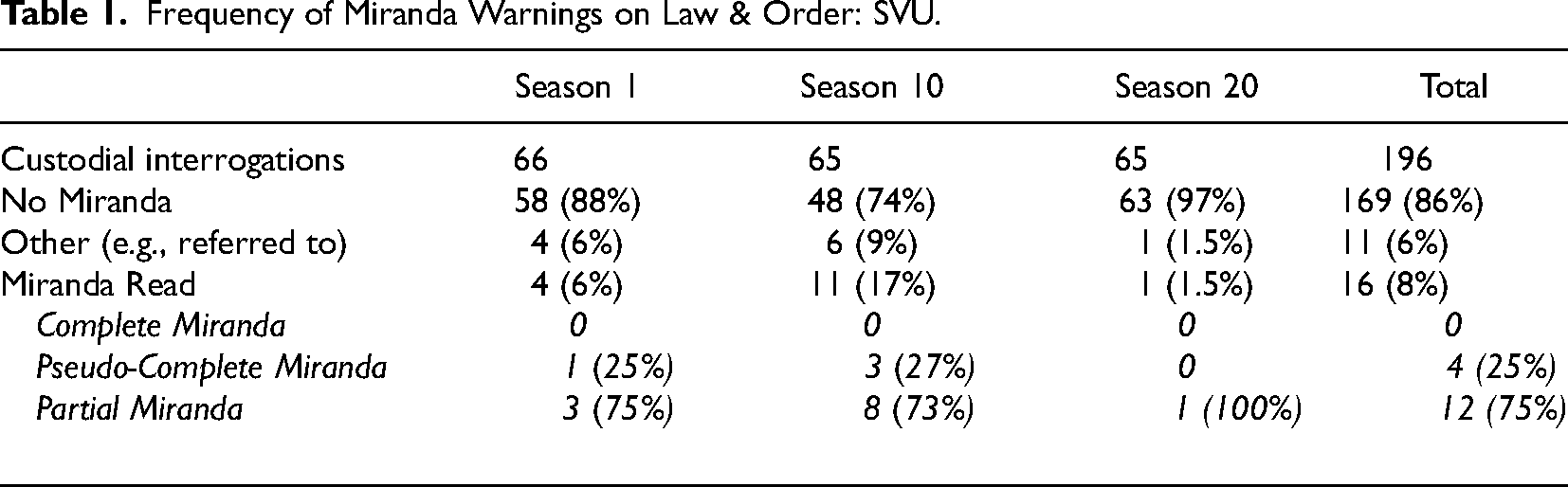
Despite 196 opportunities for Miranda warnings to be read to suspects, it was only read, at least in part, 16 times (8%). In 11 instances (6%), the Miranda warnings were referred to (e.g., “he was properly Mirandized” [S10E21]), implying that they were read to the suspect, but viewers are not actually exposed to any language of the Miranda warnings. Thus, 86% of the time there is no reference to Miranda at all, and 92% of the time, viewers of Law & Order: SVU are not exposed to the language of, or the rights included in, the Miranda warnings 2 .
On Law & Order: SVU there is never a complete version of the warnings (containing all five component parts) provided to suspects. Most often (75% of the time) a partial version is read, and 25% of the time a pseudo-complete version is read. Thus, viewers never hear the “continuing legal rights” component of the Miranda warnings. These findings indicate that Miranda warnings are not accurately presented on Law & Order: SVU. That is, viewers are not exposed to accurate representations of Miranda warnings. They are either not present at all or are presented in a reduced form. Put another way, Miranda warnings are rarely presented to suspects, and never in a complete form.
The four instances of pseudo-complete versions and 12 instances of partial versions are presented below:
Pseudo-complete versions:
DET: You have the right to remain silent. Anything you say can be used against you in a court of law. You have the right to an attorney. (unintelligible) will be appointed to you. (S1E19) DET: You have the right to remain silent. Anything you say can and will be used against you in a court of law. You have the right to an attorney. If you cannot afford one, one will be appointed to you. (S10E8) DET: You have the right to remain silent. Anything you say can and will be used against you in a court of law. You have the right to an attorney. If you cannot afford one, one will be appointed to you. (S10E10) DET: You have the right to remain silent. If you give up that right, anything you say can and will be used against you in a court of law. You have the right to an attorney. If you cannot afford one, one will be appointed to you. (S10E12)
Partial versions:
DET: You have the right to remain silent. (S1E1) DET: You have the right to remain silent. (S1E12) DET: You have the right to remain silent. If you refuse that right anything you say can and will be used against you in a court of law. You have the right to an attorney. (S1E14) DET: You have the right to remain silent. Anything you say can be used against you. (S10E3) DET: You have the right to remain silent. Anything you say can and will be used against you in a court of law. (S10E12) DET: You have the right to remain silent (S10E17) DET: Bridget Sulloway, you have the right to remain silent. Now if you give up that right anything you say can be used against you in a court of law. (S10E16) DET: Jeff, You know you don’t have to talk to us if you don’t want to. And if you do, we can use what you say against you. And if you want a lawyer we have to get you one. (S10E15) DET: You have the right to remain silent. Anything you say can and will be used against you. (S10E15) DET: You have the right to remain silent. (S10E19) DET: You have the right to remain silent. (S10E20) DET: This is the part where you have the right to remain silent (S20E17)
Invoking (and Waiving) Miranda Rights
Table 2 presents the frequency of invocations in the same custodial interrogations described above, showing that invocations are made 34% of the time. On average, suspects explicitly attempted to invoke their rights 11% of the time (though these decreased as the seasons progressed). Of these, invocations were successful half of the time. Additionally, a pattern emerged in which legal representation appeared in the interview room without any explicit indication of the suspect invoking this right. As such, the suspect's rights to counsel were implied to be invoked 23% of the time. The implied invocations, together with the successful explicit invocations, indicate that only 29% of the time invocations are successful on TV.
Frequency of Miranda Invocations on Law & Order: SVU.
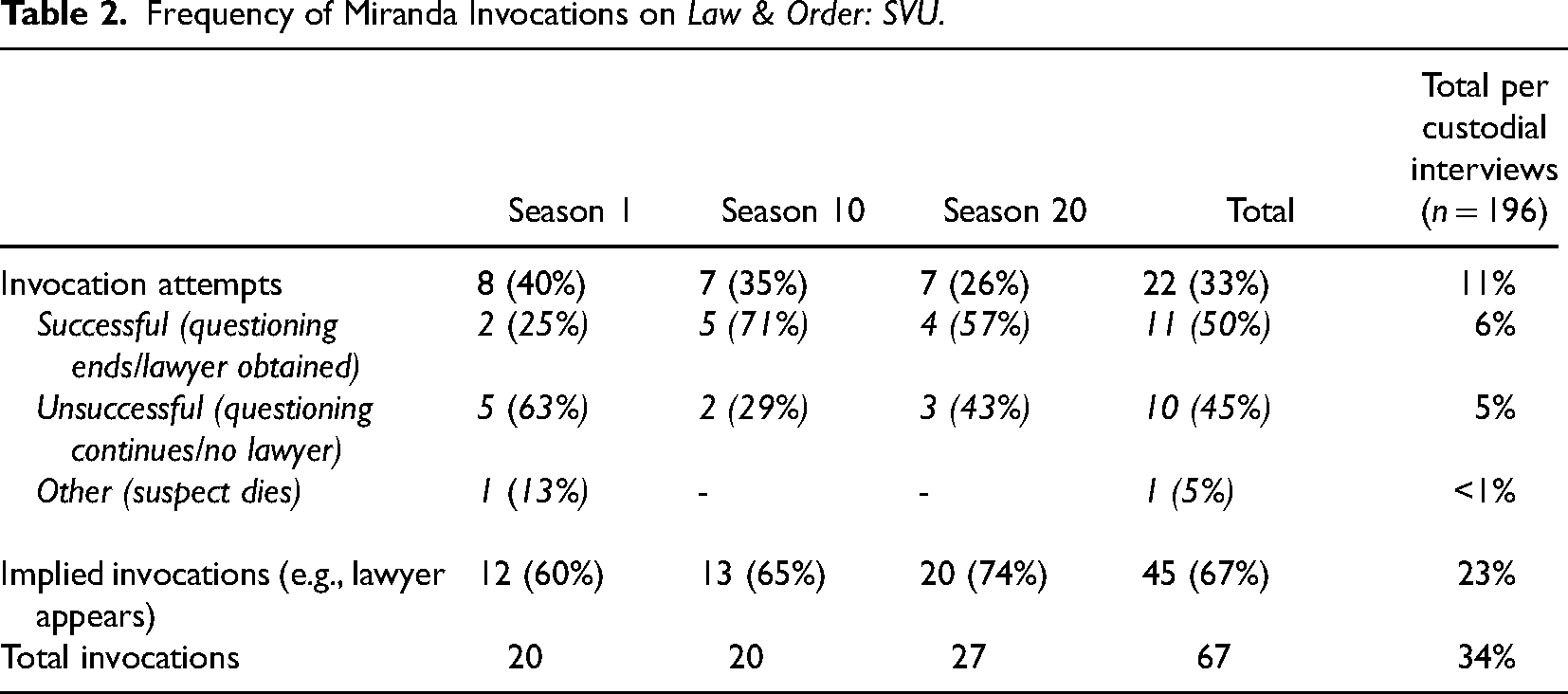
Implied invocations account for the majority (67%) of the invocations of a suspect's Miranda rights (and this increased over time). That is, when viewers do observe a suspect obtaining legal counsel, they most often (and increasingly over time) do not see or hear how the suspect requested one—a lawyer just appears. In this sense, invoking rights and obtaining legal counsel is not like on TV. In real life, suspects must use clear, unambiguous, and unequivocal language to invoke their rights (Davis v. United States, 1994, see also Ainsworth, 2008; Mason, 2013).
Guilt and Innocence
As noted above, throughout the 196 custodial interrogations, suspects (attempt to) invoke their rights (explicitly or implicitly) only 67 (34%) of the time. Of these, Table 3 shows that the suspect is guilty of the crime they are being accused of 64% of the time, guilty of another crime 13% of the time, and innocent 11% of the time. That is, when a suspect invokes their rights on TV, 83% of the time they are guilty of something (either the crime being accused of or another crime) whereas 35% of the crime the suspect is not guilty of the crime they are being accused of.
Distribution of Miranda Invocations and Waivers made by Guilty or Innocent Suspects on Law & Order: SVU.
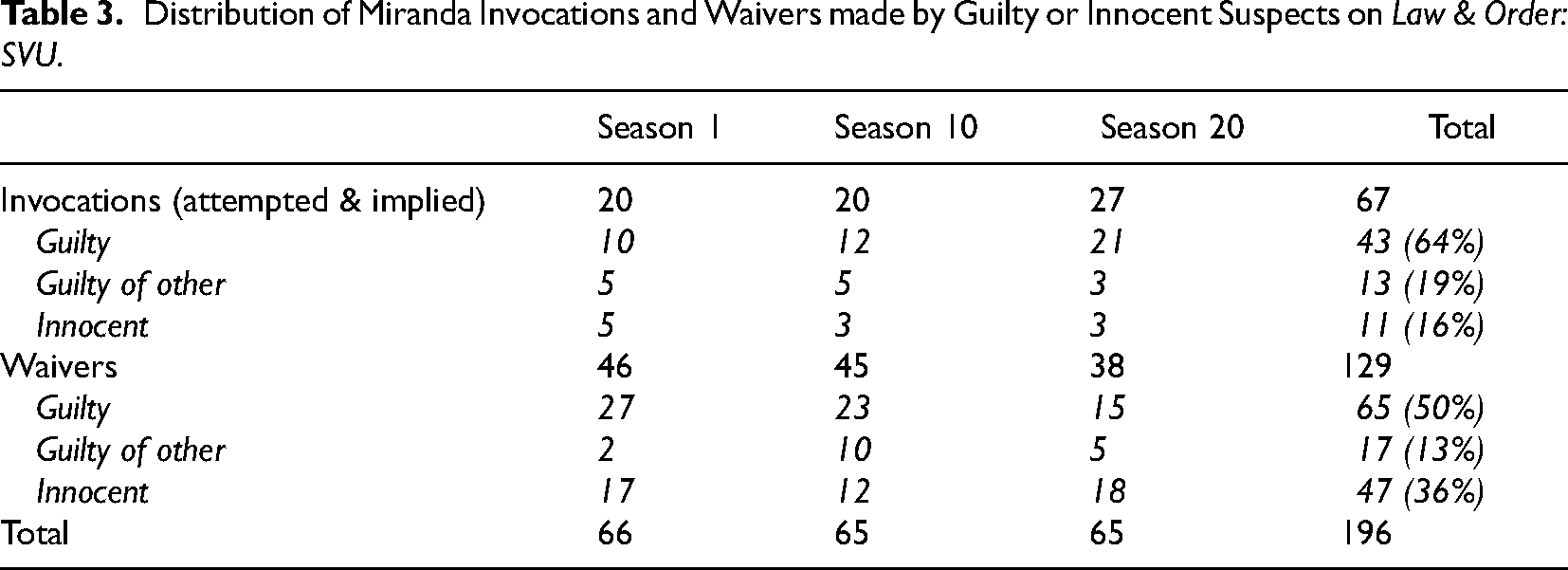
Conversely, when a suspect does not (attempt to) invoke their rights on TV, they are innocent 36% of the time, guilty of a different offense 13% of the time, and guilty of the crime being accused of 50% of the time. That is, when a suspect waives their rights, 63% of the time they are guilty of something (either the crime being accused of or another crime), and 49% of the time they are not guilty of the crime they are being accused of.
The same data from Table 3 is consolidated in Table 4 to better demonstrate patterns of guilt/innocence. It demonstrates that innocent suspects often (81% of the time) waive their rights.
Distribution of Guilty and Innocent Suspects Invoking or Waiving Miranda on Law & Order: SVU.

While Table 2 shows that guilty suspects also more often waive their rights than invoke them, Table 3 shows that the majority of the invocations are made by guilty suspects.
These analyses demonstrate that there is a relationship between guilt/innocence and invocations/waivers of rights on TV; invocations are primarily made by guilty suspects, and innocent suspects often waive their rights. This aligns with popular perceptions noted by Corn (2011), that suspects often have to “choose between asserting on the right to silence and ‘looking guilty,’ or attempting to explain to the accuser why the accusation is erroneous” (p. 763). Thus, the presentation of the Mirandizing process on TV appears to be (re)enforcing a popular ideology that guilty people invoke their rights and innocent people waive them.
In this regard, suspects that were guilty of a crime other than the crime they were being accused of present an interesting quandary. Whereas innocent suspects may waive their rights to explain their innocence and avoid looking guilty, suspects who are not guilty of the accused crimes but guilty of something else may similarly try to explain this to a questioning officer. However, because they are still guilty of something, they may also be portrayed as invoking their rights. Indeed, Table 4 shows that such suspects almost equally waive and invoke their rights.
Discussion
As discussed above, when real-life officers compare and rely on the dissemination of the Mirandizing process on TV when Mirandizing suspects, they are often relying on ideological assumptions that suspects are already familiar with their rights and that they understand their rights. If this presupposed knowledge is supposedly coming from TV (exemplified by officers comparing the process to TV), the analysis presented above demonstrates that suspects are likely to be ill-informed of their rights (and when their rights apply) from TV. That is, on TV, Miranda warnings are often not presented to suspects in custodial interrogations, and when they are, they are very rarely presented in full. Relying on such insufficient representations of these rights has the potential to result in waivers that are made based on an inaccurate and incomplete understanding of rights. As Keaton (2020) notes, “if suspects have an incomplete understanding of their rights, the likelihood that they will utilize them is further diminished” (p. 58).
The analysis demonstrates that on TV, officers rarely inform suspects of the “continuing legal rights” component of the Miranda warning. This finding aligns with Rogers et al. (2010) who found through a free recall task that participants omitted this component part over 97% of the time. The findings presented in the analyses above might offer an explanation for their finding: component parts that are presented less on TV are less likely to be known by the American public. As such, the media seems to play an important role in informing the public about law and civil liberties. However, not all TV shows are designed with educational goals; many fictional shows are primarily produced for entertainment purposes. Thus, there may be competing functions of some programming, which may be conflated when officers rely on and refer to the representation of constitutional rights on TV. This begs an important question as to how the American public is taught about law and civil rights and liberties, and what responsibility popular culture has in accurately reflecting these.
The presumption that suspects know and understand their rights from the representation of them on TV highlights the relationship between TV and lay persons’ perceptions of the law and the legal system. This relates to the concept of legal consciousness, in which people make sense of, and shape their understanding of the legal system (Ewick & Silbey, 1998; Merry, 1990). Indeed, Podlas (2005) notes that “legal scholars have accepted that television imagery can influence the public's assumptions and attitudes about law” (p. 443) and the American Bar Association notes that “media can and does impact some people's knowledge” (Anderson, 1999, p. 1315). Shows that portray legal experiences, regardless of whether or not these may or may not reflect reality, may affect how consumers of this media use these experiences to help situate and make sense of laws and legal processes, such as the Mirandizing process.
One area that has received a lot of attention in this regard is what is often referred to as the “CSI effect” in which unrealistic, fictional portrayals of forensic science on TV are viewed as potentially influencing perceptions of forensic evidence in the courtroom and therefore affecting jury decisions (Cole & Dioso-Villa, 2009). While some legal scholars dispute the actual impact that the media has on jury verdicts (e.g., Podlas, 2005), the notion of the CSI effect has led to legal actors adapting their practices. For example, Cole and Dioso-Villa (2009) note that “changes in prosecutorial behavior include questioning potential jurors about their television viewing habits in voir dire, presenting negative evidence testimony, discussing CSI in summations, and requesting legally unnecessary forensic tests” (p. 1343–1344). Thus, while prosecutors (and judges) may highlight such unrealistic expectations that lay persons (jurors) may have based on TV representations (e.g., Boatswain v. State, 2005; Commonwealth v. Seng, 2002), the opposite appears in the discursive practices discussed in this study in which officers encourage lay people (suspects) to rely on media presentations of the Mirandizing process.
The comparison to TV also consequently equates the Mirandizing process to fiction. The explicit comparison to TV may therefore have the effect of creating the presumption that the warnings themselves (the suspects’ rights) are not real. However, in reality, the warnings are very real and a suspect's decision to waive or invoke these rights can have significant implications for them. As such, the way the officers discursively introduce Miranda warnings may have meaningful effects in how a suspect understands the warnings and makes an informed decision. As noted above, Leo and White (1999) suggest that referring to the Miranda warnings’ dissemination on TV de-emphasizes the significance of the rights. While it is not clear that this should be necessarily viewed as an officer's intention, it is perhaps better understood as an effect of this discursive practice. As Wilson (2017) notes, “[t]here should not be too many risks associated with making real-life Miranda warnings a little bit more serious than they are presented on TV”.
As a police procedural and legal drama, Law & Order: SVU consists of plots that are typically focused on solving various crimes. However, the Mirandizing process rarely features as a central focus of a storyline. However, the analysis above demonstrates that the Mirandizing process is referred to (e.g., “he was properly Mirandized”) almost as often as it is actually read (at least in part), showing that the Miranda warnings are at least occasionally situated as a procedural component that should be completed. Indeed, there are a few occasions in which issues regarding the Mirandizing process are highlighted. For example, in season 1, episode 2, there is a discussion regarding a statement made by a suspect to a family member while in custody and whether it can be “used,” and in season 10, episode 18, there is a discussion as to whether a suspect's attempted invocation should be considered successful. Moreover, other iterations of the show such as Law & Order contain instances in which un-Mirandized confessions are disputed (e.g., season 13, episodes 10 and 19).
When fictional suspects do “lawyer up” (invoke their rights), it is often portrayed as an inconvenience for the investigation, and, as demonstrated above, is more often done by guilty suspects. This aligns with a popular perception that guilty people invoke their rights as they have something to hide, and innocent people waive their rights to explain their innocence to avoid “looking guilty” (Corn, 2011, p. 763). While the analysis presented above demonstrates an implicit association between invoking rights and guilt, this is also made explicit on TV. For example, in season 10, episode 18, when a suspect attempts to invoke their rights (“I think I need an attorney”), the officer states “for what you're guilt free.” This perception that invoking rights infers guilt highlights what Corn (2011) refers to as the “missing Miranda warning” (p. 764), such that suspects are not informed that silence in the face of an allegation cannot be used against them. Indeed, studies have shown that 20%–37% of people (inside and outside the legal system) failed to recognize that their silence is constitutionally protected and cannot be used as incriminating evidence (Rogers et al., 2010, 2013). The analysis presented above shows that TV reinforces the perception that silence infers guilt. That is, media representations of the Mirandizing process may be contributing to the erroneous portrayal of constitutional rights.
Despite this, trends in popular culture have recently included an uptake in true crime and social (in)justice (Campbell, 2019), with various media sources such as docuseries (e.g., Making a Murderer) and Podcasts (e.g., Serial) sometimes focusing on civil right and civil liberty violations. The increased presence of such issues in the media may have positive effects on informing the American public of their rights and legal processes. Future research should consider the representation of rights and legal processes in media presented as nonfiction.
Conclusion
Despite officers’ comparison of the Mirandizing process in real life to that as presented on TV, the analyses above demonstrate that the process is not “just like on TV.” Rights are often not provided at all, and when they are provided, they are primarily an incomplete version. Additionally, suspects are rarely shown actually invoking their rights. When this is shown, the invocations are shown to be successful only about half of the time. More often, legal representation appears without any language from the suspect requesting it.
It is therefore problematic if suspects are encouraged to rely on the inaccurate representations of the Mirandizing process on TV. When officers make comparisons of the Mirandizing process to TV, this reinforces the popular myths and assumptions that suspects already know their rights and that being familiar with the Miranda warnings is equivalent to understanding the Miranda warnings. Moreover, patterned portrayals of innocent suspects often waiving their rights and invocations primarily being made by guilty suspects reinforce problematic perceptions of the right to silence and of who should and should not invoke or waive their rights.
Footnotes
Declaration of Conflicting Interests
The author declared no potential conflicts of interest with respect to the research, authorship, and/or publication of this article.
Funding
The author received no financial support for the research, authorship, and/or publication of this article.
