




Abstract
In the initial phase of COVID-19, Aotearoa New Zealand was internationally praised for its pandemic response that included lockdowns to control the spread and work toward elimination. Community compliance with control measures was thus essential when pursuing elimination as a policy. Using a mixed-methods approach, we sought to explore whether New Zealand Police (NZP) were trusted to police the lockdown rules at Levels 4 and 3. We analyzed 1,020 survey responses comparing trust among respondents who had been stopped by NZP over the lockdown rules (contacts) with those who had not (non-contacts). We found that both contacts and non-contacts expressed greater trust in NZP to enforce the Level 4 than the Level 3 rules; contacts expressed less trust in NZP to enforce the lockdown rules than non-contacts; contacts perceived NZP more heavy-handed than non-contacts; contacts perceived NZP as only somewhat procedurally just and feeling somewhat encouraged to comply with the lockdown rules and; that unexpected high-profile policing-related events during the survey only affected contacts’ trust significantly. We offer two explanations: (1) NZP were perceived as procedurally unjust or inconsistent in applying the lockdown rules, (2) members of the public and NZP learned the lockdown rules simultaneously. We caution that the unfamiliar character of pandemic policing may jeopardize trust in NZP even among segments of the population that typically express high levels of trust in NZP, that is, people of European descent. We conclude that community compliance with pandemic control measures is no matter to be dealt with by the criminal legal system.
New Zealand Police as Public Health Educators During the 2020 COVID-19 Lockdown
Public health issues have long lingered on the periphery of policing and criminal justice studies (Punch & James, 2017). Although the COVID-19 pandemic and related social control measures (such as nationwide lockdowns and travel restrictions) have propelled both public health education and intervention measures into the spotlight of police work, much of the criminological research on the impact of COVID-19 lockdown measures continues to be concerned with conventional criminal justice questions, such as the effect of lockdown measures on crime rates (e.g., Ashby, 2020; Stickle & Felson, 2020), policing practices and culture (e.g., Alcadipani, 2020; White & Fradella, 2020), and the health and mental health of police officers (e.g., Rooney & McNicholas, 2020; Stogner et al., 2020). Meanwhile, the public health sector has become increasingly aware of the role policing plays in addressing epidemiological threats (Anderson & Burris, 2016; van Dijk & Crofts, 2017). Yet, that “does not mean […] that police work is ‘like’ public health work, let alone that police and public health agencies share important features in culture and methods” (Anderson & Burris, 2016, p. 300). This observation raises important questions about the role of the police in public health policy. It implores us to ask whether (and if so why) members of the public trust police around the world when they are asked to take on the dual role of public health educators and lockdown enforcers in the context of unprecedented, large-scale intersectoral interventions mandated by the COVID-19 pandemic. Our study focuses on Aotearoa New Zealand (NZ), where safeguarding the integrity of public health measures through education, encouragement, and enforcement (NZP, 2020a) became a new primary task for New Zealand Police (NZP) frontline officers during the first pandemic lockdown in March 2020. We examine whether NZP were trusted to police the lockdown rules at Level 4 (lockdown) and Level 3 (heavy restrictions) 1 and whether being stopped by NZP over the lockdown rules affected trust levels.
The goal of the COVID-19 public health strategy in NZ in 2020 was elimination. The strategy encompassed six key interventions. These targeted border control, detection, surveillance, contact tracing, quarantine, and community support of control measures (Ministry of Health, 2020a). The Ministry of Health (2020a) described the latter as the “most important measure to restrict the spread” of COVID-19. That community members practized “physical distancing, good hygiene, staying home if sick and effective use of PPE when required […] [was] fundamental to the overall response and a high level of compliance [was] needed.”
In NZ, governance and delivery of public health promotion and education have been primarily attributed to 12 designated Public Health Units and a range of non-governmental organizations (Ministry of Health, 2016a, 2020b). Until 2020, NZP have only played an ancillary role in the government's public health promotion and education strategies as their public health-related tasks were limited to monitoring the sex work industry (often in connection with the NZ Prostitutes’ Collective), enforcing liquor licensing laws and liquor bans in public areas (Ministry of Health, 2009), drug and alcohol harm education through specialized School Community Officers (NZP, 2021), and reducing assaults on children (Ministry of Health, 2016b). Moreover, NZP respond to a family violence callout every four minutes (Solomon, 2020) and 90 callouts to people in a mental health crisis (including suicide attempts) every day and thus spend “a significant amount of police time [on] managing people suffering mental distress” (NZP, 2017). Although these tasks constitute a significant amount of hands-on public health intervention work, regular NZP frontline officers were, until 2020, rarely tasked to act primarily as educators in public health prevention work. This changed, however, with the government's announcement of the four-level alert framework and the imposition of the first lockdown in March 2020.
Tasked with policing key public health measures at various alert levels during the COVID-19 pandemic, NZP employed a policing tactic that prioritized public health education over law enforcement during the lockdown and beyond (NZP, 2020a, 2020b). The Operational Policing Guidelines for Alert Level 4 were issued on the 3rd of April 2020. Based on the Peelian principle of policing by consent, they mandated a “graduated response to any situation” (NZP, 2020a, p. 2) compelling officers to adhere to the following rules when interacting with members of the public: (1) if necessary, educate members of the public on the lockdown requirements to correct their behavior; (2) if required, encourage compliance with the lockdown measures; and (3) if absolutely necessary, enforce the law with a warning or prosecution. Arrests were described “as a last resort” in any situation (NZP, 2020a, pp. 6–13).
In sum, equipped with its usual discretionary powers of who to stop, NZP were tasked to educate community members on four public health intervention measures, that is, (1) what constitutes “essential business” allowed to operate during lockdown; (2) what constitutes “essential personal movement”; (3) how much physical distance should be maintained between people; and (4) who needs to physically distance from whom (according to “bubble” 2 arrangements). This is what we mean by “policing/enforcing the lockdown rules.” In the end, a total of 62,969 breaches had been reported to NZP. Police took action against 5,971 individuals during Alert Level 4, compared to 999 during Alert Level 3, and 40 at Alert Level 2 (NZ Herald, 2020). Despite NZP's declared intention, to act primarily as public health educators, by the end of June 2020, NZP interventions had resulted in 1,000 people being charged (i.e., 14% of those taken action against) and 159 people having been convicted. Of the 159 convicted, 38 were imprisoned for up to 6 months, 41 were sentenced to community work, 22 received probation, and 58 had to pay a fine of up to NZD 4,000 (Owen, 2020). Reportedly, 20–30-year-olds were responsible for most of the breaches (40.7%), followed by 30–40-year-olds (28.1%). Men (72.9%) breached lockdown rules more often than women (27%). A disproportionate number of breaches were attributed to Māori (36.1% compared to 16% of the general population). Whereas Pākehā were underrepresented (37.6% compared to 70% of the general population). NZP recorded most actions being taken in Counties Manukau, which is mainly populated by Indigenous and ethnic minorities (Māori, Pacific, Asian) (Counties Manukau Health, 2018), both with regards to the total number of violations and violations per capita (NZ Herald, 2020). These statistics reflect three frequently observed phenomena in the criminal legal system: the age-crime curve (Fabio et al., 2011); the gender disparity in recorded crime (Bushway & Forst, 2011); and the overpolicing of Indigenous and Pacific communities and neighborhoods in NZ (Bull, 2004; Cunneen & Tauri, 2016; Tauri, 2014; Webb, 2009). The latter finding aligns with what Harris et al. (2022) observed in the context of pandemic policing in the UK, where police disproportionately targeted racialized communities and thus undermined public health measures.
Since NZP's education-first approach to policing the lockdown rules was widely publicized (see, e.g., Cheng, 2020), our study is based on the premise that NZP adopted the role of frontline public health educator during the 2020 lockdown and beyond. Given the importance placed on public compliance with the lockdown rules, we ask to what extent NZP were trusted to enforce the lockdown rules, particularly by individuals who came into direct contact with NZP over the lockdown rules (contacts) compared to those who did not (non-contacts). In particular, we investigate trust level changes among the part of the population that typically expresses the highest level of trust in NZP, that is, Pākehā. 3 Since our research yielded an insufficient number of survey responses from minority populations to make definitive statements, further research may be required to investigate trust level changes among NZ minority populations, who typically express low trust in NZP (Anae, 2012; Borrisenko, 2021; Gravitas, 2020; Kightley, 2017; Nakhid, 2017, 2018), particularly Māori (Gravitas, 2020; Te Whaiti & Roguski, 1998) for whom COVID-19 also poses a disproportionate threat (Stanley & Bradley, 2020). Since two unexpected policing-related events occurred during our survey, that is, the murder of George Floyd in the US on 25 May 2020 and the evaluation of the NZP Armed Response Team trials end of May/early June 2020, and such events have been associated with significant changes in public trust in police (Nägel & Nivette, 2022), we also explored how contacts’ and non-contacts’ trust levels were affected by these events. A growing body of literature demonstrates that trust in police and the willingness to comply with both officer commands and the law are partly shaped by the perception that police act procedurally just (Gau, 2011).
Procedural Justice and Trust in NZP
Jackson et al. (2011) contend that when the public's trust in police is high, officers are perceived as having “the right intention towards citizens,” being “competent to act in specific ways in specific situations” and “deal effectively with crime, disorder and other forms of emergency, and to be impartial and fair.” Citizens’ “trust is demonstrated, earned and justified […] by communicating and engaging with [them]” (p. 270). Similarly, Hough (2020) differentiates civilians’ trust in officer competence, procedural fairness, fair decision making (outcomes), and non-discrimination. Trust in police has received much research attention over the last few decades (Cao, 2015; Hu et al., 2020; Ruddell & Trott, 2022) because high levels of trust have been associated with civilians’ willingness to cooperate with police and comply with the law (Bolger & Walters, 2019; Worden & McLean, 2017). According to the procedural justice framework, “the quality of police treatment of people and the quality of police decision making” determine whether the public trusts the police (Mazerolle et al., 2014, pp. 2-3). Members of the public perceive police as procedurally just when they treat members of the public respectfully, appear trustworthy, make decisions perceived as being unbiased, and provide members of the public with an opportunity to have their say before making a decision. Hence, national surveys and academic research frequently measure overall trust in police (Jones, 2020).
In NZ, the last national survey before COVID-19 reached the country's shores, was conducted in 2019/2020. The survey results show that 77% of respondents expressed full/quite a lot of trust in NZP, 16% some trust, 4% not much, and 2% no trust in NZP (Gravitas, 2020, p. 10). These figures have remained relatively stable over the last decade. However, trust varied among social groups. Pākehā have more trust in NZP than minority populations, particularly Māori and Pacific peoples. And people who had contact with NZP in the previous six months expressed less trust compared to non-contacts. However, a weakening of trust after contact with NZP was only associated with being a crime suspect, not with traffic stops and other roadside encounters (see Gravitas, 2020, pp. 2, 55).
An early study of the public's trust in NZP during the COVID-19 pandemic (Sibley et al., 2020) found that “in the early stages of the nationwide lockdown” (p. 9) people expressed slightly greater trust in NZP compared to the pre-lockdown period but survey respondents self-reported no differences in satisfaction when engaging directly with NZP. However, the study investigated public trust in NZP in general, that is, with reference to traditional policing tasks, not specifically about public trust in NZP to enforce the lockdown rules, and it does not differentiate trust levels of contacts and non-contacts. While a respective research gap exists in NZ, overseas research has addressed the link between pandemic policing and trust in police.
Pandemic Policing and Trust in Police
While Harris et al. (2022) have demonstrated the negative impact of pandemic policing on racialized minorities in the UK, they did not measure how general public trust in police was affected. US-based scholar Jones (2020) predicts that contemporary pandemic policing will shape public attitudes toward police for a long time to come, suggesting that it may increase trust if police are perceived as acting in procedurally just ways but may decrease trust if police are perceived as procedurally unjust.
Few COVID-19-related studies engage empirically with the intersection of policing and public health work (Aborisade, 2021; Deckert et al., 2021; McCarthy et al., 2021; Menichelli, 2021). In the NZ context, only one study has addressed the matter, identifying the key public and private agents that primarily policed the lockdown and the means they used to do so (Deckert et al. 2021). The study found that NZP were the primary policing agent next to Indigenous-led community checkpoints and community members who directly policed each other. This peer-to-peer policing “frequently invoked the NZP as a punitive force with which neighbours and passers-by could be threatened” (p. 634). Both the frequent invocation of NZP as a punitive force and the varying levels of trust in NZP raise the questions of how the public perceived NZP in their role as frontline public health educators, how this perception affected people's willingness to adhere to the lockdown rules and the long-term consequences that such perceptions might have.
Research on trust in police is important as it links perceptions of police with civilians’ (legally compliant) behavior (Bolger & Walters, 2019; Worden & McLean, 2017). Consequently, willingness to comply with the rules after a police encounter is, in turn, indicative of high trust in police. We argue that public perceptions of NZP become paramount in a pandemic context in which the government's elimination strategy, first and foremost, relies on the public's compliance with public health intervention measures. In a context in which police adopt the role of frontline public health educators, trust in NZP to fulfil this new role needs to be specifically investigated instead of relying on overall satisfaction rates, because if civilians fail to trust NZP in their new role as public health educators, they may, as Jones (2020) suggests, start questioning NZP's competency overall and trust may deteriorate in the long term.
With this background in mind, our study sought to determine how the public perceived NZP in their dual role as public health educators and lockdown rule enforcers during the 2020 lockdown. To do so, we asked the following research questions:
Were NZP trusted to police the lockdown rules at Level 4 and Level 3? How were NZP perceived in their new role as public health educators by members of the public who were stopped by NZP over the lockdown rules (contacts) compared to those who were not (non-contacts)? Did members of the public feel particularly encouraged to comply with the lockdown rules after an encounter with NZP? If at all, how have contacts’ and non-contacts’ trust levels been affected by two unexpected policing-related events that occurred during our survey, that is, the murder of George Floyd in the US on 25 May 2020 and the evaluation of the Armed Response Team trials in NZ end of May/early June 2020?
Research Design
The study used a mixed-method design. We created and conducted two nationwide anonymous self-administered online surveys that contained closed as well as open-ended questions to yield both quantitative and qualitative data. These surveys addressed a range of life aspects at different COVID-19 alert levels, including but not limited to policing. 4 The first survey ran during the last week of Level 3 (4–11 May 2020), the second during Level 2 (21 May–6 June 2020).
The surveys used self-selecting convenience samples. Participants were chiefly recruited via paid advertising that integrated the survey link for Facebook users across the country. Adverts did not mention policing but used general questions such as “How was your lockdown?.” Respondents were also recruited via social media posts and word of mouth. We asked questions about NZP and direct contact with NZP at Levels 4 and 3. More specifically, we asked both contacts and non-contacts about perceived trust in NZP to enforce the respective Levels 4 and 3 rules and whether NZP were perceived as too heavy-handed during the lockdown. We used a seven-item scale to measure degrees of trust. Furthermore, contacts were asked about their perceptions of NZP acting procedurally just (politeness, educational approach, overall doing a good job) and whether contacts felt encouraged to comply with the lockdown rules as a result of their encounter with NZP. We used a seven-item scale for these questions as well. We modelled the data collection and analysis of the quantitative data after Sibley et al. (2020) to allow for a direct comparison with their findings on trust in the police during the lockdown.
Differentiating between non-contacts and contacts, we examined answers to open-ended survey questions for procedural justice themes (e.g., had the encounter with NZP been respectful and were lockdown rules indiscriminately enforced) and perceived trust (e.g., did participants trust the police to enforce the lockdown rules; did individuals trust that NZP knew the rules well enough; was the policing accepted or contested, and on what grounds). Although a link between trust in police and procedural justice, and, in turn, compliance is empirically supported, we used separate survey items, because Gau (2011) warns that, although the two are related, compliance “does not fit in the same factor with trust in the police” but is “a construct all of its own […]” (p. 495).
The qualitative data yielded from open-ended survey questions were thematically analyzed (Gibbs, 2018) using the constant comparative method, that is, during the reading process, each data point was compared with previous data points to identify similarities and differences, and similar data points were grouped under a descriptive theme (Strauss et al., 1998). We thematized responses according to how NZP were perceived and how these perceptions influenced whether or not individuals felt encouraged to comply with the lockdown rules. Individuals were differentiated according to who had experienced direct contact with NZP.
In the following two sections, we first present our quantitative findings concerning trust in NZP to enforce the lockdown rules and the “George Floyd effect,” and then our qualitative findings.
Quantitative Findings
A total of 1,188 people responded. In the first survey, 90% answered our questions about NZP (591 of 652), and 80% in the second survey (429 of 536). Of the 1,020 respondents who answered our survey questions about NZP, 10.7% (N = 109) were stopped by NZP during Alert Levels 4, 3 or during both levels (contacts). The remaining 911 respondents said they had not been stopped by NZP over the lockdown rules (non-contacts).
Trust in NZP to Enforce the Lockdown Rules
Some of the 109 contacts were stopped multiple times and/or gave multiple explanations as to why they had been stopped. Of the 109 contacts, 88 were stopped driving a motor vehicle, 13 were stopped while exercising or walking, six were questioned at work and three at home, three were stopped while shopping, and one was questioned when sitting outside reading a book. Of the 109 contacts, 105 were only questioned about their activities. The remaining four were questioned and issued with a warning. Of these four, one drove his motorbike recklessly and one read a book outside—according to them “far away from other people.” The third respondent was stopped driving to supply his 85-year-old father with groceries at Alert Level 4 but did not elaborate further on the encounter or the reason for the warning being issued. This either calls into question the details of the respondent's answers or the legality of the warning because contactless delivery of groceries was permitted by Alert Level 4 rules. The fourth respondent was issued a warning because their bubble arrangements allegedly violated the Level 4 rules.
Table 1 shows the demographic data of all non-contact and contact survey respondents. Ethnicity/indigeneity, gender, age, sexual orientation, and education level are evenly distributed across the non-contact and contact samples.
Descriptive Statistics for Both Non-Contacts and Contacts from Both Online Surveys.
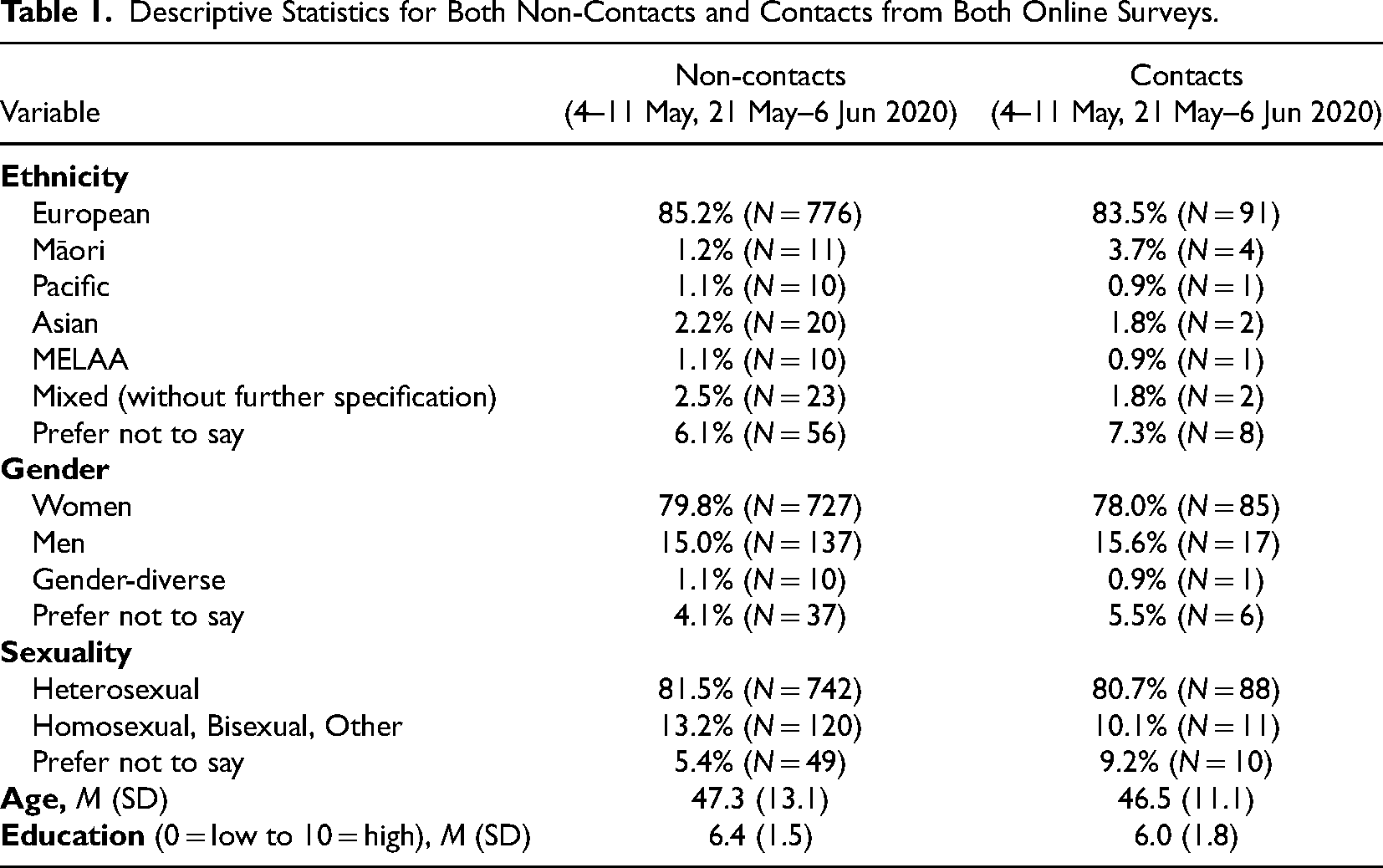
Means and mean differences for non-contacts and contacts across items/questions within the two broad categories are presented in Table 2. They were calculated for all survey respondents and all Pākehā respondents—the social group that dominated our samples and which typically expresses having full or a lot of trust in NZP generally (Gravitas, 2020, p. 2). The contact sample sizes were too small for survey respondents who self-identified as Māori (N = 4); Pacific (N = 1); Asian (N = 2); Middle Eastern, Latin American, or African (MELAA) (N = 1), and Mixed (N = 2) to obtain data of statistical significance. Since women dominated both the contact and non-contact samples, no data of statistical significance could be obtained for gender differences. More research may thus be required, as women typically express having more trust in NZP than men (Gravitas, 2020, p. 2), which corresponds with the fact that NZP reported having contact with more men than women over lockdown breaches (Owen, 2020).
Non-Contacts’ and Contracts’ Trust in NZP to Police the Lockdown Rules.
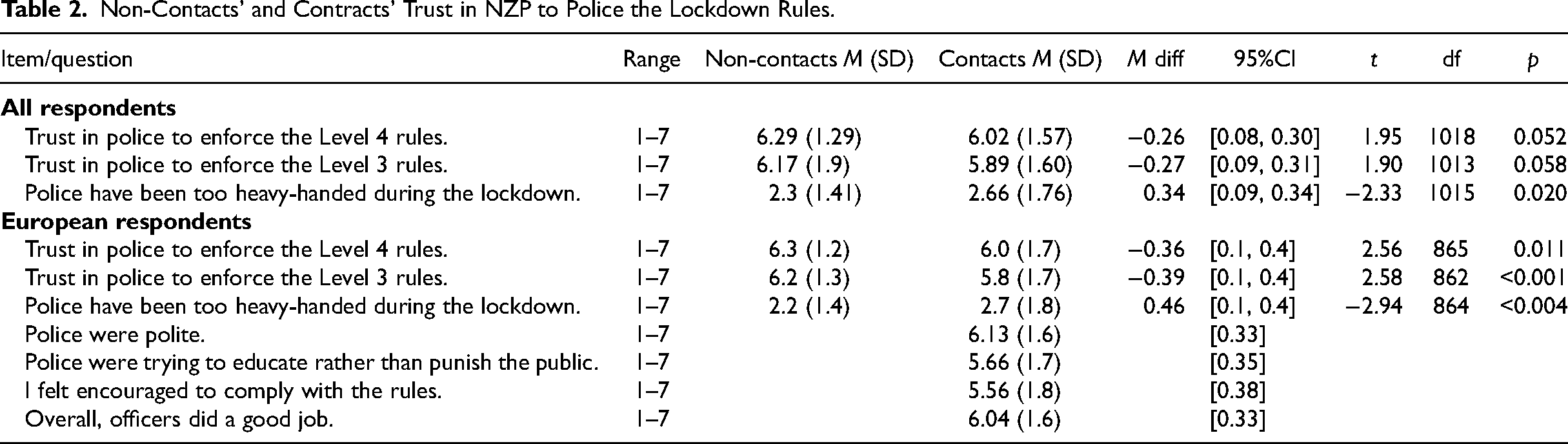
A score of 1 indicates no trust in NZP to enforce the lockdown rules, while a score of 2 indicates not much trust and a score of 3 indicates some mistrust in NZP to enforce the lockdown rules. A score of 4 represents a lack of either agreement or disagreement that NZP can be trusted to enforce the lockdown rules. A score of 5 indicates some trust, a score of 6 quite a lot of trust, and a score of 7 full trust in NZP to enforce the lockdown rules (cf. Sibley et al., 2020). With regards to the statement, “NZP have been heavy-handed during the lockdown,” a score of 1 indicates strong disagreement with the statement, a score of 2 disagreement, a score of 3 represents some disagreement, a score of 4 neither agreement nor disagreement, a score of 5 some agreement, a score of 6 represents agreement, and a score of 7 strong agreement.
While, overall, both non-contacts and contacts indicated having quite a lot of trust in NZP to enforce the Level 4 and Level 3 lockdown rules, both expressed greater trust in NZP to enforce the Level 4 rules than the Level 3 rules. Both non-contacts and contacts expressed having quite a lot of trust in NZP to enforce the Level 4 rules, the trust level was lower among contacts. While non-contacts also expressed having quite a lot of trust in NZP to enforce the Level 3 rules, contacts only expressed having some trust in NZP to enforce the Level 3 rules. With regard to the survey questions concerned with procedural justice, Pākehā contacts considered NZP to be somewhat polite, somewhat educational in their approach to pandemic policing, felt somewhat encouraged to comply with the lockdown rule, and overall deemed NZP officers to do somewhat of a good job (see Table 2).
Moreover, Table 2 also demonstrates that contacts expressed more trust in NZP to enforce the lockdown rules (6.0 at Level 4 and 5.8 at Level 3) than they perceived NZP as public health educators (5.66) and then they felt encouraged to comply with the rules after their encounter with NZP (5.56). However, perceptions of NZP as polite (6.13) and officers overall doing a good job (6.04) exceeded contacts’ reported level of trust.
George Floyd Effect
Some may argue that the killing of George Floyd in the US on 25 May 2020 may have affected survey responses about trust in NZP (Nägel & Nivette, 2022). The same could be argued for the evaluation of the NZP Armed Response Team trials, which made headlines in NZ media from 27 May 2020 onwards (RNZ, 2020a). The latter event may even be expected to have a greater effect on survey respondents as the issue was associated with NZP specifically and not policing in general. Indeed, both events may have been pertinent as evidenced by the fact that rallies in NZ merged both issues—support for Black Lives Matter and protest against the Armed Response Team trials (RNZ, 2020b). If there was a “George Floyd effect” or “Armed Offender Trials effect” that impressed on the entire NZ population, as Nägel and Nivette (2022) suggest, then changes in trust levels should be observable among both non-contacts and contacts alike. Hence, we investigated whether non-contacts’ and contacts’ trust in NZP to enforce the Level 4 and Level 3 lockdown rules was affected by these unexpected events.
When comparing survey responses of non-contacts before and after 25 May 2020, 5 the mean difference was negligible for trust in NZP to enforce the Level 4 rules and trust in NZP to enforce the Level 3 rules. In fact, slightly fewer non-contacts perceived NZP as heavy-handed after 25 May 2020, than before. While we cannot observe any significant changes in trust among non-contacts after 25 May 2020, we can observe significant changes in trust levels among contacts after 25 May 2020. Both trust in NZP to enforce the Level 4 and Level 3 lockdown rules reduced from quite a lot of trust to some trust after 25 May 2020 and while, overall, contacts disagreed with the statement that NZP were heavy-handed before 25 May 2020, contacts only somewhat disagreed with the statement after 25 May 2020.
Qualitative Findings
In this section, we supplement our quantitative findings with qualitative data from open-ended survey questions in which we asked contacts to further elaborate on their encounter with NZP or on anything they felt was important to share with us. While the quantitative data demonstrates that NZP were overall perceived as trustworthy and positively interacting with civilians, the qualitative data also demonstrates that because of their traditional role as law enforcers—thus a punitive force—public trust in NZP may be affected when taking on a different role. While, overall, contacts felt somewhat encouraged to comply with the lockdown rules, some experiences were less fruitful as the following findings demonstrate.
By and large, police were perceived as polite. They stopped us because there were two of us in the car. We explained that I needed to go to the doctor, but my car wasn’t working and couldn’t drive my partner's car because it was a manual, so my partner needed to drive me there and was going to wait in the car when I went in. They accepted that and let us go. (Pākehā woman, 30s) I was in my work uniform driving home from work (essential worker), so they were pretty understanding. (Pākehā woman, checkout supervisor, 20s) I was stopped 3 times but of course, being in my uniform, they could see I was a working nurse travelling to and from the hospital. (Pākehā woman, nurse, 50s)
However, these findings need to be read in light of the composition of our study sample, because, as the existing literature shows, NZP are not perceived as acting politely or fairly toward Māori and ethnic minorities (Anae, 2012; Borrisenko, 2021; Cunneen & Tauri, 2016; Gravitas, 2020; Kightley, 2017; Nakhid, 2017, 2018; Te Whaiti & Roguski, 1998). Also, blue-collar work gear did not necessarily elicit courteous engagement and some perceived police as rule-breakers instead of as public health educators, which needs to be considered particularly counter-productive for any public health intervention. Absolutely idiotic and robotic efforts from the Police. At a level 3 roadblock. No PPE, leaning right in my car window, well inside 1 m, and initial contact was “why aren’t you at home”, when clearly in hi-vis work gear. “What industry”, in clearly sign written hi-vis. “Where are you going”, home. “Where is that”, you don’t need to know. “Excuse me”, that's right. You can ask, but I have no obligation to tell you anything, and you’re lucky I’ve been as cordial as I have. If there's nothing else, get out of my personal space, so I can leave… and they left it at that. (Pākehā man, scaffolder, 50s)
Considering that educated Pākehā women, who were overrepresented in our survey sample, tend to have less contact with NZP in general and tend to view NZP more positively, it was interesting to find that NZP sometimes struggled to implement their education-first approach at an individual level. Indeed, for some, these interactions had an erosive effect on respondents’ attitudes toward, and trust in NZP as a whole: The officer assumed I had done something and never bothered getting my side. He was aggressive and unkind. I’m in my 50s had done nothing wrong and have never been in trouble with the police before. It was extremely distressing.
Even when officers were not perceived as aggressive or unkind, some respondents found the experience of having their movements monitored to be intrinsically unpleasant: It was upsetting being stopped and questioned going to client's homes as an essential worker. (Pākehā woman, healthcare worker, 50s) One cop made a rude misogynistic comment. […] we were stopped entering [town name]. My husband was driving and explained we run an essential service as a stock feed supplier, (it’s actually my business […]). The cop looked in the car and said to my husband “I hope she helps you”. My husband was so stunned he began to stutter. The cop made some, funny to him remark, laughed, and waved us through. Just utterly bizarre. (Pākehā woman, business owner, 40s) We were a group of white middle-class middle-aged walkers […] socially distanced but clearly a group of more than two bubbles. The police were very polite and didn’t even ask our names to issue a warning. However, my clients who have criminal histories have been harassed by the police, stopped frequently, issued warnings, and been arrested. (Pākehā woman, lawyer, 50s)
Moreover, the following narrative exemplifies that NZP were not necessarily trusted to act as public health educators who would properly interpret or apply the lockdown regulations: They [NZP] told me that they were stopping me under the Health Act and just wanted to know what I was doing. […] I looked it up on the Ministry of Health website because I wanted to know the rules and it was quite clear that I was allowed to do what I was doing. I just didn’t want to be stopped and have to deal with a policeman's interpretation of someone else's rules. I work with legislation, and I work with 15 other people who interpret the same piece of legislation differently. I know that happens and I didn’t want to have to deal with it. (Pākehā woman, 40s)
Discussion
Firstly, our study set out to determine whether NZP were trusted to police the lockdown rules at Level 4 and Level 3. Secondly, our study explored how NZP were perceived in their new role as public health educators by members of the public who were stopped by NZP over the lockdown rules (contacts) compared to those who were not (non-contacts) and if they felt particularly encouraged to comply with the lockdown rules after an encounter with NZP. Lastly, our study sought to find out whether non-contacts’ and contacts’ reported trust was affected by two unexpected policing-related events that occurred during our survey, that is, the murder of George Floyd in the US on 25 May 2020 and the evaluation of the Armed Response Team trials in NZ end of May/early June 2020.
Trust in New Zealand Police to Enforce the Lockdown Rules
Most survey respondents expressed having quite a lot of trust in NZP to enforce the public health measures during Alert Level 4. The majority also trusted NZP to do the same once NZ had moved to Alert Level 3. This corresponds with overseas studies (Dhkar et al., 2020; Reuben et al., 2020; Vasconcelos Bezerra et al., 2020) and our NZ-based study (Long et al., 2020), which confirm that public attitudes toward lockdown measures have been mostly positive. It is, therefore, not surprising that the enforcement of these measures is also welcomed by most members of the public. However, both non-contacts and contacts expressed greater trust in NZP to enforce the Level 4 rules than the Level 3 rules, indicating that trust in NZP to enforce the lockdown rules diminished as lockdown rules got more complex. While these findings speak to the trust in NZP to enforce the lockdown with the new powers granted to them, trust in NZP as policing agents does not necessarily reflect perceived trust in NZP as frontline public health educators. It is, therefore, important to establish whether contacts perceived NZP as public health educators and felt encouraged to comply with the lockdown rules after engaging with NZP as the related findings speak directly to not only the effectiveness but also the perceived trust in NZP as public health educators and pandemic policing as a potential public health issue.
Overall, contacts expressed less trust than non-contacts in NZP both to enforce the Level 4 and Level 3 rules. These findings suggest that direct contact with NZP over the lockdown rules affected trust levels negatively. This weakening of trust due to contact with NZP over the lockdown rules is surprising because this phenomenon is typically only associated with being suspected of having committed a criminal offence, but not with traffic stops and other roadside encounters with NZP (see Gravitas, 2020, pp. 2, 55), which was the situation in which most contacts in our study encountered NZP. Yet, according to our observations, a weakening of trust in NZP seems to occur when traffic stops and roadside encounters with NZP are related to pandemic policing with an education-first approach, instead of being traffic-related. In other words, contacts’ trust in NZP seems to diminish when the policing activity falls outside the realm of traditional policing tasks and into the realm of public health education. Since Pākehā women dominated our survey sample and that is the social group that typically expresses the highest levels of trust in NZP, these findings are particularly insightful for pandemic policing, which is likely to bring more Pākehā women into contact with NZP than they would experience outside a lockdown. Indeed, many responses from Pākehā women are reflective of the white privilege they typically enjoy in interactions with police. While some emphasized that NZP had treated them better due to their race and class, others felt affronted by being stopped. These reflections suggest that global pandemics can act as equalizers in interactions with police but also evoke self-awareness of how white privilege typically protects from negative encounters with police.
NZP guidelines were aligned with the overall messages issued by the government to “unite against Covid-19.” This meant prioritizing verbal communication with members of the public about what it means to “stay home” and thus provide positive encouragement to “save lives.” To “be kind” was reflected in NZP primarily relying on enforcement tools such as warnings, with arrests and prosecution as a last resort. However, our survey data showed that actions by NZP were only partially successful in conveying the NZP's emphasis on educating people about COVID-19 public health measures. Contacts only somewhat agreed that NZP were pursuing an educational rather than punitive approach and that NZP were doing a good job. Considering that community compliance with pandemic control measures was deemed essential as NZ was pursuing COVID-19 elimination, the public leaving encounters with NZP only somewhat encouraged to comply with the lockdown rules suggests that tasking NZP officers with public health education may be counter-productive to control and enforce pandemic intervention measures. Since our sample was dominated by Pākehā women, who typically report having full or a lot of trust in NZP (Gravitas, 2020, p. 2), these findings speak directly to the level of trust in NZP as a punitive force compared to NZP as an educational public health force. We have to conclude that perceived trust in NZP in their new role as public health educators demonstrates room for improvement.
Perceptions of Procedural Fairness and Feeling Encouraged to Comply
While, overall, both contacts and non-contacts in our study trusted NZP to police and enforce the lockdown rules at Levels 4 and 3, our data also evinced a simmering awareness that NZP might not always be acting in a way that was fair, accurate, or in keeping with public health guidelines. Such perceptions—further fostered through both immediate encounters and pre-existing attitudes toward NZP—limit the efficacy of public policing as an optimal strategy for enforcing compliance with public health intervention regulations—especially in cases where NZP were called upon to exercise their discretion over how to respond to members of the public “bending” the rules to meet compelling personal or care needs (Long et al., 2020).
Since the sample in this study was skewed toward Pākehā women and police-recorded statistics suggest that predominantly Māori and Pacific communities were overpoliced during both Alert Levels 4 and 3 (NZ Herald, 2020; Stanley & Bradley, 2020), we suggest that more research needs to be conducted with members of these communities to explore how trust in NZP is affected among populations who experience systemic racism. Nevertheless, even within a respondent pool that was generally positively inclined toward NZP, direct experiences of policing varied, with both perceived biases regarding certain types of bodies and uniforms and the personal self-presentation of officers mediating the extent to which respondents felt educated rather than punished in their interactions with NZP.
The comparably lower trust levels among contacts compared to non-contacts also question the rate at which police encounters lead to legally compliant behavior by civilians: as Bolger and Walters (2019) suggest civilians are less likely to comply with the law if police are perceived as not trustworthy. Again, this needs to be viewed in light of our sample being skewed toward a social group that tends to express greater trust in police and tends to have better experiences when encountering police. Moreover, most survey respondents indicated having travelled for justifiable reasons (essential work, grocery shopping, doctors’ appointments) and did not act out of mere defiance, which, according to McCarthy et al. (2021), would, by default, lead respondents to consider police-initiated encounters procedurally unjust.
Furthermore, the responses suggest that positive judgments about encounters with NZP overall do not necessarily produce trust in NZP in their role as public health educators. Even though our respondents described their encounter with NZP largely in positive terms overall, contacts perceived NZP as more heavy-handed than non-contacts, which also speaks to NZP's ability to act in a non-punitive educational manner with regard to public health measures. This raises the question of whether taking on the role of public health educators has the potential to undermine positive pre-pandemic perceptions of NZP and erode trust and confidence in NZP long term. There might be a spillover effect.
“George Floyd Effect” Only Among Contacts
After the murder of George Floyd on 25 May 2020 and after NZP made headlines over their Armed Response Team trials, non-contacts reported no change in trust in NZP. We found that contacts in our study reported having significantly less trust in NZP after 25 May 2020. These findings suggest that the encounter with NZP was the cause of a reduction in trust levels. We can observe that contacts perceived NZP as more punitive after 25 May 2020 than before in their approach to pandemic policing and fewer contacts agreed with the statement that NZP officers were overall doing a good job (see Table 3).
Mean Differences Survey Responses for Non-Contacts and Contacts Before and After Unexpected Policing Events.
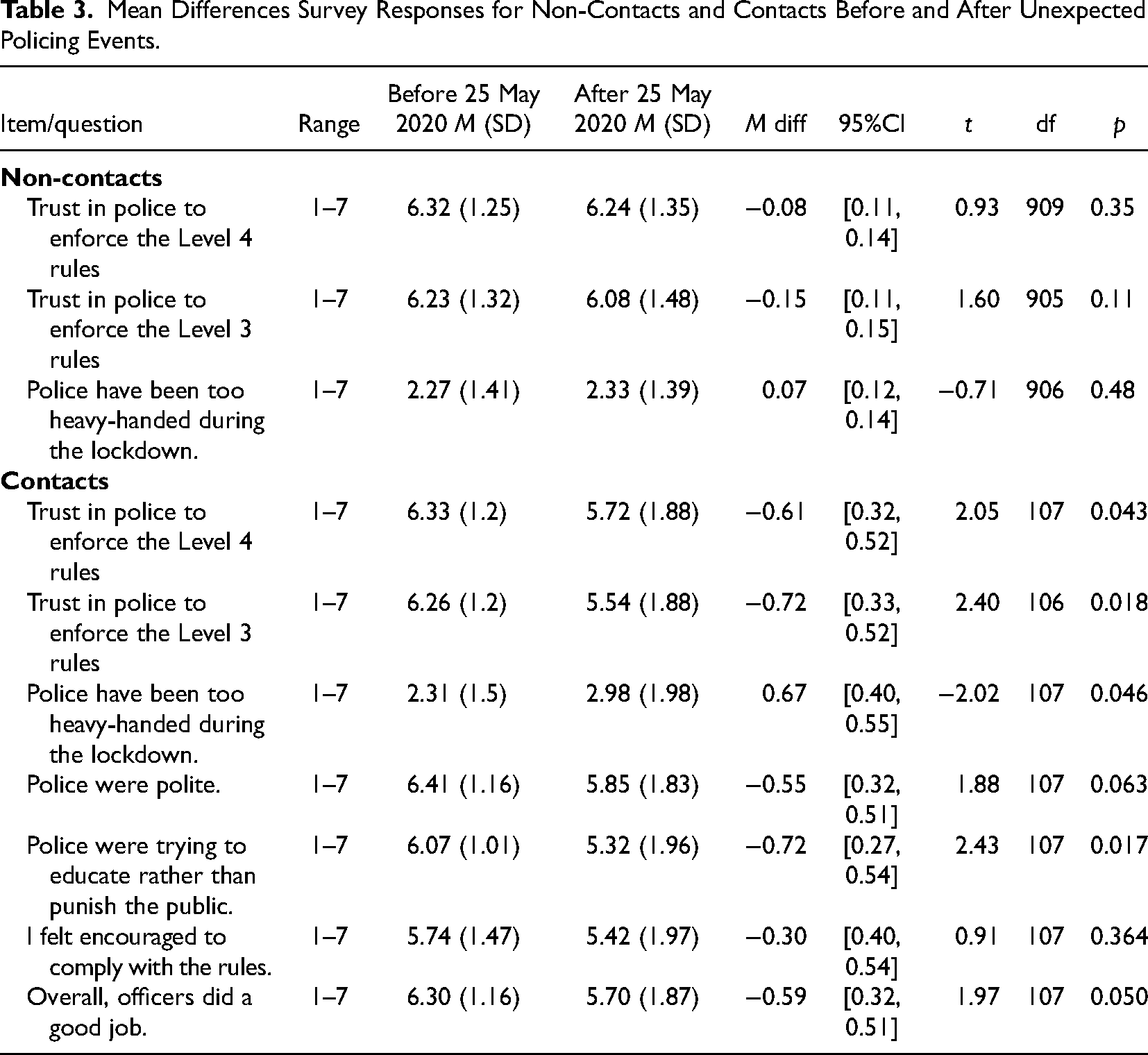
Since Nägel and Nivette's (2022) study—which suggests that high-profile policing events, like the killing of George Floyd, diminish reported trust in police around the world—is silent on any differences in trust levels of non-contacts and contacts, further research is required to determine what may cause such differences. Likewise, Sibley et al. (2020) did not differentiate trust levels of non-contacts and contacts when they asserted that overall trust in NZP slightly increased after the lockdown. While Gravitas (2020) suggests that people who had contact with NZP over traditional criminal justice matters in the last six months tend to express less trust in NZP, such weakened trust is only associated with becoming a crime suspect, not with becoming a contact at traffic stops and similar roadside encounters with NZP. However, our observations find diminished trust is also associated with traffic stops and roadside encounters when they occur in the pursuit of pandemic policing with an educate-first approach. In this context, it is important to note that only a small proportion of people in NZ is affected by crime and has contact with NZP over criminal justice matters (Ministry of Justice, 2022, p. 4) while pandemic policing potentially affects all people in NZ and, therefore, brings more people into contact with NZP who would otherwise not encounter them. Pandemic policing may, therefore, particularly cause erosion of trust among populations who would otherwise maintain high levels of trust.
Conclusion
Based on the premise that NZP took on the role of frontline public health educators, we argue that NZP were trusted to police the lockdown at Alert Levels 4 and 3 and also achieved a sufficient level of trust with regard to their new role as frontline public health educators among Pākehā and particularly Pākehā women. However, the perceived trust in NZP to act as public health educators shows room for improvement compared to the overall trust NZP have to enforce the lockdown rules. Above all, we caution that the perceived punitiveness and biases of NZP may stigmatize the delivery of public health messages and interfere with NZP's objective to act as public health educators. This may erode trust in NZP among populations who typically express high levels of trust in NZP.
To the extent to which NZP lack reported trust in their new role as frontline public health educators, we suggest that the reasons are twofold. Firstly, the limited trust stems from experiences of direct interaction with NZP during the 2020 lockdown in instances where officers were perceived as procedurally unjust or inconsistent, for example, police not keeping the necessary social distance when talking to members of the public while not wearing PPE gear or exhibiting misogynistic attitudes. Inevitably, the enforcement of lockdown rules by NZP, as the primary policing agent, increased opportunities for contact between members of the public and the NZP, especially amongst populations that would normally have no or infrequent contact with police, but as essential workers saw themselves confronted with regular police stops. This heightened contact frequency increased the chance of both positive and negative encounters with NZP. Especially groups that would normally not have any direct contact with police and tended to hold positive views of NZP now increased their odds of a negative encounter that had the potential to change their view of the police permanently. Secondly, we argue that NZP achieve limited trust in their role as public health educators because civilians and NZP learned the lockdown rules simultaneously, rendering police advice, education, and enforcement vulnerable to high degrees of scrutiny and contestation from a public who, in some cases, may have had a more thorough grasp of the rules than officers themselves.
Insofar as public trust in NZP's newly adopted public health educator role is limited compared to the trust they enjoy to enforce the lockdown rules, calls to defund the police, that is, to reallocate financial resources away from police toward other social service providers (Molyneux, 2020; Ray, 2020; Vitale, 2017; Whaipooti, 2020), are echoed. Such defunding aims to avoid punitive responses to non-criminal actions by civilians as also experienced in NZ during the 2020 lockdown (Shank, 2020). Despite calls to defund the police, NZP continues to grow with funding for 1,800 new officers approved in 2020 (Walters, 2020). In 2017, the police budget was NZD 1.54 billion, which increased over time to NZD 2 billion, leading to “record amounts of funding” (Strang, 2021). Due to the expansion of the NZP force and the criminalization of lockdown breaches in 2020, there appears to be a real risk for NZ to entrench its trajectory toward a carceral state. That contemporary carceral states have extended their powers into areas outside the criminal legal system—such as schooling, mental health, and social work (Jacobs et al., 2021)—has been widely acknowledged (Gottschalk, 2008). Public health constitutes no exemption. Public health researchers have defined “carceral public health work” as any kind of public health work that operates based on ideas of social control, uses coercion and punishment to manage minority communities, and collaborates with the criminal legal system (Hastings et al., 2021). Hence, pre-empting mission creep, defunding the police, and removing pandemic-related public health work from the police portfolio of tasks alone may be insufficient to unhinge the criminal legal system from public health work.
Our findings suggest that perceived trust in NZP may be enhanced through achieving elevated levels of trust for enforcing the lockdown rules but may also be threatened through achieving lower levels of trust in their new role as public health educators. Hence, if defunding NZP and a reallocation of pandemic public health education and surveillance tasks to other service providers are unfeasible, NZP may benefit from simply pursuing a law enforcement strategy without styling themselves as public health educators. In terms of lessons learned for future pandemics, the NZ government may want to consider alternative resources, such as community-based professional public health educators, that do not contribute to NZP losing public trust.
Footnotes
Declaration of Conflicting Interests
The authors declared no potential conflicts of interest with respect to the research, authorship, and/or publication of this article.
Funding
The authors received no financial support for the research, authorship, and/or publication of this article.
