




Abstract
Reviewing national literature on homicides in Brazil, this article explores questions that relate to the nature, trends, determinants, and impact of these crimes on society, as well as interventions to combat this type of violence. The article contributes to the international literature by reviewing and critically discussing a sample of 112 theses on homicides from the Portuguese-language literature using the Brazilian Digital Library of Theses and Dissertations from 2000 to 2020. Highlighting an issue that primarily affects young, poor Black men, the article helps advocate for a better understanding of other types of lethal violence that affect women, LGBQTI and other minorities. The article calls for a better understanding of the role of the state, the police and other criminal justice actors as generators and/or controllers of violence, as well as the need for other perspectives on homicide prevention, which include the microsituational aspects of killing, organized crime, and interaction between the individual and the environment.
Keywords
Brazil has one of the highest homicide rates in the world. At approximately 30.76 per 100,000 population in 2020, according to DATASUS, the rate was three times the world average. High rates of homicides is persistent problem in Brazil (Murray et al., 2013), a country where violence is exacerbated by socioeconomic inequalities and racism (Instituto de Pesquisa Econômica Aplicada/Fórum Brasileiro de Segurança Pública [IPEA/FBSP], 2016; Truzzi et al., 2021), and is historically featured in the country’s colonization by forced occupation and slavery (Langfur, 2006). In addition, the country has one of the most violent police forces in the world (FBSP, 2016). As a comparison, police in the United States took 30 years to kill the same number of civilians as police in Brazil did in 6 years from 2008 to 2013, despite a U.S. population that is approximately 50% larger (Oatman, 2015). Finally, Brazil has one of the highest rates of feminicide (Costa, 2016; Lodetti, 2016; Romio, 2017) and one of the highest number of lethal violent crimes against LGBQTI people in the world (Mendes & Silva, 2020), as well as hundreds of dead each year in land conflicts (Ceccato & Ceccato, 2017), reflecting the legacy of a society with extreme infringement of basic human rights.
Brazil is the largest country in Latin America by population, with 213 million inhabitants in 2021, and sixth globally (Worldmeter, 2021). It is a Global South 1 country, comprising 26 states, one federal district and 5,570 municipalities. In recent decades, it has carried out several anti-violence programs that could interest an international audience. In addition, an absolute high number of homicides provides an opportunity for researchers to test hypotheses and explanatory models, such as the relationship between violence and its determinants, in extreme different environments: from mega cities like São Paulo and Rio to remote rural areas of center-east and Amazon regions.
Yet, much scholarship on violence in Brazil is unknown to an international audience. Despite being the ninth most-common language in the world, and the second most-common Romance language (after Spanish), Portuguese is not widely accessed by the international research community. This article helps remedy that by reviewing and critically discussing a sample of the Brazilian literature written in Portuguese using the Brazilian Digital Library of Theses and Dissertations (BDTD) from 2000 to 2020. The aim is to capture the basic features of homicide research conducted by scholars affiliated with Brazilian universities. This is achieved by discussing the types of lethal violence analyzed in the studies, mapping the academic production on the subject, indicating the most important disciplines to the understanding of lethal violence in Brazil and the general aspects that can be extracted from the analysis of the studies, such as nature and trend of crimes, profile of victims, structural determinants, methods, and implications of public policies.
This study follows and complements a systematic literature overview with 14 studies (in English and or Portuguese) carried out by Murray et al. (2013). In that review, authors compared homicide rates in Brazil with other countries worldwide, examined time trends in homicide, and identified risk factors for lethal violence in Brazil. A key conclusion of the review was that there was need for more systematic data collection on crime and violence in Brazil. Because the call remains unanswered, and some new emergent questions 10 years on are still of more relevance than before, we argue for the need of a new systematic review of the literature. Instead of making an in-depth analysis, this systematic review reports the topics of studies from a variety of multidisciplinary fields devoted to lethal violence in Brazil from 2000 to 2020. For other references in Portuguese, see partial recent collections carried out by Kopittke and Ramos (2021) which is an evaluation of programs directed to homicides and de Oliveira et al. (2020) on articles only about homicides in the last decade (2006–2016). In this review, we focused on PhD theses only, published from 2000 to 2020; a decision that was taken because of the massive amount of materials of varied quality (reports, articles, and theses) available in this area and because we believe that PhD theses represent the highest quality materials in this area, which allows comparisons with international publications at the same level. Another important feature of this review is that it gives voices to a rich multidisciplinary field, reviewing pieces of research from Sociology, Economy, Social-Political Science, Epidemiology, Public health, Anthropology, and other related fields such as History and Geography, to name a few, using various methods, quantitative, qualitative or mixed-methods.
Definitions and Limitations
We excluded studies on jails, tribunal and juridical topics, theology, forensics, cinematography, and Brazilian literature.
Violence, in most studies discussed here, means lethal violence or homicide. We focus on homicides, because it is a robust and comparable type of violence with a clearly defined set of records in official statistics compared to overall violence (Ceccato et al., 2018).
Homicide is defined in the Brazilian Penal Code as “to kill someone” (article 121). In this analysis, homicide is regarded as intentional killing, recorded as homicidio doloso (Ceccato et al., 2007).
Feminicide or femicide is term coined by the United Nations General Assembly Resolution 68/191 to define “the gender-related motivation associated with the killing of women and girls” (United Nations Office on Drugs and Crime [UNODC], 2018, p. 24). Note that comparison of rates is problematic because of different legal definitions of feminicide in each country.
Infanticide is a criminal offense in the current Brazilian Criminal Code and defined as the act of killing, under the influence of the “puerperal state,” one’s own child, during labor or shortly after (Angotti, 2019).
Homicide-suicide is defined as a crime in which a person takes the life of another and then kills her/himself within 24 hr (A. K. S. Azevedo, 2013).
Research Questions
This literature review aims to respond to the following questions. When, where and by whom (gender) have the theses been published? Which are the most important disciplines publishing on lethal violence in Brazil? What is the nature and extent of violence in Brazil? Which are the major determinants of violence in Brazil? Do they differ from the international ones? Which are the major spatiotemporal trends in violence in Brazil? Which programs/safety interventions are used to prevent homicides? What future research and practice are recommended?
First, we briefly present the steps taken to collect and analyze the theses, then we report the results by answering the above questions. Finally, we identify research gaps in the literature and suggest an agenda as well as policy implications of the current knowledge.
Method
We started by selecting published articles and theses on criminology from two major databases that are a reliable source of publications in Brazil. From 3,610 publications selected by a collection of general keywords, 1,332 were selected for analysis (Figure 1), first by eliminating 607 duplicates, and later by excluding those that were not relevant. Out of 250 theses devoted to homicides, 167 were initially selected using keywords, and then 55 were eliminated because they did not satisfy the criteria below (Appendix Table A1 shows a list of all keywords). Because of the massive amount of theses and articles and varied quality of articles, we decided to focus our review on PhD theses (exception of two of masters). Note that we report an article only when the theses were composed of a collection of distinct articles.
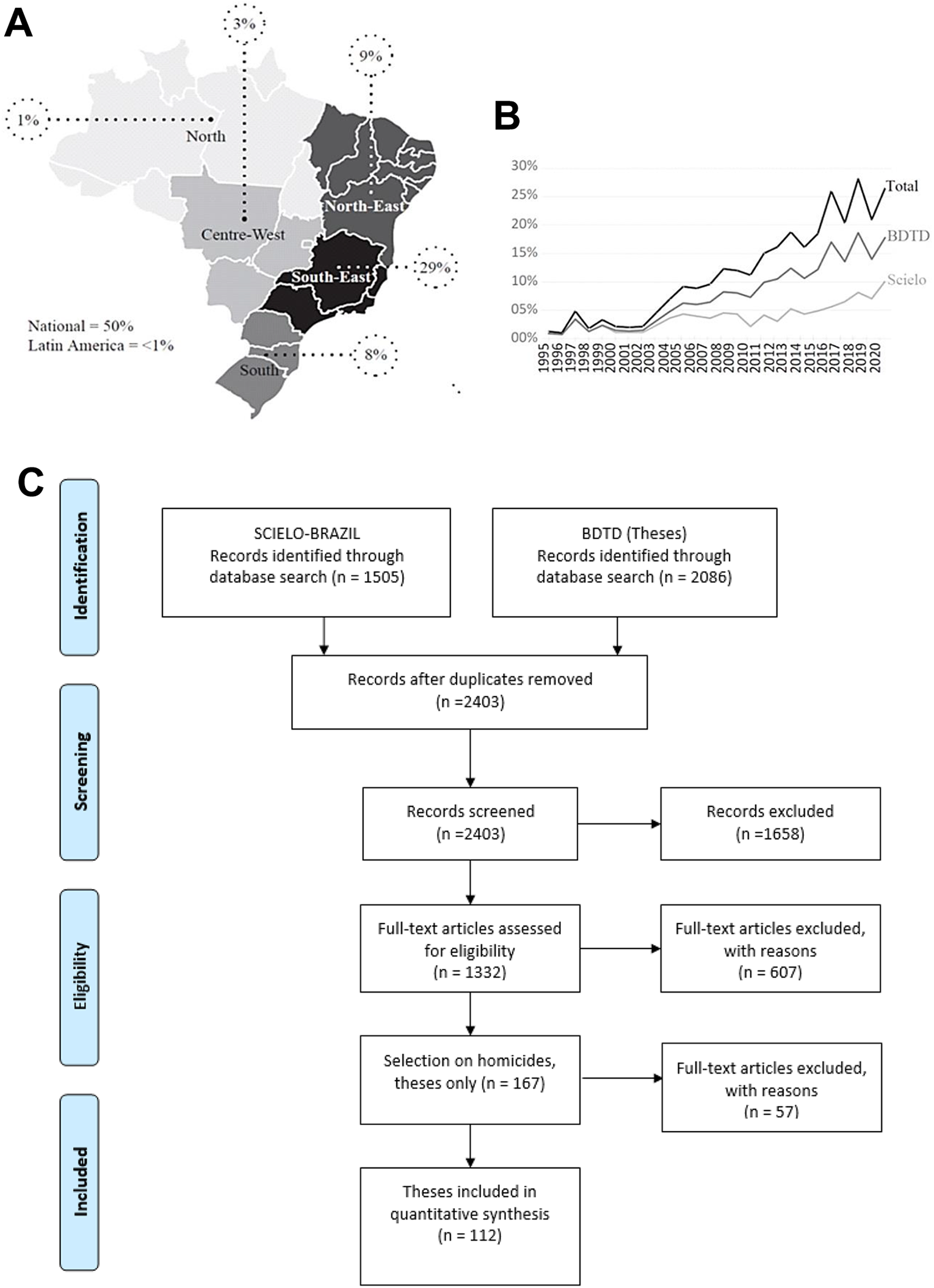
Literature selection by region (A) and by year (B). N = 3,610. (C) Selection of bibliographic material using the Brazilian Digital Library of Theses and Dissertations (BDTD) and Scielo-Scientific Electronic Library Online (database of articles and reports). Source. Authors.
We adopted the systematic review protocol of type PRISMA-P 2015 (PRISMA-P Group et al., 2015) to support inclusion based on the following criteria of importance. Studies were published between 2000 and 2020 in the BDTD. Empirical studies devoted to the analysis of different types of violence in Brazil. Interdisciplinary pieces of research mostly, from Sociology, Economy, Social-Political Science, Epidemiology, Public health, Anthropology, and other related fields such as History and Geography. We have focused on quantitative/mixed methods approaches (e.g., regression analysis based on surveys, correlation) and qualitative studies (e.g., discourse analysis, descriptive analysis of data, ethnographic studies, field works, action research); Studies that were representative for all Brazilian states, as study area and/or university where the study was published. Exclusion of studies on penitentiaries, jails, tribunal and juridical topics, theology, forensics, cinematography, and Brazilian literature.
We selected theses because they represent studies of high quality in the country and can easily be compared to international standards. Note that this study is based on 112 theses on homicides only from the BDTD from 2000 to 2020, which is an open access and governmental database which gathers and disseminates complete texts of theses and dissertations defended in the Brazilian teaching and research institutions, as well as theses and dissertations defended abroad by Brazilians since 2002. The main goal of BDTD is to enable greater visibility to national scientific production, nearly 99% of its content is in Portuguese.
Results
Bibliometric Analysis
The bibliometric analysis included all Portuguese-language publications based on 112 doctoral theses published on the topic lethal violence/homicides from 2000 to 2020. One-fifth of these theses were published in the University of São Paulo, followed by the University of Pernambuco, then University of Campinas; one-fifth came from various universities throughout Brazil. More than 60% of the publications are from the Southeast region (the states of São Paulo, Rio de Janeiro, Espírito Santo, and Minas Gerais, where 42% of the Brazilian population lives, containing the biggest financial center in Brazil and one of the biggest financial centers in the world). The second biggest group of publications was from universities in the Northeast (the second most populous region), in particular the Universities of Pernambuco and Bahia states (Figure 2A). It is worth mentioning that the Northeast is the region where homicides increased most in the last decade, which partly explains the increased interest in the topic. Public security and violence have become a more integral part of the research agenda in the last two decades, and the number of theses in the last decade in particular reflects the efforts to fight lethal violence. The number of theses on the topic each year has increased dramatically, from two in 2000, to 16 in 2017, an increase of 700%. Monograph is still the most common PhD format. More recently, theses have been composed of a set of internationally published articles (often quantitative research), or a hybrid materials.
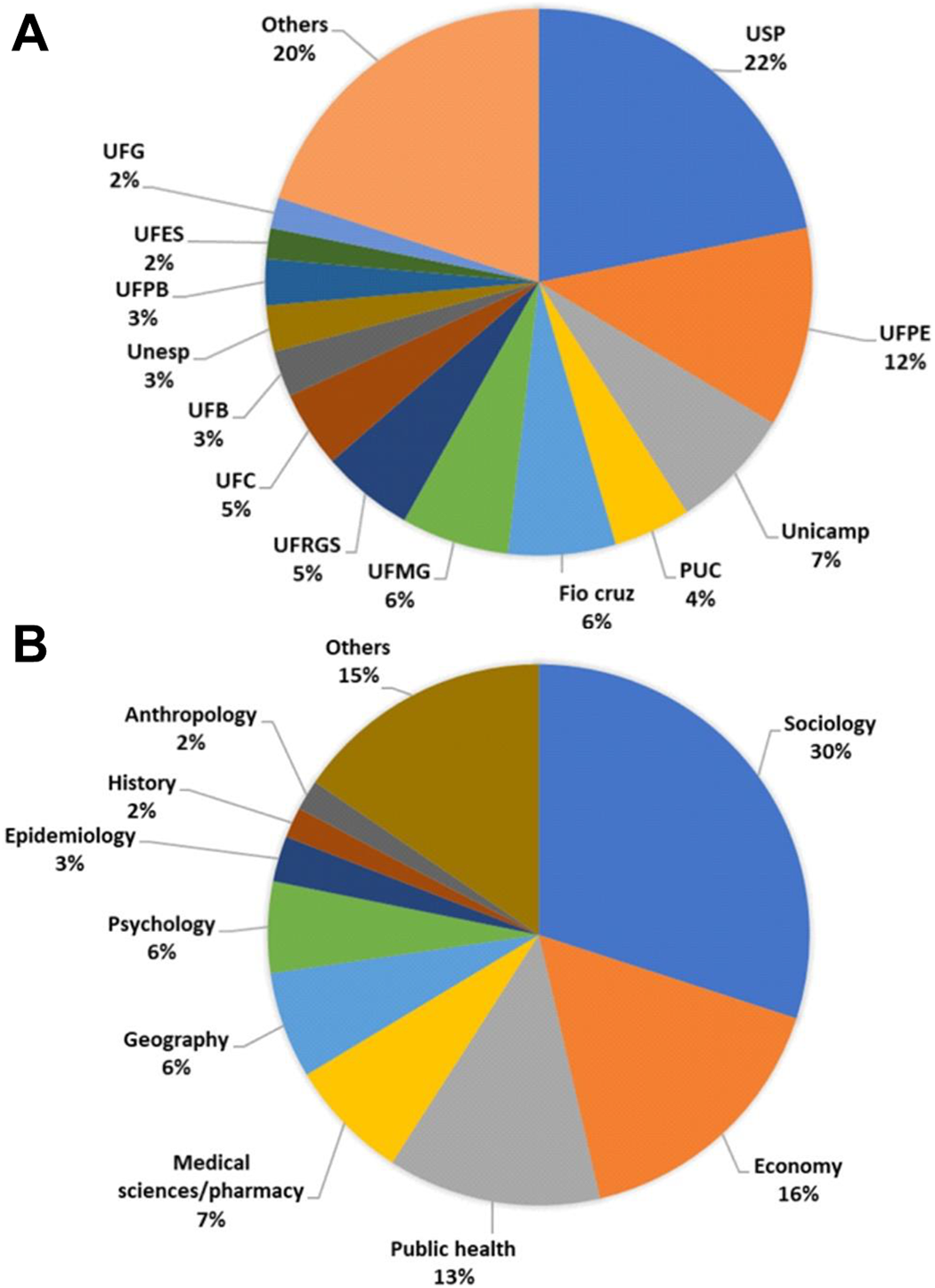
PhD theses 2000–2020 on the topic homicides/lethal violence by university (A) and by research discipline (B). N = 112, keywords = murder, homicide, feminicide, infanticide, for a full list, see Appendix Table A1.
Women are authors of 58% of the publications and dominate in the fields of Public health, Epidemiology and Medical sciences, while men tend to research more in Economics and Geography. A more balanced picture appears when the total number of theses written by women and men in Sociology and Political science are compared.
Sociology/Criminology and Economics are the fields that contribute most to the research on lethal violence in Brazil, followed by Public health, Medical sciences, Geography, and Psychology (Figure 2B). (Note that these proportions are subject to a sample that excluded particular fields of research, such as the Arts, Literature and Forensics.) de Oliveira et al. (2020) suggests that the Brazilian scientific production in homicides and health is on the rise. Unsurprisingly, quantitative approaches (descriptive or confirmatory statistical analyses) dominate methods employed in Economics, Epidemiology and Public health, while qualitative analyses dominate in Anthropology and History. The use of geocoded data from secondary sources, both police recorded data (e.g., Infocrim) and health-related databases (e.g., DATASUS), has increased with the advent of geographical information systems (GIS). GIS have made geographical analyses of crime data possible for a wide number of users, facilitating the integration of many types of data into a common spatial framework and allowing crime pattern detection over time in combination with spatial statistical techniques (see, e.g., Camargo, 2007; Costa, 2014; Verona, 2006). In Psychology, there are several theses using psychoanalytical approaches, through hearings, discourse analysis, interviews, and observations (e.g., Kohara, 2019); while others combine quantitative approaches (e.g., Estevam, 2011).
It is a difficult task to estimate the exact amount of topics of the theses (in lethal violence) since studies often are devoted to overlapping subjects. Roughly, close to three thirds of the theses relate to homicides in general followed by feminicide and then a minority on others (infanticide, robbery followed by death). de Oliveira et al. (2020) report on articles published between 2006 and 2016 to declare that homicide composed about half of the articles, the one seventh by feminicide followed by others.
Social disorganization theory (Shaw & Mckay, 1942) or Becker’s rational choice (Becker, 1968), serve often as criminological principles of analysis of lethal violence in Brazil. However, the theoretical approaches adopted by the theses vary, and in particular, because the sample was highly multidisciplinary, any type of generalization is a difficult task. Studies from psychology, anthropology, political science, policing, geography, demography, public health, and gender studies, often use different theoretical frameworks from those of sociology and criminology. In criminology and sociology, the most common theories are social disorganization theory (linking homicides to factors such as deprivation, ethnic heterogeneity), anomie and social change (to explain spatiotemporal trends), rational choice (cost and benefit analysis and the economics of crime, frequently underlying the work done by economists in particular), and other environmental criminology principles, such as routine activity approach and principles of evidence based policing in the analysis of security programs.
In-Depth Analysis
The bibliometric analysis supports the selection of “research domains” that are discussed in more detail below. The in-depth analysis is guided by our research questions, namely our interest in reporting the content of Brazilian studies on the nature of lethal violence, its determinants and violence prevention.
Victims of homicides
As in other parts of the world (Liem & Pridemore, 2013; Tuttle et al., 2018), in Brazil young men are the most frequent victims of lethal violence (e.g., Carvalho, 2004; Villela, 2005; Nachif, 2006; Fraga, 2012), especially Black men. In 2009, the male homicide rate (51.1 per 100,000) was over 10 times the female rate (4.3 per 100,000). The homicide rate was highest for black people (34.6), then indigenous (32.5), white (16.3) and people of Asian descent (6.8) (Murray et al., 2013). There are major interracial regional differences. In the state of Alagoas, in northeast Brazil, the Black murder rate reaches 67.9 per 100,000, but it is as low as 3.7 for non-Blacks, being the safest state for this demographic group (IPEA, 2020). Therefore, in order to develop an appropriate public security policy, Leite (2017) remind us about the need to identify a conjunction of varying factors that potentially expose young poor people to situations of violence.
Many studies in this area situate violent deaths in the field of Public health, establishing relationships between aggression and situational context. In this vein of research, Nachif (2006), in Central-West Brazil, shows that the majority of the “aggressors and their victims were male, 15–25 years old, with poor schooling, living in the periphery of the city, with mutual informal ties” (p.2). Minamisava (2010) also confirms the concentration of deaths among youths aged 15–24 years in Goiânia. This group had a significantly higher proportion of people with the lowest educational status, lowest income and poor housing conditions compared to the rest of the city. In addition, going beyond poverty and race, other studies mention the problem of socialization in environments with cocaine traffic, weapons trading, and money laundering, in which drugs are often exchanged for weapons and are related to lethal violence that often affect young people. Fraga (2012), for instance, finds a predominance of the deaths of children and adolescent males, 15–17 years old, by firearms in a city in southeastern Brazil, while Lebarch (2017) finds a presence of drugs and/or alcohol in nearly half of all victims of homicides in a metropolitan region of southeastern Brazil. Silva (2014a) confirms the importance of drugs and alcohol but also shows that firearms were the most frequent means of youth homicides.
A large share of victims of homicide in Brazil are women. Fernandes (2018) reports that women are not only overrepresented as victims of intimate partner violence (IPV), but they also constitute the majority of those who are affected when a murder happens. Acquaviva (2015) assesses the indirect impact of homicides on the victims’ partners, finding that 81% were women. Fernandes (2018) investigates the environmental and socioeconomic determinants of violent deaths perpetrated against women in Recife to find that this violence is concentrated in the poorest populations and shows differences in ethnic background and types of weapons used, often knives/nonfiring weapons. These findings show the need to formulate public policies that meet the diverse needs of women as crime victims in different parts of the country. See also the subsection Feminicide and Women’s Empowerment.
Offenders
Individual and family risk factors explain why people engage in violence and kill, most of these factors in Brazil are similar to those in high-income countries (Murray et al., 2013). Numerous studies have attempted to understand why people kill (for international references see Kivivuori et al., 2014; Liem & Pridemore, 2013; Murray et al., 2013; Tuttle et al., 2018). In the Brazilian literature, Serafim (2005) assesses psychological factors such as individuals’ temperament, character and impulsiveness and anxiety traits among 105 male individuals condemned for homicide and shows a correlation between anxiety and criminal behavior among psychopaths and nonpsychopathic homicidals. The impact of violence in the family is associated with adolescents’ health and homicides. For example, Pinho (2006) finds an association between behaviors and psychiatric disorders in adolescents when studying 290 adolescents kept in confinement in Salvador/Bahia, in 2002 and 2003, and with maltreatment, sexual abuse and a history of crime or murder in the family. Using a sample of 208 adolescents in the suburbs of João Pessoa, Paraiba, Estevam (2011) shows that delinquent adolescents are less resilient, have less family support and their human values are oriented toward experimentation compared to nondelinquent adolescents. In addition, “violence begets violence” is often associated with the decision to kill. Rocha (2017) investigates homicide as an act of revenge between groups, in which each aggression serves as a justification for subsequent killings. Silva (2014a) suggests that family violence and IPV as well as turf wars, armed violence and police violence have a role in explaining why an individual becomes violent and commits homicides. Relatively few studies in the Brazilian literature deal with serial killers. One study that does was carried out by K. M. S. L. Monteiro (2012), investigating the role of destructive fantasies in the commission of crime through interviews with prisoners in penitentiary units of the States of Rio de Janeiro and São Paulo who had been convicted of serial killings. In the same vein of research, A. J. Santos (2014) investigates the maternal and pattern role in the formation of adolescents who murder. See also Andrade (2015).
Women who kill
Women commit disproportionally fewer homicides than men do, while the gender gap is evident, research has found that women commit homicide in different contexts than men, partially because of differences in victim–offender relationships and differences in the motives for killing. In the United States for instance, findings show that as women’s social and economic resources increased, the rate of women’s homicide offending declined (Campbell & Jensen, 2021), which is partially confirmed in the Brazilian literature (e.g., Martorelli, 2017). In Brazil, Almeida (2000) investigates the social representations associated with murders committed by women. Her study is based on the perspectives of women jailed for homicide, from their own viewpoint as well as from the representations created by other social agents. Focusing on adolescents only, the study of Freitas (2010) evaluates the contexts in which girls involved in the commission of murder form identities using girls involved in killing practices. Considering gender as an integral part of the analysis, Silva (2012) analyzes the life histories and involvement with violence of women serving time in a female prison in Cuiabá, Mato Grosso, identifying the elements that led to the transgression and characterizing their copying mechanisms in prison.
The second most common frequent target for women killers is family members, including their children (Silverman & Kennedy, 1988). Angotti (2019) investigates cases of infanticide. The research shows a great discrepancy in the way the cases are interpreted and decided: the mother accused of killing her own newborn is considered more or less cruel depending on the lenses through which the case is viewed. Recognizing the needs of specific groups of female offenders, it is crucial to develop an appropriate health policy system and to reduce recidivism among offenders who demonstrate greater risk, especially those more at risk, mainly attributable to drug-use lifestyle and offenses related to drug use (Martorelli, 2017).
Structural determinants of homicides
European and American criminology research has long revealed strong associations between structural and cultural factors and violent crime at the intraurban and regional levels. Even though relatively little is written in English between these associations about Brazilian cities (but see, e.g., Ceccato et al., 2007; De Melo et al., 2015), there is a rich flora of studies written in Portuguese about the dynamics of intraurban patterns of violence in many cities in Brazil, especially in the Southern states. As previously suggested, being a man, young, Black, with little schooling, living in a place with great social inequality (such as urban peripheries and agricultural frontiers, lack of income) and involvement with trafficking/drugs stand out as determinants of homicide in contemporary Brazil (Wanzinack, 2018). Hartung (2009) shows the importance of taking into account demographic variables such as fertility rates when explaining trends in homicides in São Paulo but also for other Brazilian states. Carvalho (2004) studying the municipality of São Paulo, Southeast Brazil, shows a negative impact of poor social conditions on the risk of death by homicide (and also by different types of disease), by gender and age. Manso (2012) suggests how mechanisms of social control have a direct effect on the process of growth and the decline of homicide in the São Paulo metropolitan area between 1960 and 2000. Similarly, in South Brazil, in Santa Catarina, the rates of homicides increased from 8 to 17 deaths per thousand inhabitants between 1992 and 2017, and such an increase has also been noticed elsewhere by F. M. Monteiro (2019). In addition, Menetta (2013) shows evidence of the relevance of sociodemographic factors to explain two contrasting dynamics of killings among young males in central Brazil, where male juveniles do not appear as a dominant group among those killed. Villela (2005), investigating Belo Horizonte’s metropolitan area, reports about links between traffic accidents and suicides in a historical time series from 1980 to 2000.
Education has an impact on lethal violence. Teixeira (2011) shows that an increase in the dropout rate of students in the first year of secondary school correlates with an increase in the homicide rate. The study also finds that an increase in violence in schools reduces the likelihood the student will perform satisfactorily. Becker (2013) also confirms these findings, indicating that educational policies can contribute to crime reduction, while Oliveira (2019) finds that an increase of BRL 100 in the average income of a neighborhood in Fortaleza, Northeast Brazil, would be associated with a 5% reduction in its homicide rate. With further examples and international comparisons, see risky factors in studies described by Murray et al. (2013).
Trends in homicide rates in Brazil
Economic changes in Brazil since the 1980s have led to greater impoverishment and larger inequalities in income distribution between rich and poor, which has influenced the population’s health and mortality differently, therefore affecting also levels of homicides (Figure 3).
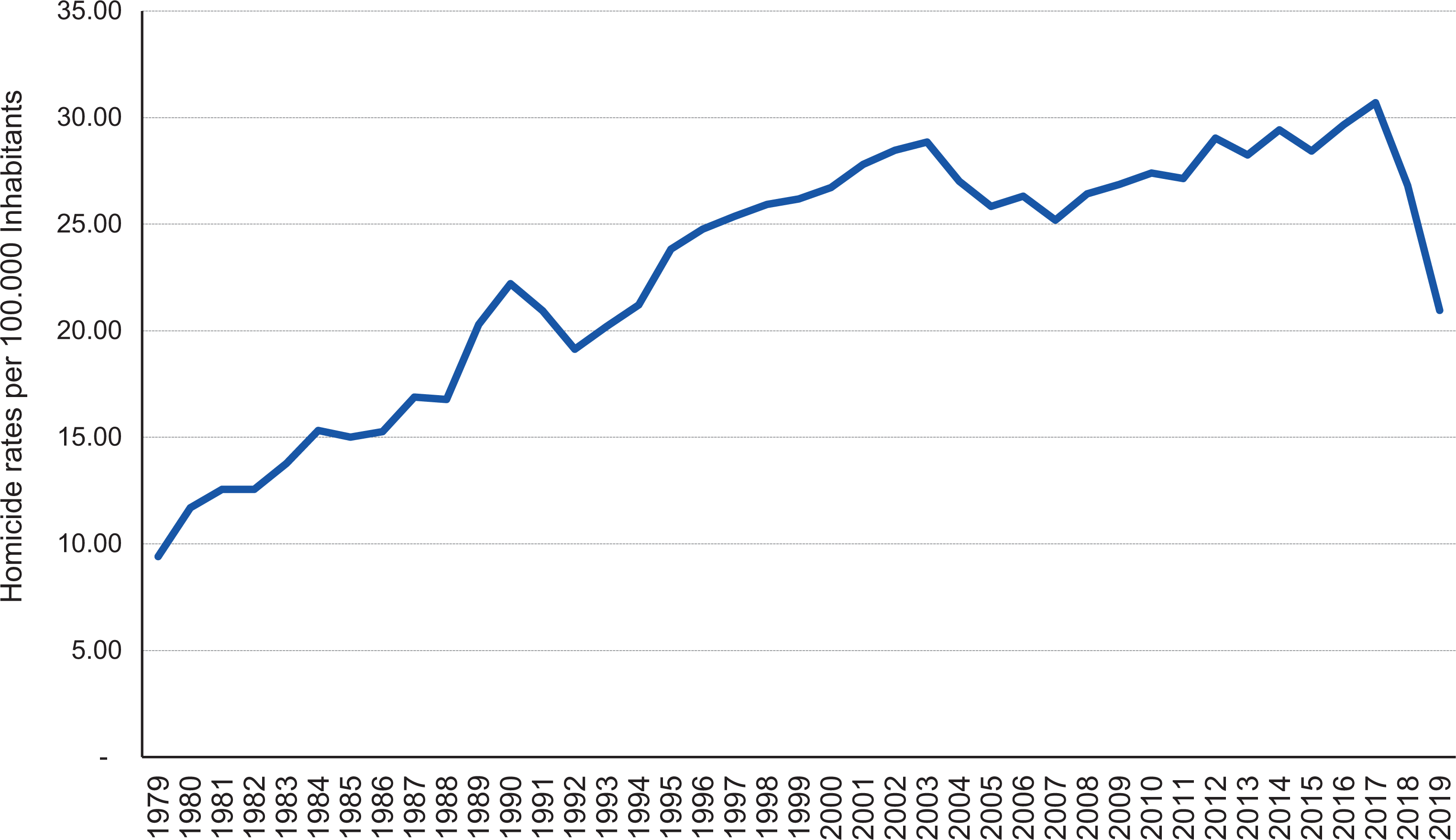
Deaths by aggression from 1979 to 2019, lethal violence. Source. DATASUS, 2019.
As other countries of Latin America, Brazil has only had a decline in homicide trends during a few years of the mid-1990s that then plateaued or increased up to the end of the 1990s (Tuttle et al., 2018). In the early 2000s the homicide rate started to drop to 25 per 100,000 inhabitants. This reduction can be explained according to Cerqueira (2011) by a combination of several processes: a reduction of economic inequality, a decrease in the proportion of young people in the population, more police in the streets, an increase in rates of incarceration and a greater control of firearms. The author argues that the decrease was inhibited by drug use that led to an expansion of illicit markets in several states. Yet, many states have observed an increase in lethal violence since the mid-2000s. The drop in rates after 2018 is controversial and has been associated with changes in the methodology of analysis, problems with data collection, genuine criminogenic factors such as pacification of organized crime and an improvement in the Brazilian economy (Kahn, 2020). Figure 4 shows the increase recorded from 2000 to 2017 by the states of the federation.
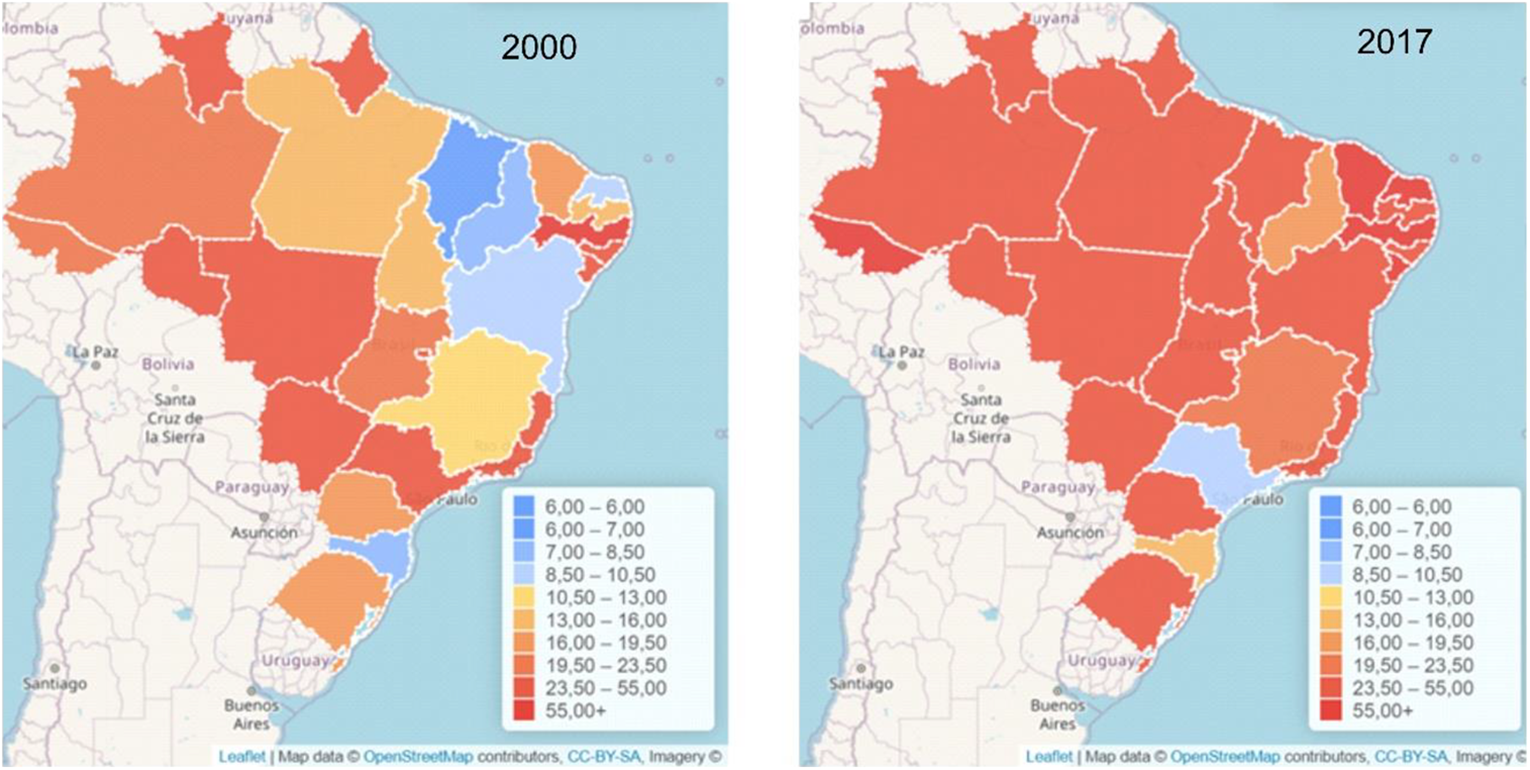
Homicide rates per 100,000 inhabitants, 2000–2017. Source. IPEA, 2020.
While the overall murder rate jumped 24% in 10 years, the rise in northern and northeastern states (which are Brazil’s poorest) was a staggering 68%. In 2017, the number of Blacks killed was almost three times higher than non-Blacks, a group encompassing White, Asian, and indigenous people (Figure 5). Kahn (2021) refers to an example of Simpson’s paradox: while national homicide rates decreased, an increase was found among Blacks and non-Blacks, at least in a few states of the federation.
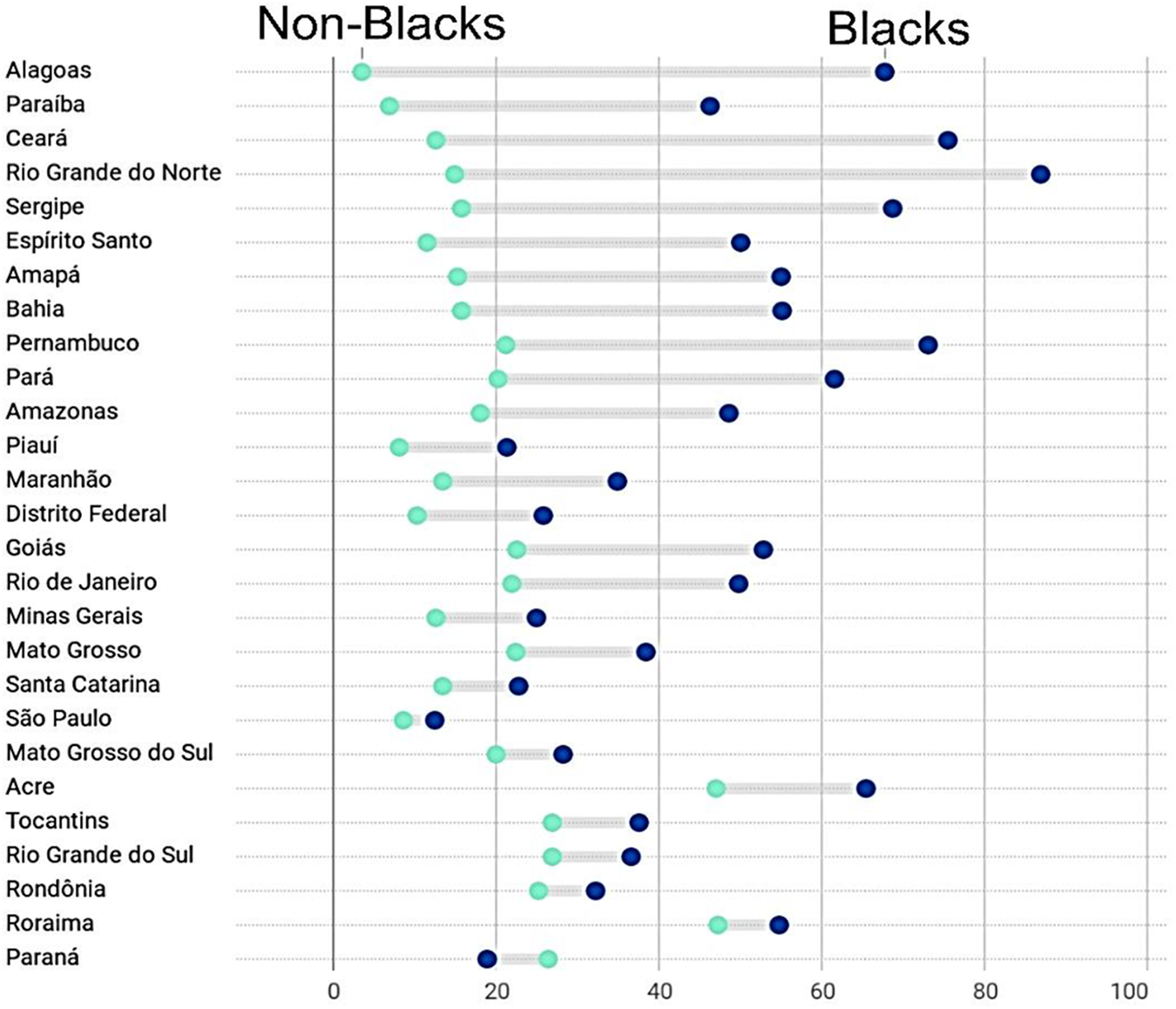
Homicide rates per 100,000 inhabitants according to ethnic background, 2000–2017. Source. IPEA, 2020.
Regional differences in homicide rates are a relatively neglected area of research internationally, but not in Brazil. Border regions are target of all sorts of (organized) crime, from property crimes (cargo theft) to smuggling of weapons, drugs, and people (Instituto de Desenvolvimento Econômico e Social de Fronteiras [IDESF], 2021). Kleinschmitt (2016) investigates the nature of lethal violence in the borderlands between Brazil, Argentina, and Paraguay. Using the same area of study, Luz (2020) focuses on crimes in the border strip, such as disputes over territory between drug traffickers, smuggling (cigarettes), misdirection and drug trafficking while Costa (2015) finds some regional shifts in homicides in Pará state calling for homicide crime prevention policies beyond big cities. In addition, Silva (2014a), shows that the cities with the highest homicide rates belong to the metropolitan areas of Northeast Brazil (Paulista/PE and Lauro de Freitas/BA), for the general population and for young people. Because the dynamics may be similar, but the causes may not always be the same, Nóbrega (2010) investigated potential differences in determinants of homicides in Brazil using the Northeast region as a reference. The author found that despite the improvement of socioeconomic conditions in the Northeast, most northeastern states exhibited growth in homicides in their territories, suggesting poor performance of public policies in security were decisive in the lack of control of lethal violence.
Temporal patterns of homicides
Quételet (1842) suggested that most violent crimes against persons are committed during the summer and the fewest during the winter. Since his seminal work, researchers have found empirical evidence on how crime levels vary and the way in which these variations relate to temporal variations of routine activity and weather conditions. However, evidence has shown contradictory findings, sometimes even within the same urban area. In São Paulo, Ceccato (2005) suggested that central and peripheral deprived areas showed the highest number of killings over the year, when most people had time off, especially during vacations (hot months of the year), in particular during evenings and weekends. Bando (2012) also identified a significant spike in homicides during Christmas and New Year, which can be partially explained by changes in people’s routine activity. However, Pereira (2016a) found no significant seasonal differences in homicides in Recife, Northeast Brazil, but instead a significant increase in homicides during the weekends and evenings on weekdays. Curiously, Machado (2016), using daily data for Brazilian states, verified the influence of “summer time” on homicides in Brazil. He found robust evidence in favor of a reduction of around 14% in the number of homicides in the “treated” states. This effect is mainly concentrated in hours that before the “summer time-change” were dark and after the change became lighter.
Spatial patterns of homicides
Homicides are not randomly distributed over space, and many studies in Brazil have often shown clustered patterns, regardless of scale: in particular settings, in neighborhoods or in regions. Research shows that areas classified as “rural” have experienced greater increases in violence than urban areas since the 1980s. For homicides with the use of firearms in particular, a rise has more recently been observed in municipalities with 50,000–100,000 inhabitants, while most large cities and metropolitan regions have experienced a reduction (Ceccato & Ceccato, 2017). Waiselfisz (2016) suggests a typology of violence for municipalities with the highest homicide rates: border municipalities are generally small or medium-sized but, due to their location, become a magnet for transnational organizations smuggling goods and/or weapons, piracy, and drug trafficking; new poles of growth are municipalities within states (often inland municipalities) that, since the 1990s, have experienced fast economic development, high employment, and intense immigration but with limited investment in welfare and public security; municipalities in areas of “new frontier,” characterized by deforestation, illegal logging, slavery, land stealing and killings of indigenous people, often due to the expansion of monocultures that demand “unoccupied” lands, with the support of political and financial interests; municipalities of predatory tourism, located mainly on the Western coast of Brazil, attracting large amounts of temporary population, summer, and weekend tourism; and finally, municipalities of traditional violence, which exist and subsist throughout time, such as the “marijuana polygon” of Pernambuco.
Another example was the study by Lima (2003), who assessed the temporal and spatial evolution of homicides in the state of Pernambuco from 1980 and 1998. The thesis reveals patterns of concentration and shifts of homicides, from the major city to the municipalities of the greater metropolitan area of Recife: one cluster located in the predominantly urban area and another in the region called the “marijuana polygon.” Focusing on the periphery of São Paulo, Hughes (2003) discusses the formation of 20th century segregation patterns in relation to the worsening life conditions of the poorest, who are thought to have been expelled to peripheral areas of the city. Similar analysis was carried out by Bercovich (2004), also by Verona (2006) and by Costa (2017) focusing on youth, and by Cunha (2017) devoted to children. Melo (2017) shows that traditional environmental criminology theories widely tested in other contexts can explain, at least partially, the distribution of crime in Brazil (See also the recent study by Lira, 2019). More recently, Aransiola (2020) attempts to understand the nature of the growth of lethal violence in Brazil 2000–2017 using municipalities as unit of analysis. He found evidence of change in the geographical distribution of lethal violence over time, illustrated by a steady increase in the North and Northeast regions and a reduction in growth in the South and Southeast regions of Brazil; changes that were associated with unemployment and income inequality to different degrees over time. The author predicts that the “new” growth patterns experienced across Brazilian regions may cause homicide rates to grow toward high levels throughout Brazil in the close future.
Schabbach (2007) also finds that the level of urbanization, presence of school gangs and use of private safety services helps to explain the variation in homicides rates in three regions in southern Brazil in the 1990s and mid-2000s (for a comparative analysis of victimization between São Paulo, Rio de Janeiro, Recife and Vitória, see B. T. Peixoto, 2008). More recently, Nery (2016) investigates why some homicide rates are stable while others increase or decrease. The author approaches this phenomenon through several urbanization and homicide patterns that characterize the municipality of São Paulo and concludes that homicide trends in space and time cannot easily be explained by universal theories, calling for more research and theories adapted to intraurban spatiotemporal dynamics in cities of the Global South.
Feminicide and women’s empowerment
It is perhaps not a surprise that in Europe, one of most frequent topics of homicide research is intimate partner homicide (Kivivuori et al., 2014; Liem & Pridemore, 2013), especially because violence against women is a global problem (Ceccato & Loukaitou-Sideris, 2020). However, different legal definitions of feminicide make it difficult to obtain reliable country-based comparisons. According to the 2018 UNODC Global Study on Homicide, the world average rate of feminicide was 1.3 per 100,000 women in 2017, while in Brazil the rate was 1.05 per 100,000 women, slightly smaller than the world average, lower than the African (3.1) and the Americas (1.6), but higher than the European (0.7 per 100,000 women) or Asian (0.9 per 100,000 women).
Using a different data source, Brazil is placed eighth in feminicide among the highest in Latin America countries according to ECLAC—United Nations (2019). The highest rates per 100,000 women in Latin American countries are observed in Honduras (6.2), El Salvador (3.3), the Dominican Republic (2.7) and Bolivia (2.1) (Figure 6). The legal definition of feminicide came into force in 2015 in Brazil, previously to that year; homicides of women were classified simply as homicides, independent of motivation, context, or relationship with the author of the crime. With the creation of the new law, lawyers, delegates, promoters, or judges progressively substituted the old legal classification for the new, which is believed to have led to an artificial increase, at least partially, of the number of cases of feminicide.
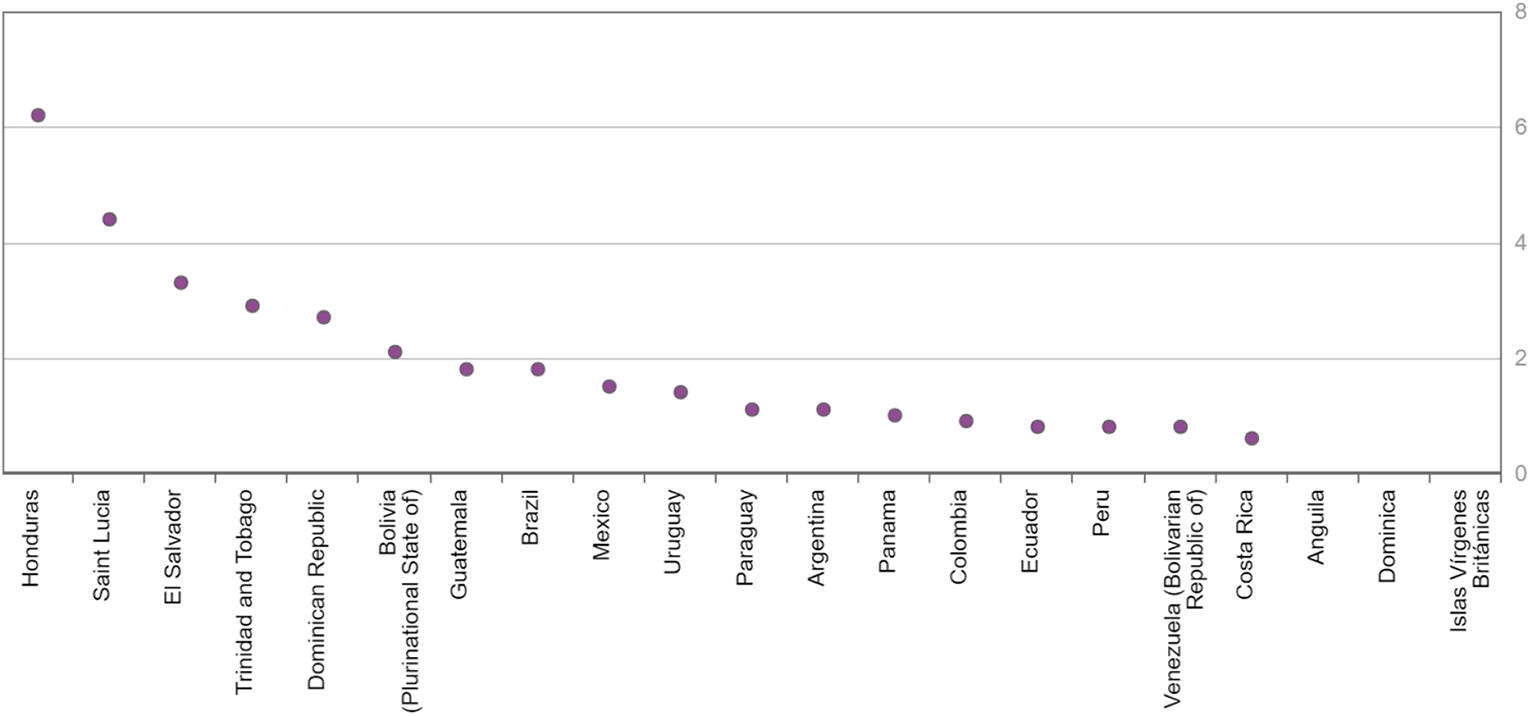
Feminicide rates per 100,000 women in Latin America and the Caribbean. Source. ECLAC—United Nations (2019).
Costa (2016) found that from 2008 to 2012, 19,000 women were killed by assault in Brazil. These women were mostly young, single, Black, and uneducated. To obtain a better understanding of the social dynamics that produce female homicides in Pernambuco, northeast Brazil, Gomes (2014) studied the situations, from 2004 to 2012, in which women were murdered and compared them to those of men, finding that income inequality, urbanization rate and factors related to gender inequality, such as female head of household and total fertility rate, were associated with women’s vulnerability. The author highlights that the contexts of homicides of women are diverse and obey distinct social dynamics, in which gender plays a fundamental role. Souza (2015) highlights specifically the honor culture motivating feminicides in Pernambuco, Northeast Brazil.
Although research acknowledges the influence of neighborhood factors on IPV, few studies investigated the distribution of IPV against women and its relationship with social inequalities, urban violence, and social capital. Kiss (2009) finds no evidence that neighborhood factors impact IPV in the City of São Paulo, which reinforces the assumption that gender is central to understanding and preventing IPV. The study by V. L. A. L. Azevedo (2011) investigates violence against women living in Belém, Pará, and analyzes the implications for nursing care. A similar study was carried out by Souza (2019), analyzing the feminist movement as a form of resistance in an area highly hidden by violence against women in the outback of Ceará state, Northeast Brazil.
An extreme dimension of IPV is the occurrence of homicide-suicide in a relationship. The homicide-suicide is a gendered crime, because men make up the majority of the killers and women the victims. A. K. S. Azevedo (2013) investigates the meanings of the experience of homicide-suicide from women who have survived the act. Most of the women experienced what is described as “loving relationships characterized by strong jealousy, with the presence of fantasies of betrayal and feeling of possession.”
A few studies are devoted to historical crime cases, such as the study by Rodrigues (2013) investigating how violence among women in 19th century Brazil was employed in the defense of life and honor in southern Mato Grosso state. The author shows that women “succeeded in establishing small and significant changes in social relations in daily life” at that time, in particular with the representatives of the judiciary, politics, and local and federal government.
State authoritarianism and police that kill
The Brazilian civilian–military dictatorship, which occurred from the 1960s to the 1980s, was marked by thousands of cases of human rights violations and institutionalized and systematic violence, with forced disappearances, torture, murder, illegal detention, and exile. Dias Filho (2015) studies the violence that military dictatorships committed against indigenous peoples who were taken from their lands for two federal prisons in the state of Minas Gerais, Southeast Brazil. From dictatorship to the transition to democracy, repression has been witnessed by Brazilian society in different ways. For instance, records of police killings in absolute and in relative terms have increased since the 1990s in Brazil, with major increases after the 2000s. The significant increase reflects a genuine rise in police violence but also reflects, at least partially, an improvement in the way the records are kept either by police or hospitals. Rebellions in prisons, riots and confrontations with organized crime are just a few of the circumstances in which police violence may happen (Ceccato et al., 2018). Based on the analysis of a sample of filed criminal proceedings and police investigations in São Paulo municipality in the 1990s, Garcia (2013) investigates how impunity and a repressive police and criminal justice system can lead to a circle of violence, while Lemos (2019) focuses on the characterization of three jails in Southeast and Northeast Brazil and cases of human rights violations. See also the study by F. F. Araujo (2016), and studies of unconscious determinants of lethal police force by Kohara (2019) and Bueno (2018), who investigate the persistence of lethality in the actions of the military police of São Paulo state despite the reduction in homicides observed in 2000–2016.
In a similar vein, Winter (2008) analyzes how the criminal justice system dealt with cases of illegitimate violence carried out by state agents in charge of maintaining public order. The focus of the research was on intentional homicides committed by military police against civilians. The limits of justice and of the democratic apparatus in situations of violence is also the subject of a study carried out in São Paulo’s context by Prado (2008). Seventy sentenced cases concerning intentional homicide that occurred in Goiânia in 2007 and 2008 were used as a basis by Franco (2014) to study how the state acts in relation to homicides and specifically how the state exerts its monopoly on force over a specific group, most of whom are poor, young Black men. Oliveira Neto (2020) investigates why police officers kill. The author suggests among other things that the police’s organizational management permanently sets police officers in conflicting situations, capable of mobilizing an existential crisis in certain individuals that can result in abusive actions of acute violence.
Hate crimes
Several studies analyze the social construction of hate crimes, including homicides, motivated by homophobia (Efrem Filho, 2017; Melo, 2017; Pereira, 2016b) or hate against ethnominorities (Wanzinack, 2018). According to a survey conducted by the Gay Group of Bahia (Valente, 2020), in 2017 murders of LGBQTI people increased 30% compared to 2016 (see also, Farid et al., 2019). V. B. Peixoto (2018) describes violence against LGBQTI groups as systemic in Brazil; in other words, it produces its own system based on hierarchical unique factors of gender identity and sexual orientation. Efrem Filho (2017) seeks to understand how gender and sexuality relations operate on narratives about violence. How gender and sexuality stereotypes impact the judgment of homicide cases based on the sexual orientation and gender identity of the victim is treated by Melo (2017), for example. Pereira (2016b) reports on violence against LGBQTI persons in Manaus, Amazon state, and the contemporary political contexts dominated by conservatives that make it difficult for LGBQTI persons to exercise their rights, focusing on landless rural workers and homosexuals as victims of homicides.
The distribution of homicides against indigenous people in the states of Mato Grosso do Sul and Roraima was studied by Wanzinack (2018). The author finds a national average of indigenous homicides of 22 per 100,000 indigenous inhabitants per year; the homicide rate of indigenous men was twice as high as that of women, but the rate for indigenous people was more than twice that of nonindigenous; high homicide rates of indigenous children (under 1 year) are reported in areas of the states of Roraima and Amazonas.
Drugs and weapons
Firearms and drugs are highlighted as important factors in the commission of murder in which young people, often poor males, are involved as victims and perpetrators (Lolis, 2008; Ruzany, 2000; Silva, 2004; Takitane, 2019). The potential link between drugs and death by homicide among young males was tested by Silva (2004) in a rural region of São Paulo state. The author finds evidence of an increase in death by external causes and the consumption of drugs outside big urban centers. Lethal violence was also associated with layers of vulnerability generated by the intersection of gender, age and ethnic group in the socioeconomic context and illicit activities such as drugs and illegal weapons in Londrina, Southern Brazil, in the study by Lolis (2008).
One of the most relevant studies on the costs of violence is by Cerqueira (2011), who analyzes the causal relationship between guns and violence. The results show the substantial effect of firearms on violent crimes, especially homicides. Costa (2014) also shows that homicides in the municipality of Itabuna-Bahia, Northeast Brazil, 2006–2012, were related to availability of weapons in the streets (firearms). Also relevant is the study by M. J. Santos (2012) which show clear links between the law of weapon reduction on lethal violence in the city of São Paulo. The author also evaluates possible causes of a significant reduction of violence to find that lethal violence was positively related to unemployment, negatively related to real wages, and negatively related to the results of public policies directed to reduction of weapons from the streets.
Similarly, Alves (2014) confirms links between drugs and homicides in Maceio, Alagoas state, also in Northeast Brazil, when assessing data on killings 2001–2012. Nascimento (2011) assesses violence linked to gangs, in particular how groups of young people share a common identity and systematically get involved with violence and drugs. Moreover, speculations about the role of organized crime are suggested by F. L. Santos (2016), who investigated homicides in the male population of the metropolitan region of São Paulo, 1979–2013, and shows that adolescents and young adults predominated among victims.
Prevention of homicides
Traditionally, the use scientific evidence to resolve the problems of violence in Brazil is problematic. Kopittke and Ramos (2021) have recently attempted to identify evidence on the efficiency of programs to reduce the number of homicides in Brazil. They review 13,352 studies to show that the country has innovative programs that effectively reduce homicides, while actions traditionally cited as solutions do not present scientific evidence that they work. Major barriers are detected by authors in decision-making processes of implementation of these programs, which are said to be based on corporatism, prejudice, and political populism. Below we discuss a number of so-called successful interventions. Scholars recommend successful interventions based on assessments using data obtained through secondary data, case studies, interviews, focus groups and field observations.
Silva (2014a) finds that municipalities with a rising trend in homicide rates also experienced situations of impoverishment of public services and social protection and social policies, while in those municipalities that show a downward trend in homicide rates, there appears to be greater synergy between macrosocial and macroeconomic policies and local contexts that involve the social organization of the municipality and community participation. Such trends were also found by Costa (2014).
Schiavon (2017) assesses the impact of women’s protection laws, The Maria da Penha law introduced in Brazil in 2006 on domestic violence using a differences-in-differences strategy, and compares homicides rates of males and females before and after the passage of the law. The author finds that the law significantly reduced female household homicide rates and these effects were concentrated in small municipalities. Macaulay (2021) found similar results. Drawing from interviews with police officers who have set up and operated the patrols, operational data provided by police forces, and empirical studies produced by policy entrepreneurs within the police, the author show that victims in the protection program are much less likely to suffer repeated assault or feminicide than those who are not.
In addition, in line with international evidence, the Brazilian results demonstrate that crime prevention evidence based policing programs are much more effective than reactive actions, which have often been implemented in the country. Although Brazil is still timid, Kopittke (2019) demonstrates that the revolution of evidence in public security has already begun in the country, through occasional experiences and that the paradigm has great potential to increase the effectiveness of public spending in the area. Kopittke (2019) provided evidence on 24 types of intervention, eight of which were effective in reducing homicides.
An example is a quasi-experimental study by Silveira (2007) who shows evidence of reduction of homicides among young people through the implementation of the “Stay alive” program in a neighborhood in Belo Horizonte, Southeast Brazil. The program that was effective in rescuing and preventing the entry of young males in gangs, has also contributed to the community’s perception of improving the local quality of life, reducing violence in schools, but has shown modest results with regard to the increased capacity for local organizations to mobilize and interfere in issues of crime. For other preventive alternatives, see Schabbach (2007) and M. C. Araujo (2019). Additionally, private security has grown in recent years, gaining economic importance not only in major urban centers but also in small cities. A. V. Santos (2016) assesses the increase of private security in relation to the perception of violence experienced by economic agents in the Northeast states of Brazil in the period 2007–2012 to find a significant relationship with the murders, especially in larger cities.
Homicide rates decreased 67% in São Paulo from 2000 to 2010. Cabral (2016) investigates the extent to which the criminal information system INFOCRIM, adopted by 67 municipalities in São Paulo by 2010, played a role in this development, after controlling for determinants of crime and other public security actions. The author found that the system can be considered successful in fighting lethal crime because, among other things, it has helped police prevent 2,546 homicides over the period. Similarly, Pereira Filho (2016) investigates the effects of the implementation of municipal guards on crime rates to show reductions in homicide rates in small municipalities but no effects from the so-called Federal funding directed to public security at local levels.
However, there are examples of failure or unexpected results. Seeking to control and mainly reduce homicides with firearms, after a popular referendum the Federal government approved in 2006 the Disarmament Statute (Federal Law 10,826/2003, whose central objective was the control of all trade and transfer of firearms, ammunition, and accessories for weapons throughout the country), Wakim (2017) tests its efficiency and finds that the statute failed to reduce homicide rates. In addition, Castro (2019) evaluates the impact of the Programa Nacional de Segurança Pública com Cidadania (PRONASCI) on the homicide rates of the municipalities that received resources from the program for the years 2000 and 2010 to show that the program failed in reducing the homicide rate, while Dias (2019) finds that the risk of dying from homicide in places with and without intervention did not differ in Belo Horizonte, Southeast Brazil. The exception was in areas with the longest intervention projects, especially if they targeted young Blacks with poor schooling. Similarly, Ferreira (2017) assesses the public policy implemented through the organizational model of the Pacifier Police Units in the state of Rio de Janeiro to show how it worked as an adaptation of the city to the territorial requirements due to two major sporting events (Soccer World Cup and Olympics). However, findings show that this model was extremely costly and unable to maintain the lower homicide rates achieved in the early years of the policy.
Perceptions of violence, the police, and criminal justice
The different ways in which everyday violence manifests itself are a major challenge for research seeking to interpret the phenomenon (F. F. Araujo, 2016). Silva (2014b) interviews young people in a neighborhood in São Paulo to better understand the perception of urban violence by young people born and raised in areas with deprivation and violence. A similar study was carried out by Lima (2016) in Bahia state, Northeast Brazil, to report that young people take precautionary measures and recognize the potential of social mobilization to cope with fear of violence. In addition, Zaicaner (2007) assesses perceptions of violence by interviewing family members of homicide victims, opinion makers, health professionals and the protagonists of violence with the intention to contribute to improved public policy. With a historical perspective in Criminology, Ferrari (2013) investigates how newspapers, psychiatry and the defendant himself builds his image in a case of two children who were murdered in 20th century Rio de Janeiro, while Gomes (2018) investigates, through case studies, how masculinity is established for poor young men living in peripheral areas of Ponta Grossa, Paraná, South Brazil, and involved with homicide violence.
Teixeira (2016) investigates the repercussions of the death of a young Black resident of a deprived area of São Paulo on the life of survivors. The survivors, or hidden victims, are people who are not revealed by statistics but have their daily routine modified by the extreme violence. Findings indicate changes in their mobility patterns, reduced income because of the loss of the provider and inability to work because of a constant need to escape after witnessing the crime or fear of leaving the house at night. Prejudice and discrimination were reported by residents, and the media are seen as responsible for increasing the sense of fear in the population and support for repressive police measures.
Measures and methods in homicide research
Many studies suggest innovative tools to assess the patterns and trends of lethal violence and apply these tools to diverse data sets (e.g., Camargo, 2007; Chiavegatto, 2010; Oliveira, 2007; Pinho, 2006; Prado, 2008; Steeves, 2014). We discuss a few below. Being able to detect mortality inequalities is essential to developing more equitable health policies, including among those more exposed to violence. Thus Prado (2008) calculates differentials of risk for homogenous population groups in São Paulo. Similarly, Oliveira (2007) suggests a decision support system to monitor external causes of death by combining different databases. Aiming at advancing decision-making support systems in lethal violence, Camargo (2007) proposes and tests a geostatistic methodology to estimate the risk in rare events, in this case homicides in São Paulo, with encouraging results. Chiavegatto (2010) tests the use of propensity score matching to model homicides for the 96 districts of the municipality of São Paulo. The statistical model includes 16 variables to account for local heterogeneity. The statistical methodology was effective in controlling for local social and demographic heterogeneity, allowing the comparison of similar districts only. For similar studies, see Sousa (2016), and for a model to identify the vulnerability of areas to homicides, see Figueiredo (2018). R. Pereira (2017) shows how different statistics (polarization measures) indicate positive impacts on rates of intentional homicide and theft and robbery of vehicles in municipalities in Brazil.
Crime underreporting is a problem regardless the chosen methodology because it affects both the research quality of the phenomenon and the efficiency of public security policies, especially regarding resource allocation. An example is illustrated by the study of Moreira (2017) who uses stochastic frontier analysis to estimate the underreporting of crimes against property in Minas Gerais. The author finds that underreporting affects the interpretation of the official statistics and influences criminal activity.
Final Considerations
This article reviews and synthesizes a growing literature on homicides written by Brazilian scholars in Portuguese that is unfamiliar to an international audience. This article makes a contribution to the international literature by systematically reporting a sample of the Brazilian literature on lethal violence, focusing on academic theses from 2000 to 2020. Findings show that the great majority of the theses were published in the last 10 years. A sharp increase in interest has been observed in the nature of homicides, trends, and prevention (from two to 16 theses yearly). On a positive note, although more than half of the theses were published by universities in Southeast Brazil (where most of the Brazilian population and the universities are located), the second most important university is in Northeast Brazil, where there has been an increase in homicide rates (University of Pernambuco). More than half of the theses have a woman author, showing a good gender balance.
Sociology/Criminology and Economics are the domains that contribute the most research on lethal violence in Brazil, but an increasing amount is observed from Public health, Medical sciences, Geography and Psychology, before other minority fields. The plethora of theories come from different paradigmatic schools of thought and traditions. While certain disciplines still have the monograph as the most common PhD format, in others theses are more often being composed of internationally published articles, or a hybrid, that tend to report more quantitative research. From Sociology and Economics theses, social disorganization theory (Shaw & Mckay, 1942) or Becker’s rational choice (Becker, 1968), and much less so inspiration from Environmental Criminology theories, serve as principles of analysis and homicide prevention. Currently, homicide in Brazil is often tackled by long-term policies with little appreciation of the need to consider other perspectives on homicide as a subject of research and its prevention. Little is still known about the importance of the microsituational aspects of killing (Clarke, 1983) and, in particular, the interaction between individuals and the environment (Wikström et al., 2010) and the types of moral contexts in which individuals take part before, during and after crime commission.
New innovative methods of research and homicide prevention have also been suggested and tested, but it is difficult to generalize about their efficacy in different contexts but poverty and deprivation are indicated to be common denominators of lethal violence. Ceccato (2017) suggests that international research has identified challenges when attempting to untangle the effects of poverty from the effects of relative deprivation on violence, as proxies for violence tend to be correlated. There have been concerns about whether current theories, methods and measures truly capture the reality of the Brazilian context, as they are often treated as unproblematic when transplanted from the Global North. There is growing evidence that risky factors, such as possession of a firearm, drugs/alcohol consumption and unemployment, have much more pronounced effects on violence in a context of economic, social, and institutional poverty (see IPEA, 2020) such as that of Brazil and other countries of the Global South in general than such factors do in a Global North context. There is an abundance of criminological research and experiences of significance in the Global South that are worthy of recognition, with important implications for South–North relations as well as global security and justice (Carrington et al., 2018). In the next section, we recommend potential areas of future research.
Conclusions and Recommendations
Brazil is a country of continental dimensions, as well as one of the most criminogenic countries in the world (UNODC, 2018), has the highest years of life lost to violence out of any WHO member state (Murray et al., 2013) and victims likely to be young, male, and black. These facts alone can inspire researchers from all around the world to join research to find better ways to fight violence and public security challenges in Brazil. This review of the literature points to a number of areas where more research is needed on the topic of homicides, so we conclude this article with recommendations for further research and policy in specific areas.
First, a way to understand the dynamics of homicide is to study individuals’ mobility and their environment as triggers of violence. Land use shapes the flow of human routine activities and affects the number of interactions that are criminologically relevant and that lead to offending and violence. An example is cargo theft which is highly violent crime in Brazil (Justus et al., 2018). In cities, inner city areas tend to be violent places regardless of the time of year because they concentrate functions that attract crime and violence (e.g., bars and sport activities). Therefore, homicide prevention should be sensitive to these spatiotemporal issues.
The article calls for a better understanding of the role of the state, the police, and the criminal justice system, on the one hand as “generator of violence,” and on the other as “controller” and/or “protector” of citizens. In an unequal society like Brazil’s, with a historic legacy of political repression, corruption and chronic racism, important questions about the mechanisms of violence remain to be investigated with a more critical lens. For example, social disorganization theory (Shaw & McKay, 1942, linking homicides to factors such as deprivation, ethnic heterogeneity) and the Beckerian rational choice (G. S. Becker, 1976, is frequently adopted in theses among economists) are still the most common adopted theoretical frameworks in theses in criminology in Brazil. As Ceccato et al. (2018) suggests, Brazil’s rapid political, socioeconomic, and demographic changes have not been followed by changes in the criminal justice system, police organization and training, or democratization of police institutions that would be expected to positively affect police practices. If and when such changes do happen, we as researchers must be prepared to investigate them adopting perhaps new theoretical lens that better fit the criminogenic and historical–cultural conditions of particular places.
While this literature is quite definitive about the relationship between disadvantage, poor life chances and lethal violence affecting young Black men in the streets, the mechanisms behind domestic violence and its prevention are a relatively neglected field. However, such violence is highly gendered and kill thousands of women and girls each year in Brazil. Evidence shows that those women who are killed are mostly young, single, Black, and uneducated—this calls for a research agenda that encompasses a more intersectional perspective on victimization, particularly in relation to gender, age, and ethnic background. More focus on ways of preventing homicides (in general and as hate crimes), as well as reporting current forms of resistance and empowerment of those most targeted by such violence, is also necessary. Studies of hate crimes, especially against LGBQTI groups, elderly people and other minorities are just starting. In addition, there is a gap in knowledge about the motivation of homicides (see Kahn, 2021), in particular the relationship between drugs and violence. In particular, we welcome international comparative research that goes beyond homicides' underlying structural and individual factors. In the United States, for example, there exists a long, well-established debate about the role of race in violent victimization after controlling for structural and individual factors (Phillips, 2014; Sampson et al., 2005). This is an aspect of lethal violence that is not well understood in Brazil and, as in the United States, the Brazilian racial homicide differential is also large (Figure 5), with Blacks exhibiting much higher homicide rates than whites.
Finally, it is desirable that a research agenda for public security should reflect national as well as region-specific challenges. Rural areas have experienced greater increases in violence than urban areas since the 1980s, but little is known about the nature of violence in the rural–urban continuum, from urban fringe to the most remote areas. Genocide linked to land conflicts, organized crime, and violence in border regions, as well as the overall social sustainability of the countryside are research topics that demand urgent attention. It is positive that certain topics of research attract the interest of the international academic community, but there is a risk that such external interest disguises an “appropriation” of topics that are dictated by funding organizations that neglect the big questions that are sufficiently relevant to the country or to the local knowledge of Brazilian scholars.
The implications of this literature overview for practice are many. We echo Murray et al. (2013) on the “need for more systematic data collection on crime and violence in Brazil. In particular, police recording of offenses and offenders needs to be conducted systematically across the country, and records compiled nationally to monitor numbers of officially recorded crimes and offenders, and characteristics of offenders in Brazil.” In particular the need to establish “regular national victimization surveys in Brazil to provide reliable estimates of crime frequency and time trends that can be compared with official statistics and with other countries” (p. 480). With regards gender violence, we need to be aware of comparison of feminicide rates is problematic among countries because of different legal definitions. Similarly, we agree with de Oliveira et al. (2020) that call for an integration of perspectives to violence, an interdisciplinary public health approach, with involvement of various public sectors and civil society to achieve better responses to both policies and services to prevent violence and particularly homicides. In terms of interventions, it is important to reveal initiatives against homicides that do not work as initially expected so they can be avoided in the future. Finally, we also suggest following recommendations by Lum et al. (2011) that governments, international organizations, and private financiers may use findings from evidence-based research to guide their decision-making process and to prioritize efforts made to ensure their effectiveness.
Brazil has the highest absolute number of homicides in the world, and these deaths represent more than 10% of homicides worldwide. It seems reasonable to expect that more international attention should be given to the topic and to the current knowledge that is being built up to tackle problems of violence. Despite limitations, this paper attempts to show examples of the most recent research published in Portuguese carried out by Brazilian scholars in several disciplines relevant to the study of homicides.
Footnotes
Appendix
Declaration of Conflicting Interests
The authors declared no potential conflicts of interest with respect to the research, authorship, and/or publication of this article.
Funding
The authors received no financial support for the research, authorship, and/or publication of this article.
