




Abstract
Solastalgia is the pain caused by the loss of solace and isolation from one’s environment. Solastalgia is contrasted with nostalgia, which is defined as melancholy characterized by homesickness or the distance from one’s home. The present study examines the two concepts of solastalgia and nostalgia in the context of climate change among diverse populations of older Israelis. In total, 50 older persons from four different population groups (e.g., veteran Israeli Jews, Israeli Arabs, immigrants from the former Soviet Union, and Ethiopian immigrants) were interviewed. All interviews were transcribed and analyzed thematically. Members of all four groups expressed emotional distress and grief associated with the changing climate, increased environmental pollution, and the disappearance of nature. Perceptions around the undesirability of these changes were quite unanimous, thus leading us to conclude that the outcomes associated with solastalgia and nostalgia are quite similar despite different etiological explanations.
• Respondents reported a sense of loss associated with the changing climate, increased environmental pollution, and the disappearance of nature. • These experiences of loss were common to all four population groups interviewed in this study. • Findings suggest that the two concepts of solastalgia and nostalgia result in similar experiences, despite different etiological explanations.
• More attention to the emotional impact of the changing climate and environment on older persons is needed. • Environmental changes might be attributed to different reasons, but their impact on older persons is similar, and thus could possibly justify similar interventions. • In addition to addressing physiological and psychological losses that occur in old age, it is important to acknowledge environmental losses.What this paper adds
Applications of study findings
Introduction
The physical environment and, in particular, attachment to one’s place play an important role in the health and wellbeing of older persons (Afshar et al., 2017). With the advancement of old age and the increasing number of chronic conditions and disabilities, older persons become increasingly more confined to their homes and their attachment to place becomes even more pronounced. Under such circumstances, older persons’ social and physical life is constrained to their near home environment (Rowles, 1980). Indeed, research has shown that place attachment becomes stronger in old age and that the home environment plays an increasingly more important role in the life of older persons (Mahler et al., 2014; Trecartin & Cummings, 2018).
Given the importance of the home and the near neighborhood environment in the lives of older persons, the person–environment fit becomes crucial in old age (Cao & Hou, 2021; Oswald et al., 2005). There is plenty of support to demonstrate a connection between the characteristics of the physical environment and older persons’ social activity, physical activity, health, and wellbeing (Lu et al., 2021; Stephens et al., 2020). In general, more prosperous environments are preferable in terms of the sense of safety and opportunities for social and physical engagement they allow for (Cleland et al., 2019).
Climate Change and the Environment
Environmental research on the role of place and space among older persons has largely been disconnected from literature on climate change and older persons (Devine-Wright, 2013). This is unfortunate, given the fact that place attachment likely has a direct association with people’s response to the changing environment including willingness to engage in adaptation and mitigation efforts (Devine-Wright & Batel, 2017). Likewise, the changing climate and environment also have a potential to impact people’s attachment to their own environment (Praskievicz, 2022).
Instead, much of the research on climate change and older persons has stressed the susceptibility of older persons to extreme climate events (Yu et al., 2012; Åström et al., 2011). Research has consistently shown that older persons are likely to experience increased morbidity and mortality following exposure to extreme climate events such as wildfires, droughts, and flooding (Giang et al., 2014; Willoughby et al., 2017; Yu et al., 2012). Regarding the mental health effects of climate change on older persons, research is mixed. On the one hand, there is some evidence to show that following exposure to extreme weather events, older persons are more likely to experience posttraumatic stress disorder and adjustment disorder compared with younger populations (Kun et al., 2013; Parker et al., 2016). However, on the other hand, research has shown that younger people and children are particularly susceptible to climate anxiety brought by fears about the impact of climate change on our lives (Hickman et al., 2021; Léger-Goodes et al., 2022).
One concept which has been investigated mainly in relation to older persons and climate change is solastalgia (Albrecht, 2005). The term solastalgia is composed of two words: solace (comfort) and desolation (abandonment, isolation, loneliness) (Albrecht, 2005, 2020). Solastalgia is defined as the distress associated with environmental changes. The reference to the environment is quite broad and includes the biophysical landscapes and spaces in which people live and refer to as home (Albrecht, 2020). Hence, environmental changes are those associated with climate change, brought by earthquakes, volcano eruptions, drought, as well as other forms of distraction inflicted by technological advancements such as the mining industry (Albrecht et al., 2007; Warsini et al., 2014).
Solastalgia is the pain caused by the loss of solace and isolation from one’s environment. Solastalgia is contrasted with nostalgia, which is composed of the term nostos (back to the origin) and algia (pain). Nostalgia is defined as the melancholy characterized as homesickness or the distance from one’s home (Albrecht et al., 2007; Warsini et al., 2014). Hence, whereas the former term represents a yearning for something which has gone through varied modifications, yet the person is still located in the same physical environment, the latter term represents yearning to a place that one is no longer part of (Albrecht, 2020).
Like solastalgia, nostalgia is considered a negative emotional state, which is characterized by negative affect. However, a more recent conceptualization of nostalgia stresses its positive aspects which contribute to improved affect, self-esteem, social connectedness, and reduced sense of existential threat (Hepper et al., 2021; Sedikides et al., 2008). Among older persons, nostalgia has shown to be protective against sense of loneliness and to result in improved life satisfaction and psychological wellbeing (Fawn, 2020). When considering the two terms, it is important to consider their evolving nature and the fact that the two terms have slightly changed their meaning over the years. Hence, it is important to examine how the two concepts relate in contemporary sociocultural contexts.
The Present Study
The study was supported by a grant from the Israel Science Foundation (ISF 217/20). The present study examines the two concepts of solastalgia and nostalgia in the context of climate change among diverse populations of older Israelis. The choice of interviewing older persons rather than younger persons stems from our interest in obtaining a lifespan perspective on changes that have occurred over time.
The older population (65+) in Israel is quite diverse, composed of veteran Israeli Jews (13% of the entire population), most of whom (78%) born outside of Israel but immigrated many decades ago, Arabs (8% of the older population; 20% of the entire population), older persons who immigrated to Israel in the past three decades, mainly from the former Soviet Union (FSU; approximately 23% of all Israelis over the age of 65) (Brodsky et al., 2018), and a very small group of older Ethiopian immigrants, who immigrated to Israel mainly between 1979 and 1991. Whereas Ethiopian immigrants in Israel represent about 1.7% of the entire Israeli population, only 6.4% of them are over the age of 65, compared with the broader Israeli population, of which 11% is over the age of 65 (Ethiopian National Project, 2022).
We approach these diverse populations of older Israelis with the understanding that they likely represent diverse perspectives concerning Israeli climate and climate change. Veteran Israeli Jews are most likely to have an urban lifestyle, compared with Arabs who tend to live in the northern and southern parts of the country and have a more traditional/rural lifestyle (Brodsky, 2018). Both immigrants from the FSU and those from Ethiopia represent groups that had to adapt to a different environment and climate in middle age. Yet, they originally come from very different climate zones.
When considering these four population groups, it is important to regard the sociopolitical nature of space and environment. In general, research has found a stronger attachment to place in the native community compared to migrants (Kohlbacher et al., 2015). In the case of ethnic minorities, place attachment is largely a function of perceived race discrimination and subgroup identity, with place attachment being lower following exposure to discrimination (McAuley, 1998). Attachment is also lower in more deprived environments (Bailey et al., 2012).
Hegemonic population groups of power rely on the spatial environment to exclude other population groups (Sibley, 1995). In the case of Israel, this certainly concerns the Arab population, which views spatial planning as a means of control characterized by restrictions on its territory, confiscation of the land, and the promotion of an urbanization process, which disconnects the Arab population from its land (Kheir & Portnov, 2016). Nonetheless, the Zionist territorial strategy has been described as a settle and rule mechanisms also in the context of Israeli Jews, with the settlement of Jewish immigrants aiming for the geographic periphery (Schwake, 2020).
Whereas immigrants from the FSU and from Ethiopia might express solastalgia in response to their transition to a different climate and environment, the veteran Israeli Jews and Israeli Arabs can be characterized as experiencing primarily nostalgia in relation to a lost environment and climate, which are no longer part of their lives. There are expected differences because of migration history and ethnic minority status (Kohlbacher et al., 2015; Shdema & Martin, 2022), but their exact nature is unclear, given limited research in the field. Nonetheless, given the highly diverse climate zones the immigrant groups came from, we expected diversity in the experiences of solastalgia and nostalgia across the four groups.
Methods
Participants
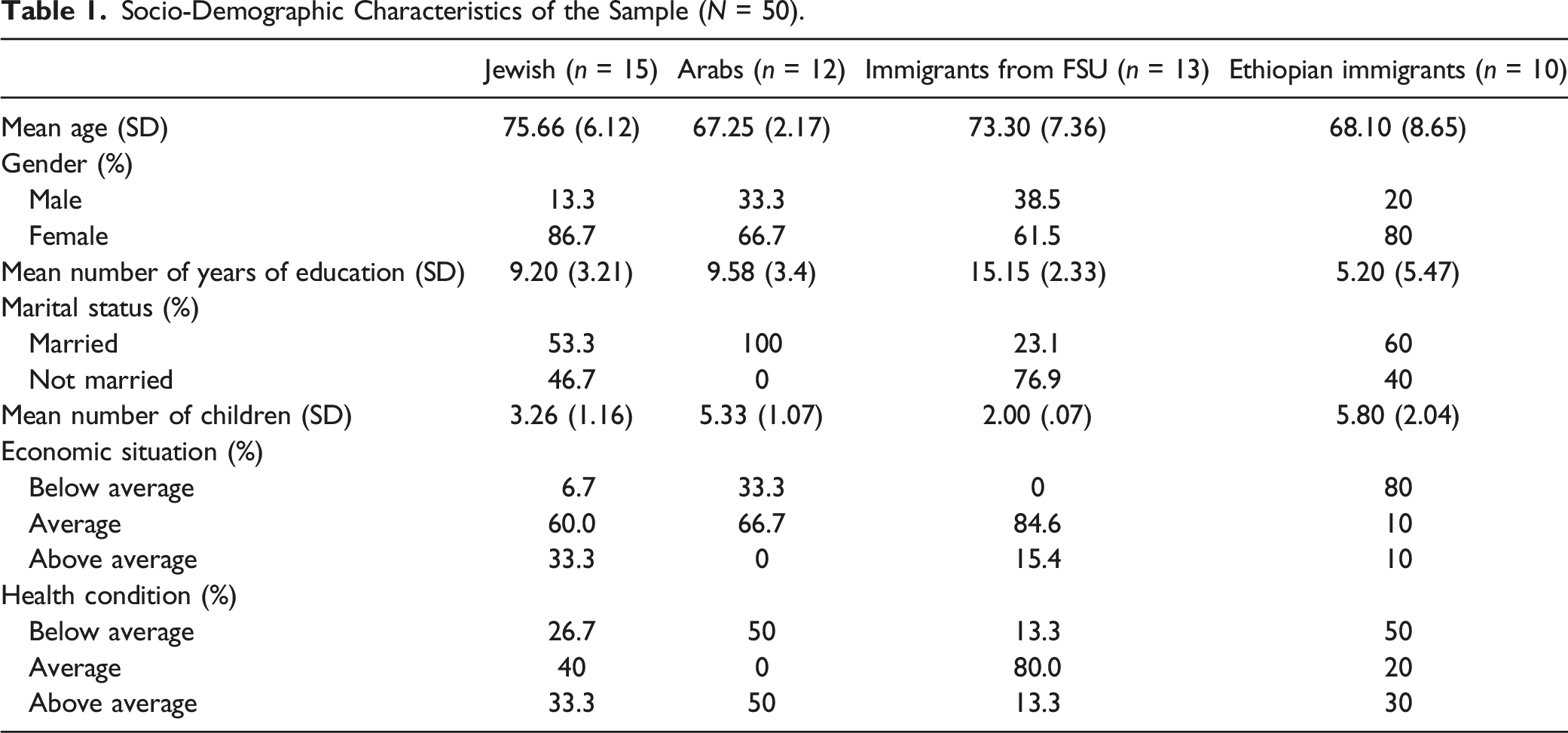
All interviews and focus group discussions were conducted between April 2022 and September 2022. We relied on criterion sampling. Inclusion criteria were older persons (>=60 years), who belong to one of the following groups: Veteran Israeli Jews (were either born in Israel or immigrated to Israel more than 60 years ago), Israeli Arabs, Ethiopian Jews (the immigration wave of 1980–1990), and immigrants from the FSU (the immigration wave of 1990–2000). The decision to focus on these four groups stems from the fact that veteran Israeli Jews, Israeli Arabs, and immigrants from the FSU are considered the three major population groups in the country and are represented in other national studies, such as the Survey for Health Ageing and Retirement (SHARE-Israel). Ethiopian Jews were included even though this is a relatively small population group because they too represent an immigrant population, which has received very little attention, yet is likely highly different from the other three population groups usually studied in relation to Israel.
Socio-Demographic Characteristics of the Sample (N = 50).
Interview Guide
As is customary in qualitative research, the interview guide was developed jointly by the researchers in Hebrew and then translated into Arabic, Russian, and Amharic by native speakers. We aimed to maintain the meaning rather than the literal translation of each question. The interview guide consisted of broad questions about participants’ experiences in their environment and climate: “Tell me about the changing climate over time or between your country of origin and Israel,” followed by more detailed questions aiming to reveal participants’ perceptions regarding global climate change and to examine concepts of solastalgia and nostalgia: “Have you experienced the phenomenon of climate change and its consequences? What are the effects of the changing climate on your daily life?”. In addition, they were asked about feelings of longing to climate or nature in the past: “What climate, nature, and environment phenomena do you miss the most?”
Procedure
The study was approved by the ethics committee of the PI’s university, and all respondents signed an informed consent available in their native language prior to participating in this study. Focus group discussions and in-person interviews were audio-recorded and then transcribed and translated to Hebrew verbatim (in the case of non-veteran Israelis) using pseudonyms.
Veteran Israeli Jews were recruited from two adult day-care centers in the central and northern parts of Israel via the assistance of professionals in these centers. Two focus groups (n1 = 7 and n2 = 8) were held by an experienced moderator in Hebrew. Each group lasted approximately 1 hr.
Arabs and immigrants from the FSU were recruited through social and professional connections of two researchers (HAG and NU) and subsequently expanded using snowball sampling. The Arab participants were from the central and northern parts of Israel. The interviews with them were conducted via Zoom in Arabic and lasted approximately 20–40 min. Interviews with immigrants from the FSU were conducted in person in Russian at the participants’ homes in the northern part of Israel. Their average length was 50 min.
Immigrants from Ethiopia were recruited from an adult day-care center and a Synagogue community in a small city in the northern part of Israel relying on the personal connections of one of the researchers (ShI). One focus group (n = 5) was conducted in Amharic in a quiet place in an adult day-care center and lasted 1 hr and 15 min. In addition, five in-person interviews were held in participants’ homes and lasted on average 30 min. Although the focus group consisted of several participants, the interviews centered on a single person at a time. This explains the different time allocation. The choice of two methods of interviewing was primarily based on participants’ preferences.
Analysis
We conducted thematic analysis following a series of iterative processes of reading and re-reading the interviews (Braun & Clarke, 2012). We started by familiarizing ourselves with the interview data through the repeated reading of interviews and the generation of initial thoughts concerning the main themes in the text. This was followed by a more thorough categorization of each interview into thematic categories that represent descriptive themes. For instance, themes such as “enjoying the heat” or “no problems adjusting to the weather” were identified at this stage. Next, we re-read all interviews and thematic categories to reach more interpretative thematic categories. These categories reflected the grouping of varied descriptive thematic categories into interpretive overarching themes. Hence, the two categories described above were grouped under a single thematic category called “adjustment to weather changes.” This iterative process took place separately in relation to each population group. Next, we examined similarities and differences across the four groups using constant comparisons, going back and forth between thematic categories and population groups. The final stage consisted of deciding on a common storyline which represents a coherent grouping of the main thematic categories identified (Stuckey, 2015). In the present study, the focus was on the identification of environmental and climate changes and the response to them. The decision as to which categories to include and which ones to exclude was made once the focus of the paper was decided. This decision was made through a consensus rather than independently by each of the coders. Hence, we decided that the focus would be on solastalgia versus nostalgia, and themes which concerned pro-environmental behaviors or assigned responsibility for the changing climate to various stakeholders were kept for a separate paper as they did not fit well to the overall theme of this paper.
To improve the trustworthiness of the findings, we bring direct quotes from the text, relying on a thick description. We also keep an audit trail to ensure that all stages of analysis are well documented (Creswell & Miller, 2000). All transcriptions were read and re-read independently by two of the authors (LA and NU) who discussed thematic categorization and agreed on the division into themes and subthemes. In our review of the coding system, it appeared as if both authors reached consistent thematic categories. However, the decision as to which themes to include and which ones to exclude was made collaboratively through a consensus rather than independently by each of the coders. We did not calculate interrater reliability but rather resolved disagreements through a discussion.
Findings
Members of all four groups expressed emotional distress and grief associated with the changing climate and environment. However, whereas Israeli veterans and Arabs experienced these changes without physically relocating to a different home environment, the two groups of immigrants experienced a physical change of location due to immigration, which has contributed to their sense of loss and grief associated with the changing climate and environment. Despite these notable differences, we also identified similar experiences across all four groups. These experiences reflect a sense of loss associated with changes in climate, increased environmental pollution, and the disappearance of nature. In this section, we bring direct quotes from each of the four population groups to represent both differences and similarities between the groups while considering the two concepts of solastalgia and nostalgia. A detailed description of this section, accompanied by quotes from the interviews, is provided in the supplementary materials.
Discussion
Conceptually, solastalgia and nostalgia are positioned as two largely different concepts; the first concerns the emotional response to changes within one’s living environment, whereas the latter term reflects changes largely brought by an actual transition to a different environment (Albrecht, 2006; Albrecht et al., 2007). Either way, the two concepts represent a sense of loss and longing for something that is no longer present. In the present study, our focus was on the changing climate, which was described by respondents as being accompanied by intense pollution and the fading of nature. Unique to this study is the focus on four different population groups, which represent the majority group as well as three minority groups in Israel. This is important given past research which has highlighted differences in the experiences of older persons of their environment across different ethnic groups as well as across immigrants versus non-immigrant groups (Kohlbacher et al., 2015; McAuley, 1998).
Whereas two of the groups (veteran Israeli Jews and Israeli Arabs) have primarily experienced what we call solastalgia because their physical location has not changed but their environmental conditions have changed, the other two groups (immigrants from the FSU and Ethiopia) likely have experienced nostalgia brought by physically transitioning from other countries, leaving behind a familiar climate and land. Such experiences of loss and grief also have been noted in past research among varied populations (Comtesse et al., 2021; Ágoston et al., 2022). Nonetheless, we identified more similarities than differences across the four groups of interviewees, which lead us to stress similarities between these two concepts. Hence, one might argue that to some extent nostalgia in its current contemporary form represents solastalgia due to the pervasive nature of the changing climate. By pointing to nuances associated with environmental losses and grief, the present study can assist practitioners who work with older persons to better understand the varied sources of mental angst associated with the changing climate and therefore possibly identify ways to address it.
All four groups were able to note the changing climate, which was described as harsher and less variable than the climate experienced during their childhood and early adulthood. These findings resemble past research, which has found that the yearning for a past that is no longer available is part of the climate change movement’s discourse (Sjögren, 2020). The study adds by showing that although different regions experience different climates and different climate changes, the experiences reported by people who have been living in the same area all their lives are not much different from those who relocated from different climate zones. Hence, it appears as if the subjective experience of change for the worse is quite common regardless of the actual changes that have taken place. Nonetheless, it is important to note that this perceived change for the worse could also reflect a general tendency of older persons to report positive autobiographic memories (Schlagman et al., 2006), and thus view their past as more positive than the present.
Although not directly queried about it, respondents identified pollution as one component associated with the changing climate. Pollution was described as occurring at the environmental level due to fellow citizens but also due to industry and limited infrastructure to prevent it (e.g., limited public transportation). Noise pollution also was identified as a problem, attributed to increasing land and air traffic. The impact of pollution on older people’s mental and physical health was discussed by almost all respondents, regardless of their geographic location and/or migration experience. This is problematic given ample research on the negative impact of pollution on people in general and specifically on older people’s physical health and cognitive functioning (Andersen et al., 2012; Tham & Schikowski, 2021).
When considering respondents’ views of pollution in their living environment, it is important to note that both trash and pollution are distributed unevenly across population groups, and often represent a case of environmental injustice, in which disempowered groups in society are more likely to be exposed to pollution even if they are less likely to contribute to it (Martuzzi et al., 2010). A run-down environment is considered detrimental to the health and wellbeing of older people because the ability of older people to face climate change is affected by the quality of their living environment (Klinenberg, 2015). It also is important to acknowledge sociopolitical historical processes that result in substantial power differential between the majority group and minority populations. For instance, an ethnographic inquiry of the Bedouins in the south of Israel has concluded that trash talk, which views the Bedouins as disordered and dirty, forms a basis for the perspective of the Bedouins as a group that needs to be removed or reformed (McKee, 2015). On average, the majority group of veteran Israeli older persons is more prosperous than the other three groups examined in the present study. Although the present study did not specifically address the socioeconomic status of the respondents, it is highly likely that their experiences of pollution and environmental degradation are related to their socioeconomic status as has been shown in past research which has pointed to such a relationship (Dale et al., 2015; Schuyler et al., 2022).
Respondents identified the fading of nature as another loss, which represents a change in their environment and was intuitively tied to the changing climate. Once again, regardless of where the respondents lived or have lived, the absence of green areas, the reduced availability of fruits and vegetables available for pick-up directly from the land, and the limited space free of urban development was a shared experience reported by all four population groups. This highlights urbanization processes that have taken place globally (Gupta & Medappa, 2020). There is plenty of research to show the beneficial effects of nature on younger and older people alike (Keniger et al., 2013). Moreover, even viewing pictures of nature has shown to have beneficial cognitive effects (Berman et al., 2008). Hence, there is no doubt that these perceived changes in access to and availability of nature are detrimental to all four groups of older persons interviewed in this study. Nonetheless, it also is important to note some differences between the different population groups, with the veteran Israeli group representing the group that has lived in urban areas most of its adult lives, whereas the Arab and Ethiopian groups growing up in more rural areas, thus, likely being more affected by the changing of the environment and the disappearance of nature.
When considering the findings, it is important to acknowledge some of the study’s limitations. First, all four population groups examined in this study are highly heterogeneous. Hence, to some extent, examining each of the groups separately would have provided a more nuanced understanding of the topic. However, this would have compromised the comparative nature of the study. Moreover, even the terms used to describe the four population groups are somewhat contested, as some prefer the term Palestinians to describe Israeli Arabs. In addition, the term veterans often is used to describe army veterans rather than veteran citizens, who in the Israeli case also largely represent an immigrant group, which settled in the country many decades ago, and thus now represents the veteran population. In addition, although the four researchers who conducted the study largely represent the four population groups of interest in terms of their sociocultural origins, they are younger than the studied populations, and thus hold somewhat different experiences and attitudes compared with the populations of interest. It also is important to acknowledge the fact that data collection relied on both in-person and online interviews. Although online interviews offer a cheap and flexible alternative, they may result in the loss of nuanced data, such as non-verbal behaviors, which is particularly important in the case of qualitative research (Oliffe et al., 2023).
Implications and Recommendations for Practice, Policy, and Research
To sum up, our findings show that indeed older persons are disturbed by changes in their environment. In addition to the changing climate, which has become more extreme and less seasonal in recent years, respondents also identified the pollution of the land and air and the disappearance of the natural environment as important components within the larger umbrella of climate change. These changes were reported by older persons of varied origins and quite different life experiences. Although some differences between the four population groups were noted, our conclusion is that whether these changes are due to immigration or a result of the changing environment in the absence of an actual relocation, respondents identified similar categories of change. Perceptions around the undesirability of these changes were quite unanimous, thus leading us to conclude that the outcomes associated with solastalgia and nostalgia are quite similar despite different etiological explanations. This suggests that perhaps a contemporary form of nostalgia is reflected as solastalgia, given the changing climate and environment.
The most notable finding concerns the need of older persons to readjust to the changing environment and climate, which are often seen as worse off compared with their childhood experiences. This can be a source of anguish and sadness, but also a source of inspiration. Practitioners may be able to use these perceived changes to motivate older persons for action. Currently, older persons are under-represented in the climate change movement, which is largely seen as a youth movement (Cloughton, 2021). Given the enormous impact the changing climate and environment have on older persons (Ayalon et al., 2021), it is important to acknowledge perceived changes and turn them into possible instigators for action. It also is possible to capitalize on older persons’ experiences and use their knowledge of traditional practices toward the betterment of the environment. Moreover, given the unanimous view of the environment and climate as being worse off at the present time, it is imperative to ensure that both local and global policies address the changing climate and take older persons’ unique experiences and needs into account.
Research-wise, the present study was limited to older persons, and therefore, it is important to assess younger people’s experiences to see whether they share similar experiences or whether changes in the environment and climate can be seen more clearly through the perspective of the passage of time. It also would be important to assess in future research the relationship between solastalgia, nostalgia, and socioeconomic status, given the importance of socioeconomic status in shaping the built environment and one’s relationship with the environment (Schuyler et al., 2022).
Supplemental Material
Supplemental Material - “We Used to Have Four Seasons, but Now There Is Only One”: Perceptions Concerning the Changing Climate and Environment in a Diverse Sample of Israeli Older Persons
Supplemental Material for “We Used to Have Four Seasons, but Now There Is Only One”: Perceptions Concerning the Changing Climate and Environment in a Diverse Sample of Israeli Older Persons by Liat Ayalon, Natalie Ulitsa, and Hanan AboJabel in Journal of Applied Gerontology
Footnotes
Declaration of Conflicting Interests
The author(s) declared no potential conflicts of interest with respect to the research, authorship, and/or publication of this article.
Funding
The author(s) disclosed receipt of the following financial support for the research, authorship, and/or publication of this article: This work was supported by the Israel Science Foundation (ISF 217/20) awarded to Prof. Liat Ayalon.
Ethics Statement

Supplemental Material
Supplemental material for this article is available online.
References
Supplementary Material
Please find the following supplemental material available below.
For Open Access articles published under a Creative Commons License, all supplemental material carries the same license as the article it is associated with.
For non-Open Access articles published, all supplemental material carries a non-exclusive license, and permission requests for re-use of supplemental material or any part of supplemental material shall be sent directly to the copyright owner as specified in the copyright notice associated with the article.
