



Abstract
Although poor deception detection accuracy is thought to be an important risk factor for fraud among older adults, this link has not been explicitly studied. Using a cross-sectional design, older and young adults viewed and made judgments of real, high-stakes truths and lies with financial consequences. Older (vs. young) adults exhibited a greater truth bias when evaluating individuals pleading for help in finding a missing relative, which was associated with greater donations to deceptive pleaders. However, all participants were highly vulnerable to fraud. Future research should consider both risk and protective factors affecting financial fraud across the lifespan.
Fraud is the most common form of elder abuse and costs older adults in the U.S. upwards of $36 billion each year (TrueLink, 2019). Some instances of fraud involve a breach of trust between an older individual and a family member or close friend who misuses funds. Other instances—namely, fraud—involve manipulation by strangers. Older adults sometimes willingly provide their funds to nefarious actors in response to deceptive pleas for help or disreputable advice (Weissberger et al., 2019). Accordingly, older (vs. young) adults’ ability to detect deception is thought to play an important role in their vulnerability to fraud (Spreng et al., 2021).
The propensity to trust others appears to increase across the lifespan (Poulin & Haase, 2015). Older (vs. young) adults report significantly higher levels of generalized trust toward family, friends, neighbors, and strangers (Li & Fung, 2012). Increased trust among older adults also appears in the context of deception detection: older (vs. young) adults are more likely to mislabel liars as truth-tellers—suggesting a truth bias in their judgments (Ruffman et al., 2012; Stanley & Blanchard-Fields, 2008).
A truth bias may increase compliance with requests for money or assistance, making older adults vulnerable to fraud. Here, we present a novel paradigm for directly examining the connection between deception detection and fraud. We examine older (vs. young) adults’ ability to discriminate liars from truth-tellers in real, high-stakes appeals for help. Further, we consider the sensitivity and bias of these judgments to determine how these performance metrics affect the risk of fraud.
Method
Participants
One-hundred and nineteen participants were recruited for the study. We recruited 61 young adults (48 women, 13 men; M age = 19.03, SD = 1.47, and range = 18–27) from the University of Denver. The young adult sample was primarily Caucasian (75.4% White, 13.1% Asian American, 8.2% Latino/a, 1.6% African American, and 1.6% Middle Eastern). Fifty-eight older adults were recruited (43 women, 15 men; M age = 74.12, SD = 8.21, and range = 60–93) from retirement communities and a continuing education organization for older adults in the Denver area. The older adult sample was primarily Caucasian and less diverse than the young adult sample (98.3% White and 1.7% African American). All participants reported normal or corrected-to-normal vision and hearing. Sensitivity power analyses (1− β = .80; α = .05) indicated that this sample size was sufficient to detect a medium effect size (d = .52) on independent samples t-tests, and a medium-sized interaction (Cohen’s f = .26) in a 2 × 2 mixed ANOVA. This research was reviewed and approved by the Institutional Review Board at the University of Denver (Protocol No. 989739-17).
Materials
Emotional pleas
Participants viewed 12 individuals pleading for the return of a missing relative. Videos were chosen from ten Brinke and Porter’s (2012) sample of N = 78 using stratified random sampling to ensure an equal number of men and women, genuine and deceptive pleaders. Deceptive pleader videos depicted individuals who were later convicted of murdering the missing relative based on strong physical evidence (e.g., DNA, possession of the murder weapon). Genuine pleaders were not involved in the disappearance of the missing relative; the missing individual was either found in the absence of foul-play, or another individual was convicted of their murder based on strong physical evidence. Participants watched six genuine (three men and three women) and six deceptive (three men and three women) pleaders. On average, videos were 35.42 seconds long (SD = 40.38).
Procedure
Participants provided consent and older adults completed a consent “quiz” to ensure they understood the information presented in the consent form. Participants also completed the Mini-Cog assessment of cognitive impairment (Borson et al., 2003): older adults (M = 4.33, SD = .78) did not differ from young adults (M =4.31, SD = 1.13), t(116) = −.06, p = .95, d = −.07. Participants then watched the emotional pleas in random order. After each emotional plea, participants were asked to judge the pleader’s veracity (lying or telling the truth). To measure financial consequences, participants indicated how much (hypothetical) money ($0–$100) they would donate to a GoFundMe fundraiser supporting the search for each missing person. Finally, participants completed a series of surveys and demographic questions. 1
Data Preparation
Accuracy was calculated for each participant as a percentage of all 12 videos that were correctly labeled as liars or truth-tellers. Accuracy (%) was also calculated for genuine and deceptive videos, separately. Poor accuracy could result from either poor sensitivity to cues to deception, a decision-making bias, or both. To avoid confounding these factors, we also used signal detection analysis (Stanislaw & Todorov, 1999) to calculate sensitivity (d’)—the ability to discriminate between truths and lies—and criterion (c)— the tendency to favor a particular response (e.g., a truth judgment). We first calculated the hit rate (correctly identifying a liar) and the false alarm rate (misidentifying a truth-teller as a liar) and replaced extreme values of 1 or 0 with .99 and .01, respectively (Macmillan & Kaplan, 1985). Hits and false alarms were then standardized, and sensitivity was calculated by subtracting standardized false alarms from standardized hits. Sensitivity indexes observers’ ability to discriminate lies from truths, where positive scores indicate good discrimination accuracy, negative scores indicate mislabeling of liars as truth-tellers (and vice versa), and scores near zero indicate a lack of discrimination. Criterion was calculated by adding the standardized hit rate to the standardized false alarm rate and multiplying by −.5. Criterion indexes observers’ response bias, where positive scores indicate a truth bias, negative scores indicate a lie bias, and scores near zero indicate no response bias.
Results
Deception Detection Performance
Sensitivity and bias
Pearson Correlations Between Age, Participant Gender, Mini-Cog Scores, Accuracy (%), Sensitivity (d’), Criterion (c), and Financial Donations to Genuine and Deceptive Pleaders.
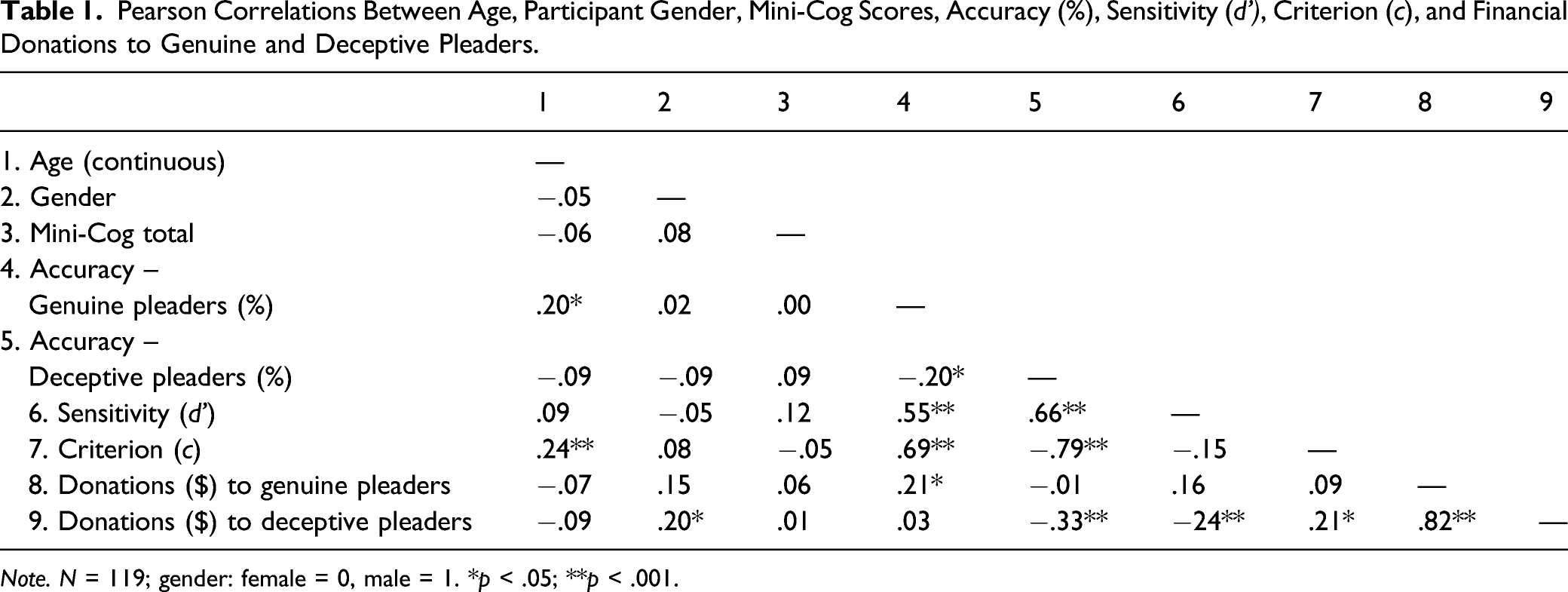
Note. N = 119; gender: female = 0, male = 1. *p < .05; **p < .001.
Accuracy (%)
Across all participants, overall accuracy (M = .57, SD = .13) was significantly above chance (i.e., .50), t(118) = 5.73, p < .001, 95% CI [.55, .59], d = .53, 95% CI [.33, .72]. While truth accuracy (M = .66, SD = .19) was significantly above chance, t(118) = 9.17, p < .001, 95% CI [.62, .69], d = .84, 95% CI [.63, 1.05], lie accuracy (M = .49, SD = .23) did not differ from chance, t(118) = −.73, p = .47, 95% CI [.44, .53], d = −.07, 95% CI [-.25, .11].
Fraud vulnerability
Descriptively, 95% of our sample gave a hypothetical donation to genuine pleaders, whereas 93.3% of our sample donated to deceptive pleaders. Concerning the amount of those donations, a 2 (veracity: genuine v. deceptive) × 2 (age group: older v. young adults) mixed ANOVA with hypothetical donations to pleaders as the dependent variable indicated a significant main effect of veracity, F(1, 117) = 46.32, p < .001, ηp2 = .28. Participants indicated that they would donate more money to genuine (M = 41.22, SD = 25.86), relative to deceptive (M = 31.59, SD = 25.41), pleaders. However, there was no significant main effect of age, F(1, 117) = .70, p = .406, ηp2 = .006, nor an age × veracity interaction, F(1, 117) = .58, p = .447, ηp2 = .005.
A multiple mediation model (see Figure 1) revealed a significant indirect effect; older adults exhibited a greater truth bias than young adults, which was associated with greater fraud, a2b2 = .05, 95% CI [.003, .104]. Multiple mediation of the effect of age (young adult = 0 and older adult = 1) on donations to deceptive pleaders through sensitivity and criterion. The indirect effect of sensitivity, a1b1 = −.02, 95% CI [−.06, .01], was not significant. The indirect effect of criterion, a2b2 = .05, 95% CI [.003, .104], was significant. Note: *p < .05, **p < .01.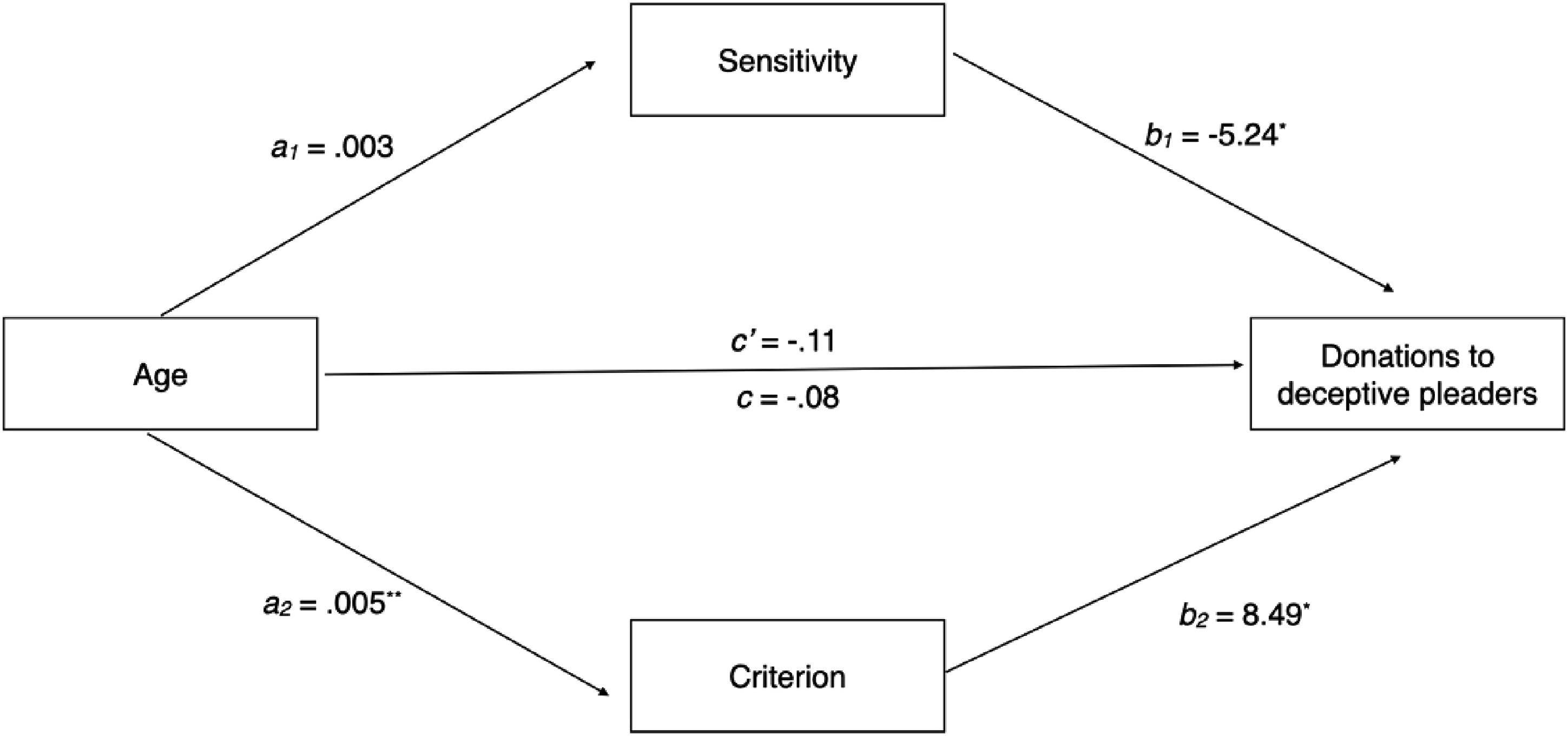
Discussion
As predicted by Spreng et al. (2021), we found evidence that truth bias was a risk factor for fraud. A significant indirect effect indicated that older adults exhibited a greater truth bias than young adults when assessing the veracity of emotional pleas, and this was associated with larger donations to deceptive murderers. However, there was no direct relationship between age and fraud. Thus, while truth bias appears to be positively associated with fraud for older adults in highly emotional contexts, unmeasured protective factors affecting older adults’ financial decisions (e.g., social supports; Beach et al., 2018) or unmeasured risks affecting young adults (e.g., poor financial literacy; Xiao et al., 2014) may cancel out any direct effect of age on fraud. Findings dovetail with recent work by Bailey et al. (2018) which suggests that older (vs. young) adults experience greater empathy for those in pain, but do not differ in the extent to which they offer help to others. In other words, while older and young adults may differ in their evaluations or reactions to social stimuli, their offers of assistance (financial or otherwise) may not (see also Ross, Grossman & Schryer, 2014). In our study, both older and young adults donated similar, non-trivial amounts of money to deceptive murderers ($31).
While our findings provide insight into age-related differences, the cross-sectional nature of these findings cannot be assumed to reflect a causal effect of aging (Lindenberger et al., 2011). This concern is tempered to some extent by previous research which suggests that age-related differences in trust can be identified in longitudinal data, too (Poulin & Haase, 2015). However, future research should consider using longitudinal research methods. Additionally, while our stimuli improve upon the ecological validity of previous research by using real, high-stakes truths and lies with conceivable financial consequences, they differ from actual experiences of fraud. For example, participants had no opportunity to interact with the pleaders to ask questions and gather further information prior to making decisions about veracity or helping (Levine, 2018). Future research should consider whether these factors affect deception detection ability and, ultimately, fraud. Last, it should be acknowledged that the participants in the current study were a convenience sample of young and older adults, which may be atypical from the general population. Future research should replicate and extend these findings to other samples of older and young adults.
Conclusion
While all participants evidenced a truth bias, older (v. young) adults were particularly biased to believe deceptive murderers, which was associated with greater monetary donations. However, donations did not differ by age, which may suggest other unmeasured protective factors for older adults or risk factors for young adults. Future research should adopt longitudinal methods to further understand multiple psychological mechanisms underlying fraud across the lifespan.
Footnotes
Declaration of Conflicting Interests
The author(s) declared no potential conflicts of interest with respect to the research, authorship, and/or publication of this article.
Funding
The authors disclosed receipt of the following financial support for the research, authorship, and/or publication of this article: This work was partially supported by a grant from the Knoebel Institute for Healthy Aging Grant.
