




Abstract
Flexibility in work schedule and work location have been suggested as being work features that may promote prolonged employment among older workers. This study focuses on the question whether access to workplace flexibility differs between male and female older workers and how potential differences can be explained. Analyses are based on data collected in 2015 among 4,813 Dutch older workers (age 60-65 years), who were employed in the government, education, care, and welfare sectors. Results show that the studied women on average perceive to have less workplace flexibility than men, both in work schedule and in work location. The gender difference in perceived location flexibility can be fully explained by differences in the human capital and job characteristics of male and female older workers. The gender difference in perceived schedule flexibility can be captured less clearly by these factors. This disadvantaged position of late-career women warrants attention in discussions about prolonged employment.
Introduction
Flexibility in terms of work schedule and work location have been suggested as being beneficial work features that may promote continued employment of older workers (e.g., Dropkin, Moline, Kim, & Gold, 2016). Access to workplace flexibility (i.e., “the ability of workers to make choices influencing when, where, and for how long they engage in work-related tasks,” Hill et al., 2008, p. 152) may, however, differ considerably between workers (Organisation for Economic Co-operation and Development [OECD], 2016). Given that persistent gender gaps are observed in many aspects of working lives—for example, in labor participation, job quality, representation in leadership positions, earnings (Olivetti & Petrongolo, 2016; OECD, 2017)—an important question is whether a gender gap in workplace flexibility can be observed among older workers as well. Such a gender gap would suggest that older women face less beneficial working conditions than men, making prolonged employment more difficult. Our research question is “To what extent do older male and female employees differ in their levels of perceived workplace flexibility and how can these potential gender differences be explained?”
The existing literature on workplace flexibility of older workers is mainly focused on the consequences of workplace flexibility for late-career employment and retirement. Recent studies on flexibility interventions (Cahill, James, & Pitt-Catsouphes, 2015; Moen, Kojola, Kelly, & Karakaya, 2016; Morelock, McNamara, & James, 2017) and personalized flexibility agreements (Bal, De Jong, Jansen, & Bakker, 2012) suggest that workplace flexibility is beneficial for prolonging working lives, although there are also studies—using broader flexibility concepts—that do not observe the hypothesized effects (e.g., Van Solinge & Henkens, 2014). Little is known, however, about antecedents of workplace flexibility among older workers (Damman, 2016). Studies carried out among prime-age workers suggest that women have less flexibility in the time they begin and end work than men (Golden, 2001, 2008, 2009; Lyness, Gornick, Stone, & Grotto, 2012), and have less schedule control (Chung, 2019).
The current study contributes to the literature in three ways. First, we use subjective indicators of workplace flexibility as our outcomes of interest. Perceptions of workplace flexibility capture a broader phenomenon than just the use of organizational flexibility policies (Kossek, Lautsch, & Eaton, 2006); they may for instance also capture flexibility resulting from personalized arrangements, or flexibility resulting from the increasing adoption of information and communication technologies (e.g., e-mail, video calling, access to work files via Internet; cf. Van Yperen, Rietzschel, & De Jonge, 2014). Two dimensions are studied separately: schedule and location flexibility. Second, this study improves our understanding of potential gender differences in perceived late-career workplace flexibility, by examining underlying structural mechanisms. Literature on workplace flexibility has shown that human capital and job characteristics relate to the level of workplace flexibility workers have (e.g., Lyness et al., 2012). Literature on gender and employment has shown that men and women differ considerably with regard to the jobs in which they work (OECD, 2017), which also partly explains their differences in employment outcomes (e.g., Boll, Rossen, & Wolf, 2017; Mandel & Semyonov, 2014). The structurally different situation in which older women work, may therefore offer an explanation of why their level of perceived workplace flexibility differs from the level of male older workers. We study to what extent human capital characteristics (i.e., educational level, years in the labor market), and job characteristics (i.e., work hours, occupational level, supervisory position, sector) can explain late-career gender differences in perceived workplace flexibility. Third, we examine how workplace flexibility is associated with late-career work satisfaction, to see whether schedule and location flexibility are indeed beneficial work characteristics for older workers.
Method
Study Sample
This study is based on data from the first wave of the NIDI Pension Panel Study (Henkens, Van Solinge, Damman, & Dingemans, 2017). These data were collected in 2015 among older employees (age 60-65 years), who were randomly sampled via three of the largest Dutch Pension Funds and were asked to complete a questionnaire anonymously. Almost 15,500 questionnaires were sent out; 6,793 were completed (response 44%). For this study, we focus on employees working in four sectors in which relatively many women are employed: government, education, care, and welfare (N = 5,460). A subsample of workers who received a shorter version of the questionnaire that did not include all relevant variables were excluded (n = 499), as well as respondents that did not answer all four dependent variables (n = 148). This resulted in a study sample of 4,813 older workers. In the Netherlands, policy measures have been taken to restrict early retirement options and to raise the state pension age (i.e., from age 65 in 2012 to age 67 in 2021). Among the respondents, the average expected retirement age was 65.8 years, which is slightly lower than their official average state pension age of 66.4 years.
Measures
The measures are presented in Table 1. In general, item nonresponse on the predictor variables was low (maximum 1.21% missing on occupational skill level). Missing values were imputed 25 times by a multiple imputation procedure (Stata 14: mi impute chained). To deal with the structure of the data (employees nested within organizations), standard errors that allow for intraorganizational correlation were used.
Means, SDs, Coding of Variables, and Wording of Survey Questions.
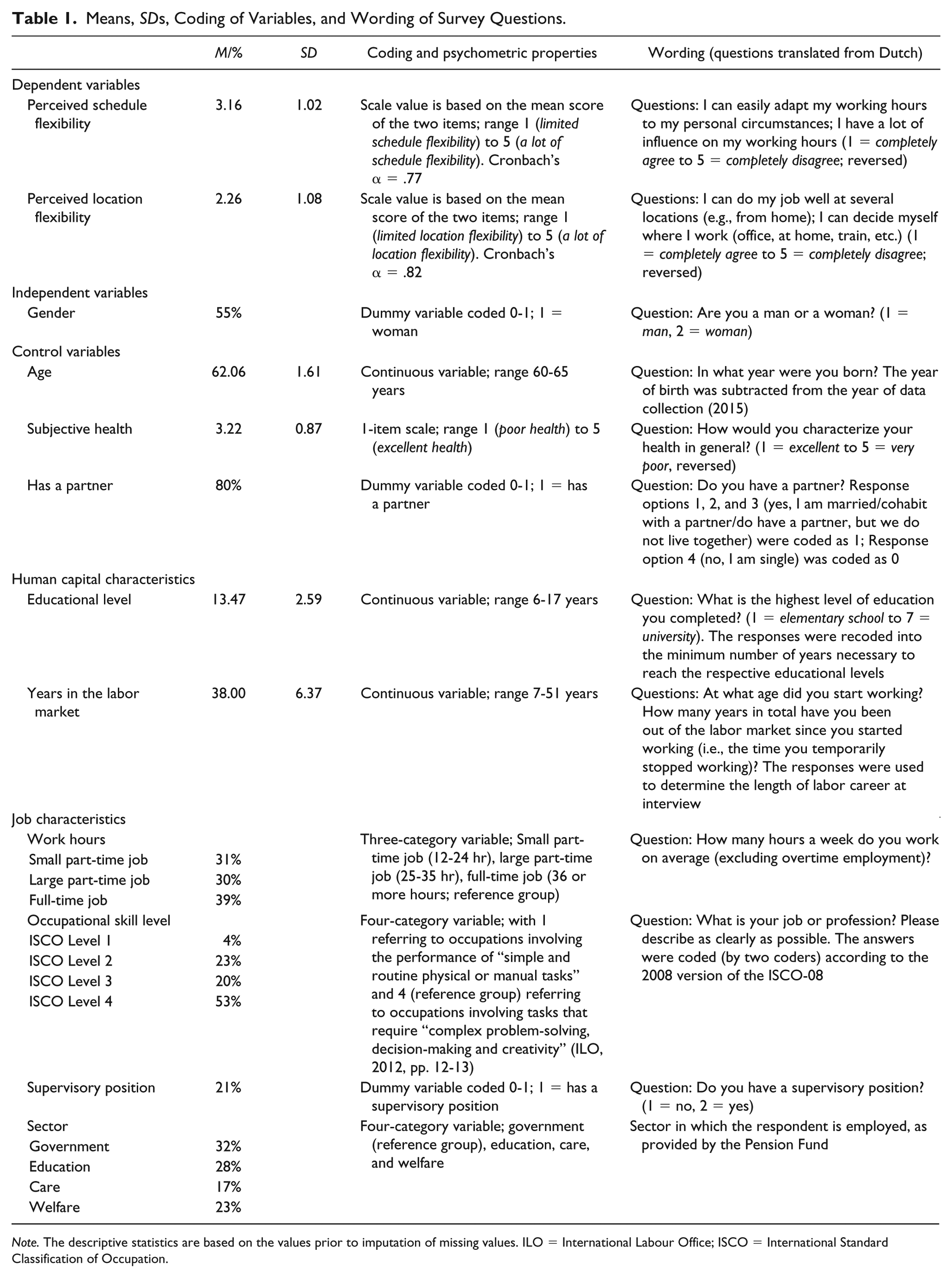
Note. The descriptive statistics are based on the values prior to imputation of missing values. ILO = International Labour Office; ISCO = International Standard Classification of Occupation.
Results
Descriptive Findings
Gender differences were consistently observed across the four workplace flexibility items (see Figure 1). Among men, for instance, 47% perceives to have a lot of influence on their working hours, versus 32% of the studied older women. Table 2 provides the descriptive statistics of the predictor variables by gender, and highlights that men and women differ significantly in many aspects of their human capital and job situations.
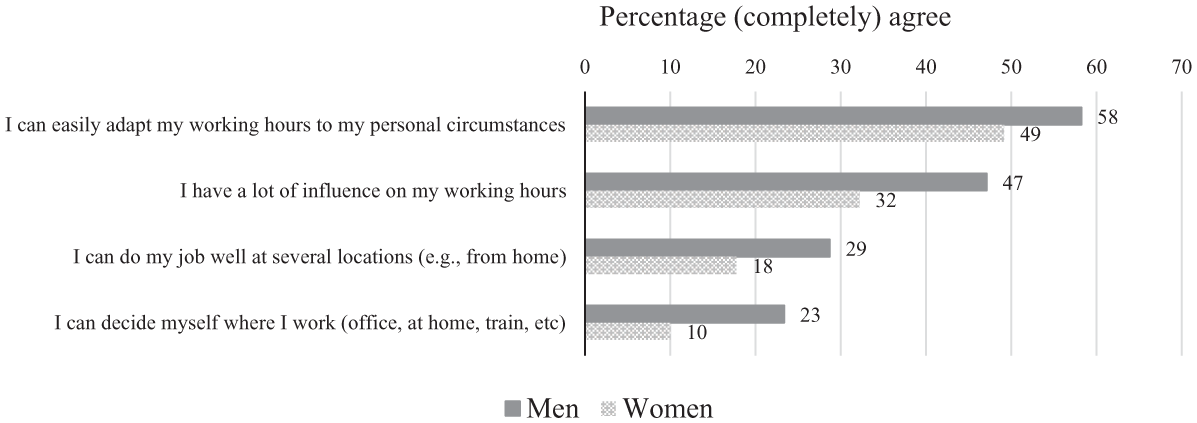
Gender differences in perceived workplace flexibility among Dutch older workers.
Descriptive Statistics of Predictor Variables by Gender.
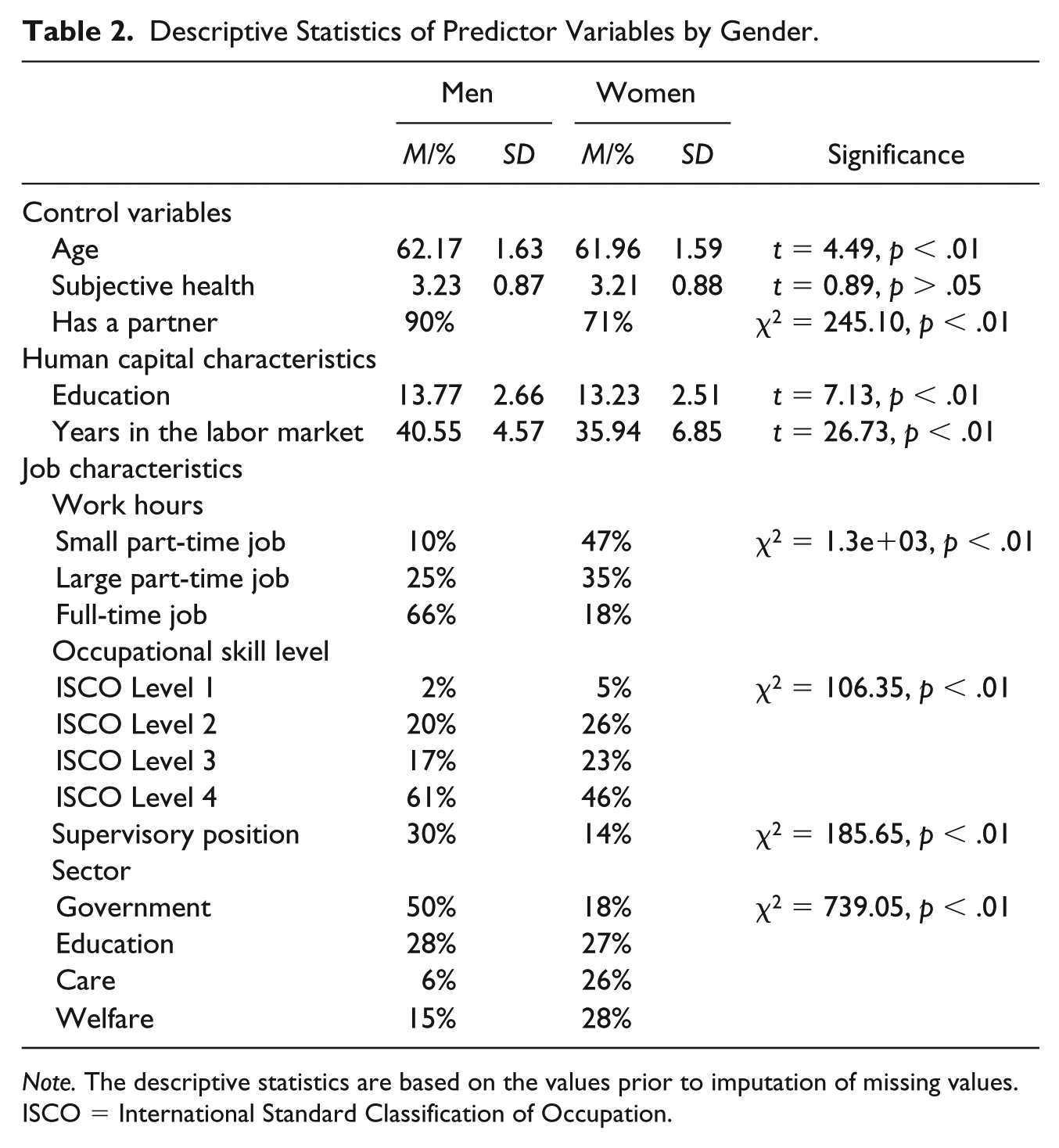
Note. The descriptive statistics are based on the values prior to imputation of missing values. ISCO = International Standard Classification of Occupation.
Multivariate Findings
The results of Model 1A (Table 3) show that women report less perceived flexibility in their work schedule than men. When taking control variables, human capital indicators, and job characteristics into account (see Model 1B), the gender coefficient is reduced (from −0.28 to −0.18), but remains statistically significant. Older workers in higher level occupations, in managerial positions, and in government sector employment have a relatively high score on the perceived schedule flexibility measure. This is also the case for older workers in small part-time jobs, and for those who are older, and in better health.
Results of Regression Analyses to Explain Differences in Levels of Perceived Workplace Flexibility, Coefficients and Standard Errors (N = 4,813).
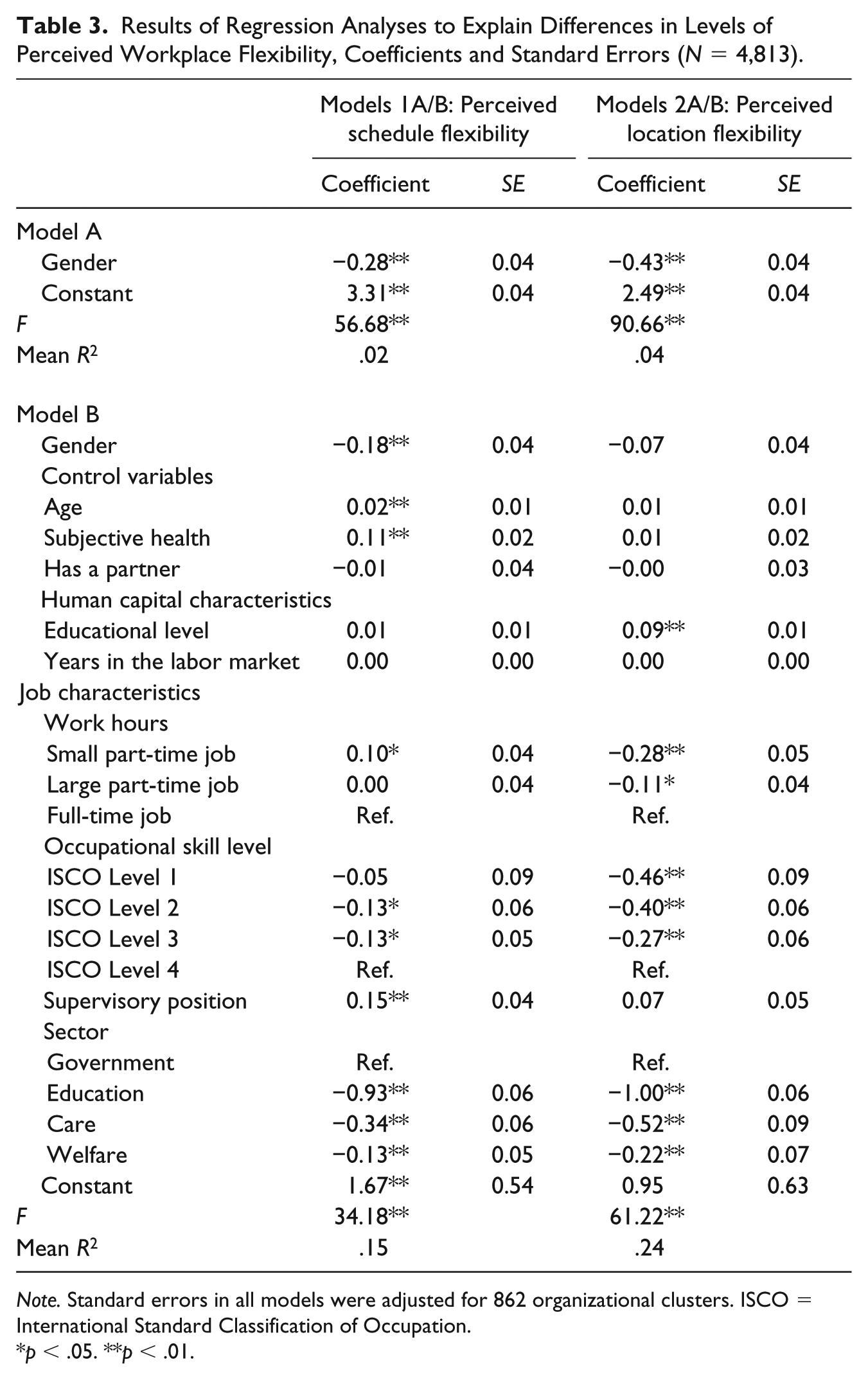
Note. Standard errors in all models were adjusted for 862 organizational clusters. ISCO = International Standard Classification of Occupation.
p < .05. **p < .01.
Model 2A shows a statistically significant gender difference in perceived location flexibility. Interestingly, as shown in Model 2B, this gender difference can completely be explained by the human capital and job situations of the studied older men and women (from −0.43 to −0.07). The studied male older workers are on average higher educated, work more hours, are employed in higher level occupations, and are more likely to work for the government (see also Table 2), which can fully explain their higher scores on the perceived work location flexibility measure.
Workplace Flexibility and Satisfaction With Work
The observed gender gap in workplace flexibility suggests that women approach their retirement in less favorable working conditions than men. Figure 2 illustrates the impact of the lack of workplace flexibility on older workers’ well-being at work. Workplace flexibility—and in particular schedule flexibility—is clearly positively related with work satisfaction. Among those having very low scores on the perceived schedule flexibility scale, about 30% indicated being “very/extremely” satisfied with their work, while about 70% of those with very high schedule flexibility reported high satisfaction with work (r = .21, p < .01). For perceived location flexibility the relationship is weaker, but in the expected direction (r = .05, p < .01).
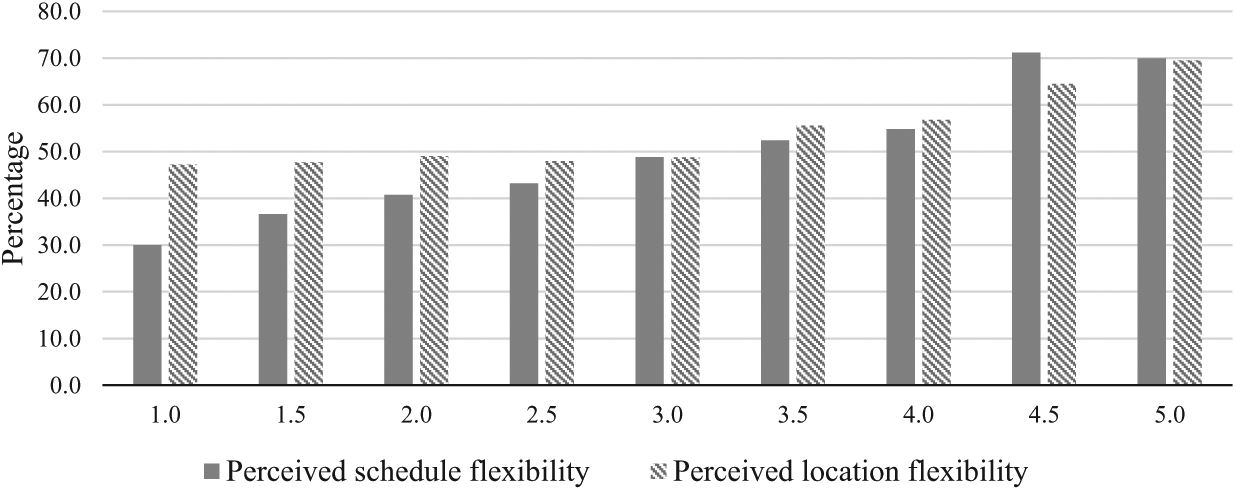
Percentage of respondents being “very/extremely” satisfied with their workª, by workplace flexibility measure.
Discussion
In debates about prolonged employment, flexibility in work schedule and work location have been suggested as valuable work features, which may enable the continued employment of older workers (e.g., Dropkin et al., 2016). This study focused on the question whether older male and female employees differ in their perceived workplace flexibility, and to what extent this can be explained by their structurally different human capital and work situations. On average, the studied older women perceive to have less workplace flexibility than men. The gender gap in work location flexibility could completely be explained by differences in human capital and job characteristics of men and women, suggesting that flexibility in work location is a feature that “comes with the job.” The gender gap in schedule flexibility, however, could only be explained to a limited extent by the studied structural factors.
The unexplained gender effect for perceived schedule flexibility suggests that unobserved processes in the work context (e.g., gender differences in manager support) or unobserved employee characteristics (e.g., gender differences in personality, or flexibility expectations/preferences) may play an explanatory role. Previous research among prime-age workers has highlighted the importance of informal arrangements (e.g., ad hoc flexibility as agreed with one’s supervisor) for generating gender differences in schedule flexibility (Golden, 2009). An important direction for future research would be to simultaneously disentangle gender gaps in different facets of late-career schedule flexibility, such as in formal flexibility policies, in flexibility practices, and in perceived access to flexibility (Kossek et al., 2006).
This study has some limitations. First, although the studied research question is particularly relevant for the four employment sectors included in our study (in which relatively many women work), the findings cannot be generalized to all wage-employed Dutch older workers. Second, the country context may have influenced our findings. The Netherlands has been described as being among the “forerunners in workers’ access to schedule control” (p. 7), and among the few European countries where prime-age men do not have more access to schedule control than women (Chung, 2019). It may therefore be the case that in other countries the gender differences in workplace flexibility among older workers are even more distinct than observed in this study.
Despite these limitations, the gender differences in perceived workplace flexibility we observe in this study (for schedule flexibility even regardless of job characteristics) warrant attention of employers and policy makers. Given that flexibility—and schedule flexibility in particular—appears to be a highly beneficial work characteristic, our findings point at a disadvantaged position of women in a context focused on extending working lives. These findings, combined with other recent results showing that older women experience more worry about their ability to keep up physically in the job until state pension age than men (Van Solinge & Henkens, 2017), clearly highlight the need to pay attention to gender-specific implications of policies and practices being developed to stimulate the extension of working lives.
Footnotes
Declaration of Conflicting Interests
The author(s) declared no potential conflicts of interest with respect to the research, authorship, and/or publication of this article.
Funding
The author(s) disclosed receipt of the following financial support for the research, authorship, and/or publication of this article: This work was supported by the Netherlands Organization for Scientific Research (NWO) (VICI Grant 453-14-001 to K.H.; VENI Grant 451-17-005 to M.D.) and Netspar.