




Abstract
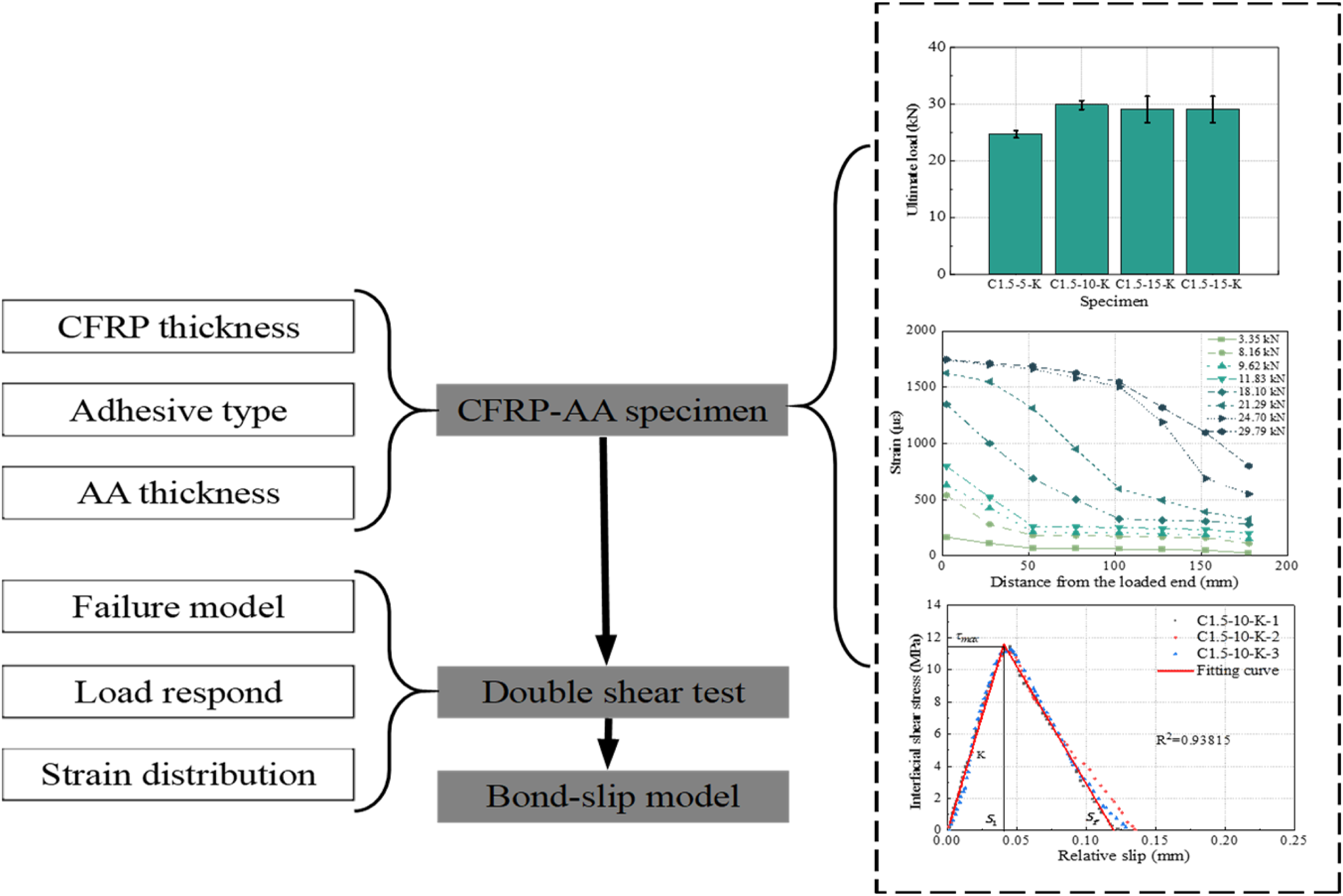
The bond–slip relationship between carbon fiber reinforced polymer (CFRP) and aluminum alloy (AA) is an important factor in predicting the performance of CFRP-strengthened AA structures. Despite its importance, research on this relationship remains limited. In this study, thirty specimens were tested under double shear loading to explore the effects of adhesive type, the stiffness ratio between CFRP and AA plates, and the thickness of the CFRP plates on the CFRP-AA bonded interface. The analysis focused on key parameters such as failure modes, load–slip behavior, and strain distribution. The results revealed that CFRP delamination was the predominant failure mode for the CFRP-AA bonded interface. Moreover, the ultimate load of the specimens initially increased with greater CFRP plate thickness. However, variations in the stiffness ratio between the CFRP and AA plates had little impact on interfacial shear stress. Specimens with identical AA thicknesses exhibited larger initial and ultimate slip when the non-linear Araldite_2015 adhesive was used, compared to the linear two-component epoxy resin. Building on these findings, an interfacial shear bond–slip model that incorporates the adhesive type used in this study was developed. The model demonstrated strong correlation with the experimental results, offering a reliable framework for predicting the behavior of CFRP-AA bonded interfaces under shear loading.
Get full access to this article
View all access options for this article.