




Abstract
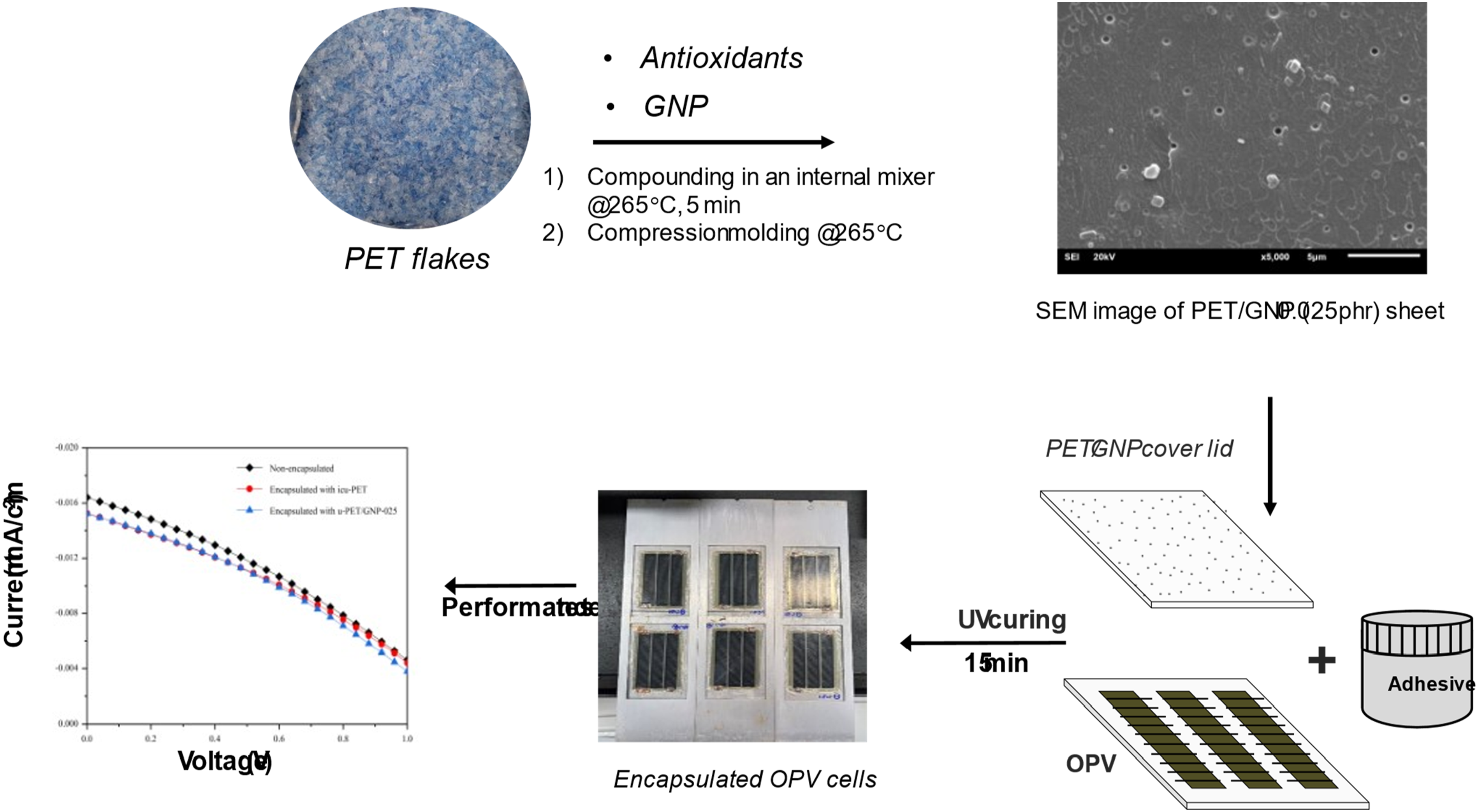
This work has concerned upcycling of used PET bottles by compounding with graphene nanoplatelets (GNP). The effects of antioxidants concentration on molecular weight and mechanical properties of the recycled PET sheets were examined, using 1H-NMR spectroscopy and a universal testing machine, respectively. The optimum antioxidants concentration was found to be 1.5 phr, as it is effectively mitigated PET chain scission. When loaded with 0.2 phr of GNP, the crystallinity of the PET/GNP sheets increased from 20.11% to 25.75% while the water vapor transmission rate of the PET sheet dropped from 16.795 (g.mm/m2.day) to 11.585 (g.mm/m2.day) accordingly. The improvements were obtained at the expense of visible light transmittance which decreased from 77.70% to 10.76%. A similar but more pronounced effect was observed when a surface-functionalized GNP was used. For the encapsulation of organic photovoltaic (OPV) cells, PET composite sheet containing 0.025 phr of GNP was chosen. After 2 weeks, the normalized PCE of OPV cells encapsulated with recycled PET sheets were about 0.61–0.62, whereas that of the bear OPV cell dropped rapidly to 0.20. In overall, this work demonstrated a feasibility of using PET/GNP composite sheets as a cover lid for encapsulation of OPV, aiming to enhance durability and lifespan of the devices.
Keywords
Get full access to this article
View all access options for this article.
References
Supplementary Material
Please find the following supplemental material available below.
For Open Access articles published under a Creative Commons License, all supplemental material carries the same license as the article it is associated with.
For non-Open Access articles published, all supplemental material carries a non-exclusive license, and permission requests for re-use of supplemental material or any part of supplemental material shall be sent directly to the copyright owner as specified in the copyright notice associated with the article.
