




Abstract
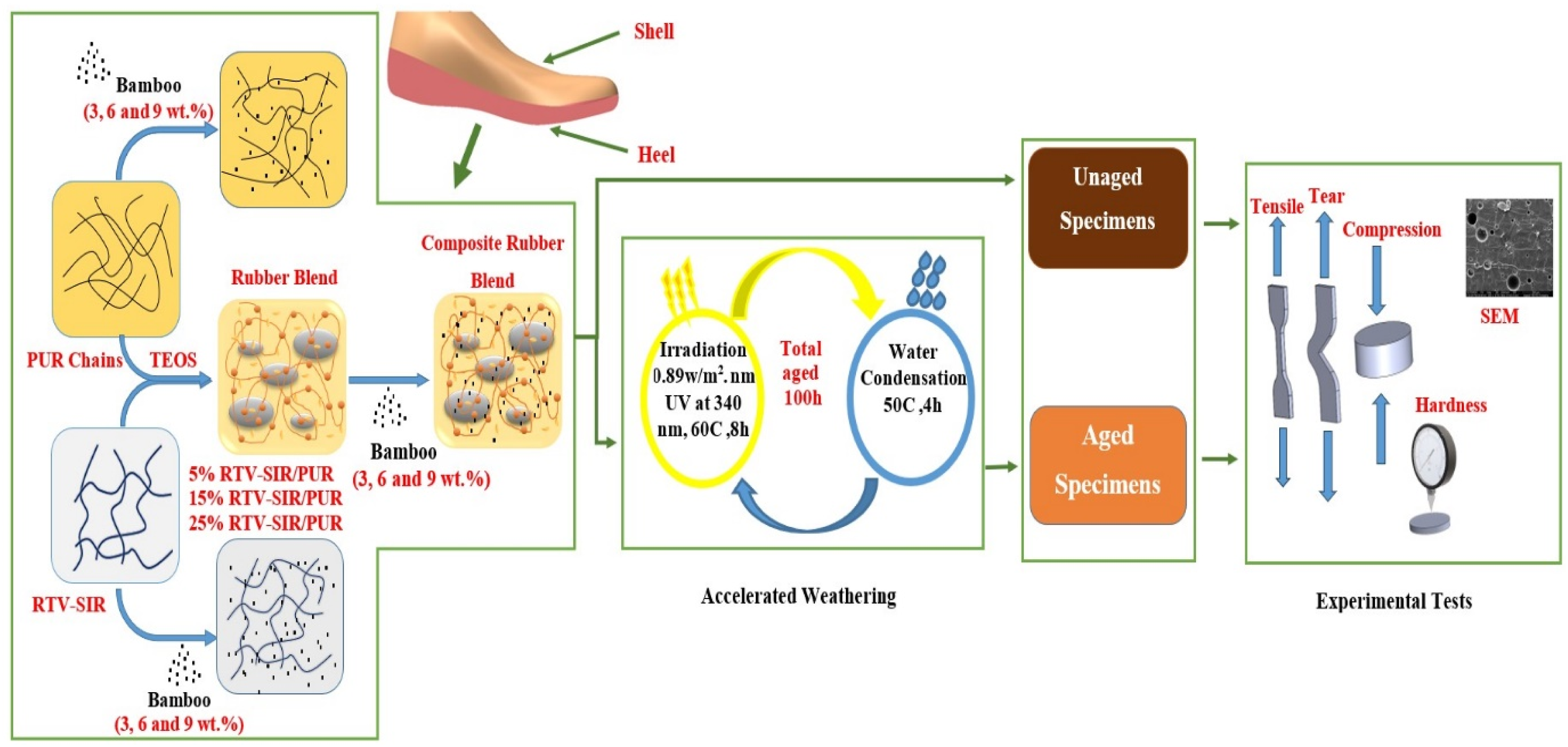
This study investigates the effects of accelerated weathering (UV radiation and humidity) on the properties of rubber blend and composite rubber blend used for the heel and outer shell of the prosthetic SACH foot. Room Temperature Vulcanized Silicon Rubber (RTV-SIR) was added in various percentages by weight of polyurethane (PUR) (5%, 15%, and 25%), to form a rubber blend. Also, alkali-treated bamboo particles were added in various percentages by weight of rubber blend (3%, 6%, and 9%) to form a composite rubber blend. To minimize the immiscibility between RTV-SIR and PUR, Tetraethoxysilane (TEOS) was added as a percentage by weight of the blend structure (0.1%). The vacuum desiccator procedure was used to create the specimens, and then the specimens were subjected to an accelerated weathering device for 100 h. The mechanical characteristics examined were tensile, tear, compression, and hardness. Also, SEM allowed for the observation of microscopic changes in the bamboo particles after alkali treatment and in specimens after weathering. This diversity and different material structures led to other choices for the best structure for the heel and outer shell of a prosthetic SACH foot. The results showed that the best tensile strength, modulus, tear strength, compression strength, and hardness values of 11.39 MPa, 9.2 MPa, 57.64 N/mm, 11.1 MPa, and 84 Shore A, respectively, were found in aging composite rubber blend of 5% RTV-SIR/PUR reinforced with bamboo of weight fraction (9%). The findings demonstrate that specimens of the rubber blend system showed developed properties post-weathering, thus indicating that the rubber blend is more resistant to weathering than its elastomers.
Get full access to this article
View all access options for this article.