




Abstract
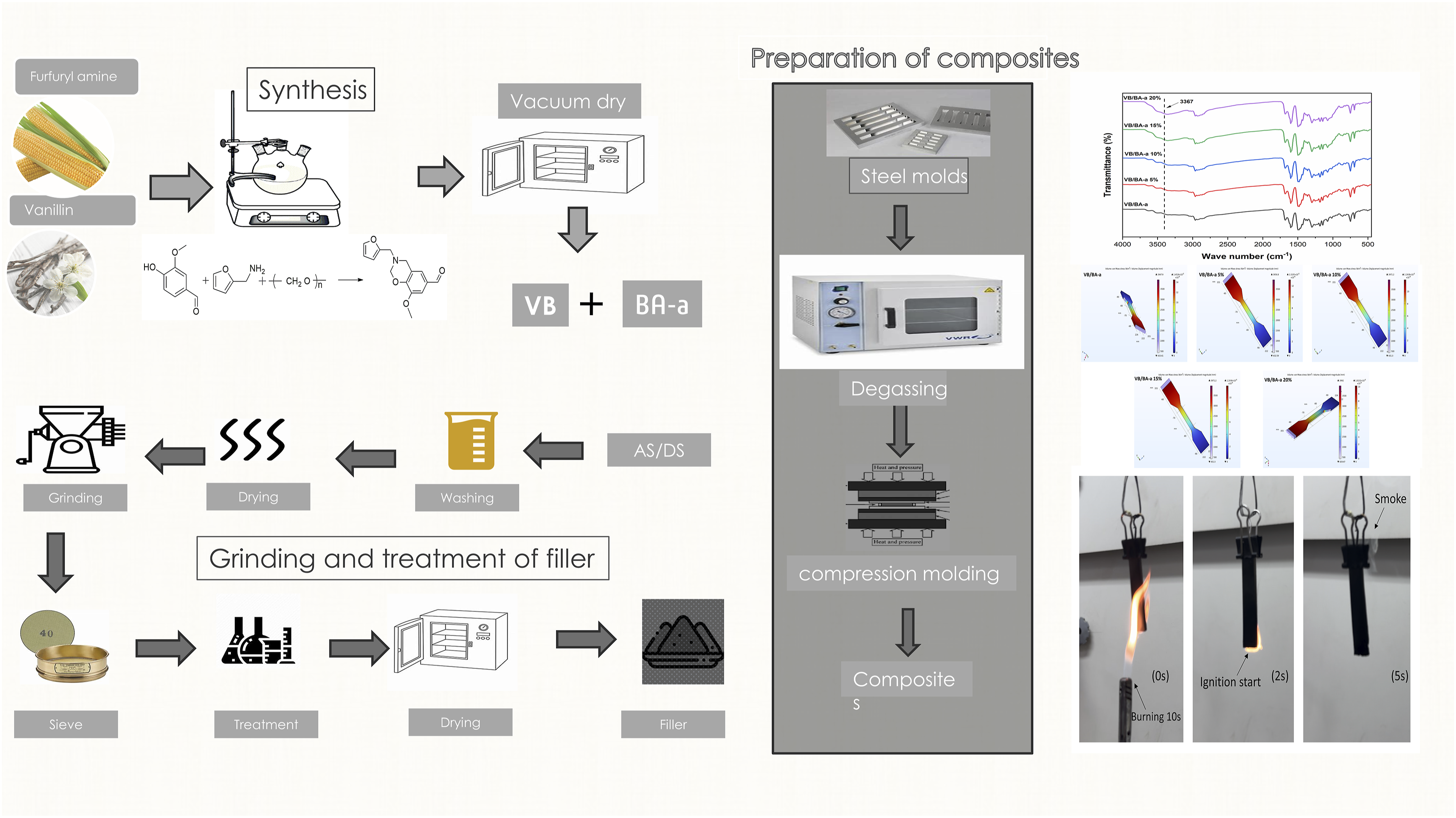
An isothermal compression molding process was used to create composites reinforced with pistachio shell particles. The composites were made using Bisphenol A–aniline-based benzoxazine and bio-based benzoxazine (VB) monomers derived from vanillin and furfuryl amine. The benzoxazine composites were developed by following green chemistry principles and blending with different weight percentages of Alkali treated pistachio shell particles. Proton nuclear magnetic resonance and Fourier transform infrared spectroscopy confirmed the structure of the VB monomer. Differential scanning calorimetry study shows the curing behavior of monomers and their blends. Surface treatment significantly enhanced the filler’s thermal stability. Copolymerization improved mobility and helped to align the chain and activate reactive groups at lower temperatures, lowering the curing temperature to 229°C with the inclusion of particles. The mechanical properties of composites are significantly enhanced. Compared to the neat matrix, composites showed a maximum increase of 155% in bending strength and 104.5% in impact tests. The theoretical model and simulation results are in good agreement with the experiment data. Thermogravimetric analysis of composites showed that neat polymers and composites have excellent thermal stability (T10% of 296; Y c 38.4%). The flammability test (UL-94) reveals that composites are rated as V-0 and can be categorized as flame-retardant materials.
Get full access to this article
View all access options for this article.
References
Supplementary Material
Please find the following supplemental material available below.
For Open Access articles published under a Creative Commons License, all supplemental material carries the same license as the article it is associated with.
For non-Open Access articles published, all supplemental material carries a non-exclusive license, and permission requests for re-use of supplemental material or any part of supplemental material shall be sent directly to the copyright owner as specified in the copyright notice associated with the article.
