




Abstract
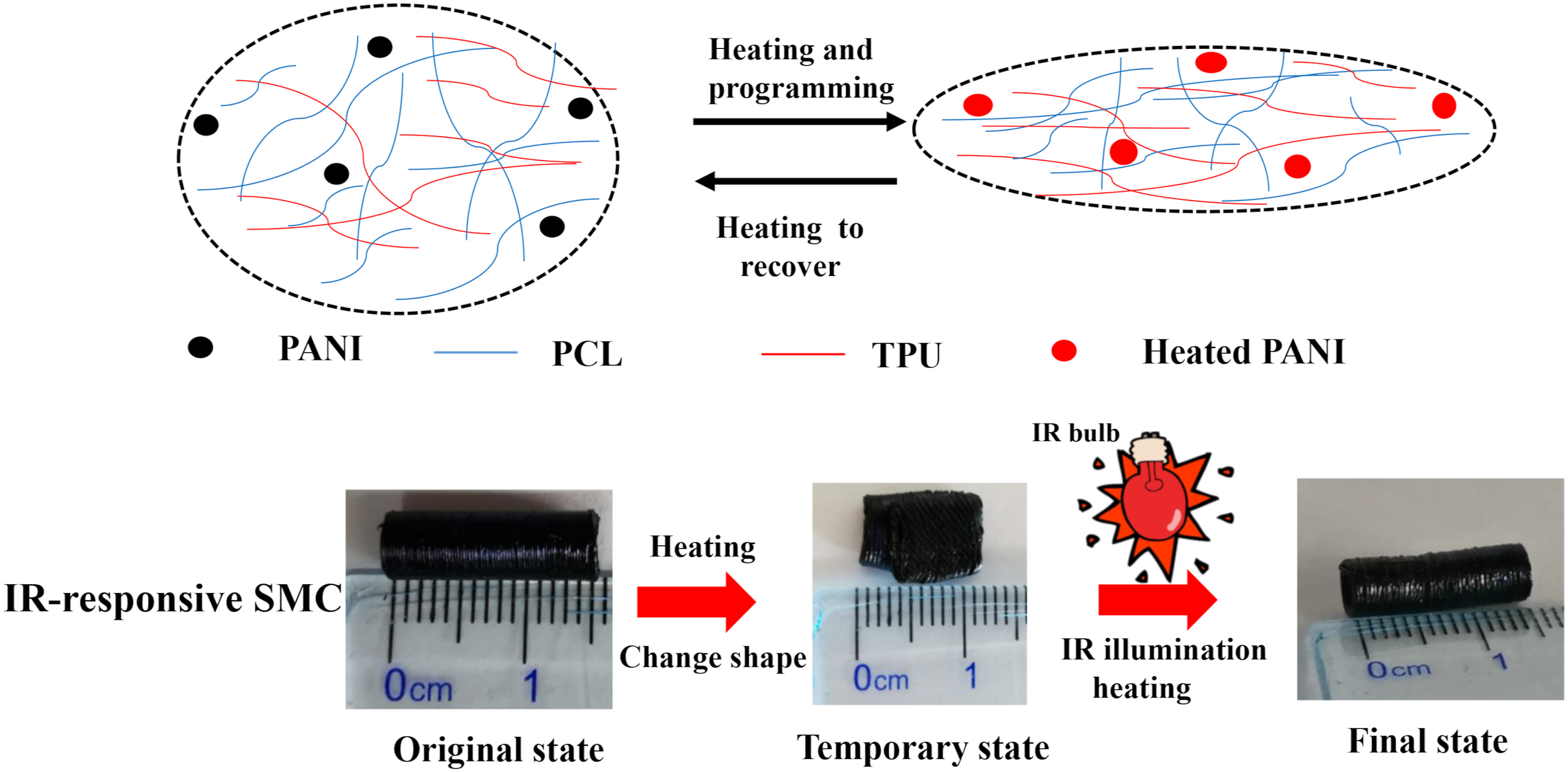
3D printed tracheal stent based on light-responsive shape memory composites (SMC) has a good application prospect due to its remote, non-contact drive and the ability to adapt to complex environments. This paper detailed the fabrication, characterization, and infrared light (IR) actuating shape memory effects of the SMC based on the thermal polyurethane (TPU)/poly(caprolactone) (PCL)/polyaniline (PANI)/composites. Herein, the experiments have explored the preparation and process parameters and 3D printing properties (e.g., filament-molding temperature, 3D printing temperature, and speed) on the premise of smooth printing of the composites. The thermogravimetric analysis (TGA), Fourier transform infrared spectroscopy analysis (FTIR), differential scanning calorimetry analysis (DSC), micro-morphology, and tensile testing was operated to characterize the properties of the TPU6/PCL4/PANI composites. Additionally, shape memory performance has shown that the shape memory fixation rate of the prepared IR-responsive SMC was about 99%, and the shape recovery ratio was approximately 95%. Therefore, this work customized the tracheal scaffold based on TPU6/PCL4/PANI composites by 3D printing technology (FDM), which possesses excellent IR-triggered remote-controlling structure deformation performance. Moreover, by collaborating with minimally invasive surgery, 3D printed IR-actuating SMC structures can expand the application scope in the biomedical field and provide a new way for personalized implantable medical devices.
Get full access to this article
View all access options for this article.
References
Supplementary Material
Please find the following supplemental material available below.
For Open Access articles published under a Creative Commons License, all supplemental material carries the same license as the article it is associated with.
For non-Open Access articles published, all supplemental material carries a non-exclusive license, and permission requests for re-use of supplemental material or any part of supplemental material shall be sent directly to the copyright owner as specified in the copyright notice associated with the article.
