




Abstract
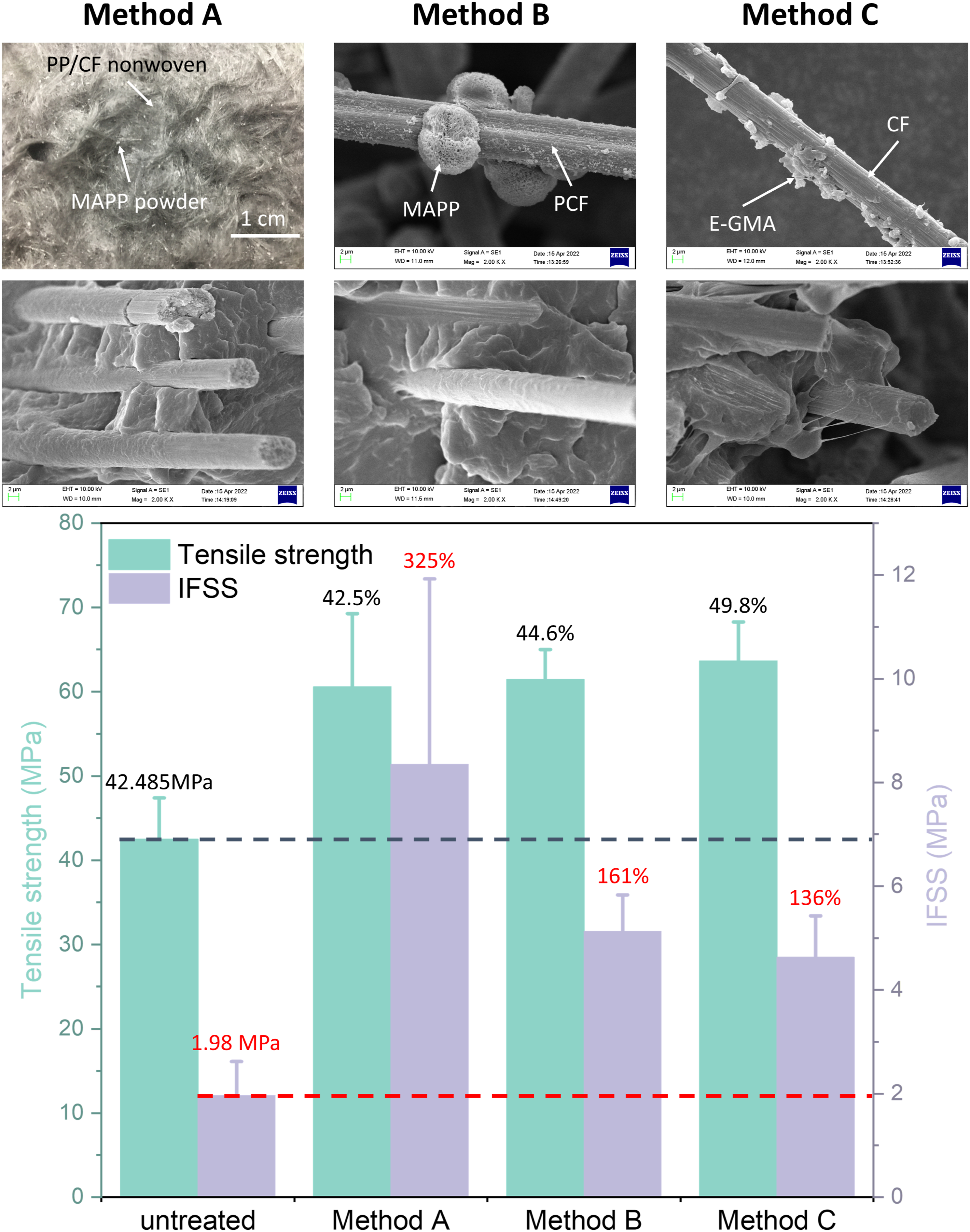
This paper introduces three different methods to improve the interfacial shear strength (IFSS) of PP/CF nonwoven composites: (A) mixing maleic anhydride-grafted-PP (MAPP) powder into polypropylene/carbon fiber (PP/CF) nonwoven preform, (B) grafting MAPP onto polydopamine-coated-CF (PCF) utilizing esterification reaction, and (C) coating ethylene–glycidyl methacrylate (E-GMA) copolymer onto CF through solution dipping. First, scanning electron microscopy (SEM), Fourier transform infrared (FTIR) spectra, and X-ray photoelectron spectroscopy (XPS) results over modified CFs show that the MAPP and E-GMA were delivered onto CF. Surface Chemistry analysis validated the esterification between MAPP and PCF. Second, the tensile test and SEM observation of composites’ tensile fracture region confirmed the improved interfacial adhesion. Tensile strength was improved by 42.5%, 44.6%, and 49.8% by Method A, B, and C, respectively. Finally, the Bowyer-Bader methodology estimated the IFSS improvement of 352%, 161%, and 136% produced by Method A, B, and C, respectively.
Get full access to this article
View all access options for this article.
References
Supplementary Material
Please find the following supplemental material available below.
For Open Access articles published under a Creative Commons License, all supplemental material carries the same license as the article it is associated with.
For non-Open Access articles published, all supplemental material carries a non-exclusive license, and permission requests for re-use of supplemental material or any part of supplemental material shall be sent directly to the copyright owner as specified in the copyright notice associated with the article.
