




Abstract
Service providers and researchers often describe people affected by homelessness as hidden. This study aims to study social relationships and implications for outreach services through a qualitative content analysis of reports written by field investigators for the New Mexico Office of the Medical Investigator that involve people affected by homelessness who died between 2014 and 2019 across the state (N = 512). Findings describe variation in what is newly conceptualized as the aspects of the visibility framework, which organizes people as most engaged and surveilled, most visible and exposed, or most hidden. Recommendations include facilitating greater engagement with hotel/motel management and staff about harm reduction and engaging more with local business communities and first responders (including the criminal-legal system). This research also conceptualizes subsistence ties, acquaintances that both provide longer-term support and further hide people who are precariously housed. Future research and policy recommendations are described.
Introduction
Providing services for and conducting research with structurally vulnerable populations including people affected by homelessness is a long-standing challenge (Cloke et al. 2000; Flook, Grohmann, and Stagg 2020; Jiao et al. 2022). People affected by homelessness may be hidden to social services, health services, and researchers, due to many factors including previous negative experiences, perceived stigma, and geographical barriers (Acosta and Toro 2000; Belcher and DeForge 2012; Kryda and Compton 2009). In addition, structurally vulnerable people are often focused on daily survival needs that take precedence over seeking health and social services (Stajduhar et al. 2019). Although people affected by homelessness are often described as hidden or hard to reach (Deleu, Schrooten, and Hermans 2023), it is important to recognize a large body of knowledge about homelessness exists—coming from both services and research activities (Fowler et al. 2019; Lee, Tyler, and Wright 2010; Shinn and Khadduri 2019; Shlay and Rossi 1992). However, it must also be acknowledged that prevalence counts and outreach efforts are commonly described as incomplete (Conroy and Heer 2003; Smith and Castañeda-Tinoco 2018).
Though facing similar constraints, a large body of research using death records has consistently shown that people affected by homelessness have an increased risk of premature mortality (Baggett et al. 2013; Hibbs et al. 1994; Nicholas et al. 2021). Data for such studies come from vital records and statistics, medical examiners and coroner’s offices, and collaborative mortality workgroups (Funk et al. 2022). There are unique aspects to this data warranting greater study (Greene 2022, 2023). In some jurisdictions, data include rich text narratives that inform medical examiner decisions (e.g., whether to conduct an autopsy) and potential legal cases (National Health Care for the Homeless Council 2021). These data are ideally suited to posthumously studying the lives of hidden populations. Importantly, although the people in these records have already died, the data provide unique insights about places of homelessness and social relationships in relation to opportunities to improve service access and quality for people living in similar conditions in the present. This study makes use of novel data from the New Mexico Office of the Medical Investigator (OMI), employing a qualitative content analysis of death records produced by field investigators between 2014 and 2019 to study reported social connections and opportunities (and challenges) for outreach and intervention among people affected by homelessness (N = 512).
Background
People affected by homelessness are often described as hidden or hard to reach (Bonevski et al. 2014; Buccieri and Gaetz 2013; Ellard-Gray et al. 2015; Flook et al. 2020). This language comes from sampling challenges and methods for respondent-driven sampling (Aglipay, Wylie, and Jolly 2015; Heckathorn 1997). It is important to consider that the term hard to reach may obscure socially structured inequalities and barriers to services (Dej 2016). Furthermore, researchers have found that among those who are structurally vulnerable and do access services, many have significant remaining unmet needs (Kosteniuk et al. 2022). Efforts to address disparities in palliative care and social determinants of health are instructive (Reimer-Kirkham et al. 2016; Richards 2022; Stajduhar and Gott 2023). As such, this study explores hidden homelessness from a viewpoint of disparities in end-of-life experiences (Stajduhar et al. 2019).
Outreach Considerations
Outreach typically involves traveling to people with unmet needs to build relationships and provide support (Jiao et al. 2022). Such efforts are particularly valuable for people affected by homelessness (Kopanitsa et al. 2023; Olivet, Bassuk, et al. 2010). Although not all service organizations conduct outreach services, those that do have demonstrated success (O’Connell et al. 2010). Yet, outreach to people experiencing homelessness brings to the fore important ethical considerations (Cloke et al. 2000). Such individuals often have histories with services or institutions that precipitate distrust (Acosta and Toro 2000; Flanagan and Hancock 2010; Kryda and Compton 2009). Furthermore, people affected by homelessness face stigma and blame (Belcher and DeForge 2012; Desmond and Western 2018). Additional known barriers include fear, embarrassment, lack of money, and living chaotic lifestyles (Caton, Greenhalgh, and Goodacre 2016). There is also mistrust of outreach workers (Flanagan and Hancock 2010; Kryda and Compton 2009). The criminalization of homelessness (e.g., prohibiting asking for money on the street, sleeping on benches, and living in vehicles, Fischer 1992; Robinson 2019), and forms of social control and surveillance from the medical system (Michaud, Der Meulen, and Guta 2023) and the criminal-legal system often furthers these negative experiences (Herring, Yarbrough, and Alatorre 2020; Welsh Carroll, Flanigan, and Gutierrez 2023).
To mitigate challenges to outreach and services engagement, homelessness services have increasingly adopted trauma-informed care program models in which experiences of trauma are anticipated and housing needs are addressed alongside longer-term healing (Olivet, McGraw, et al. 2010). The U.S. Interagency Council on Homelessness (2019) outlines that the core elements of effective street outreach include being systematic, housing-focused, person-centered (in addition to trauma-informed and culturally responsive), and safe (including practicing harm reduction). In addition, services increasingly comprise peer-delivered outreach and interventions (Barker and Maguire 2017). Peer-delivered outreach includes people with lived experience that can help with engagement and support recovery through shared affiliation and deeper understanding (Fortuna, Solomon, and Rivera 2022). Scholars have critiqued outreach efforts (broadly speaking, inclusive of social workers, community health workers, and other health professions) as needing to improve by better removing structural barriers to care (Jiao et al. 2022). Yet, it is clear that social relationships matter in terms of connecting structurally vulnerable people with resources and support (Shier, Jones, and Graham 2011).
Research Considerations
Research on homelessness has advanced in recent decades as have foci on diverse subpopulations of people affected by homelessness (e.g., youth, families, veterans, people with mental illness, etc.) (Lee et al. 2010). Research on homelessness and related data often come from administrative datasets or the alignment of several administrative datasets (Montgomery, Metraux, and Culhane 2013). Indeed, improvements to the coordination of datasets have benefited research and services (Fowler et al. 2019; Frazer, Paul, and Kroll 2020; Rutter et al. 2017). Yet even coordinated systems are limited by organizations that participate—and still miss those who are structurally vulnerable with unmet service needs (Mosites et al. 2021). To this end, knowledge about the extent of individuals who are affected by housing instability and are hidden is limited (Shaghaghi, Bhopal, and Sheikh 2011).
Prevalence counts and smaller qualitative studies demonstrate important challenges. According to the most recent Housing and Urban Development (HUD) Point-in-Time (PIT) count (2020), over half a million people were experiencing homelessness in the United States, but this has ubiquitously been described an undercount (Conroy and Heer 2003; Hopper et al. 2008; Smith and Castañeda-Tinoco 2018). Subsequent research on hidden homelessness has found that an additional 3.7 million people in the United States are doubled up related to economic hardship (Richard et al. 2022). In contrast, smaller qualitative studies have used snowball sampling to study hidden homelessness (Crawley et al. 2013; Faugier and Sargeant 1997; Watson, Crawley, and Kane 2016). Such studies demonstrate the possibilities of building rapport with more hidden populations but are necessarily limited in scope. Still, they have yielded important insights informing the feasibility of conducting more community outreach.
In summary, the landscape of homelessness is challenging to describe and contextualize despite important efforts by researchers and service providers. Many people affected by homelessness are structurally vulnerable and hidden. Yet social relationships are important to outreach engagement and recovery (Padgett et al. 2008). To this end, assessing the social lives of people affected by homelessness and potential applications for outreach and intervention is important. It is paramount to explore other ways of knowing about people affected by homelessness—including those outside of services—to develop solutions that address those that are backgrounded and typically unseen or excluded (compared with those that are most foregrounded and seen). Such work involves noting what is often not noted (Zerubavel 2015). Making use of a novel dataset describing death scenes and living circumstances prior to one’s death, specific to cases that involved homelessness, this study aims to answer the following research question: How do social connections among people affected by homelessness prior to their death suggest challenges and opportunities for outreach and intervention?
Data and Methods
Mortality Data
This study utilizes existing data from the New Mexico OMI from 2014 to 2019. Data include demographic characteristics, cause of death determined by a medical examiner, and textual data on the death circumstances, field scene descriptions, and additional log notes. Investigative reports are written by Field Deputy Medical Investigators (FDMI) who attend and document death scenes in addition to conducting research about decedents for investigative reports submitted to the office of the medical examiner.
This dataset is unique. Most data from medical examiners are collected within a city or county, whereas this dataset includes the entire state of New Mexico. Moreover, the data present a window into the discourse between experts, systems, and social institutions—medical, criminal-legal, and families. The data are uniquely suited to a theory-driven qualitative study (Bradbury-Jones, Taylor, and Herber 2014) that uncovers the social world of people affected by homelessness—including those that are most hidden from view.
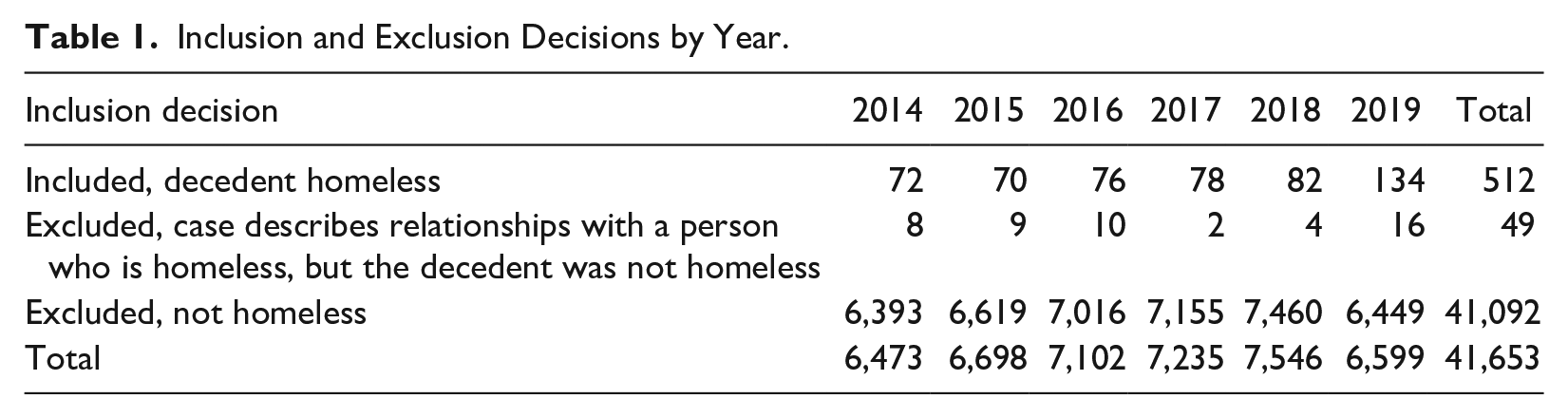
Death data were requested from the New Mexico OMI in relation to community-engaged research and the formation of a local homelessness mortality review team. Data from 2014 to 2019 were accessed in Excel and reviewed for inclusion and exclusion criteria. Cases with the word homeless in the narrative were included. Cases that did not include the term homeless were excluded, as were cases that involved a person affected by homelessness who was not the decedent. Table 1 depicts inclusion and exclusion results by year. Notably, cases of homelessness dramatically increased during this period of time, particularly between 2018 and 2019. This mirrored increases in unsheltered homelessness in PIT counts. After cases of homelessness were identified and coded in Microsoft Excel, data (N = 512) were imported into Stata version 14.1 and NVivo version 12. Summary statistics are presented in Table 2. This study was reviewed and approved by the University of New Mexico’s institutional review board.
Inclusion and Exclusion Decisions by Year.
Demographics.
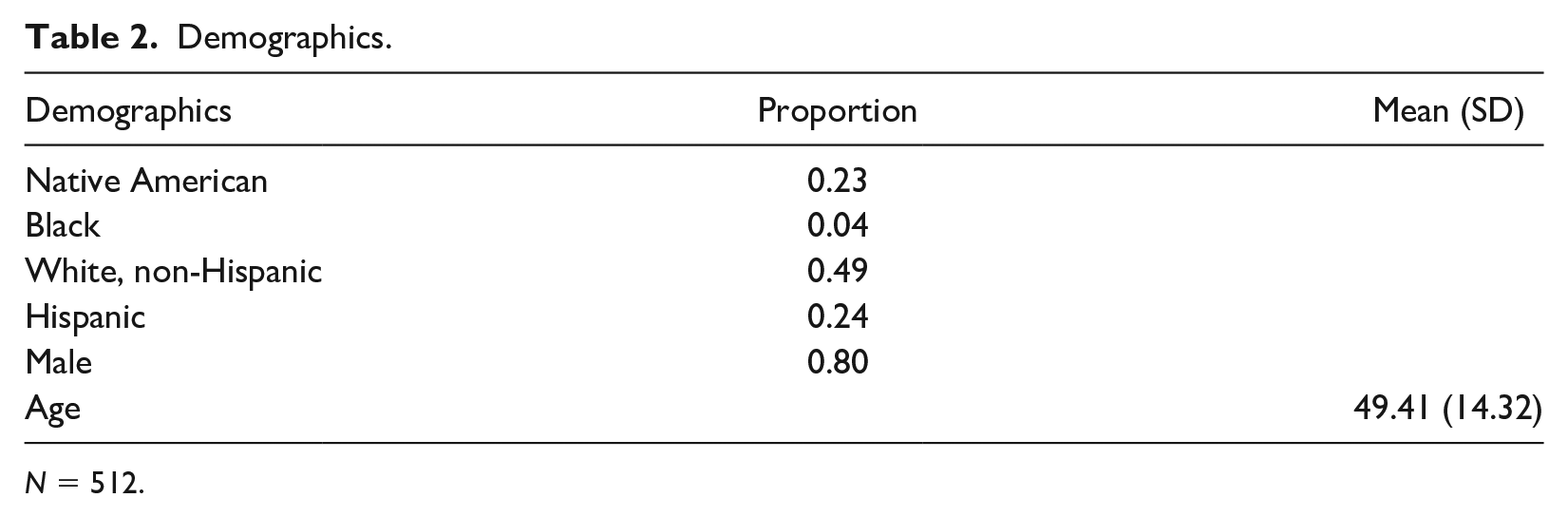
N = 512.
Content Analysis
A qualitative content analysis approach (Schreier 2012) of existing narrative text data was completed using NVivo version 12. This approach considers texts such as that found within the notes written by first responders at death scenes to be written by social actors for specific reasons. The notes are naturally occurring without researcher intervention and are not biased by researcher observation in the same way that a survey or interview can be (Bowen 2009; Dixon, Singleton, and Straits 2019).
An abductive approach to theory and analysis (Timmermans and Tavory 2012) was used whereby indicators of homelessness, witnesses (or who found the body), social relationships, and systems involvement were created as nodes into which field notes were coded. In relation to definitions of homelessness and literature on social relationships (and stories found within the data), subthemes were created. Specific cases were selected to highlight interwoven themes on place, connections to social ties and systems, and challenges and opportunities related to outreach and efforts to end homelessness. Such interwoven cases informed a newly conceptualized framework (aspects of visibility) which is presented with implications for outreach and intervention in Figure 1. This framework reveals relationships between place, social connections, and opportunities and challenges for outreach and intervention.
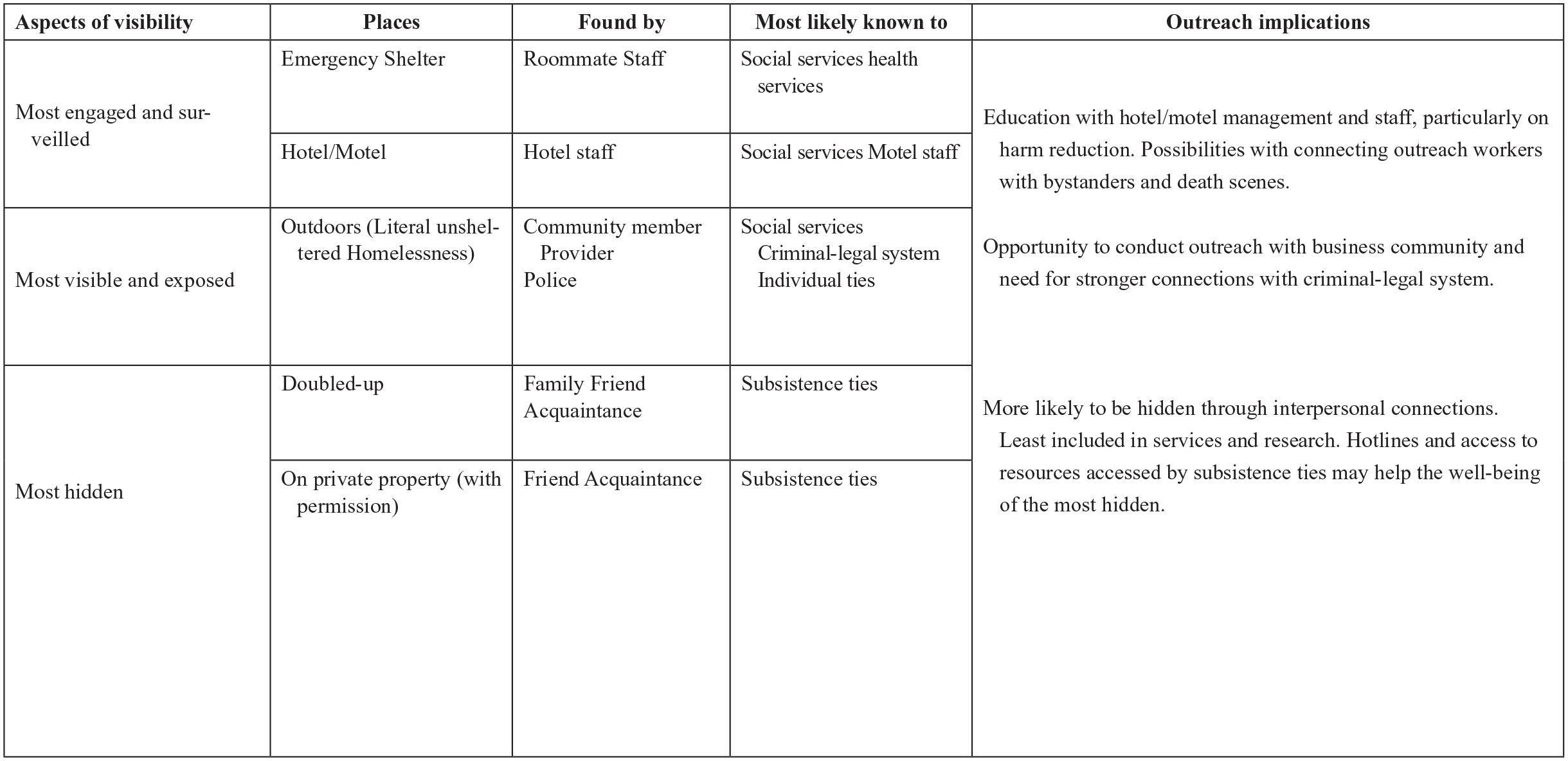
Aspects of visibility framework.
Findings
Findings suggest that trends in the type and quality of relationships among people affected by homelessness are variable by place and location. Place is a grouping that suggests how engagement with services may be existing, possible, or less likely and underscores structural vulnerability. Thus, findings are presented below according to a new framework called the aspects of visibility. In the first grouping individuals, are most engaged and surveilled, residing in shelters or in hotels with vouchers through housing services. The second grouping are the most visible and exposed, comprising individuals who are unsheltered and living outside, such as in tents and camps. The third grouping (most hidden) are those that are the least engaged in services and most challenging to conduct outreach with, comprising people who are doubled up or living on private property. The cases presented below are those that suggest the following aspects of visibility, individuals that are: (1) most engaged and surveilled; (2) most visible and exposed; and (3) most hidden. Within this framework, social ties and connections are described in relation to implications for outreach.
Most Engaged and Surveilled
The most engaged and surveilled comprise those who are living in shelters and hotels or motels with vouchers. Such individuals may have engaged with services with or without the benefit of outreach programs. As such, they provide a window into conditions and relationships to people and systems from within the homelessness services system. To this end, individuals in these places are most likely to be known by homelessness services and health care systems. Within the data, these cases often involved fewer details and occasionally contained comments from a roommate to the effect of “I didn’t know them, and they kept to themselves.” Trends suggest that people in shelters may have fewer positive individual social ties and a greater need for social services and systems. The following cases showcase these observations. Findings are presented with data attributes for race, ethnicity, gender, age, county, and year.
The decedent had been living in a homeless shelter for approximately a week. The decedent’s roommate stated that the decedent had gone to bed around 11 the night before and when the roommate got up around 7, the decedent was unresponsive. The shelter called EMS [Emergency Medical Services] and they arrived, looked at the decedent and left. (White, Non-Hispanic, Male, 71, San Juan County, 2015)
In this case, we see a person affected by homelessness dying after residing in a shelter for a short duration. They are known to their roommate and shelter staff. Emergency medical services are called when they are found unresponsive. Such cases show the interaction between shelters and medical systems. The next case involves an overdose in an emergency room, further connecting the shelter and medical system.
On February 16, 2016, I was called to [location omitted] for a woman who was brought into the ER [Emergency Room] for a drug overdose. When I arrived, I met with the decedent’s family, and the ICU [Intensive Care Unit] nurse [name omitted]. I was told that the decedent had been brought in early in the morning with CPR [Cardiopulmonary resuscitation] in progress. She was stabilized in the ER and transferred to the ICU. The decedent was residing at [location omitted] a homeless shelter in Santa Fe. She was released from jail 4 months prior and had been staying there since. She made contact with an old boyfriend who picked her up and took her to his house. Reportedly they partook in intravenous heroin use and took several other drugs. The boyfriend’s mother noticed that the decedent was not breathing right so she called 911 and EMS arrived. She coded several times in transport and in the ER. (White, Non-Hispanic, Female, 29 years old, Santa Fe County, 2016)
This case suggests the interrelationship between the criminal-legal system, shelter, and medical systems. We also see interpersonal relationships through what appears to be a former partner and his mother—with an indication of strained interpersonal relationships. Continuing with the most engaged and surveilled aspect of visibility, the next scene entails a decedent who had lived in a motel using a motel voucher.
According to the report given by the APD [Albuquerque Police Department] officer, the decedent checked into the hotel on [date omitted] with a voucher from Healthcare for the Homeless and was expected to leave on [date omitted]. When she had not checked out, the staff went to the room and knocked on the door, getting no answer. The door was opened with the master key, finding her unresponsive on the bed. 911 was called, with rescue responding, although no attempts were made due to the obvious demise. The APD officer was unable to locate the decedent through booking slips, and no NMDL ID [New Mexico Drivers License Identification] located. She had checked in under the name of [name omitted] . . . with UNMH [University of New Mexico Hospital] records checked, finding the decedent listed, as being seen in the clinic in February of this year, after moving to Albuquerque from [location omitted] to live with her daughter. The notes state that she was not happy with any wound care specialists and had not been able to locate a physician that she was comfortable with to treat the breast cancer that she had on her right breast. Another note stated that she had become suspicious of her daughter taking her social security money, so she left her home, and had been living in homeless shelters since. I spoke to the daughter, who reported that she had wanted to go back to [location omitted] but had not made any further plans to leave. The daughter reported that her mother had told her that she did not want to see her anymore, so she complied, not being able to track where she had been the past few months. (White, Non-Hispanic, Female, 73 years old, Bernalillo County, 2018)
In the case above, we see strain in the relationship between the decedent and her daughter. We also see the connection to systems through previous time in emergency shelter and continued engagement with services through the motel voucher as well as a weaker connection to hotel staff and the University of New Mexico Hospital. As such, the investigation reveals health concerns (i.e., breast cancer) and housing instability. We also see distrust of the medical system as the woman could not find a provider that she felt comfortable with.
The most engaged and surveilled cases, taken together, show relatively limited interpersonal connections, but greater engagement and connection to services and systems (despite noted distrust). Accordingly, this type of homelessness includes people more likely to be surveilled—counted, connected to homelessness services, and included in research and knowledge production. Of note, this group also includes people who have already been reached or have engaged with services on their own. Although many people in hotels and motels have engaged with services and vouchers, another group may be precariously housed and approachable through outreach efforts. Such efforts might begin with education on harm reduction within these settings and include resources to services for people not already engaged with services.
Most Visible and Exposed
Data and cases in this category involved people who lived outside in places like tents or camps, underneath overpasses, in vacant lots, or behind businesses or housing complexes. Such cases comprise those affected by and experiencing literal unsheltered homelessness or rough sleeping. Cases that are more visible are more likely to be known to local communities and community members. The places and in some cases the people are also known to outreach workers and law enforcement. Other cases involve direct relationship or at least proximity to the local business community—and thus are more likely to cause public concern and reactions—as shown below in the first example.
The decedent was last seen alive by some homeless men on [date omitted]. The men were all drinking together and were camping behind an old Applebee’s Restaurant. They went to bed after dark. The others woke up this morning and found the decedent cold and unresponsive. They called 911 before leaving the area. EMS arrived and found the decedent pulseless and apneic. No resuscitation was attempted. Taos police officers responded and recognized the decedent as a member of Taos Pueblo. They contacted Taos Pueblo officials and requested OMI to respond. Tribal police and tribal government officials were on scene when I arrived. When I arrived on scene, I was handed the decedent’s NM ID card [number omitted] . . . by TPD [Taos Police Department] Officer [name omitted]. The ID was photographed. The decedent’s social security number was obtained from Taos Central Dispatch as part of the initial notification to respond. (Native American, Male, 47 years old, Taos, 2017)
This case suggests the more visible literal unsheltered homelessness similar to examples of asking for money on the street or sleeping outside doorways or in alleyways. Such cases are emblematic of those to which outreach efforts are often targeted. These data suggest—given that many areas are described as “known for homelessness,” using mortality data with locations (e.g., cross streets or GIS coordinates) could be a valuable way to check existing outreach routes. In addition, increased outreach and education might be directed toward local business communities. Although many cases of homelessness are quite visible when outdoors, others are outdoors and further removed from the public. One such example is presented below: I received a call from McKinley Metro in regards to a body that was discovered at [location omitted]. Upon arrival I met with Detective [name omitted] with the Gallup Police Department and he reported the following, the initial call was reported at 7:23 a.m. by a local transient. According to the women, she was sleeping in the same field where the body was discovered about 20 yards north. The woman got up in the morning and walked down to the center of the field to a known camp area to use the bathroom. She discovered an unresponsive woman face down, she immediately went across the street and had someone call 911. Upon arrival [the] decedent was facing up [and] she was laying on a tarp with a blanket over her. Female witness reported that the female looked like . . . [name omitted] who is a known alcoholic and she is known to hang out in the area where the body was discovered . . . Family has not been identified. (Native American, Female, 37 years old, McKinley County, 2015 McKinley County)
In the above example, we encounter a woman living in a camp in a field. The decedent is found by another woman living in the camp, but it does not appear that the two people knew each other well. In this case, it is noted that the family of the decedent was not found, suggesting further isolation. And yet, such cases are often in areas known and frequented by outreach workers, law enforcement, and first responders. This suggests the potential for field investigators to connect bystanders or witnesses in camps with homelessness services resources or connections to outreach workers. The next case demonstrates the overlap between hidden homelessness and the criminal-legal system: The Office of the Medical Investigator was contacted by the APD regarding the unattended death of a White male found by two APD officers lying on a cement ledge next to the bike trail [location omitted]. This body is about .75 mile from case [number omitted]. The two officers had been assigned a tech plan of rousting and clearing out homeless persons who were living in high numbers along the bike path that runs along [location omitted]. They had just started at the [location omitted] and were about to duck under a hole in the fence on the south side of the bike path into a fenced-in area where there was a large amount of trash and various belongings. They noted that the decedent was lying supine on the ledge by a sleeping bag and belongings. They spoke to the man and got no answer. They tried to awaken the man and realized that he might be dead. They called dispatch and rescue arrived and confirmed death. No other homeless people approached the officers to provide any type of information on this decedent. The officers felt that the decedent was known to APD for various vagrancy type “crimes.” (White, Non-Hispanic, Male, 53 years old, Bernalillo County, 2017)
The above report shows how law enforcement engages with people affected by homelessness and how homelessness is criminalized. It further suggests how criminalization may act to further hide homelessness (making it less visible to the public) and increase transience from one place of homelessness to another. These examples suggest value with complex systems engaging more with the business community and with the criminal-legal system. Furthermore, field investigators are often called to scenes in which people are living in similar settings and may be interviewed about decedents. During these interviews, such individuals might also be referred to homelessness services resources and outreach teams.
Most Hidden
People in doubled-up situations, also, commonly described as couch surfing, vary by living with family, friends, or acquaintances. Such individuals may temporarily stay in a room or bed of their own but often stay on a couch or the floor. These situations provide little privacy and often strain relationships, which can shorten the duration of this type of housing option. People in this location are most likely to be known to interpersonal connections but least likely to be known to outreach teams or complex systems. As with other places of homelessness, doubled-up placements are often temporary and fluid. This can be seen in the first example below: According to [name omitted], the decedent had just been released from jail. On [date omitted], a friend of his saw him in the area of University and Central. He told him that he could stay at his apartment as the temperatures were cold outside. The decedent is homeless and had nowhere to stay. The decedent slept on the couch that night. The friend got up this morning around 9 AM. He told the decedent he was going to the bank and [was] running some errands. The decedent had no complaints at that time and went back to sleep. When the friend returned home, he found the decedent on the floor next to the couch. 911 was called, and EMS responded to the scene. ACLS [Advanced Cardiac Life Support] was done for a short time but was stopped via radio by a Lovelace physician. The friend denied that they had been using drugs or drinking alcohol. (White, Hispanic, Male, 57 years old, Dona Ana County, 2014)
As depicted above, the doubled-up individual had recently transitioned out of the prison system without a place to go. However, he was able to stay with a friend, though he was there only a short time before dying. This case suggests the vulnerability of individuals transitioning from institutions like prisons, particularly when housing placement has not been secured. It also suggests the importance of connections between the criminal-legal systems and outreach and housing services. This case and the next allude to the relationship between poor health, poor environmental conditions, and temporary placement with friends or families. As follows: The decedent is homeless and asked to take a shower at his sister’s apartment. She is in the process of moving and told him he could stay the night at her apartment as she was staying at her new apartment. He was complaining to her of not feeling well. He was sweating, short of breath and shaking. Sister wanted to take him to the hospital, but he refused. She last saw him alive at 2030 when she left. She returned today at 0745 to continue moving and found the decedent dead on the bathroom floor. (White Hispanic, Male, 46 years old, Dona Ana County, 2019)
The case above presents a person, who might otherwise be unsheltered, being allowed to stay in his sister’s apartment while she was moving. In this case, the man appeared to be ill but refused the offer of transportation to medical care. As with many cases, the man had a place indoors to stay, albeit briefly, before death. This social connection and others like it facilitating doubled-up arrangements can be seen as consisting of subsistence ties. Such ties contain limited resources—not enough to truly help exit cycles of homelessness and housing instability, but enough to survive for a certain amount of time and refrain from engagement with services.
The group least likely to be known by systems and services and to have the fewest interpersonal connections are those who find accommodations on a single friend or acquaintances property in which they live in makeshift housing, a building not meant for human habitation (without electricity or running water) or in a camper or recreational vehicle (or another vehicle). Such individuals tend to rely on subsistence ties (or a single tie) to maintain longer-term placement. As such, this group is less likely to cycle within different places of homelessness and be least known to local communities, services, and systems. The following cases suggest longer-term situations compared with cases present in previous categories. The first case demonstrates a person’s living accommodations within a camper: I was contacted and requested to respond to an unattended death at [location omitted]. The decedent lived in a camper trailer in the back yard of a person who befriended him about 5 years ago. Prior to having his trailer in the corner of the yard he was “homeless.” It was reported to me that [name omitted] came to the United States in 1968 leaving his family behind in Mexico. They claim he has had no contact with the family in the 5 years they have known him. [He] did drink beer with the “friends” that lived in the house at this address daily. They reported to me that he “used to drink a lot” . . . He did not smoke or use illegal drugs. He always made statements such as “I want to die” and complained of chest pain regularly (over the past 4 months). He made a habit of being in his trailer between 4 and 6 in the evening because his eyesight was “bad.” He ate at a local soup kitchen and worked odd jobs for money to pay for food and beer. His trailer had no running water and heat was supplied by a small area heater placed near the bed. (White, Hispanic, Male, 76 years old, Hobbs County, 2014)
The previous example reveals that people in this type of location are both more hidden and removed from systems and services (except for the local soup kitchen), keeping only a few interpersonal ties. We learn that the trailer has no running water and heat is limited to a small heater near the bed, thus illustrating a place not meant for human habitation. The next example involves another case of living in a recreational vehicle, located on the property of a friend’s business. Lack of heat becomes an issue precipitating carbon monoxide poisoning: The decedent’s daughter [name omitted], who lives in [location omitted], gave case history. According to [name omitted], her father was homeless but owned an old 1948 vintage Greyhound bus which he had converted into something of an RV [Recreational Vehicle]. The decedent was allowed to park the bus on the lot of a local automotive repair shop which was owned by a friend. The friend told [her] that the electric generator which the decedent normally used to power a heater and other electrical devices had broken and left the decedent without electric heat. He therefore had to start the bus engine and use the vehicle heater in order to have heat. The friend stated that in the evening of [date omitted] he noticed that the bus engine was running and assumed that the decedent was warming up with the heater. When he returned to the shop the next day, he noticed that the bus was still running. He checked on the decedent and found him unresponsive, still in his clothing and slumped over on the bed with his feet hanging over the edge. He assumed that the decedent had fallen asleep during the night and had not shut off the engine. EMS personnel transported the decedent to Presbyterian hospital with anoxic brain injury due to carbon monoxide poisoning. (White, Non-Hispanic, Male, 62 years old, Bernalillo County, 2016)
This case shows relationships between a person affected by homelessness, his daughter, and a friend. The man is hidden from other social connections and potential resources with some help from social ties and personal self-sufficiency. Such living conditions present distinct risks and dangers. The final example in this grouping shows another case involving risk from cold weather and life in a vehicle: The decedent was homeless, but his friend allowed him to stay in his abandoned trailer nearby. The trailer doesn’t have electric or heat. The decedent was last known alive at 1900 when he ate dinner at the friend’s house. The friend saw him take his medications with dinner and then the decedent left to go to bed. The friend noticed that he hadn’t seen the decedent today and went to check on him. The trailer was not locked (which is not unusual) but no answer from the decedent . . . FDMI [Field Deputy Medical Investigator] noted 2 drops of blood from his left ear but did not see any associated abrasion or laceration. The blood trailed to his temple and appeared smeared. The decedent also had some healing abrasions on his arms. No other obvious trauma noted. When the decedent was rolled to examine his back, the blood did not continue to exude from the ear. The decedent’s only known medical history about his friend was seizures (unknown etiology) and alcoholism, although he did not drink last night. Medications found on scene were Dilantin and Phenytoin and appeared to be taken as directed. No alcohol containers were found on scene. Marijuana pipe and small residual amount was found on scene. No other drug paraphernalia. The trailer did not have any heat source and it was approximately 20’s last night in Espanola. I requested the FDMI to get the decedent’s medical records and to continue to try to reach the sister to get a more accurate medical and social history. (White, Hispanic, Male, 62 years old, Rio Arriba County, 2014)
As depicted above, people living on private property with tacit permission (e.g., living in makeshift housing, a vehicle, or a building) are typically without regular access to electricity, heat, or running water. Such individuals have a connection and permission to stay on the property from a friend or acquaintance—or subsistence ties. Such people may be most removed from services and hardest to find among outreach workers or service providers. As such, they comprise the most hidden group and one still at risk to the elements, not dissimilar to people living in places of literal unsheltered homelessness. People in these most hidden places may still be supported by a single tie and through this tie additional support may be possible. This is where there may be additional value through research with people who have supported family members or acquaintances who have struggled with housing stability. Subsistence ties may also benefit from connections to resources through hotlines for immediate or growing concerns. In total, this data has helped to conceptualize a new framework called the aspects of visibility. The framework organizes groups by their visibility (i.e., most engaged and surveilled, most visible and exposed, and most hidden) and location in relation to the people most likely to have found the decedent, as well as known social relationships and outreach implications.
Discussion
This study makes several important contributions. First, it makes use of a novel dataset that provides a broader overview of the landscape of homelessness that includes many people who are conceptualized as hidden. This has paved the way for a new framework based on places of homelessness and aspects of visibility in which important distinctions are made between those that are the most engaged and surveilled, those that are the most visible and exposed, and those that are the most hidden. This framework is recommended to inform the evaluation of prevalence counts, research activities, and policies such as decisions to build new shelters and/or invest in affordable housing. This work adds to research on hidden populations in method and theory (Cloke et al. 2000; Deleu et al. 2023). Specifically, the methods from this study can be applied to better understand the context for other structurally vulnerable (Kosteniuk et al. 2022; Stajduhar et al. 2019) groups not exclusive to housing and homelessness.
Previous research has noted ambiguity in conceptualizing hidden homelessness (Deleu et al. 2023). This study has articulated several forms of hidden homelessness and has illuminated important outreach implications. This study also corroborates the need for measuring different forms of homelessness such as those who are doubled up—a form of hidden homelessness that can be systematically measured (Richard et al. 2022). In addition, this study suggests that greater outreach and education on harm reduction within hotel and motel management and staff could be valuable. Researchers have called for partnerships in similar settings to facilitate harm reduction—particularly during the COVID-19 pandemic (Buer et al. 2022; Thatcher 2020). This study also suggests the importance of engagement with business communities and stronger connections with the criminal-legal system as important strategies to expand upon systems approaches and collaborations to prevent and end homelessness (Fowler et al. 2019; Frazer et al. 2020; Rutter et al. 2017). Although improved data can be beneficial, concerns with surveillance and social control have diminished some harm-reduction efforts and such consequences must also be taken into account (Michaud, Der Meulen, and Guta 2023).
Finally, the framework highlights some of the most hidden and their relationships with newly conceptualized subsistence ties that provide resources to people with unstable housing that keep individuals removed from outreach efforts and the provision of services. Subsistence ties include both conventionally strong family and friendship ties that have been strained (Shinn, Knickman, and Weitzman 1991), disposable ties (Desmond 2012), and acquaintances providing longer-term support. Such relationships may provide resources that further shield people affected by homelessness from outreach activities but may also provide inroads to better research strategies in survey research—such as supplementing questions on lifetime homelessness (Link et al. 1994) with new questions about relationships to people facing housing instability, and new avenues for research that focus on people who have supported individuals who may otherwise have been more transient.
Limitations
Several limitations to this study should be noted. First, the data analyzed for this study involve only people who have already experienced homelessness and have died. In addition, it is important to note that the data involve descriptions of people who have died under suspicious circumstances. Thus, some cases are inevitably not included, and others are missed (Greene 2022). As such, the overall OMI dataset is not inclusive or representative of all deaths. However, it is inclusive of many deaths of people affected by homelessness and draws inferences from those who have died to those who are presently in similar settings.
In addition, this study does not systematically include information about case histories with outreach services or homelessness services. Field investigators sometimes connect with service providers as part of their investigations, but that data are not systematically entered into the reports that were analyzed. Finally, this study provides only a snapshot into the lives of people affected by homelessness prior to their deaths. It does not account for movement between places which is something that warrants future research.
Implications
This study yields several important implications for intervention, policy, and research. First, based on findings related to hotel and motel deaths and deaths outside business, it is recommended that outreach and education about harm reduction are introduced within hotels and motels particularly those that accept housing vouchers. Outreach workers may benefit from using death data with geospatial data to evaluate outreach patterns as well. Coalitions to end (and prevent) homelessness and outreach groups may benefit from stronger engagement with the criminal-legal system, too. Local business communities (including hotel/motel management and staff) may benefit from access to a hotline for assistance with people affected by homelessness as might subsistence ties actively supporting people who are precariously housed.
Although a person affected by homelessness might be unreachable by most methods, it may be more possible to support people who provide support to family members or friends who are facing housing instability. Thus, this study also supports efforts to invest in affordable housing, explore basic income, and expand supports for families (Bassuk, Hart, and Donovan 2020; Kerman 2021; Padgett and Henwood 2018; Shinn and Khadduri 2019). Future research might study subsistence ties through survey questions about knowing and supporting people who are precariously housed. Interviewing subsistence ties about these relationships may further elicit barriers to outreach and engagement with services as well as policy solutions that would prevent and end housing instability.
Conclusion
This study extends previous research on structurally vulnerable populations using a novel dataset. People affected by homelessness are often considered hidden, but they are often known about and connected to other people even when isolated. The aspects of visibility framework suggest important variations by places and social connections as they pertain to outreach efforts, challenges, and future opportunities for intervention. Outreach services may benefit from greater connections with hotel/motel management and staff, local business communities, and other first responder teams (including the criminal-legal system). Often policy is focused on the most engaged and surveilled and most visible and exposed. Such efforts de-emphasize the most hidden. Future research should study how subsistence ties (e.g., acquaintances providing long-term support) are formed and how they support people who are precariously housed. To this end, innovation in outreach and investment in social supports that address social determinants are recommended to help families and community members in need—including those that are the most hidden.
Footnotes
Acknowledgements
For their feedback on this study and manuscript, I thank Jessica Goodkind, Kristin Barker, Noah Painter-Davis, Annette Crisanti, and Owen Whooley. I also thank Anita Cordova, Matias Vega, Rachel Biggs, Guy Dameron, Garon Bodor, and Sarah Lathrop for their insights into this data. Thank you to all the New Mexico field investigators for the important work that you do.
Declaration of Conflicting Interests
The author(s) declared no potential conflicts of interest with respect to the research, authorship, and/or publication of this article.
Funding
The author(s) disclosed receipt of the following financial support for the research, authorship, and/or publication of this article: This work was supported by a training grant (T32-AA018108) from the National Institute on Alcohol Abuse and Alcoholism (NIAAA).
