




Abstract
Recent studies on the experiences of gay Asian men demonstrate that members of these groups experience both subtle and blatant forms of racism within lesbian, gay, bisexual, transgender, and queer/questioning (LGBTQ) communities. This study expands on previous research by examining how gay Vietnamese American men experience racism within the gay community of Southern California, how racism affects members of this group mentally and emotionally, and their responses when facing racism. Based on 17 semi-structured, in-depth interviews with self-identified gay Vietnamese American men living in Southern California, this study found that they experienced racism similarly to other gay Asian men. Race and racism shape the everyday experiences of gay Vietnamese American men through the racial paradox of gay desire as they are either deemed undesirable and rejected as a potential sexual and romantic interest, or they are racially fetishized. However, members of this group do not experience racism passively but actively respond through various acts of resistance and intra-racial and ethnic community-building.
Keywords
Studies examining the experiences of gay Asian men and other gay men of color have demonstrated that members of these groups endure high levels of racism in the larger gay “community” (Giwa 2022; Ocampo 2022; C. W. Han 2021). As Chong-suk Han (2007:58) explains, “Like racism everywhere, these forms tend to operate with the goal of excluding, in this case, men of color, from gay institutions,” often leading to the perception that being gay and a man of color are mutually exclusive (Giwa 2022). For example, gay establishments in New York City, Philadelphia, Boston, and Los Angeles were found to engage in carding practices, enforcing arbitrary dress codes, and even physically removing patrons in order to prevent gay Asian men and other gay men of color from entering (C. W. Han 2021; Philadelphia Commission on Human Relations 2017; Romesburg 2004). Even when gay men of color did access these spaces, they experienced racist remarks and unwelcoming nonverbal gestures by others, usually White patrons (Wat 2002).
Sexual Racism: Rejecting the Undesirables
While such blatant acts of racial discrimination and exclusion are easy to spot, the most common form of racism reported by gay Asian men and other gay men of color in previous studies has been sexual racism, “a specific form of racial prejudice enacted in the context of sex or romance” (Callander, Newman, and Holt 2015:1991). As Sonu Bedi (2015:998) explains, sexual racism prioritizes “individuals as romantic partners in a way that reinforces ideas of racial hierarchy and stereotypes.” Such racial hierarchies are created and maintained through both sexual exclusion and racial fetishization that has the effect of centering White men as normal while “othering” men of color (C. W. Han 2021). Within gay communities, gay White men are highly desired, while gay men of color are usually deemed undesirable and rejected, most often by gay White men but also by men of their own race as well as other non-White gay men. Even when they are desired, they are desired only as a racial fetish (Giwa 2022; C. W. Han 2021).
Sexual racism is most visibly evident in online dating and hookup Web sites. In Callander et al.’s (2015) study, 58 percent of the 2,177 gay and bisexual men surveyed, regardless of race, indicated that they have experienced racial discrimination on dating and hookup Web sites. Nearly all the men (96 percent) expressed having seen profiles engaged in racial discrimination. For gay Asian men in particular, studies have documented blatantly racist statements toward them such as “no Asians,” “squinty eye, no reply,” “I don’t like Asians, I like big cock,” and “Caucasians only” on personal online dating and hookup profiles, particularly on profiles of gay White men (Ayres 1999; C.-s. Han and Choi 2018; C. W. Han 2015; Paul, Ayala, and Choi 2010).
Within the broader gay community, sexual racism toward gay Asian men is tied to the perceived femininity of Asian men along with the anti-effeminacy attitude well-documented among gay men (Cho 1998; C.-s. Han 2008; Manalansan 1996; Phua 2002; Ridge, Hee, and Minichiello 1999; Sánchez and Vilain 2012; Sánchez et al. 2010; Taywaditep 2001).
Within both the gay and mainstream press, Asian men are constructed and reified as the feminized racial “Other” to the masculinized White man (Hagland 1998; C. W. Han 2015; Manalansan 1996). As Paul EeNam Park Hagland (1998) noted, gay media engages in Orientalist discourse by depicting Asian men as strange, foreign, exotic, boyish-looking, innocent, and eager to pursue and please White men. Orientalist discourse also involves excluding older gay Asian men from achieving and maintaining the boyish and innocent Orientalist imagery. In short, sexual racism manifests through anti-effeminate attitudes and Orientalist discourse. It reinforces a gendered racial hierarchy that positions the allegedly superior, masculine gay White men at the top and relegates the inferior, undesired feminine gay Asian men to the bottom (Bedi 2015; C.-s. Han 2007; Paul et al. 2010).
Racial Fetishism: Desiring the Foreign and Strange
Although most gay White men do not sexually or romantically desire Asian men, a relatively small number of usually older, White men, often derogatorily referred to as “rice queens,” fetishize Asian men (Ayres 1999; Chuang 1999; C.-s. Han and Choi 2018; Rafalow, Feliciano, and Robnett 2017). This racial fetishism is a sexual attraction toward Asian men based on racial stereotypes of the foreign, feminine, exotic, submissive, and passive qualities that are part of the gay White male imagination (Hagland 1998). As Tony Ayres (1999:89) wrote, “It is an attraction to me because of my Asianness, my otherness.” Racial fetishism can also be understood as what French sociologist Pierre-André Taguieff refers to as le racisme d’exploitation, which is loosely translated to “racism of inclusion” (cited in Fredrickson 2002:9). In other words, racism is not always the act of exclusion. Instead of excluding and rejecting gay Asian men, racial fetishism is inclusive but on Orientalist terms. Thus, it continues to gender, objectify, and stereotype gay Asian men, thus maintaining them in the position of the racial Other.
The Effects of (Sexual) Racism on Gay Asian Men
Some gay Asian men internalize, accept, and perform the expected feminine and submissive sexual stereotype to appear more desirable and attract gay White men (Chuang 1999; C. W. Han 2015). In other words, they engage in self-orientalization. As a result, their worth derives from their ability to live up to these fetishized stereotypes. To their detriment, partnering with gay White men who fetishize and expect them to perform this imagined Orientalist gender role creates an unequal distribution of power within these interracial same-sex relationships (Chuang 1999; Paul et al. 2010; Ridge et al. 1999). In these relationships, gay White men can dominate gay Asian men relationally and sexually because they have the power to select or reject their desired partner (Cho 1998; Chuang 1999; C.-s. Han 2008). This is poignantly captured in the following self-reflective statement by Song Cho (1998:3) in his book Rice: Explorations Into Gay Asian Culture + Politics, “With all the attention focused on White guys, I instinctively knew that as a gay Asian, I rarely had the power to choose and would always be the one chosen.”
The idealization of gay White men and the devaluation of gay Asian men due to sexual racism also affect how they view themselves and treat each other. Studies found that low self-esteem, a sense of inadequacy, depression, distress, and anxiety are positively associated with racial group devaluation and experiencing racism among gay men (Chae and Yoshikawa 2008; Choi et al. 2013; Thai 2020). And those who experience stress as a result of racism and racial discrimination were also more likely to engage in unprotective anal intercourse (C.-s. Han et al. 2015).
Additionally, many gay Asian men come to view one another as undesirable, actively reject one another as potential sexual or romantic partners, and treat one another as competitors over the limited number of rice queens (Chuang 1999; C. W. Han 2015; Rafalow et al. 2017; Ridge et al. 1999). After analyzing 300 personal dating advertisements of Asian American men seeking men, Voon Chin Phua and Gayle Kaufman (2003) found that 31 percent of advertisers indicated a preference for dating only White men, compared with 8 percent who indicated a preference for dating only Asian men. Similarly, after analyzing 229 Internet dating profiles of gay Asian men, Glenn T. Tsunokai, Allison R. McGrath, and Jillian K. Kavanagh (2014) found that gay Asian men prefer to date Whites over non-Whites and were 85 percent less likely to indicate a preference for dating fellow Asian men. Most recently, after analyzing 4,266 online dating profiles of gay and lesbian daters across 4 racial groups (White, Black, Asian, and Latino), Matthew H. Rafalow et al. (2017) found that 97 percent of the gay Asian men in their study who indicated a racial preference favored White men compared with only 4 percent who indicated a preference for their own race.
Some gay Asian men physically distance themselves by not associating with other gay Asian men and mentally distance themselves from their racial identity (Choi et al. 2011; C. W. Han 2015). They do this by using stereotypes about gay Asian men to justify how “different” they are from their racial group and how similar they are to Whites (Poon and Ho 2008; Ridge et al. 1999). As a participant in C. Winter Han’s (2015: 227) study expressed: I’m the Whitest Asian boy you’re ever going to meet. I mean, I’m just not like other Asians. I’ve always felt a little uncomfortable around them . . . I’m not the stereotypical Asian guy.
In fact, some gay Asian men have even expressed not wanting to be Asian and the desire to be more like Whites (C. W. Han 2015). In doing so, they come to identify more with the gay White male imagery.
To further identify with the gay White male imagery, some gay Asian men adopt and perform the masculine White imagery to distance themselves from the feminine, submissive, and passive Orientalist imagery. For example, by going to the gym to physically construct a larger bodily build or adopting “gay fashion” that is frequently equated to Whiteness (Ayres 1999; Chuang 1999; C.-s. Han and Choi 2018; Ridge et al. 1999). As Kent Chuang (1999:33) describes his personal experience: The journey of finding self-worth naturally began at the gym, that factory where White Gods are cloned, and where my shamefully slim Oriental frame could be transformed into a more desirable western body.
Essentially, gay Asian men come to identify with the oppressor and attempt to emulate them. In using racial stereotypes about gay Asian men to justify their differences and distancing strategy, some gay Asian men essentially promote and reinforce these stereotypes (C. W. Han 2015). They become active agents of White supremacy by othering their fellow gay Asian men to distance themselves, thus perpetuating their own racial marginalization.
Gay Asian Men Respond to (Sexual) Racism
Not all gay Asian men passively experience and tolerate racism. As Maurice Kwong-Lai Poon and Peter Trung-Thu Ho (2008:251) argue, “[W]e must not assume that gay Asian men are simply being oppressed without any agency or resistance.” In fact, gay Asian men understand that racism is a reflection of a broader systemic and institutional issue within the gay community. These men rearticulate and reframe racism as being imposed on them by racist gay men instead of internalizing racism as a manifestation of an inherent personal failing (Choi et al. 2011; C.-s. Han, Proctor, and Choi 2014; Poon and Ho 2008).
Previous studies have demonstrated a number of different tactics and strategies that gay Asian men, as well as other men of color, use to challenge racism, ranging from directly confronting racism, using humor, seeking support from friends and romantic partners, advocating for racial justice, avoiding gay spaces, and so on (Giwa 2022; C.-s. Han and Choi 2018; Ridge et al. 1999; Wilson and Yoshikawa 2004).
Specifically in terms of sexual racism, prior work has shown that gay Asian men attempt to raise their racial status, directly challenge the racial hierarchy, and reduce competition among gay Asian men for gay White men by engaging in intra-racial dating, embracing and increasing their racial identification, and building a strong coalition of gay Asian men within the gay community (C.-s. Han and Choi 2018; C. W. Han 2015, 2021; Poon and Ho 2008; Wat 2002). While the phenomenon of “sticky rice,” Asians who prefer other Asians as potential sexual and romantic partners, is not new, it has recently garnered more academic attention as scholars, activists, and writers attempt to examine ways that Asians attempt to decenter the White gaze. As Cynthia Wu (2018) noted, intra-racial same-sex desires among Asian men have the potential to challenge White standards of desirability, resist White supremacy, and build coalitions within Asian American communities. Thus, sticky rice politics has the potential of “[creating] alternative standards of desirability that privilege racial solidarity and rejection of racial subordination” (Pham 2024) while challenging the Whiteness that organizes gay sexual cultures. As C. Winter Han (2021) demonstrates, sticky rice politics is complicated and complex when examined through the lived experiences of gay Asian men with some Asian men viewing intra-racial desires as a political strategy to challenge White supremacy, while others view it as a way of recognizing their own worth as Asian men. Even among gay Asian men who prefer White men, there seems to be a high level of dissonance and mental navigation to justify their preferences as something other than their blind acceptance of White supremacy, even while believing that other Asian men’s racial preferences may be based on beliefs about the superiority of White men (C. W. Han 2021).
Current Study
The purpose of this study is to examine how one ethnic group of gay Asian men experience racism and how racism continues to operate and manifest to produce and reinforce racial hierarchies within the larger gay community. To do so, this study focuses specifically on how gay Vietnamese American men experience racism within the gay community of Southern California, paying particular attention to sexual racism, the type of racism reported most by the men in our study.
Southern California provides a unique site for examination because it is home to America’s first Little Saigon—a (“straight”) Viet ethnic enclave—that consists of the largest Viet immigrant community existing outside of Viet Nam and is considered the “capital of Viet America” (Le 2015; Masequesmay 2003a; Võ 2008). The existence of a large and geographically concentrated Viet community and Viet population throughout the Southern California region is notable because, as Gina Masequesmay (2003a) explains, it acts as a buffer to racism and hostility from the host society and allows for Viet immigrants and subsequent generations to maintain their cultural practices and provide cultural resources and support.
Additionally, it is among this large Viet community of Southern California in which ethnic-specific lesbian, gay, bisexual, transgender, and queer/questioning (LGBTQ) support networks and groups for LGBTQ Viet people emerged, such as the historic group Ô-Môi and Gay Vietnamese Alliance (GVA)—which are discontinued—and the more recently established Viet Rainbow of Orange County (VROC) (Huynh 2022; Masequesmay 2003b). These ethnic-specific LGBTQ groups have been shown to facilitate the formation of a queer Viet identity among LGBTQ Viet people by helping them to reclaim a queer dimension to their Viet heritage, provide them with social and psychological well-ness support, and give them a sense of belonging as “chosen families” (Huynh 2022; Masequesmay 2003a, 2003b). These groups also help LGBTQ Viet people with combating and resisting heterosexism and homophobia within their Viet community and racial prejudice and discrimination that pervades in what they perceive to be a White LGBTQ community (Huynh 2022; Masequesmay 2003a, 2003b).
This study contributes to the literature that explores the lives of gay Asian men and build on studies that examine sexual racism within the larger gay community by examining how gay Vietnamese American men experience sexual racism within the gay community, how sexual racism affects them mentally and emotionally, their responses when facing sexual racism, and the role that an ethnic-specific gay group plays in helping them navigate a racialized and racist gay terrain.
Methods
Data for this study came from semi-structured, in-depth interviews with 17 self-identified gay Vietnamese American men, 18 years old and older, who reside in Southern California. We used a qualitative interview research approach because it allows for the collection of rich, exploratory, first-person, and detailed accounts by having informants tell their stories about their experiences of being gay and Vietnamese within a U.S.-based gay community. Holistic account helps “develop a complex picture of the problem or issue under study” by “reporting multiple perspectives, identifying the many factors involved in a situation, and generally sketching a larger picture that emerges” (Creswell and Poth 2018:44). While unstructured, interview questions covered three major areas: (1) personal life, (2) social life, and (3) race relations and racism within the gay community.
Procedure
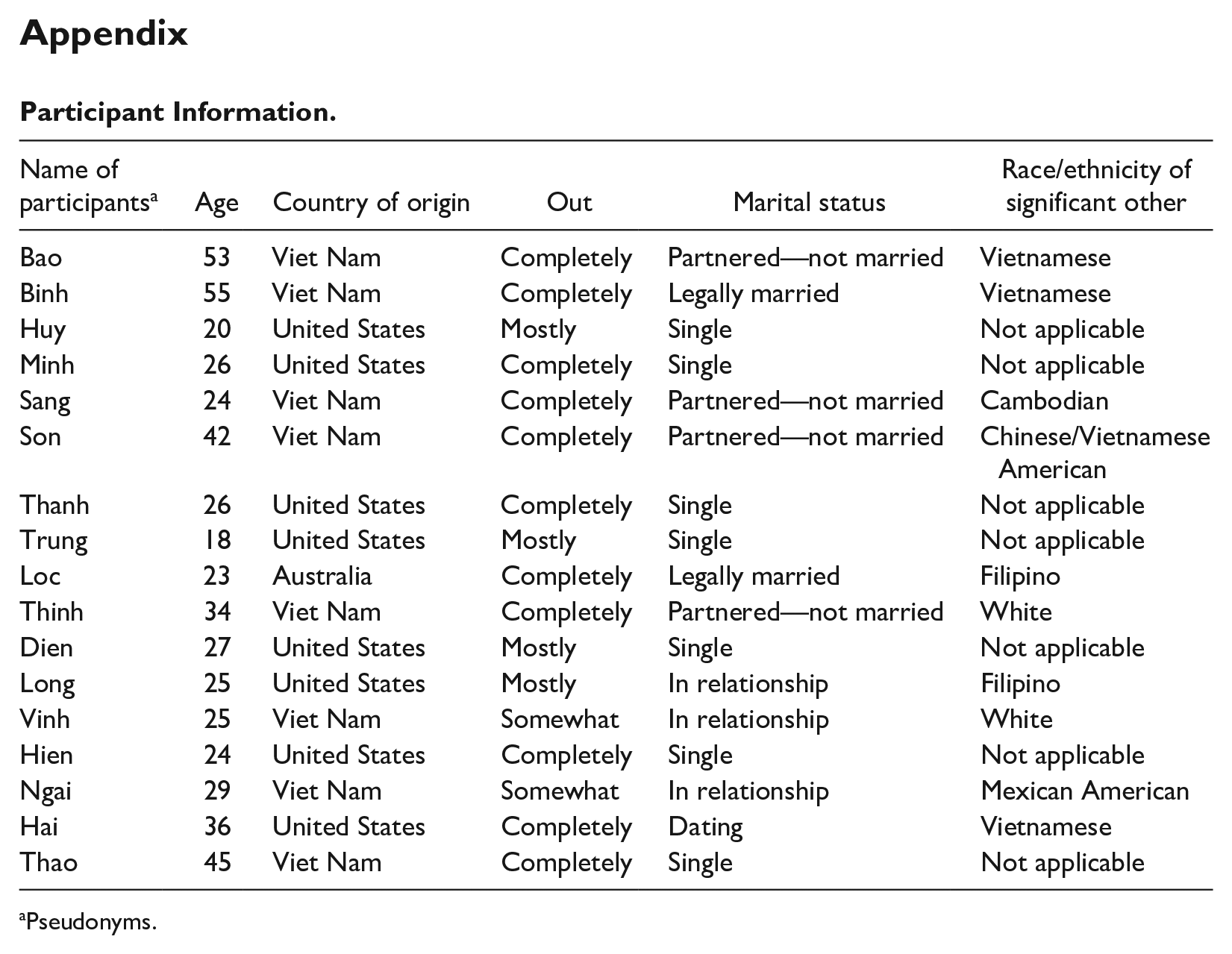
The 17 participants were recruited during the summer of 2018 through the spring of 2019 using snowball sampling, to better access prospective participants due to the challenges faced with recruiting those who self-identify as gay Vietnamese American men. Participants’ age ranges from 18 to 55. They live in various cities across Southern California and have all lived in the state for a minimum of one year. Seven participants are U.S.-born, one was born in Australia, and nine were born in Viet Nam. Those who were born outside of the United States moved to the country at various times between 1975 and 2010. One participant revealed during the interview that they self-identify as ethnically Vietnamese Chinese because one of their parents is of Chinese background. Another participant self-identifies as “Thai and Chinese from Viet Nam” because he was born and lived in Viet Nam for 14 years, but his dad is ethnically Thai, and his mom is ethnically Chinese.
Out of the 17 participants, 15 reported as being “mostly” or “completely out”, and 2 participants reported as being “somewhat out.” One participant also revealed during the interview that they identify as bisexual. However, for the sake of simplicity and to avoid having to explain their sexual orientation to others constantly, they often introduce themselves as gay. Regarding marital status, seven participants reported being single while one is “dating,” three are “in a relationship,” four are “partnered not married,” and two are “legally married.” The race/ethnicity of the significant others of the 10 non-single men includes 2 Whites, 2 Filipinos, 3 Viet, 1 Vietnamese Chinese, 1 Cambodian, and 1 Mexican American. See Appendix.
Coding and Data Analysis
All interviews were transcribed by the first author using Temi, an online audio transcription software that digitally transcribed each interview by converting audio files into editable texts. Temi also allowed the primary author to play back each audio file to review each interview word-for-word and make edits to each transcript.
Upon completing transcriptions of all interviews, the primary author engaged in open and focused coding, which involves close analysis of each transcript, line by line, to categorize various segments of the interview into a list of codes that would later be collapsed into multiple broader analytic themes (Emerson, Fretz, and Shaw 2011; Lofland et al. 2006). The first author utilized open and focused coding to explore particular ideas and issues of interest related to the research questions. The overall coding process served to identify and develop concepts, themes, and analytic insights from the data (Emerson et al. 2011).
Findings
Interview data revealed a number of broad themes regarding the way the men in our study experienced (sexual) racism and how they responded to these experiences. The men in our study experienced the larger gay “community” as largely catering to and dominated by gay White men. Virtually all of the men experienced sexual racism, whether in the form of sexual rejection or sexual fetishization. While many of the men confronted such acts of racism in line with previous findings on gay Asian men, many also responded by seeking support from pan-Asian as well as co-ethnic gay groups, with some men engaging in sticky rice politics in order to redefine and renegotiate the politics of racial desire.
A Community So White
Most participants described the larger gay community as White, whether they were referring to particular neighborhoods, bars and clubs, or other social institutions and spaces. That is, White people are overrepresented; their images and voices dominate gay media; and their social, political, and material needs are highly prioritized over the needs of other racial groups. For example, as Sang expressed: The platform is always given to White folks to tell their gay stories, right? You always hear about these gay White narratives, even in our movies right now . . . It’s always been the White gay narrative that allowed our community to stand up to certain inequality.
Sang’s comment alludes to representational racism in which he feels that films that focused on gay characters frequently revolve around the lives of White people and neglect the representation of people of color (POC). Similarly, Thanh explained that the dominant imagery of a White gay community is further reified through marketing advertisements and posters that center on White men. As Thanh stated: Advertisements in the queer communities are always buff, hairy, White men or skinny, White twinks [i.e., slender gay men], or it’s always White, Whiteness, you know? It’s very, very, very White.
In contrast, participants expressed how they rarely see Asian men, particularly Viet, reflected in mainstream gay culture. Such sentiment is captured in the following statement from Vinh: We’re not as represented much. There’s not really any gay icons or model, role models, I think who are Vietnamese gay men. I don’t think I’ve heard of any, so I don’t think they’re represented as much.
Although previous studies argue that representational racism operates through the overrepresentation of White people and the lack of gay Asian representation, and the perpetuation of the stereotypical Orientalist imagery in gay media (Fung 1991; Hagland 1998; C. W. Han 2015), Vinh’s account reveals that representational racism also occurs through the homogenization of Asian Americans by the lack of Asian ethnic representation. That is, for participants such as Sang, Thanh, and Minh, not only is there a sense of erasure of their racial identity but also their ethnic identity.
The impression that the larger gay community is a White community extends beyond media representation and into physical spaces. For example, Bao described his impression of one of California’s gay neighborhoods, West Hollywood (WeHo), as “very White.” Although Bao acknowledged that he has seen Black, Asian, and Latinx people in WeHo, for him, the “air [of WeHo] seems very White.” Similarly, Thinh expressed how he felt uncomfortable being in predominantly White spaces such as the Abbey compared with the once-a-week Asian night at Rage Nightclub known as GAMeBoi: I remember thinking going into WeHo, going into Rage, is like a different sense. It was like, “Oh my God, my peeps are here, my people are here.” All the API [Asian Pacific Islander] folks and other folks. Then going into the Abbey, which is a different beast. It’s set up to be this glamorous thing where celebrities go, and it’s very, very White, very Caucasian, very. So, you walk in . . . feeling uncomfortable in those kinds of spaces.
Participants such as Bao and Thinh pointed to the Whiteness of gay spaces as the underlying reason why they frequently feel out of place within the larger gay community. What makes such spaces particularly uncomfortable for these participants is not only that White people predominantly occupy these spaces but also how the Whiteness of these spaces is manifested through the subtle neglect of gay Vietnamese American men. These men are made to feel unwelcomed, unnoticed, and essentially invisible even when they are physically present in those spaces.
Gay Vietnamese American Men and the Racial Paradox of Gay Desire
When participants described what they do not like about the larger gay community and the negative experiences that they have had, they consistently brought up issues of sexual racism and racial fetishism, which we refer to as the racial paradox of gay desire of being gay Asian men. They are either deemed undesirable and rejected as potential sexual and romantic interests, or they are racially fetishized, often by gay White men, based on the stereotypical Orientalist imagery of the exotic, feminine, submissive, and passive gay Asian man.
Sexual Racism: An Online Story
Nearly all of the participants described having experienced sexual racism to some degree, primarily through online dating and hookup apps and Web sites. Consistent with previous studies (Callander et al. 2015; C. W. Han 2015; Paul et al. 2010), participants overwhelmingly described how they encountered dating profiles of gay men who blatantly display racially discriminatory statements such as “no Asians” on their profiles. In contrast, none of the participants indicated that they witnessed phrases such as “no Whites,” although some participants have seen phrases such as “Whites only.” For example, here is how Hien described his experience when using the dating app Grindr: I’ve seen it multiple times on hookup apps, mostly Grindr. . . There are people who will say, “Whites only” or “No Black guys” or “No Asian guys.” It’s pretty common throughout hookup apps.
Additionally, Thanh described not only the direct rejection that he faced but also the less outright rejections, such as how gay men use race to rate and rank others on gay dating apps: The first instance of racism that you’ll see on Grindr is always the profiles. It’s always, “No fats”; “No Asians.” The worst one I found is, “Asians+++++, Black+++, Latino—.” When you literally rate someone, or their interaction, based on their race.
As Thinh and Hien’s experiences show, sexual racism among gay men can be subtle or blatant and a salient form of racism in which gay men use race as a measure to determine the romantic and sexual worth of others. And in Thanh’s case, sexual racism can manifest into a visible constructed racial hierarchal scheme because men are rated and ranked as desirable or undesirable based on how many plus or negative signs are placed after their racial category.
Consequently, the participants in this study described being negatively affected emotionally and mentally when experiencing sexual racism. For example, the following remark by Thinh wholly captures the adverse effect of sexual racism: Oh my God, it makes you feel like shit. Even though it’s not directly to you, but I think it makes you, if you see that constantly day in and day out, like damn, you would be like, “Oh shit, I’m not desirable.” What is the message? I’m not desirable. I’m not wanted. I’m less-than. And so, what does that do to your self-esteem and your confidence that you already don’t have? It’s not “no fat, no fem, no Asian.” That’s not the message. The message is that “you’re not worthy”; that “you don’t belong. Nobody wants you.” That’s the message.
Thinh and other participants described feeling sadness, disappointment, and shame after experiencing sexual racism on gay dating apps and Web sites. They also expressed that it made them question their self-worth and the value of being a gay Asian man in the broader gay community. These accounts show that not only does racism produce a hierarchy of social worth based on race, but it also produces real consequences that negatively affect the emotional and mental health of gay Vietnamese American men.
Part of the reason that sexual racism has such a profound impact on the emotional and mental health of gay Vietnamese American men is because, for many of the participants, the gay community is supposed to be a place to escape marginalization. Many participants described how they were expecting to find spaces within the larger gay community to build connection and community alongside other gay people who also experienced discriminations and prejudices from the broader society. Much to the participants’ surprise, being among gay White men had the opposite effect. For example, here is how Dien described his initial expectation of using gay dating apps: My expectation at first was that people were just there on these apps for the same thing: trying to find a space, trying to find community, trying to find connection. I didn’t expect people to be exclusionary in terms of who they wanted to talk to or who they were willing to talk to.
Dien goes on to explain: It would make me feel really confused ‘cause, like I said, the queer spaces that I have access to, I’m assuming we’re expecting that the people who are navigating these spaces identify as queer. So, for queer person who’ve experienced marginalization, for them to repeat that, it is confusing to me because it doesn’t tap into the level of empathy that a person who’s experienced marginalization could or should experience.
Once again, the contradiction between expectation and reality stems from how on one hand, the expectation is that the gay community is a safe and welcoming place for gay Vietnamese American men. Yet, on the other hand, participants unexpectedly find themselves racially discriminated against by other gay men instead of experiencing the social solidarity that the gay community is supposed to engender. Consequently, when expectations and reality collide, participants find themselves in an emotionally and mentally confused, disoriented, and painful state of being.
Racial Fetishism: The Uncomfortable State of Being Desired
At one extreme, participants described witnessing and experiencing sexual racism, most often in online dating and hookup apps and Web sites. At the other extreme, many participants, regardless of their age, described the uncomfortable experience of being sexualized and fetishized online and in face-to-face interactions by gay, usually older, White men. The following remark by Hien encapsulates the problematic nature of the racial paradox of gay desire that gay Vietnamese American men in this study experience: Another fact that sucks on the opposite side of [sexual racism] is there are some people who fetishize Asian men and are like, “Oh my God, I love Asians” and “Asians only,” which I appreciate the attention because I don’t get a lot of it. But it is also problematic when you’d like someone just because they’re Asian.
Similarly, Sang described how he is exoticized and objectified: White guys hollering at me just to experience exoticness. But the intent has never been, like, valuing me as a human being, as a relationship, but as a booty call because they never been with an Asian before. There’s that mentality of Asian being submissive that comes into play. And how I know this is in a sense of the way [they] interact with someone. So, the way people come at me on Grindr is very, “You’re going to be submissive . . .” It would be like a dick pic and they’d be like, “Hey, you want to experience some dominant top?”
As reflected in Hien and Sang’s accounts, racial fetishism is a sexual attraction toward gay Asian men based on the stereotypical Orientalist imagery of the exotic, foreign, feminine, submissive bottom, and passive qualities that are a subtle part of the gay White male imagination.
Racial fetishism also manifests in the form of nonconsensual, physical, and verbal, sexual contact by the “fetishizer” toward the participant. For example, Thanh’s account shows how racial fetishism manifests subtly through microaggressive comments: Do you know how many times I have been fetishized by White gays? It’s so gross how they’re just like, “I love Asians,” “I love anime [Japanese cartoon]”, “Oh my God, JPop [Japanese popular music],” “What Asian are you?” “Can you show me how to use chopsticks?”
Thanh went on to recollect another particular instance of racial fetishism that occurred not only verbally but physically: I was walking in West Hollywood with friends and these gay White dudes will come up, like, straight up groped me while I was walking on the street. Or I’ll go into the club and they’ll say like, “Oh, I love Asian boys.” Or they’ll try to flirt with me, but always starting off with the whole racial. They start off with like, “Oh, you’re really cute for an Asian guy.”
Minh also described a similar situation in which an older gay White man inappropriately touched him without his consent while he was dancing at the club: I’m just there dancing with my sister and whatnot. We’re just talking, and then all these White guys, the older White guys, try to talk to me and try to get in my business. And then as I was dancing, my butt was being caressed and everything by this guy as I was dancing.
As Thanh and Minh’s accounts show, racial fetishism operates in subtle and blatant ways. Thanh’s statement shows that racial fetishism can be subtle through the form of microaggression in which a gay White man expressed an affinity for Asian culture by stereotyping and conflating him for another Asian ethnic group. Or how other gay men were surprised that Thanh could actually be “cute for an Asian guy,” which seems to imply that Asian men are generally considered unattractive. And both Thanh and Minh’s experiences show that racial fetishism can manifest into blatant nonconsensual, physical, sexual contact.
When encountering racial fetishism, participants described feeling angry, frustrated, uncomfortable, grotesque, and even unsafe. While many participants expressed an aversion toward sexual racism and being rejected based on their race, they also firmly and actively object to being “desired” based on their race, especially when such desire involves nonconsensual, physical, and verbal, sexual contact.
Gay Vietnamese American Men Respond to Racism
Depending on the circumstances, participants respond to and resist the various forms of racism in the gay community through the use of several different strategies. Consistent with a study by Kyung-Hee Choi et al. (2011), one strategy for dealing with racism is to engage in direct confrontation, particularly when it occurs in face-to-face interactions. For example, as Bao expressed with a firm resolute against racism and sexism: So, I would go to functions, and if people who are racist or sexist, I call them on it right away. I call you on the carpet right away. I don’t tolerate it. And I have choices. I either try to change your opinion or I leave you. As I get older, I’m finding that I don’t have time for that. So, if you’re prejudiced, I don’t need to be around you. I’m in control. I choose not to be around. Right? I choose not to allow myself to subject to that climate. So, I’m in totally control.
With a similar firm resolute, Long expressed that he does not tolerate racial fetishism, especially if someone touches him without consent. Long recounted an instance when he was sexually harassed: “When I was being groped, I would just push them away or say, ‘No, I’m not interested.’” By utilizing a direct confrontational approach, participants such as Bao and Long reclaim their space from those who attempt to invade their personal space. They also maintain their dignity by establishing strict boundaries between acceptable and unacceptable behaviors and exert their power by directly confronting those who attempt to dominate them.
When encountering racism, particularly sexual racism online, some participants use a nonconfrontational avoidance approach in which they avoid confrontation and avoid engaging and interacting with racist profiles altogether. For example, as Sang described: “When someone sends me a message on Grindr that is blatantly racist, I leave it. I leave it as is.” Similarly, Hai expressed, “I usually don’t say anything. I just kind of brush it off. I don’t think I’ve ever confronted to anyone about it.” And as Trung noted, “It’s not worth my time to, so I would just not respond.”
The notion of avoidance may imply passivity due to the lack of direct confrontation, but we argue that it should not be interpreted as passivity. For example, here is how Dien described how he engaged in avoidance: I’ve kind of seen profiles that have said, “No fat, no fem, no Asians.” And for me, I’ve learned to avoid those profiles. I’ve learned to feel as though those behaviors are very petty and not worth my time. So, what I’ve done is, I’ve been able to change my fixation or prioritization onto people who might be in line with the people that I do want to talk with . . . I read their profile. I don’t just blindly message somebody. Specifically, on Grindr, if you double-tap [on the person’s profile], you go immediately into the chat; I don’t do that. I click [on the profile] and I might read, I might review, I will assess and kind of see if this person, based off of what they’re saying, is worth my time. I use also intuition to make sure that maybe this person might want to speak to me or might not want to speak to me. [Then] I’ll give it a try.
Through the process of social filtering other men’s dating profiles and mentally reorganizing whom he determines is worth his time based on the values that he thinks that the other person and he shares, Dien’s testimony demonstrates that nonconfrontational avoidance is thoughtful, strategic, and a form of power that gay Vietnamese American men exert to avoid interacting with racist gay men. Dien’s statement also shows that there is an extraordinary level of agency in avoidance because choosing a nonconfrontational avoidance approach to deal with racism is a form of active self-preservation of the participant’s time, energy, and mental health.
Another strategy, similar to what Choi et al. (2011) refer to as “disassociation,” is detachment avoidance in which participants detach themselves entirely from particular people and spaces. After experiencing a high level of racism within the gay community, Thanh explains how he completely detached himself: It’s [the gay community] actually really exclusionary even though it likes to promote itself as inclusive . . . I don’t participate in queer communities’ stuff. I don’t go out to West Hollywood. I don’t associate with, like, non-POC queers. Like White gays, I avoid them like the plague.
Similarly, the following is a recount of how Minh, who was 26 at the time of the interview, attempted to date men through the gay dating app Grindr. Here, he explained the outcome of his dating experience: Well, they’re all really much older. They’re 60 plus. So, they were just asking sexual stuff or get dick pics and whatnot. And I’m like, “Okay.” So, I stopped it for awhile . . . And afterwards, I was like, “I’m not doing this anymore.”
Essentially, Minh described his dating experience as being pursued by mostly much older gay White men who solicit him for sex and send him unsolicited photos of their penis. Minh indicated that having been sexualized, fetishized, and objectified deterred him from using the apps, to the point where he stopped using dating apps altogether.
Unlike Choi et al.’s (2011) disassociation, which does not specify temporality, participant accounts in this study show that detachment avoidance can be a temporary or permanent strategy, usually the latter, to detach and avoid gay White men and predominantly LGBTQ White spaces to ensure that they no longer expose themselves to racism. Moreover, Choi et al.’s (2011) disassociation focuses primarily on physical spaces, whereas this study found that participants engage in detachment avoidance strategy in both physical and online digital spaces. Finally, and more importantly, Choi et al. (2011) found that Black and Latino men in their study engaged in the strategy of disassociation, but Asian men did not. Instead, Asian men in their study engaged in “selective affiliation” by selectively avoiding individuals instead of spaces. Yet, the current study shows that gay Vietnamese American men engage in an active avoidance strategy by detaching themselves from social spaces and social interactions where racism may or may not have occurred, particularly in instances that also involve sexual harassment, such as experiencing unsolicited and nonconsensual sexual encounters.
A Community of Their Own
Detachment does not mean that participants are without a community. Although studies show that, historically, gay Asian men avoided one another, distanced themselves from their racial identity, or that racially marked “Asian” spaces primarily catered to gay White men’s desire (Cho 1998; C. W. Han 2015; Wat 2002), participant accounts in this study reveal social behavioral patterns that depart from what previous histories have shown. For example, as Thinh explained: Like discrimination, racial discrimination, it happens in the gay community . . . So, because of that, we had to find our own space. We had to create our own space. So, there’s reason for that. There’s historical reason.
As a response to the Whiteness of the community, gay Vietnamese American men in this study actively sought out spaces that are oriented toward gay Asians and Viet Americans and where they did not have to feel different against a sea of Whiteness.
Moreover, Binh explained that he has no idea about the “White [gay] community” because: When I coming out [i.e., going out], I only, specifically, hanging out with other Asian groups and people. So, in the White community, I don’t have, I have no idea about them at all because you’re not going to go in there and deal with them. And then even the White people don’t exist in our mind and in my mind anymore because, you know, you don’t need them to be a part of our gay life, you know? I only hang out with Asian. I don’t associate with White people.
Participants such as Binh and Thinh turned to their fellow gay Asians to create a community of their own. Instead of avoiding gay Asian people, they avoid interacting with the broader, “Whiter,” gay community where they have experienced marginalization along the line of race. By detaching themselves from people and spaces where they have been or could be marginalized, rejected, and fetishized due to their race, participants selectively engage in spaces and with people in which they know that they will feel racially, ethnically, and culturally welcomed and safe.
Having an ethnic-specific community and dedicated spaces that recognize the intersectional experiences of gay Viet people can have a positive impact on their sense of self and reduce the possibility of experiencing internalized racism (Huynh 2022). For example, Thanh and Hien expressed that they never really felt accepted as gay Asian men in the broader gay community until they encountered online Facebook social groups geared toward community-building among gay Asians. For Thanh and Hien, these online social groups positively impacted their self-esteem and sense of self-worth because these groups affirmed their intersecting identities of being gay and Asian and provided them with a sense of community and social acceptance. As Thanh stated: “I’ve never really felt accepted as a queer Asian person before SQuAD [Subtle Queer Asian Dating].”
Moreover, while previous studies show that gay Asian men deemed one another as undesirable, actively rejected one another as potential sexual and romantic partners, and viewed one another as competitors over gay White men as a result of internalized racism (Cho 1998; C. W. Han 2015; Wat 2002), participants in this study paint an alternative picture. Many participants did not express an affinity toward gay White men. Nearly all of the participants in this study indicated that they have or had sexual and romantic relations with gay Asian men and other gay men of color. Take Huy as an example, who expressed a desire to date other gay Asian men for cultural similarity and understanding. As Huy explained: I think that it’s definitely a lot easier to date an Asian because of cultural similarities. Just like, they understand the same things as you and stuff like that. So, just a lot more understanding, you know?
Similarly, Son is mostly interested in dating gay men of color and has only been with one gay White man: I’ve dated Latino, Black. I have dated one White guy. Well, he was interested in me and I, kind of, wanted to give it a chance. It was very short-lived. I think because I’m more interested in people of color, particularly Black, Latino, Asian, especially Vietnamese.
In fact, out of the 10 participants, seven are in a relationship with a gay Asian man, four of whom are of Viet heritage, while the other participant’s partner is a Mexican American man (see Appendix). Part of this diverging dating pattern, when compared with previous studies, could be attributed to the fact that the majority of the participants in this study surround themselves with gay Asian and Viet people or are involved in Asian and Viet-specific LGBTQ groups.
There are also noticeable intergenerational differences too, particularly whether these men are U.S.-born or not and their close ties to the Viet community of Little Saigon. For example, although gay Vietnamese American men turned to other gay Asians for a sense of community, older participants also described unmet needs in panethnic Asian social groups during the early 1990s. Here is Bao’s account that provides a historical insight into those unmet needs and how gay Vietnamese American men formed their own Viet-specific gay social groups: We [gay Vietnamese American men in the early 1990s] originally were part of GAPSN, Gay Asian Pacific Support Network, of all gay Asians. And then, we realized that there was Vietnamese who showed up and struggled understanding the conversation because they spoke very limited English. So, that was where the need came from. So, we created GVA [Gay Vietnamese Alliance], specifically for gay Viets.
Echoing Bao’s story, Binh shared a similar account: At the time, when I was on the board of GAPSN in the Asian group, most were Chinese, Filipino, and me. And I was thinking, “There’s no Vietnamese.” And at the time, a lot of newcomer from Viet Nam also arrived, the boat people. And those gay guys, they don’t speak English. So, I tried to get [them to], “Oh, come to GAPSN!” but they don’t understand English initially, and they get lost. So, I’m thinking, so we need a Vietnamese group. That’s when we start to go down to OC [Orange County] and tried to organize that. The Vietnamese group.
Bao and Binh’s accounts demonstrate that gay Asian Americans are not homogenous. Even within a unified racial group, the needs of the larger group may not always reflect the needs of its members who may be part of a smaller subpopulation (Delgado and Stefancic 2012).
Despite gay Vietnamese American men expressed feeling disconnected, distanced, and erased from the broader White gay community and responding to these feelings by seeking out other gay Asians, Bao and Binh’s accounts show that feeling disconnected—based on unmet ethnic-specific cultural needs—can remain even within gay panethnic Asian social groups. As Bao further explained, “So, most of [GVA’s] function, we spoke to each other or converse with each other in Vietnamese rather than in English. That’s how it was, out of necessity for the limited English proficiency gay Viets.” As such, older generation gay Vietnamese American men responded by seeking out fellow gay Vietnamese American men and forming Viet-specific gay social groups such as GVA. These groups were dedicated to gay Vietnamese American men where they could communicate and connect with members of their ethnic groups to celebrate their distinctive ethnic, cultural identity that is uniquely different from the broader pan-Asian gay community. This is most evident in the following statement by Son: I think I pretty much stayed in the gay Vietnamese community or in the Vietnamese community. Yeah. I didn’t get involved or ventured out. . . . I didn’t feel the need to. I didn’t want to venture out of my comfort zone being around to people like me, speaking Vietnamese, eating Vietnamese food.
For Son, he not only turned to a gay Asian group but also to the gay Viet community as part of forming a “chosen family” for ethnic, cultural familiarity, and closeness (Huynh 2022).
In fact, it was through the GVA social group that helped Son overcome his sense of internalized racism and find a community among members of his ethnic group. For instance, when Son first came out, he did not have any exposure to gay Asian or Viet spaces, nor did he surround himself with gay Asian or Viet people. He also expressed how he hardly found gay Asian and Vietnamese American men attractive. He attributed his lack of attraction to Asian men as, essentially, internalized racism: I don’t know. I couldn’t understand myself. I think it was something internal. I kind of like hated them, but I think that there was some kind of an internal conflict. To be honest, I think I’ve always find Vietnamese men to be attractive. And even when I was in high school in Viet Nam, I had crushes on my friends. I don’t know why I behave that way.
However, when he began chatting with gay Vietnamese American men online, increased his interactions with gay Vietnamese American men both on and offline, and involved himself with GVA and other gay Viet-specific social groups, that was when he began to develop an attraction toward his fellow gay Asian and Vietnamese men. Although he used to find White men more sexually attractive, he expressed that he no longer has a sexual affinity toward White men and is currently engaged to a gay Chinese-Vietnamese American man.
The opportunity to find other gay Vietnamese American men to form Viet-specific gay groups is due in part to the fact that some of these men live within or in close geographical proximity to a Viet ethnic enclave that emerged out of broader historical and political events (Le 2015; Masequesmay 2003a; Võ 2008; Zhou and Bankston 1998). Their close tie to the Viet ethnic enclave seems to anchor them to their Viet cultural heritage, allows for them to engage and interact with other gay Viet people when faced with unmet social needs from pan-Asian oriented groups, and allows them to avoid interacting with the broader perceived “White” gay community—which is what ethnic enslave have historically allowed for Viet immigrants to do (Juan 2005; Le 2007; Zhou and Bankston 1998).
Conclusion
This study explored the embeddedness of racism within American society and how racism continues to operate and reinforce racial hierarchies even within oppressed groups such as the LGBTQ community.
Participant accounts show that the gay community is not the affirming and safe place as many of the participants had imagined or hoped for it to be. Instead, they described feeling marginalized, unwelcomed, undesired, and in several cases, unsafe in the gay community. Gay Vietnamese American men in this study described the social relations within the gay community as organized around Whiteness, thus reinforcing White dominance and privilege.
This study also found that sexual racism and racial fetishism, which we refer to as the racial paradox of gay desire, are the two most salient forms of racism that participants experience. Participant accounts affirm that sexual racism racializes gay desire and sexual worth by degrading the worth of gay Vietnamese American men. Consequently, experiencing constant rejections among gay men can take a toll on gay Vietnamese American men emotional and mental health, evidenced by their accounts of feeling sadness, disappointment, and shame, in addition to questioning their self-worth.
Many participants also described the uncomfortable experience of being sexualized and fetishized online and in face-to-face interactions, often by older gay White men. Although some scholars frame racial fetishism as a subtle form of racism, racial fetishism also results in unwanted, unsolicited, nonconsensual, physical, sexual contact by the “fetishizer” toward gay Vietnamese American men. As such, we argue that racial fetishism should be reframed as both a subtle and blatant form based on its physical manifestation.
Similar to the adverse effects of sexual racism, participants described feeling angry, frustrated, uncomfortable, grotesque, and even unsafe when experiencing racial fetishism. Just as sexual racism degrades gay Vietnamese American men worth, racial fetishism similarly operates through the Orientalist imagery that frames gay Vietnamese American men and gay men of color as inferior, exotic, and sexual objects.
However, the men in this study do not experience racism passively. As part of engaging in sticky rice politics to redefine and renegotiate the politics of racial desire, participants actively respond to and firmly resist the various forms of racism in the gay community through the use of direct confrontation, nonconfrontational avoidance, and detachment avoidance. Through the direct confrontation approach, participants reclaim their personal space from invaders, maintain their dignity by establishing strict social boundaries of acceptable behaviors, and exert their power by directly confronting those who attempt to dominate them. Through the nonconfrontational avoidance approach, respondents avoid engaging and interacting with those committing racist acts.
Finally, this study found that participants avoid interacting with the broader “Whiter” gay community, where they have experienced marginalization, rejection, and fetishization. They do so by turning to their fellow gay Asians, and at times, specifically to gay Viet people, to create groups and spaces of their own that recognize their intersectional identities. Participants in this study are able to turn to other gay Asians and Viet people because they reside in a region that consists of a large population of Asian Americans that has created ethnic enclaves that allow for them to anchor themselves to their ethnic community, form gay ethnic-specific groups, and shield themselves from the broader perceived “White” gay community. In short, gay Vietnamese American men engage in sticky rice politics by challenging the Whiteness of the broader gay community by embracing their ethnic identity and creating spaces and communities where they feel safe, desired, and a sense of belonging among other gay Asian and Viet Americans.
Limitations and Future Directions
The goal of this study was to contribute to the theoretical understanding of the embeddedness of racism and how it operates and manifests. To do so, we situated our analysis within the gay community of Southern California. We sought out personal accounts of gay Vietnamese American men to contribute empirically to the varying ways in which gay men of color experience and respond to racism. Future studies should consider expanding the exploration of gay Viet Americans experience by broadening the population of study to include lesbian, bisexual, transgender, and/or queer/questioning Viet Americans. For example, Masequesmay’s 2003 study shows that despite Vietnamese lesbians, bisexual women, and transgender women coming together to form a supportive ethnic-specific queer group based on a shared sense of “Otherness,” female-lesbian issues dominate, thus, neglecting and marginalizing the needs of bisexual and trans women’s issues. In addition, there is growing evidence that the racialized experiences of Asian lesbians may be significantly different from the racialized experiences of gay Asian men (Pham 2024). If marginalization can occur along the line of gender and sexuality within an ethnic-specific queer group, future studies should also study how lesbian Vietnamese American women experience and respond to racism in the gay community. What would their experience further teach us about how race and racism operate in American society? In doing so, studies can further explore how race and racism shape the everyday life of gay Viet Americans by taking into account the intersectional dimensions of race, gender, and sexuality.
Moreover, our analysis primarily focused on micro-level, face-to-face experiences and only alluded to structural/institutional factors. For example, we discussed the pervasiveness of racism in dating apps and Web sites but focused mainly on individual actors and not how organizations, such as Grindr and Adam4Adam, play a role in shaping the online environment to allow for racism to flourish. To take on a more structural analysis, we recommend that future studies explore the role that LGBTQ-based corporate companies play in (re)producing and maintaining racism, focusing on regulatory practices (or lack thereof) toward its users’ racial exclusionary behaviors (Lipsitz 2007). Studies should also explore how institutional policies and practices of LGBTQ-based companies racialize online dating and hookup spaces by focusing on how their policies and practices organize and regulate access to social, spatial, and material resources along racial lines.
Also, while some men engaged in multiple strategies, we did not explore various factors that may influence the types of strategies that they are likely to deploy and under which social, historical, and contextual factors such strategies are used. Yet it is likely that both personal and situational factors such as the men’s self-confidence and sense of self-worth as well as their own ethnic and/or racial identity versus their sexual identity, their participation in the larger Viet community, their relationships with non-gay Viet people, their families, and so on is likely to influence their responses to racism.
Finally, the majority of the participants in this study are involved in gay Asian and Viet-based organizations to varying degrees. This may be owed to the fact that they live in a geographical region that consists of a large population of Viet people along with an emerging and growing presence of gay Viet people. For example, Huynh theorized in his 2022 study that members of VROC, queer and non-queer identifying, resist the assimilation process and cope with racism through the creation of a “chosen family” alongside their biological family and holding onto their Viet cultural beliefs. Similarly, this study’s participants’ involvement in Asian and Viet-based organizations potentially shaped their sense of awareness and outlook on racial issues that exist within the gay and broader gay community and influenced how they responded to these issues. Participants in this study may have a more heightened and developed understanding of racial issues in comparison to other gay Vietnamese American men. Future studies should include participants who are involved and less involved in LGBTQ Asian-based organizations. In doing so, future studies can explore how LGBTQ Viet Americans vary in their understanding, outlook, and experience regarding race and racism in the larger LGBTQ community based on their involvement with LGBTQ Asian-based organizations.
Limitations aside, this study provided new insights into how race and racism continue to shape the lives of LGBTQ Asian Americans and social relations within the LGBTQ community, and how racism remains deeply embedded in American society and continues to play a central role in reinforcing White dominance and privilege.
Footnotes
Appendix
Participant Information.
| Name of participants a | Age | Country of origin | Out | Marital status | Race/ethnicity of significant other |
|---|---|---|---|---|---|
| Bao | 53 | Viet Nam | Completely | Partnered—not married | Vietnamese |
| Binh | 55 | Viet Nam | Completely | Legally married | Vietnamese |
| Huy | 20 | United States | Mostly | Single | Not applicable |
| Minh | 26 | United States | Completely | Single | Not applicable |
| Sang | 24 | Viet Nam | Completely | Partnered—not married | Cambodian |
| Son | 42 | Viet Nam | Completely | Partnered—not married | Chinese/Vietnamese American |
| Thanh | 26 | United States | Completely | Single | Not applicable |
| Trung | 18 | United States | Mostly | Single | Not applicable |
| Loc | 23 | Australia | Completely | Legally married | Filipino |
| Thinh | 34 | Viet Nam | Completely | Partnered—not married | White |
| Dien | 27 | United States | Mostly | Single | Not applicable |
| Long | 25 | United States | Mostly | In relationship | Filipino |
| Vinh | 25 | Viet Nam | Somewhat | In relationship | White |
| Hien | 24 | United States | Completely | Single | Not applicable |
| Ngai | 29 | Viet Nam | Somewhat | In relationship | Mexican American |
| Hai | 36 | United States | Completely | Dating | Vietnamese |
| Thao | 45 | Viet Nam | Completely | Single | Not applicable |
Pseudonyms.
Declaration of Conflicting Interests
The author(s) declared no potential conflicts of interest with respect to the research, authorship, and/or publication of this article.
Funding
The author(s) received no financial support for the research, authorship, and/or publication of this article.