



Abstract
Why and how do workers stay in bad jobs? Based on 972 questionnaires and longitudinal data from 45 interviews, the article finds substantial support for the labor of love and the psychic income theories and no support for the miscalculated risk and commitment device theories. It documents personal strategies (overworking and childlessness) and institution-related strategies (diploma-hoarding and institutional pegs—a term introduced in this article). The article argues that the existing dichotomy of market-driven art and the state-subsidy-driven art could be enriched by the third model epitomized by Poland—a country with neither the art market comparable to that of the United States or the United Kingdom nor a state spending on art comparable to that of France or the Netherlands—where free higher education is used as a fallback option in the context of scarce resources.
With rising precarity, workers are increasingly pushed into bad jobs, defined as low-paid, unstable, and short-term work. Yet, some people accept or even welcome these working conditions. Why and how do they stay in markets that grant them no economic recognition? The visual arts are well suited to answer these questions. Across high-income countries, the number of artists per 100,000 inhabitants is increasing but few maintain a career in the arts (Menger 2014). Most entrants leave the industry within five years (Fraiberger et al. 2018). This mobility, linked to exceptional hardship, gives rise to the first research question of this article: Why and how do some artists stay in a market despite these difficulties?
Prevailing socioeconomic theories focused more on the why than on the how—and it doing so relied on individual-level preferences, such as utility, identity, or commitment device—showing little connection between the individual strategies and the institutional set-up. Even if visual arts have some common features internationally—oversupply of aspirants (Menger 2014) and winner takes all markets (Caves 2000)—the sheer size of the market and state subsidies afford different opportunities for aspiring artists. This gap in the literature gives rise to the second research question: How are artists’ coping strategies interwoven in the institutional setting?
The paper begins with a review of the literature on preferences for bad jobs. Then, it situates the existing research in the triangle of the state, the market, and the education system to show how these theories were shaped by the institutions of the country of research. Third, the data and methods are described. Fourth, the results evaluate four theories for choosing bad jobs. Fifth, the motivation to choose bad jobs is analyzed from the viewpoint of its influence on coping strategies. I conclude with a discussion of how Poland—a country with neither the art market with a mass of private buyers comparable to that of the liberal countries (such as the United Kingdom or the United States) nor a state spending on culture comparable to that of social-democratic countries (such as France or the Netherlands)—can enrich the existing literature.
This article contributes to sociology of work by testing and advancing the theory of precarity-as-choice. It does so by showing how motivation is intertwined with coping strategies possible in a given institutional set-up. The article introduces the concept of an institutional peg, defined as stable, low-paid jobs at publicly funded institutions. I called them pegs, as they allow individuals to gain a foothold in the art circuit, while pursuing self-expressive art after hours. I argue that they are Poland’s adaptation to precarious art markets of small size with low state subsidies but with widely funded education system.
Definitions
Deciding who is an “artist” has been a major challenge that led to the development of five parallel definitions in European legal systems. 1 In Poland, the issue of who qualifies as an artist has been so contentious that it has blocked artists’ social rights bills—which subsequent governments have tried to pass since the 1990s.
This paper will settle on a definition that will help to explore the links between the education system and the labor market. Visual artists will be defined as people educated at fine art academies who perform creative work in visual arts, such as painting, sculpture and graphics, intermedia, industrial design, and others. Although artists perform work of different levels of creativity and payment, I initially distinguish only between self-expressive work, understood as creative work for art’s sake; “potboilers,” defined as art commissions with freedom of expression limited by what the buyer wants; and nonart work taken up due to financial necessity (e.g., waiting tables). In this context, bad jobs are understood as jobs that meet the three criteria: They are low-paid, precarious (unstable and short-term work), and dead end (not leading to a better job in the future) regardless of the work’s substance.
Relevance of Visual Arts to Sociology
The art world embodies, par excellence, the transfer from the first to the second modernity (Beck 2000). The first modernity was built on a collective lifestyle and full employment that financed the welfare state within the boundaries of the nation. Its mode of production—“the Fordist regime”—was about the mass standardization of production and consumption and collective solutions, such as trade unions, collective bargaining, and government intervention. The second modernity brought precarious employment and globalization, while education, enrichment, and the internalization of political and social rights fuelled individualization. Flexibility moved the risks from the collective toward the individual. Individualized production and consumption made it possible to live “a life of one’s own” (Beck 2000:53).
Artists embody all these transformations not only because they function in endemic insecurity but also because their chief values—self-development and independence—are the by-products of the processes of individualization that Beck wrote about. Creative industries project the image of being a “meritocratic blueprint for a new form of post-industrial economy” (O’Brien et al. 2016). Yet, nomadic, project-based work, usually involving self-employment, resembles neither traditional entrepreneurship nor traditional labor. In practice, it places new workers at the heart of the political economy of insecurity and outside the bounds of the welfare state. As new cohorts of young labor market entrants seek independence and self-development, they may be more vulnerable to accepting precarious conditions in the name of the new totem of self-actualization.
The art careers differ from other paths chosen to facilitate individualization in three ways. First, they are riskier. In Poland, culture is the single worst paid sector of the economy (Sedlak & Sedlak 2012). Internationally, most artists do not survive even five years in the industry (Fraiberger et al. 2018), due to the oversupply, “winner takes all” distribution, and fewer fall back options. Second, taste-based judgment puts art adepts at the mercy of the taste jury which adds another level of insecurity: unclear criteria of quality. Third, “art for art’s sake” defies typical motivations for choosing jobs known from neoclassical economics—leading to a nonzero labor supply even at the price of zero.
Against this backdrop, visual arts have been chosen as an “extreme case” that should render the two phenomena more visible: precarity and self-development. Furthermore, it is in creative sectors where the relationship between these two concepts can be explored: as precarity seems to be the price that some workers are ready to pay for the promise of self-development. In the arts, precarity is linked to a small overall market with low pay, high surplus of supply over demand, high unemployment, and a subsegment of labor performed without any pay. Most jobs in the arts are offered entirely in a project-based format, epitomizing post-Fordist capitalism (Boltanski and Chiapello 1999). Yet, the situation in Poland goes further: Its art market has been described as a “mirage” by M. Kozłowski, J. Sowa, and K. Szreder (2014), who found that two thirds of art workers earn from art production less than 10 percent of their overall income. These phenomena suggest difficult market conditions, fierce competition, and a strong nonfinancial motivation. The next subsection will present theories that tried to understand why do people pursue such jobs anyway.
Theories of Ending Up in Bad Jobs
In a classic article on artists’ motivations, P. M. Menger (1999) reviews three theories that explain why artists enter such difficult markets: miscalculated risk, labor of love, and psychic income. The first argument—miscalculated risk—emphasizes that artists make occupational choices in conditions of uncertainty. Market entry is like a lottery (Marshall 1947) and artists either like this risk or miscalculate their chances in a market where a few winners take most resources.
The opposite assumption—that of perfect market information—is made by the second theory: “psychic income.” It assumes that work rewards are twofold: monetary and psychic. Also called a “theory of equalizing differences” (Rosen 1986), this perspective submits that more attractive work compensates for monetary shortages. Inspired by Adam Smith, the theory makes a series of assumptions typical of classical and neoclassical economics: People execute individual preferences and both the supply side and the demand side of the market have access to perfect information.
The third theory posits that artists are exercising the “labor of love”—skilled and sustained activities to which people are irresistibly committed and in which they would partake voluntarily. Such activities entail a social value beyond market exchange resulting in an inelastic labor supply. In this sense, art could be a labor of love if motivations for doing it are not self-interested (Freidson 1990).
The second and third theories seem to be insufficiently distinguished and Menger does not clarify how psychic income is different from “love”—as one would expect loved activities to bring some type of psychic income and, hence, be a subset of it. Regardless of the name, this strand of literature reverberates through recent studies of musicians (Chafe and Kaida 2020; Umney and Kretsos 2015) and visual artists (Abbing 2002) disguised under the concept of passion that justifies the lack of material rewards, stigmatizes treating art as a trade, and instills a desire for self-improvement at the expense of material stability.
Since Menger’s paper, new perspectives have been added to our understanding of the motivation behind work without adequate compensation. The commitment device theory (Adler 2021) submits that artists choose bad day jobs to reinforce dedication to the art as a priority pursued “after hours.” From an economic perspective, this means that the present self and the future self have different preferences so there is no way to compare their utility increments (Schelling 1984). In the case of artists, a commitment device helps to avoid the formation of alternative commitments that are likely to arise in better paid jobs (e.g., a corporate day job, although better paid, could be mentally taxing and increase the probability of dropping the arts). This theory, however, does not explain why workers are so motivated to stay in the arts in the first place. It is also at odds with statistical evidence which shows that American artists who ever worked outside the arts have 89 percent lower chances of staying in the arts (Frenette and Dowd 2020).
The presented theories are helpful for understanding individual motivation but have two shortcomings that this article attempts to address. First, they rarely reflect on how individual strategies are shaped by available institutions. Second, they are insufficiently attentive to the ways in which motivation to perform underpaid work is linked to the possibility to do so and, hence, they are better suited to understand why artists enter the industry rather than why they remain there. The “why”—motivation to remain in a difficult market over years—is underwritten by the “how”—coping strategies that make it possible to stay—a theme on which there is less work, especially in a longitudinal perspective.
Coping Strategies
Internationally, the main strategy of dealing with “bad jobs” is exit. Using reconstructed careers of 496,354 artists from 143 countries, S. P. Fraiberger et al. (2018) showed that a half of artists with a low initial reputation 2 leave the industry within 3.3 years, while a half of those with a high initial reputation do so within seven years. Fifteen years after entry into the market, only 3 percent of those with a low initial reputation and 23 percent with a high initial reputation remain in the industry. “Giving up” on the aspirations for a career in the arts typically entails seeking more stable employment outside of the sector (Bille and Jensen 2018)—often after a decision to start a family (Stokes 2017).
Among those who stay and try to survive, the typical strategies are portfolio employment—where a person maintains more than one job. Strategic National Arts Alumni Project data, representative of the population of three million art graduates in the United States, found that nearly 40 percent work more than one job—typically across different sectors (commercial, nonprofit, community), disciplines (i.e., many art forms), and roles (Frenette 2017). Typically, this includes jobs much below artists qualifications, such as stereotypical waiting tables in Los Angeles (Alper and Wassall 2000), or working in services, for example as nannies, retail sellers, ticket takers, bartenders—sometimes consciously avoiding more demanding jobs (Adler 2021).
Social Class
In countries with a strong upper-middle class bias in the arts (especially the United Kingdom and the United States), a typical coping strategy involves private resources—as shown, for example, in how British musicians get by thanks to family money (Umney and Kretsos 2015). The private resources, self-evidently, do not help to explain coping strategies of artists of modest background who try to survive in the arts without such means. Here, the Polish case study can shed a new light on coping strategies—as the country shows lower class bias than that of the United Kingdom and the United States that dominated the literature.
In English-speaking countries, the arts are especially skewed toward the upper-middle class (Grugulis and Stoyanova 2012) through a series of mechanisms such as the readiness to pursue unpaid art internships (Frenette 2013), the ability to afford equipment and years-long art training (Umney and Kretsos 2015), or art concentration in metropolitan areas (Oakley et al. 2017).
Friedman and O’Brien (2017) showed that class background plays a crucial role for U.K. actors through: enabling culturally legitimate educational pathways, which facilitated key early opportunities, and the ability to navigate the periods between jobs—which affected artists’ capacity to reside in expensive metropolitan areas, such as London, where art opportunities concentrate. K. Oakley et al. (2017) found that underrepresentation of working classes in Britain’s arts occurs concurrently with disproportionate “class of origin pay gap”: Artists with working-class backgrounds in London earned 85 percent of those from more privileged backgrounds, compared to 90 percent in the rest of the United Kingdom.
Institutional Setting: The State, the Market and the Education System
Even if the oversupply of artists is an international phenomenon—as many researchers would have it (Adler 2021; Caves 2000; Lingo and Tepper 2013; Menger 1999)—it is enmeshed in different institutional triangles of the state, the market, and the education system. Much of the debate about why artists stay in bad jobs, often narrated as if it were place-neutral, relied on only four countries: the United States (Adler 2021; Frenette and Dowd 2020), the United Kingdom (Oakley et al. 2017; Umney and Kretsos 2014), the Netherlands (Abbing 2002; Velthuis 2005), and France (Menger 2002) and, within them, a narrow set of metropolitan areas, such as New York (Currid 2006; Neff, Wissinger, and Zukin 2005), Los Angeles (Randle and Culkin 2009), or London (Oakley et al. 2017; Umney and Kretsos 2014, 2015). The four countries represent a limited purview: The first two are rather liberal with large art markets, the remaining two are rather social-democratic with the state playing a key role in art funding.
The narrowness of the geographical and institutional focus led to some generalizations, such as those about dynamic art markets, rampant entrepreneurialism, and quickly emerging opportunities (Lingo and Tepper 2013)—a statement that fits better the American than the postcommunist context with its small art market.
Both within and between countries, the visual art market is extremely skewed. Out of the global art market valued at $50 billion in 2020, two thirds fell for only two countries that dominated the research: the United States (42 percent) and the United Kingdom (20 percent), leaving France (6 percent), the Netherlands (1 percent), and Poland (0.2 percent) behind (Statista 2021).
However, Western European countries with low market share tend to have high state subsidies. For example, the Netherlands—with eight times larger per capita governmental spending on the arts ($46 vs $6) than that the United States (Velthuis 2005)—can be presented as “subsidy-driven.” Dutch artists derive the second lowest share of their income from the market (73 percent) and the highest from gifts and donations, right after the clergy (Abbing 2002). The Dutch market might seem small—but only from the vantage point of the United States and the United Kingdom that dominated the literature. When compared to Poland—where artists derive only 14 percent of income from art sales (Kozłowski et al. 2014)—it still looks market-oriented.
In turn, France subsidizes the art sector not only through targeted funding of art institutions but primarily though the social security system called “intermittent du spectacle” that pays benefits between art contracts (French Sénat 2013). Artists are automatically classified as employees even if they are on short-term contracts, meaning that they enjoy labor projection according to Article L7121-3 of French Labour Code.
At the micro level, such institutional set-ups have profound consequences for individual biographies. For example, in 2018, over 127,000 French artists claimed benefits for, on average, eight months over a year at the level significantly higher than the remaining unemployed: €1,730 monthly when compared to €1,158 (Pole Emploi 2017). This enabled some of them to create self-expressive art even in the face of no market demand for it. This scenario radically differs from that of American artists who, between paid art gigs, typically resort to jobs well below their qualifications—as symbolized by a stereotype of artists working as waiters in Los Angeles (Alper and Wassall 2000).
At the macro level, institutional set-ups can shape the patterns of social distinction. For example, in France, generous state subsidies facilitate accessibility and autonomy, which helps people to make more cultural and less economic distinctions. Decommodification affords people greater distance from economic motivation, when crucial life services are provided by the state. In contrast, in the United States, where cultural institutions are under greater market pressures, social and cultural producers are forced to care more about socioeconomic status (Lamont 1992).
Another missing “institutional” question in the literature was: Who pays for art education? For example, privatized higher education likely influenced the sample of U.S. art graduates in the study of L. Adler (2021). Similarly, when C. Umney and L. Kretsos (2014, 2015) or Oakley et al. (2017) wrote that the privileged are twice or three times more likely to succeed in the arts than the general population, this pertained to the United Kingdom with its particular class structure and institutional, geographical, and networking set-up.
Privatized higher education in English-speaking countries likely amplified the double preselection bias toward the upper-middle class in the arts. The first bias happens at the point of entry to the education system: Upper-middle class candidates are more likely to enroll in paid art majors that yield lower dividends after graduation. The second bias happens at the point of market entry and survival in the crucial first five years in the arts. For example, in the United States, student debt over $50,000 is a strong predictor of giving up on the art career even after controlling for family background (Frenette and Dowd 2020)—showing how privatized education can cast a long shadow into aspiring artists’ lives.
Case Study of Poland’s Visual Artists
Poland could be theorized as an alternative institutional context to those presented in the literature. The country fits neither the liberal art market model nor the social-democratic state subsidy model. Both market expenditure and state expenditure are of small size and a large share of art labor is performed without any pay (Kozłowski et al. 2014).
By contrast to most Western European countries, 3 Poland did not legally regulate the situation of artists. Part of the reason was political inability to agree on a definition of an artist—necessary to form the basis of the legislation. This legal and definitional void hinders the capacity to generate policy responses addressed to individual artists and means that Poland’s cultural policy is more institution-oriented.
This leaves artists who do not find institutional employment at the mercy of the small market. In Poland, art alumni have the single lowest probability of employment when compared to the alumni of all other disciplines (Jasiński et al. 2017). At the time of the country’s historic low unemployment (3 percent), 41 percent of art alumni did not have any paid work three years after graduation (Table 1). Those art graduates who did find jobs earned 2,949 zł, or 67 percent of the country’s mean salary for employees three years after graduation. This translates into 53 percent of the mean salary in places where these alumni live, as the art world is concentrated in big cities with a higher than average income and a higher cost of living. This shows that artist’s economic situation goes against—not alongside—the overall economic situation: Currently, the lowest unemployment in Poland’s postcommunist history means that artists could easily find employment elsewhere—but choose not to.
Labor Situation of Art Alumni Compared to All Alumni in Poland (2020).
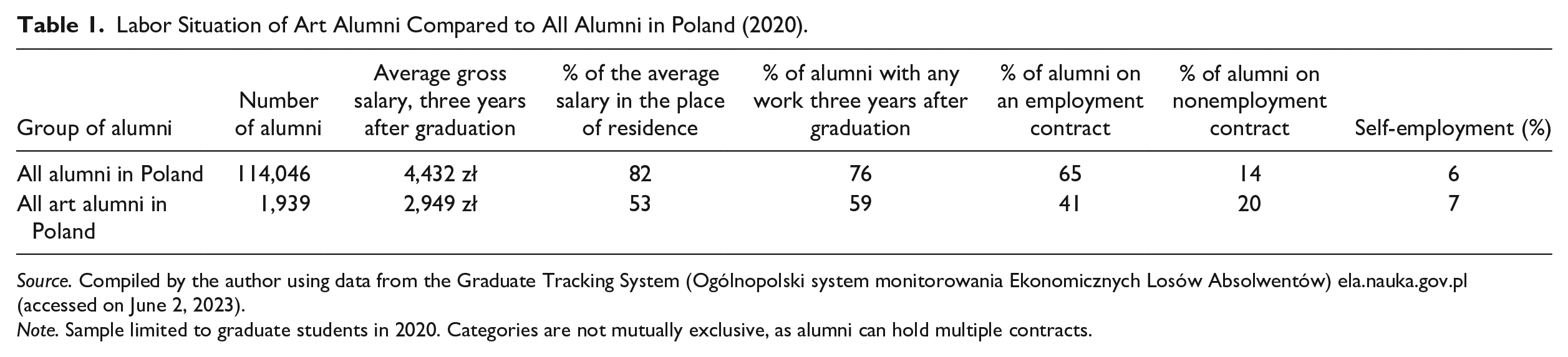
Source. Compiled by the author using data from the Graduate Tracking System (Ogólnopolski system monitorowania Ekonomicznych Losów Absolwentów) ela.nauka.gov.pl (accessed on June 2, 2023).
Note. Sample limited to graduate students in 2020. Categories are not mutually exclusive, as alumni can hold multiple contracts.
Despite the small art market, artists have their strongholds, especially the higher education system. Like many postcommunist societies, Poland is committed to free tertiary education on which the state spends 1.3 percent of gross domestic product—almost the double the EU average (Eurostat 2021). Other European countries also have free higher education but it tends to be more compatible with their labor market. In Poland, the coexistence of noncomplementary institutional logics has led to “patchwork capitalism” (Rapacki 2019) causing disparities between the overblown education system, which produces many university graduates and the labor market’s demand for lower skilled workers (Mrozowicki and Trappmann 2021).
Free art education is accompanied by merit and means-tested scholarships so that the barriers of entry are lower and the class gradient of artists is weaker to that discussed in the literature. Yet, 43 percent of art PhD students never complete their degrees (NIK 2015)—which might suggest the use of doctoral education as a survival zone. The article will show how an institutional affiliation—either as a student or as an employee—provides a buffer sheltering art aspirants from an extremely harsh market.
Data and Methods
The study’s methodology relies on mixed methods with the dominant role of qualitative material. Following U. Flick (2009), I use quantitative data to sketch the initial structure (Who wants to stay in the arts? Who thinks it is realistic to stay? What is their class gradient?) and qualitative data to understand processes (Why and how do artists stay in the arts?).
Quantitative Data
The target population included students and recent alumni of all nine academies that offer graduate visual art degrees in Poland. Students and alumni were asked to fill in an anonymous paper or online questionnaire distributed through student governments, college offices, lecturers, and art students’ social media groups. Respondents have been informed that the survey is carried out to determine the aspirations and experience of visual art students. A pilot study was run to make corrections and shorten the survey. Between May and September 2015, a total of 972 questionnaires were collected.
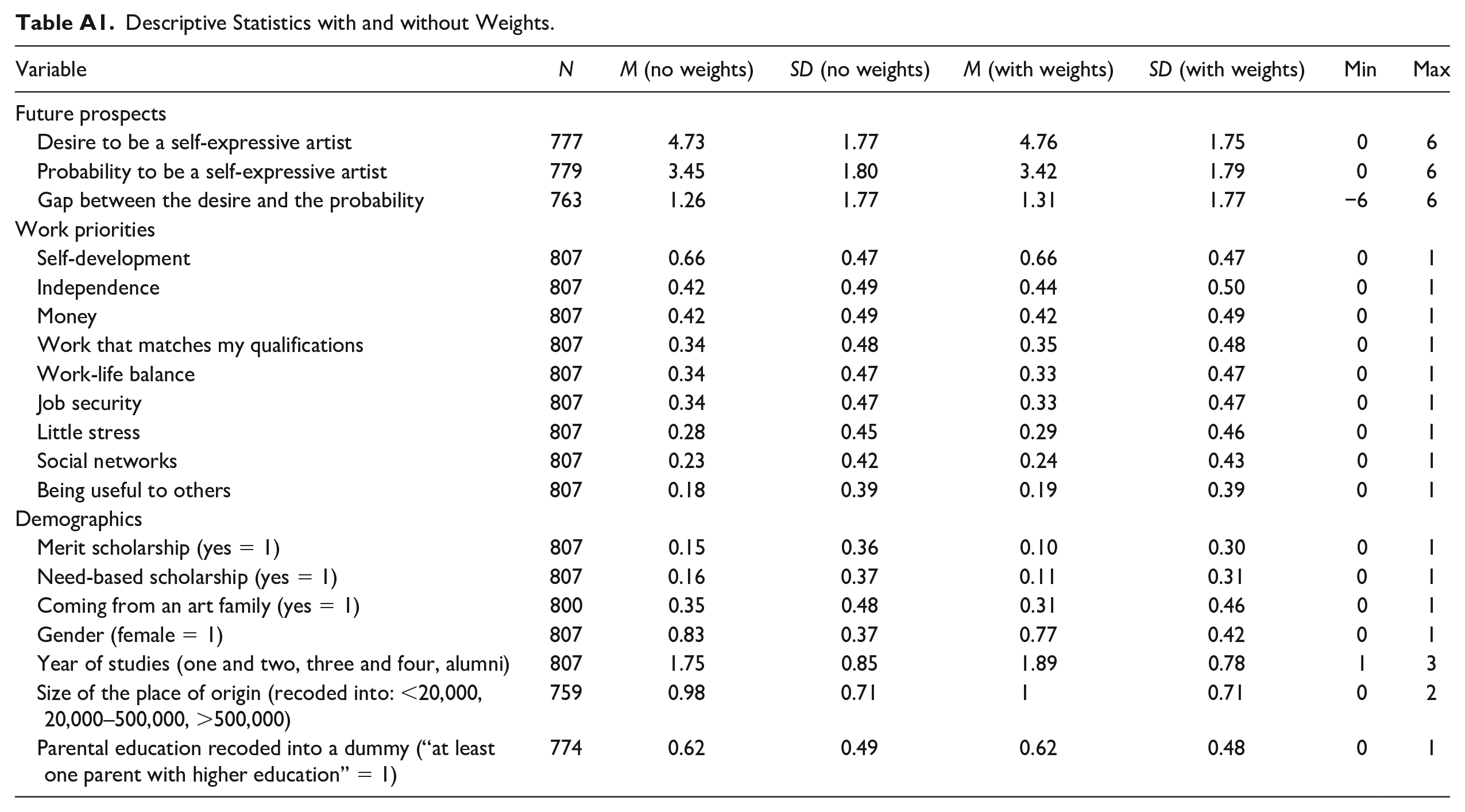
As a quality check, the sample was compared with administrative data obtained using legal methods. Freedom of information inquiries were sent to all targeted institutions—as in Poland publicly funded institutions are required to release information on legal demand. This provided a battery of demographic data on the student body that served to construct weights. The sample was slightly corrected by weighting it on four variables—gender, merit scholarship, means-tested scholarship, and the year of studies. Appendix A provides a list of variables and descriptive statistics run on unweighted and weighted dataset—numbers are very similar pointing to the representativeness of the sample.
Qualitative Data
Between 2015 and 2019, 45 in-depth, semistructured interviews were conducted with 32 interviewees in four cities. Sampling was based on four career stages:
Level 1: eight top players: visible artists, frequently covered by the press, professors of art (the emblematic case sampling: sampled because of their recruiting power on multiple fronts: academic, curating, coexhibiting, commissioning, recommending, sitting in awarding bodies etc.).
Level 2: eight midcareer players: young to midcareer artists (quota sampling)
Level 3: eight recent alumni (quota sampling)
Level 4: eight first-year art students (quota sampling)
As geographical location has been shown (Oakley et al. 2017; Pinheiro and Dowd 2009) to contribute to unequal labor market outcomes in the arts, I divided the cities into four income categories: high, medium-high, medium-low, and low. Diversity in seniority, city, and gender was assumed to translate into a diversity of coping strategies.
Longitudinal Sociography
I adopted a dynamic approach to studying transitional stage artists (Levels 2 and 3) in the expectation that their motivation and coping strategies would likely be influenced by career changes. Three years later, I returned to the interviewees from these stages: Level 2 included young to midcareer art workers with three to eight years of work experience, which is the timespan when most entrants leave the art market (Fraiberger et al. 2018). Level 3 included alumni who graduated within the past year from an art school and, as such, they embody the challenges of the school-to-work transition.
The interviews started with a narrative prompt inspired by biographical interviewing: “Could you tell me the story of your artistic life from your first artwork until today?” This vast, open-ended question served to elicit a spontaneous autobiographical narrative of the artist’s professional life with minimal imposition of language, content, structure, and prepackaged categories. It was inspired by the biographical method of F. Schütze (1977) and its classic opening question (“tell me the story of your life”), but it narrowed down its scope to “artistic life.”
All 45 interviews were recorded with permission of the interviewees, transcribed to over 1,000 standard pages, coded in MAXQDA, and analyzed inductively. All names used are pseudonyms and all identifying information is removed to protect informants’ privacy. Interviews were conducted in Polish to put respondents at ease. Translation happened only at the reporting stage (as recommended by B. Czarniawska (2004)), to postpone the moment when translation could affect the analysis.
Generalizability
The quantitative sample is representative for Poland’s aspiring artists in transition from art academies to the labor market so the findings can be generalized to the whole country and, with caveats, to Eastern European countries with a similar institutional set-up. The qualitative sample makes no claims to generalization to a larger population but to generalization about the nature of a process (Gobo 2004): the condition under which coping strategies exist as well as the interactions between institutional set-up and individual behavior.
Results
The Totem of Self-development Underwrites Precarious Art Market
Well, my development is the priority. (Marek, midcareer male, low-income city, 2015) You have to find time for your own art, as time runs out quickly. Another year has passed, people came and went. And you’re like: damn, what have I done? Where is my development? (Marek, midcareer male, low-income city, follow-up interview in 2018)
Visual artists work extreme hours in unstable conditions for little money. Why do they remain in a market that treats them so harshly? They are extraordinarily motivated. A survey showed that almost all respondents (98 percent) wanted some form of a career in the arts. To learn whether aspiring artists find this plan realistic, the survey asked them about desired and probable career prospects (Figure 1). The most desired option was being a self-expressive artist (average score 4.8 on a scale of 0–6) but it was considered much less probable (3.4). The gap between the desirability and probability of this option was the same for first-year students and recent alumni suggesting that art students are aware of the market difficulties right from the start—so they did not misjudge their chances as the miscalculated risk theory would have it.
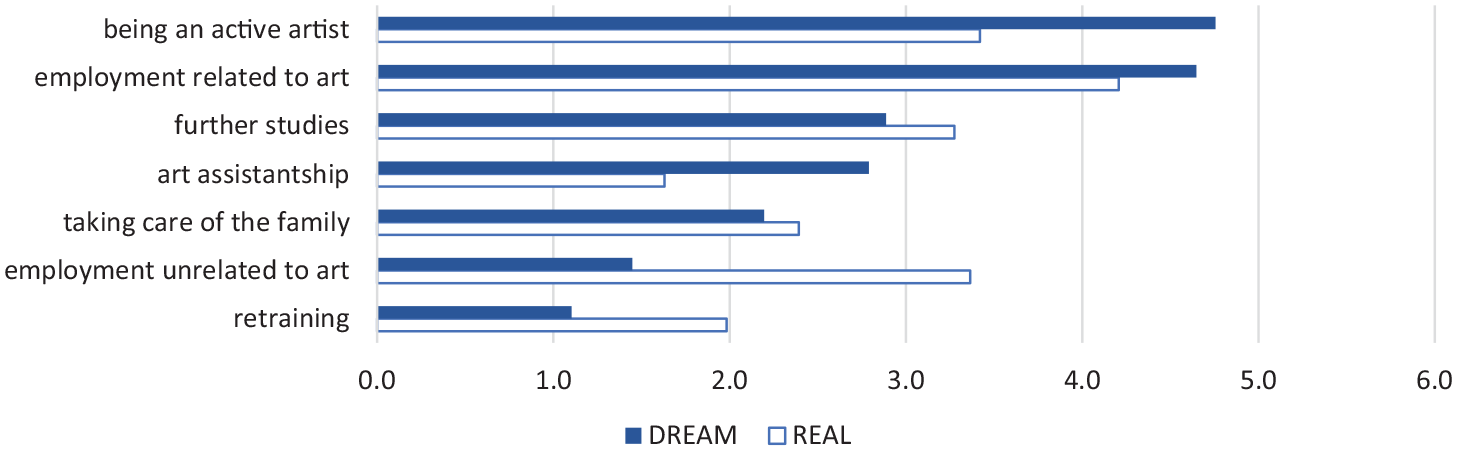
Being an artist is seen as attractive but improbable.
To learn what it is exactly that aspiring artists seek in their work, the survey asked them to pick their priorities from a list of 10 items (Figure 2). Self-development dominated all categories. It was the only goal chosen by most respondents (66 percent), with independence (42 percent) and a good salary (42 percent) coming next. In the interviews, self-development was presented as an alternative form of compensation, as explained by a midcareer female: “I often participate in unpaid projects and exhibitions, but it’s a win-win because I develop.”
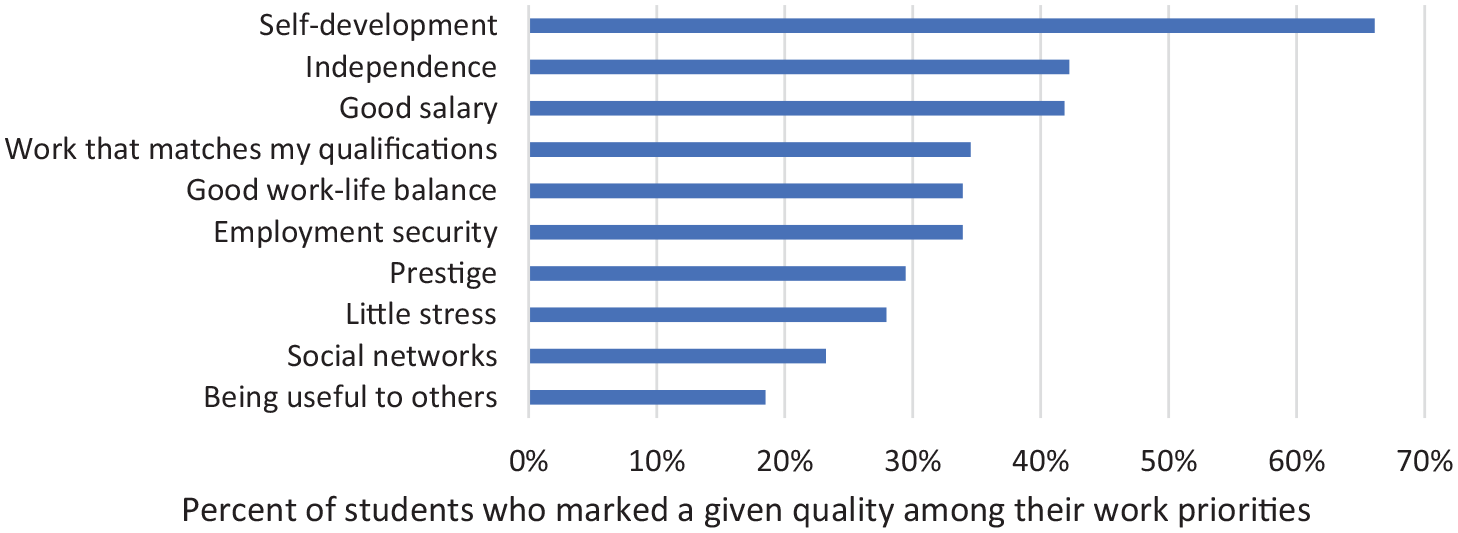
Aspiring artists want self-development, independence, and money.
To see how work priorities relate to future prospects, I run two ordered logistic regressions: on the self-assessed desire and the probability of working as a self-expressive artist (Table 2). Respondents who valued independence and didn’t value money expressed the highest desire to be self-expressive artists. Those who valued money, job security, and work-life balance assessed this scenario as the least realistic. Psychic income theory submitted that monetary and psychic incomes are equalized—so that more attractive work would compensate for monetary shortages. However, my results suggest that artists do not balance the two but, rather, might be subjected to a preselection bias: Those with stronger extrinsic motivation (salary, job stability) are less likely to deem an art career desirable and probable in the first place, when compared to those with more intrinsic motivation (independence).
Ordered Logistic Regression of the Desire and the Probability of Working as a Self-expressive Artist.
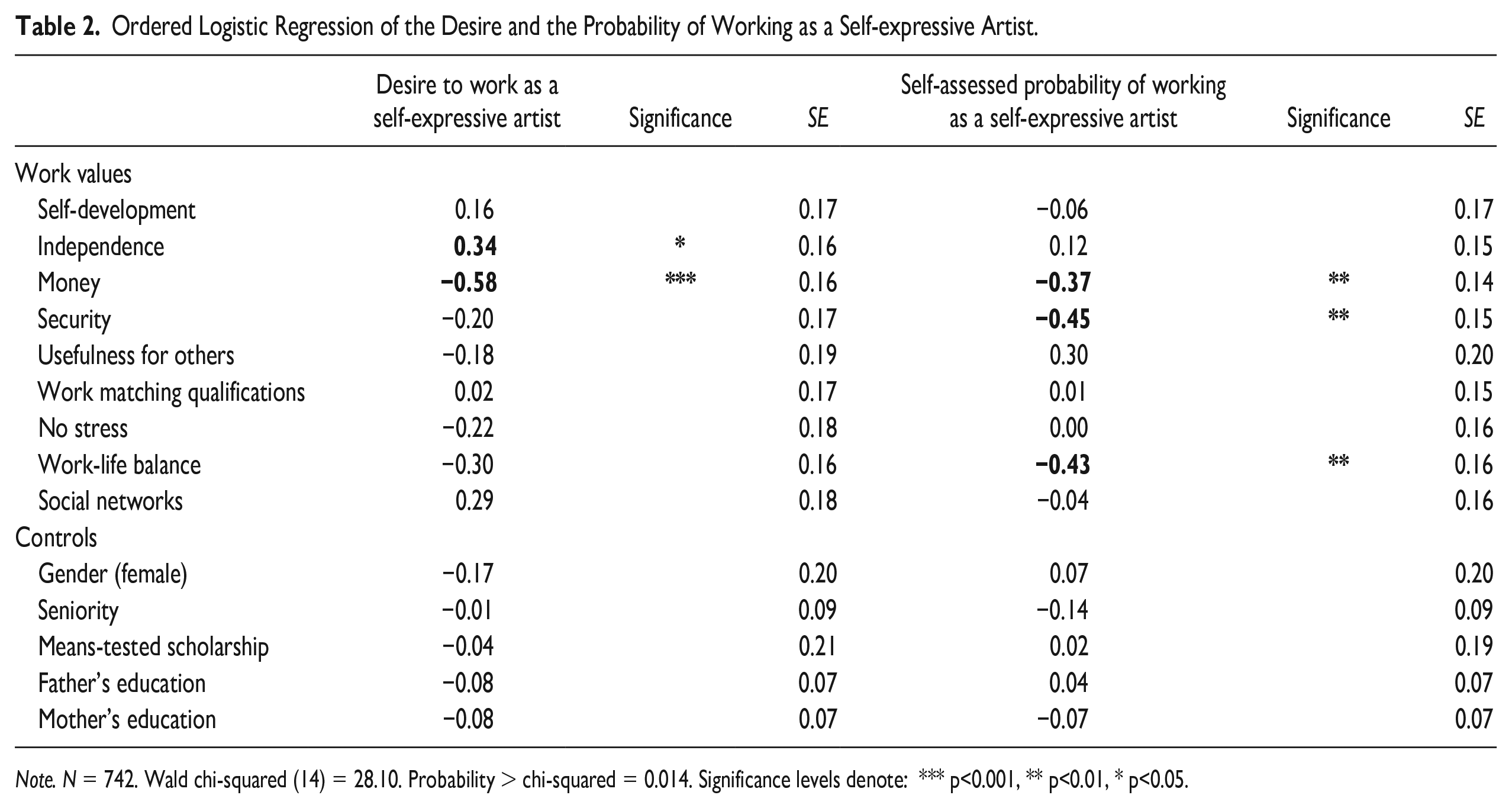
Note. N = 742. Wald chi-squared (14) = 28.10. Probability > chi-squared = 0.014. Significance levels denote: *** p<0.001, ** p<0.01, * p<0.05.
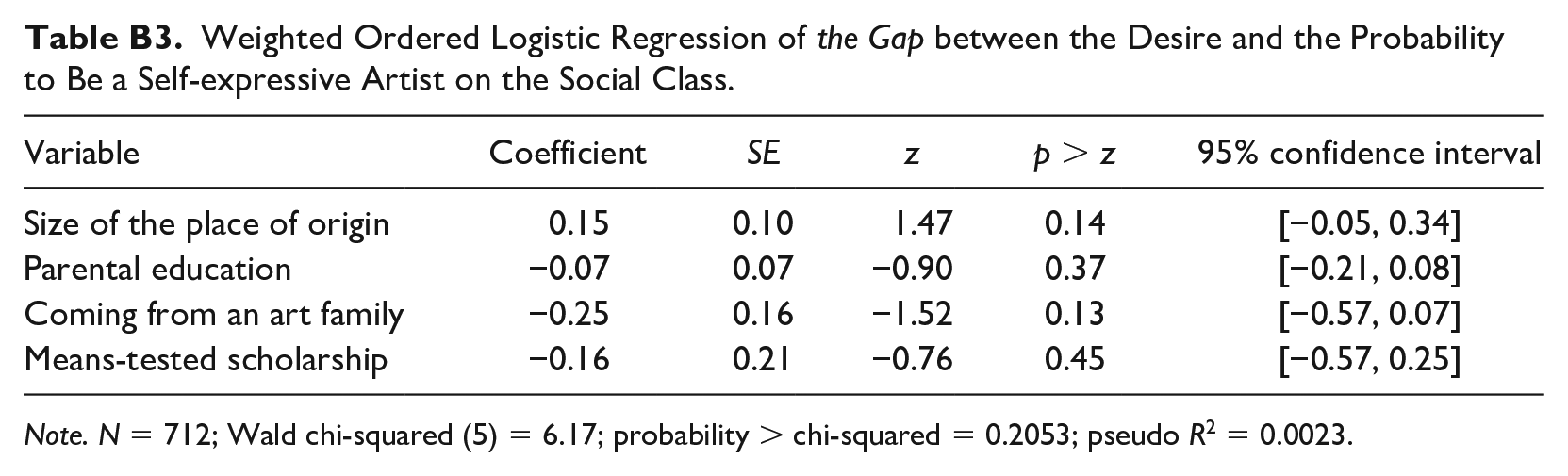
All models accounted for social class but those controls proved insignificant. To check whether the statistical power of class was subsumed under work priorities (e.g., upper-class artists disregarding money as the Bourdieusian “distance from necessity” would have it), I run additional models with social class only (Appendix B). I choose four proxies for the class of the family of origin—parental education, means-tested scholarship, having a professional artist in the family, and the size of the place of origin. I run them on three dependent variables: the desire, the probability, and the gap between the two. None of them was statistically significant. It is likely that in Poland social class exercises weaker influence on the average perception of future prospects than it does in the United Kingdom and the United States. However, as will be shown in the qualitative part, some aspects of social class play a role in the survival between art gigs.
Coping Strategies
Following artists over time allowed to identify main coping strategies that bridge the dissonance between the desire to be a self-expressive artist and a lack of market demand for this self-expression. Two strategies were personal: childlessness and overworking oneself to the limits. The remaining two relied on the institutional-level arrangements and, hence, are likely to be more influenced by Poland’s political economy of arts: diploma-hoarding and latching onto institutional pegs.
Overworking oneself to the limits was a strategy that bought time. It allowed postponing the moment of deciding between self-expressive arts, a stable income, and a private life. All interviewees functioned in four to eight realms—mixing education, nonmarket work, and market work. For everyone, self-expressive art was the leading goal. Such extreme multitasking led to self-declared weekly workloads of 60 to 80 hours.
The typical private life strategy was receiving gifts from family and friends, accepting instability, and postponement of life landmarks, most importantly parenthood. Childlessness was the case for 14 out of 16 transitional stage interviewees—overwhelmingly in their 30s, some in their 40s. In the survey (with most respondents aged 20–26), out of 922 aspiring artists who answered the question about parenthood, 97 percent said they were childless.
The two personal strategies are known from the literature—although their application is taken into extreme in Poland’s small art market. However, institutional-level strategies are not only quantitatively but also qualitatively different. They are linked to the political economy and, hence, are more pertinent to countries with similar institutional set-up to that of Poland.
The first was “diploma-hoarding,” enabled by free tertiary education with few limits on the years spent studying and the number of degrees one can earn free-of-charge. In the survey, 38 percent respondents said they studied for more than one degree. In the longitudinal qualitative sample (with informants aged 26–40), most interviewees had double or even triple diplomas—usually a mix of fine arts (painting, sculpture, traditional graphics) and more marketable arts (graphic design, industrial design)—and at some point were enrolled in PhD programs to get scholarships, as if the educational system provided a safety cushion to fall back on. Some had graduated with highest honors at their faculties but still found themselves in a precarious and low-paid equilibrium. For others, it could not be described as an equilibrium—they continued to incur debt and lagged many months behind on rent.
The key coping strategy was to find an institutional peg —a term I introduced to refer to stable, low-paid jobs at art institutions, such as at an art academy, gallery, museum, or other public organization. I call them “pegs,” as they allow individuals to gain a foothold in the art circuit and use its networking potential, while doing self-expressive art after hours. An institutional peg allowed the individual to acquire “institutionalized” art capital that could later be converted into other types of capital. Such a peg might be preferable to a profitable job external to the arts, because it enabled individuals to network, to build their own “gang,” and to stay in circulation. The next section will show the meaning of such “pegs” for individual biographies.
Institutional Peg as the Adaptation to Precarious Art Markets: Merging the Why and the How in Individual Biographies
This section gets granular in presenting coping strategies of artists whom I followed over three years. The section is narrated biographically to show how institutional pegs are intertwined along the life course with personal motivation to pursue self-expressive art at the micro level, networks at the mezzo-level, and institutional set-up at the macro level.
Institutional Peg Allows to Stay Faithful to the Leftist Values
My art is created for a reason and it isn’t for sale. (Maria, a midcareer female, medium-low-income city)
Maria avoids commercial work, which reflects her entrenched anticapitalistic values and unsavory experience with art markets. After graduating with a BA, she worked in commercial galleries in the United States. The pace of work led to burnout within a few months, while treating art like a product troubled her. Her next job was an assistantship to an internationally known artist working in New York. Yet, she “could not fully respect someone who tries to own you” and felt that she was sacrificing for somebody else’s art.
She returned to Poland. “Cold calling” got her interviews at cultural institutions that were impressed by her international experience. Yet, they offered conditions that led her to comment, “I didn’t realise that people agree to such things in Poland.” Such things included: unpaid contracts, contracts with pay fully conditional on the future income of the institution, “full availability” contracts below minimum wage, or contracts that paid prorated legal wage only because they were formally described as part-time even if they required systematic overtime.
Some arrangements were shrouded in the language of investing in the job before it paid off, leading her to think that people who agree to such conditions must “get money from parents or sponsors”—as was the case for some of her colleagues even well into their 40s. Hidden understaffing meant that with a three-fourth time contract she was subjected to systematic overtime, which left no time for the priority that prompted her return to Poland: the quest for artistic development. After two such experiences, she was determined to steer clear of such jobs.
At the time of the follow-up interview, Maria had succeeded in executing her values: She was a self-expressive artist who did not commercialize her art. This was possible thanks to an institutional peg at an art academy and an inherited flat that freed her from having to pay rent. With the institutional peg, she was able to spend some time teaching students and still have energy left for self-expressive art, described as follows: You do it, even if it doesn’t bring you money and even when it costs you money. It’s not a hobby. It’s everyday work, which is on your mind all the time, even if you are not doing it at the moment. You can’t leave it like any other job, you stay after hours. It accompanies you all the time and you can’t stop it.
In 2015, she said: “I’m lucky that I didn’t start a family, because I would not be where I am right now.” In 2018, she added: “I just know it from my own example. If you don’t work all the time, you won’t survive.”
Institutional Peg as a Networking Resource and Fallback Option during COVID-19
I don’t value money. What is most important is how and who you work with. (Anna, a midcareer female, high-income city)
For years, Anna has functioned in four parallel realms: self-expressive art, market commissions, and two institutional pegs (art assistantship and a PhD position at fine arts academy). These affiliations started yielding dividends already during her studies. In her first year, she obtained her first commission through her mentor approached by a client who trusted that he would choose the right subcontractor among his students. In her second year, she was offered subcontracting on a well-paid set design project. In her fourth year, she was preselected for a competition in which an influential artist was choosing future collaborators. This was a turning point that led to multiple friendly and professional collaborations: “At this point, my life opened up; later projects were well-paid, even if they were artistic.”
Another professor recommended her for a well-paid design job with a private company. During her employment there, a full-time institutional peg became available: An assistantship post opened up in the studio of her mentor, and she won the competition, which led to overlapping periods of full-time employment on top of her own artwork, fixed-term commissions, and doctoral art education.
For her, an institutional peg “offers no financial gain in any way. It’s a pure ethos. And a mission—cultivating ideas in which you believe.” Yet, at the academy, she had a full-time contract and received a regular salary. What she meant by “no financial gain” was its incompatibility with market prices. Still, this “nonfinancial” institutional peg meant new art opportunities accrued through networking: Her mentor kept coming up with new offers, including curating exhibitions or editing art books.
In late 2020, at the time of the last desk-research follow-up during the COVID-19 pandemic, Anna lost almost all commissions and the “nonfinancial” institutional peg remained her only source of regular income.
Institutional Peg Underwrites the Project of Self-development in a Country Where the Art Market “Doesn’t Exist”
Art market? It’s all-in wrestling, free market, Russian roulette (Marek, a midcareer male, low-income city)
For Marek, self-development is the ultimate goal—other “jobbies” only serve to enable it. Self-development is also a prerequisite for being good: “A good artist is someone who achieves self-fulfillment. Egoistic thinking is the correct thinking” when going in the direction of developing one’s passion. Yet, self-development is not just about the self. For Marek, it’s also crucial to offer students something more than a recycling of ideas.
An institutional peg at an art academy has been the only stable source of income in Marek’s 10-year career. He thinks that “everyone would like to stay at the academy, because, unfortunately, it’s what work looks like.” Yet, at some point, his income fell below the minimum wage. During the first months of his employment, his rent consumed three fourths of his salary.
When Marek was in his 30s, he heard from a gallery owner that he was “too old.” Age mattered, because it was deemed easier to promote “young and promising” artists as rising stars. He intentionally withdrew from the art market, as it contradicted his values and his character: I tried to show my work, put it into galleries, etc. It’s difficult and time-consuming. In today’s world, every contemporary artist must be a good marketer to get in. I’m not this type of person. I am not the type of person who is like “me, me, me” and “mine, mine, mine.” It’s ridiculous. So much of their [galleries’] sales are total rubbish.
He described the logic of the art sales in his town as a form of “Russian roulette”—randomness referred to the mismatch between the artistic value and the market value: “Some really good pictures sell for nothing, and some bad pictures sell for a decent buck.” For him, there is no such thing as an art market in Poland, because the country’s middle class is still under construction. Thus, it’s better to be truthful to one’s own art, values, and friends and live off of an institutional peg than to try to make it in a market that does not exist.
Losing an Institutional Peg Means Instability and “Ideologically Safe Potboilers”
I latch onto all paid commissions as long as I have the strength. (Grzegorz, alumnus, high-income city, follow-up interview three years after his graduation)
Grzegorz was involved in seven parallel workstreams: art creation, doctoral art education, exhibiting, an institutional peg, art sales, commissions, and a nonart job. Still, all streams of artwork did not equate to any form of stability, so Grzegorz fell back on a full-time job with systematic overtime in a restaurant, where he spent nine years. In the period 2015 to 2018, all this effort, motivated by financial, ideological, relational, and self-expressive reasons, totaled what he estimated as a weekly workload of 60 to 80 hours.
Toward the end of his studies, he got his first institutional peg: He was invited by an art professor to assist at the art academy, a task he initially performed for free and then for symbolic remuneration. The post was temporary and later, in an open contest, it was given to his colleague.
After losing an institutional peg, Grzegorz enrolled into doctoral art education—on which he could not spend more than six hours weekly, as it coexisted with a full-time job, commissions, and self-expressive art. Similar to most interviewees, his most fervent desire was to live off of self-expressive art. He showed his portfolio to galleries but was rejected on the grounds that it was too “ideologically engaged.” At the time of the follow-up interview in 2018, Grzegorz was planning to prepare an ideologically safer portfolio and to try again.
In 2020, at the time of the last desk-research follow-up, Grzegorz gave up his work in a restaurant, and his “ideologically safe” portfolio was accepted by the gallery whose art offer he had described two years earlier as “terrifying.”
Linking the Why and the How
The coping strategies of artists were intimately intertwined with their motivation behind pursing bad jobs (Figure 3). The quest for self-development—accompanied by core values of independence, authenticity, and anticommercialism in the condition of no market demand—led to overworking, portfolio employment, postponing the life-course landmarks, and, most importantly, the quest for institutional pegs. Despite the diversity of gender, city, and age, most of the 13 artists followed over three years demonstrated a mix of coping strategies intertwined with such pegs.
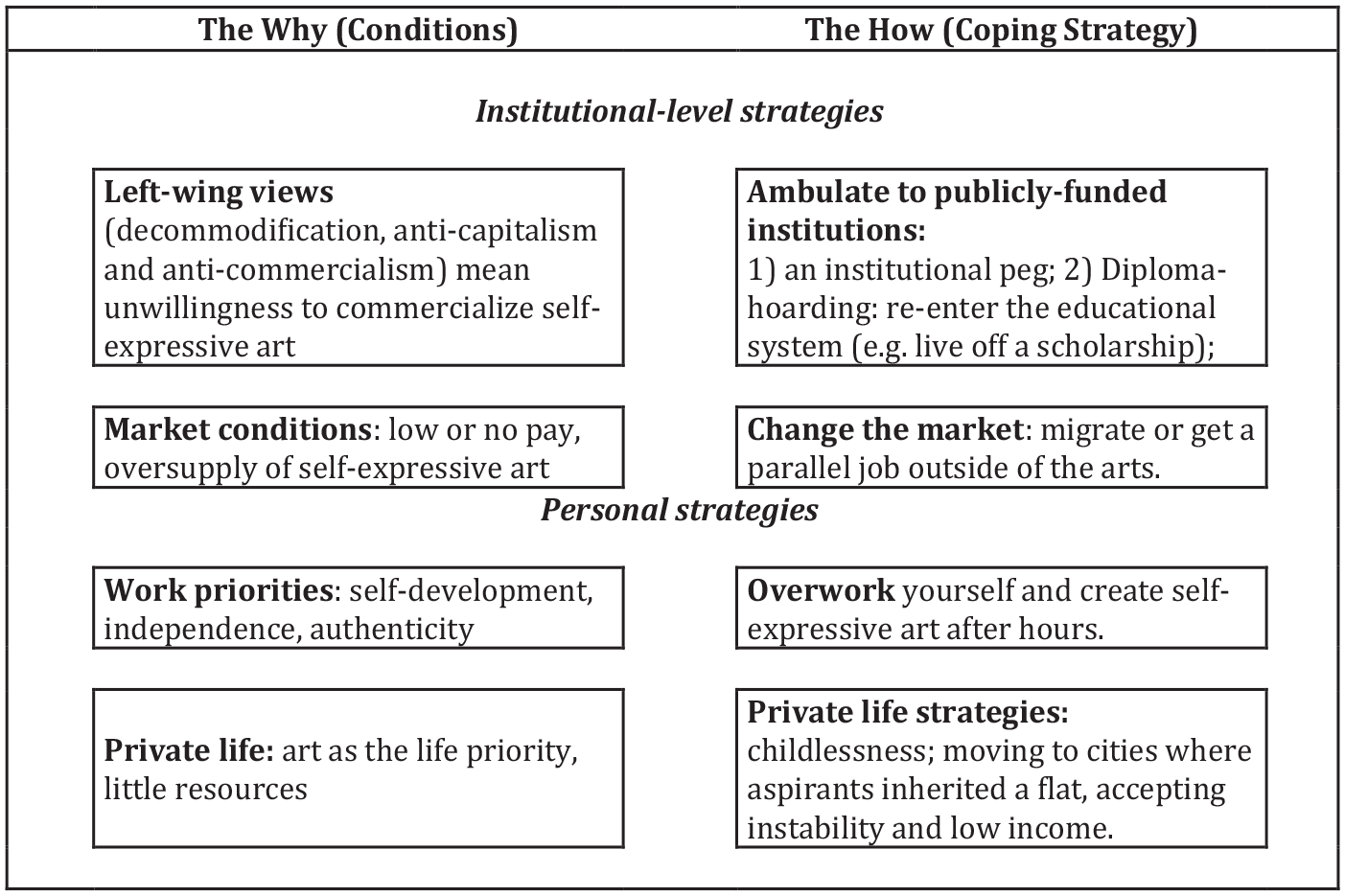
The why and the how—how motivation influences coping strategies.
At the micro level, institutional pegs allowed interviewees to stay faithful to their values: Artists took anticapitalistic stance against commercializing self-expressive art linked with disparagement of the popular taste. For them, catering to the market demand would mean not only succumbing to the commercial forces but also to the “terrifying” taste of the buyers. At the mezzo-level, institutional peg facilitated networking. This strategy, though, worked best in the capital city with many individuals and institutions to get connected to. An institutional peg didn’t have the same connecting power in smaller Szczecin or Łódź. By contrast to centrally funded art education with institutional pegs independent from local supply and demand curves, the market and networks were more location-specific. At the macro level, institutional peg sheltered artists from the precarious market of small size and no demand for a type of art that they wanted to create.
Discussion and Conclusion
Why Do Artists Stay in Markets That Grant Them No Economic Recognition?
Both quantitative and qualitative data featured the promise of self-development as a main form of psychic income. The narratives were dominated by the concept of the self as the ultimate goal—up to the point where a “good artist” was defined as someone who achieves self-fulfillment. Yet, psychic income theory submitted that monetary and psychic incomes are equalized—so that more attractive work would compensate for monetary shortages. My results suggest that artists do not balance the two but, rather, are subjected to a preselection bias: Those with stronger extrinsic motivation (money, job stability) are less likely to deem an art career desirable and probable in the first place, when compared to those with more intrinsic motivation (autonomy).
The “labor of love” argument—skilled and sustained activities to which people are irresistibly committed—found considerable support. Poland’s visual artists—like artists studied by Umney and Kretsos (2015) and H. Abbing (2002)—pointed to passion and vocation. Yet, in their research, passion for work legitimated precarity and the disruption of the life course. In this study, precarity and disruption were legitimated by the quest for self-development—a vision of who individuals could become thanks to art rather than simply by the love of art.
I found little support for the miscalculated risk and the commitment device theories. In both survey and interviews, aspiring artists were aware of scant market chances from the beginning of their studies. Also, not a single informant assumed that a bad day job would help them to stay faithful to the arts. On the contrary, informants shared a clear hierarchy of jobs: self-expressive art at the top, art “potboilers” in the middle (as they still require some artistic skills even if freedom of expression is limited by what the buyer wants), and nonart work at the bottom. Possibly, the difference stems from different country contexts: Adler’s U.S. sample was heavily skewed to upper-middle class informants who preferred ensuring time for art over maximizing money.
How Do Artists Stay in Markets That Grant Them No Economic Recognition?
Artists were motivated by the promise of self-development but their ability to pursue this totem was underwritten by a battery of coping strategies. A dissonance between the desire to create independent art and the realization that it is “dependent” art that sells was bridged by personal and institution-related strategies: an institutional peg; diploma-hoarding; overworking oneself to the limits; and adapting one’s private life.
Personal coping strategies were already described in the literature but took a different scale in Poland’s political economy of the arts. For example, Adler’s American interviewees, even if succumbed to the “the barista-by-day and painter-by-night” stereotype, held, on average, 3.3 jobs per person in their professional history. In my qualitative sample, interviewees juggled four or more workstreams at a time. Such arrangement led to weekly workloads of 60 to 80 hours. This sacrifice, however, was facilitated by factors that are likely to happen at early career stages—being healthy, childless, and financially supported by others. In my study, the postponement of the life-course landmarks continued well into participants’ 30s and even 40s embodying what Umney and Kretsos (2015) called “indefinite extension of transitional periods.”
It is possible that the overworking strategy was used more because the strategy of private resources—well established in the U.S.-/U.K.-dominated literature—was used less frequently. Although the arts are internationally skewed toward the upper-middle class, the scale of the bias seems to be smaller in Poland due to lower barriers of entry. Although a few interviewees in this study had an easier start due to inherited flats, 4 social class did not have major explanatory power for any of the two research questions. It is possible that social class would exercise stronger impact on the far end of the distribution (e.g., break-through to main galleries requiring heavy investment and networking) than on mere survival in the arts. It is also possible that social class acts primarily through networks—a topic worth exploring in further research.
Institutional-related strategies—diploma-hoarding and an institutional peg—were heavily embedded in Poland’s institutional set-up. Free higher education provided a safety cushion to fall back on and some aspirants reentered the system at critical life points to get affiliation and scholarships—the very opposite of what is assumed in the American literature where student debt impeded the survival on the art market (Frenette and Dowd 2020).
In turn, institutional pegs—stable, low-paid jobs at a publicly funded institutions—enabled individuals to gain a foothold in the art circuit. They absolved aspirants from disparaged “potboilers” and nonart work, while leaving enough time to pursue self-expressive art after hours. At the individual level, institutional pegs have underwritten the project of self-development without compromising left-wing values in a right-wing society. At the mezzo-level, they worked as a networking hub. At the macro level, they served as a shelter—regulating the oversupply of self-expressive artists and a lack of market demand for their self-expression.
Poland’s “institutional pegs” differed from bad jobs pursued by artists in the countries that dominated the literature. Typically, they were not treated too seriously—as if reflecting the communist-time proverb: “They pretend to pay us, we pretend to work” (pl. “Oni udają, że nam płacą, my udajemy, że pracujemy”). Most of the institutional pegs held by interviewees were contracted as full-time jobs. Yet, none of my informants treated them as such. To the contrary: Their value stemmed primarily from the possibility to treat them flippantly lest they crowd out time and energy saved for what respondents perceived as a higher good: self-expressive art.
I would argue that this is a small-scale illustration of a large-scale phenomenon of Poland’s institutional weakness. Some workers cling to “pegs” that can be treated unseriously because (1) the candidates lack real opportunities in the domains of their choice, and (2) the pegs at public institutions—due to the pay divergence between Poland’s public and the private sector—do not pay sufficiently and assume workers’ engagement elsewhere.
The offhand treatment of “pegs” is illustrated by doctoral education approached like a hobby—as measured by the self-declared workload of 5 to 10 hours weekly. This lack of commitment suggested the use of higher education as a survival zone from which the participants can venture into more valued territories of self-expressive art. This phenomenon can also help to explain what Poland’s Supreme Chamber of Control (NIK 2015) criticized as empty public investment in doctoral education—never completed by approximately a half of PhD students.
Poland diverges from the countries studied in the past and can enrich our understanding of how artists’ work preferences are shaped by an institutional triangle of the market, the state, and the education system. The country has neither art market with a mass of private buyers comparable to that of the United States nor a state spending on the arts comparable to that of France. Art institutions receive modest funding from either central or local government in the context of political pressure. However, the publicly funded education system creates a network of badly paid institutional pegs that most interviewees featured in case studies held at some point. Those who lost such pegs could still benefit from the system by reentering education, winning a scholarship, and weathering the economic storm under the institutional umbrella.
Footnotes
Appendix A
Descriptive Statistics with and without Weights.
| Variable | N | M (no weights) | SD (no weights) | M (with weights) | SD (with weights) | Min | Max |
|---|---|---|---|---|---|---|---|
| Future prospects | |||||||
| Desire to be a self-expressive artist | 777 | 4.73 | 1.77 | 4.76 | 1.75 | 0 | 6 |
| Probability to be a self-expressive artist | 779 | 3.45 | 1.80 | 3.42 | 1.79 | 0 | 6 |
| Gap between the desire and the probability | 763 | 1.26 | 1.77 | 1.31 | 1.77 | −6 | 6 |
| Work priorities | |||||||
| Self-development | 807 | 0.66 | 0.47 | 0.66 | 0.47 | 0 | 1 |
| Independence | 807 | 0.42 | 0.49 | 0.44 | 0.50 | 0 | 1 |
| Money | 807 | 0.42 | 0.49 | 0.42 | 0.49 | 0 | 1 |
| Work that matches my qualifications | 807 | 0.34 | 0.48 | 0.35 | 0.48 | 0 | 1 |
| Work-life balance | 807 | 0.34 | 0.47 | 0.33 | 0.47 | 0 | 1 |
| Job security | 807 | 0.34 | 0.47 | 0.33 | 0.47 | 0 | 1 |
| Little stress | 807 | 0.28 | 0.45 | 0.29 | 0.46 | 0 | 1 |
| Social networks | 807 | 0.23 | 0.42 | 0.24 | 0.43 | 0 | 1 |
| Being useful to others | 807 | 0.18 | 0.39 | 0.19 | 0.39 | 0 | 1 |
| Demographics | |||||||
| Merit scholarship (yes = 1) | 807 | 0.15 | 0.36 | 0.10 | 0.30 | 0 | 1 |
| Need-based scholarship (yes = 1) | 807 | 0.16 | 0.37 | 0.11 | 0.31 | 0 | 1 |
| Coming from an art family (yes = 1) | 800 | 0.35 | 0.48 | 0.31 | 0.46 | 0 | 1 |
| Gender (female = 1) | 807 | 0.83 | 0.37 | 0.77 | 0.42 | 0 | 1 |
| Year of studies (one and two, three and four, alumni) | 807 | 1.75 | 0.85 | 1.89 | 0.78 | 1 | 3 |
| Size of the place of origin (recoded into: <20,000, 20,000–500,000, >500,000) | 759 | 0.98 | 0.71 | 1 | 0.71 | 0 | 2 |
| Parental education recoded into a dummy (“at least one parent with higher education” = 1) | 774 | 0.62 | 0.49 | 0.62 | 0.48 | 0 | 1 |
Appendix B
Weighted Ordered Logistic Regression of the Gap between the Desire and the Probability to Be a Self-expressive Artist on the Social Class.
| Variable | Coefficient | SE | z | p > z | 95% confidence interval |
|---|---|---|---|---|---|
| Size of the place of origin | 0.15 | 0.10 | 1.47 | 0.14 | [−0.05, 0.34] |
| Parental education | −0.07 | 0.07 | −0.90 | 0.37 | [−0.21, 0.08] |
| Coming from an art family | −0.25 | 0.16 | −1.52 | 0.13 | [−0.57, 0.07] |
| Means-tested scholarship | −0.16 | 0.21 | −0.76 | 0.45 | [−0.57, 0.25] |
Note. N = 712; Wald chi-squared (5) = 6.17; probability > chi-squared = 0.2053; pseudo R2 = 0.0023.
Declaration of Conflicting Interests
The author(s) declared no potential conflicts of interest with respect to the research, authorship, and/or publication of this article.
Funding
The author(s) disclosed receipt of the following financial support for the research, authorship, and/or publication of this article: Research has been funded by the National Science Centre, Poland (grant no. 2017/27/N/HS6/03040) and the Katarzyna Kozyra Foundation (grant no. 05800/15 from the Ministry of Culture and National Heritage).