




Abstract
In recent decades, advocates have sought to combat stereotypes about sexual violence and victims. This effort included replacing the term “victim” with the term “survivor,” but researchers have little understanding of how people who have experienced violence understand these terms. Drawing on in-depth interviews of 30 young people marginalized by gender who have experienced sexual violence, I find that few strongly identified with either label. Respondents described victim and survivor in contrast with each other, creating two typologies of response post-violence that exist along a continuum. Respondents described “victim” as an all-encompassing label that communicated overall weakness and passivity. Most distanced themselves from the victim label and aspired to the survivor label. However, most did not identify as survivors. They described being a survivor as the result of a long process toward becoming strong, morally worthy people who had “moved on” and were ready to advocate for others. Respondents’ descriptions of survivors constitutes what I theorize as the “perfect survivor narrative,” a cultural script that made it difficult for most people in the sample to identify as a survivor, with implications for their racialized and gendered self-perceptions. The findings demonstrate the freedoms and constraints of using new language to combat dominant narratives.
Anti-violence advocates and violence scholars increasingly use the term “survivor” to describe someone who has experienced sexual violence. 1 Leading sexual violence organizations in the United States, such as Rape, Abuse, and Incest National Network (RAINN) and the National Sexual Violence Resource Center (NSVRC), overwhelmingly refer to those seeking help as “survivors,” not “victims.” The term survivor has also been used within the academic literature on sexual violence and is often used interchangeably with victim (e.g., Kennedy and Prock 2018). While the intention behind the adoption of the term “survivor” was to emphasize strength and counter the totalizing image of a “victim” (e.g., Barry 1979), others argued it could be alienating or reinforce an individualized outlook on violence (Dunn 2005; Mardorossian 2014; Stringer 2014). Although sociologists have begun to interrogate the cultural understanding of these terms in particular contexts (Boyle and Rogers 2020; Hockett and Saucier 2015; Miller 2018; Schwark and Bohner 2019; Sweet 2021; Williamson and Serna 2018), we lack a detailed understanding of how young people from diverse backgrounds who have experienced different forms of sexual violence understand these terms in relation to their social identities.
I ask: How do young people who have experienced sexual violence make sense of the survivor and victim labels and incorporate them into their identities? Through 30 in-depth, semi-structured interviews with college-educated people marginalized by gender, 2 I find that people who have experienced sexual violence have distinct understandings of both the survivor and the victim labels. They view the labels as opposites on a continuum, with victim describing a weak or broken person, and survivor describing a strong or healed person. I theorize the concept of the perfect survivor narrative, which frames an “ideal” survivor as one who has “moved on” to become a healed and morally worthy person. While few participants in this study embraced survivor or victim as core identities, they understood them to be important background labels that helped participants to understand themselves in relation to their experiences.
This paper revises an assumption in the literature regarding the survivor label: that it is an empowering term. In line with the literature, I show that people who have experienced sexual violence associate the victim label with weakness and view it as low status, whereas they associate the survivor label with strength and higher status (Boyle and Rogers 2020; Miller 2018; Philips 2000). However, the perfect survivor narrative outlines a perhaps unattainable standard for a future state: most felt that they had not yet, and may never be able to achieve, the morally worthy, healed survivor status. Like the “ideal victim” (Christie 1986), these constraints of the perfect survivor narrative impacted disclosure, help-seeking, and self-perceptions. Thus, I argue that feminist efforts to displace the negativity of the victim label have only partially been successful: creating a new term (survivor) may have displaced some stigma from the old (victim), but it ultimately created a new prescriptive stereotype with which people who have experienced sexual violence must contend, which was particularly challenging for participants who are LGBTQ (lesbian, gay, bisexual, transgender, and queer), Black, or the children of immigrants. Moreover, participants were hesitant to define themselves by the violence, regardless of the label. The example of survivor as a term created by social movement actors demonstrates the freedoms and constraints of adopting new language to address old problems.
Sexual Violence, Survivors, and Victims
Defining and Labeling Sexual Violence
People who have experienced sexual violence continue to face old stereotypes about sexual violence, even as our understanding of it has changed. For example, throughout early U.S. history, defining an incident as rape was generally dependent on a woman’s sexual passivity and purity, both of which were determined by a woman’s social status: her race, class, and adherence to expectations of womanhood (Freedman 2013). Despite some cultural changes (Hart 2019), in general, the most culturally legitimate type of victim is a cis White woman who physically resists an assault by a cis man, especially one of lower social status. This dominant image of victimhood excludes women of color, victimized people of other genders, and perpetrators of other genders (Harris and Linder 2017; Levine 2021). Social scientists refer to a theoretical victim who meets these requirements as the “ideal victim” (Christie 1986), and she is popularly referred to as the “perfect victim” (Dockterman 2022). Even after the MeToo movement (Hart 2023), this imagery continues to shape popular understandings of sexual violence: the ideal victim stereotype influences attribution of blame and credibility by both outsiders (Gravelin, Biernat, and Bucher 2019) and people who have experienced sexual violence (Peter-Hagene and Ullman 2018; Philips 2000).
The ideal victim stereotype shapes how those who experience violence describe their experiences. Researchers have identified “unacknowledged victims”: those who would be labeled victims in a behavioral survey but do not view themselves as victims or survivors and do not label the incident sexual assault (Koss, Gidycz, and Nadine Wisniewski 1987; Wilson and Miller 2016). If one’s experience deviates from the ideal victim narrative, one may believe it was not serious enough to constitute sexual assault, leading to low rates of disclosure and help-seeking (Littleton et al. 2006; Peterson and Muehlenhard 2004; Welsh et al. 2006). In short, legal, academic, and popular understandings of sexual violence may not align with how someone labels their own experience(s).
Theories about labeling and stigma provide insight into why one may avoid labeling an experience violence and oneself a victim. Victim is typically a non-visible characteristic, what Erving Goffman (1963) would term a stigmatized “blemish of character.” Because labeling is a key component of such stigmatization (Link et al. 1989), by not labeling, one might distance oneself from the stigmatized victim identity and some outcomes caused by stigmatization, including self-blame and shame, as well as blame and scrutiny from others (Kennedy and Prock 2018; Littleton, Breitkopf, and Berenson 2008). When labeling, one marks an experience as morally and socially unacceptable based on familiar stereotypes about sexual violence and people labeled as victims.
Experiencing sexual violence, and viewing oneself as a victim, can challenge one’s existing identities and self-conceptions. Sociologist Kathleen Barry (1979) argued that victimization becomes the defining aspect of a person who experiences sexual violence. Victims are often seen as weak and powerless (Kelly, Burton, and Regan 1996). Shamus R. Khan et al. (2018) find that students who had been sexually assaulted in college did not label it as sexual assault because to do so would interfere with their sense of self as strong, responsible, and successful people. Similarly, Lynn Philips (2000) argues that her participants avoided “victim” because they wanted to see themselves as “autonomous agents capable of transcending social constraints and exercising free will” (157). Yet, these studies do not examine both survivor and victim labels, overlooking the social movement context that led to the popularization of the term survivor in recent decades.
Victimhood and Survivorship
Victimization is often framed as an individualized issue. Feminist advocates of the 1970s and 1980s used the term “victim” to emphasize different types of sexual violence as collective experiences of common oppression, seeking to “raise consciousness” about multiple types of historically underrecognized violence (Kelly et al. 1996). In the 1990s, some scholars (e.g., Roiphe 1993) argued that feminists created a culture that encouraged women to see themselves as victims and perform victimhood (Stringer 2014). Carine M. Mardorossian (2014) argues that such criticisms of “victimhood” have permeated mainstream thought on sexual violence; instead of seeing social inequalities as the cause of victimhood, victimization is now an individual issue in which one becomes a victim due to some personal moral “failure” (Bumiller 1988), like weakness or promiscuity. As an individualized issue, victim becomes a stigmatized identity (Dunn 2005; Leisenring 2006) that many people avoid using (Bay-Cheng and Eliseo-Arras 2008).
In response to negative victim stereotypes and the debate over the extent and cause of sexual violence, some feminists use the term survivor to refer to people who have experienced sexual violence (Dunn 2005). Social movement actors use new language to influence the framing of the issues and identities central to social movement mobilization (Taylor and Whittier 1992). Advocates who adopted the term survivor argued that it rhetorically moves power back into the hands of those who experienced violence: rather than define someone based on another’s actions, they are defined by their resistance (Gavey 1999). Barry (1979) claimed “surviving is the other side of being a victim. It involves will, action, initiative” (38). Through popularizing “survivor,” people may more readily label their experiences, dispelling stigma and expanding anti-violence movements. “Survivor” may also underscore the seriousness of sexual violence: it can be deadly, requiring deliberate strategies for survival (Dunn 2005).
Yet, both feminist scholars and activists disagreed with each other; some argued that survivor was too intense, perhaps alienating those who did not feel the violence was harmful enough to warrant the term or had not heard the term in relation to sexual violence (Lamb 1999). In addition, avoiding the victim term may contribute to negative victim stereotypes and reinforce an individual, rather than a structural, explanation for sexual violence (Arielle 2016; Mardorossian 2014; Stringer 2014). Some activists (e.g., Arielle 2016) have warned that the term may create a new, unhelpful stereotype. The debate remains largely theoretical, with few studies examining how people make meaning of both labels in relation to their experiences with violence.
Research on both victim and survivor highlights how these labels carry cultural meaning that impacts how people view sexual violence. Framing women in studies as victims or survivors impacts how they are viewed by peers, with survivors viewed more positively than victims (Hockett and Saucier 2015; Schwark and Bohner 2019). Paige Sweet (2021) explains how women who experience domestic violence paradoxically perform survivorhood—which includes demonstrating recovery and worthiness—to gain access to key institutional resources designed to address consequences of violence. Research suggests these terms impact people who have experienced sexual violence, who generally prefer the survivor label (but see Williamson and Serna 2018). The women Susan L. Miller (2018) interviews and observes—all of whom had been in abusive relationships—did not view themselves unidimensionally as victims, which they associated with fragility and weakness. Many framed victim and survivor as opposites on a continuum, emphasizing their increased strength and resilience over time. Through their survey of 169 college students, Kaitlin Boyle and Kimberly Rogers (2020) found that survivor (25 percent) was a more common self-ascribed identity than victim (11 percent), and it was associated with more positive emotions. However, few students embraced only the victim or survivor identities: 44 percent identified as both and 20 as neither. Moreover, women of color experienced more intense emotional responses to the identities than White women; “victims” experienced more distress, and “survivors” experienced greater happiness. These differences may be due to cultural narratives of “strong” women of color that better align with survivor identification than victim identification (McGuffey 2013). Building on this literature, this paper examines how people make sense of the survivor and victim labels in relation to their identities, detailing implications for their disclosure and help-seeking.
In sum, as our legal and cultural understandings of sexual violence have changed, so has our understanding of who constitutes a victim. However, we continue to rely on ideal victim stereotypes when determining blame and sympathy, which in turn impacts how individuals respond post-violence. The narrow conceptualization of the ideal victim contributes to low rates of labeling sexual violence. Labeling the violence and viewing oneself as a victim challenges existing self-conceptions of strength and competence. Some feminist advocates sought a new term that would dispel negative victim stereotypes: survivor. Social scientists find that people who have experienced sexual violence generally prefer the survivor label, which is associated with more positive outcomes than the victim label. Sexual violence research typically focuses on one type of violence, like sexual assault or intimate partner violence, and focuses disproportionately on White, cisgender women victimized by cisgender men (Levine 2021). This focus limits our ability to understand the experience of sexual violence across different backgrounds and experiences. Moreover, how survivor and victim identities are shaped (or not) in relation to other social identities, such as race, gender, and sexuality, remains underexamined. How does a diverse sample of young, college-educated people who have experienced sexual violence make sense of the survivor and victim labels and incorporate them into their identities? Studying the victim and survivor labels will allow us to better understand the consequences of violence, as well as how new terms shape identities.
Methods
To understand how people make sense of these labels and identities post-violence, I conducted 30 in-depth interviews in person and over video call. I began with questions about their general background, easing into questions about sexual violence. This approach allowed me to establish a relationship with each participant while navigating a potentially re-traumatizing conversation (Weiss 1994). In addition, sharing that I have advocated for campus sexual violence policy and resource changes helped establish that I was a trustworthy interviewer—or at least not an adversarial one.
Participants
I used online and snowball recruitment to sample a diverse group of young, college-educated people (Weiss 1994). Because sexual violence has been framed as a gender issue, and researchers find that people marginalized by gender experience the highest rates of sexual violence (Mellins et al. 2017; Walter, Chen, and Breiding 2013), I only include their experiences in this analysis (see Note 2). I asked participants to share their race, gender, age, and sexual identities (see Table 1). The participants currently inhabit a similar socioeconomic position—they were all employed or attending college full time—yet their socioeconomic backgrounds varied.
Summary Characteristics of Interview Sample.
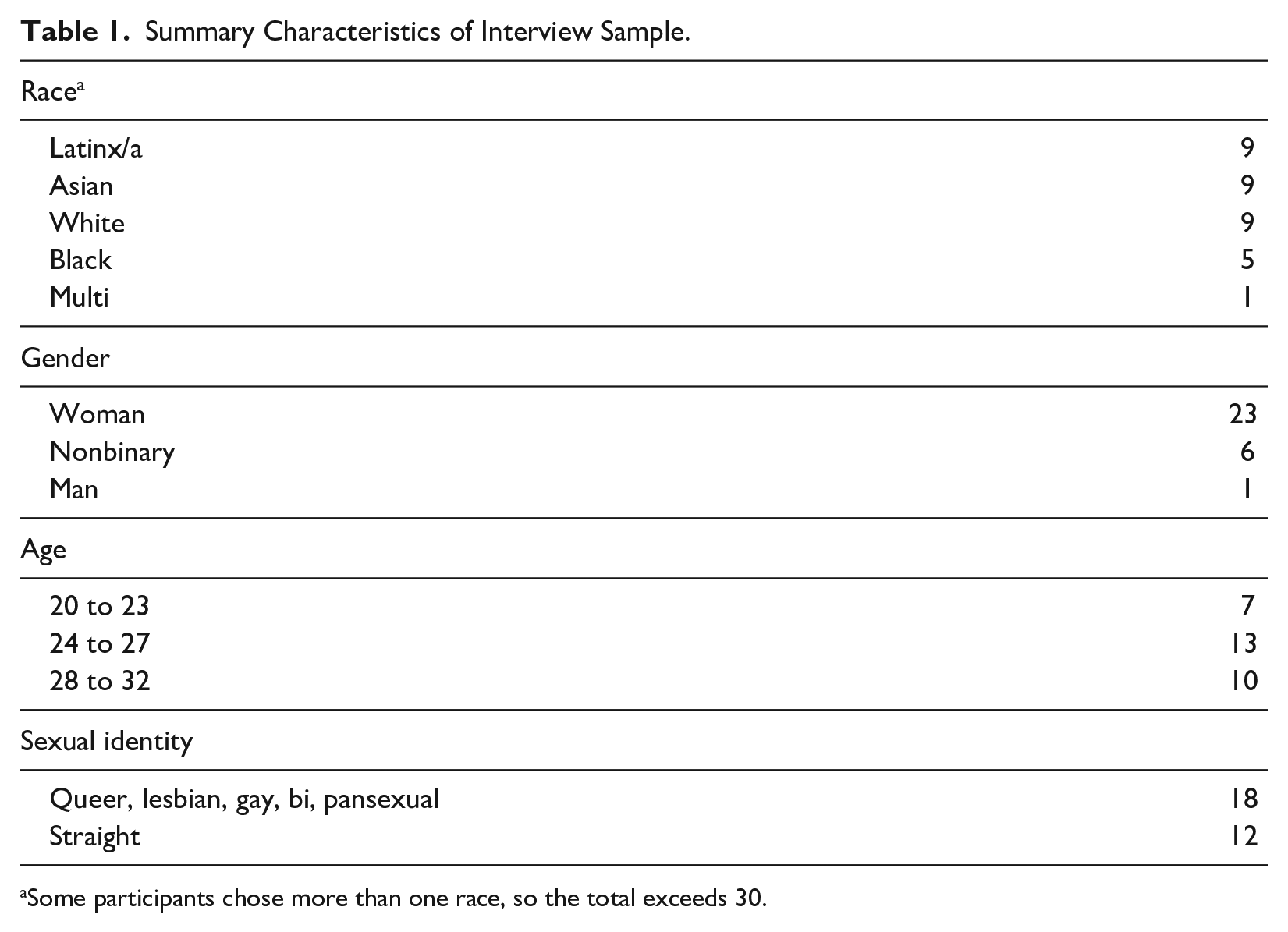
Some participants chose more than one race, so the total exceeds 30.
I recruited participants through listservs, social media posts, and snowball sampling, seeking “people who have experienced sexual violence.” I did not screen participants in advance, instead trusting them to determine that their experience(s) counted as sexual violence. They described the experiences in their own words, and I did not apply labels during the interview. Using behavioral definitions of sexual violence (see Note 1), almost all had experienced rape or sexual assault, and many experienced multiple types of violence. They all felt violated and uncomfortable immediately, yet some labeled their experience a form of sexual violence soon after the experience(s), and others processed the experience(s) over time. 3 Some still expressed discomfort using labels, like “rape” or “sexual abuse,” echoing patterns found in the “unacknowledged victims” literature. When the different types of violence were perpetrated by one person, participants discussed the types of violence together, rather than discussing each type of violence separately using legal or academic terms. Strangers, teachers, colleagues, friends, family members, and romantic partners perpetrated the violence. They experienced violence at different stages of their lives. Eight of the 30 participants reported to their university, the police, or both, while the rest did not report. 4 As is common (Eisenberg et al. 2021), few participants (6) sought out support groups or other sexual violence resources.
All participants were young adults between the ages of 20 and 34, with an average age of 26. The popularization of the term survivor is a relatively recent one, so I focused on those who would have had the most exposure to the term: people who had recently attended college. Some were undergraduates, some were graduate students, and others had graduated from college in the last few years. Most participants either lived or attended school in the San Francisco Bay Area, and all lived in urban or metropolitan areas. They attended four-year public and private universities where students typically lived on or near campus. Areas with large populations of college students have historically been the locus of anti-rape activism, and much feminist mobilization begins on college campuses (Bevacqua 2000:47; Dauber and Warner 2019). Interviewing young, college-educated people allowed me to explore understandings of survivor and victim among those likely to be most familiar with the terms and with anti-violence organizing.
I conducted the first 17 interviews in-person, and because of Covid-19, the final 13 were conducted over video call, primarily Zoom. I did not find thematic differences between the two types of interviews. Interviews were typically one hour long, but they ranged in length from 45 minutes to three hours. Interviewees were given a $30 Amazon gift card for their time, paid for with department-provided research funds.
Participant confidentiality and well-being are paramount, especially in studies of sexual violence. In addition to using Institutional Review Board (IRB)-approved protocols, I sought to create comfortable environments. Interviews were conducted in a private space of the participant’s choosing. Before the interview, I reminded participants that they could skip questions or take breaks. I kept their information confidential, storing information locally, securely, and temporarily (until transcription was complete). After each interview, I emailed the participant a list of local and national resources, including those dedicated to sexual violence and mental health.
The interviews focused on participants’ general background, experience with social movements, experience with violence, social support post-violence, and thoughts on the survivor and victim labels in relation to sexual violence (see Appendix). The data from this latter section are the backbone of this paper. Throughout the research process, I reflected on my own position as a White woman who was involved in anti-violence organizing, and I deliberately sought participants who were underrepresented in the literature. At first, my experience led to a focus on organized anti-violence efforts. As I conducted and analyzed interviews, I learned that anti-violence organizing had little direct influence on experiences, so I refined my interview guide to focus on emerging themes. I asked what each label meant to them, how they felt about each label, and how they incorporated them into their identities, if at all. How did they become aware of these labels? Have their feelings about the violence and labels changed over time? How have their feelings about themselves or any of their identities changed, if at all? I kept these questions open-ended and did not ask participants to compare the labels.
Analysis
As I conducted, transcribed, and analyzed interviews, I amended the protocol to streamline interviews and allow for a deeper analysis of emergent themes, centering participants’ voices (Timmermans and Tavory 2012). I sought a diverse sample to explore differences by race, gender, and sexual identity. I did not use leading questions or analyze the data with the aim of supporting a pre-selected theory (Weiss 1994). I stopped conducting interviews when I reached saturation, or when repeated interviews did not grant new insight into how people understood the survivor and victim labels. I used the qualitative coding software NVivo, taking an iterative approach to coding through increasingly specific analytical codes across rounds of coding (Weiss 1994).
Findings
Almost all participants (27) defined victim and survivor in contrast with each other, with victim defined as passive, and survivor as active. In other words, victim and survivor became dichotomous. Participants described a process in which one “moves on” from being a broken victim to being a healed and strong survivor. Their responses demonstrate the impact of the perfect survivor narrative, analogous to the perfect (or ideal) victim narrative. Because few felt they had “moved on,” only a few participants fully embraced the survivor identity, while most felt a sense of ambiguity. They hoped that someday they would feel strong and healed enough to become survivors, yet few felt they had achieved the morally worthy status of being a survivor, even those who had not experienced violence in years. Although having experienced sexual violence was a core part of their personal histories, participants rarely embraced either survivor or victim as identities. In addition to grappling with the victim to survivor process, participants marginalized by race, gender, and sexuality faced stereotypes that shaped how they thought about their social identities as well as their experiences with violence. Below, I demonstrate (1) the common view of a victim as powerless and broken, (2) the survivor identification process, (3) the constraints of the perfect survivor narrative, (4) the influence of the survivor as a background label, and (5) how survivor interacts with social identities.
The Passive Victim
Most participants viewed “victim” as passive, indicating overall weakness. They felt that the passivity associated with victimhood would reflect on their character, not just on some of their behavior during the violence. Yet, this association was not universal: although they still hoped to be survivors someday, three participants preferred the term victim because they appreciated the emphasis such a term placed on suffering caused by another person, and they did not think this term applied to their overall character. However, almost all participants tied the weakness of victimhood to one’s character. They did not remember where they first internalized this idea. Sam’s (they, White) 5 response was typical; they think of a victim as “someone who’s super like, helpless, like hopeless just like . . .in need of saving.” Not only did they did not see themselves as weak or helpless, but they also said it would be “kind of disempowering” if someone else were to call them a victim. Kelly (she/they, Asian) also viewed “victim” as disempowering, explaining that reflecting on her childhood experiences of sexual abuse made her feel “empowered from violence or feeling like I was victimized because of this violence.” In Kelly’s framing, victimhood is incongruous with empowerment.
Victimhood was also all-encompassing; identifying as a victim flattened their experiences, denying their complex realities and self-perceived strength. In other words, participants considered victim a sort of “master status” for those who experienced violence. Ben (he, Latinx) explained that being a victim means acting “almost like it’s dictating your life, you know?” He avoided viewing himself as a victim because he did not want his experiences with violence to control his life. Participants’ thoughts on the victim identity reflected those of Barry (1979)—that being a victim becomes the totality of one’s experience. Like those Khan et al. (2018) study, these participants distance themselves from the image of the weak, incompetent victim.
For those who took some time to label their experiences, the contradiction between how they viewed themselves and how they viewed victims created ambivalence over labeling the incident as sexual violence in the first place. Because they did not perceive themselves as passive or broken, they took time to label the incidents and describe themselves as victims or survivors. Carla (she, Latina) did not want to see herself as a victim, so she hesitated to label the sexual abuse she experienced as a child.
So I don’t—I didn’t feel like a victim. I also felt really attached to my—I don’t know, sense of resilience or like stubbornness. Like, this is absolutely not going to knock me down. I am not a victim, so I don’t know what you would call that. But so when I was introduced to the term survivor, I actually had an easier time accepting what had happened because I didn’t identify with victim.
Some, like Carla, preferred the term survivor because it did not evince weakness. While most participants could not recall when they first heard the term survivor in relation to sexual violence, Carla remembers learning it from a Planned Parenthood flier she saw on the bus. Seeing “survivor” provided her an opportunity to think beyond the one-dimensional victim image. Participants’ self-image and the cultural image of a victim were incompatible. This incompatibility impacted both labeling the incident sexual violence and referring to themselves as victims. Overall, participants described a victim as someone who was weak, passive, or stuck in the pain. Nobody associated being a victim with being powerful, although a few criticized the absence of that association.
Survivor Identification as a Process
If they remembered where they first learned the term survivor in relation to sexual violence, they referenced sexual violence resources: pamphlets, new student orientation, and support groups. Participants defined survivor in active terms, in contrast to their descriptions of victims. As I will show, they typically focused on how people respond after an assault. However, others focused on agency during the assault. Janet (she, White) was intoxicated at the time of the assault, which is a common reason people blame themselves (Peter-Hagene and Ullman 2018). Using the label survivor allowed her to balance both self-blame and agency: It makes it a little bit more difficult still for me to like be like, “I was a victim, and I had no role in this happening.” Whereas survivor, it’s like something that happened to me, and it doesn’t necessarily have to be entirely not [my] fault.
Janet’s understanding does not align with the feminist intent behind the term, yet she still found it empowering. While participants had different understandings of what type of agentic behavior defined survivor, almost all agreed that being a survivor involved agency, especially compared with being a victim.
Other participants, however, defined survivor based on how someone responds after the assault. Survivors had completed a healing process or otherwise had “moved on.” Abigail (she, Black) describes this process as being a victim and then becoming a survivor: Survivor in my mind means that you've come through something; like a victim is like you're still in it. So like survivors like . . . You came out the worst of it. And you came out of the storm.
Abigail describes becoming a survivor as a temporal process, like weathering a storm: being a victim is like being stuck in a storm, which eventually ends, leading to survivorship. Andrea (she, Black and Latina) takes this healing process a step further, “survivor is more about having gone through that process and having taken care of yourself. And like you’re at a point where you’re more . . . you’re stronger than ever.” For Andrea, being a survivor does not just mean moving on, but also becoming stronger and more morally worthy than she was before the violence.
Being a survivor was a completed state that did not simply reflect that people were literally surviving post-violence. Instead, it reflected the culmination of a healing process post-violence, with participants feeling like a victim in the initial stages. Participants struggled to describe the “storm,” as Abigail describes the process of becoming a survivor. It included anger, sadness, struggles with mental health, lost social ties, and/or career impacts. When Juliana (she, Latinx) felt like she was in “the thick of processing it,” she balked at being called a survivor, insisting she was a victim. Now that she has processed it, she only thinks of herself as a survivor in relation to the violence.
Some participants argued that survivor is an empowerment-focused political identity adopted when someone is “ready” to advocate for others. Here, the agency of survivor is tied to helping others. They still embrace a conceptualization of a survivor as someone who has “moved on,” but in this framing they moved toward helping others in addition to helping themselves. Sage (she, Black) says that while a victim encourages pity, a survivor “is somebody who wants to use their experience as a platform to move, like, advocacy stuff forward. To make meaning out of what happened to them.” Similarly, Janet (she, White) explains, “it’s sorta like taking ownership of this, and it sucked, but now I want to do something to make sure it doesn’t happen to other people.” When reflecting on her early adoption of the survivor identity, Abigail had a similar understanding, sharing that she had decided “I’m going to be active . . .I’m a survivor, I’m gonna help other people, make things better.” In short, this explanation focused on both a completed healing process and an other-oriented, political identity.
While some participants assured me that they had “moved on,” others described a less linear process. Kelly (she/they, Asian) took a few years to label their childhood sexual abuse, and they began describing themself as a survivor in college. They thought they were “someone who was super-duper empowered, and I’m not gonna let this affect me negatively. I’ve done all the processing, done all the healing. I’m good.” At the time, they talked about their sexual abuse experiences frequently and openly, describing themself publicly as a survivor. As they got older, they changed their mind. They told me they do not feel like a survivor today because “I still carry a lot of like anger and hatred.” Thus, they had not “moved on,” which was considered a crucial aspect of survivorship. Kelly felt anxious and uncertain about her movement away from viewing herself as strong and healed, which participants described as the ultimate end of the process of becoming a survivor. Kelly’s anxiety about no longer identifying as a survivor underlines the moral worthiness associated with the survivor label. Moreover, Kelly’s experience demonstrates that healing is not linear, and time since violence does not dictate how people relate to the survivor and victim labels.
The Prescriptive Stereotype of the Healed Survivor
Fourteen respondents preferred the term survivor, highlighting some empowering connotations, yet they still emphasized its limitations. These limitations were also reflected by the number of participants who did not embrace either label: nine primarily felt ambivalent about both labels, and four rejected them entirely. Participants described a perfect survivor narrative, which, like the perfect victim narrative described in the literature, created a limiting prescriptive stereotype about what a survivor should be. Like Kelly, some participants felt limited by the images of strength and healing they associated with being a survivor. So while “survivor” was defined as empowering overall, it did not displace the victim identity or create a clear path to avoid the stigmatization associated with experiencing sexual violence. Tracey (she, Latina) describes feeling constrained by being a survivor: I find like, survivor as limiting as like victims in a way . . . I just feel like that schema is really constraining. And so I just like don’t like people ascribing that identity to me, really, unless they're like very close with me.
As an activist who had publicly shared her story in the press, Tracey felt pressure to act as a strong survivor for others who needed help. As the psychological ramifications of trauma continued to impact her, so did the social pressure to be a strong survivor. Feeling like “inspiration porn,” she decided to set boundaries to “to break out of that mold of like, I don’t have to be in this identity forever.” While others felt empowered through describing themselves as survivors, Tracey and other participants who publicly shared their experiences with violence felt stronger after “moving past” the survivor label. Some referred to this as the next stage in a “victim, survivor, thriver” process.
Those who did not publicly share their experiences also struggled with the pressure to perform strength. Alex (they, White) said they prefer to be called a survivor, but immediately critiqued strength, which they associated with survivorship: I think generally people call you strong for being vulnerable and they respect what you're doing. But at the time I felt like people were calling me strong because they were like, “You're so able to be stoic and not evince the symptoms of being crazy and feeling horrible.”
For Alex, survivorship required strength and an outward appearance of normalcy. They were suffering after being sexually assaulted at a group event in high school, but they were praised by friends for immediately continuing life as normal, rather than “breaking down” like a stereotypical victim. Alex was proud of their outward display of strength, even though they were suffering. Acting as a strong survivor required that they not show others they were “feeling horrible” and in need of help.
Andrea (she, Black and Latina) also struggled with the pressure to perform strength, highlighting the intersectional nature of the victim and survivor labels: Especially being a Black woman, I think we’re already meant to be strong, or told to be strong and all these things, so to me, like, “I'm a survivor” is like: that's not really helping me get better, or feel better, or heal.
Andrea volunteered her concern with the intersectionality of being a survivor. Alluding to the “Black Superwoman” stereotype (McGuffey 2013), Andrea and other Black women expressed similar concerns with performing strength and passivity in relation to sexual violence. Reflecting on the survivor label, Andrea did not feel freed from a negative stereotype about victims of sexual violence but burdened with an existing one about Black women. Instead of feeling supported in a healing process, she felt like she had to perform strength for others.
The association between survivor and strength or empowerment led many to feel that they did not yet qualify as a survivor, even if they preferred that term. Sage (she, Black) describes this feeling of being in between categories: I’m in a middle ground where I think I still feel too much shame to feel like a survivor, but I don’t want to feel the weakness and fragility that comes with being a victim, either.
Although some participants did not see themselves as broken, they also did not see themselves as completely moved on. Sage did not think of herself as a survivor because she was not ready to move beyond the negative feelings of victimhood to advocate for others. Because participants defined victim and survivor in contrast to each other, they felt like they should be one or the other, and they were frustrated and tongue-tied when trying to articulate feelings that did not reflect this dichotomy. Some participants explicitly argued that they could be both at once, yet these participants still defined victim and survivor in contrast to each other. Participants viewed survivor and victim as opposites in terms of strength and agency, and they described a healing journey toward becoming a survivor.
The expectation to perform strong survivorship made some people uncomfortable disclosing their experiences, anticipating that others would expect them to be strong. For example, Melissa (she, Latina) described feeling like she should not tell her friends after she was sexually assaulted a second time. She explains, “I don’t feel strong enough to be a survivor.” She was still processing the first rape, and she “didn’t want to add to it in like my public life.” Similarly, Vanessa (she, Asian), did not tell her mother about her assault because her mother had undergone hardship: an abusive partner as well as struggles as an immigrant to the United States. As Vanessa explains, She’s very like, pull yourself up by the bootstraps. Because she is an immigrant, like the mentality that like, “Oh, I suffered when I moved here to this country, so. Like, what's the big deal? You know, I made it, I survived.”
Vanessa did not feel she had reached the level of strength she associated with survivorship, the “awareness and ability to come out stronger, even if it takes years after the fact, but to become a stronger person; to recognize your worth.” She anticipated her mother would have expected her to embody this strength as well. Because she did not feel like she had moved on, she did not tell her mother about her experience. Other participants who were the children of immigrants, like Vanessa, described similar pressure to be strong, capable people, which they tied to their parents’ experiences immigrating to the United States. These expectations informed participants’ understanding of a survivor as a morally worthy, strong person. While expectations to perform strength and achieve success were not exclusive to participants who were the children of immigrants, their responses show how the perfect survivor narrative can interact with other cultural narratives and expectations. The perfect survivor narrative shapes how people feel they should respond post-violence, impacting disclosure and help-seeking.
Although few participants felt “healed” enough to be a survivor, they did emphasize their recovery. Participants described themselves as “moved on,” “healed,” or “OK,” even if they did not think they were “healed” enough to call themselves survivors. They compared their current emotional and psychological state with a prior one, emphasizing improvement. This was true for Anna, who was sexually harassed a month before the interview, and Kelly, who was sexually abused over a decade before the interview. In other words, there was not a set amount of time, such as a few months or even years after an experience with violence, where people indicated they were struggling before they “moved on”; therefore, this healing narrative is not simply a reflection of a linear timeline of how people respond to trauma. Instead, this reassurance that they were OK was an effort to move away from the broken version of a victim without fully embracing the “healed” status of a survivor. They ultimately hoped to achieve that morally worthy “healed” status. Although Anna (she, Asian) experienced harassment within a month of our interview, she was frustrated that she was not healing faster. She felt like she was burdening her friends and partner, and she asked me when she was going to “get better.” Participants not only anticipated being “healed” from the violence, but they also actively tried to distance themselves from the socially undesirable image of a victim as broken, weak, or in need of help.
Survivor as a Background Label
While participants wanted to become survivors someday, only nine embraced being a survivor as a core part of their identities. These participants embraced the healing narrative without critique. Experiencing sexual violence was a key part of all participants’ personal histories, and it shaped how many participants thought about other identities, especially their gender identities. But most did not incorporate it into their sense of self as many did their gender, race, sexual identity, religion, and immigration status. Angela (she, Latina) explains why she “definitely” describes herself as a survivor, but feels uncomfortable defining herself that way: Because anything that is done to me without my consent, without me wanting it should definitely not define who I am as a person should definitely not—I mean, it does affect me. But that shouldn’t—I should not be defined by what happened to me by someone else.
Angela outlines an important reason most participants did not embrace “survivor” as one of their identities. She felt uncomfortable adopting an identity because of another person’s actions, while many other identities are based on ongoing actions or preferences.
Avni (she, Indian) felt similarly, explaining why she struggled to identify as a survivor: Yeah, like you’re a survivor. But that's not your identity. Like your identity is the things that you like to do with people, like, you like to be with. And your, your job. But not THAT; that's not your identity.
Like Angela, Avni frequently thought about her experience with violence, and it continued to distress her. For both women, their experiences with violence shaped their career choices, personal relationships, and mental and physical health. At least one of these consequences impacted each participant. But despite its relevance to their everyday lives, their experiences with violence did not become part of almost all participants’ core identities.
Most participants preferred survivor as a label or descriptor, but the term did not displace enough stigma to become something they openly embraced or make the experience one they wished to incorporate into their identities. Ben (he, Latinx) explains why he does not consider victim or survivor one of his identities: It always is there, if that makes sense. It is there even just as faint background noise in all the things that I do . . . I do think that it is always going to be there a little bit. And like, maybe it's like having the TV on in the background and it’s like almost muted, but you can kind of hear it still—like that’s kind of what it is.
Ben’s visual evocation helps describe participants’ response to the survivor label. While most eschewed the victim label, they felt more ambivalence toward the survivor label. It more accurately represented who they were—or who they wished to become—in relation to the violence, but they did not fully embrace it as an identity. Instead, it was a background reality that impacted their lives but did not define who they were as complex people. This reluctance to embrace survivor as an identity may also be due to feelings of anticipatory stigma, like how not labeling sexual violence may protect people from some consequences of stigma (Kennedy and Prock 2018).
Interactions with Social Identities
Although survivor and victim were background labels, experiencing violence shaped how some participants thought about their social identities. Some women felt more connected to their gender after experiencing violence. Olivia (she, White) explains that after she was assaulted, “being a woman became more important to me.” After her experience with sexual assault in high school, Olivia thought, “oh, I'm a woman now, like, I have this thing.” Other girls at her high school described sexual assault as common; it was not assault, but just how boys had “rough sex.” Because of this normalization of violence (Hlavka 2014), Olivia described her sexual assault as a “rite of passage” into womanhood and took some time to label the experience assault. Sexual violence reminded participants of their status as women, especially in relation to men. Melissa (she, Latina) explained that prior to her assault, she was “very expressive about makeup and stuff like that.” But after, she explains, “I was afraid to express, like anything feminine. I really didn’t want to call attention to men.” She cried as she described ongoing struggles with expressing her femininity, which she ties to vulnerability to violence. For Olivia and other cis women participants, this tie did not challenge their gender identities as it did for trans and non-binary participants.
LGBTQ participants struggled with stereotypes about victimization and gender and sexuality that cis, straight participants did not face, further complicating how they thought about violence, the survivor/victim labels, and their LGBTQ identity. Some LGBTQ participants struggled with the stereotype that they were “made” LGBTQ through sexual violence. For example, Alex’s dad asked if they were “doing it” (coming out as non-binary and queer) because of the assault. Alex (they, White) struggled with the role their traumatic experience played in their evolving gender identity (see Nordmarken 2023). While Alex knows they are not non-binary because of the sexual assault, the stereotype and response from their father left them with an “odd mix of emotions” that shaped how they thought about “expressing [their] femininity,” as well as their comfort labeling and help-seeking in the future. While the victim and survivor labels, as well as their limitations, were similar for participants across gender and sexuality, openly embracing the survivor or victim labels while being openly LGBTQ came with some additional complications.
Discussion and Conclusion
Although “survivor” increasingly replaces “victim” as a common way to refer to someone who has experienced sexual violence, scholars lack a detailed understanding of how young people who have experienced different forms of sexual violence (e.g., sexual assault, stalking, etc.) understand these terms and how they relate to their social identities. Through 30 interviews, I find that, like labeling sexual violence, describing oneself as a victim or survivor is far from automatic. While few strongly embraced survivor or victim as identities, they still considered them important background labels to describe key points in their personal histories. Most participants described themselves as stuck between two archetypes: the broken victim and the strong, morally worthy survivor (Arielle 2016). I introduce the concept of the perfect survivor narrative to complement the perfect (or ideal) victim narrative. The perfect victim narrative influences how people define and describe their sexual violence experiences (Littleton et al. 2006; Peterson and Muehlenhard 2004; Welsh et al. 2006). Similarly, the perfect survivor narrative shapes how people describe their experiences and their moral worthiness as “healed” survivors.
This paper builds on studies that find that victim is a stigmatized identity associated with weakness. Almost all participants adopted the common understanding of a victim as broken and weak. On the other hand, they considered a survivor a strong person. My research also provides an explanation for why most of Boyle and Roger’s (2020) survey participants use both or neither label: people find themselves stuck between two archetypes that do not adequately describe their relationship to sexual violence. Like Miller (2018), I find that participants identify survivor and victim as opposites on a continuum. This binary led to internal ambivalence, in which they distanced themselves from the broken image of victim, highlighting their resilience, yet they did not feel they had “moved on” enough to be a morally worthy survivor. This ambivalence made some participants uncomfortable seeking resources, like support groups, advertised to survivors. I did not find a linear healing timeline; participants felt like they had not “moved on” enough if they had just experienced the violence or if they had experienced it over a decade prior. As activists have argued (Arielle 2016), we can break down the victim/survivor binary and the mostly unattainable perfect survivor narrative. As a start, we can use language that centers people’s experiences, such as “people who have experienced sexual violence.”
In contrast to Miller (2018), I find that while describing oneself as a survivor can feel empowering, the perfect survivor narrative can act as a limiting, not a freeing, narrative. Encouraging “pathways to survivorship” (Miller 2018:173) may cement a perfect survivor archetype that people who have experienced sexual violence cannot attain. This may lead to feelings of inadequacy and shapes help-seeking and disclosure for those who do not feel they have achieved survivorship. Like Paige Sweet’s (2021) participants, the young people in this study felt they needed to ultimately perform strength and healing to qualify as survivors and become morally worthy—and in my study, few feel they have achieved this status. Sweet et al. (2021) focuses on the performance of domestic violence survivorhood in relation to state and therapeutic institutions, but few people in this study interacted with these institutions or anti-violence organizations. Instead, I underscore the complexity of participants’ relationship to themselves and their identities. The internalized perfect survivor narrative shaped how these participants viewed themselves and who they should become.
This paper also demonstrates how survivor and victim dichotomies map onto other dichotomies, such as strong vs. weak and man vs. woman. Those who experience violence distance themselves from the low-status, feminized characteristic of weakness (Conway, Pizzamiglio, and Mount 1996; Prentice and Carranza 2002), which they associate with victim. Instead, they aspired to the higher status, masculinized strength they associated with survivor. Some described questioning their gender as women and the perceived overlap with weakness. Another gendered characteristic shapes the survivor label: having a communal orientation (Burgess and Borgida 1999). A survivor was not just strong individually, they were strong on behalf of others. This conception of survivor balances strength and agency, which are characteristics women may be socially sanctioned for holding, with communal behaviors, which women are socially rewarded for holding. Thus, the perfect survivor narrative may allow people who have experienced sexual violence, especially cis women, to maintain a socially acceptable femininity.
Unlike much survivor and victim research (Boyle and Rogers 2020; Miller 2018; Philips 2000; Sweet 2021), this paper includes a diverse group of people by race, gender, sexual identity, and experiences with different forms of violence. Focusing on one group, or one type of violence (e.g., sexual assault or intimate partner violence, etc.), limits our ability to make claims about how people experience different types of violence, which typically co-occur, and in this sample, were not experienced as isolated events. I find that the perfect victim and survivor narratives are strong cultural images that impact college-educated people from diverse backgrounds and are not linked to only one type of violence.
While the commonality of the “broken victim” to “healed survivor” narratives was not patterned by race, gender, and sexual identity in this study, my findings suggest that certain social identities and experiences may impact how people think about becoming a survivor. Even as most participants felt pressure to preform strong survivorship, Black women’s experiences were uniquely shaped by the stereotype of the impervious and resilient “Black Superwoman” (McGuffey 2013) that other participants did not face. In addition, LGBTQ participants also faced some challenges to the survivor identification process that straight and cis participants did not face. Some participants struggled to label the violence, and themselves survivors and/or victims, when talking to other people, fearing others would think the violence “made” them LGBTQ. Participants whose parents were immigrants emphasized the expectation that they be strong, successful people, which heightened the pressure to become a survivor. In other words, describing themselves as survivors/victims of sexual violence complicated participants’ other, more strongly held, identities and self-conceptions.
Through interviewing a diverse group of young people, we see the power of the survivor and victim narratives across different backgrounds alongside nuanced implications for social identities. Future research may examine the role of other social characteristics, such as social class and age. As all participants had attended, or were currently attending, a four-year university in the United States, the themes I present may reflect cultural scripts learned in college. This study was designed to explore those who had attended college during recent campus sexual violence activism. Some participants first learned the survivor term through student activism or university-required anti-violence presentations. Future research could explore the role of college attendance and socioeconomic status in the definition and adoption of the survivor and victim labels and identities.
Some attempts to rename and reclaim identities in the past have been arguably successful. “Queer” used to be primarily used in a derogatory way, but efforts to reclaim it have led to its usage as an umbrella term that refers to multiple sexual and gender identities (see Miller, Verta, and Rupp 2016). Attempts to reclaim the feminist label were also arguably successful. While the use and (re)adoption of both terms were contentious, they helped expand the categories and draw attention to the issues. The adoption of “survivor” has similarly challenged the “perfect victim” dominant narrative it was created to change, but it also shows the limits of using new language to address old problems. It crystalized (or added a new) dimension: the perfect survivor narrative, the expectation that one should be a survivor who “moves on” by embodying strength and advocating for others. The expectation to perform strength impacts self-conceptions, help-seeking behaviors, and disclosure. While this new perfect survivor narrative may be considered an improvement on the old, it still creates a constraining image of how people should behave. We can challenge the idea that someone should “move on” from violence and perform strength. Moving forward, scholars and activists should use descriptive language, like “people who have experienced sexual violence,” instead of using the morally laden victim/survivor binary that ties one’s identity to their experience with violence.
Footnotes
Appendix. Interview Guide
As semi-structured interviews, every interview followed its own flow. However, the following questions were addressed, and I typically asked them as outlined.
Acknowledgements
Thank you to Matthew Clair, Shelley Correll, Amy Johnson, the 2020 ASA Panel on Violence and Victims, and members of Stanford’s Gender Workshop and Qualitative Methods Workshop for the generous feedback.
Declaration of Conflicting Interests
The author(s) declared no potential conflicts of interest with respect to the research, authorship, and/or publication of this article.
Funding
The author(s) disclosed receipt of the following financial support for the research, authorship, and/or publication of this article: Research funding was provided by the Stanford Sociology Department.