




Abstract
Unique high Andean ecosystems in South America as the “páramos” have been the object of conservation plans in the last decade. In Colombia, this spurred heated discussions when their conservation was promoted through the cartographic demarcation of their boundaries: what counts as “páramo” and what kind of activities should be allowed there have been highly contested topics. As part of a multisited ethnography that studies the case of páramos conservation with biologists, geographers, and campesinos in the Sumapaz region of Colombia, I argue that the analysis of boundaries is a crucial matter in the unfolding of conservation. By analyzing how boundaries are configured, coordinated, and contested in the conservation of páramos in Colombia, I advance an ontological approach to boundary-making as practices embedded in the concrete transformation of environmental worlds through the involvement of multiple agents such as humans, plants, and technologies.
Keywords
Maria is a biologist with a long experience about plants in the Colombian Andes. She researches páramos and its plants in Boyacá, a high mountain region in Colombia, located above 2,500 m/8,200 ft of altitude in one of the most populated high plateaus of the northern Andes in South America. Since the nineteenth century, páramos have been a cult-like object for a long-standing cohort of scientists studying the high Andean mountains: the diversity of plants, animals, and endemic species found there is abundant, no other “biodiversity hotspot” seems to evolve as faster as them (Madriñán, Cortés, and Richardson 2013).
Páramos are also relevant for the Colombian state that since the last part of the twentieth century until today has enacted a wide legislation that regulates their conservation, especially for their role in provisioning water in Colombia (Sarmiento and Zapata 2016). Among those, it was promulgated the “páramos demarcation” in 2011, the policy to conserve páramos by tracing their limits and protect them from the expansion of extractivism. However, as Paula Ungar (2021) argues, this policy brings a scheme of coercive and centralized conservation: First, because the state imposed a highly restrictive regime to human activities within the limits of páramos, being the prohibition of agriculture one of the most sensitives, and, second, because the conservation of páramos was rendered by the state as a technical matter to be addressed by particular forms of knowledge, especially those coming from the natural sciences.
This meant that the Colombian state required the support of other scientific practices to establish what counted as “páramo” for their conservation. The state alone could not carry out this task, so it required the association and practices of biologists setting boundaries regarding the kind of entities that constitute the páramos for conservation and also those of geographers involved in the use of geographic information systems (GIS) technologies to produce boundaries in maps. But simultaneously with the impulse of the new conservation policy, campesino 1 communities, inhabiting páramos all over the country, like in the Sumapaz region, felt threatened by a policy in which they did not take part. The possible consequences for these communities would be restrictions to their livelihoods based on activities part of what is generically known as agriculture. In the worst case, consequences could include the eviction of campesinos from their lands. That is why campesino communities in the Sumapaz region of Colombia have contested such boundaries through the organization of a movement that stands for a páramo with campesinos.
As part of a two-year multisited ethnography (Marcus 1995) with biologists, geographers, and campesinos in the Sumapaz region of Colombia, I argue in this paper that the study of boundary-making is central to getting a deeper understanding of how conservation unfolds in practice. Taking the case of páramos conservation in Colombia, I explore the intersections of science, conservation, and environmental politics that are relevant in current environmental sociology discussions. With that reflection, I also aim to offer insights to understand how STS and environmentalsociology can contribute in current efforts to research the hybrid character (Latour 1993; Whatmore 2002) of contemporary environmental problems.
Following the scholarship that takes boundaries in a broad sense as relational outcomes rather than aspects dictated by an a priori order of things (Barad 2007; Mol and Law 2005; Whatmore 2002), this paper analyzes how boundaries are configured, coordinated, and contested in the context of páramos conservation in Colombia. With this, I propose and advance empirically an ontological notion of boundaries that can be fruitful and relevant for the sociological inquiry interested in the multiplicity, porousness, and instability of the objects that constitute matters of concern (Latour 2004b) in diverse areas of contemporary environmental issues such as it happens in conservation.
For doing so, in the first section, I offer an analytical alternative beyond forms of environmental sociology analysis engaged with the boundary between “nature” and “society.” Then I examine how that alternative can be built from the literature on boundaries offered by sociology, political ecology, resource management, and science and technology studies. In the second section, I present the “assemblage-method” (Law 2004) that was necessary to design in order to analyze boundaries in the making of páramos conservation in Colombia. The third section contains the analysis of how the boundaries of conservation are configured by biologists, coordinated by geographers, and contested by campesino communities. Finally, the fourth section offers the conclusions of the paper and discusses how the study of boundaries is still an important tool for sociological analysis.
Opening the Boundaries of Environmental Sociology Analysis
The boundary that divides the domains of “nature” and “society” has been perhaps one of the most pervasive features of environmental sociology analysis. It presupposes that there is a universal nature to which diverse cultures/societies adapt: the former independent from society and the latter as constructed or created by humans. Analytically, it has been helpful for a variety of purposes; however, the assumptions behind such a division pose analytical and practical limitations to environmental action (Latour 2004a). Below, I consider those limitations following approaches that problematize transcendent notions of “nature” in conservation (Hinchliffe 2007; Lorimer 2015; Whatmore 2002).
The study of boundaries in conservation should be made in tandem with a reflection of the very boundaries underlying environmental sociological analysis. My purpose is not another attempt to overcome the nature-society divide, but to enable other forms of sociological analysis towards alternative engagements with conservation. Here I follow the calls in environmental sociology to forms of “post-constructivist” analysis, where taken-for-granted divides such as the one between “nature” and “society” are scrutinized as the result of relational processes rather than given domains that explain environmental matters (Escobar 2010).
The possibility of such a project has been paved by the scholarship in the intersections of sociology and anthropology. We know for a long time from Donna Haraway (1991) and Marilyn Strathern (1980) that the very divide between nature and society is not foundational among people like the Hagen in New Guinea and perhaps not even for us in the so-called “western world.” In fact, for Latour (1993), the divide constitutes the modern condition: the one that holds an absolute dichotomy between the order of society and the order of nature. This, following Latour, is a paradoxical condition only possible when rendered invisible both the mediation practices that produce hybrids of nature and culture and the purification practices that create the two distinct ontological zones. The incapacity of the moderns to sustain such a divide is what makes him declare that “we have never been modern.”
This coincides with works, which although differ in scope and reach, assert the importance of decentering “nature” or ceasing to take it as the universal and foundational domain to think about how we engage with the environment. For example, in the work of Philippe Descola (2013), the relationships between humans and nonhumans in different places around the world cannot be sustained in terms of two separated domains. This is just one way, according to Descola, which moderns have projected over other peoples to study their ways of living. A further step is taken by Eduardo Viveiros de Castro (1998), who in his case takes “Amerindian cosmologies” as the basis to interrogate “western” categories as the nature-society divide. In Amerindian perspectivism, different beings, including humans and nonhumans, can see in the same way but adopt different perspectives. These perspectives render each being and the world seen by them as different, allowing the possibility of a multinaturalism. With a similar starting point, Tim Ingold (2000) stresses that environments are constituted in life through the engagement between living beings, and not just in thought as the idea of “cultural construction of nature” suggests.
As these authors invite to reflect, the nature-society divide depends on intricate forms of purification and boundaries production that are exceeded in practice by diverse collectives of humans and nonhumans. The main limitation that this poses is the asymmetry that assumes this dualism as the only standard to judge and analyze environmental problems and topics. If there is a domain of nature left only to scientists and another of society exclusive to sociologists, then we fall into the divide and its politics of explanation (Latour 2000). Against this division and its disciplinary boundaries of explanation is that the following pages develop a “practical ontologies” (Jensen 2021) analysis to understand the ontological role of boundary-making. In that direction, now I explore how such an approach is situated in the intersections that study boundaries in sociology, political ecology, resource management, and STS.
The Social Formation of Boundaries
The study of boundaries in sociology has been a fruitful way to explore the social processes involved in the formation of identities (Lamont and Molnár 2002; Riesch 2010), class distinctions (Bourdieu and Passerson 1977), and professions (Goodwin 1994; Vallas 2001). This has spurred new elaborations which has helped to re-elaborate social identity and social representation theories, proving the potential that studying boundaries bring to theory building (Riesch 2010). In the research of professions, Charles Goodwin (1994) has offered one influential contribution. In his study of lawyers and archeologists, he suggests that professionals are engaged in building and maintaining an organized way of seeing and understanding events that are relevant to the interests of a particular social group. That constitutes in his words, a “professional vision.” In short, the literature on boundaries in sociology advances a notion of them as both an outcome of social relations and embedded in them. This means that interrogating boundaries points to the relational processes involved in a wide range of social phenomena where the contours of identities, objects, communities, and other entities are constantly in production and negotiation (Lamont and Molnár 2002).
In the case of environmental sociology, the concept of boundaries has been extended to analyze how environmental agencies negotiate their space of action in the “science-policy” interface by tracing “organizational boundaries” that ensure their position as institutions relevant for policy making (Huitema and Turnhout 2009). In relation to conservation plans, Sharon Bryan (2012) has shown that the implementation of “protected areas” involves exercises of boundary drawing between nature and society. However, following her argument, this boundary depends on the production of knowledge that necessarily requires decisions, commitments, and choices that ultimately dictate how the boundary is delineated. It is not surprising then that conservation boundaries are a frequent scenario of conflict, which makes relevant questions related to how boundaries assume certain characteristics, their mechanisms of maintenance, and their role in forming social groups (Lamont and Molnár 2002). The case of páramos conservation provides the scenario to examine the social relations through which boundaries are continuously shaped, negotiated, and contested.
Boundaries in Conservation and Natural Resource Management
But what kind of boundaries produce conservation and resource management? Why are they often a conflictive matter? The scholarship in political ecology that has analyzed conservation “as control” offers some directions for the study of boundaries in environmental sociology. In this tradition, the literature has raised the problems behind the role of conservation promoting the creation of “protected areas” through the material deployment of boundaries. In practice, that means the enclosure of a piece of land by means such as fences, barriers, walls, and forms of punishment to human-restricted activities (Büscher and Fletcher 2020). The purpose of those areas has been usually associated with efforts to promote “sustainability” or protect “the environment” or “nature.” What seems an apparently desirable and noble endeavor has been instead full of struggles and impositions over local communities, which has limited the very goals of conservation because of the conflicts it causes imposing models of “natural” landscapes by coercive means (Agrawal and Redford 2009; Neumann 1998; Robbins 2012; West 2016).
Consequently, political ecology stresses the “coercive character of territorialized environmental control” of conservation associated with the production and enforcement of boundaries (Robbins 2012). A form of control where diverse forms of violence, that, as Diana Bocarejo and Diana Ojeda (2016) have pointed out, are not unintended consequences but actions justified in the name of conservation. Similarly, Jonas Hein et al. (2020) and Anselmo Matusse (2019) show that conservation brings boundaries that, in the first case, allow the appropriation of land by the state and non-state actors replacing customary land tenure regimes and, in the second case, through the legislation of protected areas where indigenous knowledge and peoples are marginalized in the name of economic, scientific, and touristic values.
The relevance of this scholarship is that those practices that violently remove people from protected areas and erode their livelihoods are considered fundamental for the boundaries and jurisdictions necessary for the “successful” implementation of conservation plans. However, in the field of natural resource management, boundaries do not carry always negative consequences. In the influential work of Elinor Ostrom (1990), boundaries of resources are central to ensuring the successful management of a common pool resource. The effects of boundary-making as a principle for resource management have been permanently assessed. For example, Moeko Saito-Jensen and Casper Bruun Jensen (2010) highlight that boundaries are far from neutral, so the analysis of their success should be combined with the attention to how local actors engage to support or undermine policies in the process of inclusion and exclusion that boundaries bring. Recent works suggest as well that it is important to differentiate among kinds of boundaries, their limits, and ambiguities, so new frameworks are proposed to understand the circumstances where boundaries change and their role in resource management (Bluemling 2021). Central in this process is the role of discourses, legal tools, and scientific knowledge as constitutive of the boundaries that (re)make resources and the distribution of their harms and benefits (Furlong, Verdy, and Uribe-Albornoz 2021). In short, as Helene Ahlborg and Andrea Joslyn Nightingale (2021) suggest, boundaries allow particular socionatural relations with extraction and conservation practices that include and exclude some people as having the “right” knowledge for resource management.
Far from innocuous or imaginary, boundaries are material and consequential in the sense that they exclude, impose, and ultimately displace people to unfold conservation and resource management in practice. From these perspectives, boundaries depend on materials and are inscribed in the social worlds of people inhabiting near or within protected and resource areas. However, the case of páramos conservation in Colombia poses a situation where boundaries are resisted and rearranged. This in turn makes necessary a more practical understanding of boundaries and how they make objects and entities come into being.
Toward an Ontological Take on Boundaries: From Boundary Work to Boundary Projects
Literature on boundaries from STS has offered a broad understanding of their dynamism. Thomas F. Gieryn (1999), in his influential study of science controversies, analyzed that scientists are involved in “boundary-work” activities where they produce constantly a rhetorical boundary that distinguishes science and other forms of knowledge. Here boundaries work as tools to expulse rivals, distinguish science from other epistemic authorities, and protect the autonomy of scientists. In contrast, the literature on “boundary objects,” emphasizes an approach to boundaries as interfaces that facilitate coordination or collaboration across different social worlds towards a particular goal (Bowker and Leigh Star 1999; Star and Griesemer 1989). Whereas boundary work can be imagined as a task of tracing limits that usually exclude, boundary objects are situations where diverse actors and practices converge in a shared space for doing things together (Leigh Star 2010).
This literature on boundaries provides an appropriate entry point to study their variability, changeability, and volatility marked by the local contingencies where science and other objects are questioned. However, the focus of boundary work and boundary objects is not necessarily interested in how boundaries in practice produce worlds, leaving open the possibility to approach them ontologically to understand their role in how worlds are concretely made or transformed by the relations of multiple humans and more than human agents (Jensen 2021; Jensen et al. 2017).
The ontological sensitivity toward boundaries that I propose here follows other trajectories in STS, which can be traced back to the work of Donna Haraway (1988, 1991). For her, the figure of the “cyborg” challenges the boundaries that sustain dualisms and the tendency to explain hybrids in terms of divides, such as usually happens in environmental discussions (Ahlborg and Nightingale 2021). Her proposal of “situated knowledge” is an invitation to think objects and entities as “boundary projects,” which means that they do not preexist as such, but rather they are provisionally materialized in social interaction and are generative of meaning and new objects. This trajectory has been taken and pushed forwards by works like the one of Karen Barad (2007), for whom boundaries are central in her understanding of the ongoing material configurations and reconfigurations of the world. Following her argument, boundaries are not merely abstract delineations of phenomena, rather than that, it is through boundaries that specific determinacies and phenomena are simultaneously produced. This line of thought is the basis for the practical ontologies (Jensen 2021) notion of boundaries that I explore in this paper. This, I claim, is central to understanding how the objects and entities of environmental sociology analysis come into being through the production, maintenance, and dispute of boundaries that provide the sociomaterial conditions for environmental and conservation matters to emerge.
Raising this sensitivity toward boundaries makes me suggest that although they have been studied for a long time in sociology, political ecology, resource management, and STS, we still have pending the task of considering them from a “performative idiom” (Pickering 2019). From there, boundaries are instances to explore in practice the politics of “ontological constitution” (Woolgar and Lezaun 2013) that materialize entities and objects such as “species,” “protected areas,” “farms,” “maps” and political forms to act in relation to them. In the pages below, I examine the scope and possibilities of approaching boundaries in this way by taking the case of páramos conservation in Colombia and how boundaries are produced, coordinated, and contested.
Method: Doing Multisited Ethnography of Boundary-making
The conservation of páramos in Colombia, as perhaps any other conservation plan in areas inhabited by people, is a very contentious issue where no single site offers a privileged view of what is going on. The relations that define the present and future of páramos conservation are taking place at different sites, and that is where a multisited ethnography (Marcus 1995) was helpful to understand the unfolding of páramos conservation in practice. For this research, it took a two-year fieldwork during 2020 and 2021 following the practices of campesino communities inhabiting a páramo, biologists in charge of curating páramo plants, and geographers designing geographic models to demarcate the limits of the páramo. I conducted formal and informal interviews about how they put into practice the páramo. My analysis was based on 10 interview recordings and transcripts with biologists and geographers, a fieldwork journal where I kept my experience living with campesinos, joining to their meetings in the Sumapaz region, and my visit to an herbarium in Colombia. I consistently made a photographic record of my fieldwork as well, which resulted in more than 300 photographs that I organized in a library. These data made possible the juxtaposition and comparison across the multiplicity of practices that enable forms of action and intervention regarding the páramo. The actual analysis was driven by the data, which was facilitated by an open coding strategy where some topics became prominent, being for this paper the role of boundaries in the ontological politics of páramos conservation as I will develop in the next section.
Nevertheless, my research practice and methods understanding is more interested in the kind of politics that it enables rather than engaging in a politics of representation exclusively interested in the correspondence between “words” and “objects.” This means that I follow a performative understanding of methods as an assemblage that enacts relations that generate presence, manifest absence, and Otherness (Law 2004). Therefore, I take distance from formal and dominant accounts of methods usually found in textbooks and manuals that treat them as technical tools to “unveil” a given reality. My choice to engage with multisited ethnography comes more from its possibility of playing a political role in crafting modes to apprehend multiplicity, making visible realities that can be otherwise and the social worlds that I want to help make more real through the study of boundaries (Law, Ruppert, and Savage 2011).
Analysis
Producing Boundaries along with Plants
When one thinks about boundaries and conservation, probably maps are the first thing that comes to mind, but among biologists who have been working for years in páramos, boundaries do not necessarily mean making maps. In biology, páramos have been configured through scientific practices that involve close relationships with plants, from which a good amount of what is taken as páramo in their conservation policy comes from. The canonical definition of páramos locates them in a section of the Andean Mountain chain, and it is based on the altitudinal ranges of plant distribution, but most importantly, by defining “species” as the kind of entity that constitutes páramos. I learned this in a conversation with Maria, for whom in her practice as a biologist and director of a regional herbarium in Colombia, páramos must be conceived as ecosystems or as she explained to me: “as the interaction of organisms, species populations and their environment.” Her words were complemented by a paper journal that she read aloud to me: páramos are the extensive treeless areas that crown the mountain ranges above the Andean forests from the 3800 mts (12400 ft) of altitude, locally from the 3200 mts (10500 ft) . . . they are cold and humid, with sudden meteorological changes, they are almost always covered by fog.
As “treeless areas” are located between certain altitudes of the Andean Mountain range, a boundary takes an altitudinal form that makes the mountain amenable to be sliced into sections according to the distribution of plants, from which one should belong to the páramo. But “treeless” is not the most indicative attribute to establish the kind of entities that constitute the páramo. After closing the journal, Maria says: “As you ascend, vegetation become stubby because altitudinal conditions don’t allow trees to be taller. When you are touching the subparamo around 3,000 m then vegetation is a ‘dwarf’ vegetation so to speak.” Then she adds something remarkable: “páramos have specific conditions, they have generated unique species . . . That is why it is interesting to study them, because they are refuges where there are unique plants species and unique animal species.”
Maria’s account implies that species are important in the practices of biologists studying the páramos. Taking seriously their practices, it becomes more obvious that, to emerge as a “species,” a plant and its boundaries have to be a part of the “boundary project” (Haraway 1988) where they are reconfigured to be part of the practices of biology (Martínez Medina and Hernández-Manrique 2020). Following the process through which first the plant must be composed as a “sample” and then identified as a “species” illustrates how the practical production of boundaries, or boundary-making, is related to the ontological task of making and reconfiguring worlds. I analyze this process following biologists’ practices during the collection and identification of plant species to be curated in the herbarium collections.
During the collecting, usually, a branch is taken from the plant, and in the best scenario, it should have leaves, flowers, and fruits in good condition. However, after collecting thousands of samples, Maria knows that a branch with those characteristics is rarely found, so the sample is not an entity out there waiting to be found by passive biologists detached from their environments. Instead, it must be composed by putting together leaves, flowers, fruits, and branches from the same or different plants. In other words, the boundaries of the plant are rearranged, so it can become a sample.
By doing so, biologists know that the plant will change during the collecting practice. If these changes are too abrupt or made in an uncontrolled way, surely the plant will not meet the requirements to be part of the herbarium. The sample must keep a “plant-like” shape; otherwise, it will not be a proper object to be intervened in the herbarium. It cannot, however, remain completely as a plant; otherwise, it can easily decay on its way to the herbarium or bring uninvited fungi, microbes, plagues, or insects. So, when the branch is cut from the plant and as the flowers and fruits are taken, a biologist with a notebook writes down its color, the number of petals, the plants that were close of it, or if it had any traces of being eaten by any other organism. The notebooks will be as well stored in the herbarium for anyone that needs any detail of the plant before it was collected, it will be a material and temporal extension of it.
In its becoming “sample,” biologists sterilize the plant with alcohol to prevent it from being attacked by other organisms and then dry it to be stored in pressed newspaper. The new boundaries of the plant, now turned into a sample, are to be found in the notebook, the scattered leaves, flowers, and fruits, but as well in the sheets of newspaper that make possible the transportation of the sample. This needs to be a coordinated process (Mol 2002), because collecting practices change their objects as they move from one place to another (Mol and Law 1994): the plant in the form of scattered parts is not the same as the one in written form of the notebook; each one affords multiple forms of action with the plant later on. The interesting is that both can hang together once the very collecting practices enable the possibility of controlling how the boundaries of the plant are ontologically rearranged to count as a sample.
These boundaries facilitate curating plants in the herbarium, where many practices are involved to produce a new collection item from one plant sample. Among those practices, one of the most taken for granted during the identification of plants is observation. After all, it seems as if observing plants only consists of indicating attributes that biologists carefully unveil to the naked eye. But in the same manner as it happened with producing samples from plants, observation is not a straightforward or self-evident practice. It needs to be organized and accomplished by assembling and performing a “vision.” Through this vision, boundary-making practices reconfigure the ontology of the plant as a sample. Then, it can be expanded to reconfigure its ontology as a species: the kind of entity that establish the basic unit for practical conservation (Lorimer 2015) and that set the first “ontological cut” to perform a páramo amenable for the conservation plans.
A diversity of materials participate with biologists in the assembling of this vision; some of the most prominent are the optical instruments. With them, Maria and other colleagues like Pedro spend vast amounts of time when they need to identify a particular sample. Deciding a species name is a delicate task and Pedro usually needs the help of the microscope for that. For doing so, he needs a whole leave and some branches of the sample. Carefully, he takes them from it with a pair of fine-tipped tweezers. Then he puts them on a small recipient with a few drops of water, so the leaves and branch open a bit. Afterward, he takes them onto a glass slide, so it can be mounted on the stage, a platform in the microscope to place the slides. It is a fortunate name that one of “stage,” for it must be prepared to make possible all observations: it is part of the action. A non-properly adjusted stage will result in blurry images, making useless the sample for the task of identifying species. While mounting the slide with the sample on the microscope stage, Pedro observes, through the eyepiece, his hands keep moving, so he cleans the slide and separates each part to make easier the observation. If he was able to perform this task, it was because his eyes and hands with the tweezers were participating in the observation in a particular manner. Once he is done with the result, he invites me to see through the eyepiece:
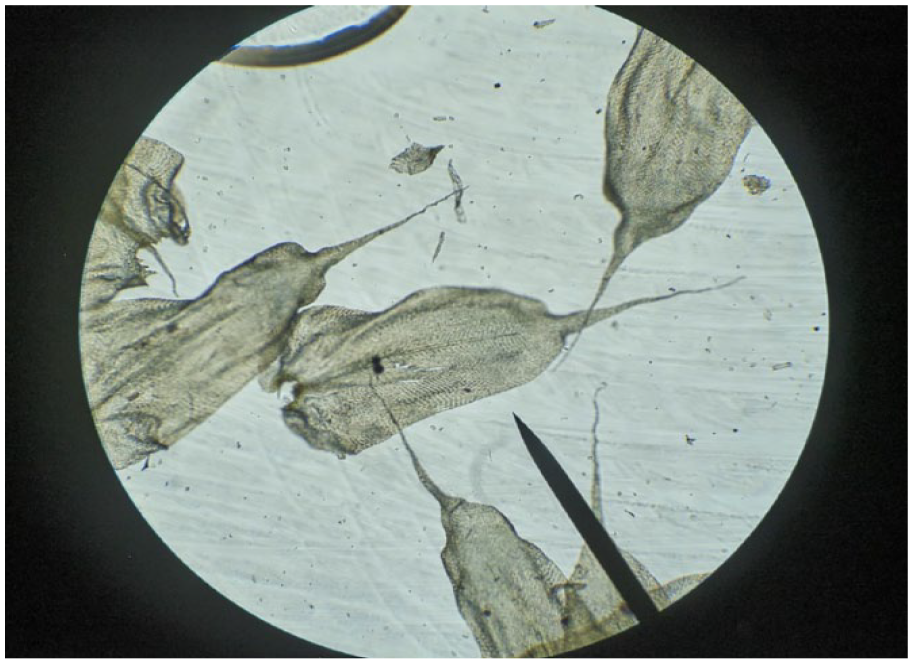
Some bryophytes leaves under the microscope. (Photo by author).
It is exciting to see through the microscope when one seldom uses them. Nevertheless, these sophisticated instruments are not in the herbarium just for the sake of contemplation, so I ask Pedro what they do when they do use the microscope. He invites me to look again, but it must be himself who guides my sight to what is relevant here for curating plants. The small sections, says Pedro, are the cells and with them comes a large amount of information to differentiate between species like, for example, their shape, size, distance between each other, and more. In addition, the leaf’s shape and the form of its margins can be also an indicator of the species. At that point, I realized that cells, margins, shape, species, and so on were boundaries of practice produced with the help of plants, microscopes, taxonomic keys, and more to allow the ordering work and vision involved in curating plants (Haraway 1988; Latour 2000; Law 2008). These boundaries are crucial for biologists like Pedro to reconfigure the ontology of plants, so they can engage with a vision that is consistent with both the practices that configure the páramo as composed by species and the boundary-making practices that sustain this possibility such as the collecting and the identification of species.
But what is the importance of this take on vision? How does it contribute to the study of boundaries in the environmental sociology of conservation? First, vision contributes to situating the identification of plants as part of the practices where humans and more than human agents arrange “species” as one of the boundary projects that configures the páramo in the practices of biologists. Second, this boundary project sustains an ontology of “species” (Lorimer 2015:67–69) that brings a particular politics of what forms of action and intervention are privileged in the conservation of the Andean páramos. The question of how that happens implies navigating across other practices and their boundaries that changed the ontological configuration of the páramo as a “bounded entity.”
Drawing Things Apart: How to Produce and Coordinate “Boundedness”
Despite the abundant research on páramos in Colombia, the purpose of making maps of them was not the priority a decade ago. As I showed in the previous section, for biologists, it is enough the boundaries in terms of altitudinal ranges and species that they produce to engage with the páramos in order to curate plants in the herbarium collections. However, that kinds of boundaries are not automatically usable for cartographic practices involved in producing boundaries in a map. As mentioned in the introduction, the “páramos demarcation” policy required a clear-cut configuration of them in terms of their geographical limits. This made relevant for the policy the role of geographers experienced with GIS to make maps. The task was not straightforward though, for it required the coordination (Mol 2002) of different ways of making the páramos, so a “bounded” one could come out of it.
As others in STS have suggested (Bloomfield and Vurdubakis 2005; Brown and Middleton 2005; Mol and Law 2005; Turnbull 2005), “boundedness” should be better understood as an outcome of all the entities, objects, formalisms, practices, and so on involved in the production of boundaries. No pre-given order of things dictates the form of boundaries, so they should not be taken for granted or as a given. In the pages below, I analyze how the “boundedness” of páramos was the relational outcome of how their boundaries were coordinated first considering a seminal attempt to map the páramos and second with the elaboration of a model to demarcate them through GIS. As I will argue, these practices translated and coordinated the ontology of páramos necessary to configure them as the “bounded” entities required by the conservation policy.
Before 2011, geographers had already some hints of how to coordinate and translate páramos into maps. One of them was Jules, who has been deeply involved in making maps of páramos since their inception: first working for the Colombian National Parks System and second in the Colombian Humboldt Institute. One day, in 2008, when Jules was posted in National Parks, his boss received an urgent request from the highest institution of fiscal control in the country. The request consisted of a single question as clear as frightening: “how many páramos manages National Parks and how well protected are they?” As anything that sounded like involving maps, the request was forwarded to Jules, the problem, though, was there was not any map of páramos at all, not even one, nada:
“So, the first thing I asked my boss and myself was: where is a map of páramos?” said Jules.
“Then how did you manage to answer that?” I asked him.
“There was a map of ecosystems at that moment, but its terminology was a bit odd, you would not find anything like ‘high Andean Forest’ or ‘páramo,’ there were instead things like ‘tropical biome of extreme cold climate’ and cryptic terms like those . . . So I took the direction of the páramo as a climatic phenomenon, so I said myself: let us going to understand on the map that páramo is any ecosystem that develops between certain temperature [9°C annual average], which was the only criterion I found in that information [The map] similar to what I read on the literature.”
When Jules stumbled upon with the aforementioned “ecosystems map,” its terminology, boundaries, and limits were committed with other ontologies not necessarily engaged with demarcated forms of conservation as it happens today. Jules had to reconfigure both the map and the páramos, making emerge a subtle boundary that coordinated páramos as temperature in gradients of a map with the páramos of scientific literature in terms of its average temperature defined by species distribution. One could say that maps represent a discrete entity called “páramo” and their divergences were simply repaired. Rather than that, what I am interested to argue is that these practices coordinate the attempts to singularize (Mol 2002; Woolgar and Lezaun 2013) the páramo, facilitated by the arrangement and use of maps as potential objects to transform the ontological configuration of páramos and their boundaries.
By those years, the páramo disccused by those involved in the demarcation project could be easily understood as a boundary object (Star and Griesemer 1989) that facilitated collaboration between disparate practices and their social worlds, crossing their boundaries and making them “less absolute” (Mol 2002:138). However, the boundary-object concept and other boundary conceptualizations referred to before do not necessarily address the ontological reconfiguration of páramos. In other words, to be part of the new conservation policy, páramos were ontologically reconfigured to establish new boundaries with specific forms of action and intervention such as those brought by cartographic practices. For the conservation policy from 2011 onward, the need for an ontology of páramos as “bounded entities” with clear-cut lines would be a mandatory requirement. It established that páramos: “shall be demarcated geographically by the environmental authority based on technical, social and environmental studies. Páramos will be demarcated with conformity to the cartographic information provided by the Humboldt Institute” (Republic of Colombia 2010). Fulfilling that task would bring not new boundaries in the form of maps and lines to an already fixed páramo, but a new páramo as a “bounded” entity.
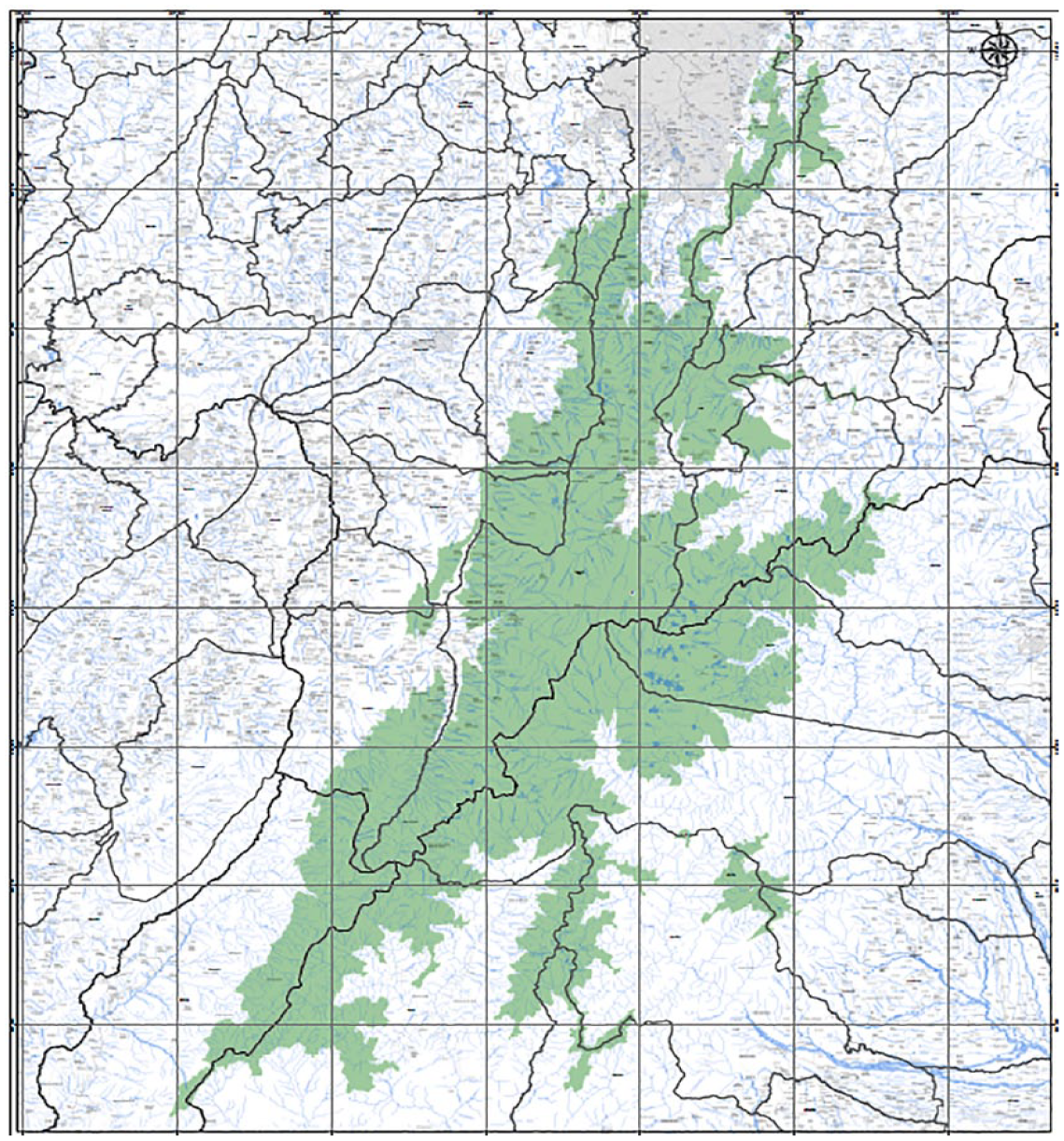
The green area corresponds to the “Sumapaz Páramo” demarcation (Colombian Ministry of Environment and Sustainable Development, 2017).
The Humboldt Institute was in charge of leading the discussion about the criteria for the demarcation project, which spurred a never seen before conversation and debate regarding páramos in the country (Cortés-Duque and Sarmiento 2013). But at the end of the day, only the aspects legible in the probabilistic model, designed by Jules and his colleagues, would have a role in the demarcation. As Jules explained to me, these tools have been used before to model the geographic distribution of species but not for an entire ecosystem, at least back in 2011. The model worked under the assumptions of the “species distribution models,” where the geographic range of a species has a relation with environmental conditions identified as “variables.” But not anything could count as such. Basically, to be included as a variable, it had to be supported with maps at a scale of 1:25,000. If no maps were available for a potential variable, then it would be discarded since that was the input necessary for the model. That was the main reason why no “social variable” was included in the model. Two big variables were part instead: first, the topographic, whose inputs were provided by images produced by satellites surveying the earth’s surface, and second, the climatic variable, which was fed by meteorological stations measuring temperature averages in the high mountain.
Once put together the variables, the model would make an estimate of the presence probability of vegetation along the Andean Mountain taking as a control reference the samplings of biologists. Those areas where the presence of trees and shrubs overlapped would be expressed through GIS as dots of color: this area would indicate the transition zone between páramo and forest. The final task for the geographers would be to trace a line linking the dots. The resulting line would demarcate an area indicating the limits of páramos, making of them a “bounded” entity no more elusive for the public authorities and geographers like Jules.
The conservation of páramos through their demarcation, produced a version of them as “bounded” entities with traceable limits, something controversial for biologists for whom “ecosystems do not have limits” and who were not included in the tracing of the maps. Most of the biologists that I interviewed, including Maria, would clarify that they were part of the demarcation project but that they were not involved in the demarcation as such. These attempts to produce páramos as “bounded” entities offered another possibility to analyze boundaries in an ontological sense as instances central to the composition and transformation of the world. Here both entities and practices through which ontologies are reconfigured are not already settled. It is through boundaries that those entities emerge and take their form and contours, but the practices through which these boundaries are produced are isomorphic with the character of such entities.
To perform the boundaries that produced the “bounded” páramo, it was necessary the arrangement of satellites, light, algorithms, other maps, skills to elaborate models, legislation, meteorological stations, and of course humans like Jules and their colleagues. Together, they also demarcated the boundaries of practice to be part of the demarcation of the páramos: like organizing the criteria and elements that were possible to include in the probabilistic model. Without bounding the practices through which new boundaries were produced, it would have been almost impossible to produce a “demarcated páramo” in the first place. This is how sometimes things are drawn apart to preserve ontological singularity (Woolgar and Lezaun 2013). But what happens when these boundaries that seek ontological singularity are contested? I explore that question in the next section.
Contesting Boundaries and Ontological Singularity
Between April and December 2014, a research group affiliated with a Bogota’s university was commissioned by the colombian Humboldt Institute to collect flora and fauna samples in Sumapaz as part of the demarcation project. The research group identified twenty one places to visit in the first exploratory fieldwork. Each place was assessed in the field, so in the end they chose five for a second visit to collect the samplings. Among the discarded places, there was one, where the group reported the following: In La Union Sumapaz . . . the local community shows resistance to allow the researchers do their job (in particular the communal organization: the agrarian trade union from the locality). Finally, the spot is discarded because of ecological, access and permissions reasons . . . (Humboldt Institute 2015:23)
Years later not so far from the place mentioned above, I was having a coffee in a kitchen with Rosa, a campesina affiliated to SINTRAPAZ, the agrarian trade union mentioned in the report. When I brought up the episode narrated by the scientists, she made explicit that the very presence of any researcher or institution without the community’s approval is a cause of distrust: “before coming with projects, why not to ask why we live here and why we still remain?” Rosa told me. Her complaint was about the lack of interest in the conservation plans to incorporate the histories and experiences of campesinos, who like her and thousands in Sumapaz, have lived in the páramo for a long time even before any conservation plan was designed. She said: “The páramo should be protected, but with me inside.” But what does it mean in practice that she and other campesinos can be “inside” of it?
A páramo with campesinos is certainly not the same as the ones with which biologists and geographers engage as in the previous section. As I will develop in the next pages, campesinos contest and bring boundaries to reconfigure the ontology of the “demarcated páramo” and its conservation. To advance this point, I will analyze “measuring the pastures,” a daily campesino’s practice where some boundaries and entities that compose their ontologies emerge. Afterward, I will show how campesinos protect these practices and themselves by engaging in the ontological politics of páramos conservation through litigation.
Mario is a young campesino who lives with Albert, his father, in a finca they inherited from their ancestors that struggled for land rights in the past. Campesinos land property in Sumapaz is a recent achievement. A century ago, this finca and the rest of the land around was part of the “Sumapaz Hacienda,” a single large state property of the region’s big landowner. By those times, campesinos looking for a place to live and work had to rent it from the Hacienda and work for his owner. As it happened in other Colombian regions during the early twentieth century, agrarian movements created by campesinos stopped paying their obligations to landowners and claimed that land was public property and not private (LeGrand 1988). Sumapaz was not the exception: campesinos abolished the “Hacienda” and obtained the right to own land (Londoño 2011; Varela and Romero 2007).
In their finca, Albert taught almost everything he knows about “working in the campo [the countryside]” to his son Mario. With him, I was part for the first time of “measuring the pastures,” a practice vital for maintaining the finca. It takes place when cows deplete the grass for their feeding and consists of moving the fence where the cows are enclosed to other portions of land with enough pasture crops for a few days more. Each of the activities involved must be performed in a coordinated way: cows must be moved without leaving one of them behind, the new spot should be well provisioned, the wooden fence post has to be disassembled, and its wires have to be tightened in a correct way once the wood sticks are set back again in to ground to the new fence’s location.
Things happen too fast. I clumsily try to help Mario in the task, who points with her index finger to the grass and says:
“You see that one? That is jucua [smutgrass], these cows do not like it”
“Really? Then what do you do with it?” I ask
“Well, it is simple, you just leave the cows for a time and once they eat all the pasture, they will leave behind anything they do not like, whatever they leave we have to clear it afterwards otherwise it will get rastrojo” [instead of pasture the ground will be covered by weeds]
“And what about that ditch?” I say while helping Mario to bring the first cow so the others will follow her slowly to the new pasture.
“Sometimes we have to dig those ditches as well, so water keeps flowing, otherwise jucua will grow from puddles.”
As we walk back home, we cross a line of tall alder trees that contrasted with the plain pastures. As Mario told me, they are “living fences” planted by his father decades ago and that help retain water during the driest seasons. There I realized how dense are campesino’s ontologies. Almost anything I can ask a question has a role and a story in the finca. It would be kind of romantic to say that campesinos just accommodate and are part of the “páramo,” because it does not come separately from their practices. It is through boundary-making that specific entities emerge and are maintained to assemble the relations necessary in the campesino’s way of life. This means that campesinos must produce and sustain boundaries that are literally alive and are active part of their worlds.
The pastures, the cows, the weeds, the water flowing, and the fences, just to name a few, are constantly changing, so boundaries must be produced in practice by digging a ditch, cultivating new pastures, managing the plots for moving the cows, taking care of them, and planting trees. These practices, which I named boundary-making, both bring the practical relevance of those entities for campesinos and establish ways of performing activities. These make possible the heterogenous forms of agency and relations required for maintaining the finca as a boundary project that remains generative and productive (Haraway 1988). However, when juxtaposed with the boundaries presented in the previous sections, and the restrictions imposed by the conservation policy, it is clear that campesino’s practices are beyond those limits as it happens in other regions of the world (Tsing 2003). The interesting, and borrowing Anna Tsing’s argument for this case, is that perhaps from there that alternatives to encounter and make possible a “renovated” conservation can emerge.
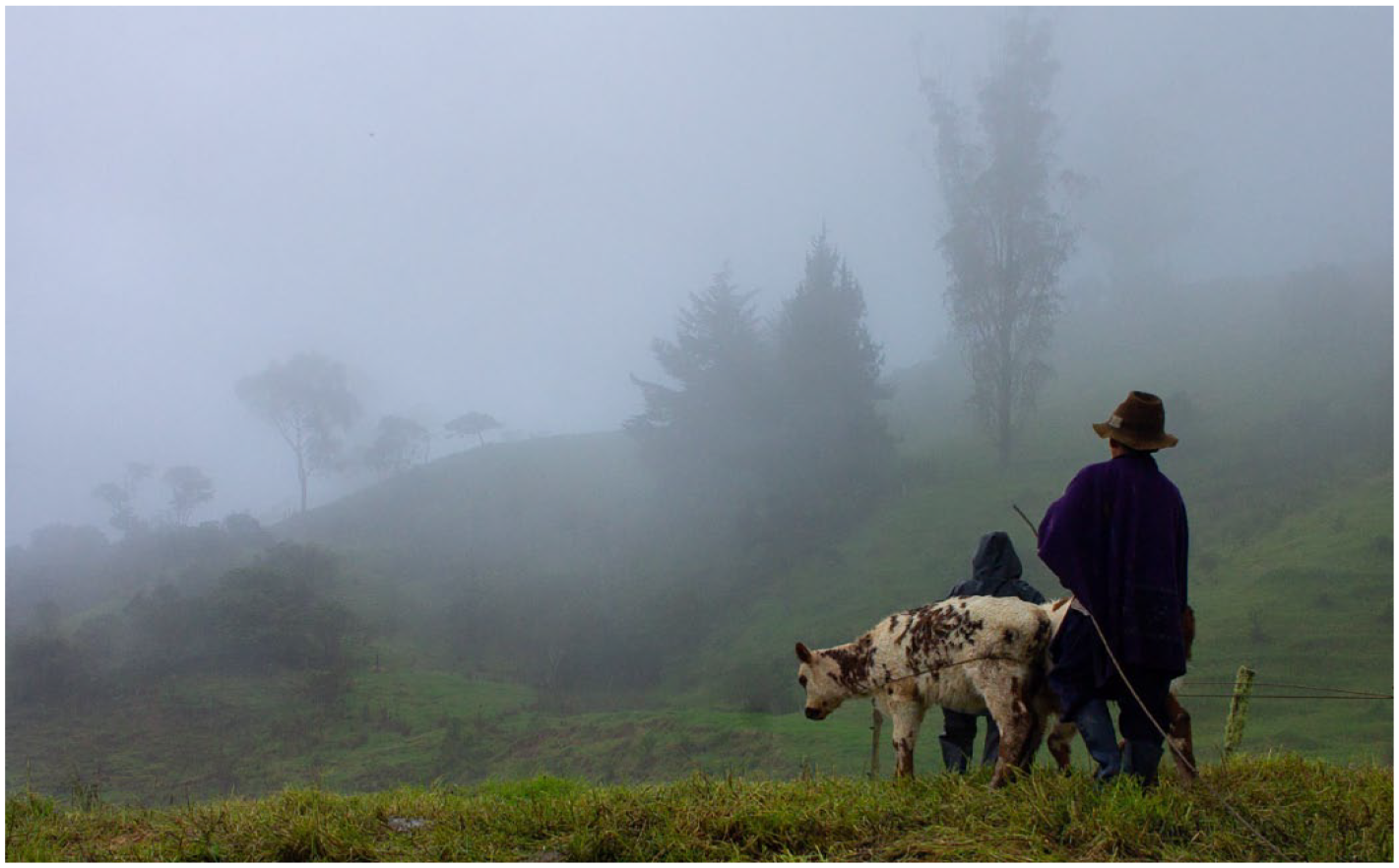
Larry, a campesino boy, moving the calves after “measuring the pastures.” (Photo by author).
For campesinos, the question of engaging with páramos in terms of their limits has been a recent issue. Once entire fincas or plots of them were included in the maps of the demarcation, vital practices for them, like “measuring the pastures,” could be restricted in the coming years, making the possibility of their existence even more fragile. This reason made Albert and other campesino leaders in Sumapaz to include the páramos demarcation as an issue in the meetings of their veredas. 2 With the support of urban political organizations close to them, they created “The Sumapaz Campesino Coordinator” in 2019 (from onward “the Coordinator”).
I met Albert in a Coordinator’s meeting organized in his vereda in October 2020. In the meeting, was presented a report of the lawsuit elaborated by this organization against the Colombian Ministry of Environment for demarcating the páramo without campesinos participation. The lawsuit was made and discussed during meetings in 2019 in veredas like this one. It basically demanded the guarantee of campesinos’ rights to environmental participation. After it was received by a court, the campesinos’ demands were accepted by the judge who ordered to the Ministry of Environment a new demarcation applying a process of environmental participation (Coordinadora Campesina de Sumapaz 2019).
The Coordinator managed to contest and reconfigure the boundaries of the “demarcated páramo,” because now campesinos had to be recognized as rights holders, whose guarantee was mandatory for the páramo conservation. Through this organization, campesinos managed to intervene in the ontological politics of the páramo conservation and a new páramo that is still in the making will come after the litigation. The politics performed by contesting these boundaries goes beyond what is implied by conventional boundary work and social boundaries analysis (Gieryn 1999; Lamont and Molnár 2002). Here boundaries are open, porous, and leaky to the inventive ways through which humans and more than humans shape in practice “novel configurations of the world and its elements” (Jensen and Morita 2015:84). For campesinos, it meant intervening in the boundaries of the conservation policy, so a different páramo with a new form of politics where they can be part is now being configured.
Conclusion
The study of boundaries in environmental sociology serves as an analytical tool to dive into the ontological openness and reconfiguration of environments, even when those seem settled. As sociology has established before, boundaries are socially formed and are involved in the ordering of social worlds, but as I developed in this paper, in order to understand the configuration and reconfiguration of environmental worlds in practice, boundaries require an ontological approach. Following the analysis of the paper, the páramo for conservation was not a pre-given object, but the upshot of world-making practices where humans and more than humans intervened. The variability and openness of páramos facilitated by the different boundary-making practices analyzed allowed a sociological approach that combined STS perspectives with classical conceptualizations of boundaries.
One possibility of this approach is that boundaries are not to be found in abstract places but in the practices of actors as STS proposes. Boundaries, as shown in this case, were inscribed and translated in the practices that enabled the “vision” necessary for biologists to configure “species” as the entities contained in páramos; the “boundedness” of maps through which geographers offered a “bounded” version of it and the “contesting” of campesinos to attempts of enacting a singular páramo without them. Including ontological boundaries in the repertoire of sociological analysis could be then an alternative for studies interested in how the very character of reality and environmental worlds are open to permanent ontological reconfigurations with particular forms of politics that define the shape that take certain entities and objects and who can act regarding them.
A sociology of ontological boundaries is related to the task proposed by Andy Pickering (1994; 2019) of moving to a performative idiom to capture the dynamism of the material world and the ontological constitution of entities. This invites us to think of agency in a more symmetrical way, by including in the analysis as I did in this paper, a vast array of actors such as biologists, geographers, species, plants, páramos, campesinos, maps, models, and other entities. From that performative idiom, it was possible to consider boundaries as the entry point to locate in practice the situations where the question about the páramo conservation was as well a matter of defining new forms of politics and knowledge production.
Footnotes
Acknowledgements
The author expresses his gratitude to SINTRAPAZ for their collaboration and support to conduct this research with the campesino communities in Sumapaz”
Declaration of Conflicting Interests
The author(s) declared no potential conflicts of interest with respect to the research, authorship, and/or publication of this article.
Funding
The author(s) disclosed receipt of the following financial support for the research, authorship, and/or publication of this article: This study was partially funded by the Swedish Research Council (VR grant VR990780)
