



Abstract
Keeping and telling secrets are acts of intimacy. This article explores secret-telling-friendly methodologies, capable of encouraging individuals to share their life stories in their own terms, with particular episodes, emotional connections, protagonists, and also secrets. The openness of our research design played an important part in the identification of the role of secret-storytelling in the understanding of life. This was enhanced by methodological tools mobilized during the biographical interviews with individuals of families (the life calendar and the socio-genealogical tree). It testifies the importance of the research design, and method lato sensu, in the sociological analysis of secrets. Each secret connects to the person’s biography, social positioning, historical context, and generational anchor, contributing to understand more about wider social, gender, family, interpersonal, and normative values of given time-space coordinates. Secrets are narrative and emotional devices to build biographical narratives and chronologize life stories, bridging biography and society, exemplarily.
Introduction
The stories behind holding, keeping, and telling secrets contribute to a sociological understanding of social and personal relationships. Behind the effort that is made to keep a secret from others lie social norms, interpersonal expectations, intimate feelings toward others and oneself, and also the management of impressions regarding the presentation of self, all of which can act as proxy of the social values in a given temporally anchored society. With the passing of time, the inertia of holding back that piece of intimate information is frequently maintained, and secrets may end up lingering in time. In some situations, the historical or interpersonal reasons behind keeping a secret may no longer be important or valid, and yet, the secret is kept. However, certain circumstances may provide unique conditions and motivations to tell someone—a friend, a lover, a stranger, a researcher—a secret. In sociology, this hidden layer of crucial biographical information provides a fresh contribution to the understanding—even if retrospectively—of social relationships and the space of contexts, values, and structures through which they flow.
These ideas constitute the departing points of our article: that the methodology used and the secret (story)telling are a conjoint analytical lens, albeit being possible to present, to some extent, separate conclusions on each component. This article is as much about secret-telling-friendly methodologies as about secrets themselves. As such, we argue that our research design, approach, and instruments to collect family histories by means of individual interviews, life calendars, and genealogical trees, in project X, may have contributed to one of these singular—and narrative—opportunities of secret disclosure. We did not intend originally to observe secrets, which, we will argue, made the disclosure dynamics much more organically, spontaneously, and holistically included in the broader biographical narrative. Throughout the interviewing process of all adult members of 15 families (49 participants), individual or family secrets revealed their relevance. How? A secret kept in one, and disclosed in another point in time, encapsulates a biography-society story of its own. As such, the secrets emerged from the interviews as rich and important biographical material that unites and differentiates the individual and the family histories and, additionally, provides analytical and dialectical insight into the sociological understanding of the management of private feelings and events against a background of specific social and historical context, thus contributing to a deeper understanding of social change.
The interaction and the research instruments provided an implicit, yet compelling invitation to safely disclose intimate issues, namely secrets. Judging by the way the secrets organically emerged in the interviews, as part of a coherent sequence of events, of a process being unfold, led us to argue they are rhetorical instruments or storytelling. This narrative feature of a secret is linked to several social and analytical levels, such as intrapersonal, interpersonal (family and other close people), and broader social norms and contexts. All these levels were particularly explored by each one of the instruments of collection and production of data, particularly the calendars—for the chronologization of the story—and the genealogical trees—for the generational and family contexts. Secrets are multi-level and it takes a holistic, yet open-ended methodological approach to encounter them or to set the appropriate conditions for its disclosure. Regarding this one point, we will discuss the research design, serendipity, and “how” the secrets are disclosed—the timing within the interview, their recurrence, and overall importance and role of secret telling to the biographical account shared in the course of the interview.
Another component of our article concerns the very qualities and characteristics of the secrets told. Once the secrets were told, and their effects, qualities, contexts, and other features encoded, we were able to map their inter-related characteristics, in relation to the participants’ family and anchored in their particular social background, as well as in the broader socio-historical context at play. Analyzing the contextualization and chronologization that comes with keeping and then telling a secret is, on one hand, central to the understanding of social change. The analysis of individual and family secrets helps us, thus, acknowledge and understand the functioning of social norms and values as anchors of their times and also as sets of practical reasons (Bourdieu 1998) that families seek to follow out of fear of disapproval, shame, or punishment, for example. The opposite can also happen amid changing social standards, as what was once a source of shame may be a source of pride today (Barnwell 2019b). On the other hand, secrets constitute information that is carefully and reflexively managed interpersonally, as G. Simmel ([1906] 2002) already analyzed in his seminal research on secrets. This occurs having in mind each person’s characteristics, which dictates the relevance of the information that will be kept secret or revealed and to whom (Brown-Smith 1998), and also, perhaps more importantly, the positioning and role of this given person in the overall relationship network and dynamics—for example, depending on gender, embedded social context, publicly accepted social norms, and power relations—within and outside the family—as C. Smart (2009, 2010, 2011) argues. There are consequences, over time, at both the individual and family levels, of having, keeping, or telling secrets (Vangelisti and Caughlin 1997). That is why it is so important to explore their dynamics and impacts to make sense of interpersonal relationships and social change. Moreover, the timing of keeping and of telling a secret is particularly indicative of this interpersonal dynamic, as it directly involves the “others” from which the information is kept hidden.
In addition to secrets, taboos are also part of the family dynamics. The meaning of the word taboo concerns “a subject, word, or action that is avoided for religious or social reasons” (Cambridge, 2022). While secrets are hidden subjects, taboos are avoided topics. These interdictions may be related to secrets kept and/or produced in family situations likely to generate disagreement or discomfort when addressed. Thus, they focus on forbidden subjects that, like secrets, aim at the preservation of the family unit—the protection against shame or other consequences resulting from social judgments. There are conscious or tacit agreements, elaborated between families, or simply apprehended (incorporated) part of the family’s own rules and dynamics, about what and with whom one should talk. Family taboos can also be passed down between generations, impacting the history of families and reflecting social and cultural norms that remain and change over time (Barnwell 2018, 2019b). Having this in mind, we chose to look at taboos as incorporated in a broader notion of family secrets, as they seem to act as inseparable parts of the dynamics of information management in family relationships.
In view of all this, we discuss the importance of family histories as a methodological arena of analytical tools and theoretical premises that allow us to approach and understand each family as a myriad of social relationships and generational transmission and reproduction processes (Brannen 2015; Nilsen 1992; Smart 2011), as well as a “microcosm” of the wider social world (Bertaux and Delcroix 2000; Bertaux and Thompson 1993). We analyzed the “sociological pearl” that each family represents (Bertaux and Delcroix 2002) with multiple methodological tools including the family tree as proposed by Bertaux (2000) and explained by Miller (2000). We do not focus our interest on specific topics, such as migrant families (Brannen 2015), or generational social mobility (Bertaux and Thompson 1993), or women’s experiences, but take a more horizontal approach to the members of the family. This proved to have a big impact on the secret-storytelling and the capture of secrets. We also address some of the ethical challenges involved in the analysis of family histories, especially in what concerns a topic as sensitive as secrets. Finally, we present a panorama of the secrets, resulting from the thematic content analysis developed with the use of the CAQDAS MaxQda®.
We reach two sets of conclusions. First, and relating to method, ethics, and serendipity, we show how the act and process of sharing secrets with researchers can be a manifestation of how individuals are drawn to make (verbal) sense of their lives and articulate this sense coherently, throughout their biographical narratives. This “manifestation” constitutes a reflexive and agentic decision of the participants to tell their story in their own terms and with their own intimacy co-management of the interaction and conversation, thus including the amount and the details of secrets they absolutely want. This manifestation is, however, made easier by the lack of a strictly structured or intrusive interview script, on one hand, and by the enhancement of an empathic interaction, on the other.
This storytelling is clearly anchored on a “biography and society” framework, where cultural contextualization and “chronologization” come into play very spontaneously by the interviewees. In good qualitative research, and well-conducted biographical and in-depth interviews, this quality in which the interviewees often state “I am not used to talk about this,” “I’ve never told anyone what I am about to tell you,” or “could you please turn off the voice recorder for a while?” emerges with certain frequency. The fact that the rest of the family is interviewed in the same research process only enhances, in our view, the complexity, detailing, and chronologization of the secret telling. We argue that not having asked specific questions about secrets, on one hand, and having asked specific questions about the timing, sequence, and the people involved in the events that compose a trajectory (through the life calendar and the genealogical tree), on the other, enhance the secret mention and display and contextualization. Secrets function as narrative devices that are triggered by the research design. Second, we present a panoramic view where the complexity and heterogeneity, on one hand, but also the sociological meaning and importance of secrets, on the other, are portrayed. This was possible with widening the scope of the interest of the secret beyond its very content. Understanding the reasons, emotions, timing, context, and re-interpretation of the secret is where, we argue, the core sociological importance of the secret lies.
Approach Matters
How does one study a subject that is so private and, by definition, unspoken? There are at least three inter-related research and ethical related aspects relevant to the discussion of the study of secrets in our article. One has to do with the research design, the other with interaction, and the last with privacy. One directly deals with the conditions for telling secrets put together by the research procedures, the other relates directly to the interaction and ambiance of trust while the secret is told, and the other with the ethical approach necessary to anonymously analyze, yet still humanize these secrets. Methods are transversal to the very possibility of studying secrets: the open and multi-actor research design allows them to emerge in the stories told, the interaction made the disclosure comfortable and respectful, and the strategies for publication guaranteed privacy and anonymity.
Family histories are an umbrella term for collecting narratives and other biographical manifestations from many members within a family, but it holds a theoretical argument alongside: that family is a “microcosm” of generational, normative, power, gender, and other relationships present in the wider society, and that this living and transformative being can, perhaps, be looked at from individual angles. Each member’s view provides glimpses of the family’s angle.
Research Design
Keeping a secret takes reflexivity and effort. But, with time, it also takes a certain degree of normalization. The content of the secret is kept away from daily routines, normalized, and, at times, artificially but eventually naturally forgotten. So, what triggers the act of telling someone a secret? Although it may be argued that to systematically study secrets the research design and the processes of data collection must be prepared to grasp its complexity and detail (Vangelisti et al. 2001), we counter argue that it is a safe and more open environment of interviewing that actually allows the “relevant” secrets—that is, to the story—to emerge.
Our research design consisted in carrying out family histories in Portugal. During 2019 and 2020 (in a pre-pandemic context), in up to three-generation households, all members aged 18 years or more were interviewed. A total of 49 individuals were interviewed in 15 families. It is in the light of this particular—but not exceptional—generational social and historical contexts that the secrets told were interpreted. However, it is important to highlight that the core of the analysis, although grounded in the Portuguese context, concerns societal transversal topics related to gendered normative values, children-parent relationships, conjugal or financial infidelity, and other secret-like subjects, even if they can assume diverse configurations in different social contexts. We are more interested in the general processes at play in the emergence and maintenance of family secrets than in the specificities of the structural contexts that frame them.
We used individual life calendars and family socio-genealogical trees (Bertaux and Delcroix 2000), embedded in individual biographical interviews, to co-produce these family histories. Family histories, combined with different traditions and methodologies, can “tell us stories, spread processes and elucidate trajectories” and can be thought as a radar to understand changes in different social patterns (Nico and Silva 2022). Our strategy involved collecting a diverse social mosaic of family histories and, at the same time, reconstituting the biographies of each family member, considering multiple perspectives of the family life course and recognizing the “multi-layered and multidimensional nature of interactions and their meaning” (Vogl et al. 2018:180). Interviewing all members of the same family allowed us to learn multiple perspectives on the same event, dynamics, and relationships, including a greater likelihood to encounter secrets. Without this triangulation of information, we might not even have identified secrets as such: participants would not have felt the need to ask for discretion (knowing we were in the process of interviewing other members of their family) or would have told us something perhaps casually, and without it being omitted in other interviews of the same family, we would not have been able to identify them as concealed information.
The secrets were not a direct, specific, or tailored focus of the goals or concerns of the main project and, as such, were not reflected in specific questions directed at the participants. Yet, the interview script had, due to the use of the life calendar and the socio-genealogical tree, a strong chronological character. Everything else, including the conversation around the family socio-genealogical tree, was even more loose and open, and did not involve the exploration of specific themes other than the sociological obvious ones: educational, work, housing, romantic, family, and health trajectory. We argue that both the openness of the research design and the multiplicity of instruments of collection and co-production of data facilitated the telling of stories, allowing us to capture some blind spots, stories where secrets actively took part. If specific questions were made about having secrets, chances are individuals would have assumed a conscious or unconscious omissive, defensive, and/or a very de-contextualized approach in the decision or act of telling specific secrets. Chances are that secrets could also narratively become more relevant than they were before the interview. We were not looking to “get what we asked for” or to allow the participants to take up the concept of secret to (re)construct the narrative about their lives (Carlsson 2012). Following C. Carlsson (2012) and the use of “turning points” in the trajectories of offending, we ended up approaching secrets as narrative and empirical instruments that helped the participants express the process of their lives, and subsequently also helped us analyze and theorize them.
As such, in the relation between research design, instruments of collection of data, and script of the individual interviews, we sought to understand the context/interaction/point of the interview script in which the secrets were revealed to us. This is relevant because it might allow us to perceive the biographical function of the secret. As we did not ask directly about them, the act of revealing some secrets might have been, then, part of the narrative process of making sense of the stories told. The “unpreparedness” might have constituted an advantage in this regard, as the secrets told performed an unsolicited function during the interview. They were an integrant part of how the interviewees chose to tell their stories and guided the interaction. For an autobiographical narrative to make sense when shared with others, one cannot simply skip or avoid certain events or feelings. Our participants tended, despite their varied social backgrounds, to lean more toward biographical eloquence and coherence, at the expense of their intimacy. These were situations where the logic of the “life as told” needed to be strongly grounded in the “life as lived” (Bruner 1984) to make sense of the family history. In addition, even if this was an unintended consequence, the fact that we thoroughly explored the relationships between family members, especially using the family tree, may have acted as an important trigger to the sharing of family secrets. Revealing or unraveling secrets was not a premeditated—neither on our part nor on the part of the interviewees—thing to do. The participants seemed to find it inevitable to do so, when defending, through their narratives, the preservation of the meaning given to their lives and/or the presentation of the self they choose to perform at that point, on that day, of their lives.
Although very flexible, the interview script was prepared to include a section on only biographical accounts without any additional instrument, a section where these accounts are based on the need to co-filling in of the life calendar, and a section where the socio-genealogical tree is at the center of the conversation. In fact, we found that out of the total mentions of the secrets and their details and ramifications, almost two thirds emerged during the process of co-filling in the life calendar, which tends to prompt new realizations on the sequence of events and as such of the importance of forgotten, censured, hidden, or normalized events as well, or during the creation of the genealogical tree where, for example, the feelings urged by the secrets, that is, the feelings toward other people, were particularly displayed.
However, the same “unpreparedness” also raised some ethical issues. Researchers were faced with information that emerged “out of the blue” and had to deal with “ethically important moments” during the interviews, that is, “the difficult, often subtle, and usually unpredictable situations that arise in the practice of doing research” (Guillemin and Gillam 2004: 262). Taking into consideration the sensitive nature of secret disclosure, we made sure the interview moment was a safe context to share intimate matters, we showed interest in the secrets that were being shared with us, we did not make any comments or asked questions that could jeopardize the trust environment, we reassured them that no spillover to other participants would take place, and we never used the information we had on family secrets to ask specific questions to the other family members.
Interaction and Interpersonal Intimacy
The access to a “secret” piece of story was, in part, a result of the methodology: the questions on family histories may have triggered specific memories on hidden subjects, the life calendar created the need to ensure the timeline of the story had no “holes” and that stories made sense, and the genealogical tree may have prompted secrets kept specifically from relatives. But telling a secret is also an act of interpersonal trust, and as such, it is also a result of the research interaction, of trust in the interview’s ethical environment and in the “social contract” of the research itself. At a more micro level, participants who shared theirs or keep secrets of others felt it was a safe space to talk about those intimate issues and topics with the interviewer, despite the fact the researcher would interview other members of the family (what in principle could represent a reason not to tell a secret because of the risk of information spillover). This “confessional effect” of the interviews has already been pointed before (Brückner and Mayer 1998:152). Participants very often find it easier to disclose personal matters and sensitive issues to the researcher (someone who is not part of their daily lives and does not have a judgmental attitude) than to close friends or family. And the importance of talking about these issues is understood here as a way to complement and give meaning to the participants’ narratives about their lives and their families. Even the unprepared and not calculated disclosure of secrets can be a reaction to simple but profound questions about the course of one’s life. Family memories (inherited and also experienced) take the form of narratives (auto and hetero) that are shaped in response to social family ideals, values, and traditions. Family secrets are embedded in these stories, whether the research design was prepared or not to capture that. They are part of the rehearsed and updated narratives carried by families across generations, according to the specificity of each period and context (Barnwell 2019a, 2019b; Smart 2011).
The interview is a social situation, an encounter between two people, each with their own dispositions and ways of thinking. As such, it cannot be totally predictable. No matter how formatted the situation may be in terms of control of the environment (mainly of the interviewees when it occurred in their homes) and of the direction of the conversation (mainly of the interviewer with the preprepared questions), it is impossible to predict and control every behavioral and narrative aspect of the interaction. The participants may not have thought of sharing a certain family issue with the researchers, but as the interview progressed and they felt more comfortable, it certainly became more difficult to monitor everything they shared, especially when it was something important to explain the family history. Either for one or a combination of reasons, we had more access to the meanings and stories of their lives and of their family, and thus their identity as a household unit (Afifi and Steuber 2010; Vangelisti and Caughlin 1997; Vangelisti et al. 2001).
Close observation, contact, and interaction with participants, as well as the depth in which it deals with people’s subjectivity, meanings, and emotions are ethical challenges faced by researchers using qualitative methods. But the ethical nature of this data collection process, specifically in what concerns family secrets, is also strongly connected to the fact that this was a subject introduced in the interview by the participants and not by the researchers. First, it is important to note that, even if it occurred without having been directly questioned about it, people only reveal—to a researcher, to a stranger, to someone close for that matter—what they feel and/or think can be revealed. One chooses the secrets one tells, and within these, the parts that make them acceptable, explainable, contextualized, or capable of producing empathy in the listener. We do not consider that the interviewees revealed all their individual and family secrets to us, but instead chose to tell us the ones they felt inevitable for the sake of biographical coherence and/or that did not jeopardize their image of themselves (that they also intended to convey to us). Therefore, the parts of secrets the participants chose to tell us and the parts or whole secrets they choose not to tell us are both representative of the agentic process of the interview and of human interaction tout court. After all, “if human interaction is conditioned by the capacity to speak, it is shaped by the capacity to be silent” (Simmel [1908] 2009:340). In this sense, we believe that this research, which was not about secrets but collected data about secrets, ended up doing it in a very successful and ethical way, as it provided the participants the prerogative to share only the secrets and parts thereof that they felt made sense to share when recounting their family history, without any direct prompts that could make them feel pressured to approach a taboo subject.
Ethics and Privacy
Questions of spillover, confidentiality, and disclosure of sensitive and extremely private information do not respect the limits of the family. Research is thought through, put into practice, but the problem of how to deal and publish results of such singular and unquantifiable personal and family data resists to the end of the interaction of the interview per se (even more so in a longitudinal project such as ours). This set of issues concerning the eventual (ethical) legitimacy of using and publishing these sensitive data, given to us voluntarily but paradoxically, without much preparation on the side of the interviewer as well, needs to be duly considered. Our approach is based on several strategies, from which we chose what to reveal and how to reveal, aiming to minimize risks to the privacy of interviewees and also ensuring consistent data analysis (Rappert 2010). One is to produce more than two articles on the family secrets, presenting different angles and approaches toward the subject, making it hard to put the pieces together in a way which would allow the identification of the individuals and/or the families. Fictitious names are also changing in each publication. Other is to only present and publish in scientific events and in English, being as further as possible from the possibility of, by chance, being heard or seen by the participants speaking of such private aspects of their lives. As to the events, we will not allow them to be recorded if occurred digitally. We also make a scarce use of quotations in any of these events or publications.
In this publication, we additionally choose to use the secrets as units of analysis and keep the results aggregated by variables other than “the family” in most of the cases. This allows us to protect the identification and privacy of the families and their secrets, and also reveals a more panoramic view of the types, characteristics, and prevalence of secrets among families. Additional information on the stories behind those secrets was intentionally left out of this particular article to protect the privacy and identity of the individuals who trusted us with their life narrative as a whole.
A Panoramic View of Secrets
In our view, there are three interrelated angles to analyze secrets. There is, of course, that of the individual who holds the secret. Through her/his social characteristics—such as gender, generation, or social positioning, just to mention a few—we can confirm that secret holding (and telling) is socially stratified. As such, certain individuals, due to their positioning in a society of a certain time, are more subject to life events that are not approved, positive, or safe to share. Second, there is that of the secret itself. What the secret is about and what the reasons and contexts behind its existence are inform us about the social and cultural norms at play at the time of the initial concealing of information. And finally, there is that of the narrative through which the secret was told. The recurrence of secret mentioning, the variety of the details provided, and the permeability of secret telling to certain methodological instruments testify the important narrative device secrets represent.
These three angles require different analytical strategies that combine analytical and outputs potentialities of MaxQda® in the development of thematic content analysis. One was the possibility to associate individual variables with each interview (to characterize the individuals and cross that information with the dimensions of the secrets). For this purpose, a set of relevant sociodemographic features characterizing each participant were inserted as document variables: social mobility trajectory, kinship within the family, gender, age, educational level, and region, which were later crossed with the themes and dimensions of the secrets that were addressed in the interviews. Another was the possibility to graphicalize the discourse of the individuals (and thus visualize the recurrence of secret mentioning in the whole narrative, namely with the document portraits). For this purpose, although not exclusively, we carried out a holistic form analysis, which focused on the “whole” interview, having more in mind the structure/sequence/plot of the secret-storytelling process per person. Document portraits, produced by MaxQda®, provided a graphic overview of such structure in a comparable manner. And, finally, the classical content analysis and the possibility to carry out frequencies and crosstabs/co-occurrences of different dimensions and its categories of secrets, aiming at finding privileged relations between different aspects of secrets. To make this possible, a code tree was created in MaxQda®, grounded in the literature, with the thematic dimensions and categories capable of grasping the complexity and multidimensionality of our data and analysis: the topic of the secret; who the secret refers to in the family; the strategy to keep the secret; the date of the emergence of the secret (furthest decade); the duration of the secret; the scope of the secret; the status of the secret; the emotions involved; the existence of therapy; the function of the secret; and the impacts of telling the secret to the family.
We reached this code tree using a different approach to secrecy than the one operated by Simmel ([1906] 2002). The arena between the individual and the meso level, in this case the family, is the one where we found, not necessarily looked for, secrets—as uncut diamonds, rough material, rich and less accessible. Despite the popularity and familiarity of the theme of family secrets, the sociological literature on the subject is solid but not overabundant. Ethical issues on publishing about these findings, the psychological (and not necessarily sociological) processes involved, and the difficulty in putting together research designs capable of tackling such sensitive topic are likely some of the reasons behind this relative, only relative, small body of publications in sociology.
Based on our literature research, we identified a large number of studies on family secrets in the area of psychology (e.g., Berger and Paul 2008; Fall and Lyons 2003; Imber-Black 1998; Orgad 2015). In sociology, the topic is also present, particularly in what concerns family stories. One of the main references on the subject is Carol Smart (2009, 2010, 2011), namely in what concerns issues of reproductive, paternity, and maternity issues, very much connected to women (the most at-risk of having this information out in the open), on one hand, and the dynamics, memory, and oral transmission of secrets within the family, on the other. Family is tackled as the arena where the secrets live and survive over generations, instead of an observatory of individual secrets (that can be kept within or from the family). Similar to Smart’s research is the decision, left upon the participant, to trust the researcher with that piece of intimate information. Few articles approach the ethical issues of researching secrets in a more direct way; however, given the difficulties of researching and, above all, publishing secrets of others, it is not unusual to find articles based on the authors’ autobiographies, disclosing secrets of their own families (Davis 2009; Goodall 2008; Reale 2015). It is also worth mentioning the presence of the subtheme of reproductive secrets, especially in regard to the search for the biological past in cases of artificial insemination (Parseval 2009; Smart 2010, 2011). Another relevant issue found in the literature is the discussion around the State secrets and the construction of nation ideals and their influence on the management of information in families (Barnwell 2018, 2019a, 2019b; Goodall 2005, 2008).
We developed a strategy to compile a specific body of sociological literature on family secrets (secrets of families and secrets within families), trying to complement the psychological perspectives. This was oriented at a first—and most important—goal of providing us with an analytical framework from which we could encode the collected data. This was even more crucial because our research was not originally about secrets, so we needed to equip ourselves with the appropriate theoretical tools to analyze them. A second motive is related to the need to find the best possible way to deal with the challenges and ethical issues arising from the study of secrets, especially when using multiple-perspective interviews as we did in the project.
The Secrets
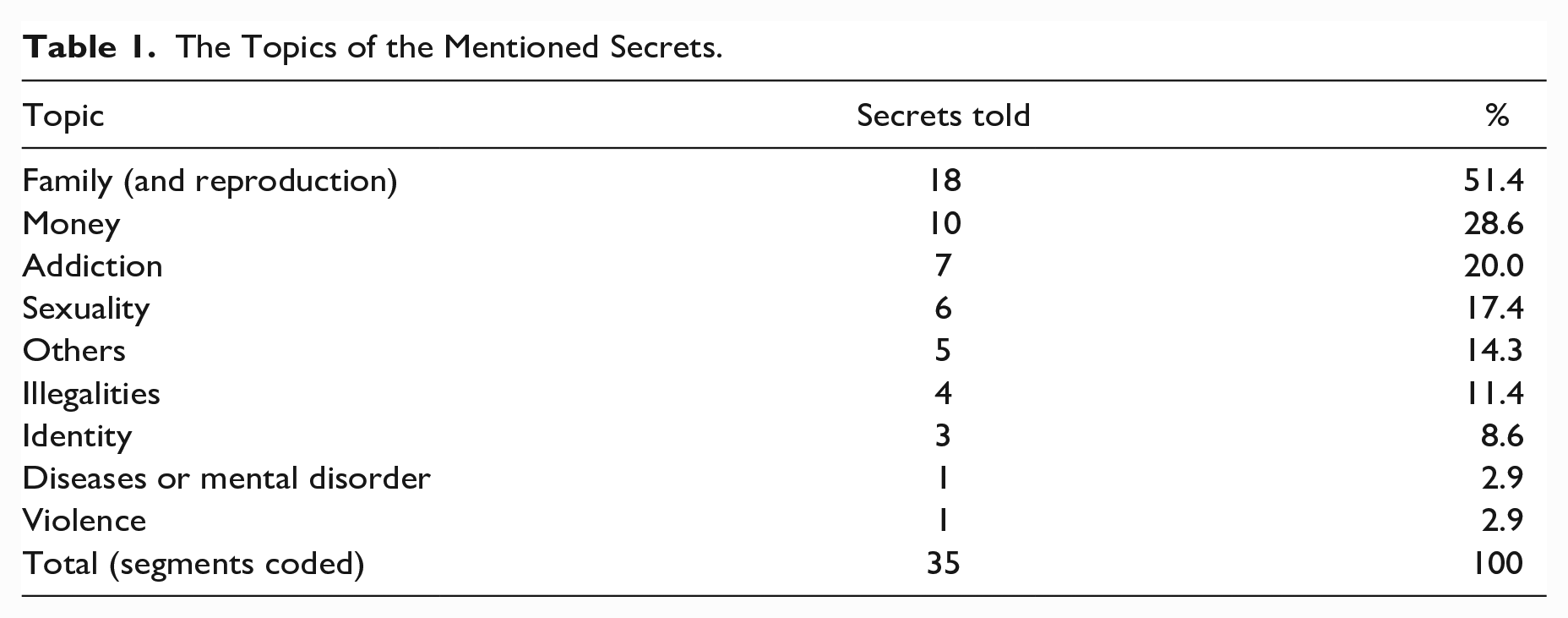
We are very much aware that in terms of secret—individual or family—revealing, we have only scratched the surface. But it is still relevant that even among those secrets to which we had access to, some themes were more shared than others, which has to do with the processes of individual intimacy management and of self-presentation and maintaining biographical coherence in an interview situation. As in other research, secrets referring to family and reproduction are very prominent (51.4 percent) (Barnwell 2019a, 2019b; Parseval 2009; Smart 2010, 2011), but financial (28.6 percent) and addiction secrets (20.0 percent) are also quite common (Table 1).
The Topics of the Mentioned Secrets.
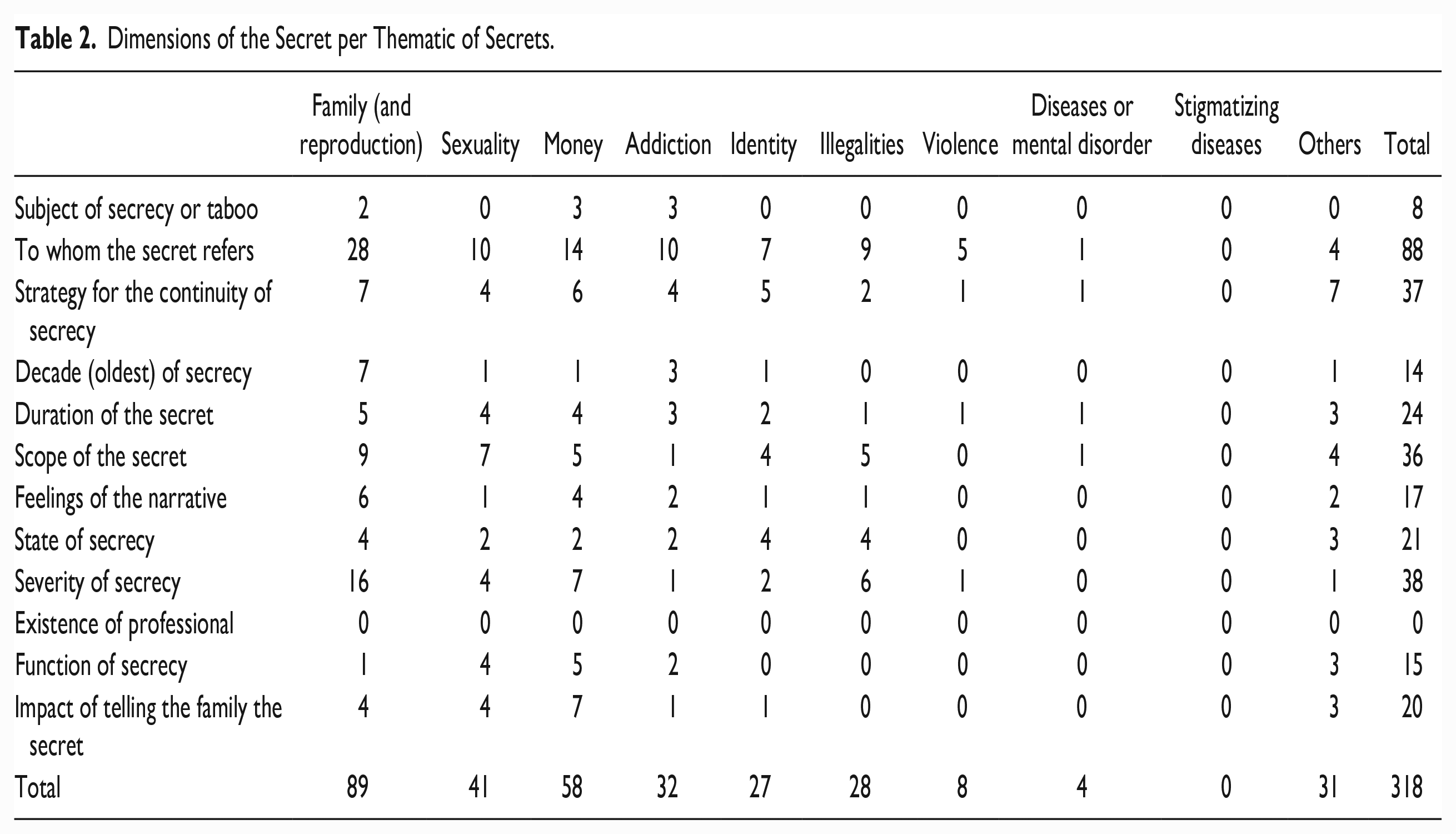
Family and reproduction secrets mainly refer to the conjugal wellbeing, fertility struggles and problems (most mentioned by women), and past and present kinship relationships. They are the most intimate, and interpersonal, secrets of them all, capable of not only displaying gender rules, cultural norms, and legal frameworks but, at the same time, feed on emotions, reflections, love, and intimate thoughts (Table 2). Money and addiction, on the other hand, are kept as secrets not within the family necessarily, but by the family, toward others. They are more mentioned to explain social trajectories and life outcomes, more on the meso-family level, than as emotional narrative devices (Table 2).
Dimensions of the Secret per Thematic of Secrets.
The topic of the secret is just one of the relevant information about it. There are many other aspects that testify the relational and interpersonal importance of this concept. As such, disclosing a secret mainly implies explaining the impact (experienced and/or imagined) of telling it to the family (21.4 percent, mostly through the interview), expressing the emotions experienced (19.2 percent, mostly during the fulfillment of the family tree), and also mentioning the person to whom the secret refers to (13.7 percent, mostly through the fulfillment of the life calendar) (Table 3). All these components confirm the strong interpersonal and multifaceted nature of the secrets as concepts to understand and account for a life trajectory. Keeping or revealing secrets has an impact on peoples’ lives, both individually and in interpersonal relationships, especially if we are observing family groups (Vangelisti et al. 2001).
Dimensions of the Secret per Number of Mentions.
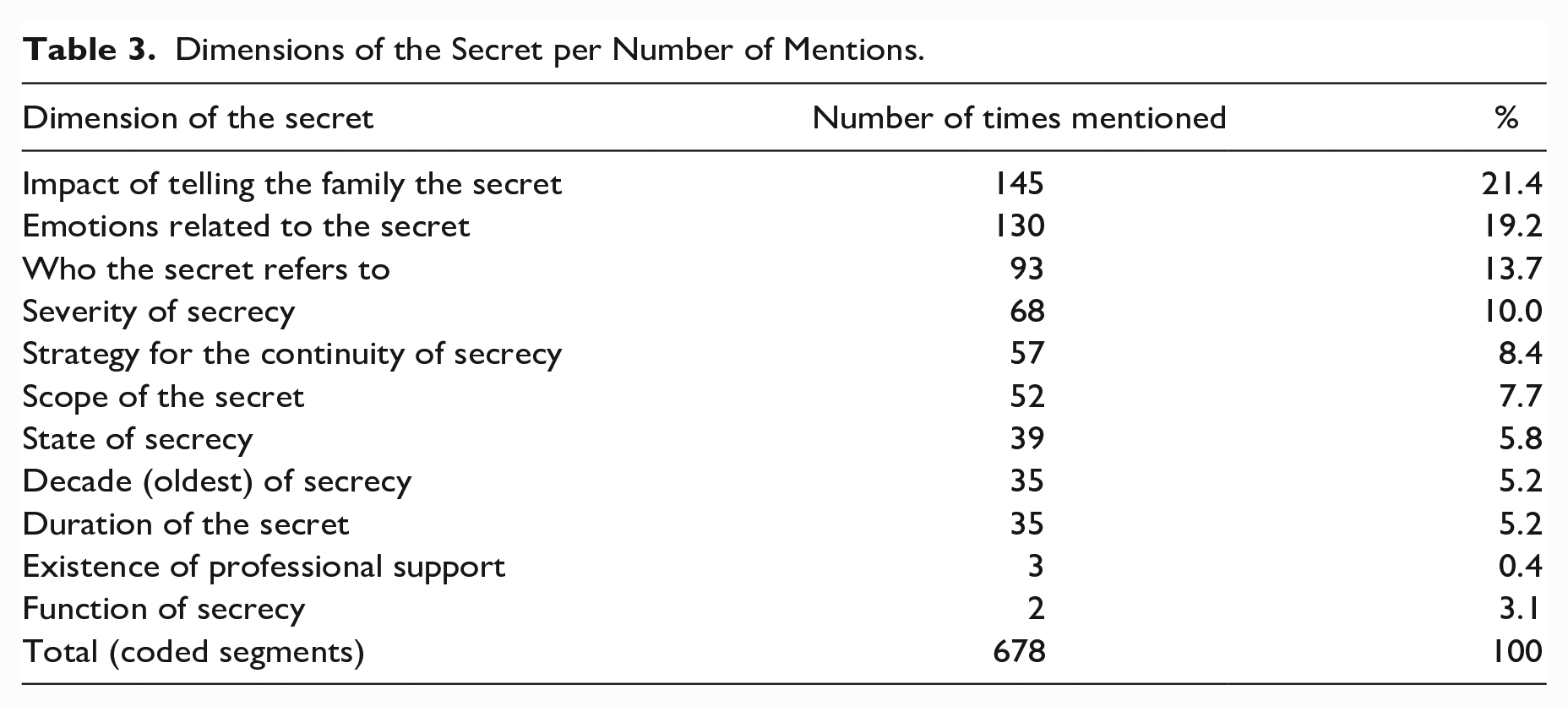
Another set of dimensions mentioned refer to the effort and rationale of having kept or keeping a secret, such as the severity of the secret (or why it had to be kept) and the strategy to conceal the information (lie about it, keep quiet about it, avoid if possible to talk about it). They fall into the category of morally justifying the secret and the efforts made on its behalf. And finally, the temporal dimensions of the secret were very important, as a whole, to help the interviewees explain the life course (cultural location and timing of life) context, that is, the structure that framed the secret.
A large part of the narrative around the secret is about justifying its existence in the first place. In fact, discussing the impact in such a strong way can be a rationalization of the need to keep certain secrets. It also helps to understand why not everyone within the same family talks about secrets and taboos. Thus, to consider the effects of secret disclosure is also to make calculations about what is less damaging to the family relationships: not revealing and managing secrecy or revealing information and dealing with possible consequences (Barnwell 2019a, 2019b).
Some interviewees express this kind of assessment more emphatically, mentioning the importance of the impact of the secret several times at different moments of the narrative. The actually experienced consequences of disclosing a secret tend to be more related to how the revelations occurred and, above all, how events unfolded from the moment the secret was discovered. These impacts were felt both individually and in terms of family dynamics. This was the case, for example, when the disclosed secrets and taboos were directly focused on relationship problems and break-ups between family members.
Emotions are also very evident in the discourses on secrets. This is not surprising if we think that behind hiding something important from close people and maintaining that secret are mainly emotional reasons connected to the importance of family ties and self-image preservation. People choose to hide a certain issue from others because they feel ashamed, fearful, or guilty about something, whose disclosure could also have an emotional impact. It is as if it was unavoidable to express and mention emotions when individuals speak of their own secrets, tell someone else’s secret, or speak of the impacts of discovering a family secret. Biographical eloquence, as we have already mentioned, even when it is not purposeful, evokes the narrative of feelings, and talking about it details what they consider important and likely to share about their secrets. H. S. Becker (1994) advocates that the level of detail through which an event is told testifies its importance (p. 186). The way individuals look at themselves and others reflects an emotional relationship with the world, and thus, emotions can act as filters in terms of the degree of importance assigned to what happens (Archer 2004; Burkitt 2012). The emotions shared during the interviews testify, in this case, to the importance of that secret in the overall story told about the individual and/or family lived life.
Combining information on both the dimension and the thematic of secrets, in terms of their co-occurrence, it stands out the fact that family and reproduction secrets were mentioned very much in connection with their chronological contextualization (Table 2). As such, they refer to the times in life when situations were experienced and to the impact of the event at a certain point in life. It is linked, on one hand, to the research design itself and the data collection tools used, such as the life calendar, which offers the possibility of ordering the life events and functions as a tool for capturing additional information on the life story being narrated (Nico 2015). Another possible reason for this chronological detail in relation to family and reproductive secrets is historical and has to do with the relative rapidness and progressiveness of the social and family values, and legal framework changes (Smart 2009), especially over the last four decades in this regard, since the democratic transition took place (in Portugal, the country where this research was developed): parental obligations, same-sex marriage, same-sex adoption, legal abortion, de-stigmatization of fertility issues, and so on. Some choices such as adoption, abortion, or extramarital relationships had a completely distinct context at the time and may have produced a whole different traumatic or stigmatizing experience than if they have happened nowadays (Barnwell 2019a, 2019b; Smart 2009). This “chronologization” of the secrets may fall in the category of proxy for contextualization. In this sense, interviewees put a date on their family and reproductive events and secrets because it is a way of unveiling their cultural and normative context. Setting the chronology right may as well represent the relationship between “biography and society,” and ordinary, real, stories.
“Chronologizing” was also frequent when the subject of secrecy was addiction. Situating an addiction in time serves to treat the issue of addiction as a past situation, overcome or to be overcome. In this topic, strategies to keep the secret are also frequently mentioned, and this may be related to fear of judgment and shame, and also linked to the process of perception about the addiction both by the person experiencing the problem and for the family as a whole.
Attention should also be drawn to the connection between family and reproduction secrets, and their severity. We observe, therefore, that in addition to mentioning the secret in the narrative of their lives, the meaning becomes more complete when the discussion turns to how serious the secret is. This is an element that is important for the perception of the life history. It is also key to justify the existence of the secret or the reactions and impacts experienced from the moment a certain secret is discovered.
The Individual
Having secrets is a socially stratified experience. Our data only allow us to analyze the mention of individual or family secrets. Stratifying the mention of a secret is nonetheless relevant to understand how this information is managed and its connection with certain sociodemographic characteristics. On the other hand, it may contribute to understand how the family dynamics can be altered by this management and disclosure.
The data reveal that women mention secrets more often in their narratives than men, although the difference is not expressive when this analysis is at the individual level. However, when we analyze by family, we see that among the six families where not all members talked about secrets, most of the participants who did not approach it were men (in five out of the six families). This can be thought by a combination of reasons. One is that the secret is (totally or partially) hidden from men by the women in the family, namely their wives, often referring to miscarriages, infidelity, and “illegal” abortions. Others refer to secrets kept from us, the researchers, by male interviewees such as money-related problems, addition issues, and infidelity. These are mostly told by their wives or ex-wives in an interpersonal fashion. But, unfortunately, it is in the nature of the secrets that we find the most profound explanation. It is women who have had the need to keep more secrets, the cultural and social norms have always been tighter with them, and violence was always more possible when perpetrated on them—domestic violence, parental violence, reproductive rights: phenomena made possible in earlier decades especially during the dictatorship and the gender-biased legal framework in this regard.
Other than gender, age is also important, but, we argue, as proxy of historical period. Telling or mentioning secrets during the interviews seems either more useful, in a long cathartic autobiographical narrative sense, or safer for the older generations than for younger ones. This is so because these secrets are mostly old, expired, and not active. In this sense, telling a secret and explaining the need of its existence and its impact might perform an important role in giving and sharing the meaning of a trajectory. How life became because of how things were—a retrospective and reflexive account of the past, long, life. It is useful, as a narrative device, in the sense that these secrets are used to explain not only their own biographies but also the social norms and values of that time in a full biography and society cycle. It is also a safe space-time coordinate to tell the secret. Even if discovered, it would not be of any impact in the relationships at sake, as the reasons from concealing the information might have expired (abortion, illicit behavior, the already biographically processed event). This is even more so for people who have lower educational levels, which confirms the argument of the period, and not necessarily age effect.
The Narrative
We have argued that secrets function as a narrative device that is prompted by the ontological need to tell a good, worthwhile, meaningful story of one’s life, but also by the space and challenges presented by the research design—the flexibility of the interview, combined with the chronological and interpersonal structured information asked for during the co-fulfillment of the life calendar and the socio-genealogical tree. But what is the place and space, and thus role, performed by the secret mention in the whole interview process? To answer this question, we developed, with the aid of specific MaxQda® analytical tools, two outputs.
One is a holistic form analysis. The set of Figure 1 consists of document portraits produced in MaxQda®, which visually represent each individual interview. We chose to present the images grouped by family, using a graphic editor (Figma®), where linages and kinship are represented. In each of these portraits, we can observe (1) the presence of secret mentioning in each interview (the very presence of color), (b) the dimensions to which those secrets refer to (the specific color or darkness represented in the document), (c) the recurrence with which the mention of secrets appears (the number of separate times a secret is mentioned in any of its dimensions), and (d) the family configuration of these mentioned trends (who mentions secrets within the family). 1
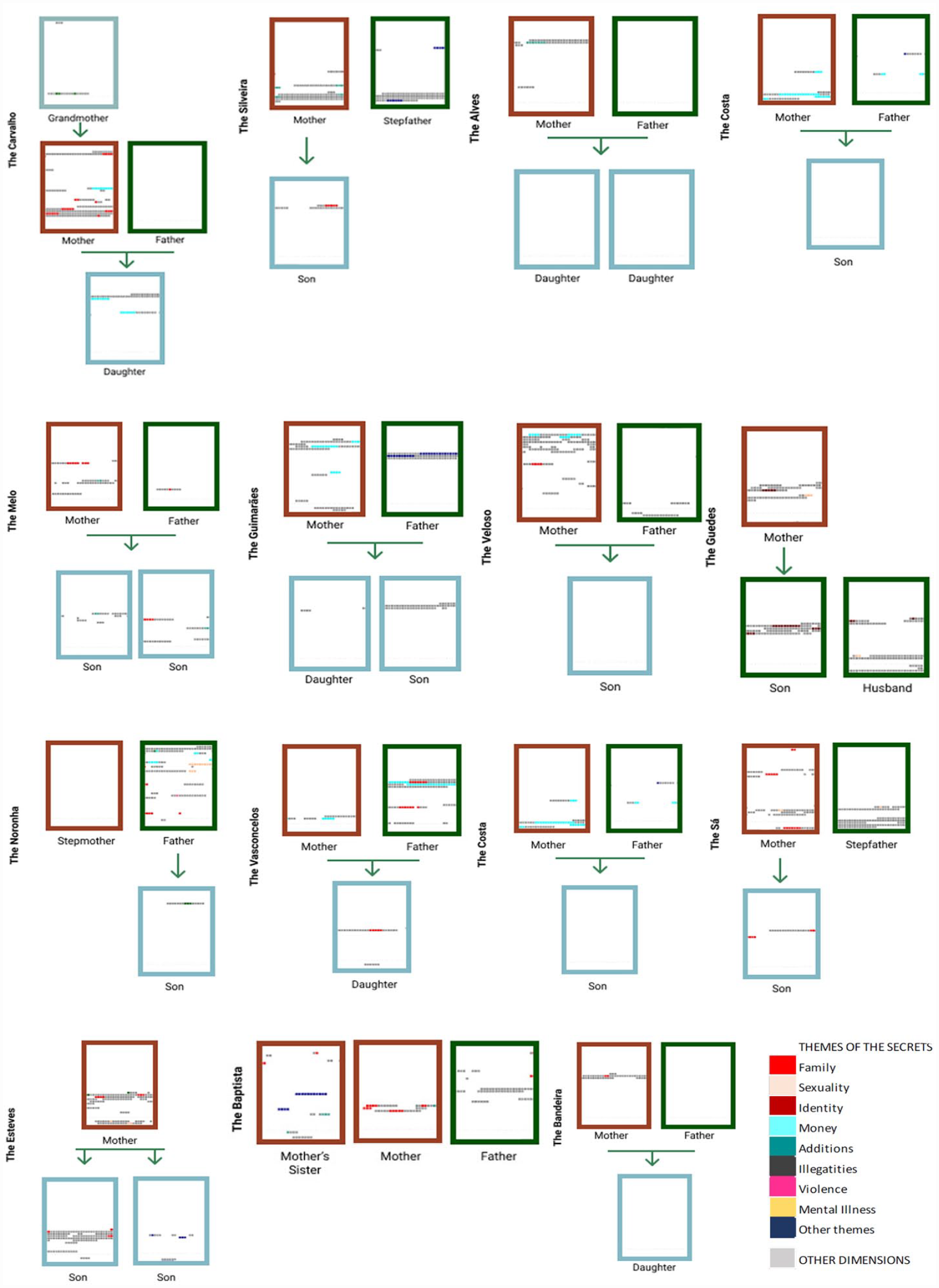
Secrets represented in individual document portraits for each interview (nested by family).
A first broad visual analysis of all the document portraits immediately reveals that most participants spoke, in greater or lesser detail/length, about family and/or individual secrets (and/or taboos). Despite being a present theme in the narratives, the interview was not immensely populated by this topic. The secrets did not take over the script, as much as they do not take over a life. It is not about the secret that people talked to us. It was never about telling us the secret. It was about telling us a story in which the secrets played a role. Not surprisingly, then, the secret told most of the time (48.6 percent of mentions of secrets) refers to oneself; it is part of an autobiographical account, and most of the remaining times it refers to the partner/spouse (as in secrets that they kept from the interviewee, making them, in a different way, part of their own life story). As the interviews were individual and the discourse was autobiographical, people resorted more often to their own secrets and to events linked to this secret, mentioning their impacts and consequences on others and linked lives. Moreover, sharing information about oneself might be easier, more likely, and less problematic from the point of view of family relationships and ethical standards that the participants, even if not perfectly consciously, followed. This reinforces the idea of secrets as autobiographical narrative devices.
We can also see the centrality of secrets by analyzing the recurrency in which families mention secrets. In more than half of the families, all the interviewees mentioned, even if en passant, one secret or taboo. In the other families, there is a discrepancy in the disclosure of secrets. This can be explained by different family dynamics. One scenario is that the secret is not a family secret, but a secret kept from the family and as such only mentioned by the interviewee. Another scenario, which can overlap with the previously mentioned, is that the secret is still “active,” and as such still makes sense to only very carefully display it, and while some members might have a more cautious approach, others can be more trustful in the interview process. A third common scenario is when the secret was kept from the interviewee by another participant. In these cases, the most frequent cases are when the secret—infidelity, debts—was kept from the wife. They opened up about these issues in the interviews, the partners did not.
It is relevant to underlay, to this regard, that the discrepancy of secret mention per family, which is only possible in such a research design based on family histories, actually provided the means to the identification of secrets, which were not possible otherwise. Had we not developed a family history research design, the likelihood of identifying secrets would have been quite smaller. As such, by interviewing many members of the family, paradoxically, the secret, kept but also told, is more visible. Secrets would still be secrets, but if kept from us as well, by the only person able to disclose it, we would not be able to identify them. This is arguably the most relevant contribution of the research, that is, the important impact of the multi-actor research design, a multi-member family research design, in the disclosure of a secret.
The second set of outputs confronts the mention of certain dimensions with the methodological instrument used at that moment of the research interaction (Figure 2). Having in mind that the interview is a unifying instrument in the overall interaction, what we see is that the calendar pushes for particular additional details on temporal aspects of the secret, such as the duration, the status (if the secret is active or not at the moment), the decade of the emergence of the secret, and the generational amplitude of the secret. It is, thus, a fundamental instrument that helped the interviewees to contextualize and chronologize the secret, and put biography and society into relation. Family trees, on the other hand, proved to have had an important part in the manifestation of feelings, as an expression of the relevance of the interpersonal, of how secrets tell stories of relationship endurances, successes, and failures. Feelings and emotions are among the most frequent aspects associated with secret telling, especially when it refers to family, reproduction, and money. The fact that this is enhanced by the instrument of the family trees is not a coincidence: issues concerning a significant other are most likely involved. The stories about marriages, divorces, infidelities, and financial addictions of hardships are stories of interpersonal trajectories. Money issues imply strategies of social mobility, objective living conditions, ambitions, and lifestyles. In what concerns the couple’s relationship, financial issues have been pointed out as one the most relevant reasons behind conflicts and discussions (Dew, Britt, and Huston 2012), reason why they may fall into the secret or taboo categories. Problems such as financial infidelity are also highly damaging and have an impact on personal and family trajectories (Garbinsky et al. 2020).
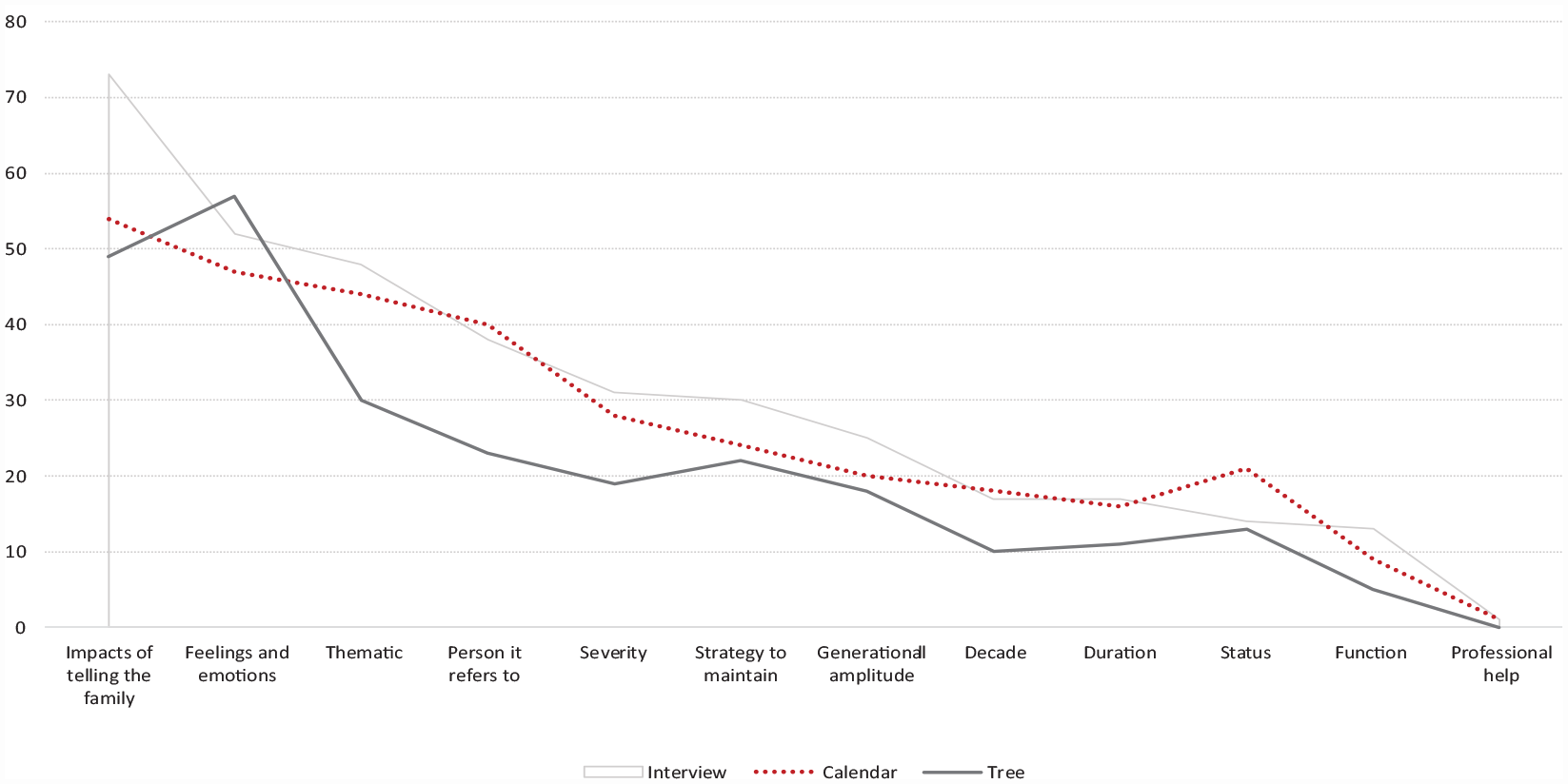
Dimensions of secrets mentioned per methodological instrument used (number of mentions in descending order of mentions in the interview).
The openness of the instruments used to direct the interview, the empathy used to conduct the interaction, and the multiplicity of the angles on the same family stories created an interpersonal and research environment conducive to secret-storytelling.
Final Remarks
Family histories are networks of serendipity that reveal much analytical potential, particularly when combined with different traditions and methodologies. The access and possibility of analysis of family secrets and taboos emerged in our study very much in function of the methodological design initially outlined, which envisaged doing family histories at different levels, capturing individual perceptions of these stories, and combining multiple perspectives in an open-ended approach.
By not addressing secrets directly in our research project, we were able to address other, perhaps more relevant, aspects of having and telling a secret. The act of talking about family secrets and taboos was a choice made by interviewees while telling us about their lives and families and giving them meaning. Those who did so chose to tell certain secrets and reflected on what they thought could be revealed at that moment according to their own ethical criteria (they talked much more about secrets and taboos that referred to themselves than to other family members, for example). The co-production of the family tree during the interview functions as a script-free part of the interview. It is this openness, not exclusively but predominantly of the family tree, that allows the participants to tell the stories in their own terms, with their particular episodes, relationships, and secrets. This is, arguably, one of the most important premises of qualitative research, in which the story of a life is best told in first person, with time, narrative freedom, safety, and comfort. Too strict agendas and scripts constrain this premise, serendipity, and people’s oral histories. Methods play, in this regard, an important part in this humanistic and qualitative sociological agenda.
Moreover, our research project design and the data collection tools used contributed to the incorporation of the secrets into a chronology, linked to life events, which occurred especially through the use of the life calendar during the interviews. This “chronologization” of secrets and taboos also implied a contextualization resource, as it is directly linked to society and its transformations, changes in standards, social values, as well as the acceptance of behaviors that were previously seen as susceptible to negative judgments and repression, such as issues of identity, sexuality, abortion, and reproductive behavior. Participants were quite explicit about the connection between their biographical secrets and the social environment of the time, putting the theoretical links of “biography and society” into common—realistic—biographical storytelling.
Another methodological tool for data collection, the family tree, was also fundamental for a better perception of the events and secrets that directly affect family relationships, bringing people and the different nuclei (branches) that make up the same tree, the same family, closer or further away. Looking at the family as a factory and observatory of secrets makes the relational characteristic of secrecy even more evident and concrete. After all, one keeps secrets from others. Secrets tell us as much about the person who hides them as about the people from whom they are hidden. This encapsulates the dynamics of secrecy.
Footnotes
Declaration of Conflicting Interests
The author(s) declared no potential conflicts of interest with respect to the research, authorship, and/or publication of this article.
Funding
The author(s) disclosed receipt of the following financial support for the research, authorship, and/or publication of this article: This article was developed in the scope of a Project funded by Fundação para a Ciência e Tecnologia (Reference PTDC/SOC-SOC/29132/2017).