




Abstract
Previous literature has found that noncitizens are punished in U.S. federal courts more severely than U.S. citizens for offenses that are legally equivalent, though less is known about variation in the noncitizen effect depending on the defendant’s nation of citizenship. Using United States Sentencing Commission (USSC) federal courts data from 2018 to 2020, we analyze group differences in the noncitizen penalty across regions of national origin. We draw from literature on group threat and the focal concerns perspective to guide our expectations. We find that noncitizens from all regions except Asia and North/West Europe have higher odds of being incarcerated compared with U.S. citizens, and noncitizens from Mexico, Central and South America, the Caribbean, and Africa receive longer sentence lengths than U.S. citizens. Implications concerning the theoretical mechanisms relevant to the noncitizen penalty are discussed.
Introduction
According to the Supreme Court, both documented and undocumented noncitizens living in the United States are granted the same Constitutional rights as U.S. citizens, including equal protection and due process of the law (e.g., Plyler v. Doe 1982; WongWing v. US 1896; YickWo v. Hopkins 1886). Just as criminal punishment should be neutral to race, ethnicity, gender, and religion, the court has held that citizenship status should not have an impact on criminal sentences. To ensure these protections, federal and state sentencing commissions have been established with the explicit goal of standardizing sentencing practices and reducing disparities through formal guidelines (United States Sentencing Commission [USSC] 2016).
Despite this definitive legal standard, research consistently finds that citizenship status affects a defendant’s sentence. In comparison to U.S. citizens, noncitizens are more likely to be incarcerated (Demuth 2002; Light 2014; Light, Massoglia, and King 2014; Wolfe, Pyrooz, and Spohn 2011) and less likely to receive downward departures from the recommended guidelines (Hartley and Armendariz 2011). Some studies also find that noncitizens are given longer prison sentences than citizens (Albonetti 2002; Kautt and DeLone 2006), though other studies do not find a noncitizen penalty for sentence length (Wolfe et al. 2011). Yet noncitizens are not a monolith, and scant attention has been paid to potential differences in punishment across noncitizen groups. It is important to analyze sentencing of noncitizen groups across different regions because public perceptions of these groups differ from each other both currently and historically, which likely translates into varied official responses to offending in the criminal justice system. 1
Most previous research on sentencing disparity has focused on race/ethnicity (for a discussion on this trend, see Baumer 2013). A small number of studies have found that noncitizens are penalized net of the disadvantage associated with their race/ethnicity (Light 2014; Wu and D’Angelo 2014). Yet the majority of research on citizenship and sentencing has not examined variation in the noncitizen effect by the defendant’s nation of citizenship (e.g., Light 2014; Light et al. 2014; Wu and D’Angelo 2014; Wu and DeLone 2012). The few studies that have done so limit analyses to drug offenses (Iles and Adegun 2018; Logue 2009), examine only courts outside of the continental United States (Iles 2009), compare within one ethnicity (Logue 2009), or do not provide a comparison to U.S. citizens (Iles and Adegun 2018). For multiple offense types, nation-wide analyses of disparities between noncitizens (across regions of national origin) and U.S. citizens are nearly absent in the extant literature.
A recent study by Koo, Feldmeyer, and Holmes (2022) is the only study to have done so, though our study extends their contribution in several ways. The theoretical framework in Koo et al. (2022) relies on the notion that certain groups are perceived to be more dangerous to the community than are other groups. As will be discussed in more detail, this theoretical contention is problematized by some of their regional categorizations. Our regional adjustments and corresponding theoretical discussion complicate the conceptual paradigms relied upon in prior studies.
Moreover, we examine only non-drug offenses in our supplementary analyses, which have not been reported in any prior study. On one hand, it is possible that the noncitizen penalty in federal courts is primarily driven by drug crime. Anti-immigrant rhetoric often revolves around drug crime (Finley and Esposito 2020), and drug law enforcement is the primary avenue by which immigrants in the United States are detained and deported (Tosh 2021). On the other hand, it is also possible that noncitizens are given more punitive sentences for all crime types because noncitizens may be perceived as more deviant than native defendants due to their offending being seen as an “abuse of U.S. hospitality” (Logue 2009:441). Determining whether there is a noncitizen penalty for non-drug offenses can indicate whether noncitizens are perceptually linked to crime extending beyond drug-related crime, which would implicate a more general image of criminality.
Furthermore, prior research on the regional variation of the noncitizen penalty has produced mixed findings regarding which regions are penalized most severely (e.g., Koo et al. 2022; cf. Iles and Adegun 2018). For this reason, research using more recent data is needed to establish whether there is a consistent pattern of disparity across regions of national origin for noncitizens in U.S. federal courts.
Using USSC federal courts data from 2018 to 2020, we analyze the currently understudied differences in the severity of punishment across noncitizen groups. Specifically, we compare the odds of incarceration and the sentence length for noncitizens from each region to those of U.S. citizens. Selective dynamics of focal concerns and group threat theory are used to conceptually guide and inform our analyses. As is common in sentencing literature (e.g., Iles and Adegun 2018; Koo et al. 2022), we are unable to provide explicit tests for all of the theoretical mechanisms we consider (for more details on this limitation, see Lynch 2019). Our findings show that immigrants are not treated equally to U.S. citizens in federal courts, though there is variation in the severity of citizen-noncitizen disparity across the regions of national origin. We suggest that a constellation of factors (e.g., group size, depictions in attitudinally influential sources of public rhetoric, etc.) may combine to create distinct perceptions of various noncitizen groups and, in turn, lead to disparity in criminal punishment.
Selective Dynamics of Group Threat
A central mechanism of the sentencing disparity between citizens and noncitizens, we posit, stems from the threat that the “subordinate” group poses to the “dominant” group. It has long been theorized that feelings of prejudice develop among members of the dominant group when they sense that the subordinate group has altered their position (and thus, challenged that of the dominant group) within the hegemonic hierarchy of group memberships (Blalock 1967; Blumer 1958). With this occurrence, the dominant group no longer perceives members of the subordinate group on the basis of their respective individualities, but rather on an abstract image of the latter’s collective. Group threat dynamics are easily applicable to citizen-noncitizen relations, as noncitizens take on an “outsider” status and are often perceived by the “insider” group as threatening the economic and/or symbolic order of the given society.
We suggest that established patterns in reactions to threat can help make sense of the relationship between non-citizenship and severity of sentencing. When in antagonistic relation, it has been theorized that groups seek to actualize a high degree of unified organization to develop an advantage over the opposing group (Simmel 1955). A group’s centralization of authority, Simmel (1955) contends, is key to successful organization against the adversary collective. Relatedly, research in political science and social psychology has found strong associations between perceived threat and respect for authority (Hetherington and Suhay 2011; Lavine et al. 2005). In reaction to threat, individuals seek a sense of order by supporting the legitimacy of social and political institutions that offer control (Kay et al. 2009).
Court actors are not free of these psychological dispositions, and thus, if they perceive a threat from a particular group, it could be reasonably envisaged that they channel their reaction to said threat through their means of institutional influence. The goals that court actors center their assessments around are delineated by the focal concerns perspective. According to this perspective, said goals are (1) determining the defendant’s culpability and blameworthiness, (2) protecting the community from harm, and (3) adhering to practical and organizational constraints of the jurisdiction (Steffensmeier, Ulmer, and Kramer 1998).
Guided by these priorities, court actors use the information available to them, known or inferred, to evaluate the defendant and select a sentence within the boundaries established by the law. Court actors cannot have all of the information that would be required to make a “fully rational” decision, however (Albonetti 1991). They do not know, for example, the exact likelihood of recidivism for each defendant. Faced with unavoidable uncertainty, court actors make decisions using both legally relevant (e.g., criminal history) and legally irrelevant (e.g., citizenship status) characteristics to infer latent qualities of the defendant (Albonetti 1991; Steffensmeier, Painter-Davis, and Ulmer 2017). 2 We contend that assessments of dangerousness are influenced by the defendant’s status as a noncitizen, which is pertinent to concerns related to community protection. This dynamic may be especially relevant to undocumented immigrants, who could be perceived as carrying an inherently illegal and thus blameworthy identity.
To guide our expectations of how court actors’ inferences differ by region of citizenship, we draw on selective aspects of competitive threat theory. Competitive threat theories are primarily concerned with conflict over scarce resources (Bobo 1999; Sherif and Sherif 1953) and the relative size of the outgroup (Blalock 1967; Quillan 1996). According to this theoretical perspective, intergroup competition intensifies as the relative size of the subordinate group increases, which leads to feelings of hostility and prejudice toward the outgroup. Consistent with this perspective, previous research has found that racial/ethnic minority defendants are perceived as threatening to their communities and, consequently, receive harsher sentences when their populations are large and/or increasing (Jacobs, Carmichael, and Kent 2005; Wang and Mears 2015). Similarly, Light et al. (2014) find that districts with a larger concentration of immigrants sentence noncitizens more harshly than do districts with a smaller concentration of immigrants. As immigration has been on the rise in the United States since the early 2000s, perceptions of noncitizens as threatening could have also materialized, which may have translated into a tightening of social control over noncitizens (Feldmeyer et al. 2015).
However, it would be a mistake to reduce this matter to group size alone. For example, research on this topic is sometimes concerned with the subjective perception of the size of certain migrant groups, rather than their actual size (Glaser 2003). This criticism is not without basis, as research has found that dominant groups tend to overestimate the size of the subordinate group (Sides and Citrin 2007; Sigelman and Niemi 2001). Relatedly, Wang (2012) shows that the perceived size of the Hispanic immigrant population has more of an influence on perceptions of Hispanic criminality than does their actual size. Furthermore, if sentencing disparities were determined solely by group size, it would be logically consistent to predict that all large groups, such as Asian and European immigrants, receive particularly harsh punishments. This is not an expectation we hold, however, as these are among the least likely groups to arouse suspicion of criminality (Flores and Schachter 2018).
While we believe that group size is relevant to the formation of perceived threat, we propose that this component of group threat combines with the socially constructed underpinnings of perceived illegality. Previous research has found that media images and political rhetoric influence perceptions of criminality (Callanan 2012), and Mishler and Sheehan (1993) find that public opinion has an impact on the perceptions of court actors. In tandem, these findings are troubling considering that certain media outlets tend to over-represent xenophobic rhetoric (Bail 2012). Thus, we suggest that a group’s image (e.g., being commonly portrayed as dangerous by attitudinally influential sources) and size are, by themselves, not particularly influential factors for sentencing severity. Rather, it is more likely that factors such as perceived threat, size, and public rhetoric combine with one another to jointly influence sentence severity. Regardless of intention, court actors are not immune to the influence of public rhetoric, nor to reaching for sources of control in reaction to materialist and/or ideational threat.
Previous Research
The bulk of sentencing research to date has examined the influence of defendant race/ethnicity on sentence severity. Baumer (2013:234) estimates that there are “hundreds” of studies that compare sentence severity between Black and White convicted felons. Work on racial/ethnic disparity in sentencing continues to proliferate because evidence of such disparity is clear: non-White defendants are treated more harshly than their White counterparts, even controlling for a host of potential confounders (Demuth and Steffensmeier 2004; Spohn and Beichner 2000). Non-White defendants are more likely to be perceived as violent than are Whites (Rios 2011), though despite the belief among scholars that immigrants are also stereotyped as dangerous (Feldmeyer and Ulmer 2011; Harris and Feldmeyer 2013), considerably less work has examined sentencing disparity between citizens and noncitizens.
A small but growing subset of sentencing research examines whether group threat theory is applicable to the sentencing of noncitizens (Light et al. 2014; Wu and D’Angelo 2014). Studies have found evidence of greater sentence severity for noncitizens compared with citizens (Light et al. 2014), particularly in areas with growing immigrant populations (Wu and D’Angelo 2014). Support for this application of group threat has been inconsistent, however (for findings contrary to this aspect of group threat theory, see Feldmeyer et al. 2015; Holland 2018), and evidence suggests that harsh punishment of Hispanic immigrants does not always materialize, especially in places where Hispanic immigration has historically been high (Ulmer and Parker 2020).
Yet prior research on citizen-noncitizen disparity in punishment is limited in that it typically examines one race/ethnicity (Ulmer and Parker 2020), noncitizens as one group (Light 2014; Wu and D’Angelo 2014), or only drug offenses (Demuth 2002; Hartley and Armendariz 2011; Iles and Adegun 2018; Logue 2009). Furthermore, in a study that examined homicide offenses in Texas, Orrick et al. (2021) found that noncitizens are incarcerated less frequently than U.S. citizens, adding to the uncertainty as to whether there is a noncitizen penalty for all offense types. Although evidence of sentencing disparity between citizens and noncitizens has accumulated in recent years, it is unclear which noncitizen groups are most severely sentenced, and for which offense types.
We are aware of only one study (Koo et al. 2022) that has contributed to filling this gap in the literature. We extend this contribution in several ways. Our study analyzes more recent data (2018–2020), which is warranted because previous research has produced mixed results on the regional variation of the noncitizen penalty (e.g., Koo et al. 2022; cf. Iles and Adegun 2018)—variation that could be attributed to the different time periods that have been examined.
In addition, Koo et al. (2022) find that the punishments Asian noncitizens receive are not as severe as the punishments that groups of other regions face, and conclude that these results align with the focal concerns perspective. However, it is uncertain that this is the case, for they place countries from both the Middle East and East Asia under their “Asian” regional category. Because of the common perceptual connection between Islam and terrorism, citizens of Middle Eastern nations are often depicted as dangerous in public spheres (Bail 2012; Haynes 2020), whereas East Asian immigrants are among the least likely of groups to elicit suspicion of crime (Flores and Schachter 2018). Since a group’s perceived dangerousness is a central theoretical aspect guiding sentencing research, it is important to separate Middle Eastern and East Asian nations into different regional categories. Koo et al. (2022) recognize that there may be meaningful within-group variation that is not captured in their regional categorizations (see Koo et al. 2022). We agree that there is a need for more focus on such regional variation, as the intricacy delineated here may complicate the application of the focal concerns perspective to citizen-noncitizen punishment disparity.
It is also noteworthy that the regional categorizations for European countries in Koo et al. (2022) differ from those in the present study. Koo et al. (2022) divide European countries into “Eastern European” and “Western European,” between which they find no meaningful differences. In this article, we divide noncitizens from Europe into “North/West Europe” and “South/East Europe” because, historically speaking, Southern and Eastern Europeans have been perceived as racially inferior to Northern and Western Europeans (for a more detailed discussion on this boundary, see Fox and Guglielmo 2012). 3 To determine whether this historical matter has spillover effects, we separate Southern European countries from countries in Northern and Western Europe.
Finally, we extend prior work by examining only non-drug offenses in supplementary analyses. Prior studies of noncitizen sentencing disparity have examined only drug offenses based on the assumption that (especially Latin American) immigrants are perceptually linked to drug crime in public discourse (e.g., Iles and Adegun 2018; Logue 2009). However, noncitizens may be penalized for any offense if they are perceived as more deviant than native defendants, solely on the basis of their immigrant status (Hagan, Levi, and Dinovitzer 2008). We assess whether immigrants from all regions of the world are perceived as generally more criminal than are U.S. citizens or, conversely, whether the disparity is driven by drug crime for particular regions.
Expectations
The noncitizen penalty has received little attention in the extant literature, and even less research has focused on the noncitizen effect across regions of national origin. There is a need for more analyses that focus on potential regional variations in punishment between noncitizen groups with recent data across multiple offense types. Furthermore, a comparison between drug offenses and non-drug offenses has yet to enter the scope of any previous analysis. There is also a need for adjustments in the regional categorizations of national origin that have been analyzed in prior work to better align with the core contentions of focal concerns and group threat theories.
Based on our theoretical discussion and the results of prior research, we expect noncitizens to receive more severe incarceration and sentence length decisions than U.S. citizens, net of other factors. In addition, we expect the noncitizen penalty to be stronger for groups that are depicted as dangerous and threatening (e.g., Mexican, South American, Central American, Caribbean, Middle Eastern, and African) than for noncitizens who are not depicted in such a way (e.g., European, Canadian, Asian). Moreover, we expect the noncitizen penalty to be weakened but remain statistically significant after the inclusion of undocumented status as a control variable, as prior research indicates that both documented and undocumented noncitizens are treated more harshly than U.S. citizens. Regarding offense types, we expect to find a noncitizen penalty for these regions even in analyses that examine only (1) non-drug crime and (2) non-immigration crime.
The Current Study
We analyze federal courts data provided by the USSC for fiscal years 2018, 2019, and 2020. These data contain detailed information about each defendant and offense as well as case-processing factors and the applicable legal guidelines. USSC data are well suited for our study because state courts do not systematically collect information about the defendant’s citizenship status or national origin. All offense types are included in the primary analyses. We separately analyze (1) drug and non-drug offenses and (2) immigration and non-immigration offenses in supplementary analyses. Immigration and non-immigration offenses are analyzed separately because sentence lengths for defendants convicted of immigration crime likely differ for noncitizens compared with U.S. citizens due to the possibility of deportation for the former. However, U.S. citizens are still convicted of immigration offenses in U.S. federal courts, and thus citizen-noncitizen disparity remains of interest. 4
Dependent Variables
Two dependent variables are examined separately: (1) the decision to incarcerate, and (2) sentence length. 5 Incarceration is a dichotomous measure indicating whether the defendant was sentenced to incarceration (federal prison) for any amount of time (yes = 1). Sentence length is observed only for defendants sentenced to incarceration and is measured as the number of months sentenced. Sentence length is capped at 470 months (which is consistent with commission practice; USSC 2016) and analyzed as the natural log to reduce skewness.
Focal Independent Variables
Due to the large number of nations that the defendants are from, we categorize countries into geographic regions of the world (see Supplemental Appendix A). The geographic regions of citizenship in this analysis are South America, Central America, the Caribbean, Asia, North/West Europe, South/East Europe, Africa, the Middle East, Canada, and Mexico (with the United States as the reference category). Noncitizens from Mexico make up 26.08 percent of cases, and, for this reason, Mexico is separated into its own category. In addition, the public discourse surrounding Mexican immigration in the United States is more frequent and divisive than it is for other immigrant groups (e.g., Heuman and González 2018), which could translate into especially harsh sentencing of Mexican noncitizens. We account for legal status by including an indicator for whether the defendant is an undocumented immigrant (1 = yes). 6 In Supplemental Appendix B, we report the number of documented and undocumented noncitizens from each region.
Defendant Characteristics
Our analysis accounts for potential confounders by statistically controlling for extra-legal defendant characteristics that we expect to influence sentence outcomes based on prior research. Sex is measured dichotomously (male = reference). Age is included as a continuous variable and as a squared term to account for the nonlinear effect of age (Steffensmeier, Kramer, and Ulmer 1995). The race/ethnicity of the defendant is categorized by the USSC as non-Hispanic White (reference), non-Hispanic Black, Hispanic, and “other” race/ethnicity. In Supplemental Appendix C, we report the percentages of each race/ethnicity by region of citizenship to provide an indication as to whether differences in noncitizen penalties align with differences in the racial/ethnic diversity of defendants. 7
Case Characteristics
We include all legally important characteristics of the case, which should explain most of the variation in sentencing (Engen and Gainey 2000). Offense type falls into the following categories: violent, drug, firearms, immigration, property/corruption/fraud, and all other offenses. 8 Following prior work (e.g., Iles and Adegun 2018), we account for several covariates that are standard in sentencing research: whether the case involved a departure from the recommended guidelines (upward, downward, government sponsored), mode of conviction (e.g., trial), a mandatory minimum, multiple charges, prior criminal history (using the USSC scale), and presumptive sentence (analyzed as the natural log of guidelines minimum).
Analytic Strategy
The analysis begins with a basic description of the data. Two models are then estimated for each outcome (i.e., incarceration and sentence length). The first model estimates the effects of documentation status and region of citizenship unadjusted for the control variables. The second model estimates these effects after adjusting for controls. We use logistic regression models for the dichotomous incarceration decision because the logistic function is able to model the non-linearity of the dependent variable. Ordinary least squares regression modeling is used to predict (the natural log of) sentence length due to the normal distribution of the outcome. We control for the clustering of data at the court-level and account for (but do not explicitly model) between-court effects by estimating each model with district fixed effects (for similar practices, see Koo et al. 2022). For ease of interpretation, estimates from the adjusted models are displayed graphically in coefficient plots. We then re-estimate all models comparing drug and non-drug offenses as well as immigration and non-immigration offenses. Due to the small number of cases for regions aside from Mexico, Central and South America, and the Caribbean, we combine the other regions into a separate category (entitled “all other regions”) for these analyses of drug and immigration offenses (see Tables 3 and 4) to retain sufficient statistical power.
Results
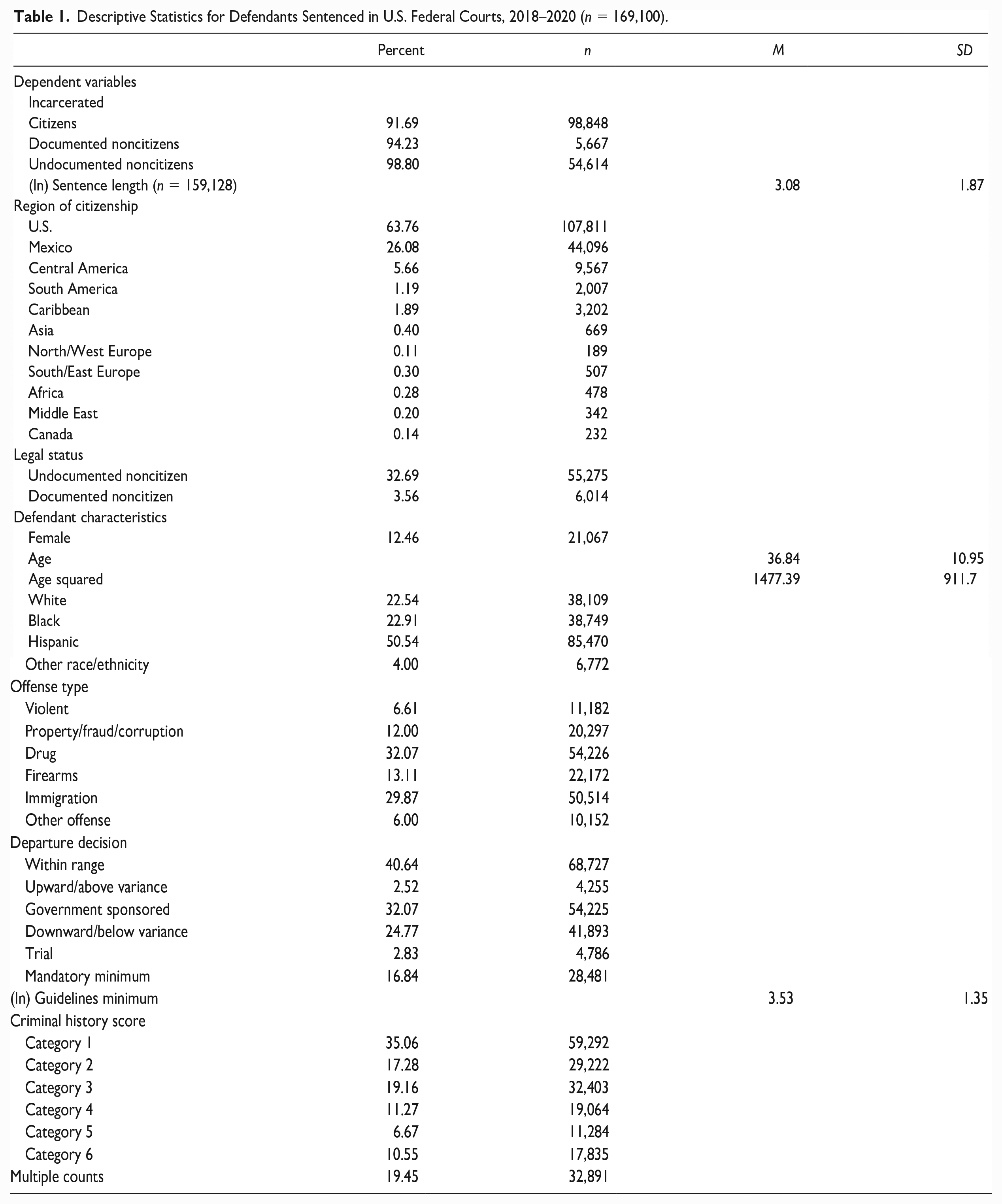
Table 1 presents the descriptive statistics of the USSC 2018–2020 data sets. As is typical of federal courts data, most of the defendants are sentenced to incarceration (94.10 percent). A smaller percentage of U.S. citizens are sentenced to incarceration (91.69 percent) compared with both documented (94.23 percent) and undocumented (98.80 percent) noncitizens. There are more undocumented (32.69 percent) than documented (3.56 percent) noncitizen defendants in these data. About 63.76 percent of defendants are U.S. citizens, 26.08 percent are Mexican citizens, 5.66 percent are citizens of nations in Central America, 1.19 percent are citizens of nations in South America, and 1.89 percent are citizens of nations in the Caribbean. Each of the other regions contains less than 1 percent of the defendants. Most of the defendants are male (87.54 percent) and the average age is 36.84. Non-Hispanic Whites compose 22.54 percent of defendants, while 50.54 and 22.91 percent of defendants are Hispanic and non-Hispanic Black, respectively. Defendants within the “other” racial/ethnic category make up 4.00 percent of the cases. Drug and immigration offenses each make up about a third of the cases (32.07 and 29.87 percent, respectively).
Descriptive Statistics for Defendants Sentenced in U.S. Federal Courts, 2018–2020 (n = 169,100).
Incarceration
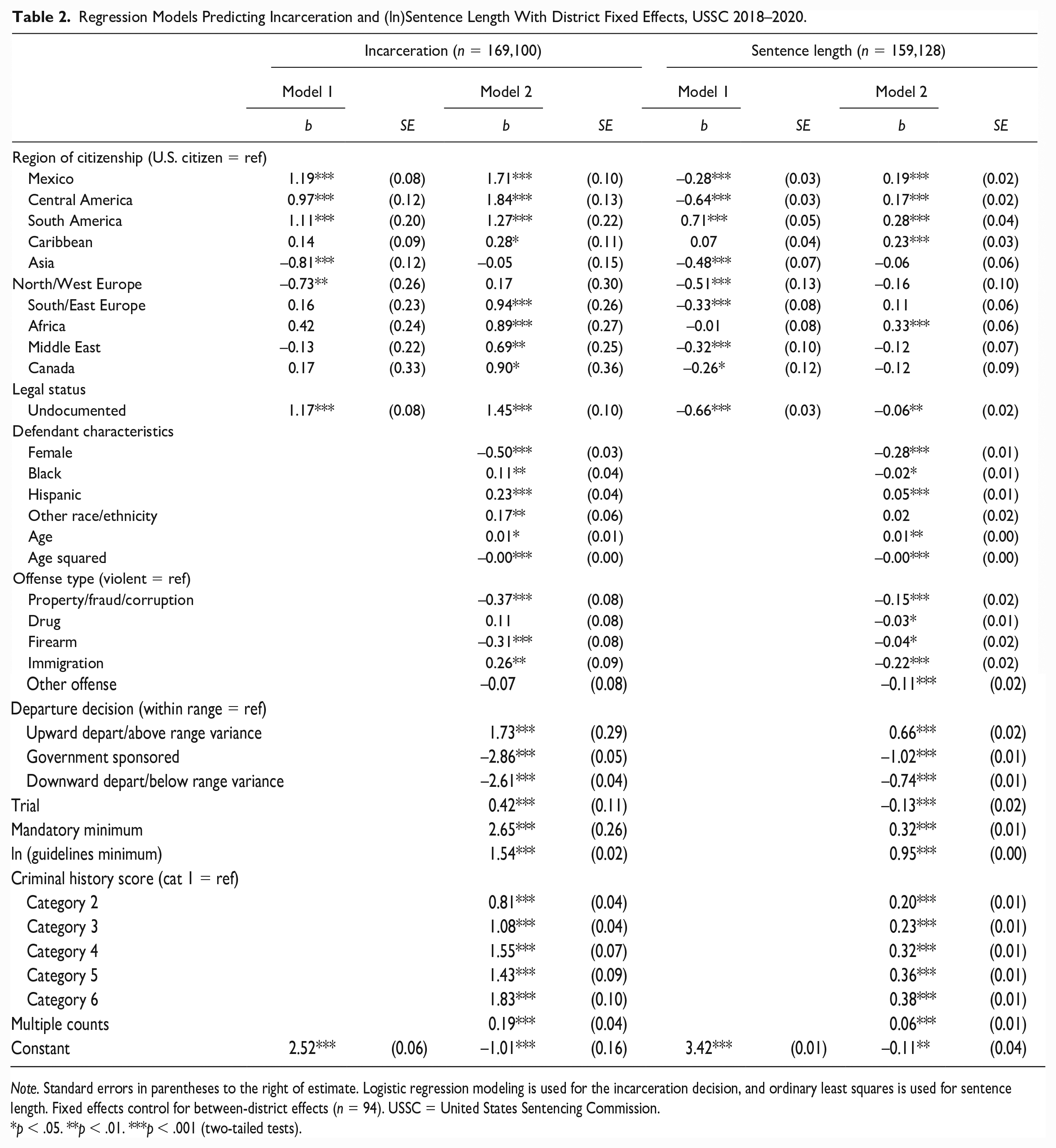
The two columns on the left-hand side of Table 2 present the results of the logistic regression models predicting incarceration. Unadjusted for controls (Model 1), being undocumented is associated with a 3.23 (p < .001) factor increase in the odds of incarceration (b = 1.17, exponentiated b [i.e., OR] = 3.23). Model 1 also shows that the odds of incarceration are higher for noncitizens from Mexico (b = 1.19; OR = 3.27; p < .001), Central America (b = 0.97; OR = 2.64; p < .001), and South America (b = 1.11; OR = 3.02; p < .001) compared with U.S. citizens, whereas the odds are lower for noncitizens from Asia (b = −0.81; OR = 0.44; p < .001) and North/West Europe (b = −0.73; OR = 0.48; p < .001) compared with U.S. citizens. The effects are statistically nonsignificant for all other regions.
Regression Models Predicting Incarceration and (ln)Sentence Length With District Fixed Effects, USSC 2018–2020.
Note. Standard errors in parentheses to the right of estimate. Logistic regression modeling is used for the incarceration decision, and ordinary least squares is used for sentence length. Fixed effects control for between-district effects (n = 94). USSC = United States Sentencing Commission.
p < .05. **p < .01. ***p < .001 (two-tailed tests).
Model 2 (see also Figure 1) presents the estimates for the effect of citizenship status and region on incarceration odds controlling for case and defendant characteristics (i.e., the adjusted model). The effect of being undocumented is again positive and statistically significant (b = 1.45; OR = 4.27; p < .001). Citizens from Mexico (b = 1.71; OR = 5.55; p < .001), as well as from nations in Central (b = 1.84; OR = 6.29; p < .001) and South America (b = 1.27; OR = 3.57; p < .001) each have increased odds of incarceration compared with U.S. citizens. Notably, the coefficients for Mexico and Central America are particularly large (being a noncitizen from Central America, for example, is associated with more than a sixfold increase in the odds of incarceration relative to U.S. citizens). Noncitizens from nations in South/East Europe (b = .94; OR = 2.57; p < .001), Africa (b = .89; OR = 2.42; p < .001), the Middle East (b = .69; OR = 1.99; p < .001), the Caribbean (b = .28; OR = 1.33; p < .05), and Canada (b = .90; OR = 2.46; p < .05) also have higher incarceration odds than U.S. citizens. Citizens of nations in Asia and North/West Europe do not significantly differ from U.S. citizens in their odds of incarceration.
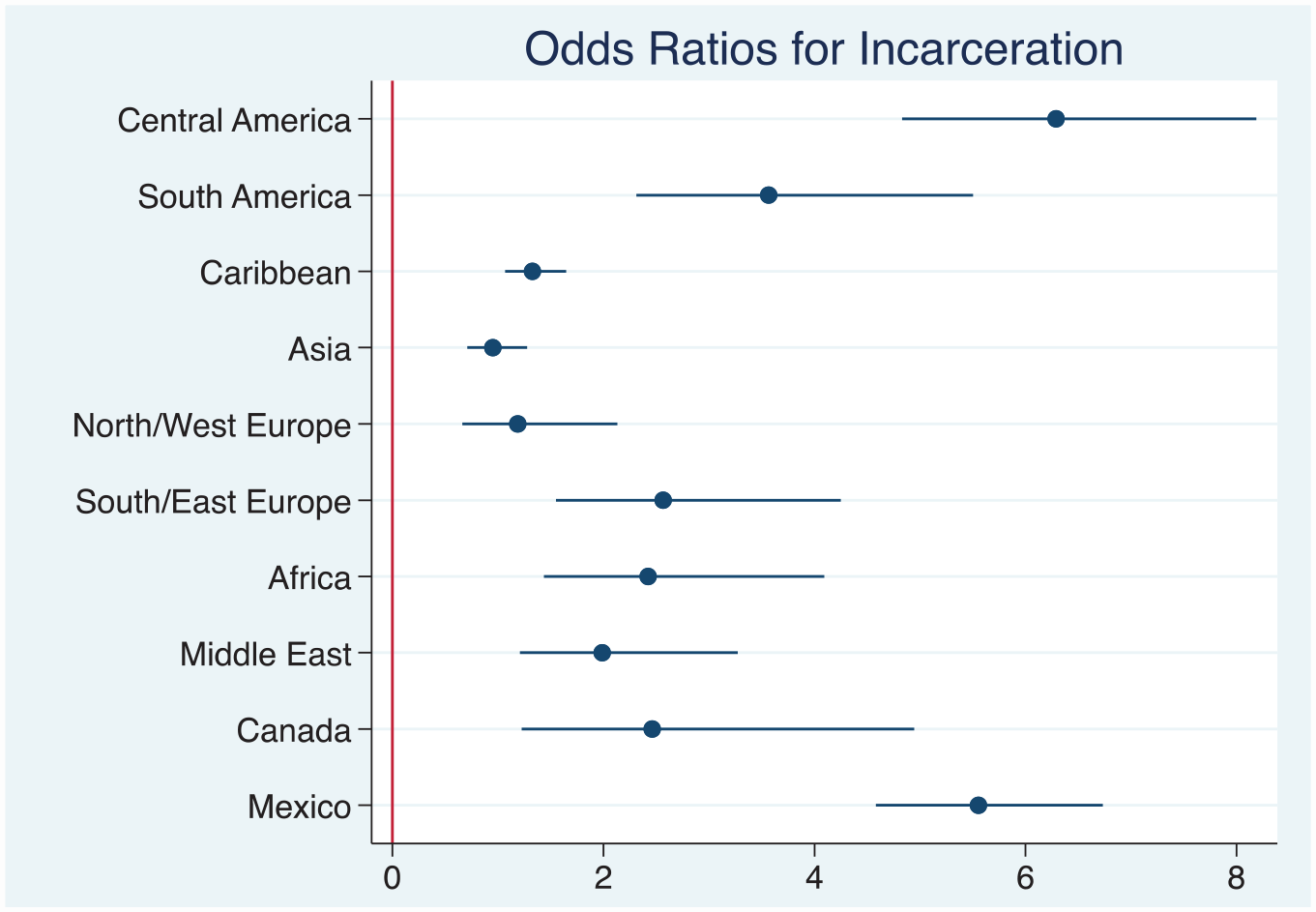
Odds ratios of incarceration for federal defendants by region of citizenship, USSC 2018–2020.
Sentence Length
The two columns on the right-hand side of Table 2 display the results of the models predicting sentence length among defendants sentenced to incarceration (n = 159,128). In the unadjusted model (Model 1), undocumented status has a negative association with sentence length (b = −0.66; p<.001), indicating a shorter prison sentence. Model 1 also shows that, absent controls, there is a negative effect on sentence length for all regions except for the Caribbean and Africa.
After adjusting for controls (see Model 2 and Figure 2), undocumented status is associated with a smaller decrease in sentence length than in Model 1 (b = −0.06; p < .01). Noncitizens from Mexico, nations in Central and South America, the Caribbean, and Africa each receive longer sentence lengths compared with U.S. citizens (effect sizes ranging from b = 0.17 for Central America to b = 0.33 for Africa). Noncitizens from nations in Asia, North/West Europe, South/East Europe, the Middle East, and Canada are given sentence lengths that do not significantly differ from those given to U.S. citizens.
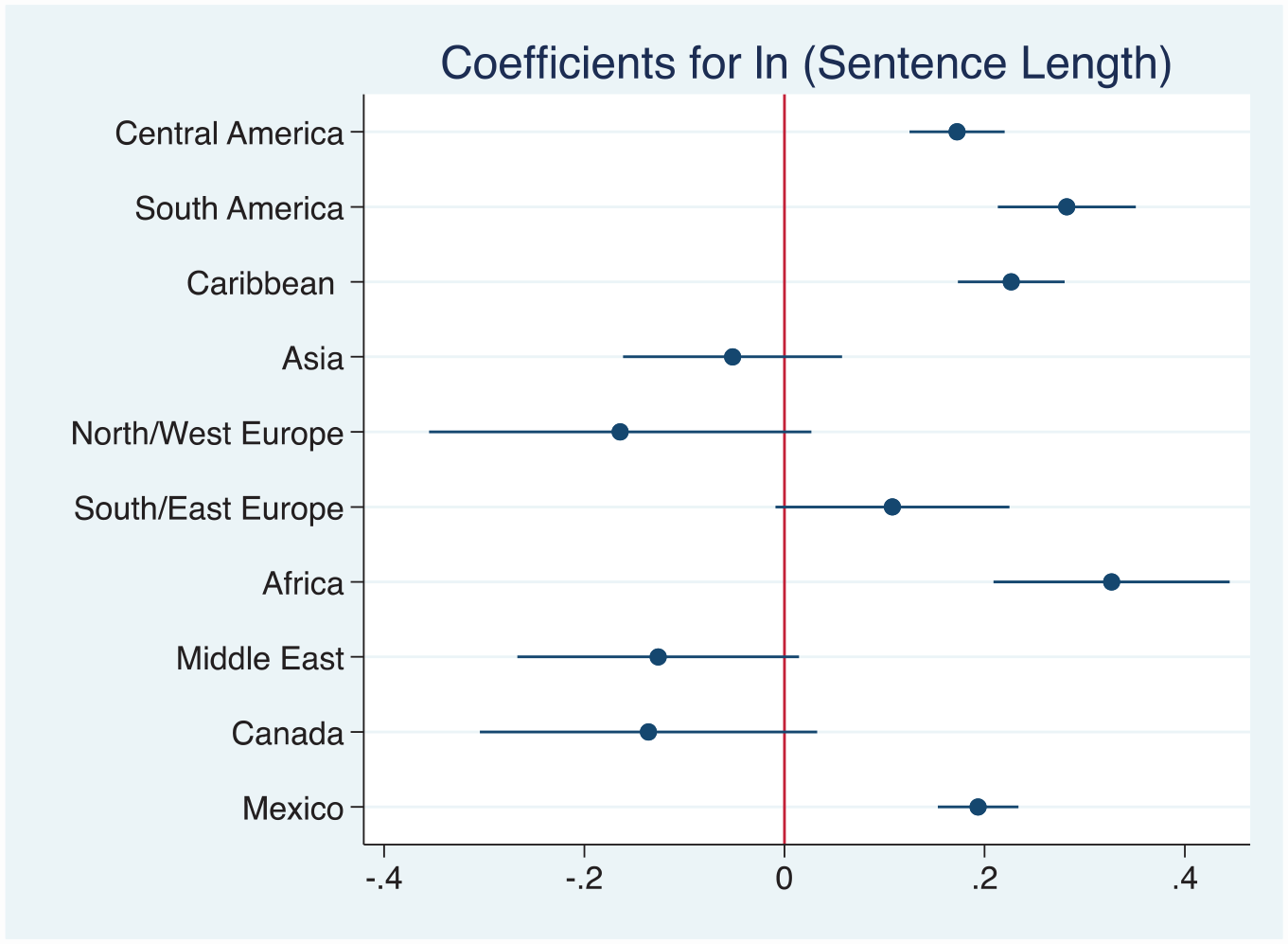
Coefficients for ln (sentence length) for federal defendants by region of citizenship, USSC 2018–2020.
Supplementary Analyses
We re-estimated each of the full (i.e., adjusted) models including (1) only drug-related offenses and (2) only non-drug offenses (Table 3). We then repeated this procedure for only immigration as well as only non-immigration cases (Table 4). For drug offenses (n = 54,226), increased odds of incarceration (in comparison with U.S. citizens) is associated with being a noncitizen from Mexico, as well as from nations in Central America and the Caribbean. Being a noncitizen from South American nations as well as nations in the “all other regions” category, on the other hand, is not associated with a difference in incarceration odds. The sentence length for drug offenses is longer for all regions in comparison with U.S. citizens.
Regression Models of Incarceration and ln(Sentence Length) for Drug and Non-drug Offenses, USSC 2018–2020.
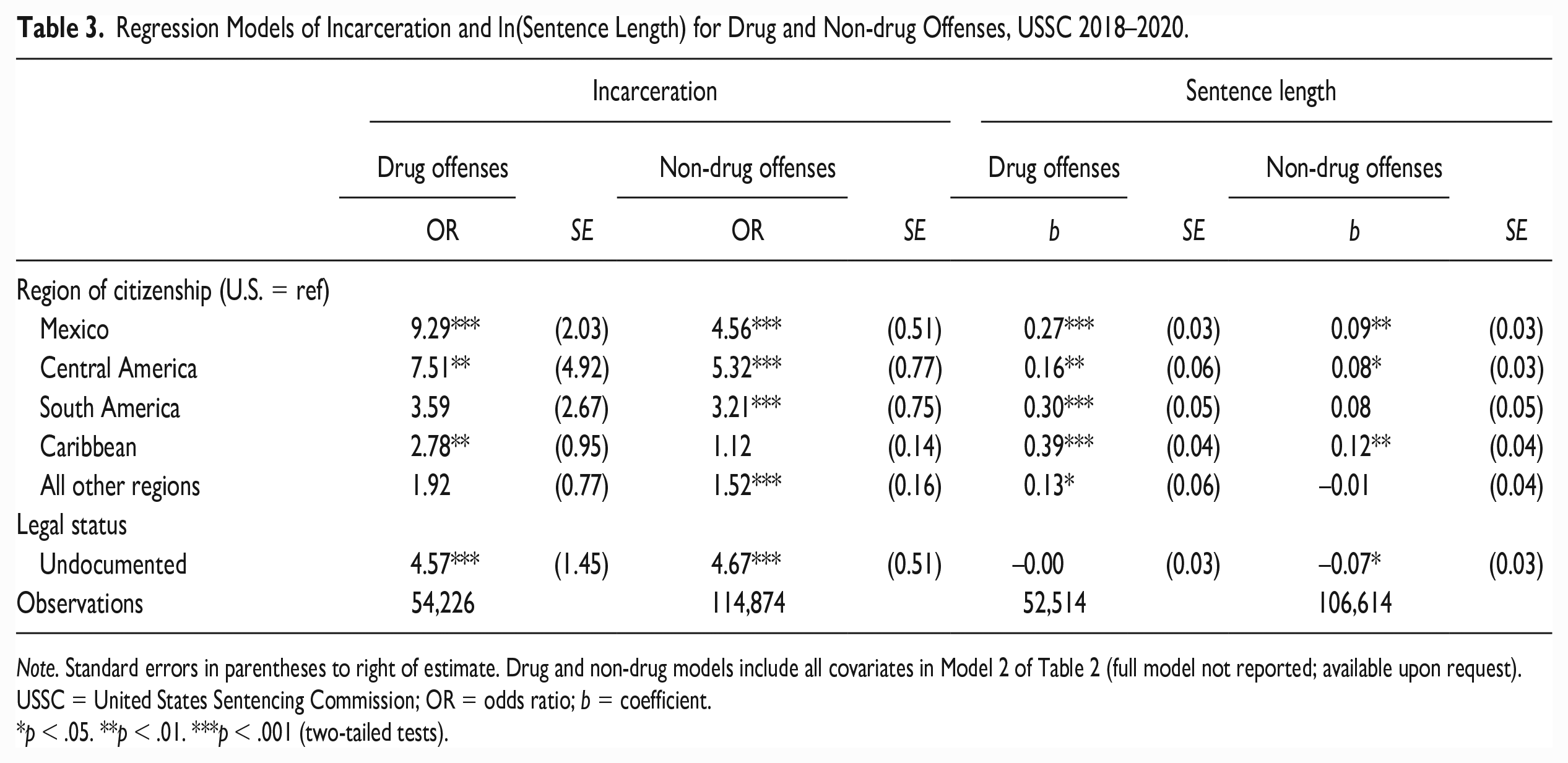
Note. Standard errors in parentheses to right of estimate. Drug and non-drug models include all covariates in Model 2 of Table 2 (full model not reported; available upon request). USSC = United States Sentencing Commission; OR = odds ratio; b = coefficient.
p < .05. **p < .01. ***p < .001 (two-tailed tests).
Regression Models of Incarceration and ln(Sentence Length) for Immigration and Non-immigration Offenses, USSC 2018–2020.
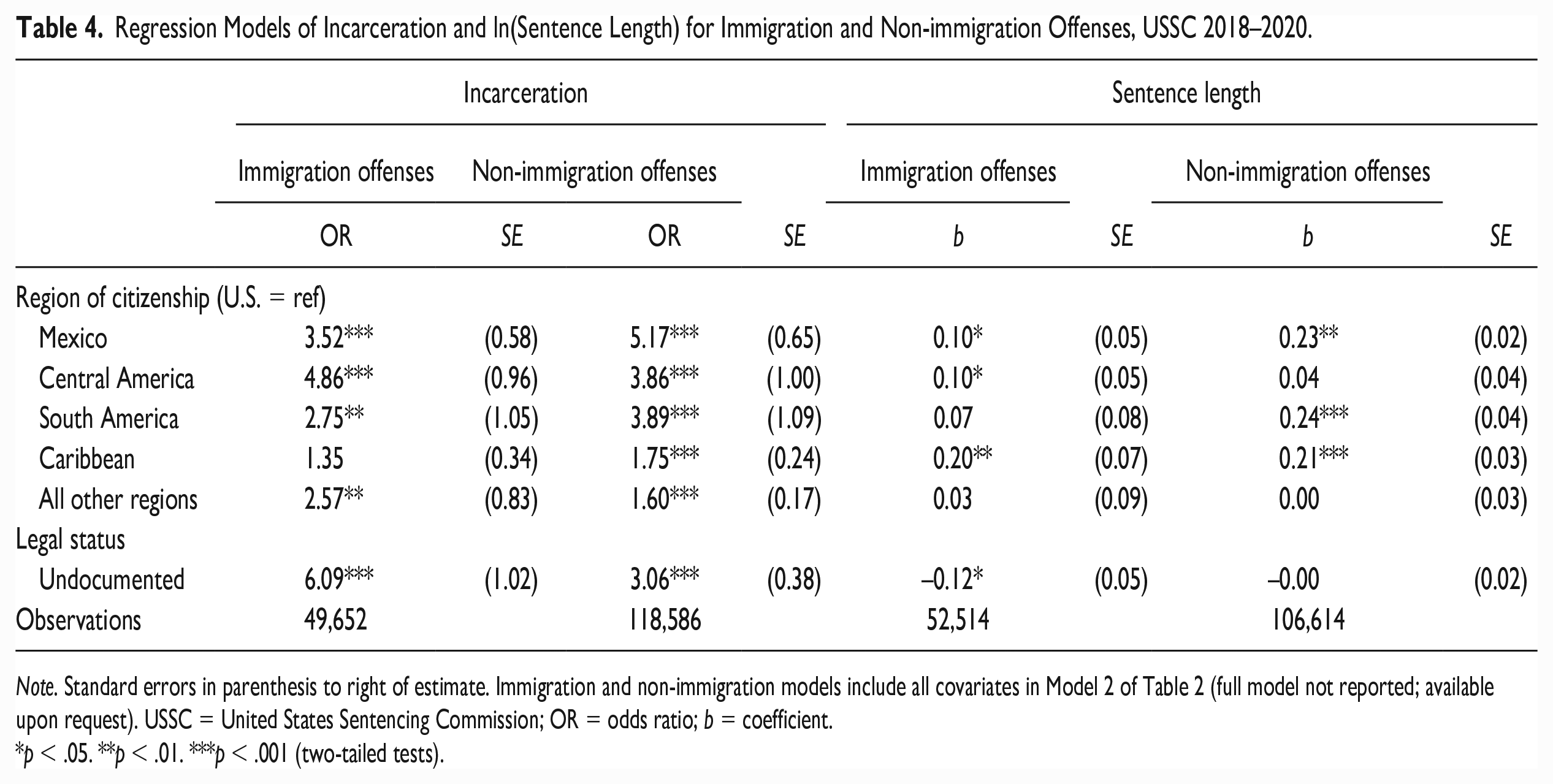
Note. Standard errors in parenthesis to right of estimate. Immigration and non-immigration models include all covariates in Model 2 of Table 2 (full model not reported; available upon request). USSC = United States Sentencing Commission; OR = odds ratio; b = coefficient.
p < .05. **p < .01. ***p < .001 (two-tailed tests).
For non-drug offenses (n = 114,874), being a noncitizen from all of the regions is positively associated with odds of incarceration, with the exception of the Caribbean. Sentence length for non-drug offenses is longer for all regions aside from South America and the “all other regions” category. Overall, these analyses suggest that the noncitizen penalties for Mexico and Central America are the most consistent across drug and non-drug offenses. These results also suggest that punishment disparities between U.S. citizens and noncitizens (for all regions) are generally greater for drug offenses than non-drug offenses (see Table 3).
Table 4 presents the results of our analyses of immigration (n = 49,652) and non-immigration (n = 118,586) offenses. Except for the Caribbean, the results indicate that citizenship from nations in all regions is associated with higher odds of incarceration for immigration offenses. However, noncitizens from the Caribbean, Mexico, and Central America are given longer sentence lengths than are U.S. citizens (b ranging from 0.10 to 0.20, p < .01). For non-immigration offenses, all associations between citizenship region and incarceration odds are positive and statistically significant. Regarding sentence length for non-immigration offenses, we observe positive associations for noncitizens from Mexico, as well as from nations in South America and the Caribbean. These analyses suggest that the noncitizen penalty for all regions extends beyond immigration crime.
As an additional supplementary test, we evaluate whether there is evidence of an interaction effect between undocumented legal status and being a Mexican noncitizen for each outcome (see Supplemental Appendices D and E). We expected that, relative to noncitizens from other regions, Mexican noncitizens would experience a particularly harsh punishment when they are undocumented (vs. documented) because they have largely been the target of negative stereotypes and social criminalization, and thus, an inherently illegal status (i.e., being undocumented) might lead to especially severe punishment. However, contrary to our expectations, we find that the interaction term for being a Mexican noncitizen and undocumented has a negative association with both odds of incarceration (OR = 0.53; p <.01) and sentence length (b = −0.22; p < .01). 9 These findings indicate that the positive effects on both sentence length and odds of incarceration attributable to being a noncitizen from Mexico are not greater when the defendant is undocumented.
Finally, we conducted sensitivity analyses to address the possibility that our findings reflect alternative explanations rooted in more subtle social causes, such as capacity to secure quality legal counsel or ability to navigate U.S. legal institutions. As our analyses did not explicitly test whether punishment disparities are due to the (conscious or unconscious) behavior of court actors, it is possible that unmeasured economic or cultural differences might lead to different experiences in the court system for noncitizens compared with citizens, resulting in the observed punishment disparity. 10
First, we control for the defendant’s education level, which serves as a proxy for economic differences between citizens and noncitizens. Accounting for education did not substantively alter our results (see Supplemental Appendix F). Second, we calculated e-values for each region’s adjusted estimate, which serve as an indication as to how robust an observed association is to potential unobserved confounders (see VanderWeele and Ding 2017). The e-values were relatively large (Supplemental Appendix G), indicating that the observed associations are likely robust. It is therefore unlikely that there are unobserved confounders as large as would be required to explain away the associations observed in the present study. For example, to explain away the observed odds ratio of OR = 5.55 (Mexico), an unmeasured confounder that is associated with being a Mexican noncitizen and with odds of incarceration by a factor of 4.14 each, above and beyond the measured confounders, would be required.
Discussion
This study has filled a crucial gap in the literature by analyzing the largely ignored group differences in the noncitizen penalty across regions of national origin. Specifically, we examined differences in incarceration and sentence length for defendants from Mexico, Central America, South America, the Caribbean, South/East Europe, North/West Europe, Africa, Canada, Asia, and the Middle East. Drawing from the focal concerns perspective, we anticipated that court actors would combat the predicament of having a lack of information by making inferences about a defendant’s dangerousness based on their status as a noncitizen. We expected that these inferences would lead to greater odds of incarceration and longer sentence lengths for noncitizens (particularly undocumented noncitizens) relative to U.S. citizens. Relying on select dynamics of group threat theory, we anticipated that noncitizen groups that are both large in size and carry a public image of criminality would receive harsher punishments than groups that are small and/or not typically linked to criminality in public discourse. Extending prior work, we examined citizen-noncitizen disparity for non-drug as well as non-immigration offenses, with the expectation that the noncitizen penalty would materialize outside of drug and immigration crime.
The higher odds of incarceration for noncitizens from Mexico, Africa, the Caribbean, the Middle East, South America, and Central America that we observed in our main analyses align with our proposition based on group threat theory and the focal concerns perspective, as each of these groups is often linked to criminality in public rhetoric. Consistent with expectations regarding legal status, these penalties persist after accounting for undocumented status.
That noncitizens from North/West Europe are not more likely to be incarcerated than U.S. citizens also provides indicative support for our theoretical expectations, as this group is not typically portrayed as dangerous in attitudinally influential sources of rhetoric. Further support for our expectation pertaining to group image is found in the lack of effect for citizenship from an Asian nation. Although Asian immigrants are a large population in the United States, they are not typically perceived as dangerous or criminal (Flores and Schachter 2018). That citizens of nations in the Middle East have higher incarceration odds than U.S. citizens also accords with our expectation that the common perceptual connection between Islam and dangerousness in public spheres (Bail 2012; Haynes 2020) may lead to a perception of criminality in court. Notably, the significant difference in incarceration odds between noncitizens from the Middle East and noncitizens from Asia aligns with our contention that these groups should be distinguished from each other in future research, especially when the results are framed by focal concerns.
Some of our findings, however, do not align with this theoretical expectation. South/East European citizens, for example, have significantly higher odds of incarceration compared with U.S. citizens. We did not expect this penalty, for we know of no evidence indicating that South/East Europeans are currently portrayed as dangerous in public rhetoric. South/East Europeans do, however, have a history of being perceived as racially inferior to other Whites (Fox and Guglielmo 2012). This historical matter may have spillover effects into the “insider-outsider” criteria embedded in contemporary psychological dispositions. The boundary between North/West and South/East Europeans “was based on religion, national origin, citizenship status, and even intra-European racial categories” (Fox and Guglielmo 2012:334). We encourage future researchers to consider said factors when comparing the perceived threat of North/West and South/East Europeans. This finding on South/East Europeans has not been reported in prior research, as other studies (e.g., Koo et al. 2022) have not categorized European nations as we have.
The significant association between incarceration odds and citizenship from Canada also does not align with our expectations because Canadian immigrants are not typically portrayed as criminal in public discourse. Furthermore, it is unlikely that the racial/ethnic diversity of Canadian defendants explains this penalty, as 71.55 percent of Canadian defendants in our study were White (see Supplemental Appendix C). It is possible that Canada’s proximity to the U.S. influences perceptions of Canadian noncitizens, as implied by work in social psychology which finds that the physical proximity of a group increases perceptions of threat (Xiao, Wohl, and Van Bavel 2016). As prior work has rarely examined the sentencing of Canadian noncitizens in U.S. courts, more research is needed to determine whether this is a robust finding.
As expected, we find that undocumented legal status is positively associated with odds of incarceration. However, contrary to expectations, our results indicate that undocumented legal status is negatively associated with sentence length. We interpret this latter finding as reflective of the high likelihood that undocumented noncitizens will be deported following a conviction in federal court, which likely renders lengthy sentences in prison less of a priority (see Wu and DeLone 2012).
Unexpectedly, our results assessing a potential interaction effect between legal status and being a noncitizen from Mexico indicate that the combination of being both undocumented and from Mexico is not related to harsher sentencing. It is possible that Mexican noncitizens are uniquely associated with all forms of illegality, including being undocumented, and that the Mexican identity may even perceptually confound the salience of legal status. This interpretation is speculative, however, and should be assessed more thoroughly in future research.
For sentence length, noncitizens from Mexico, the Caribbean, South America, Central America, and Africa are given longer sentences than are U.S. citizens, whereas noncitizens from Asia, Canada, the Middle East, South/East Europe, and North/West Europe are not given sentences that significantly differ from U.S. citizens. Overall, our study suggests that disadvantage at sentencing is greatest for noncitizens from Mexico, the Caribbean, Africa, South America, and Central America. These results are largely in accordance with our expectations based on group threat theory and the focal concerns perspective.
Our supplementary analyses revealed that there was a noncitizen penalty for non-drug offenses for all regions except for the Caribbean, which could suggest that most immigrant groups may carry an image of general criminality, rather than one that is limited to drug-related crime. In addition, as prior research has found that punishment for noncitizens from the Caribbean might be driven by drug-related crime (Iles 2009), we suggest that the Caribbean should be separated from the rest of Latin America in future work. Overall, however, our findings imply that policy changes undertaken to reduce noncitizen-citizen disparity should not target any one particular offense type, but rather strive to be broad in scope and application.
The majority of the findings here align with focal concerns and group threat theories. However, our results indicate that researchers may need to be sensitive to the ways in which the components of these theoretical paradigms intersect with one another, rather than understand them in isolation. For example, a great deal of research has considered the impact group size may have on perceptions of threat, though our study suggests that group size alone may not explain the formation of threat for the noncitizen penalty. Moreover, a group’s public image of criminality, although perhaps more telling than group size, may also need to be understood in relation to other factors, as we found penalties for groups that are not often represented as dangerous in public spheres (e.g., South/East European and Canadian noncitizens). Thus, our analysis suggests that the relationship between these theories may need to be reconceptualized as they relate to the noncitizen penalty. We encourage future research to consider how multiple factors may combine with one another in order to account for these theoretical anomalies.
Limitations
There are limitations of this study that need to be addressed. First, we did not directly measure the theoretical mechanisms we employ, as is common in sentencing research (e.g., Iles and Adegun 2018; Koo et al. 2022). Due to the difficulty of obtaining reliable data on the perceived image of noncitizen groups, we relied on previous research to determine the categorizations of each region. Future work could provide more direct evidence by examining the political and/or media rhetoric related to criminality for each group. Based on the results of previous research (Flores and Schachter 2018; Iles 2009; Massey and Magaly 2010), however, we do not expect that these measures would lead to different categorizations.
Second, we were unable to account for disadvantages accrued to noncitizens prior to conviction. Since disparity emerges at multiple stages of the criminal justice process (Kutateladze 2018), noncitizens could experience a disadvantage at arrest, charging decision, or at the bail/release decision point. Furthermore, language barriers for noncitizens might be especially detrimental for police-arrestee communication. We encourage future research to explore disparities in punitive outcomes at earlier stages of criminal justice contact.
Third, our study only examines federal crimes, which are of greater severity than average cases in state court. Extra-legal disparity can be greater for less serious offenses because court actors are “liberated” from formal requirements of the law (Spohn and Cederblom 1991), and therefore, the noncitizen penalty could be more severe in state court. Furthermore, the size and image of immigrant groups varies by region of the United States, and thus, there may be (and likely are) state-by-state differences in the noncitizen penalty. Without this level of granularity, our analysis is unable to capture how differences in group size by region may have influenced the perceptions and decisions of court actors. Although our use of district fixed effects controls for variation across regions, it is still possible that the size of local immigrant populations influenced perceptions more so than did the size of the national-level immigrant group. Future work should explore this possibility. Unfortunately, citizenship status is not often collected in state court data and, for this reason, such research will be difficult to conduct.
Fourth, it is possible that race/ethnicity plays a larger role in the noncitizen penalty than was possible to capture using court data, as the racial/ethnic identity of some noncitizens may be misperceived in the courtroom because of their immigrant status. Although we statistically control for the effects of race/ethnicity and provide descriptive statistics which suggest that regional differences in sentencing are distinct from penalties associated with race/ethnicity, we encourage future work to innovate alternative strategies for assessing how the intersection between race/ethnicity and citizenship status influences sentencing outcomes.
Conclusion
This study has revealed several important implications for future research, as well as for focal concerns and group threat theories more generally. We examined the largely understudied regional differences of the noncitizen penalty and found that not every noncitizen group is disadvantaged to the same degree at sentencing. Furthermore, our results indicate that disparity may differ based on the intersection of multiple factors, such as the group’s size and common representations in public rhetoric, that combine to influence perceptions of the given noncitizen group.
Prior work on sentencing of noncitizens has often focused on drug offenses under the assumption that immigrants are linked to drug-related crime, especially immigrants from Mexico, South America, and Central America (Iles and Adegun 2018; Logue 2009). Our analyses, however, indicate that South/Central American and Mexican defendants are given more severe sentences than U.S. citizens for non-drug offenses as well. To our knowledge, this is the first article to produce this finding. From these results, we deduce that the subjective threat connected to these groups, although linked to drug-related crime, extends beyond drug-related crime, creating a more general image of criminal dangerousness.
Finally, this article considers some of the central tenants of group threat theory as applied to the criminal sanctioning of noncitizen defendants. Our results mostly align with group threat and focal concerns theories, though these paradigms may also need to be further complicated, as our analysis suggests that a group’s image of dangerousness and size are, each by themselves, not able to account for all of the dynamics determining the severity of punishment. An intersection between factors that lead to the formation of threat and the socially constructed underpinnings of dangerousness may be worth considering in the rethinking of these frequently used theories. We encourage future research to respecify these theoretical formulations as they connect to the particularities of sentencing disparities.
Supplemental Material
sj-docx-1-spx-10.1177_07311214231180482 – Supplemental material for The Noncitizen Penalty in U.S. Federal Courts: Differences in Punishment by Region of Citizenship
Supplemental material, sj-docx-1-spx-10.1177_07311214231180482 for The Noncitizen Penalty in U.S. Federal Courts: Differences in Punishment by Region of Citizenship by Allison Kurpiel and Anthony Albanese in Sociological Perspectives
Footnotes
Acknowledgements
We thank David Ramey and Jeffery Ulmer for their comments and suggestions.
Declaration of Conflicting Interests
The author(s) declared no potential conflicts of interest with respect to the research, authorship, and/or publication of this article.
Funding
The author(s) received no financial support for the research, authorship, and/or publication of this article.
Supplemental Material
Supplemental material for this article is available online.
Notes
Author Biographies
References
Supplementary Material
Please find the following supplemental material available below.
For Open Access articles published under a Creative Commons License, all supplemental material carries the same license as the article it is associated with.
For non-Open Access articles published, all supplemental material carries a non-exclusive license, and permission requests for re-use of supplemental material or any part of supplemental material shall be sent directly to the copyright owner as specified in the copyright notice associated with the article.
