




Abstract
Researchers have found that gentrification is less likely in Black neighborhoods than in White or Latinx neighborhoods, and that gentrification looks different in Black neighborhoods. For example, researchers have found that Black neighborhoods experience marginal gentrification—changes in the educational level but not the income of residents. This study uses Census and National Historical Geographic Information System (NHGIS) data to explore the relationship between gentrification and racial change in Washington, DC between 2000 and 2019. We measure gentrification using four distinct but related measures: change in home value, rent, average educational level, and household income. The results show a positive association between changes in the percentage of residents with college degrees and the percentage of White residents in neighborhoods that were majority Black in 2000. We also find a positive association between changes in the percentage of Latinx residents and the average rent. We do not find a significant relationship between racial change and changes in home value and average income. Our findings point to the importance of including race in models of gentrification as well as using different measures of gentrification to capture it more fully.
Introduction
Gentrification involves the movement of higher income people into disinvested, low-income neighborhoods (Freeman 2005; Hwang 2016; Hwang and Lin 2016; Mirabal 2009; Smith 1987; Hammel and Wyly 1996). Although this definition of gentrification is framed primarily in terms of class, the history and present day of race and housing policies in the United States mean that gentrification is necessarily a racialized process (Charles 2003; Massey and Denton 1993; Oliver and Shapiro 2013; Rucks-Ahidiana 2021b). Theorizing gentrification as a racialized, profit-accumulating process (Rucks-Ahidiana 2021b:1), a framework of racial capitalism highlights the racialization of valuation, devaluation, and revaluation in U.S. housing markets (Fluri et al. 2022; Mumm and Sternberg 2022; Rucks-Ahidiana 2021b).
Neighborhood racial demographics influence the process of gentrification. Even though property in majority-Black neighborhoods is often less expensive and thus offers more profit potential for gentrifiers, “individual home buyers, developers, real estate investors, and businesses” avoid Black neighborhoods (Rucks-Ahidiana 2021b). Relatedly, studies in Chicago, New York, and Newark have found that gentrification is less likely in Black neighborhoods than in White or Latinx neighborhoods (Hwang and Sampson 2014; Morel et al. 2021; Sutton 2020; Timberlake and Johns-Wolfe 2017). And yet, a growing body of literature suggests that gentrification also happens in majority-Black spaces (Owens and Candipan 2019; Rucks-Ahidiana 2021a). Still, there is relatively little quantitative research that considers how racial change and gentrification are interrelated in Black neighborhoods.
This paper explores the intersection of racial change and gentrification in majority-Black neighborhoods, with a focus on Washington, DC, a historically Black city that has experienced racial turnover and gentrification in the twenty-first century. Washington, DC is similar to other cities such as New Orleans, Baltimore, Atlanta, and Newark insofar as it was majority Black at the turn of the century. It is however distinct from cities such as Chicago, Los Angeles, and New York insofar as DC had a relatively small Latinx population in 2000. DC is also distinct because all the neighborhoods that were below the median income in 2000 were majority Black. Our analyses thus help us to disentangle the particular relationship between gentrification and Blackness in a city that was until recently majority Black.
We seek to answer the following questions: How do changes in the numbers and percentages of White, Black, Asian, and/or Hispanic residents relate to gentrification? Did Black neighborhoods experience different kinds of gentrification from neighborhoods that were not majority Black? Using data from the 2020 Decennial Census 2019 and the American Community Survey, extracted from IPUMS (Integrated Public Use Microdata Series) National Historical Geographic Information System (NHGIS) with spatial panel regression models, we found that neighborhoods with increases in education level have experienced an increase in White residents and a decrease in Black and Hispanic residents. Also, an increase in the Hispanic population is associated with a rise of rent. For neighborhoods that were majority Black in 2000, there was a stronger association between racial change and gentrification. These findings provide significant implications for a sociological understanding of race and gentrification, showing how gentrification is related to racial changes in majority-minority neighborhoods.
Racial Capitalism and Gentrification in Black Neighborhoods
Ruth Glass (1964) coined the word “gentrification” to refer to the “gentry” moving into the central city. Many scholars (Freeman 2005; Hwang 2016; Hwang and Lin 2016; Mirabal 2009; Smith 1987) would agree that gentrification involves “the replacement of low-income, inner-city working-class residents by middle- or upper-class households” (Wyly and Hammel 1996:250). In this classic formulation of gentrification, race is not a factor (Hammel and Wyly 1996).
However, for U.S. cities, it is difficult to separate gentrification from racial change. Decades of discriminatory housing and lending policies mean that many disinvested, low-income neighborhoods that are “gentrifiable” are those same places where Black and Latinx people live (Charles 2003; Massey and Denton 1993). The racial wealth gap and discrimination in the labor market mean that most people with enough financial resources to gentrify are White (Oliver and Shapiro 2013).
Several studies have found that majority-Black neighborhoods are less likely to gentrify than neighborhoods where Black people are not in the majority. Domingo Morel et al. (2021) found that Black-majority tracts were the least likely to gentrify. In their examination of Chicago and New York City, Jeffrey M. Timberlake and Elaina Johns-Wolfe (2017) found that the percentage of Black residents in a neighborhood was inversely associated with White gentrification. Drawing from census data, police records, street-level observations, community surveys, and city budget data on capital investments, Hwang (2015) found that the pace of gentrification in Chicago from 2007 to 2009 was negatively associated with the concentration of Black residents, and that neighborhoods where Black residents made up more than 40 percent of residents were the least likely to gentrify.
Some studies, however, add nuance to these claims that Black neighborhoods do not gentrify. Lance Freeman and Tiancheng Cai (2015) found that Black neighborhoods that were centrally located and had low home ownership rates were more likely to experience an influx of White residents than other similar neighborhoods. In their comparison of low-income central city census tracts in the 1980s, 1990s, and 2000s, Ingrid Gould Ellen and Gerard Torrats-Espinosa (2019) found that Black and Latinx majority neighborhoods were more likely to gentrify than White-majority neighborhoods in the 1990s, while in the preceding and following decades, gentrification was more common in White-majority neighborhoods. In addition, the authors found that many neighborhoods gentrified without experiencing racial change, although a significant minority of neighborhoods that had once been majority Black or Latinx became racially integrated.
Researchers have also found that the kind of gentrification we see in majority-Black neighborhoods is distinct from that in majority-White neighborhoods. In a study of 275 Metropolitan Statistical Areas, Zawadi Rucks-Ahidiana (2021a) found that from 1970 to 2010, majority-White gentrifying tracts experienced increases in the numbers of higher income and White residents, whereas majority non-White gentrifying tracts experienced an influx of higher educated but not higher income residents. Her findings show that the racial composition of a neighborhood influences the specific kinds of racial and class changes the neighborhood will experience. Rucks-Ahidiana (2021a) found that majority-Black tracts were less likely to gentrify than majority-White or Latinx tracts, but when they did gentrify, it was most often through marginal gentrification. In Rucks-Ahidiana’s study, she distinguished between marginal gentrification, when there were increases in the price of housing, and average educational level and income gentrification, when there were increases in the price of housing and average income. She found that majority-Black tracts were more likely to experience marginal gentrification than income gentrification.
Marginal gentrification is a specific type of gentrification whereby in-migrants don’t have high economic standing but possess higher educational attainment. Typically, these gentrifiers have great social capital, and may have occupations that are artisanal or academic in nature (Elliott-Cooper et al. 2020; Moore 2009). When marginal gentrification occurs, the respective gentrifying neighborhood will not witness a substantial rise in median income as it does when income gentrification occurs. Income gentrification, on the other hand, “captures the traditional definition of gentrification, which is associated with an increase in the incomes of residents of low-income neighbourhoods” (Rucks-Ahidiana 2021a:2726). Without differentiating between these types of gentrifications, scholars may be neglecting a critical aspect of neighborhood turnover, especially in the context of majority-Black and Latinx areas.
Moreover, the price of housing is also racialized. Disinvestment produces the rent gap that makes gentrification possible. The rent gap is the difference between the land value and its potential future price after the neighborhood experiences reinvestment (Freeman 2005; Glass 1964; Lees 2003; Pérez 2004; Smith 1987, 1996). The price of housing includes not only the value of the bricks and mortar that constitute the house, but also the quality of the schools and the level and kinds of neighborhood amenities. The value of homes is also directly tied to race, as homes in neighborhoods with more Black people are valued less than those in neighborhoods with more White people (Howell and Korver-Glenn 2021; Pattillo 2013).
Racial capitalism is a conceptual framework that allows us to use theories of capital (like the rent gap) to understand racial disparities. Charisse Burden-Stelly (2020) explains that racial capitalism is a conceptual framework used “to understand the mutually constitutive nature of racialization and capitalist exploitation.” Theories of capital are necessary to understand land value. The process of “accumulation by dispossession” began with the commodification and privatization of land, which imbued land with monetary value within a capitalist system. These theories of capital, however, are deeply imbricated with racial oppression: the value of the land was enhanced through the labor of enslaved persons, who were forced clear the land, build roads, and construct houses.
Displacements and dispossessions created the nation’s capital and transformed it into a site of capitalist accumulation. European settlers uprooted Indigenous communities to steal their lands and then used enslaved African labor to enhance the profit they could extract from these stolen lands. This process began with primitive accumulation, but continued through slum clearance, redlining, segregation, and carceral investment.
Furthermore, this process continues today with gentrification, which involves displacing Black people to enhance the value of the land. Majority-Black spaces are devalorized, and this very devalorization creates the possibility for the revalorization of these places. For this revalorization to happen, however, Black people must be displaced. As Dantzler explains, “dispossession becomes the antecedent for accumulation, while displacement regenerates this cycle of exploitation.” The racialization of housing value is evident in the United States as well as in Canada (Kipfer and Petrunia 2009; Rankin and McLean 2015), England (Lees and Hubbard 2022), Colombia (Valle 2018), and South Africa (Bond and Browder 2019).
Racial Changes and Gentrification in Washington, DC
At the turn of the twentieth century, local officials in majority-Black Washington, DC embarked on a plan to attract 100,000 new residents to the city. The plan was not just to grow the city, but to gentrify it, as city officials made it clear that these new residents would be high-income and highly educated, and thus would bring more tax revenue to the city (Asch and Musgrove 2017). The city’s plan was successful: The city’s population reached nearly 700,000 residents in the 2020 Census, up from 572,059 in 2000. This plan required the gentrification of many majority-Black neighborhoods, and ultimately the displacement of tens of thousands of Black residents from the city: The nation’s capital gained 50,000 White residents and 10,000 Latinx residents in the first decade of the twenty-first century yet lost 39,000 Black residents during this time (Sturtevant 2014).
Qualitative research suggests that racial and socioeconomic change go hand in hand in Washington, DC (Asch and Musgrove 2017; Howell 2014; Hyra 2017; Prince 2016). Three recent books on gentrification in the city reflect this in their titles. Derek Hyra titled his book Race, Class, and Politics in the Cappuccino City. Hyra describes gentrification and racial change in the Shaw neighborhood, which went from 90 percent Black in 1970 to 30 percent Black by 2010. Brandi Thompson Summers titled hers Black in Place: The Spatial Aesthetics of Race in a Post-Chocolate City. She explains how real estate developers and public officials in Washington, DC upheld Blackness as a prized aesthetic even as heavy policing, predatory lending, and displacement of Black people accompanied the gentrification of Black neighborhoods. Sabiyha Prince gave her book the straightforward title African Americans and Gentrification in Washington, DC, which explores with how Black people in DC are experiencing gentrification based on qualitative interviews and participant observation.
Nevertheless, there have been remarkably few quantitative studies that explore the relationship between gentrification and racial change in Washington, DC (Jackson 2015). Although nationwide studies tend to find less gentrification in majority-Black neighborhoods and less in-migration of White people into majority-Black neighborhoods, DC presents a case that is likely to be different, in large part because most tracts in Washington, DC at the turn of the century that were eligible to be gentrified were majority Black. There were no majority-White low-income neighborhoods in Washington, DC in 2000, and there are none today. And at least one quantitative study of Washington, DC found that gentrification between 1990 and 2010 was associated with White in-migration in Washington, DC (Jackson 2015).
Washington, DC presents a unique case insofar as, in 2000, it had only majority-Black and majority-White neighborhoods (and no neighborhoods where Latinx or Asian residents were the majority); a significant number of Black neighborhoods that were not poor; and no majority-White neighborhoods that were poor. With these demographics at the turn of the century, if gentrification were to happen in the nation’s capital, it was going to have to happen in Black neighborhoods.
We would expect to see increases in rent and home value when White residents move into a neighborhood. The reasoning behind this is that neighborhoods that are majority Black will be devalued, yet the arrival of White people signifies revaluation. This should also happen independent of the personal characteristics of the White residents. In traditional theories of gentrification, the arrival of high-income residents leads to increases in the price of housing. From the perspective of racial capitalism, the arrival of White residents will increase the price of housing, independent of any changes associated with White residents’ socioeconomic status.
Gentrification is a racialized process. Given the broader context of racial capitalism, we expect that neighborhoods with increasing numbers of White residents are the neighborhoods that are gentrifying and those neighborhoods with little change in the number of White residents are not gentrifying.
Our hypotheses take into account that gentrification is a racialized process—both in terms of who the gentrifiers are and how racial composition affects the timing, pace, and kind of gentrification. We anticipate that, as neighborhoods gentrify, they will become less Black and more White. Previous research also shows that neighborhoods that are majority Black are less likely to gentrify. But, in DC, the only neighborhoods that were gentrifiable in 2000 were majority Black. In DC, we expect there to be a threshold effect, whereby neighborhoods that were majority Black in 2000 are those where it is mostly likely to see an association between racial change and gentrification indicators. To be able to see clearly the association between racial change and socioeconomic change in Washington, DC, we chose to include the entire city in our analysis. We decided against only including neighborhoods that were low income in 2000 as that would have necessarily restricted our analyses to majority-Black neighborhoods.
Building from Rucks-Ahidiana’s (2021a) study, we would also expect that gentrification in DC can be explained by marginal gentrification and not income gentrification. To achieve this, we identify four distinct gentrification outcomes: change in education (to measure marginal gentrification), change in income (to measure income gentrification), and change in home value and rent to measure gentrification in terms of housing values. Using these variables, we analyze their relationship to racial demographic changes. Exploring these aspects may help to disentangle the relationship between racial change and gentrification. Accordingly, we suggest following four hypotheses:
Data and Methods
Washington, DC experienced disinvestment and decline in the second half of the twentieth century and has been experiencing gentrification since 2000 (Golash-Boza and Oh 2021), and thus we have set 2000 as the beginning of our study period. Due to data availability at the time of the analyses, 2019 is the end of the study period. We synchronized the Census tracts—the basic unit of neighborhood—to 2010 Census tract boundaries, yielding a full data set of 179 tracts by two years (2000 and 2019).
Our census tract–level indicators came from the 2000 Decennial Census and the 2019 American Community Survey: 5-Year Data (2015–2019 ACS). To capture changes in socioeconomic status, we used (1) the median household income and (2) the percentage of residents with college degree, for each tract across years. During the last two decades, as presented in Table 1, DC neighborhoods have experienced neighborhood ascent; the median household income increased by 41.9 percent and the percentage of highly educated residents also increased by 21 percent. There also was a rise of housing values in the area, as measured by changes in (1) the median home value and (2) the median rent. From 2000 to 2019, home value increased by 80.2 percent, while rent increased by 68.1 percent. Note that the median household income, home value, and income were adjusted to constant 2019 dollars.
Descriptive Statistics (n = 179).
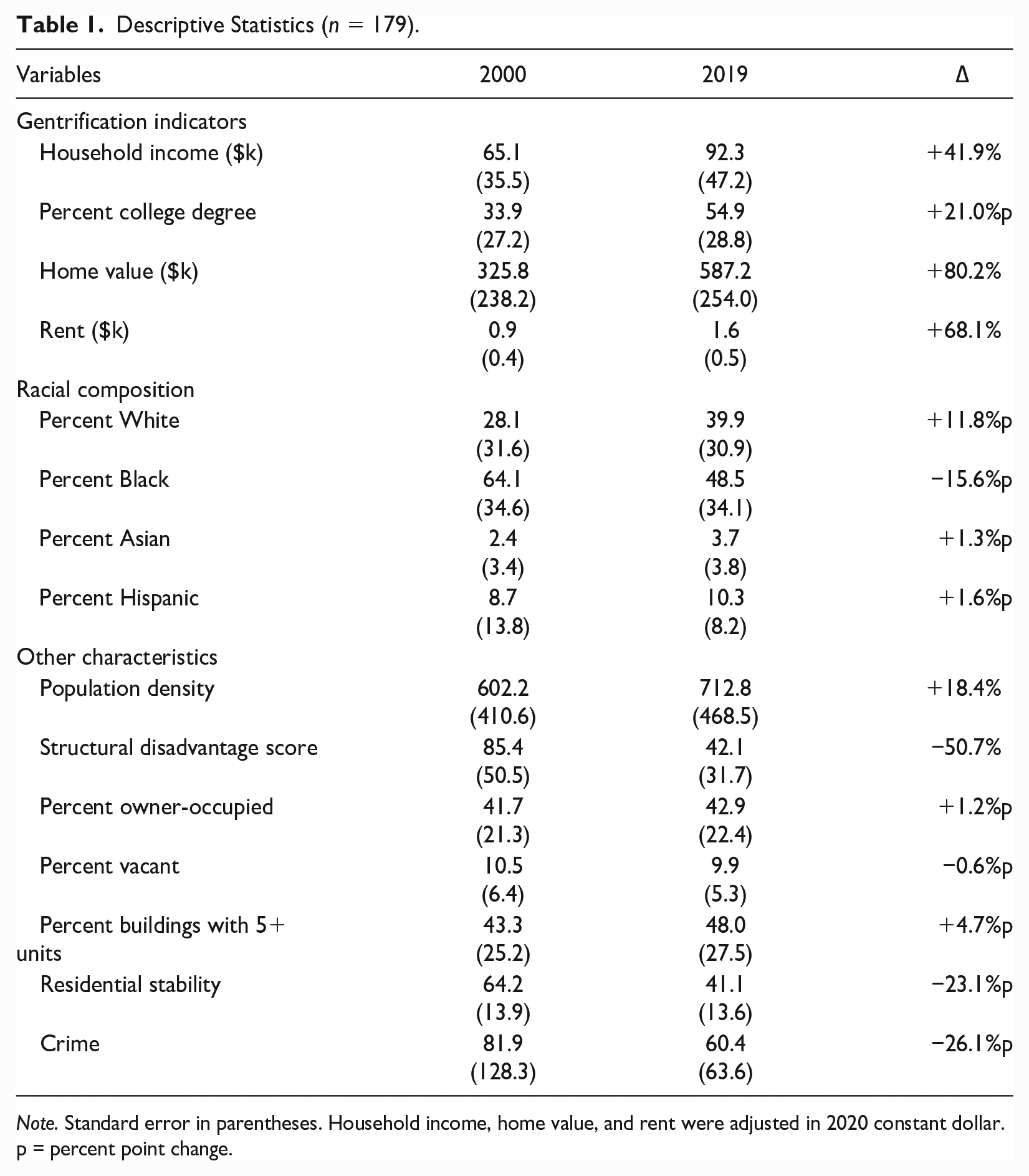
Note. Standard error in parentheses. Household income, home value, and rent were adjusted in 2020 constant dollar. p = percent point change.
Figures 1 and 2 visualize the geographic distribution of each indicator for neighborhood socioeconomic status and gentrification, for 2000 and 2019, respectively. In 2000, we found a clear geospatial trend in our variables of interest, indicating that northwestern neighborhoods showed high levels of income, education, and housing prices, compared to southeastern neighborhoods. These distributional trends were generally maintained in 2019.
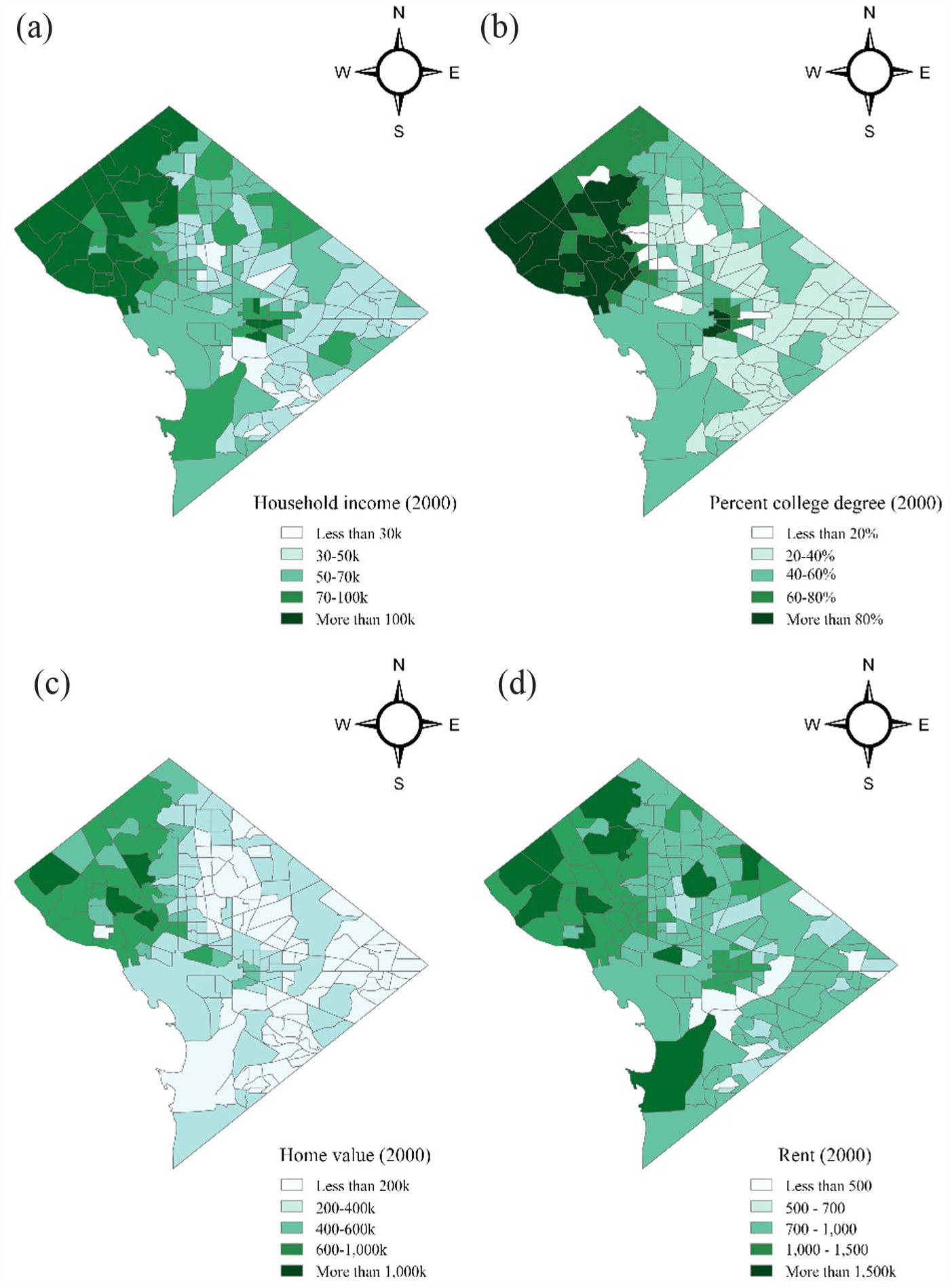
Gentrification indicators in DC neighborhoods, 2000: (a) household income, (b) percent college degree, (c) home value, (d) rent.
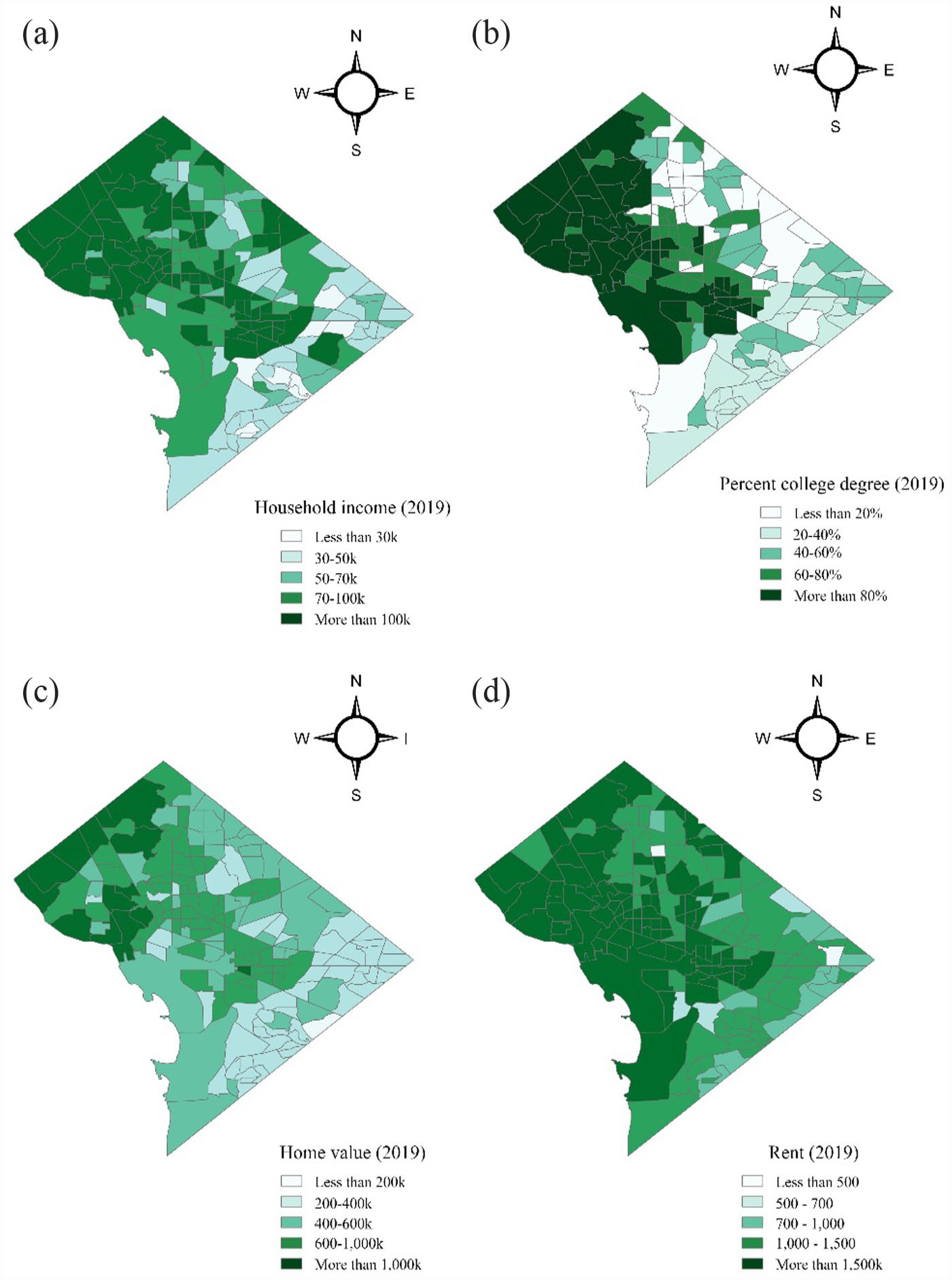
Gentrification indicators in DC neighborhoods, 2019: (a) household income, (b) percent college degree, (c) home value, (d) rent.
For racial changes, from each data source, we calculated the percentages of White, Black, Asian, and Hispanic residents for each tract across years. Table 1 reports that during the period, there was a diminishment of the percentage of the Black population in the city overall, from 64.1 to 48.5 percent. Whites largely comprised the increase (+11.8 percent), while Asian (+1.3 percent), and Hispanic (+1.6 percent) populations grew slightly. We also found that there was a trend of racial residential segregation in the city in which Western neighborhoods were White and eastern ones Black for both years. The small Asian and Hispanic populations largely lived in White neighborhoods. These racial and spatial relations are presented in Figures 3 and 4.
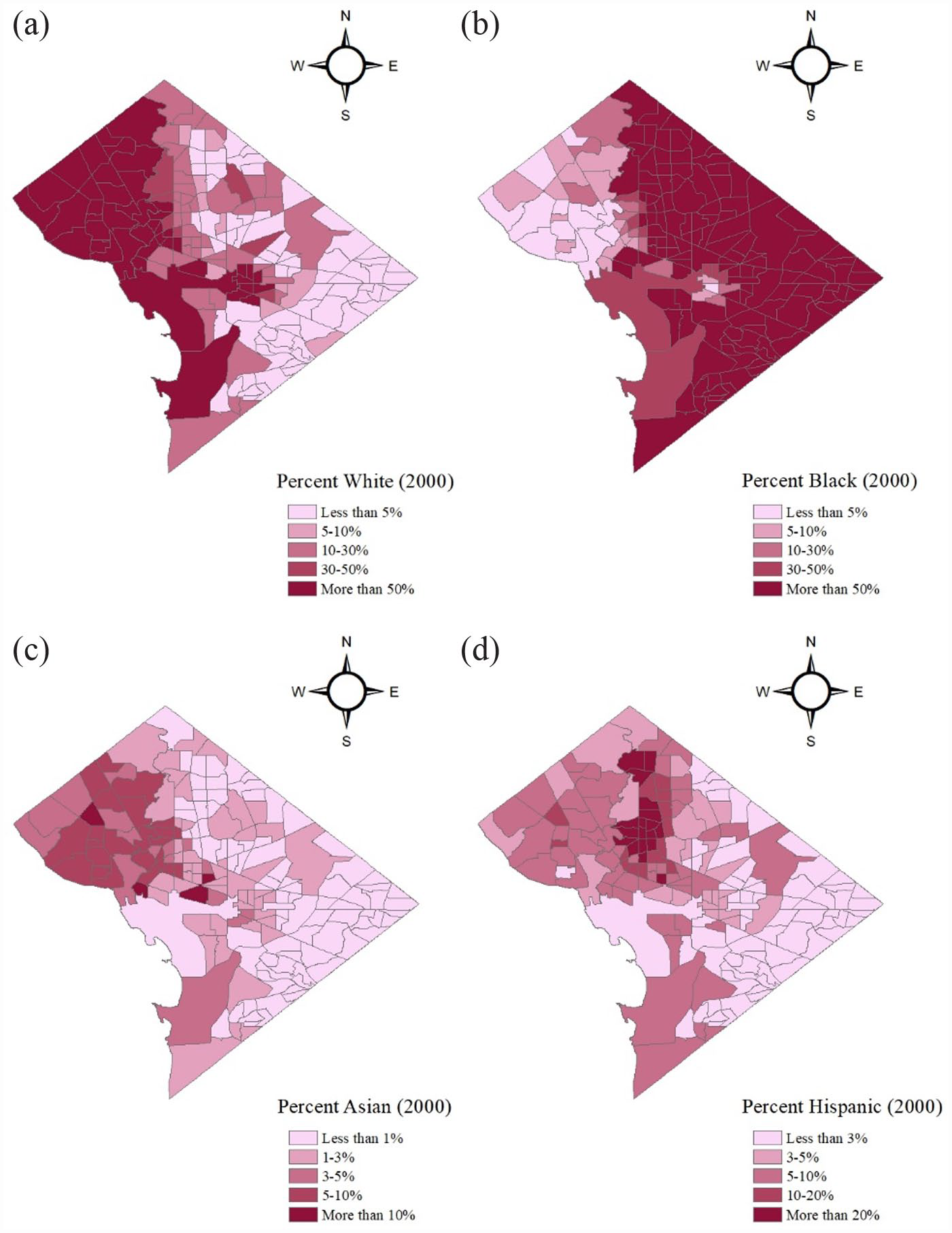
Racial demographics in DC neighborhoods, 2000: (a) percent White, (b) percent Black, (c) percent Asian, (d) percent Hispanic.
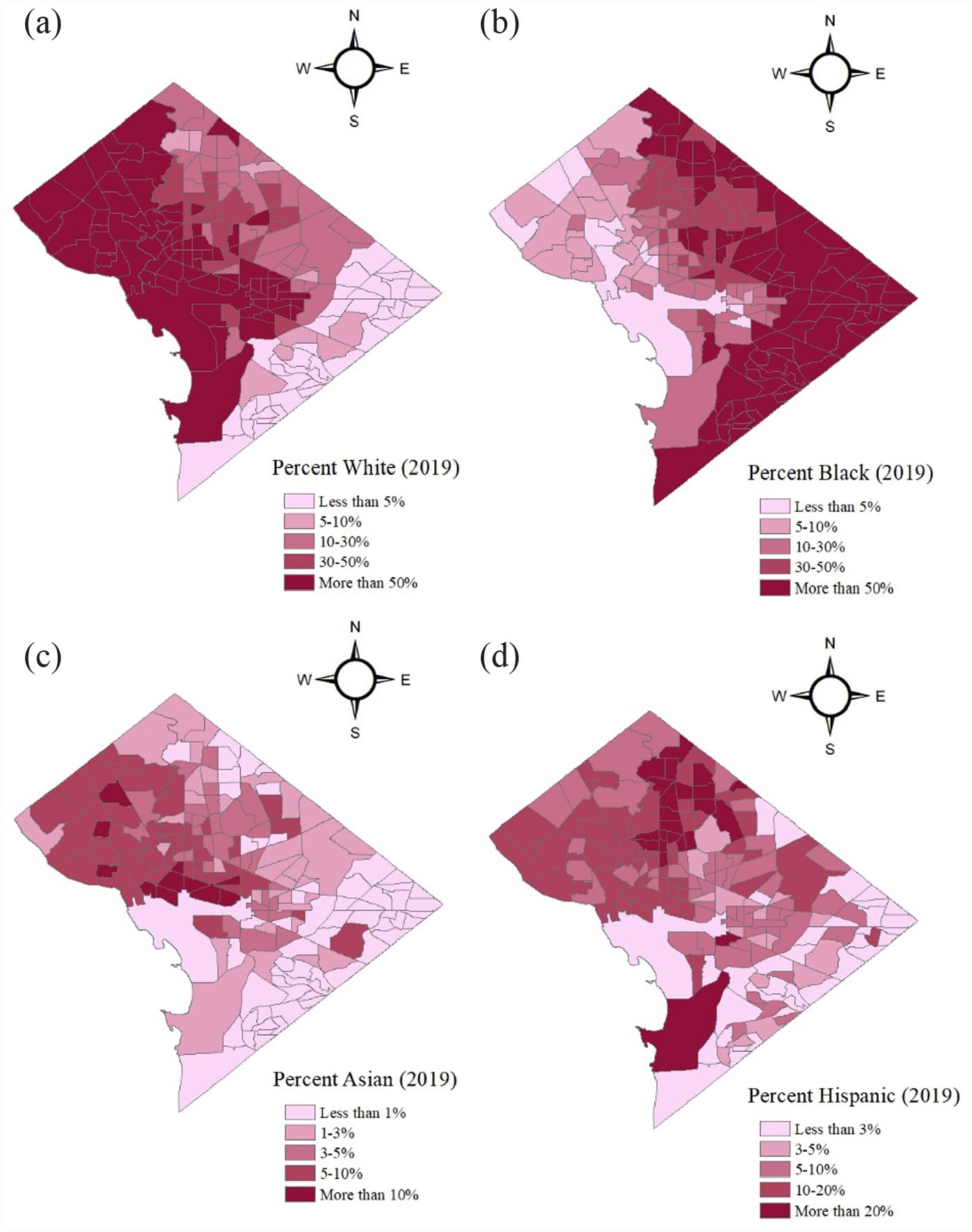
Racial demographics in DC neighborhoods, 2019: (a) percent White, (b) percent Black, (c) percent Asian, (d) percent Hispanic.
We alco accounted for other neighborhood characteristics that might influence the racial makeup of a neighborhood. The total population for each tract by year was included. We calculated a structural disadvantage score by adding the following five indicators that relate to neighborhood well-being and inequality: percentages of the population in poverty, unemployed, with no high school diploma, and percentages of households with public assistance income and of female-headed householder with children below 18 years (Donnelly et al. 2019; Golash-Boza and Oh 2021; Golash-Boza, Oh, and Salazar 2023; Kane, Gustafson, and Bruell 2013). To account for the housing situation and land use, percentages of housing units that are owner-occupied, vacant, and buildings with five more units were added. Residential stability indicates the percentage of household moved into their current unit 10 or more years. Last, we accounted for crime since crime rates are also associated with demographic changes in neighborhoods and may be a confounding factor (Golash-Boza and Oh 2021). Crime incidents account for all types of offenses in each tract across years. This indicator was extracted from the Urban Institute, Greater DC.2. Descriptive statistics for all those covariates are presented in Table 1.
To test our hypotheses, we employ a spatial panel regression analysis with fixed effects. It integrates both a geospatial analysis between units from the perspective of a spatial regression analysis and a longitudinal observation in time-series settings from the strategy of a panel data analysis. On one hand, spatial regression considers a spatial interdependence between units, indicating that a spatial unit’s characteristics influence other tracts and vice versa. Herein, the location of each unit is vital for understanding the causal mechanism between variables. On the other hand, longitudinal modeling enables us to understand how the associations between variables change over time. Furthermore, using fixed-effects models, we can estimate the roles of conditions across units and time on DC residents by controlling for the individual heterogeneity among units over time (Baltagi, Egger, and Pfaffermayr 2013; Elhorst 2003; Lee and Yu 2010; Ward and Gleditsch 2018).
We created a contiguity matrix based on the locations of each tract and the distances between tracts. We only treated tracts are “neighbors” if they share the same tract boundary. As well as our explorative visual examination with Figures 1 and 2, we further found positive and statistically significant autocorrelations in our dependent variables for both years using the contiguity matrix. In 2000, all dependent variables showed a strong spatial autocorrelation (for household income, I = .376, p < .001; for percent college degree, I = .602, p < .001; for home value, I = .524, p < .001; and for rent, I = .287, p < .001). In 2019, there still are spatial autocorrelation in our variables of interest (for household income, I = .467, p < .001; for percent college degree, I = .741, p < .001; for home value, I = .459, p < .001; and for rent, I = .495, p < .001). In order words, the geolocation of a tract influences and is influenced by its neighboring tracts for those variables. This provides the necessity of accounting for a spatial autocorrelation for our longitudinal investigation.
Findings
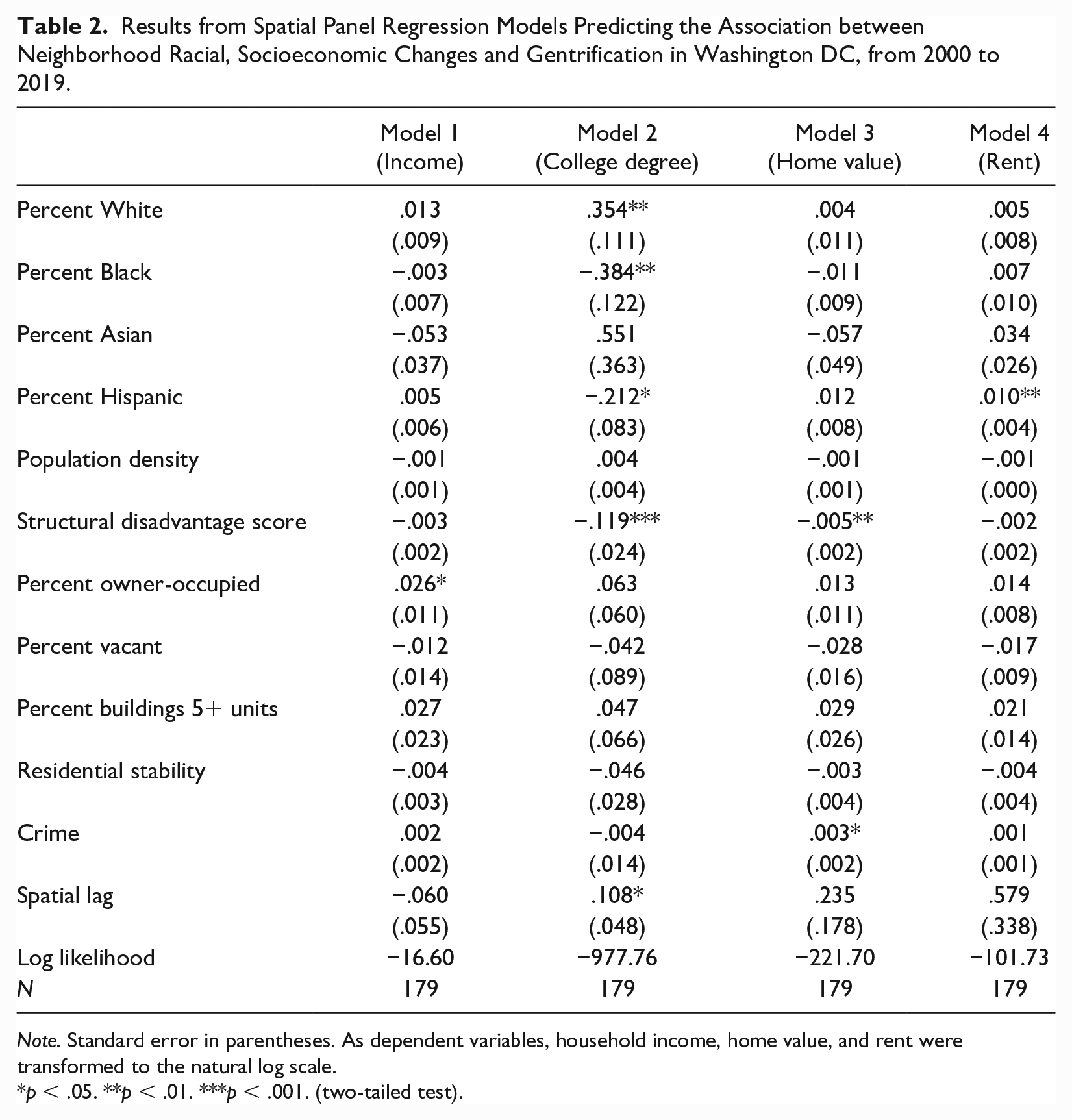
Using spatial panel regression modeling with fixed effects, Table 2 presents the association between neighborhood racial changes and gentrification in Washington, DC, from 2000 to 2019. The first two models explore how racial changes relate to socioeconomic changes in the given period, using income and education as the outcome variables, respectively, while the latter two models ascertain the association between racial changes and housing values in DC neighborhoods from 2000 to 2019. The unit of analysis for those analyses is tract-year.
Results from Spatial Panel Regression Models Predicting the Association between Neighborhood Racial, Socioeconomic Changes and Gentrification in Washington DC, from 2000 to 2019.
Note. Standard error in parentheses. As dependent variables, household income, home value, and rent were transformed to the natural log scale.
p < .05. **p < .01. ***p < .001. (two-tailed test).
The first model regresses the changes in White, Black, Asian, and Hispanic populations on the change in household income, as well as other neighborhood characteristics. We did not find any evidence that racial changes are associated with income gentrification, from 2000 to 2019. We found positive relationships between the White population and income and between Hispanic populations and income and negative relationships between Black populations and income and between Asian populations and income, yet such relationships are not statistically significant. Among controls, the variable for the percentage of owner-occupied housing units is a significant regressor, indicating that for 179 DC tracts, an increase in owner-occupied housing units is associated with an increase in household income from 2000 and 2019 (b = .026, p < .05).
Nonetheless, we found that racial changes are associated with marginal gentrification, measured by an increase in residents’ education level. Model 2 reveals that from 2000 to 2019, an increase in White residents is associated with an increase in residents with college degree (b = .354, p < .01). Otherwise, increases in Black (b = −.384, p < .01) and Hispanic populations (b = −.212, p < .05) are connected to a decrease in highly educated residents. We also found that in neighborhoods with high levels of structural disadvantages, there are fewer residents with postsecondary education (b = −.119, p < .001).
Using change in home value, Model 3 assesses the association between neighborhood racial changes and home value in 179 tracts from 2000 to 2019. It indicates that there is no significant relationship between changes in White, Black, Asian, and Hispanic populations and a change in home value in the given period. Instead, among covariates, we found that an increase in the structural disadvantage score is associated with a decrease in home value (b = −.005, p < .01), while an increase in crimes is associated with an increase in home value (b = .003, p < .05).
The last model examines how racial changes in DC neighborhoods relate to changes in rent. We found that there is a positive association between Hispanic populations and rent, indicating that an increase in Hispanic population was associated with an increase in rent from 2000 to 2019 (b = .010, p < .01).
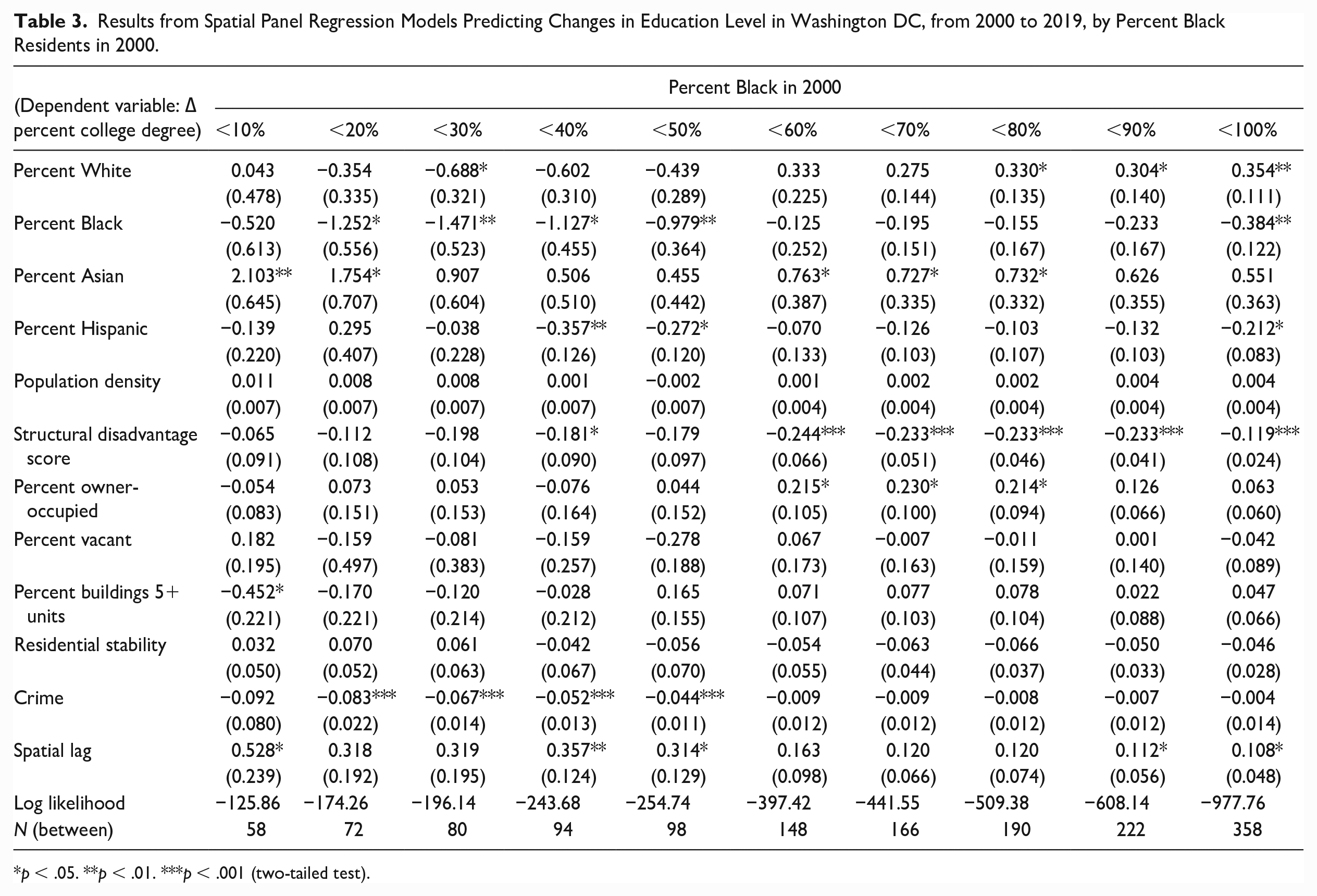
Based on our findings on the association between changes in White populations and residents with college degree from 2000 and 2019, we additionally ran a series of spatial panel models to find a threshold effect of the racial composition of the baseline year of 2000. Table 3 report the results from the models predicting the relationship between racial changes and marginal gentrification, separately by neighborhoods’ value of the percentage of Black residents in 2000 by each 10 percent, with a range from less than 10 percent Black to less than 100 percent (all neighborhoods). Regardless of neighborhood racial composition, increases in Black and Hispanic populations are related to a decrease in residents with postsecondary education, while an increase in Asian populations is associated with a rise of educational-level tracts. Nonetheless, there were negative associations between changes in the percentage of residents with college degree and the percent of White residents in models that include those neighborhoods that were less than 50 percent Black in 2000. However, after having more than 60 percent Blacks in 2000, the associations turn to positive, indicating that an increase in White residents in historically Black neighborhoods is associated with an increase in residents with postsecondary education from 2000 to 2019.
Results from Spatial Panel Regression Models Predicting Changes in Education Level in Washington DC, from 2000 to 2019, by Percent Black Residents in 2000.
p < .05. **p < .01. ***p < .001 (two-tailed test).
These findings support our third and fourth hypotheses. We predicted that there would be a strong positive association between changes in White residents and measures of gentrification in neighborhoods that were majority Black in 2000 and that these neighborhoods would be more likely to experience marginal gentrification than income gentrification. Although we did not find any support for the relationship between racial change and changes in household income, home value, and rent, our spatial panel regression models reveal that an increase in White residents is linked to an increase in educational level where neighborhoods were majority Black.
Discussion and Conclusion
Our aim for this research was to explore how gentrification relates to racial changes in the majority-minority neighborhoods. To do so, we sought to answer how changes in White, Black, Asian, and/or Hispanic residents related to various indicators of gentrification and whether Black neighborhoods experienced different kinds of gentrification from neighborhoods that were not majority Black in Washington, DC, from 2000 to 2019. Based on the literature on gentrification and racial capitalism, we predicted that gentrification would be related to Black displacement and White encroachment, and that there would be a stronger association between racial change and gentrification in historically Black neighborhoods.
Our findings provide important implications for understanding the association between neighborhood-level racial changes and gentrification. Our investigation in Washington, DC reveals that gentrification is closely related to racial changes. Gentrification driven by in-migration of residents with higher educational attainment is associated with White encroachment and Black/Hispanic displacement. Also, for our question on whether Black neighborhoods experienced different kinds of gentrification from neighborhoods that were not majority Black, our answer is yes. For education, we found variations in gentrification associated with racial changes with respect to demographic makeup of in 2000. In Washington, DC, the educational level in majority Black neighborhoods in 2000 has increased with the arrival of White residents. This aligns with Rucks-Ahidiana (2021a), who suggested that majority-Black tracts were more likely to experience marginal gentrification or gentrification by highly educated in-movers than income gentrification.
Contrary to our expectations, we did not find an association between racial change and housing value. Housing values have been shown to be deeply tied to race, with houses regularly being appraised at a lower rate in majority-Black and Latinx neighborhoods even when controlling for both time, and neighborhood, housing, and socioeconomic characteristics (Howell and Korver-Glenn 2018, 2021). In DC, our findings do not show this. We do note that there are both strong correlations citywide between racial change and housing prices. And, within particular census tracts, we do see an association between the arrival of White residents and increases in home values and rents. However, these findings do not hold up in our analyses of tract-level changes across the city, although we do see increases in rents in neighborhoods that were majority Black in 2000 that accompany the arrival of White residents. Despite our finding that a change in the Hispanic population is positively related to change in rents, in our further analyses, we did not find a consistent trend that changes in racial makeup influence rents across both gentrifiable and gentrified neighborhoods.
We acknowledge several limitations in our analysis. We unfortunately did not have access to the actual sales value of homes and instead relied on Census and ACS data to determine home values. This limitation may be the reason we did not find a strong association between race and home value. It is also worth noting that of the variables used to study gentrification, educational attainment is the most reliable, and this is the variable that we found to be most significant in our analyses. This variable is based on a survey question which asks whether people above the age of 25 have a 4-year college degree. If 10 percent of the residents of a tract above the age of 25 had a college degree in 2000 and then 50 percent had a college degree in 2019, it is most likely the case that new people have moved into the neighborhood. Of course, some of those people could be the same people—especially if they were less the age of 25 in 2000—but this is a clear indicator that the demographics of the neighborhood have changed. In contrast, if the median income of an area was $25,000 in 2000 and then $75,000 in 2019, it is possible that the same people live there and are just making more money. Similarly, the price of housing could fluctuate without any turnover in people. It is difficult to measure gentrification—understood as the in-migration of new people—with population-level variables. It is also difficult to secure individual-level data over long periods of time for one city.
Another important limitation is that we had to use multiple imputation for missing values. Since the outcome for one unit at a timepoint in spatial panel regression is a subset of complexities between other spatial units, timepoints, and covariates, it is sensitive to the presence of missing values and the number of observations. To ensure a sufficient number of observations and to have adequate standard errors for all covariates, we used multiple imputation. By the same token, given the relatively small number of census tracts in DC (n = 179), we were not able to separate out Census tracts into deciles of percentage Black and instead used a cumulative percentage of Black residents when we measured the racial makeup in 2000. Also, although in-migration of Asians is generally related to gentrification (Rucks-Ahidiana 2021a), we did not find any significant association between gentrification indicators and the change in Asian residents. We suspect that the small number of Asian residents in DC does not allow us to tease these patterns out but expect future studies will be able to do so. For Hispanic residents, although research indicates that both Blacks and Hispanics are the minority populations that experience challenges around housing affordability by racial residential segregation (Robinson 2021), we did not find that the influences of Black and Hispanic residents on housing value are identical. We suspect that the reasons might be the fact that Hispanic populations are residentially less segregated in DC. As presented in Figures 3 and 4, this new minority group lives close to Whites and Asians, not the historical minority group.
Notwithstanding, we argue that gentrification is closely related to racial changes. Within a capitalist economic system, property is assigned value and traded in the capitalist market. Within racial capitalism, the value assigned to property varies based on the racial composition of both the inhabitants of the home and the broader neighborhood (Howell and Korver-Glenn 2018; Rucks-Ahidiana 2021b). In Washington, DC, a dramatic increase in housing prices has happened alongside a significant decline in the Black population. There is a clear association between housing prices and the number and percentage of Black residents at the citywide level, even though this study did not find these trends at the census tract level. Future studies would benefit from using our perspective to understand the patterns of gentrification and its association with racial demographics in other majority-Black cities.
Footnotes
Author’s note
Hyunsu Oh is now affiliated to Louisiana State University, Baton Rouge, LA
Declaration of Conflicting Interests
The author(s) declared no potential conflicts of interest with respect to the research, authorship, and/or publication of this article.
Funding
The author(s) received no financial support for the research, authorship, and/or publication of this article.
