



Abstract
This study draws upon concepts of institutional trust and expendability to examine perceptions of risk associated with hydraulic fracturing or “fracking.” To study trust and risk, we collected data from a nationally representative sample of U.K. residents and analyzed it using multivariate regression. Perceptions of trust are measured for the oil and gas industry, central government, local government, and regulators while perceived risks are measured for seismicity, water quality, and hydraulic fracturing in general. Participants with high levels of trust in the oil and gas industry tend to perceive lower levels of risk associated with hydraulic fracturing. Levels of government and regulator trust are, however, largely unrelated to perceived risks. Importantly, trust in the oil and gas industry appears to mediate the relationship between political affiliation and perceptions of risk. Implications for theories of recreancy and environmental justice are explored.
Introduction
Interpretations of risk are often correlated with public trust in institutions (e.g., Bord and O’Connor 1992; Burda and Teuteberg 2014; Eiser et al. 2007; Ross, Fielding, and Louis 2014; Siegrist and Cvetkovich 2000; Xiao and McCright 2012). However, the way different types of institutional trust may affect perceptions of risk is not yet understood, especially when it comes to hydraulic fracturing technology. In short, trust and risk have yet to be thoroughly investigated in different settings (Brasier et al. 2013; Mayer 2016). As a result, the aim of the current research is to evaluate the potential correlation between institutional trust and perceived risks for hydraulic fracturing technology among a representative sample of U.K. adults. This investigation is needed to better understand the possible differential role of trust for diverse social institutions, such as the oil and gas industry, central government, local government, and oil and gas regulators.
The current study of perceived risks associated with hydraulic fracturing will proceed as follows. First, recent empirical studies of perceived risk and institutional trust, focusing largely on hydraulic fracturing in the U.K. context, are explored to provide a context for present analysis within the academic literature. Second, William Freudenburg’s (1993:909) theory of recreancy, or “the failure of institutional actors to carry out their entrusted duty” is described to provide the theoretical link between the concepts of trust and risk. Within that discussion of recreancy, concepts of gender, race, economic status, and political affiliation are used to explore the ways in which institutional trust can act as a mechanism of perceived risk. That is, experiences associated with different races, economic statuses, and genders may influence perceptions of expendability (Pellow 2016) and shape levels of trust which may, in turn, influence perceptions of risk. Political affiliation has often been recognized as an indicator of risk perceptions when it comes to environmental issues (i.e., McCright and Dunlap 2011b) but remains largely unexplored as a mechanism that explains the association between politics and risk. Third, data sources and methods used to empirically evaluate the relationship between trust and risk are described prior to presenting the results of the four analysis variables (oil and gas industry, central government, local government, and oil and gas regulators) representing institutional trust and three variables (seismic risk, water quality risk, and general fracking risk) representing perceptions of risk. Last, the paper concludes that while trust is correlated with perceptions of risk, the correlation is not consistent across all institutions and is largely shaped by political affiliation. However, in the case of trust in the oil and gas industry, trust appears to be strongly related to conservative political beliefs and mediate the relationship between political affiliation and perceptions of risk.
Trust, Perceptions of Risk, and Hydraulic Fracturing
Several U.K.-based studies of public acceptance of hydraulic fracturing have focused on the “risks” associated with hydraulic fracturing. While the public sees multiple risks associated with hydraulic fracturing (Evensen et al. 2017; Whitmarsh et al. 2015), human-induced seismicity and water quality stand out as two of the most important concerns. For instance, research by Lorraine Whitmarsh et al. (2015:425) reveals that both human-induced seismicity and water contamination are the most important perceived risks associated with hydraulic fracturing in the United Kingdom. And, nearly 40.5 percent of all U.K. residents agree or strongly agree they are “concerned about the risks of earthquakes from shale gas fracking.” Building on the role of risks and benefits, Darrick Evensen et al. (2017) suggests that in the United Kingdom, public acceptance of shale gas development using hydraulic fracking is not only influenced by its benefits but also by its risks that include increased seismic activity (see also de Groot, Schweiger, and Schubert 2020).
When it comes to predicting the risks of hydraulic fracturing, trust appears to be important. Several studies in different countries have examined the correlation between trust and perceptions of risk from shale gas development using hydraulic fracturing (Brasier et al. 2013; Tumlison and Song 2019; Willits, Theodori, and Lulof 2016). In the United States, Katheryn Brasier et al. (2013) discovered that lower levels of trust in the oil and gas industry are associated with higher perceptions of risk. Adam Mayer (2016) also discovered that trust in the oil and gas industry “is powerful predictor of a range of risk . . . perceptions” in Colorado (USA) communities. Both Mayer (2016) and Braiser et al. (2013) also suggest that trust in oil and gas regulators did not shape risk perceptions about oil and gas development. Thus, when it comes to risk associated with shale gas development, trust in companies seems to matter more than trust in regulators in U.S.-based studies.
The setting where trust and risk are studied also produce divergent results. Mieke Willems et al. (2016), for instance, identified an inverse correlation between general trust in government and risk perceptions associated with shale gas in South Africa. As trust in government increases, perceptions of risk decrease. However, Chin-Hsien Yu et al. (2018) learned that trust in China’s central government was positively correlated with perceptions of risk associated with shale gas development. At the same time, Yu et al. (2018) found that trust in local government was not correlated with perceived risks from shale gas development. In short, existing research on trust and risk perceptions associated with hydraulic fracturing is mixed. Not only do correlations between trust and risk perceptions vary by the type of institution but also vary across countries.
While the role of trust in predicting support for shale gas development has been identified as important in the United Kingdom, few quantitative studies examine these issues. There are, however, two important qualitative studies that provide important evidence about the role of trust in shaping support/opposition to shale gas development. Laurence Williams et al. (2017) asked six focus groups composed of residents in Northeast England about perceptions of hydraulic fracturing. Resident stakeholders were distinct and included allotment owners, parents of young children, parents of university students, ex-coal miners, historical society members, and followers of a wildlife trust. As expected, perceptions about “fracking” were varied, and positive assessments of shale gas development focused on jobs and employment while negative assessments concentrated on potential risk and/or unforeseen consequences such as the potential for seismic disasters and global warming caused by fracking (Williams et al. 2017:97–99). Perceptions of hydraulic fracturing risks were also often associated with the “trustworthiness of industry and policy actors.” Moreover, focus group participants felt like the positive industry rhetoric around fracking was being used to “sell them something” and that they were being treated like “guinea pigs” by the industry and government. This lack of trust among stakeholders uncovered what the researchers suggest is one of the biggest political challenges faced by the shale gas industry in the United Kingdom: significant “concerns about risks and other material implications of the technology of hydraulic fracturing itself” (Williams et al. 2017:100).
Some qualitative research examined levels of trust, perceptions of risk, and support/opposition for shale gas development using hydraulic fracturing. For example, Merryn Thomas et al. (2017) compares residents living in two cities in the United States (Los Angeles and Santa Barbara) with residents living in two cities in the United Kingdom (London and Cardiff). The researchers found study participants in both countries shared similar perceptions about the risks associated with hydraulic fracturing in that they were concerned about water contamination, pollution, global warming, and seismic activity (although U.S. respondents were more likely than U.K. respondents to believe that earthquakes were a major risk). Participants in both settings also pointed out that government regulators and especially the oil and gas industry could not be trusted to protect their health and/or the environment. That is, participants were suspicious of industry incentives, describing them as “bribes” and suggesting the disingenuous nature of the incentives to gain public support. Thomas et al. (2017:8) propose that residents of the United Kingdom are like those in the United States in that there is “deep-seated distrust of government and institutions” involved in shale gas policy. Thus, it appears that “citizens in the United States and United Kingdom are skeptical of government and industry motives” (Macnaghten 2017:1). Given these past observations about trust and seismic activity associated with hydraulic fracturing, this study explores how trust in different institutions may shape perceptions of risks associated with hydraulic fracturing in the United Kingdom.
Theoretical Perspective
The present research draws upon Freudenburg’s (1993:909) notion of recreancy to provide the theoretical link between trust and perceptions of risk. Within the context of this discussion, we explore implications for environmental justice through the concept of expendability when it comes to race, gender, and economic status. We also investigate how political affiliation may shape institutional trust and perceptions of risk. Each of these concepts is addressed in greater detail below.
Trust and Recreancy
Recreancy is focused on perceptions about institutions or institutional actors entrusted with managing risk (Freudenburg 1993, 2000). Simply put, recreancy is the inability to carry out a trusted social responsibility. Freudenburg (1993, 2020) developed the theory of recreancy by situating it within Weber’s concept of rationality and Durkheim’s ideas about the division of labor, where technological specialists are responsible for managing modern day risks. Freudenburg believed that when trust in social institutions diminishes, perceptions of recreancy can emerge. Recreancy has often been used to study trust in institutions during natural and technological disasters. However, disasters are not necessary for recreancy to emerge. As Duane Gill, Liesel Ritchie, and Steven Picou (2016) believe, the lack of institutional trust can be as harmful as any technological disaster (e.g., chemical spill, nuclear accident, human-induced seismic event). Moreover, Freudenburg (1996) points out that research on recreancy and risk could proceed before or after a disaster. Even so, studies of recreancy often focus on trust in institutions post-disaster (e.g., Defeyter et al. 2021; Ladd, Gill, and Marszalek 2007; McSpirit et al. 2007; Tim et al. 2020). This is not surprising as institutions responsible for disasters are under more scrutiny after those disasters occur (Gill, Ritchie, and Picou et al. 2016).
In the case of oil and gas disasters, researchers have examined the concept of trust drawing upon the perspective of recreancy (e.g., Cope et al. 2016; Gill et al. 2016; Ritchie, Gill, and Farnham 2013). For example, Michael Cope et al. (2016) studied the Deepwater Horizon catastrophe in the Gulf of Mexico in 2010 and found that the public was distrustful of both the British Petroleum (one company judged responsible for the disaster) and the U.S. government. The high levels of distrust the researchers initially measured did diminish over time, but the lack of trust in key institutional actors had significant implications for managing information as the disaster was ongoing.
Duane Gill et al. (2016) also studied the role of recreancy in the Exxon Valdiz collision in 1989 where millions of gallons of crude oil were released into Prince William Sound (Alaska). They suggest community perceptions of recreancy in polluted communities disrupted social relationships, mistrust of other residents, and withdrawal from social life, including a decline in civic engagement (Gill et al. 2016:1107). As a result, Gill et al. believe that many of the negative impacts the Exxon Valdiz disaster has on communities occur as a result of recreancy rather than the disaster itself. For example, post-disaster litigation caused many residents undue stress because those residents believed the government and the judicial system could not be trusted to do the right thing—that is, they were recreant (Gill et al. 2016).
The current study of shale gas development and the perceived risk using hydraulic fracturing also relies on the concept of recreancy. The study of oil and gas provides an excellent starting point with which to examine the role that trust may play in shaping perceptions of risk in the case of hydraulic fracturing. The industry, central and local governments as well as oil and gas regulators often compete for public trust when it comes to risks posed by hydraulic fracturing for shale gas. This competition for trust may also involve the use of recreant messages aimed at discrediting competitor institutions. For instance, in the United Kingdom the Central Government advocated for shale gas development (e.g., “going all out for shale”), claiming shale gas development was safe and would provide significant economic benefits to the community and security to the country. In the name of safety, the U.K. central government supported the “traffic light monitoring system” that regulated the level of human-induced seismicity associated with hydraulic fracturing wells, claiming the system placed its regulations among the “most stringent in the world” (Ogden 2019:9). Despite these claims of safety, local government officials often challenged shale gas development in their communities by casting doubts on the safety, among other things, of hydraulic fracturing. These challenges led to rejections of planning applications for shale gas development at the local level (Pidd and Taylor 2019). As the Mayor of Greater Manchester Andy Burnham explains, “the decision to move against fracking [in Manchester] came about after council leaders looked at what happened in Lancashire . . . The earthquakes caused by the Cuadrilla activity were a serious concern” (Pidd and Taylor 2019:19). Not only did local governments frame their rejection of shale gas development in terms of various perceived risks, but also in terms of trust in the central government. As one local community group declared, “This is a sad day as it is clear to all that this government neither listens, nor can it be trusted” (Vaughan 2016:5). The U.K. Central government fought publicly against some local bans of hydraulic fracturing by overturning local council decisions. In one case, Communities Secretary Sajid Javid reversed the Lancashire Council’s (i.e., a local government) rejection of a fracking site at Preston New Road stating, “We [Central Government] will take the big decisions that matter to the future of our country as we build an economy that works for everyone, not just the privileged few” (Vaughan 2016:4).
The oil and gas industry has also suggested that hydraulic fracturing is safe, and that the government is too stringent in their monitoring of human-induced seismicity. In an infamous interview with the Financial Times, Cuadrilla’s chief executive Francis Egan said that regulations were too hard to meet and noted, “[the industry] is at the point now where we’re saying you’ve [Central Government] drawn the noose so tight we’re just about to choke” (Sheppard and McCormick 2018). The response by the central government was best expressed by the Energy Minister Claire Perry who noted any changes to the traffic light monitoring system were unlikely because “[i]t would be a very foolish politician who would do things that would be considered to be relaxing regulatory standards when we are trying to reassure people about safety” (Gosden and Webster 2018:8). In the end, the Central Government has conceded that hydraulic fracturing is potentially unsafe, noting that a moratorium on hydraulic fracturing is justified.
As noted above, concepts of perceived risk and trust were central in conversations about shale gas development using hydraulic fracturing in a variety of industries. Initially, the central government and the oil and gas industry were perceived as unified in their support of shale gas development. At the same time, local governments were divided, and some opposed hydraulic fracturing. In some areas, local planning officers were in favor of the technology to promote economic growth through shale gas development while many councils were in opposition. It was largely local opposition to the process of hydraulic fracturing that lead local governments to oppose shale gas development as unwanted and risky. Thus, the messages from local government, central governments, and the oil and gas industry were sometimes in competition about casting doubt about trust and what constituted risk. It is within this context that institutional trust may shape perceptions of risk associated with hydraulic fracturing. When it comes to central government and the industry, it is likely that institutional trust serves as a protective factor against high levels of perceived risk. That is, more trust in government, industry and regulators are likely to decrease the perceived risks posed by hydraulic fracturing. However, given that local government focused on messages of danger associated with hydraulic fracturing, it is likely that more trust in local governments will increase perceptions of risk associated with hydraulic fracturing.
Environmental Justice
The environmental justice literature has long recognized that social positions influence trust in institutions, especially when it comes to potential environmental harm. Thus, trust in institutions and actors not only shape perceptions of risk but may be shaped by factors such as gender, race, and income. We draw upon an environmental justice framework to explain why gender, race, and income are likely to be associated with institutional trust and perceived risk. This environmental justice framework provides the theoretical underpinning that shapes the present model of risk perceptions associated with hydraulic fracturing. Broadly speaking, an environmental justice framework emphasizes how (1) various forms of discrimination are responsible for the disproportionate concentration of environmental hazards in low-income communities and communities of color (Adeola 1994; Downey et al. 2008; Pham et al. 2012; Pollock and Vittas 1995; Stretesky and Hogan 1998) and (2) how communities have organized to oppose such conditions (Bullard 2008; Taylor 2000). Early environmental justice studies include, for example, the 1987 report Toxic Wastes and Race produced by the United Church of Christ Commission for Racial Justice that documented the disproportionate number of hazardous waste sites in low-income and Black communities throughout the United States (Commission for Racial Justice 1987). While spatial justice (i.e., distributive justice) is the focus of many early environmental justice studies, it is also clear that procedural justice is a critical component of the early framework (Pellow 2016). For instance, the U.S. Environmental Protection Agency (2021:1) officially defines environmental justice as “the fair treatment and meaningful involvement of all people regardless race, color, national origin, or income with respect to the development, implementation, and enforcement of environmental laws regulations and policies.”
The recent expansion of environmental justice studies is not without its challenges. These challenges have led to “tensions” and “limitations” in environmental justice studies as scholars compete for dominance. David Pellow (2016:3) who studied the relationship between environmental justice and the Black Lives Movement suggests that within environmental justice studies, one “largely unexamined question [is] the expendability of human . . . populations facing socioecological threats from states, industries, and other political economic forces” (emphasis added). We suggest that the notion of expendability, combined with the feelings of being judged as “worth less,” are critical (and unfortunate) aspects of environmental injustice that relate to trust in government, government regulators, and companies. Therefore, trust in institutions associated with the safe operation of hydraulic fracturing may be predicted by identities such as race and gender as well as indicators of economic status such as income. For instance, one resident living near a potential commercial hydraulic fracturing site in Lancashire elaborates on these feelings of expendability: Why was this area chosen for fracking, due to being on Blackpool’s doorstep—already an area of deprivation and serious health inequalities? (Cited in Aryee 2019:256)
Expendability concerning perceive risks associated with hydraulic are likely to be similar across diverse marginalized groups. This argument is like Pellow’s (1996) idea of “shared experiences of power relationships.” For instance, issues of gender, race, and income are all likely to influence risk perceptions. That is, previous literature on perceptions of risk suggest it is highly likely low-income, racial minorities, and women will all see risks from hydraulic fracturing as a more serious issue than high-income White males. The implications of these perceptions have significant consequences for health outcomes and environmental behavior (O’Connor, Bard, and Fisher 1996). In short, marginalized groups may believe their lives are less valued by important institutions (Lake 1996). Feelings of expendability driven by racial inequalities may therefore weaken trust in governments, regulators, and industry. Moreover, across the United Kingdom, there are several studies that document how different forms of discrimination are linked to social exclusion in environmental decision-making (Agyeman 2002). We therefore suggest (1) gender, (2) race, and (3) economic status are likely to influence trust which will, in turn, influence perceptions of risk. We examine each of these concepts in turn.
Gender
Environmental hazards tend to affect women more than men (Blocker and Eckberg 1997; Bord and O’Connor 1992; McCright 2010; Mohai 1997; Xiao and McCright 2012). Findings from numerous studies are also consistent and clear: Women perceive higher levels of risks from environmental hazards than men, perhaps because they are more likely to be exposed to hazards where they work, live, and play (e.g., Brody 1984; Gwartney-Gibbs and Lach 1991). Some researchers have suggested that women may be more likely to see environmental hazards as risky because they are “more engaged than men in life maintenance activities such as child rearing and [are more involved in maintaining] the neighborhood and community” (Dietz, Kalof, & Stern 2002:361). Moreover, men, because of their institutional privilege, may be in control of many institutions making decisions about environmental policy. For instance, Susan Buckingham, Dory Reeves and Anna Batchelor (2005) discovered that waste management decisions in Ireland were more likely to be made by men in “masculine” settings. Thus, perceptions of risk are likely based in gender relationships where women are forced into subordinate roles while men take decision-making roles in institutions that shape environmental policy. As a result, women may understandably feel more expendable than men and have lower levels of institutional trust then men (Davidson and Freudenburg 1997). Women may also see hydraulic fracturing as riskier than men. In the United Kingdom, Rachel Howell (2018) discovered significant variation in public perceptions of support for shale gas among men and women in a national online survey administered by YouGov in 2015. As might be expected, women showed lower levels of support for hydraulic fracturing than men no matter where hydraulic fracturing was proposed. Howell (2018:9) therefore concluded that “men are more prone to ‘NIMBYism’ than women [or] think differently about a general scenario, with women perhaps more likely to relate the general case to themselves.” As a result, women may not only have less trust in institutions from which they are marginalized but are also more likely than men to perceive the practice of hydraulic fracturing as risky.
Race
While issues of race were pervasive in early environmental justice studies, this is also becoming the case in studies of risk perceptions. In case, James Flynn, Paul Slovic, and C. K. Mertz (1994) analyzed data from a nationally representative sample of U.S. adults and suggested that risk acceptance was related to factors such as “power, status, alienation, and trust.” Flynn et al. not only examined the potential impact of gender on risk perceptions, but they also were among the first researchers to study race and risk. That research suggests that racial and ethnic minorities are more likely than Whites to evaluate a variety of hazards risky (see also Finucane et al. 2000; Vaughan and Nordenstam 1991). Flynn et al. conclude that “[p]erhaps white males see less risk in the world because they create, manage, control, and benefit from so much of it.” Walter Peacock, Samuel Brody, and Wes Highfield (2005) also found that race and ethnicity were among the best predictors of perceived risks associated with hurricanes in Florida (USA). More recently, researchers such as Jayajit Chakraborty et al. (2017) have also examined the perceived risk associated with industrial and vehicular air pollutants in Houston, Texas (USA). The researchers revealed that Black and Hispanic residents reported significantly higher levels of perceived risks from both forms of air pollution when compared with Whites. Importantly, these findings persist even after controlling for estimated level of pollution (Chakraborty et al. 2017). Thus, trust in institutions responsible for the safe operation of hydraulic fracturing in the United Kingdom should be linked to race/ethnicity, and members of racial/ethnic minority groups may believe that industry, government, and regulators are not there to protect them from harm (MacLeod 2018). That is, they are expendable in the eyes of industry and government.
Economic status
Economic status is often noted as being central to the analyses of power relationships in environmental justice studies (Cutter 1995; Pellow 2016). Economic status is also important in studies of perceived risk. For example, Ian Savage (1993) found that low-income earners rated the risks associated with airline crashes, house fires, automobile accidents, and stomach cancer higher than low-income earners (see also Hicks and Brown 2013; Lemyre et al. 2006). Research across Europe also suggests that economic status is likely to be negatively related to institutional trust (Grossmann et al. 2021). As a result, not only will lower levels of income be associated with lower levels of trust in institutions but will also be associated with higher levels of perceived risk.
Political Affiliation
Aaron McCright and Riley Dunlap (2011a, 2011b) find that conservative political ideology is a potent variable in determining perceptions of risk. The researchers propose that individuals who hold conservative political views see environmental risks, such as those associated with climate change, as lower than individuals who hold alternative political ideologies (McCright and Dunlap 2011a, 2011b). Conservatives often suggest that economic institutions should have a good deal of decision-making power when it comes to development and risk management (Hanlon 2011). In the United Kingdom, shale gas development using hydraulic fracturing was largely supported by the central government and industry as well as conservatives (see also Andersson-Hudson et al. 2016; Choma, Hanoch, and Currie 2016; Whitmarsh et al. 2015). Moreover, as Laurence Williams and Benjamin Sovacool (2020) found, the conservative party largely controlled pro-shale messages in Westminster early in the debate. Nevertheless, they explain, a local conservative backlash and the belief in the governance of local institutions eventually worked against the shale gas industry. It is likely that conservatives trust government, the oil and gas industry, and regulators to protect them from the risks of hydraulic fracturing. Thus, trust in institutions may be a mechanism that affects perceptions about the risks associated with hydraulic fracturing. Conservatives are more likely to trust in government, industry, and oil and gas regulators.
Data and Method
Observations concerning trust and risk perceptions can be tested using a representative sample of the U.K. population along with a series of regression analyses. To carry out these analyses, data are collected demographics, trust, political affiliation, and perceptions of risk associated with hydraulic fracturing in a representative survey of n = 750 adults residing in the United Kingdom.
Sample
Following ethics approval (reference number 22790), a sample of 750 residents living in the United Kingdom (aged 18 years old and older) were obtained with the help of Prolific (www.prolific.co) in May 2020. Prolific is an online survey platform that connects researchers to participants and is often used for social and economic research (Stefan and Schitter 2018). Of the 750 participants who responded to the survey, not all provided answers to all the survey questions (all participants were allowed a “prefer not to answer” response). As a result, the sample size for the models estimated in this study range between n = 626 and n = 652, depending on variables examined. As explained below, questions about the respondent’s income were the most skipped question with a total of n = 72 missing values. A breakdown of missing values for each variable are listed in Table 1, along with descriptive statistics for the variables included in the analysis as described below. Prolific selected the sample from a population of 40,755 eligible adults living in the United Kingdom who were immediately available to enroll in the research on a first come, first served basis. All participants received a small payment in compensation for their time to complete the short questionnaire that consisted of 39 closed-ended questions. The questionnaire took less than 10 minutes to complete.
Bivariate Correlations and Descriptive Statistics.
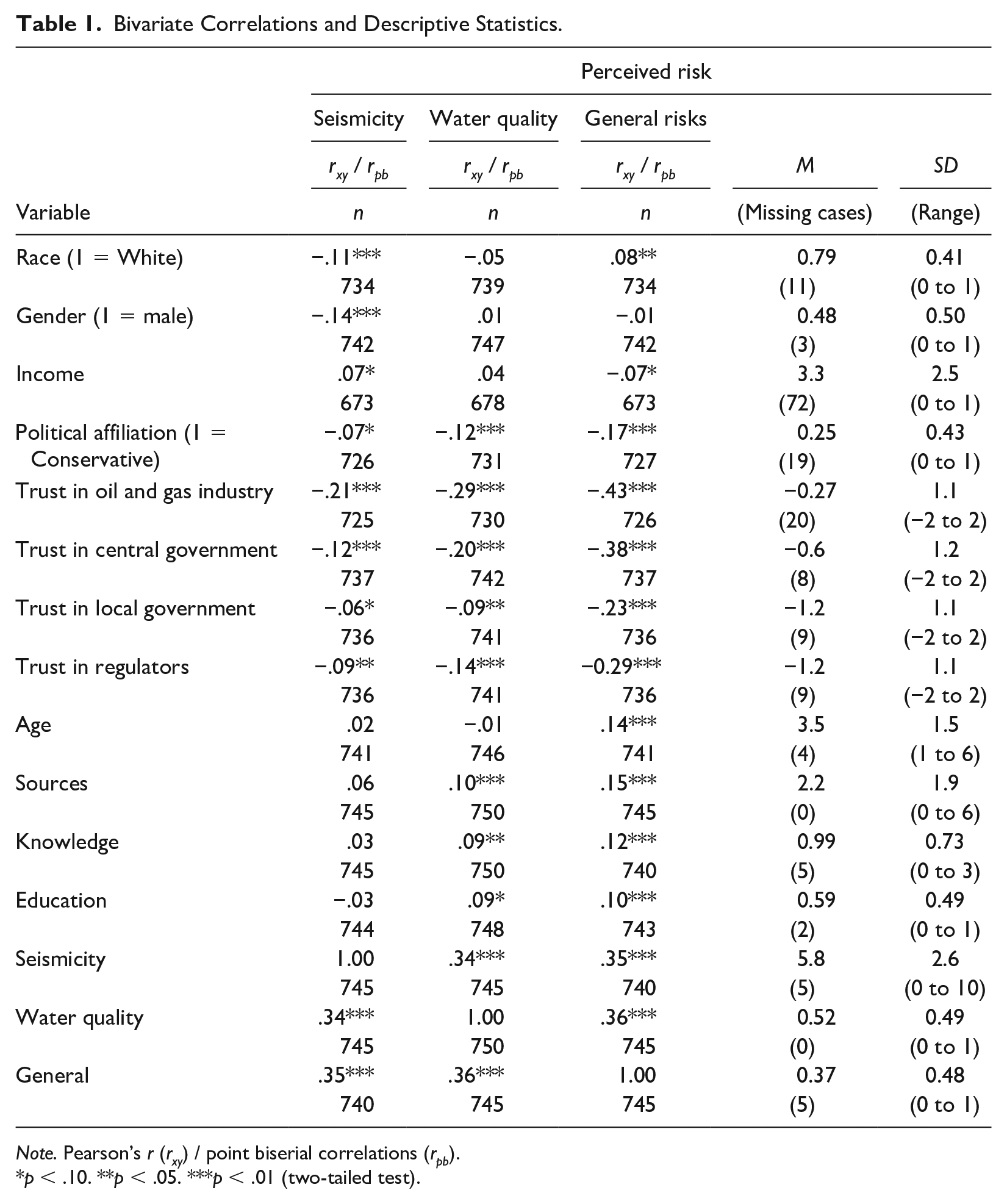
Note. Pearson’s r (rxy) / point biserial correlations (rpb).
p < .10. **p < .05. ***p < .01 (two-tailed test).
Overall, the sample was 47.9 percent male (vs. 50.5 percent in the U.K. population [Office for National Statistics 2020]); was 79 percent white (vs. 87 percent of the U.K. population [https://www.ethnicity-facts-figures.service.gov.uk/]); had a median age of 46 years for those 18 years old and over (vs. a median age of 40.4 years old for all U.K. residents [Office for National Statistics 2020]); 23 percent identified as belonging to the Conservative party (vs. 19 percent of all registered individuals in the U.K. population [Audickas, Dempsey, and Loft 2019]); and, the median household income was between £30,000 and £39,000 (vs. £29,900 in the population in 2020 [Office for National Statistics 2021]). Thus, the sample of respondents is relatively representative of the population of the United Kingdom on basic demographic variables.
Variables
The variables used to examine associations between trust, environmental justice indicators, political affiliation, and perceptions of risk are described below. Descriptive statistics (mean, standard deviations and minimum/maximum values needed to compute range) for variables analyzed are included in Table 1 along with their bivariate correlation to each perceived risk (i.e., seismicity, water quality, and general hydraulic fracturing risk) as estimated by Pearson’s r (rxy) for variables treated as continuous and point biserial correlations (rpb) for dichotomous variables (although these two types of correlations are mathematically equal).
Perceptions of risk
Given the recent U.K. literature on hydraulic fracturing, we measured perceptions of risk in three ways. First, we examine perceptions of Seismicity Risk associated hydraulic fracturing. To do this, we asked participants to rate their perception of risk using a variable created from the following question: “On a scale of 0 to 10, with 0 being no risk and 10 being extreme risk, how much risk do you think earthquakes pose to a community when hydraulic fracturing is occurring?” Overall, 745 participants answered this question with responses ranging from “0” to “10.” The distribution of these perceived risk scores was relatively normal with a mean of 5.8 (median = 6.0) and standard deviation of 2.6. The variable is not skewed (skewness = −0.41).
Second, we examine perceptions of Water Quality Risks associated with hydraulic fracturing. To do this, we asked participants to rate several “risks sometimes associated with hydraulic fracturing.” In the case of water quality, respondents who answered that they were “very” or “extremely” concerned about risks of hydraulic fracturing to water quality were scored “1” while respondents answering “not concerned” to “moderately concerned” were scored “0.” This dichotomous variable was evenly split with nearly 52 percent of the respondents reporting they were “very” or “extremely” concerned about the risks to water quality associated with hydraulic fracturing (SD = 0.49).
Third, we examined an alternative more general measure of risk associated with hydraulic fracturing (General Risk) by determining whether participants judge the risks of hydraulic fracturing as greater than its benefits. To do this, we ask participants to tell us whether they believe that the “risks of hydraulic fracturing outweigh the benefits.” The result is a dichotomous variable. Respondents who agreed with the statement, “the risks of hydraulic fracturing outweigh the benefits” (i.e., 36.7 percent of the sample) were given a score of “1” in the dataset while respondents who did not agree with this statement (i.e., 62.7 percent of the sample) were given a score of “0” (SD = 0.48).
Trust
As previously noted, we suggest that perceptions of trust can affect risk perceptions prior to a disaster or accident in several ways. Trust can increase or decrease perceptions of risk, depending on the messages institutions deliver to the public and whether those messages are labeled as recreant by other institutions. As we suggested, trust in industry and central government likely results in lower perceptions of risk associated with human-induced seismicity while trust in local government is likely to result in higher perceptions of risk associated with human-induced seismicity. To better understand how trust might be related to perceptions of risk, we measured trust in the oil and gas industry (Trust in Industry), trust in central and local governments (Trust in Central Government and Trust in Local Government), and trust in oil and gas regulators (Trust in Regulators) using four questions. In particular, and consistent with the concept of recreancy, we seek to understand whether industry and government can be trusted to protect people from the negative impacts of hydraulic fracturing by asking participants about the extent to which they agree or disagree on a 5-point scale where –2 = strongly disagree, –1 = disagree, 0 = neither agree nor disagree; 1 = agree, and 2 = strongly agree with the following statements: (1) “I trust oil and gas companies to operate safely in my community”; (2) “I trust my local government to do what is best for my community when it comes to oil and gas development”; (3) “I trust the central government to do what is best for the UK when it comes to oil and gas development”; and “I trust oil and gas regulators to protect my environment and community.”
Environmental justice
We examined the potential role of marginal group status (Gender, Race, Income) on perceptions of risk using basic demographic questions that measure a participant’s gender (male = 1; non-male = 0) and race (white = 1 vs. non-white = 0). As previously noted, the sample is nearly evenly split according to gender with 48 percent identifying as male and 52 percent identifying as female (SE = 0.50). Approximately 79 percent of the sample identifies as being white, and 21 percent of the sample identifies as having a BAME (or Black, Asian, and Minority Ethnic) background (SD = 0.41). Annual income after tax is measured using an 11-category variable where participant incomes were divided into equal £10k intervals between £0 and £99.9k. The final category was coded as £100k and over (SD = 2.5). As previously described, it is likely that males, Whites, and higher income respondents will have the highest levels of trust in institutions associated with hydraulic fracturing and, as a result, see fracking as less risky than female, BAME. and low-income respondents. Importantly, affluent White males are less likely than other groups to be marginalized from industry, government, and regulators as noted in the environmental justice literature.
Political affiliation
Jessica Andersson-Hudson et al. (2016) found that in the United Kingdom, members of the Conservative political party held the most favorable views of hydraulic fracturing. In line with Andersson-Hudson et al.’s findings, we expect Conservatives will be less likely than non-Conservatives to perceive hydraulic fracturing as a risk. To estimate the potential impact of conservative political views, the dichotomous variable Conservative was created. Participants who described themselves as a member of the Conservative party (i.e., 25 percent of the sample) were scored “1” on the variable Conservative and participants who described themselves as a member of another political party were scored “0” (SD = 0.43).
Control variables
We examine associations between trust, environmental justice indicators, political affiliation, and perceptions of risk after adjusting for four control variables. First, we control for age. Sarah Hicks and Sarah Brown (2013:215) found that perceptions of risk are likely to decrease with age. Age is an ordinal variable with six categories (“18 to 25,” “26 to 35,” “36 to 45,” “46 to 55,” “56 to 70,” and “more than 70”). Second, we control for education. Education is a dichotomous variable that indicates whether a respondent holds a university (or equivalent) qualification and is scored as “0” for “no university degree” (41 percent of the sample) and “1” for a university degree (59 percent of the sample). Savage (1993) discovered that years of education is inversely related to perceptions of risk.
Third, we control for knowledge about hydraulic fracturing. Both actual and self-assessed knowledge are likely to influence perceptions about hydraulic fracturing risk. In this study, we control for self-assessed knowledge. Knowledge is an ordinal variable created from a question that asks respondents to rate their knowledge of hydraulic fracturing from “not knowledgeable at all” scored “0” to “very knowledgeable” scored “3.” On average, people scored themselves as “somewhat knowledgeable” (mean = 0.99; SD = 0.73). Howell (2018) found that as self-assessed knowledge about hydraulic fracturing decreased, negative views about the technology increased. Moreover, higher levels of actual knowledge also seem to produce more consistent views about support for hydraulic fracturing (e.g., Andersson-Hudson et al. 2019). As a result, knowledge of hydraulic fracturing may influence perceived risks. Finally, we control for the number of different information sources about hydraulic fracturing a respondent consulted. It may be that the more sources of information a respondent consults, the higher their perception of risk (Lemyre et al. 2006). Sources measures the number of “primary sources of information that contributes to knowledge about shale gas development and hydraulic fracturing.” These sources included “local news (including newspapers and social media),” “national news,” “documentaries,” “the oil and gas industry,” “the oil and gas authority,” “the Environment Agency,” “Drill or Drop,” and nearly a dozen other sources. The variable Sources is a simple count of the number of different sources a respondent says they consulted to get information about hydraulic fracturing. Sources ranges from a low of “0” to a high of “6.” Respondents in the sample consulted an average of 2.2 sources (SD = 1.9).
Analytic Strategy
Multivariate regression (ordinary least squares [OLS] and logistic) is used to simultaneously examine the four trust variables. To determine whether trust mediates the relationship between environmental justice indicators, political affiliation and perceptions of risk, the analysis follows the analytic strategy recommended by Reuben M. Baron and David A. Kenny (1986). The first step in that mediation analysis is to regress trust (i.e., Trust in Industry, Trust in Central Government, Trust in Local Government, and Trust in Oil and Gas Regulators) on environmental justice variables (Gender, Race, and Income), Political Affiliation, and controls (Age, Sources, Knowledge, and Education). These results are presented in Table 2 (Models 1 – 4).
Ordered Logit Regression Results for Institutional Trust on Race, Gender, Income, Political Affiliation, and Controls.
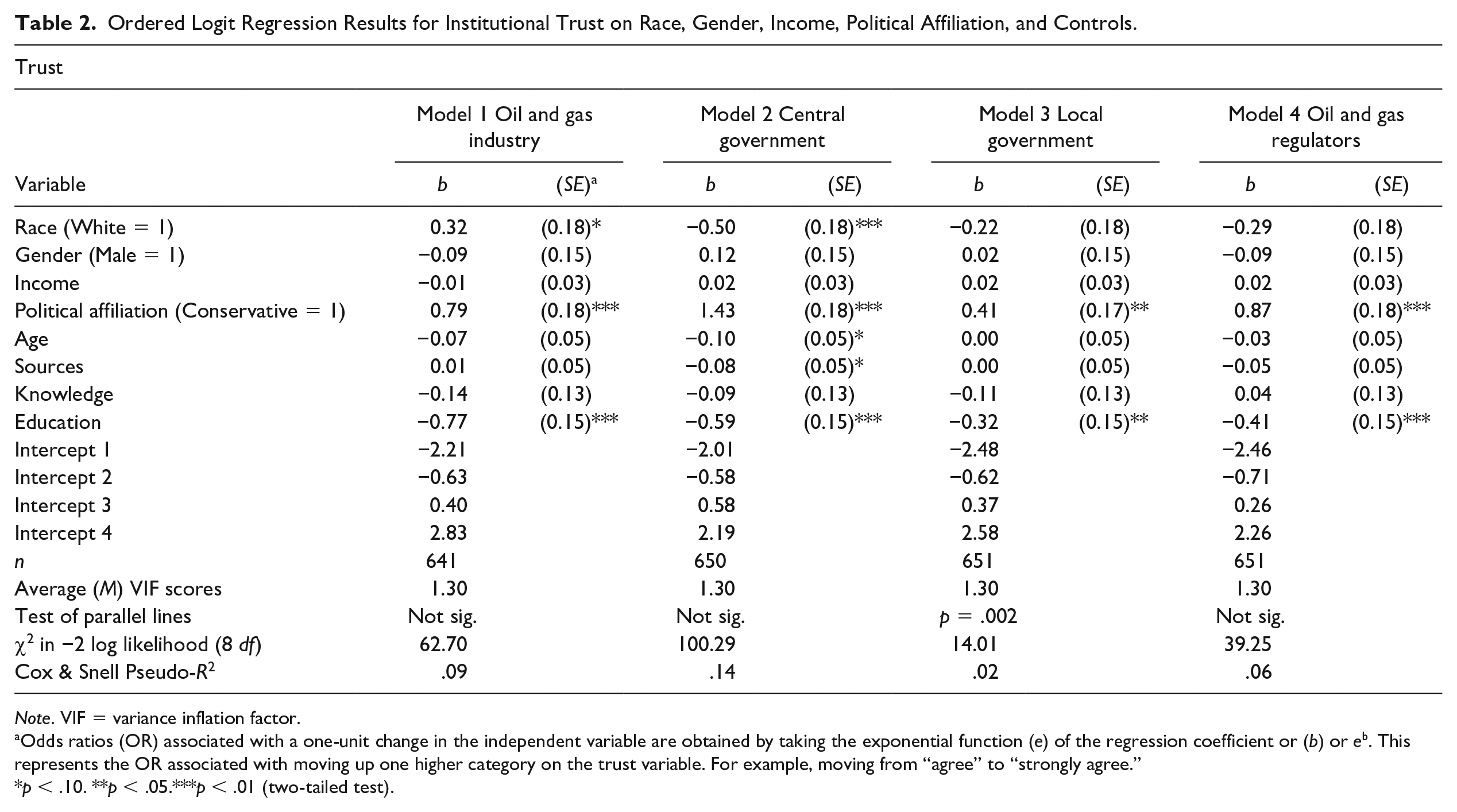
Note. VIF = variance inflation factor.
Odds ratios (OR) associated with a one-unit change in the independent variable are obtained by taking the exponential function (e) of the regression coefficient or (b) or eb. This represents the OR associated with moving up one higher category on the trust variable. For example, moving from “agree” to “strongly agree.”
p < .10. **p < .05.***p < .01 (two-tailed test).
In Table 3, we regress perceptions of risk (Seismicity Risk, Water Quality Risk, and General Risk) on the three environmental justice variables indicators (Gender, Race, and Income), self-reported political identification (Conservative) and controls (Age, Sources, Knowledge, and Education). These results are displayed in Models 5, 7, and 9 in Table 2. Finally, the three measures of perceptions of risk are regressed on the four measures of trust (Trust in Industry, Trust in Central Government, Trust in Local Government, and Trust in Oil and Gas Regulators), the three environmental justice indicators, self-reported political identification, and controls. These results are displayed in Table 2, Models 6, 8, and 10. If indicators of trust mediate the relationship between environmental justice and/or political identification and risk perceptions, then four conditions must hold: (1) There must be a relationship between environmental justice indicators, political affiliation, and perceptions of risk in the first regression (Table 2); (2) there must be a relationship between environmental justice indicators, political affiliation, and perceptions of risk (Table 3, Models 5, 7, and 9); (3) there must be a relationship between indicators of trust and perceptions of risk in the third regression (Table 3, Models 6, 8, and 10); and (4) the effect of the environmental justice variables and political affiliation on risk perceptions must be less in the third regression (Table 3, Models 6, 8, and 10) than in the second regression (Table 3, Models 5, 7, and 9). In short, the estimated coefficients for environmental justice and political affiliation should become less negative. If the coefficients of environmental justice indictors or political affiliation becomes statistically insignificant when indicators of trust are controlled, then trust completely mediates the relationship between those variables and risk perceptions. All analysis were estimated using Stata 15 using the “reg” and “logit” commands.
Regression Results for Perceptions of Risk on Race, Gender, Income, Political Affiliation, Trust and Controls.
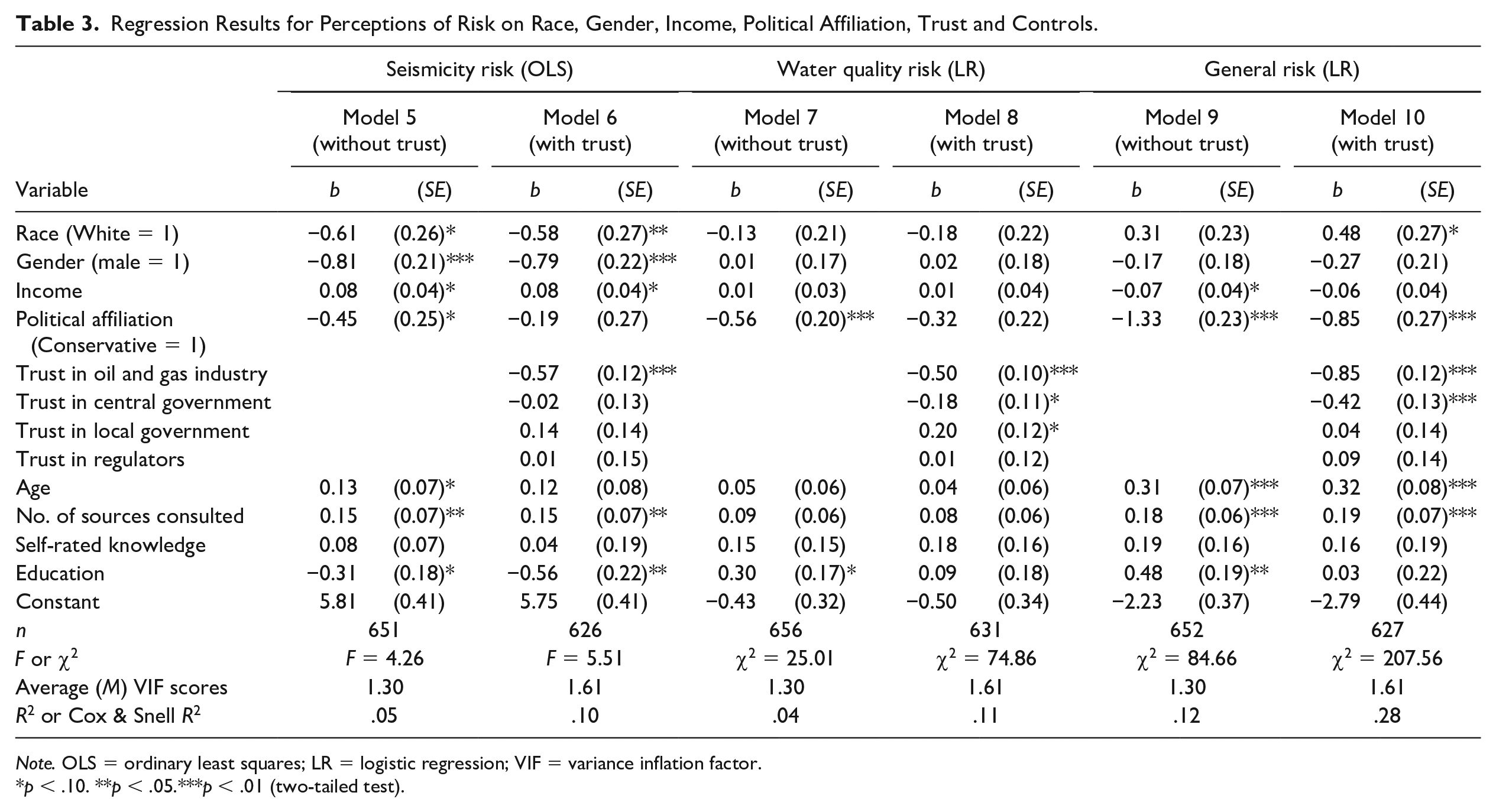
Note. OLS = ordinary least squares; LR = logistic regression; VIF = variance inflation factor.
p < .10. **p < .05.***p < .01 (two-tailed test).
Analyses and Results
Bivariate
We begin our analysis by examining the bivariate relationships between variables measuring race, gender, income, political affiliation, trust, control variables, and three perceptions of risk (seismicity, water quality, and general). Table 1 shows these bivariate relationships (rxy or rpb) along with the mean/proportion and standard deviation of each variable. The number of non-missing cases (out of n = 750) used to estimate each correlation is listed below the coefficients. It is notable that while respondents could choose the option “prefer not to answer” on any question in the shale gas trust/risk questionnaire, this was unlikely to occur with any great frequency except in the case of income where there were n = 72 missing values.
As Table 1 indicates, several interesting patterns between environmental justice indicators, political affiliation, trust, controls, and risk emerge. First, political affiliation is consistently correlated with perceived risks across seismicity, water quality, and general risks. Conservatives are consistently less likely than other political parties to be extremely concerned about perceived hydraulic fracturing risks (rpb = −.17) or a specific risk because of increased seismicity (rxy = −.07) or decreased water quality (rpb = −.12). Second, all four measures of trust are correlated with all three measures of perceived risks. As levels of trust in institutions such as government, regulators, and the industry increase, risk perceptions decrease. These correlations range from a modest rxy = −.06 (between trust in local government and increased seismicity) to rpb = −.43 (between trust in the oil and gas industry and general risks).
Other variables in Table 1 show inconsistent correlations across the three variables of perceived risk. White respondents are less likely to see seismicity as a risk (rxy = −.11) but more likely to be concerned about the general risks of hydraulic fracturing (rpb = −.08); men are less likely to see seismicity as a risk (rxy = −.14) but gender is uncorrelated with water quality and general risk; and income is positively related to seismicity (rxy = .07) and inversely related to general risks (rpb = −.07). In short, in the case of environmental justice indicators, it appears there is considerable variation in correlations across the three measures of perceived risks. Finally, every control variable is correlated with those perceived general risks associated with hydraulic fracturing. In particular, (1) older respondents felt more at risk (rpb = .14); (2) the number of sources consulted about fracking increased perceptions of risk (rpb = .15); (3) the more self-assessed knowledge of fracking, the greater respondents were concerned about hydraulic fracturing risks (rpb = .12); and (4) those residents with university degrees were more likely to be extremely concerned about the general risk posed by hydraulic fracturing (rpb = .10). Table 1 does not show consistent effects for control variables in the case of perceived risks of hydraulic fracturing as none are significantly related to all three measures of perceptions of risk. Overall, then, it appears from Table 1 that political affiliation and trust are the most important variables in predicting specific measures of risk perceptions such as seismicity and water quality and overall perceptions of risk associated with hydraulic fracturing.
Multivariate Analysis of Trust
While bivariate results are interesting, they do not allow for an examination of the role of trust as a potential mediating factor between political affiliation and perceived risk nor do those results provide any evidence of potential competing aspects of trust on perceptions of risk. Finally, it is not clear how race, gender, and income may shape levels of institutional trust when other variables are considered. As a result, we undertake multivariate analysis to simultaneously examine environmental justice indicators, political affiliation, trust, and controls. The results of that multivariate analysis are presented in Table 2, where levels of trust for the four institutions (Models 1 – 4) are estimated. Given the relative low frequency of diverse populations in the sample and theoretical concerns surrounding White power and perceptions of risk, race was modeled using a White/non-White dichotomous variable. However, Appendix A replicates the statistical analyses in Table 2 for different categories of race/ethnicity.
All four trust variables are measured at the ordinal level so ordered logit regression (OLR) is used to examine the first set of relationships between independent variables in interest and trust. OLR estimates the probability of being in one category of the dependent variable in comparison with all higher ordered categories of that variable (Long and Freese 2006). Estimates for trust in institutions are presented in four separate models in Table 2: (Model 1) Trust in Company, (Model 2) Trust in Central Government, (Model 3) Trust in Local Government, and (Model 4) Trust in Oil and Gas Regulators. Thus, each model in Table 2 estimates the effects of environmental justice indicators, political affiliation, and control variables simultaneously. Table 2 presents unstandardized coefficients (b) and standard errors (SE) with more traditional “p” values denoted by a “*” to signify when the null hypothesis (two-tailed) is rejected at α = .01, α = .05, and α = .10. To examine multicollinearity among independent variables and determine whether the distance between categories is proportional, Table 2 includes an average variance inflation factor (or VIF) score and results for a parallel lines test (Long and Freese 2006). VIF scores are all near “1” suggesting there is little reason to be concerned about multicollinearity (O’Brien 2007). We also find that proportionality assumption is met in three of the four trust models (i.e., differences are “not sig.”), indicating that coefficients are likely equivalent across categories of the dependent variable. The model predicting local government (Model 3), however, must be viewed with some caution as the null hypothesis for the parallel lines test is rejected.
As the coefficients in Table 2 indicate, there are three important patterns that emerge in these data. First, Political Affiliation is strongly and consistently related to each measure of trust. When it comes to shale gas development using hydraulic fracturing, conservatives are much more likely than non-conservatives to trust the oil and gas industry, the central government, their local government, and oil and gas regulators. The effect of Political Affiliation is relatively strong as identifying as a conservative increases the odds of falling in a higher category of trust by a factor ranging between 1.5 (i.e., b = 0.41) for Trust in Local Government and 4.17 (i.e., b = 1.43) for Trust in Central Government. Education is also related to each measure of trust. That is, having a university degree decreases the odds of falling into a higher category of trust by a factor ranging from 0.72 for Trust in the Local Government to 0.46 for Trust in the Oil and Gas Industry. Finally, it is interesting to note that race has a contradictory impact on trust where Whites have 1.38 (b = 0.32) times the odds of falling into a higher category on trust than other races in the case of Trust in the Oil and Gas Industry but have 0.61 (b = 0.32) times the odds of falling into a higher category than other races in the case of Trust in Central Government. In short, net of other effects, it appears that Whites are more likely than other races to trust the oil and gas industry and less likely than other races to trust the central government (also see Appendix A).
Multivariate Analysis of Risk Perceptions
The next step of the analysis examines the predictors of three perception or risk variables linked to hydraulic fracturing: (1) Seismicity Risk, (2) Water Quality Risk, and (3) General Risk. Independent variables include variables associated with environmental justice concerns, political affiliation, trust in the oil and gas industry, government as well as regulators and controls. It is here that the correlation between trust in four institutions (Oil and Gas Industry, Central Government, Local Government, and Oil and Gas Regulators) and the three indicators of risk perceptions are examined. This analysis also allows insight into whether trust variables may mediate the relationships between risk perceptions and political affiliation. Recall that political affiliation was consistently related to perceptions of risk in Table 2. Specifically, being conservative increased trust in all institutions while having a university degree decreased trust in all institutions. Again, the statistical analyses in Table 3 are replicated for different categories of race/ethnicity. Those analyses are presented in Appendix B.
To examine the potential impact and roll trust may play in shaping perceptions of risk, six additional regression models are estimated and presented in Table 3. For each of the three perception of risk variables, two models are estimated: (1) models without the four trust variables and (2) models that include the four trust variables. As previously noted, this methodology allows for an empirical assessment of the potential proposition that trust may mediate any identified association between political affiliation, education, and measures of perceived risk.
Perceptions of risk associated with seismicity (i.e., Seismicity Risk) is measuring using a variable scored from 1 (no risk) to 10 (high risk), so OLS regression analysis is employed to estimate the coefficients in Models 5 and 6 in Table 3. Little evidence of multicollinearity (the mean VIF scores in the models range from 1.30 to 1.61) exists in these two models, and the model residuals conform to regression assumptions. Water quality (Water Quality Risk) and general risks (i.e., General Risk) are measured using dichotomous variables where “1” indicates high levels of perceived risk and “0” indicates a lack of high levels of perceived risk. Thus, an analysis of these two variables is undertaken using logistic regression (LR). The unstandardized coefficients and standard errors of these analysis are presented in Models 7 to 10 in Table 3. Once again, there is little evidence of multicollinearity as the mean VIF scores are near 1 (indicating no collinearity among independent variables) and the model residuals conform to regression assumptions.
Because there is potential for non-response bias among participants who were not included in the analyses, as they did not answer the question about income, each model in Table 3 is also estimated without the variable Income (analysis not shown) to determine if the coefficients and standard errors may change for other variables in the analysis. Removing Income boosted the sample size in the models considerably to between n = 687 and n = 720. Results suggest that for Model 9, Race became statistically significant (b = −0.48, SE = 0.21) and that in Model 8, Trust in Central Government was no longer statistically significant (b = −0.16, SE = 0.11). Other than these two changes, the model coefficients and standard errors were nearly identical suggesting that missing values on income did not have any appreciable impact on the analysis.
The correlation between respondent trust and perceptions of risk are first considered in Models 5 and 6 (Table 3) in the case of Seismicity Risk. These findings suggest that whites and males have lower perceived risks of seismic events than other races and genders. In particular, the coefficients and standard errors are stable across both models. For instance, Whites score on average 0.61 fewer points on the 10-point Seismicity Risk scale while men score on average 0.81 fewer points on that 10-point scale. While this finding is consistent with literature about perceptions of risk for whites and males (McCright and Dunlap 2011b) and is consistent with the environmental justice literature in terms of potential perceptions about vulnerability (Pellow 2016), it only occurs in the Seismicity Risk Models (i.e., Models 1 and 2). Moreover, there is little evidence that these relationships are mediated by trust as the potential effects of race and gender on perceptions of seismic risk remain stable across Models 5 and 6 and both race and gender were found to be generally unrelated (or inconsistently related) to the four trust indicators in Table 2. Again, this is despite the relatively substantive association between these two variables and perceptions of seismic risk suggesting that race and gender have a direct impact on perceptions of risk.
While income is statistically significant and consistent across Models 5 and 6, the coefficients indicated are not substantive (i.e., b = 0.08, SE = 0.04). Thus, moving three income categories (or going up or down by £30k or the approximate standard deviation of income) across respondents is likely to increase (or decrease) perceptions of risk on seismic activity by 0.24 points on the 10-point scale. Combined with this relatively small substantive significance, there is little evidence that income is related to other aspects of shale gas risk in Models 7 to 10 except in the case of General Risk (Model 9). In Model 9, the potential effect of income is also substantively insignificant as it only reduces the odds of perceiving a general risk from fracking by a factor of 0.93. Moreover, when trust variables are controlled, Income is no longer statistically significant (Model 10). As a result, there is little indication that income matters when it comes to trust in industry, government, and/or regulators (Table 2) or in various perceptions of risk associated with hydraulic fracturing (Table 3).
In the case of political affiliation, being a self-identified conservative is both negative and statistically significant in Models 5, 7, and 9. This is an important finding as it suggests that conservatives see less risk than other political affiliations. Again, this is consistent with previous literature (McCright and Dunlap 2011b). The potential effect of being conservative is substantial. For instance, in Model 1, (Seismicity Risk) being conservative decreases perceptions of risk by approximately ½ a point on the 10-point scale (b = −0.45); in Model 3 (Water Quality Risk), it decreases the odds of perceived risk to water quality by a factor of 0.57; and, in Model 5 (General Risk), it decreases the odds of perceived general risk of hydraulic fracturing by a factor of 0.27. The potential effect of political affiliation, however, is eliminated or greatly reduced when models are adjusted for indicators of trust. For instance, in Models 6 (Seismic Risk) and 8 (Water Quality Risk), Political Affiliation is no longer correlated with risk perceptions when trust is controlled. In Model 10, Political Affiliation still matters, but the potential effect of being conservative matters much less and is associated with a reduction of the odds of perceiving that hydraulic fracturing is a general risk by a factor of 0.44. Given the findings in Table 2 that demonstrate that political affiliation is consistently related to trust, this finding provides considerable evidence that institutional trust mediates the relationship between political affiliation and perceptions of risk.
Importantly, it does not appear that all types of trust matter when it comes to mediating the relationship between political affiliation and perceptions of risk. Table 2 suggests that trust in the oil and gas industry stands out as primarily important. That is, trust in the oil and gas industry is the strongest indicator of perceptions of risk among the trust variables. That is, a one-unit (or category) change across respondents increases or decreases perceptions of Seismicity Risk by just over 0.50 points on the 10-point scale (Model 6); a one-unit (or category) increase across respondents decreases the odds of perceiving a Water Quality Risk by a factor of 0.50; and a one-unit increase across respondents decreases the odds of perceiving a General Risk of fracking by a factor of 0.47. It is notable that Trust in Regulators is not related to risk in any of the models in Table 3. Moreover, results for both local and central government are mixed. There is also evidence that trust in central government could shape perceived risks associated with Water Quality (Model 8 in Table 3 and General Risk (Models 10 in Table 3). For instance, a one-unit (category) increase in trust in central government across respondents decreases the odds of perceived water quality risk by a factor of 0.83 while a one-unit (category) increase in trust in central government across respondents decreases the odds of perceived general risks of fracking by a factor of 0.65. In short, trust in central government appears to potentially influence only some aspects of risk. Finally, trust in local government increases the probability of perceived risks in the case of water quality (Model 8 in Table 3). Thus, a one-unit (or category) increase in trust in local government across respondents in the sample increases the odds of perceived threats to water quality by a factor of 1.22. These findings suggest there is tension between local and central government as trust operates in two directions when it comes to perceptions of risk. That is, across respondents, the potential impact on risk to water quality from an increase in trust in central government appears to have quashed the same potential impact on risk to water quality from trust in local government (b = −0.18 vs. b = 0.20). This finding is not only interesting, but consistent with the review of the trust literature that competing messages about trust from different levels of government may be having contradictory outcomes where local-level concerns appear to be pitted against national interests (Pidd and Taylor 2019).
Turning to the results of the remaining control variables in the analysis, it is clear that some of these variables have potential impacts on different types of perceived risk. For instance, older respondents are more likely to perceive higher levels of risk from seismicity and fracking in general, and respondents who consult more sources about fracking are likely to see it as riskier. Education has contradictory effects across different measures of perceived risks, suggesting that the type of risk matters when it comes to levels of education. A university degree, for instance, appears to lower perceptions of risk when it comes to seismic activity but increase perceptions of risk when it comes to water quality and general risks associated with hydraulic fracturing.
Discussion and Conclusion
Sociologists have called for a greater understanding of the role of institutional trust in shaping risk perceptions (Xiao and McCright 2015). The present study considers the relationship between trust and perceptions of risk by drawing upon (1) Freudenburg’s (1993) theoretical work on recreancy and (2) developments in critical environmental justice studies on expendability (Pellow 2016). While the concept of recreancy is often applied to situate technological disasters (e.g., Cope et al. 2016; Gill et al. 2016; Ritchie et al. 2013), few studies have utilized recreancy to contextualize perceptions of risk in the case of shale gas development using hydraulic fracturing (except see Ritchie et al. 2021). The current study does just this, relying on data from a sample of U.K. residents.
We find that levels of trust are associated with perceptions of risk about seismicity, water quality, and hydraulic fracturing in general. There are, however, three important caveats to these findings that have implications for the study of recreancy and perceived risks of hydraulic fracturing. First, the association between trust and risk perceptions does not emerge for all institutions. For instance, the present study reveals that among U.K. residents, trust in central and local governments and regulators appear to matter little. However, we uncover that trust in the oil and gas industry is especially important for risks associated with hydraulic fracturing. If the associations revealed in this analysis are causal, then these findings suggest that trust in economic institutions have a greater influence on risk perceptions than governments and/or regulators. This finding is notable, but also represents a departure from previous work on recreancy. For instance, research on disasters typically reports that trust declines in a similar fashion for all institutions, including industry, government, and regulators (e.g., Cope et al. 2016; Defeyter et al. 2021; Gill et al. 2016). Moreover, recent research on the association between recreancy and human-induced seismicity in the United States (Oklahoma) combine people’s beliefs about the “capabilities” of regulators and industry together into one component (Ritchie et al. 2021). In brief, while previous research suggests the loss of institutional trust often occurs across all institutions, our findings suggest this may not always be the case. Thus, variation in trust across institutions should be considered in future research.
A second related point concerns the inconsistent correlation between trust and risk for institutions other than oil and gas. We find government trust is related to perceptions of risk in one instance. That is, trust in central government and in local government are weakly associated with perceived risks to water quality (but not human-induced seismicity or hydraulic fracturing in general). In the case of water quality, elevated trust in central government is associated with decreased perceptions of risk to water quality while elevated trust in local government is associated with increased perceptions of risk to water quality. Thus, the more trust participants place in local government, the greater the perceived risks. This finding, while seeming contradictory, is consistent with local government messages of opposition to hydraulic fracturing across the United Kingdom. Thus, these findings again underscore the importance of differentiating between institutions believed to have failed to manage risk.
Third, we discovered that trust in the oil and gas industry completely mediates the relationship between political affiliation and perceptions of risk associated with seismicity and water quality. This also has important implications for sociologists interested in the politics and risk (e.g., McCright and Dunlap 2011a). Moreover, the finding goes to the heart of Freudenburg’s concept of recreancy as levels of trust are assumed to be a product of the actual past performance of institutional actors. Our findings regarding the role of political affiliation challenge this assumption in the case of risk perceptions associated with hydraulic fracturing. Conservatives may be more accepting of risk because of the elevated levels of trust they place in the oil and gas industry despite the industry’s successes or failures. In short, perceptions of risk appear to be shaped by institutional trust which, in turn, are influenced by political ideology rather than failure to prevent, for instance, problematic levels of human-induced seismicity. This finding concerning political ideology calls for a partial reinterpretation of recreancy. Freudenburg (1993:914) recognized that the division of labor has the potential to cause serious social harm through a loss of trust when institutional actors in whom we place trust fail in their responsibilities. However, the present study suggests that actual failure of responsibilities may not be the only factor to drive lack of institutional trust and perceptions of recreancy. Instead, we discover that divided political ideology may also create strong divisions of trust that, in turn, influence risk perceptions about energy technology. To be sure, we are not the first researchers to suggest that institutional trust (and perhaps a belief that an institution is recreant) is related to politics. Thomas Beamish (2001), for instance, suggests that victimization, vulnerability, and stigma all erode trust in social institutions. Nevertheless, the current study is the first in the United Kingdom to link politics, trust, and perceptions of risk.
We also draw upon developments in environmental justice to emphasize the way in which race, gender, and income may shape perceptions of risk directly and indirectly through institutional trust. These linkages are based on perspectives of the marginalized (i.e., women, racial minorities, and the poor) who may be less trusting of technology as they feel as though institutions could/do treat them as expendable (Pellow 2016). In short, the notion that some people believe they are viewed by intuitional actors as being “worth less” may shape their levels of institutional trust and ultimately perceptions of recreancy. As a result, perceptions of recreant institutions may vary by race, gender, and economic circumstances. As Ian Carrillo and David Pellow (2021) have recently suggested, the notion of expendability is a major component in critical environmental justice studies. We see this notion as an increasingly relevant aspect of environmental justice research when it comes to managing institutional trust.
The present research findings concerning seismicity are consistent with previous studies that find white males may be more accepting of environmental risk (e.g., Flynn, Slovic, and Mertz 1994). Participants who belong to socially powerful groups (i.e., whites and men) have lower perceptions of risk while participants who belong to traditionally marginalized groups (i.e., U.K. BAME populations and women) have higher perceptions of risk. The present research, however, leaves open the question about why gender and race seem to matter greatly when studying perceived risks associated with seismicity but seem to matter little when studying water quality and general risks associated with hydraulic fracturing. Again, we suggest that this finding requires additional exploration in the future research, noting the potential role of expendability on trust and perceptions of risk.
In the end, the current study of perceived risks associated with shale gas development has extended the study of institutional trust through the concept of recreancy. In the United Kingdom, the study of shale gas development using hydraulic fracturing provides an excellent context to better understand the role institutional trust may have in shaping perceptions of risk. We find that trust in economic institutions, along with factors that may shape trust, such as political ideology, may help explain perceptions of risk which may ultimately influence U.K. energy policy. As a result, we believe that recreancy, expendability, politics, and perceived risks are likely to play an important role in other areas of environmental sociology and are likely to influence energy policy well into the future.
Footnotes
Appendix
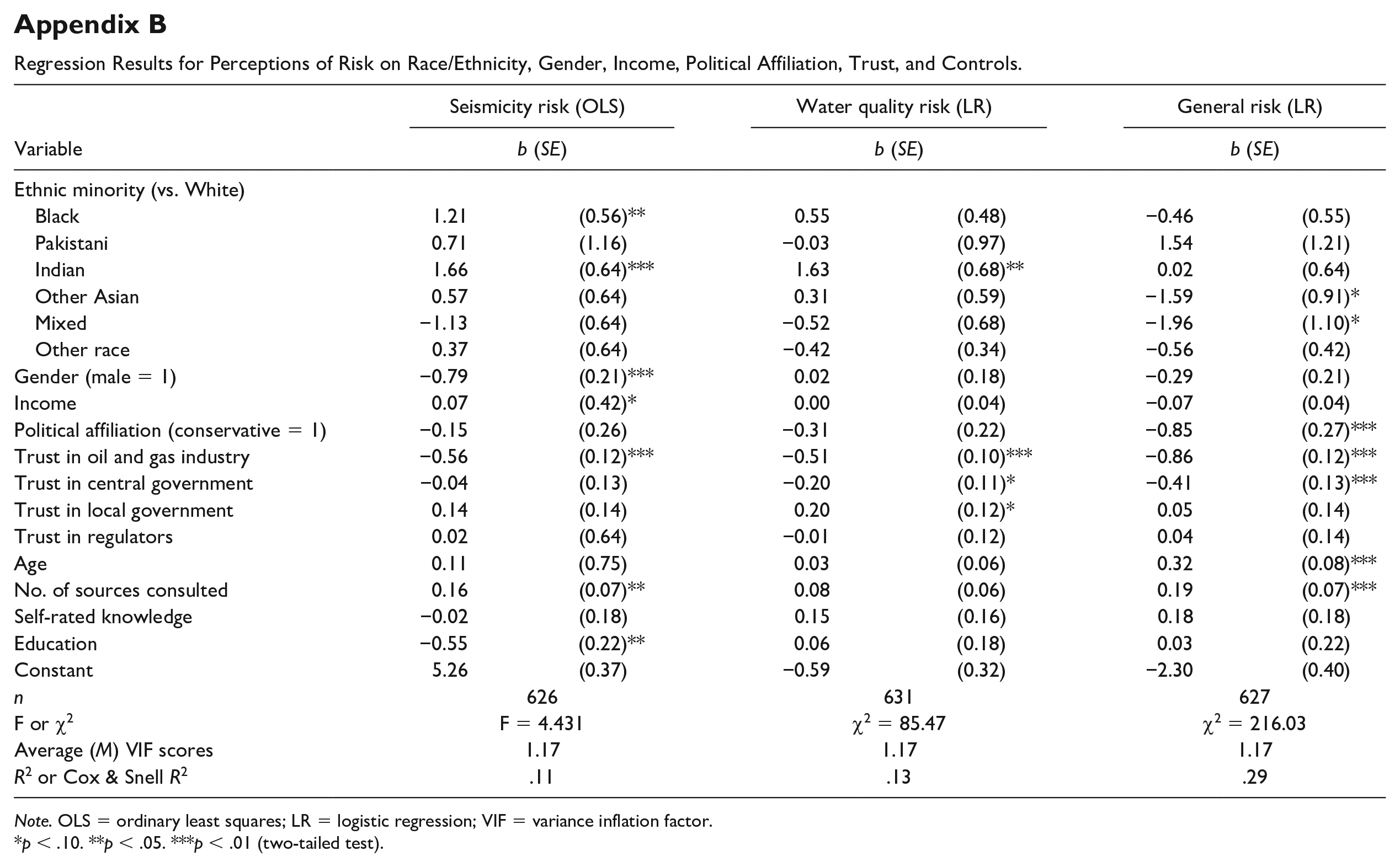
Regression Results for Perceptions of Risk on Race/Ethnicity, Gender, Income, Political Affiliation, Trust, and Controls.
| Variable | Seismicity risk (OLS) | Water quality risk (LR) | General risk (LR) | |||
|---|---|---|---|---|---|---|
| b (SE) | b (SE) | b (SE) | ||||
| Ethnic minority (vs. White) | ||||||
| Black | 1.21 | (0.56)** | 0.55 | (0.48) | −0.46 | (0.55) |
| Pakistani | 0.71 | (1.16) | −0.03 | (0.97) | 1.54 | (1.21) |
| Indian | 1.66 | (0.64)*** | 1.63 | (0.68)** | 0.02 | (0.64) |
| Other Asian | 0.57 | (0.64) | 0.31 | (0.59) | −1.59 | (0.91)* |
| Mixed | −1.13 | (0.64) | −0.52 | (0.68) | −1.96 | (1.10)* |
| Other race | 0.37 | (0.64) | −0.42 | (0.34) | −0.56 | (0.42) |
| Gender (male = 1) | −0.79 | (0.21)*** | 0.02 | (0.18) | −0.29 | (0.21) |
| Income | 0.07 | (0.42)* | 0.00 | (0.04) | −0.07 | (0.04) |
| Political affiliation (conservative = 1) | −0.15 | (0.26) | −0.31 | (0.22) | −0.85 | (0.27)*** |
| Trust in oil and gas industry | −0.56 | (0.12)*** | −0.51 | (0.10)*** | −0.86 | (0.12)*** |
| Trust in central government | −0.04 | (0.13) | −0.20 | (0.11)* | −0.41 | (0.13)*** |
| Trust in local government | 0.14 | (0.14) | 0.20 | (0.12)* | 0.05 | (0.14) |
| Trust in regulators | 0.02 | (0.64) | −0.01 | (0.12) | 0.04 | (0.14) |
| Age | 0.11 | (0.75) | 0.03 | (0.06) | 0.32 | (0.08)*** |
| No. of sources consulted | 0.16 | (0.07)** | 0.08 | (0.06) | 0.19 | (0.07)*** |
| Self-rated knowledge | −0.02 | (0.18) | 0.15 | (0.16) | 0.18 | (0.18) |
| Education | −0.55 | (0.22)** | 0.06 | (0.18) | 0.03 | (0.22) |
| Constant | 5.26 | (0.37) | −0.59 | (0.32) | −2.30 | (0.40) |
| n | 626 | 631 | 627 | |||
| F or χ2 | F = 4.431 | χ2 = 85.47 | χ2 = 216.03 | |||
| Average (M) VIF scores | 1.17 | 1.17 | 1.17 | |||
| R2 or Cox & Snell R2 | .11 | .13 | .29 | |||
Note. OLS = ordinary least squares; LR = logistic regression; VIF = variance inflation factor.
p < .10. **p < .05. ***p < .01 (two-tailed test).
Declaration of Conflicting Interests
The author(s) declared no potential conflicts of interest with respect to the research, authorship, and/or publication of this article.
Funding
The author(s) disclosed receipt of the following financial support for the research, authorship, and/or publication of this article: This research was funded by the UK’s Economic and Social Research Council, the National Environmental Research Council under project number R018146.
