




Abstract
Recent work has begun to investigate how criminalization is mediated through interpersonal relationships. While this research emphasizes the importance of gender dynamics and cross-gender intimate relations for boys and men of color, little is known about how gendered and sexualized relationships matter for criminalized women and girls of color. This study seeks to fill this knowledge gap and asks: How do system-involved Chicanas’ relationships with men and boys shape their experiences of criminalization over the life course? How do they navigate criminalization through men and boys? While previous research suggests that young men of color may avoid criminalization through their relationships with young women of color, life-history interviews with formerly incarcerated and system-impacted Chicanas reveal that relationships with Latino men and boys exacerbated their experiences of criminalization. Utilizing an intersectional criminalization framework, I argue that racialized, gendered, and heteronormative assumptions about Latinas’ interpersonal relationships condition criminalization over the life course. Chicanas employed two strategies to navigate criminalization through men and boys, both of which came at a cost to their wellbeing.
Smiley is a 28-year-old Chicana 1 from a small, rural town outside Stockton, CA. Although she has never been incarcerated, save for one night in the drunk tank in her early 20s, she is socially marked in the community and by law enforcement as a criminal alongside her justice-involved brothers. The criminal label follows Smiley everywhere she goes and has taken a toll on her wellbeing. She changed her last name in the hopes that distance from her widely recognized surname would protect her against criminalization. However, all this achieved was a strain on her family ties and even more stress, as the mark of criminality placed on her brothers and family name has been impossible for Smiley to escape.
Although Latinas generally (The Sentencing Project 2020), and Chicanas specifically (Díaz-Cotto 2006), are overrepresented in the carceral system, criminalization research often overlooks the criminalized experiences of system-involved Latinas like Smiley. This is a surprising gap in knowledge, given that while imprisonment rates for most racially marginalized groups steadily declined between 2000 and 2020, rates increased for Latinas (The Sentencing Project 2020). However, this oversight is part and parcel of a general focus on the racialized experiences of boys and men of color, which leaves us with little understanding of the conditions that shape criminalization for girls and women. This study addresses this gap in research by examining a key feature of Latina criminalization: how their interpersonal relationships with Latino men and boys shape their experiences of policing and punishment.
Recent work has begun to investigate how interpersonal relationships mediate criminalization. For example, Forrest Stuart and Ava Benezra (2018) find that Black male youth avoid street-level criminalization through exaggerated heteronormative displays of affection with Black girls. This line of research emphasizes the importance of gender dynamics and cross-gender intimate relations for criminalization processes. However, little is known about how gendered and sexualized relationships matter for criminalized women and girls of color.
This study utilizes an intersectional criminalization framework to better understand how race, gender, and sexuality shape criminalization processes over the life course for system-involved Latinas. An intersectional lens not only allows for attention to understudied intersections but also underscores how criminalization is relationally conditioned and experienced. Enlisting this framework and examining the role of interpersonal relationships, this analysis asks: How do system-involved Chicanas’ relationships with men and boys shape their experiences of criminalization over the life course? How do they navigate criminalization through men and boys? Drawing on life-history interviews with 38 formerly incarcerated and system-impacted Mexican American women, I argue that ties to Latino relatives, peers, and heterosexual partners can drive criminalization. Racialized, gendered, and heteronormative assumptions about Latinas’ roles in their interpersonal relationships condition their experiences of criminalization over the life course.
In what follows, I demonstrate the process through which Chicana girls were criminalized for their familial ties to justice- and gang-involved Latino men and boys beginning in elementary school. In adolescence, the influence of Latino male peer networks combined with that of familial ties to shape Chicanas’ experiences of street-level criminalization, as respondents became the indirect targets of police surveillance and harassment. Criminalization became a fixed status for adult Chicanas involved in heterosexual relationships with criminalized Latino men when police assumed they were privy to, and supportive of, Latino men’s presumed criminality. Negotiating criminalization took two forms, reflecting a choice between maintaining freedom or interpersonal relationships. Both options levied a hefty cost on Chicanas.
The Process of Criminalization
Victor M. Rios (2011:xiv) defines criminalization as “the process by which styles and behaviors are rendered deviant and treated with shame, exclusion, punishment, and incarceration.” As a process and lived experience, criminalization consists of constant surveillance, harassment, and discipline. Rios distinguishes between material criminalization—or physical manifestations of criminalization, such as police harassment, exclusion from public spaces, and punishment from zero-tolerance policies—and symbolic criminalization, the social stigma and degradation resulting from profiling, policing, and punishment.
Criminalization is not contingent upon criminality; one does not have to commit a crime to be labeled a “criminal.” Nor is it confined to the criminal justice system; it extends to schools, communities, social services, and the family. The multi-spatiality of criminalization renders the hyper-criminalized as criminals in nearly all spaces they occupy, a process Rios (2011) captures with the “youth control complex,” a self-reinforcing system channeling male youth of color into the criminal justice pipeline.
The effects of criminalization, what scholars call “collateral consequences” or “invisible punishments” (Travis 2002), are far from innocuous even if they never lead to legal consequences. They can include “social incapacitation”—when marginalized populations are prevented from “functioning, thriving, and feeling a sense of dignity and humanity in daily interactions with institutional forces” (Rios 2011:160). Forrest Stuart (2016) identifies “cultural collateral consequences” that reconfigure interpersonal relationships in marginalized, hyper-policed communities (see also Lopez-Aguado 2018).
To date, criminalization has been viewed primarily through a racialized lens. Indeed, it is a race-creating system that regulates racially marginalized populations, (re)produces racialized inequities, and is experienced as a “racial microaggression” in everyday life (Lopez-Aguado 2018; Rios 2011). The police, as critical agents of criminalization, exact racial control by disproportionately targeting, searching, and sanctioning Black and Brown people and communities, thereby reproducing racialized ideas about crime and who the criminals (and victims) are, which in turn justifies state violence against Black, Indigenous, people of color under the colorblind guise of “crime control” (Bonilla-Silva 2017; Carlson 2020; Epp, Maynard-Moody, and Haider-Markel 2014; Vitale 2017; Western 2006). For example, police gang units enlist stereotypes of Mexican-origin people as gang members as a pretext for hyper-policing Latinx neighborhoods (Durán 2009; Zatz 1987).
Along with the introduction of increasingly harsh policing in the street starting in the 1990s (see Fagan et al. 2016), policing in schools via school police, or “school resource officers,” and zero-tolerance policies funnel youth of color into the school-to-prison pipeline (Irwin, Davidson, and Hall-Sanchez 2013). Children of color are disproportionately targeted for punishment and surveillance in school (Ferguson 2000; Morris 2016; Perry and Morris 2014; Rios 2011). In predominately Latinx schools, school personnel’s perceptions of Latinx youth as dangerous, criminal gang members (as opposed to students) legitimize criminalization via policies that restrict students from walking or hanging out in groups (Katz 1997; Portillos, González, and Peguero 2011).
By defining criminalization through the single axis of race, criminalization is often conflated with the racialized experiences of boys and men of color, which effectively normalizes and naturalizes their experiences while ignoring women and girls or treating them as passive actors (Collins and Bilge 2020). Gender is frequently treated as a marker for masculinity or not explicitly noted (for exceptions, see Rios 2011; Stuart and Benezra 2018). Failing to fully consider the unique conditions that shape criminalization for girls and women of color, moreover, may inadvertently imply that they share similar experiences with their male counterparts or preclude their scholarly examination altogether (Brunson and Miller 2006; Morris 2016).
Indeed, prior understandings of how the process of criminalization is gendered are narrowly concentrated in the study of masculinities. For example, much of the research on policing considers the experiences of men and/or presumes gender neutrality (Brunson and Miller 2006). The police have been described as the “premier ‘masculinity-making institution’ in poor neighborhoods” (Stuart and Benezra 2018:176). Scholars find that policing may reproduce toxic masculinities (i.e., domination of others, violence, emotional indifference), as it is often interpreted as a threat to manhood (Collins 2004; Jones 2014; Rios 2011). Black and Latino boys, for instance, may internalize criminalization by enlisting coping strategies, like “acting bad,” that provide legitimacy for policing and punishment (Rios 2011).
Women are largely absent from these accounts. Yet they comprised 44 percent of all involuntary police stops in 2015 and accounted for 27 percent of actual arrests, while the use of police force against women quadrupled from 1999 to 2015 (U.S. Department of Justice Statistics 2018). In this article, I focus on the ways in which Latina girls’ and women’s presumed criminality may be read through their ties to Latino boys and men, which I argue is a primary mechanism through which Latinas experience criminalization. I build on prior research focusing on how boys and men can utilize ties to women to minimize or protect themselves from criminalization.
For instance, in their study of Black youth living in South Side Chicago, Stuart and Benezra (2018) find that Black male youth embodied a specific brand of masculinity to convey innocence and reduce unwanted police attention. Rebuffing characteristics associated with the “cool pose” (Majors and Billson 1992), such as toughness and aggression, these youth displayed emotional sensitivity, care for others, and vulnerability through overstated displays of heterosexual affection with Black girls—a strategy the authors refer to as “getting cover.” As a gendered and sexualized performance, getting cover co-constituted femininities as well, as girls performed “dominant, mainstream (typically white, middle-class) conceptions of femininity” to support this strategy (p. 188).
Notably, getting cover may not be readily available to criminalized girls and women of color whose femininities and sexualities are stigmatized and for whom embracing mainstream conceptions of femininity is not an option (García 2012). Research has paid little attention to how socially constructed assumptions about interpersonal (and often heterosexual) relationships shape how women of color experience criminalization. Rod Brunson and Jody Miller (2006) found that Black girls are more likely to be treated as suspects when in the company of Black boys, but they do not expound upon the process by which this happens—and Chicanas remain largely absent from racialized policing research (for an exception, see Díaz-Cotto 2006).
I suggest that existing stereotypes that render Chicanas’ familial and intimate relationships criminal and depict them as willing to do anything for men may also shape their institutional encounters with authority figures. For these women, assumed criminality flows through their connections to criminalized men. Studying how Chicanas’ interpersonal relationships intersect with criminalization processes requires an intersectional framework, as described below.
Intersectional Criminalization
Feminist scholars of color have long noted the need for intersectional analyses and have identified distinct processes that shape outcomes for system-involved women of color, illustrating a dynamic interplay between systems of oppression (see, for example, A. P. Harris 2011; Potter 2015; Silliman and Bhattacharjee 2002; Sudbury 2005). As Dorothy Roberts (1993: 1945) explains, intersectionality allows for examining the interconnectedness of systems of oppression and how they help determine “who the criminals are, what constitutes a crime, and which crimes society treats most seriously.”
Existing research underscores the importance of simultaneously applying racialized and gendered frames in studying criminalization processes. For example, exposure to interpersonal and state violence (Arnold 1990; Díaz-Cotto 2006; Richie 1996) and racialized motherhood coupled with state dependency (Gurusami 2019; Gutiérrez 2008; Roberts 2012) are two distinguishing features that are uncovered when race and gender are taken as co-constitutive. These examples also highlight the relationships (romantic and familial) through which the process of criminalization can occur.
Consequently, this study adopts an intersectional framework to understand how race, gender, and sexuality, among other categories of difference embedded in systems of domination, condition criminalization processes and experiences. Intersectional criminalization holds that gender, sexuality, and race matter differently for girls and women than for boys and men within the context of a social structure that is comprised of interlocking systems of oppression and privilege. This approach brings to the fore the relational nature of criminalization by attending to how the interactional dynamics and assumptions associated with relationships between women and men are central to the process of criminalization.
For instance, Chicanas are often subject to gendered, racialized, and heteronormative assumptions that they will “stand by” their family and men. As Urban Dictionary 2 highlights, a Chicana is frequently viewed as a “chola” who is “down for her barrio and is in a gang” (see also V. López and Chesney-Lind 2014). Chicanas are viewed as passive and subordinate to their men—likely to be complicit to men’s desires (J. P. López 2013). In addition, performances of femininity among Latinas are often criminalized in a way that white middle-class expressions of femininity are not (Bettie 2000; García 2012). These expectations inflect the assumptions of police, school officials, and other institutional authorities about how and why Chicanas will act and are thus implicated in Chicanas’ intersectional experiences of criminalization.
Although Chicanas are generally missing from criminalization scholarship, gang scholars identify gang-involved Chicanas as the most criminalized Latina subgroup (see Cepeda and Valdez 2003; Díaz-Cotto 2006; M. G. Harris 1994; Mendoza-Denton 2008; Moore 1991; Valdez 2007; Vigil 2008). This research tends to focus on the individual “at-risk” behaviors of Chicana gang members—for example, drug use and unsafe sexual practices—and is often less concerned with racist, heterosexist perceptions that ascribe gang involvement, hypersexuality, and drug addiction to all Chicanas regardless of the gang status (for exceptions, see Díaz-Cotto 2006; V. López and Chesney-Lind 2014; Maldonado Fabela 2022). Continuing to develop critical intersectional theorizing is essential for disrupting harmful ideas that perpetuate Chicana criminalization in the first place.
In what follows, I show that gendered, racialized, and heteronormative expectations associated with Chicanas’ connections to men are often a key mechanism through which they are criminalized. In other words, the problematizing of Chicanas’ proximity to, and relationships with, criminalized men shapes their experiences of criminalization. I also build in a life course approach that recognizes that the nature of the relationships between men and women and boys and girls varies as they age and move through different societal institutions.
A life course approach embeds individuals in social structures and history, recognizes how advantage and disadvantage accumulate over time, and considers the principle of “linked lives.” According to Glen Elder (1994), the idea that individual lives are interdependent and shaped by relational ties is the most fundamental principle of the life course perspective. Sociologists and criminologists have traditionally used life course theory to understand the risk of criminal offending from adolescence to adulthood (see, for example, Sampson and Laub 1990). However, recent criminalization scholarship shifts the focus from individual behaviors to the longitudinal effects of institutionally embedded criminalization processes and social control mechanisms (see Maldonado Fabela 2022). I build on this growing body of research to consider how age along with race, gender, and sexuality shapes and is shaped by criminalization processes.
Data and Methods
Data consist of life-history interviews conducted from spring 2018 through winter 2020 with 38 formerly incarcerated (25) and system-impacted (13) U.S.-born Mexican American women living in California’s Central Valley. This 18,000 square-mile stretch of land in the arid heart of California is sometimes referred to as the “other California” or the “Appalachia of the West” due to extreme racialized socioeconomic marginalization. Despite being one of the most productive agricultural regions in the world, the Valley has become a target for confining society’s “undesirable elements” (Braz and Gilmore 2006). Large-scale prison expansion beginning in the 1980s earned the region the moniker “prison alley” (Gilmore 2007). Currently, the San Joaquin Valley alone hosts 13 state and four federal prisons, and incarceration rates are among the highest in the state (California Criminal Justice Statistics Center 2021).
In this study, “system-impacted” references individuals who have been significantly affected by the incarceration of a close loved one (i.e., parent, sibling, partner) or who have been arrested and convicted but not incarcerated. Including formerly incarcerated and system-impacted respondents allowed me to identify within- and across-group differences, search for disconfirming evidence, and theorize criminalization absent of criminality. Notably, nearly all formerly incarcerated respondents were also system-impacted, and six system-impacted participants had spent a night in jail (usually a holding cell for intoxicated offenders to sober up). To provide clarity, I define “formerly incarcerated” as having experienced at least 30 days of confinement in a correctional facility. This delimitation is based on conversations with respondents and observing when sample groups’ experiences significantly diverge in terms of consequential life chances. Because I am focused on the experiences of U.S.-born women, I do not focus on immigrant detention or the criminalization of (im)migrants, which is sometimes referred to as “crimmigration.”
I employed a snowball sampling method particularly useful in locating “hidden” or hard-to-reach populations. To mitigate the effects of in-network biases, I cultivated varied “chains” (Biernacki and Waldorf 1981) of key contacts to identify potential participants. I posted research recruitment flyers in county probation department offices, community centers, and on community college and four-year university campuses. Digital flyers were circulated via social media platforms and email listservs.
Seeking participants through support services in the resource-poor Central Valley did not increase recruitment, as these services are often designed for a male clientele. While online recruitment was more successful, racist, heterosexist, and nativist comments from residents (e.g., “#BuildThatWall” or “go back to Mexico”) toward me and the study’s population likely impeded participation. Moreover, potential volunteers were often distrusting of a researcher interested in their lives. Even among those with expressed interest, follow-up was difficult due to many potential recruits’ housing insecurity, lack of access to a personal phone, and/or incarceration.
Participants ranged in age from 20 to 35 years. Most reported living in predominately low-income communities of color. As illustrated in Tables 1 and 2, education levels ranged considerably, from ninth grade to a master’s degree. Higher educational attainment was reported among the system-impacted sample, with most completing some college-level education. Nearly half of the formerly incarcerated sample did not finish high school. Joblessness was more common among formerly incarcerated respondents, with half unemployed or unable to work due to a disability. Cisgender, heterosexual women comprised most of the study’s sample, while eight participants, or 21 percent, identified as lesbian, bisexual, or pansexual (three declined to identify).
Demographics and Carceral Histories for Formerly Incarcerated Sample.
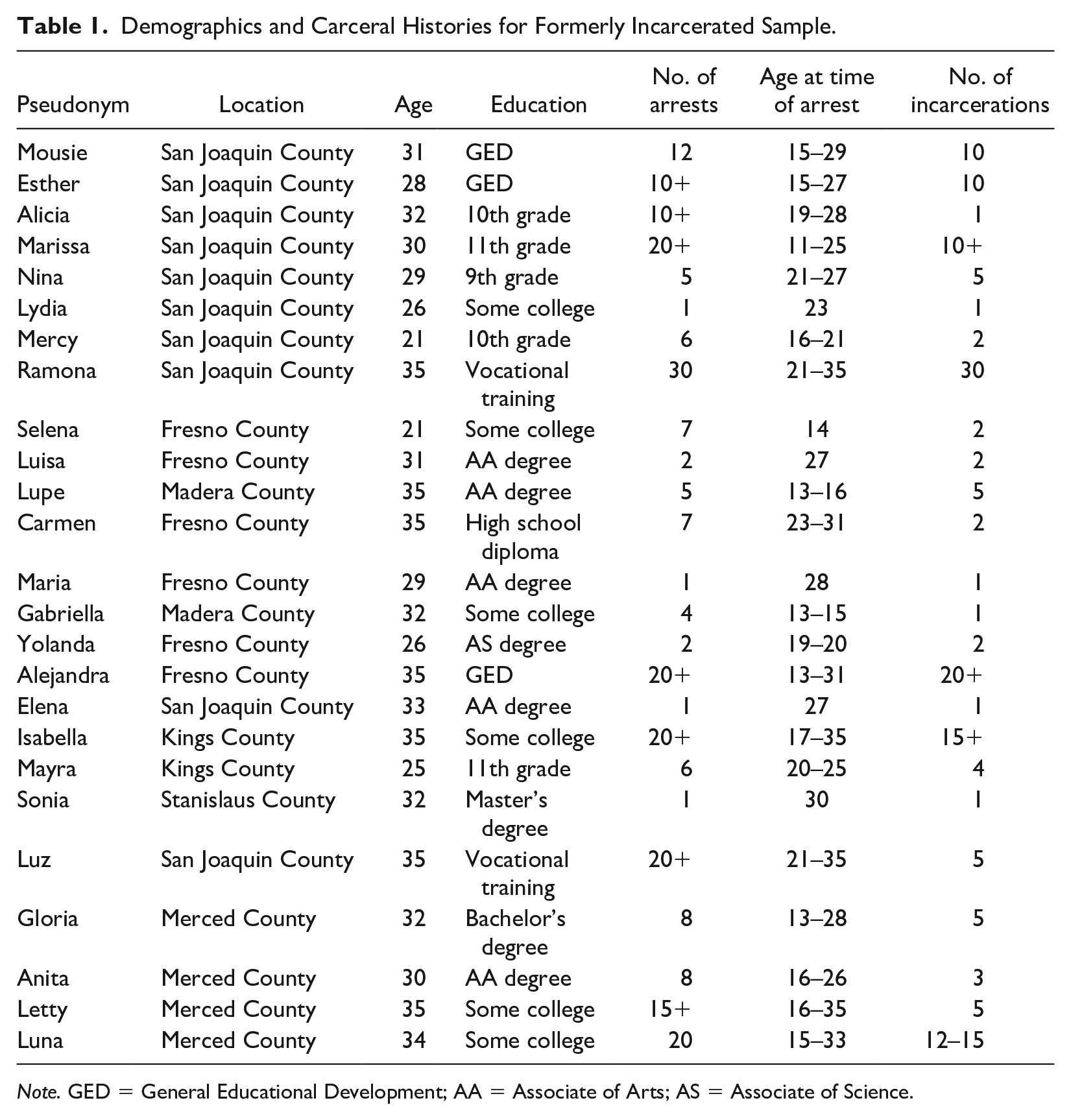
Note. GED = General Educational Development; AA = Associate of Arts; AS = Associate of Science.
Characteristics and Carceral Histories for System-impacted Sample.
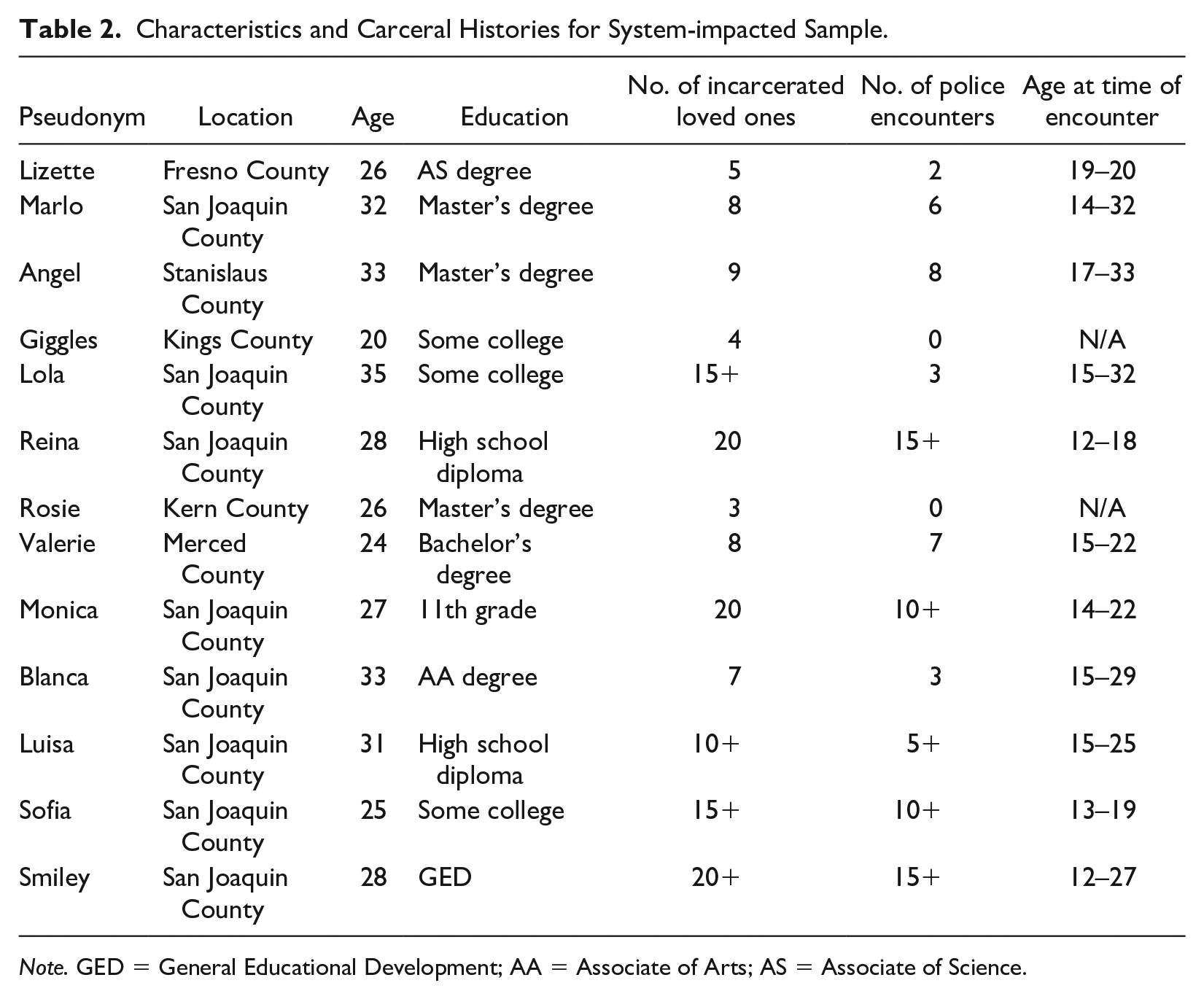
Note. GED = General Educational Development; AA = Associate of Arts; AS = Associate of Science.
Respondents were asked to estimate the number of times they experienced unwanted police contact; formerly incarcerated respondents were also asked to estimate the number of times they were incarcerated but were not asked to discuss actual or alleged unlawful activities. Two system-impacted respondents reported never having been stopped by police, but these were outliers. Across samples, participants commonly estimated being stopped by police at least 20 times, and many said they had lost count.
Among formerly incarcerated participants, two-thirds reported at least five arrests, including one respondent who reported 30 arrests. Age at the time of first and last arrest ranged from 11 to 35 years. Half of the formerly incarcerated respondents (12) had been incarcerated five times or more, and more than a quarter of the sample reported 10 or more incarcerations. Approximately 85 percent of system-impacted respondents stated they knew five or more people who are or had been incarcerated; all knew at least three, and six knew more than 15.
Some participants had current or former involvement in gangs, which they indicated on a self-administered personal background survey. Respondents were not directly questioned about gang involvement, as early interviews revealed that this query changed interactions. However, it was apparent that criminalization was not dependent on being in a gang, as participants, regardless of the gang status, shared experiences of criminalization based on racist and heteronormative assumptions that ascribe gang membership to Latinas.
Interviews followed an open-ended, semi-structured format. Questions addressed family background, experiences with institutions of control (e.g., juvenile and criminal justice systems, school, family, and social services), feelings toward criminalization, and future goals and aspirations. Interviews lasted 1–3 hours and took place in public parks, coffee shops, and participants’ living rooms or via video or phone calls. Participants received a $25 VISA gift card. Interviews were audio-recorded and transcribed with the respondent’s permission. All names used are pseudonyms.
As gaining respondents’ trust proved challenging, having respected “homegirls,” or veteranas, share recruitment flyers lent the study validity and was often the first step in establishing my credibility. In addition, I shared my experiences as a system-impacted Chicana from the Central Valley. Still, my educational privilege shaped how respondents viewed me, automatically rendering me an outsider. The carceral system has not affected my life in the way it has for formerly incarcerated respondents. If anything, my limited contact with the carceral system is tokenized and even rewarded in academic spaces. Nonetheless, I believe I established mutual trust and respect that allowed for candid conversations.
Data analysis occurred alongside data collection using the qualitative software program NVivo 12. Simultaneous data collection and analysis force researchers to pay analytic attention to data from the start of the collection process and remain in constant reflection (Gslene 1999). This inductive/deductive approach focused on the life course (from childhood to adulthood) and proceeded in the following steps: First, I “open-coded” (Corbin and Strauss 2008) transcribed interviews line-by-line to gain a sense of the data, paying close attention to how participants encountered and experienced criminalization. Next, I applied focused codes to capture major themes. I identified relational ties as a mechanism of punishment with significant influence on criminalization. Finally, during selective coding (Charmaz 1995), I grouped related codes (e.g., male relatives, peers, and heterosexual partners) under the category “criminalization through relationships with men and boys.”
Findings
When we apply an intersectional perspective to criminalization, the importance of relationships becomes readily apparent because, as a paradigm, intersectionality is particularly useful in analyzing relationships among people, categories, processes, and systems. Across sample groups, interviewees experienced criminalization in various institutional contexts. Like their male counterparts, Chicanas’ racialized and socioeconomic identities as Chicanxs living in impoverished, segregated communities were criminalized. However, they simultaneously experienced criminalization via gendered and often heterosexual relational expectations through their connection to Latino male relatives, peers, and/or romantic male partners.
Childhood and Early Adolescence: Criminalization through Familial Ties
Participants struggled to remember a time before they were criminalized because they had been born into criminalized families, and the gang status (actual or alleged) of fathers, brothers, uncles, and male cousins was transferred onto them. Chicanas’ earliest reported institutional encounters with criminalization occurred in school, where teachers, counselors, administrators, and school resource officers labeled and treated them as violent, multi-generational criminal gang members. Respondents were excessively monitored and punished for normal youth behaviors and low-level infractions. Giggles, for example, a 20-year-old system-impacted Chicana from Kings County, attributed the fact that her school’s resource officer “would always check in on the classroom where I was at” and a general perception of her as a “troublemaker” to her brothers’ gang involvement.
Anita, a 30-year-old formerly incarcerated Chicana from Merced County, recalled, I had a group of cousins [who] went [to my middle school] before me and were gang members. The year before I started school, my cousin . . . [was] shot in his head in a gang-related shooting. Our last name isn’t very common, so [school officials] automatically put our last names together and targeted me.
As she explained, school officials treated her as a threat after her cousin’s murder when they assumed that she and her family would be out for revenge.
Criminalization often begins with labeling, as in Anita’s case. Rios (2011) shows that such labeling perpetuates “a vicious cycle” of criminalization where institutions enlist informal labels, such as coming from “bad families,” to apply more serious labels, such as “criminal gang member,” which in turn justifies intense surveillance and harsher discipline. Although Anita was a high-achieving student enrolled in Advanced Placement (AP) courses, she received numerous referrals and suspensions for minor infractions, such as talking in class and being tardy. When she was expelled in high school for getting into a fight, a transgression that typically results in a school suspension, she decided not to go to the alternative high school because she was “embarrassed” and feared that attending would cement her ascribed criminal identity. Anita never finished high school.
Anita’s experience was not uncommon; schools were often referenced as sites where institutional actors like teachers and school resource officers ascribed the criminal behavior of family members to girls with no criminal records or gang ties. Luna, a 35-year-old formerly incarcerated Chicana, recalled, “I got labeled by a school resource officer just like [my brother]. We were already on their radar. They would always let us know about how they knew our family members.” Luna, who was first arrested at 13 and more than 20 times over the course of her life, made the following connection: I was treated bad growing up because of who [my mom’s husband] was, [and] who his family members and his associates were. It affected me before I got locked up. It’s the reason why we weren’t given no chances. They were just like, “You’re done. You’re getting sent away.” I don’t know, girl. It affected everything—my incarceration, how law enforcement and the system viewed me . . . because we were already labeled.
Now a youth advocate in her community, Luna lamented the recent addition of police officers to the county’s K–8 schools and noted that the girls of color she mentors now report similar experiences. Young children’s families reported to her things like an officer telling a girl, “I got my eye on you. I heard your dad’s getting out.” Or “I heard your brother just got sentenced.” As Luna reflected, “This is not the type of shit that kids want to listen to when they’re trying to be at frickin’ school, trying to get an education, and trying to have a good future.”
While generally male family members drove school criminalization, women relatives were a contributing force in one case. Letty, a 35-year-old formerly incarcerated Chicana, attributed her stigmatization to her older sisters: They used to call us the ‘[last name] Gang’ when we were in school . . . because of our chola style. [School officials] didn’t like that, so automatically it was judgment . . . Like I am either a troublemaker or I’m going to cause problems or harm to them.
While the chola is imbued with cultural significance rooted in Chicanx culture, as a racialized and gendered performance and aesthetic, mainstream depictions render cholas as violent criminals who do not fit within normative white, middle-class femininity (Moore 1991; Vigil 2008). However, cholas are also stigmatized because of who they are assumed to be romantically connected to (e.g., cholos).
School criminalization had life-altering consequences. When schools focus on punishment, underlying problems may go unnoticed, untreated, and/or become criminalized. For these women, connections to male family members—over which they had no control—set them on trajectories for educational and later life struggles, as was the case for Luna and Anita. Mayra is a 25-year-old formerly incarcerated Chicana from Kings County who called me from a sober living facility. Referencing the gang status of her father, uncle, and brothers, she reflected on her school experience: I did [get in trouble] a lot at school. They thought I was a troublemaker . . . because of my family background . . . even though I wasn’t [a gang member], I just had family that was . . . . I got kicked out in 8th grade . . . I got suspended so many times that they finally expelled me . . . . I feel like they didn’t want to give me the right resources [for my undiagnosed ADHD] . . . . Maybe I wouldn’t have got caught up in that lifestyle that I got into if they had just worked with me a little more.
Mayra’s story reflects a pattern wherein participants who earned low grades and displayed behaviors, such as fighting, drinking, or missing class, were classified as delinquent instead of needing help. In Mayra’s case, symptoms of her neurodevelopmental disorder were criminalized because she was viewed through the lens of her male relatives’ carceral histories.
While research documents the school criminalization of Black and Latinx youth (see, for example, Katz 1997; Morris 2016; Portillos et al. 2011; Rios 2011), Chicana narratives push us to consider how familial ties mediate and at times exacerbate criminalization processes during childhood and in primary institutions meant to support and nurture youth (e.g., schools). As I discuss next, criminalization through relational ties continued into adolescence, implicating other interpersonal and institutional actors.
Adolescence: Criminalization through Peer Networks and Familial Ties
In adolescence, familial ties remained a source of criminalization, but criminalization through Latino male peer networks added to the problem beginning in middle school. Simply being in the company of Latino friends made respondents increasingly vulnerable to police surveillance and harassment. Being stopped by police for noncriminal behaviors, such as walking to and from school with friends, was a common occurrence. Esther, a formerly incarcerated Chicana from San Joaquin County, explained, You know you walk in groups because your parents always tell you, “Do not walk alone. You can get kidnapped.” So, you walk in groups, but once you start walking in these groups, [the police] stop you. [They will ask], “What do you guys have? Why are you walking in groups?” [And we respond], “Because we’re going home.” [And they will say], “Oh, no. Hold on. Empty your pockets. You match somebody who did this [or] you look like somebody who did that.”
For Esther, Latino male peers seemed to be the reason behind increased police surveillance; however, her familial ties exposed her to more suspicion and stricter scrutiny once police recognized her name. She recalled that when police stopped the groups she was with, they would single her out for extra questioning, which typically resulted in her being handcuffed and searched. She described police repeatedly running her name through their computer database, looking for a record of wrongdoing even though there wasn’t one: “Yeah, it was harassment because they would never charge me with [anything].” Although never charged with a crime, Esther estimated being stopped, questioned, and handcuffed more than 20 times just in middle school. As a young adult, Esther was caught driving under the influence, a misdemeanor that typically incurs a two- to three-day sentence. However, Esther received four months in the county jail, an outcome she attributes to her last name and recurrent police encounters.
Friendships with criminalized boys also put participants at risk of police harassment. Police documented Letty as gang-affiliated through her association with Latino male peers who were also presumed to be gang members: Back in my teenage days . . . the interactions with cops were always because there was a group of us [girls and boys]. Automatically it was, “You all, up against the wall!” [They would] run our names, take our pictures, [and] put us all on files in their trunk. They had files for all of us supposedly “gang-affiliated” kids that were “running the streets”. . . Some of them were dicks and [threw] people against cars and buildings and were abusive.
Respondents described experiences where police assumed they were helping their male peers commit a crime. Lydia, a 26-year-old formerly incarcerated Chicana from Stockton, recalled, I got pulled over once before at gunpoint because I was driving in a car with nothing but guys. The cops were like, “PUT YOUR HANDS OUT THE CAR. I NEED TO SEE YOUR WRISTS!” [The cops] were doing the extreme . . . It was just crazy. And they said the reason why they pulled me over [was] “because you have a light out in the back.” So, after he let me go, I went to the back and the light was on. So, it was just a bogus excuse, but it was just because he saw a packed car of dudes and then me as a female driver. I’m sure they already assumed like, “Hey, she’s gonna be the getaway.” I guess it all depends on who you’re with . . . when it’s with a group of guys, that’s when they do the most.
The racialized, gendered, and heteronormative assumption that Chicanas play a supportive role in Latino males’ criminality (i.e., Chicanas are “supporting their men”) perpetuates intersectional criminalization via gendered relationships and expectations. As the only woman in the car, Lydia believed police suspected her of aiding and abetting her male passengers. Even if police were merely conducting a routine traffic stop, drawing their weapons for a broken taillight is excessive use of intimidation.
Hyper-surveillance and frequent police contact placed Chicanas at greater risk of arrest. Once formally in the carceral system, respondents reported harsh legal consequences that they attributed to their relational ties with criminalized men. The consequences of criminalization via male family members and peers at an early age, combined with the denial of innocence that is often extended to white youth—especially white girls (García 2012)—are demonstrated in the cases of Chicanas who were charged as adults while still minors. Selena was born into a family of Bulldogs—a large, Fresno-based gang. Her father, brothers, and cousins were justice-involved and were widely known in the community. Despite never joining a gang, Selena was marked by law enforcement as a gang member.
Selena was 21 when I interviewed her and had just finished serving six and a half years in California’s Youth Authority (CYA)—a prison for youth. At 14, she was sentenced to 11 years for having a verbal altercation with a white woman. Because she was carrying a pocketknife in her backpack, which she did not produce during the altercation, Selena was sentenced for attempted murder and terrorist threats. A pretext for her disproportionate sentence was the state’s psychological evaluation, which demonstrated that, as she put it, her “mentality was higher than a 14-year-old, so that’s why they threw the whole book at me.” Research shows that Latina girls face a “Latina penalty” in the juvenile justice system (Pasko and López 2018). Juvenile justice professionals apply negative stereotypes to deny young Latinas their youth status and any presumption of innocence, resulting in harsher legal consequences (see also Gaarder, Rodriguez, and Zatz 2004; V. López and Chesney-Lind 2014).
Like their male counterparts (see Rios 2011), Chicanas are hyper-criminalized in adolescence; however, unlike their male counterparts who may stave off unwanted police attention through proximity to women and girls (see Stuart and Benezra 2018), Chicanas are particularly vulnerable because of these relationships, which put them at greater risk of being “caught up” (Flores 2016) in the legal system. For Chicanas, gendered (and presumed sexual) relationships with their male peers were no protection against criminalization, as can be the case with boys of color. In some instances, these relational ties did not help; in others, respondents were targeted precisely because of them. Adulthood exacerbated this dynamic.
Adulthood: Criminalization through Male Partners
Criminalization became a constant feature for adult formerly incarcerated Chicanas involved in intimate relationships with criminalized Latino men when police assumed they supported their partner’s suspected criminality. Criminalization through male partners structured daily life, with several reporting near-daily police contact because of this. Police often harassed respondents for incriminating information on their partners, typically under threat of police violence or incarceration. While participants generally refused to comply, these encounters further entrenched them in the carceral system.
Mercy, a 21-year-old from Stockton, had only been home from prison for a couple of days when the following incident occurred: The other day I was right here, I parked my car, got out and a cop was right there with a gun drawn out on me. He’s all like, “Aye, is your boyfriend shooting any guns out here?!” I was like, “Bro, I just got home from the gym. I don’t know what you’re talking about.” He’s all like, “So, if I search your car—” I was like, “I don’t consent to no searches.” A lawyer told me what to say when a cop does that. Like it’s gotten so bad that we even have to ask, “Aye, so what do we tell them so they don’t search us.” And he told me just to say that because when you say that, they have to leave you alone. But the cop was like harassing me . . . It’s just how they are.
Mercy was stopped at gunpoint because police thought her boyfriend was “shooting guns.” Although she has “just gotten used to” this type of treatment, she should be able to conduct her daily affairs without fear of police violence and terror. Police harassment has become so frequent in her life that Mercy has even consulted an attorney to safeguard her rights.
Mousie, a 31-year-old from San Joaquin County, is subject to constant surveillance because of her children’s fathers. As she explained, [Police] hit my houses, I don’t know how many times. I remember when they went to my grandma’s [and] surrounded and raided that house. They flipped my whole room upside down. They [asked my grandma], “Do you know what she’s affiliated with?” . . . Them banging on doors or asking unnecessary questions or making remarks is bullshit . . . I always got the remark, “Oh, she knows something. She’s knows. I know she knows something.” I always get that. I’m always put in cuffs and set on the side . . . I’ll just sit there and be quiet. I don’t know shit. That’s all they need to know.
Police assumed that Mousie not only knew of unlawful activities her romantic partners were allegedly engaged in, but that she played a supportive role due to her refusal to comply with their demands. These assumptions were based on broader social expectations that govern Chicanas’ intimate relationships.
Respondents on parole or probation were especially vulnerable to carceral threats posed by their connections with men. For someone under state-sponsored supervision, any minor infraction or instance of noncompliance could lead to a violation and another incarceration. As Luna explained, “If you get a raunchy parole or probation officer, they try to do you dirty . . . . You get threatened, you get targeted, you’re constantly harassed.” Luna had firsthand experience with this type of treatment: When [my ex-husband] got locked up, [law enforcement] tried to mess with me. They tried to get my kids . . . They wanted to arrest me and take my kids to CPS [Child Protective Services] so [he] would hurry up and plead out, but that didn’t work out . . . They would harass me after that. They would watch my house—the sheriffs and the police department . . . They were trying to intimidate me, driving alongside me while I’m pushing a fricking stroller.
Many participants faced gang sentencing enhancements through their association with gang-involved partners. The consequences of being documented as a gang member are significant. It gives police free rein to stop and harass respondents at whim. A gang enhancement also carries a mandatory prison sentence if found guilty. Alejandra explained how the gang label shaped her encounters with police despite never actually being in a gang: I’ve never been a gang member, but my kids’ dad is a gang member . . . Now, I’m flagged on paperwork as associating with gang members . . . I’ve had bad fuckin’ experiences with cops because I have a four-way search clause. At any time, they can check my name, whoever I’m with, [and] if I’m in a house, that house gets searched . . . Anytime I get pulled over, the cops are dicks . . . . They know who my baby daddy is, so I get fucked with. When I get fucked with, they call about five cop cars out there [and] pull the car apart.
Intersectional criminalization asserts that whether and how one gets defined as a criminal is partly dependent upon others. System-involved Chicanas were more vulnerable to policing and punishment through their intimate relationships with Latino men, which was shaped by the socially and relationally constructed expectation that Chicanas support, protect, and engage in the suspected criminal behavior of their Latino male loved ones. Moreover, criminalization through men had a cumulative effect, with criminalization becoming more consequential for adult Chicanas whose daily lives and life chances were disrupted by the omnipresent carceral state. Participants’ responses to criminalization through men varied according to whether they were only system-impacted or also formerly incarcerated.
Navigating Criminalization through Men
While all participants expressed sympathy for the criminalized men in their lives, formerly incarcerated and system-impacted Chicanas took divergent paths in navigating criminalization through men. The former who were involved in heterosexual partnerships often minimized their criminalized experiences while seeking to protect their significant others from incarceration. Some even confessed to crimes they did not commit so that their partners would avoid incarceration. In contrast, system-impacted Chicanas physically and symbolically distanced themselves from their criminalized male relatives and peers to avoid criminalization. Both strategies came at a personal cost, as respondents had to decide between retaining ties to loved ones and their freedom.
Minimization—“It’s not as bad as the guys.”
Many formerly incarcerated respondents believed their male partners suffered much more at the hands of the police. According to Mercy, For us girls, it’s not as bad as the guys. The guys get—even just for having a hat on in a car, you can get pulled over . . . They’ll search your vehicle for no reason; you didn’t even do nothing.
Although Mercy could not estimate the number of times she has been subjected to unprovoked police encounters, she believed that it happened even more to her male peers and partners. Statistics indicate Mercy may be correct: Police stop Latino men more than Latinas (U.S. Department of Justice Statistics 2018). Yet this narrative minimized the injustice and harm of hyper-policing participants experienced.
The desire to protect one’s partner from carceral violence was influenced by the real and pragmatic concern that police could and would brutalize and/or kill their partners. Mousie revealed that when she hears police sirens, she automatically fears for her children’s fathers: They’re always getting locked up . . . I hate it because when you hear cop sirens, it’s like . . . “Fuck! Is [he] ok? I hope nothing happened to him.” Or if you hear about a bust or a raid, it’s like, “Are they going to go after my baby’s dad? Oh my God, I hope [he’s] ok. The last thing I need is to lose him now.”
The fear of police terror, combined with the selective over-incarceration of Brown bodies that disrupts and inflicts significant stress and hardship on Latinx families, and is disproportionately shouldered by Latinas, led Mousie and others to worry more about their partners’ wellbeing than their own. For example, when asked what she would change about the carceral system, Mousie responded that she would change how her children’s fathers are treated and made no mention of her near-daily contact with police: “I would say, them lying on my babies’ daddies, that’s it.” Interestingly, Mousie made no mention of the impact on herself, given that at the time of our interview she was fighting to regain custody of her children, having lost custody while incarcerated.
Mousie’s emphasis on the carceral mistreatment of Latino men may explain why she refused to cooperate with police even at the expense of her freedom, having confessed to a charge she did not commit. As she described, I get questioned a lot. There’s a few times when they were looking for my [second] baby’s dad . . . There was no way in hell that I was going to put him out. They busted in the door and [asked], “Is there a [child’s father’s name] here?” I was like, “No. Who’s that?!” And then they said, “[Child’s father’s nickname].” And I said, “That’s what they call him?!” I’m not going to fuckin’—hell no! I don’t know shit . . . . Then this other time, I got charged for a hit-and-run. I didn’t do it. It was my [first] baby’s dad and I just fuckin’ took the charge.
Mousie protected her children’s fathers from incarceration and separation from her and her children by feigning ignorance and offering a false confession. Ultimately, though, she was the one unprotected, suffering child separation and deeper carceral entrenchment.
Refusing to snitch, of course, also represents following the “code of the street” (Anderson 1999)— a system of accountability governing street life—that men and women typically uphold (Jones 2010). Letty, for example, stated, “I got caught up in some B.S. and I’m not a snitch, so . . . I stood there, and I took it and did my time.” Others may have been socialized into culturally prescribed gender roles associated with marianismo, such as that of a self-sacrificing caregiver who puts her family’s needs above her own. The desire to prevent one’s co-parent from going to prison is, of course, reasonable and should not be read as a cultural defect. Finally, refusing to comply with police may have occurred under duress and fear of intimate partner violence. Thus, while respondents’ orientation toward the carceral state may be read as resistance to state-sponsored violence against Latinos, it is also crucial to acknowledge the role interpersonal violence may play in shaping their actions.
Distancing—“They’re my brothers, but . . .”
System-impacted Chicanas, unlike formerly incarcerated participants, tended to strategically distance themselves from their criminalized loved ones to prevent criminalization. This strategy usually involved physically separating themselves from their male counterparts. Giggles, for example, limited contact with her brothers. As she explained, Just driving with them, I feel like I’m going to get in trouble. If I’m with them, people stare at us; cops profile us as gang members . . . . So, I tend to not hang around with them because I know [it’s] is not going to bring me any good. It sucks because they’re my brothers, but at the same time, I don’t want that attention around me . . . So, I don’t really hang out with them. I don’t really talk to them anymore. I’m kind of just growing up on my own over here.
Giggles employs a cultural frame that Stuart (2016) calls “copwisdom.” Becoming copwise involves honing the ability to “think like a cop” and modifying one’s behavior and self-presentation to avoid unwanted police attention. When Giggles is with her brothers, she feels judged and fears trouble with law enforcement. Consequently, she has chosen not to be around them anymore. At only 20, her description of “growing up on my own” is poignant. Despite the emotional cost of separation from her family, Giggles’s potential alternative was worse. According to Stuart (2016), employing copwisdom comes at a cost in personal and collective wellbeing. It interferes with communal ties and reinforces the perception that socially stigmatized groups are criminals and deserving of police attention. In this way, criminalization undermines interpersonal relationships.
Other system-impacted respondents took more extreme measures. At 18, Lola moved from the small town where she grew up in San Joaquin County to escape criminalization through male relatives. She said, It’s not because I don’t love my primos [male cousins] and tíos [uncles]. I do, very much. I just couldn’t take the constant harassment and judgment anymore. For me, it was like I don’t want the drama and stress. I rather just stick to myself.
Distance from her criminalized family offered Lola the chance to live without criminalization through familial ties.
Although the distancing strategy complicates assumptions that Chicanas are family-oriented and submissive, choosing between family and unwanted police attention was a source of heavily weighted, internal conflict for system-impacted respondents. Smiley was ambivalent about her choice to change her last name to avoid criminalization through her brothers. She explained, I changed my name not because I am ashamed of my family, but because I have no opportunities. I sort of regret it and think about changing it back . . . I feel so bad, but it gives me anxiety. I get panic attacks and shit.
Smiley’s internal battle between family loyalty and safeguarding her emotional wellbeing has had real health impacts.
Some system-impacted participants also avoided intimate relationships with Latino men to avoid criminalization. For example, Giggles deliberately chose to remain single because she did not “want the drama” that comes with men. Similarly, now married to a white man, Lola expressed relief that she no longer dealt with the frequent carceral contact that characterized her past relationships with Latino men. Still others, like Smiley, identified as lesbian or bisexual and were in relationships with women. In either case, sexuality influenced how respondents navigated criminalization.
In sum, differences in navigating criminalization through relational ties to men were influenced by what respondents were willing to lose. For formerly incarcerated Chicanas, protecting their partners from the carceral state outweighed threats to their own freedom. System-impacted respondents paid a heavy emotional toll in losing or constraining family ties to increase their likelihood of personal freedom. Both were forced to choose between negative outcomes, and their wellbeing suffered in the process.
Discussion
In this paper, I argued that racialized criminalization frameworks that fail to consider gender and sexuality cannot fully account for the criminalized experiences of Chicanas. Viewing criminalization through the single axis of race centers the racialized experiences of boys and men of color while marginalizing other identities through which race is experienced. In addition, this sole focus on race limits our view of criminalization and how it (re)produces vast inequalities and reinforces multiple systems of oppression.
This study advances criminalization scholarship by enlisting an analytical framework to capture how interlocking identities and systems of oppression condition criminalization processes over the life course. Intersectional criminalization maintains that criminalization is an institutionalized process and lived experience shaped by one’s positioning within the matrix of domination. This approach allows for scholarly investigation into often-neglected group experiences and how those experiences differ and are parallel.
Moreover, this framework is well-suited for uncovering processes of relationality over time and operating within multiple domains of power (i.e., structural and interpersonal). Building on previous scholarship, this approach maintains that the gendered, racialized, and heteronormative expectations of Chicanas’ interpersonal relationships shape their criminalization over the life course. While previous research finds that young Black men strategically evade criminalization via their enlistment of young Black women, I found that Chicanas were not afforded a comparable strategy, quite the opposite. The assumption that they would “stand by” family and romantic partners (who were assumed to be criminals) made them vulnerable to criminalization through Latino men and boys. This process began early in life when school officials labeled respondents as criminal gang members because of how their male relatives were perceived in the community. During adolescence, Chicanas’ male peer networks combined with familial ties to shape criminalization, as illustrated in their early encounters with police and the larger carceral system. Finally, criminalization through their heterosexual relationships in adulthood cemented Chicanas’ criminalized identities.
Navigating criminalization through men took two forms, both of which came at a personal cost. Formerly incarcerated respondents involved in heterosexual partnerships resisted state efforts to inflict more violence on Latino men and families by refusing to comply with the police. While seeking to protect their male loved ones from a system they believed was more harmful to Latino men, however, they experienced deeper carceral entrenchment, which they generally minimized in their descriptions. By contrast, system-impacted Chicanas strategically distanced themselves from their criminalized male friends, family, and, in some cases, potential heterosexual mates to avoid criminalization and protect themselves against police violence. They did so by employing “copwisdom” (Stuart 2016) and changing their behavior based on their anticipation of police thoughts and actions. In safeguarding their freedom, however, respondents inadvertently reinforced ideas about criminality.
Thus, being marked as a criminal is a process informed by others. For Chicanas, ascribed criminality flowed through their relational ties to Latino men and boys. Part of why the intersectional criminalization framework is so useful is because whether one is shielded from criminalization or more vulnerable to it largely depends on where they are positioned within the matrix of domination. For example, white middle-class women are often positioned in relation to white men, who are usually not assumed to be criminals. This privileged relational positionality affords white women a level of protection against criminalization—and having to choose between loved ones and freedom—that the Chicanas in this study did not have.
Taken together, the study findings illustrate the importance of incorporating intersectional perspectives into the body of criminalization scholarship. While I focus on the intersections of race, gender, heterosexuality, and age, other intersections are at play. For example, while all participants were U.S.-born citizens, their citizenship status was often questioned, and racist, anti-immigrant sentiment likely contributed to whether they would be watched and/or disciplined in the first place. Despite being “documented,” participants were inscribed with the mark of illegality. Settler colonialism, strengthened by white nationalist ideology, renders all Brown people—irrespective of indigeneity—as unwelcome “foreigners” who come to the United States illegally to extract unearned resources. Future research should carefully consider how citizenship status and the systems of colonialism and white supremacist capitalist patriarchy shape criminalization for both documented and undocumented Latinxs.
Ultimately, this study’s findings underscore the resiliency of rural Chicanas who persist and resist under daily threats of the carceral state despite being multiply disadvantaged within the matrix of domination. While far from powerless victims, as evidenced by their challenges to racist heterosexist discourses that depicted them and their families as criminals, resistance to criminalization was constrained by their structural and material conditions. The carceral state permeates nearly all our social institutions and even shapes the interpersonal relationships we, as humans, rely on to exist. Unraveling something woven this intricately into the fabric of society requires understanding how intersectional criminalization functions as a tool of the carceral state.
Footnotes
Acknowledgements
I am grateful to the women in this study who generously shared their lives with me. I also wish to thank Laura Hamilton, Zulema Valdez, and the anonymous reviewers whose thoughtful feedback on previous drafts considerably strengthened the development of this article.
Declaration of Conflicting Interests
The author(s) declared no potential conflicts of interest with respect to the research, authorship, and/or publication of this article.
Funding
The author(s) disclosed receipt of the following financial support for the research, authorship, and/or publication of this article: Support for this research comes from the William T. Grant Foundation, the UC President’s HSI Pre-Professoriate Fellowship, the UC Consortium on Social Science and Law Summer Research Fellowship, and Feminist Criminology.