




Abstract
What are the social factors shaping musical repertoires? This paper analyzes repertoires as social relations among performers, refracted through factors such as the organization of industry, genres, race, and gender. Using data from American popular music recordings, performers and songs are treated as a two-mode network and repertoire communities are operationalized as bicliques. The production of culture perspective, the sociology of genres, and theories of race and gender imply hypotheses that are tested diachronically. Analysis finds support for the first two, with genres becoming the strongest basis of repertoire community membership while race and gender are surprisingly weak. Importantly, these factors worked in tandem as reflexive mechanisms for each other. The repertoire community system documents the rise of genre as the primary means of categorizing American popular music in the early twentieth century and mediated the effect of other factors.
Keywords
Critics on both the left and right have long blamed popular culture for homogenizing society, lamenting how vernacular and high culture have been pulverized into a bland pabulum. Conversely, scholars have probed how the diversity of popular culture has aligned or bridged cleavages of nation, class, race, gender, or age into a topology of audiences, focusing on how aesthetic differences map to different consumers. But the social topology of culture is equally important among producers.
Artistic repertoires are more than personal collections of art objects. They are strategic aggregations signaling who artists are—a visible manifestation of their aesthetic commitments and social relationships with other artists (Faulkner and Becker 2009; Negus 1996; Phillips 2013a). In constructing a repertoire, artists select from a broad universe of artist objects “like mine” aligning with artists “like me.” Artists who form tight clusters of artists “like me” who perform pieces “like mine” constitute a repertoire community. When crystallized, such communities not only reflect similarity but also help constitute identities. Tia DeNora (2003) writes that music can serve as a means of control by acting as an anchoring medium, a center of gravity around which other cultural repertoire practices are aligned, a contextualizing device to frame social and environmental space. How it becomes an anchoring medium must be explained, begging the question of what social basis underlies the topology.
Conventionally, the scholarly study of popular culture has focused on content, interpreting its meaning, relating it to larger social forces, explaining creators’ dispositions, or measuring its effects on recipients. More recently, the scholarship has increasingly investigated popular culture as a field of social interaction among producers, creators, marketers, consumers, and others, developing and applying a relational perspective. A relational perspective emphasizes the relationship between actors, especially the interaction between them, in contrast to an attributional perspective that emphasizes qualities of actors themselves, eliding what happens between them (Emirbayer 1997; Lena 2015; Mische 2011). Central to the application of a relational perspective to popular culture is investigating and explaining the field’s topology, the pattern of relationships among actors, typically treated as a network (Lury, Parisi, and Terranova 2012). This paper investigates how performers of American popular music in the first half of the twentieth century formed topological communities around shared songs, that is, repertoire communities, identifying some of the social bases for those communities. The analysis reveals new insights about how race, gender, and genre helped shape the topology of American popular music.
Repertoire Communities
A repertoire community is a topological concept capturing the clustering of performers and songs around a common repertoire. It is a community as defined in network analysis, that is, an area of local density (Girvan and Newman 2002). To identify repertoire communities, songs are treated as links between performers and performers as links between songs. For example, Billie Holiday and Bing Crosby are linked because they both recorded “A Fine Romance.” “A Fine Romance” is linked to “All of Me” because Billie Holiday recorded both. The entire system is a bipartite network of performers by songs.
Position in a social topology can constrain or facilitate as well as shape actors’ perceptions, frames of reference, or position. Art worlds are never homogeneous, flat landscapes, but lumpy, with artists intuiting where they fit in, a key guide to navigating choices and careers (McAndrew and Everett 2014). When performers record a previously recorded song, they stake out a position in and alter the cultural topology in several ways. They create a relationship with previous performers, perhaps appropriating informal ownership, perhaps paying tribute. They affirm shared identities, perhaps core sociological relationships such as race, gender, class, generation, or specific subcultures. They signal aesthetic dispositions for genre, style, or level of virtuosity. While performers may not have known every performer who recorded songs being considered for their repertoire, they usually have had a vague sense, paying especially close attention to performers “like me” who recorded music “like mine.” Managers and record company officials who determined what performers recorded have similarly monitored the field to know how songs under consideration would fit into the cultural topology.
Network studies of popular music have investigated a variety of linkages. Most commonly, listeners have been linked by shared preferences of songs, genres, or performers (Lambiotte and Ausloos 2005; Lizardo and Skiles 2016; Mark 1998). Musicians have been linked by collaboration (Park et al. 2007, Teitelbaum et al. 2008), judged similarity (Cano et al. 2006; Ellis et al. 2002), shared fans (Clauset, Newman, and Moore 2004), aural similarity (Corrêa, Levada, and Costa 2011), or shared songs, as is common in discographies. Rarely have songs and musicians been treated as links to each other and, as in this article, as shared repertoire (Phillips 2011).
Topologically, a repertoire community lies between the dyadic relationship known as covering—in which one performer records a song previously recorded by someone else (Mosser 2008; Plasketes 2010; Sweeting 2004)—and a canon—a sanctified collection that all artists in a field are expected to master (Brackett 2016; Citron 1993; Dowd et al. 2002; Faulkner and Becker 2009; Phillips 2013b). Before mid-century, because individual musicians rarely “owned” a song, recording previously recorded songs was rarely understood as one performer “covering” another. Some writers have maintained that the term “cover” should not even be applied to performing previously recorded songs before mid-century, advocating that it be restricted to the mid-century racist appropriation of rhythm and blues or rock’n’roll (Gracyk 2013; Plasketes 2010). However, I use the term to describe the simple act of recording previously recorded songs, whether exploitatively, in tribute, or inadvertently.
But popular music in the first half of the twentieth century had not developed a singular canon either, even if many songs were widely recorded. 1 The concept of repertoire community presumes that songs were often recorded neither to copy an individual nor signify a canon, but to align multiple musicians who share musical or social features. Because repertoire communities are socially constituted entities orienting musicians toward each other and give songs social associations beyond their content, understanding their social importance requires identifying the social relations that constitute them. This is the paper’s research agenda.
Alternative Explanations
Paul DiMaggio (1987) specifies three theory-based foci for understanding cultural worlds: systems of production, identity, and meaning, addressed here as companies, race and gender, and genre. Because recorded music grew from nothing into a mature system during the time of my data, I test the extent to which these foci explain repertoire communities from a temporal perspective.
Systems of Production
Cultural sociologists have theorized productive systems most comprehensively through the production of culture perspective (Alexander 2003; Roy and Dowd, 2010; Crane 1992; Dowd 2004b; Peterson and Anand 2004; Wolff 1981). Richard Peterson and N. Anand (2004) succinctly describe the theory: “The production of culture perspective focuses on how the symbolic elements of culture are shaped by the systems within which they are created, distributed, evaluated, taught, and preserved” (p. 311). The symbolic elements generally refer to content, as in the literature, visual arts, or music, and the systems generally refer to organizational and institutional context, which for popular culture means the culture industry. Thus, in the logic of social science, the content of culture is treated as a dependent variable, with the practices and structure of cultural institutions and organizations as independent variables. It complements the conventional understanding treating content as the creative product of authors, composers, and artists expressing individual and collective aesthetic imagination. It thus seeks to explain content more than judge or interpret it. Cultural organizations and institutions are analyzed as similar to other organizations and institutions offering incentives, constraints, culture in the anthropological sense, and structures.
The fact that companies tended to record multiple versions of popular songs means that repertoire communities could be formed within companies. Companies released three or more versions of songs by different performers, the minimum needed to belong to a repertoire community, more than 2,500 times. The most popular songs were often recorded in many more versions. “St. Louis Blues,” for example, was recorded by Victor 19 times, by Columbia 18 times, and by Banner and Vocalion each 17 times.
Changing production practices likely had contrasting effects on repertoire community formation as the record industry developed. The earliest companies produced records more to sell phonographs than as a product in their own right, selecting songs and artists casually with prolific performers recording for all the major companies. In fact, before 1920, the 100 most prolific performers recorded for a median five companies. Then, as companies increasingly required exclusive contracts and categorized performers as different types, they would have brought repertoire communities within their borders. Moreover, after the original phonograph patents expired in the late 1910s, new companies staked out market niches such as jazz, race records, and hillbilly music, crystalizing internal communities that were based on a combination of shared genres and shared labels. As the companies channeled the songs, musicians, and styles into particular niches, they became active agents shaping repertoire communities. However, later on, the industry’s structure may have discouraged company-based repertoire communities when it contracted during the depression. Niche-based independents were especially hard hit, while surviving companies slashed their rosters of performers and songs, reducing the likelihood of company-based repertoire communities.
Identity
Identity involves how individuals orient interaction with others differently depending on their co-membership in social categories (Calhoun 1994; Somers 1994; Tilly 2005). Georgina Born and David Hesmondhalgh (2000) highlight the two sides of the relationship between identity and music. An older essentialist perspective addressed how music expresses identity, signaling to others the identities performers had internalized. For example, Philip Bohlman (1998) describes how folk music conveys a sense of peoplehood: “Music gives voice to difference, affording individuals, small groups, communities, and regions the opportunity to choose and cultivate those musics that create and express the identities that are most meaningful to them” (p. 286). In contrast, a newer constructionist perspective investigates how musical expressions help shape identities themselves. As Simon Frith (1989) puts it, “The question we should be asking is not what does popular music reveal about ‘the people’ but how does it construct them . . . .” (p. 137).
Race and gender are fundamental issues of music sociology, among the most powerful social forces shaping how people, including performers, imagine “people like me.” To the extent that performers select songs performed by “people like me,” they will cluster into repertoire communities. American popular music has been an especially strong expression of social identity, although, as Simon Frith (1996b) notes, music can play different roles for different identities, a point effectively illustrated by the contrast between two of society’s most entrenched identities, race and gender.
Race
No other categorical distinction has shaped the American popular music landscape as deeply as race—from minstrelsy to spirituals to Tin Pan Alley to jazz, rock’n’roll, and hip hop (DuBois [1903] 1989; Floyd 1995; Hesmondhalgh and Saha 2013; Lhamon 1998; Neal 1999; Radano 2003; Radano and Bohlman 2000; Small 1987; Southern 1983; Ward 1998). 2 Following the Fisk Jubilee Singers in the late nineteenth century, African Americans in the early twentieth century increasingly asserted their own cultural identity through ragtime, jazz, and blues, interpreted through the black press, Harlem Renaissance, and Civil Rights organizations, claiming black musicians as emblems of pride.
Despite the pervasive and deep-seated racialization of American popular music, contrasting mechanisms can be expected to depress or facilitate race-based repertoire communities. Racial domination can, under some circumstances, discourage race-based repertoire communities. Two of the most consequential mechanisms preserving domination have been cooptation and appropriation, which would undercut repertoire community formation. At least since the era of minstrelsy, whites have coopted non-white music leaving its non-white label intact, selectively showcasing themselves as authentic (Ramsey 2003; Wald 2009). At other times, white artists have appropriated non-white music, scrubbing its origins and making it seem white (Born and Hesmondhalgh 2000; Holt 2007; Lopes 1992; Wald 2009).
Cooptation and appropriation have been dimensions of structural racism beyond overt attitudinal racism. Whites who cover blacks typically benefited from more energetic marketing and greater demand than did blacks being covered. And while the presentation of authenticity, whether in the presentation of self as cool or labels attached to music such as jazz, can benefit blacks or whites, the structure of the industry and the society has favored whites. The rate at which whites covered black-marked songs will be labeled appropriation/cooptation less to suggest coverers’ intention than to describe the structural relationship of whites and blacks. Individual white performers covered individual black performers and black-marked songs for many reasons, and the rate at which whites covered black-marked songs may reflect other mechanisms, as most social science operationalizations do. Still, the measure does have strong face validity. Because appropriation and cooptation are impossible to distinguish on a case-by-case basis, they will be folded together in the analysis.
Conversely, scholars have identified several mechanisms that would bolster a racial basis for repertoire communities. Most commonly cited is the distinctive historical roots of African and European music, reinforced by path-dependent processes. Although American popular music synthesized them, “Black” and “White” musics have retained separate conventions, identities, meanings, and repertoires (Floyd 1995; Hesmondhalgh and Saha 2013; Small 1987; Southern 1983). Other mechanisms strengthened racial identity and reinforced how race structured repertoire communities. Music is a means of doing race, projecting what it means to be a race. The way that people perform, listen, and talk about music in particular ways helps make people socially white, black, or other races. Wynton Marsalis’ highbrow jazz, Beyoncé’s pop, and M.I.A.’s hip hop represent different variations of blackness in the twenty-first century, although all explicitly affirm blackness. Moreover, blacks can suffer from seeming too white when they perform “white” songs, as Robert Flacks was characterized in the late twentieth century (Cameron 2015) and Fletcher Henderson early in the century (Brothers 2014). Whites can burnish their credentials as white or distance themselves from whiteness, depending on repertoire and performance conventions (Peterson 1997).
The discourse around music is another mechanism strengthening racial identity, including cultural reactions to music, formal criticism, scholarship, and ideological constructions, forging and reinforcing racial and musical meanings (Bendix 1997; Lhamon 1998; Radano 2003; Radano and Bohlman 2000; Ward 1998). Discourse about music and racial identity has taken such forms as outright racism, labeling black music as primitive (Gilbert 2015), ambivalently embracing black music (Lott 1993), or paternalistically using blackness to gauge musical authenticity (Grazian 2005). Racial identity reinforced by discourse has motivated musicians to record songs previously recorded by other blacks, creating repertoire communities shaping boundaries between “us” and “them.”
Not only have musicians opted to select racially signified repertoires, they have been pushed by channeling toward different styles and audiences through overt or subtle discrimination (Roy and Dowd 2010; Brooks 2004; Dowd and Blyler 2002; Ellison 1989; Starr and Waterman 2010). While identity formation rests on artists’ agency, channeling is a form of power. Performers do not necessarily choose what to record. Record company managers often assign or veto songs for performers to record. The period analyzed here was before employees such as Artists and Repertoire (A&R) managers dictated repertoire to performers. Even when company employers selected the repertoire, the identity of the performer and previous recording artists may be a criterion for assigning or vetoing a song, especially for women and non-whites. Of course, performers and A&R managers may choose a song based on qualities of the song itself or its general popularity. Thus, there is noise in the analysis of identity, analogous to random error in conventional statistical analysis. Conclusions drawn from the analysis are based on the reasonable assumption that performers recorded songs previously recorded by others “like them,” whether the decision was theirs or of a record company manager. Like most conclusions drawn about a macro process, assumptions about micro-level intentions must be based on informed but imperfect knowledge. Still, it is important that the link between the micro-level motivations and the macro structure here is not based only on generalizing from the individual to the collective.
Channeling became especially acute in the early twentieth century when the Jim Crow system was being institutionalized throughout American life (Lopes 2002; Miller 2010; Radano 2003). As the record industry developed, managers increasingly dictated repertoire, developing racially coded labels such as “race records” or “hillbilly music.” To the extent that record companies, agents, and radio stations dictated what songs performers would perform, channeling would shape repertoire communities along racial lines.
Identity and channeling are two reinforcing sides of the same coin, differing in the locus of agency. Through identity, members of marked communities exercise their agency by choosing to cover performers “like me” with songs “like mine.” With channeling, record company managers exercise agency by assigning songs to powerless performers based on how the performers are categorized. Performers with the clout to choose their own songs on the basis of identity reinforce how they are categorized by company managers. Being channeled into songs on the basis of categorical membership reinforces the feeling of belonging to a group. Without evidence of how recording decisions are made, it is impossible to know whether observed patterns in repertoire communities stem from identity or channeling.
Gender
While African Americans have disproportionately influenced American popular music, women have been consistently excluded—caricatured in minstrelsy, shunted into the parlor for amateur piano, barred from management, ignored as composers, and judged too weak to sing popular songs (Clawson 1999; Cook and Tsou 1994; DeNora 2002; Le Guin 2006; McClary 1991; Shepherd 1989). Of all singers in my data, 89 percent were male, declining slightly from 97 to 87 percent. Although white men ruled the music world, the subordination of non-whites and women differed. While black and white music derived from different continents, blossoming in segregated art worlds, men and women interacted daily and informally. While blacks and whites both recorded popular music proportionate to their numbers in the general population, men’s and women’s social lives were funneled into separate institutional spheres: a male public sphere of work, politics, and civic life versus a female private sphere of home and family (Laslett and Brenner 1989). Treating music as an important manifestation of gender, women, especially middle-class women, were expected to learn and perform piano in the parlor, participating in the sound scape of family and domestic entertainment. It was, in part, a direct challenge to the domestication of women’s music that black women used their short-lived platform of their startling popularity in blues. Not only did their status as vaudeville or juke joint musicians stigmatize them beyond their race and gender, they sang of sensuality over domesticity, earthiness over wholesomeness, and sexuality over innocence (Danaher 2005).
Excluding women meant that women’s music, unlike black music, was not explicitly categorized in gender terms. There were no explicit gender categories analogous to race or ethnic records, no “women’s music” or “effeminate music” in advertisements, catalogs, or charts. To be sure, some categories carried strong gender overtones—early blues were strongly associated with black women, sentimental ballads with white women, and marches and early jazz with men. But even when African American women gained notoriety in early blues, their race outshone their gender (Carby 1986; Danaher 2005; Davis 1999).
Although the literature suggests that gender effects have been more subtle than race, three factors suggest that gender might influence repertoire topology. First, although both sexes recorded vocal music, instrumental music was nearly exclusively male (DeNora 1995). Except for a few women’s bands during World War II, women rarely played in bands, much less led them. Second, lyrics typically adopted either a male or a female standpoint, especially in the inescapable theme—love. Not only were the names and pronouns in love songs gender-specific, the lyrical themes differed. Third, popular music was embodied through its main activity, dance, sparking racially infused culture wars waged purportedly defending white women. White women especially would have been restrained from performing any dance music with even mildly libidinous energy. Sweet jazz perhaps, hot jazz, no. The salient point is less about how dancing itself was gendered, though of course it was, than how the culture wars gendered music by defining dance music as masculine, a kind of music that would stigmatize women performers (especially whites). Insofar as instrumental repertoires differed from vocal, women’s love songs differed from men’s, and dance music differed from non-dance music, their repertoire communities would be gendered.
However, these patterns were not fixed. Although women were generally excluded from recording, their numbers did creep up over the period. The early preponderance of instrumental gave way to more vocal music, especially after the introduction of the electronic microphone in the mid-1920s and popularity of vocalists thereafter. The culture wars over dance music ran its course after the early 1920s, as dance opened up to sweet jazz in the 1930s when popular bands often had female stars such as Doris Day or Ella Fitzgerald performing female-standpoint love songs. Thus, we would expect more female-based repertoire communities over the period.
Genre
Jennifer Lena (2015) has written that “No ordering principle is as fundamental to culture as genre” (p. 149). So it is not surprising that genres and repertoires are often associated with each other. Robert Faulkner and Howard Becker (2009), for example, describe how working jazz musicians must master the standard jazz repertoire. Similarly, Pekka Gronow and Björn Englund (2007) found that early Scandinavian recording artists based their repertoires on specific genres. Nonetheless, genres and repertoire communities are not identical. Genres are categories built on many possible principles, of which repertoire is but one. The relevant issue here is the extent to which genre boundaries and repertoire boundaries intersected in the rise of recorded music.
Because “genre” has been defined in so many ways, it is necessary to clarify how the term is used here. Sociological and musicological approaches to genre differ in two related ways. First, sociologists typically approach genre as a case of categorization and classification, akin to other categorical systems such as medical diagnoses or social identities (Dowd 2004a; Hitters and van de Kamp 2010; Lena 2012, 2015; Ollivier 1997; van Venrooij and Schmutz 2018). Second, sociological approaches understand genres’ sonic attributes such as harmony, rhythm, timbre, instrumentation, or format (Holt 2007), less as defining features than as social claims about music. People construct genres by inventing labels, erecting, reinforcing and breaching boundaries, building institutions cementing those boundaries, and reifying the resulting categories. While musicologists pursue neat, durable, and consistent distinctions, sociologists typically treat genres as naturally unsystematic, ambiguous, mercurial, and contested. That is to say, that while musicologists seek to identify etic categories in the music itself, sociologists treat genres as emic categories for which musicologists are a social group among the many making claims about essences and boundaries. Jennifer Lena (2012, 2015; Lena and Peterson 2008) has offered the richest sociological analysis of musical genres, defining genres as systems of orientations, expectations, and conventions that bind together industry, performers, critics, and fans in making what they identify as musically distinctive. In other words, a genre exists when there is some consensus that a distinctive style of music is being performed. (Lena 2012: 6)
As emic categories, no particular music inherently constitutes a genre.
Like race and gender, two genre mechanisms are especially salient in shaping repertoire communities. Genre can be an identity, motivating artists to share repertoire with “artists like me.” Those with power over artists, especially recording companies, can channel artists to songs performed by particular other artists.
Genres are one type of identity uniting and dissociating artists (Bennett 2000; DeNora 2006; Frith 1996b; Lena 2012; Negus and Román Velázquez 2002; Turino 2008). While artists can be expected to vary in their relative saliency of race and gender identity, most musicians identify with and are identified in relation to genres. Mamie Smith was a blues singer, Jimmie Rodgers a country musician, and Doris Day a pop singer, by choice, corporate assignment, and audience pressure. Identity can be expressed through semiotic codes in rhythm, harmony, and timbre, as well as contextual features such as dress, speech, body mannerisms, venues, and musical activity (Fabbri 1982). Most importantly, musical identity has been refracted through genre-based art worlds including jazz (Becker 2004; Faulkner and Becker 2009; Lopes 2002), country (Peterson 1997), blues (Grazian 2005), left-wing folk music (Lieberman 1995), and even classical (Small 1998). While genres were a mode of identity themselves, they were almost always heavily infused with racial and gender meaning. Jazz was understood as African American music, country, or swing as white. Altogether, the musically defined genre system that developed in the first half of the century evolved from the socially defined categories used by record companies such as “race records,” “hillbilly” music, and ethnic music into raced and gendered categories defined in expressly musical terms.
As the genre system developed, record companies increasingly channeled performers into genre categories. When corporations engineer or opportunistically coopt trends, they categorize and standardize them, channeling artists by recruiting, refashioning, and marketing them to conform with genre labels (Frith 1996a; Holt 2007; Lena 2012; Peterson 1997). As the industry matured beyond selling records as an adjunct to phonographs, they institutionalized genres by creating specialized labels and series, hiring A&R managers to fashion particular styles, and advertising along genre lines (Sanjek and Sanjek 1996). One of the most prolific pioneers of country music, Vernon Dalhart, for example, studied at the Dallas Conservatory of Music and was breaking into the New York opera scene and recording light classical music when companies channeled him into what was then called hillbilly music, making him one of the most prolific country singers ever (Miller 2010).
As these mechanisms strengthened, we would expect genre-based repertoire communities to proliferate. Early recording was little influenced by popular genre considerations (Gracyk 2000). Salient genres such as jazz and blues did not appear until the World War I era, followed by categories such as swing or bebop in the 1930s and 1940s. Unfortunately, there are no data to readily measure genre identity or channeling by genre per se, though scholarly consensus would document their growth over the period, so the hypothesis addresses only the trend in the relationship of genre growth to repertoire community formation.
Given that popular music increasingly was categorized by genres that musicians could identify with and that record companies were increasingly assertive in controlling what performers recorded, it would be expected that genres would increasingly shape repertoire communities.
Intersections
Although we have discussed the organization of production, race, gender, and genres separately, they obviously intersect, not only overlapping but also operating as mechanisms of each other. The organization of production is a mechanism for constructing race, gender, and genres. Race and racism permeated the organization of production, the effect of gender, and the meaning of genres. Similar intersections pervaded all the permutations. Importantly, these are reflexive relations, reinforcing each other, making causal direction difficult to untangle. Racialization, for example, has fundamentally shaped genres such as blues and jazz, enabling those genres to become a means of doing race. While the literature strongly validates all the intersectional permutations, it provides little guidance on their relative strength. Thus, I examine intersections without predictions about relative strength or temporal pattern.
Data and Method
Discographers have aggregated data on nearly all 78 rpm popular (non-classical) records. 3 From The Online Discographical Project (78discography.com), I have downloaded 320,134 record sides, including performers’ names, song titles, company label, record series, and for many, the recording date. Algorithms identified similar names and songs (e.g., John Smith, John M. Smith, and John Smyth). All name variations, including eponymous ensembles, were collapsed. Pseudonyms and alternative song titles were ignored, reasoning that decisions to cover a previously recorded record was based more on what was on the label than what was informally known about pseudonyms and alternative song titles. This methodologically conservative choice underestimates networking among actual performers and songs. Altogether, there are usable data on 23,757 artists who recorded 122,239 songs, 4 about 5.1 songs per artist with a median of three songs. As expected, the frequency distribution of performers and songs is highly skewed, approximating a Pareto-like distribution, a characteristic considered in choosing the community detection method.
Basic Features
The industry’s growth was not the expected secular rise, but sharply peaked in the 1920s, as seen in Figure 1. The Great Depression clobbered the industry, downsizing artists more than songs. Following a partial recovery in the late 1930s, a wartime-inflicted shellac shortage and a debilitating studio musician’s strike crippled the industry before output briefly rebounded until a post-war recession. This fluctuating level of output means that linear trends among relations between variables cannot be assumed but must be examined empirically.
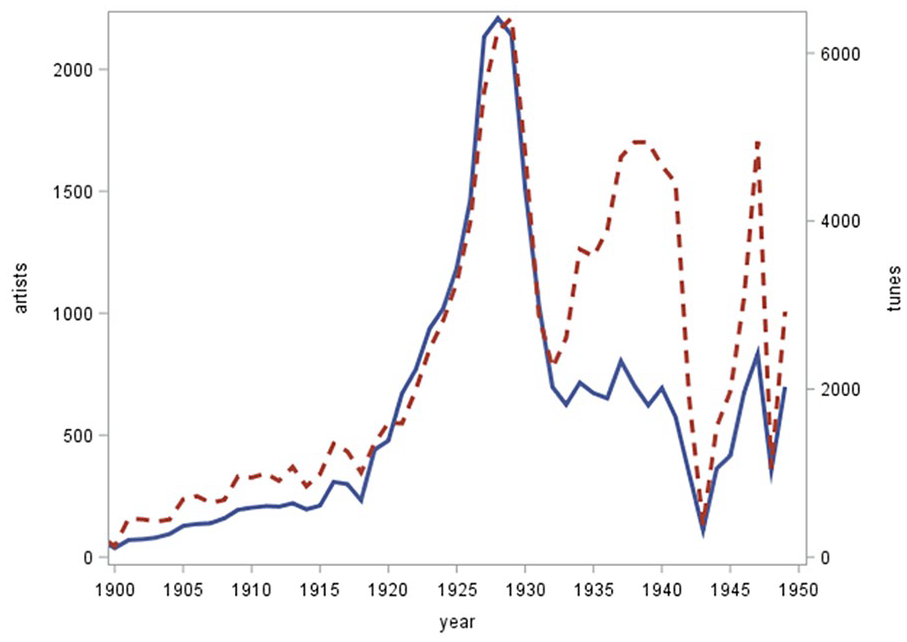
Total tunes and artists by year.
Race and gender data were gathered from secondary and online sources, especially Wikipedia and YouTube, with little ambiguity or uncertainty. Because race and gender data were scarce for minor performers, the study included the 3000 most prolific performers, who recorded at least 15 songs. Given that the results for the top 2000 artists were virtually identical to the top 3000 (actually 2937), including more would unlikely change the results.
The identification of genres as emic categories is found in authoritative claims of what songs or artists belong to what genres. Genre-based published discographies are among the most comprehensive and influential authoritative assignments of songs and performers to genres. Discographic compilers may claim to be applying musicological definitions, but the pooling of various discographies reveals sociological classifications binding together industry, performers, critics, and fans. Artists were coded with a genre affiliation if any discography listed them. For most of the genres, multiple discographies were consulted, adopting the principle that genre definitions were emic, aggregating different musical definitions. Because I use discographies to assign genre labels to artists for their entire career, some anachronistic results are found, for example, jazz artists recording before jazz appeared. This methodologically conservative method understates change across decades. (A list of discographies used for the data is available from the author.)
The era of 78 rpm records was periodized into five decades, fortunately aligning with major events in the industry—the expiration of phonograph patents and rise of independents at the end of the 1910s, the onset of the depression at the end of the 1920s, and World War II in the early 1940s. Records missing a recording date were periodized by their label series. 5 If a label fell within a decade, all records missing dates were coded to that decade. 6 Performer company affiliation was coded by decade, while race, gender, and genre were fixed.
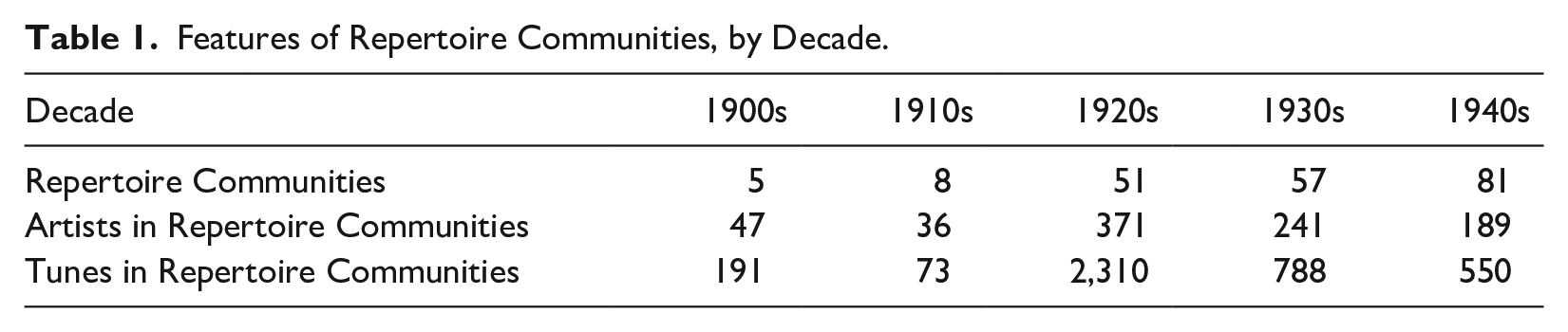
Table 1 displays some basic features by decade. The number of artists and tunes in repertoire communities peaked in the 1920s although the number of communities peaked a decade later, due primarily to the huge mainstream community in the 1920s.
Features of Repertoire Communities, by Decade.
Operationalization
Repertoire communities are operationalized as clusters in a two-mode network of artists and songs. Thus, the 203 musicians who performed “St. Louis Blues” would be linked, as would Prince’s Band’s 878 songs. Network community detection procedures identify clusters maximizing the density of links within clusters and minimizing the density of links between them (Fortunato 2010). Different techniques of community detection make different assumptions about how networks operate and commonly used procedures frequently mismatch the formal qualities of repertoire communities. First, many studies reduce two-mode networks to a single mode (artists by artists or songs by songs), sacrificing important information (Latapy, Magnien, and Del Vecchio 2008). Second, most algorithms identify network partitions, that is, exclusive groups (Corrêa et al. 2011). Given that artists and songs can have multiple identities, they can belong to several repertoire communities. Billie Holiday, for example, could belong to communities based on company, genre, race, or gender. Third, many algorithms operationalize the strength of relationship between nodes as geodesic path or the minimum number of steps between nodes (Cano et al. 2006; Teitelbaum et al. 2008). While this is appropriate where social processes are truly transitive, as in disease diffusion or information flows, it is inappropriate for performers and songs because repertoire communities are based on local conditions, that is, direct linkages.
A community based on two-mode networks, overlapping communities, and local rather than global linking is the biclique (Lehmann, Schwartz, and Hansen 2008). 7 A clique is a cluster in which every member interacts with all other members, an unreasonably stringent requirement. A biclique relaxes that requirement by prescribing that members be connected by a lower number, for example, all but one member of node a (artists or songs) be connected to all but one member of node b (songs or artists). Formally, for a biclique, “the two cliques must share at least a−1 upper vertices and b−1 lower vertices” (Lehmann et al. 2008:3). A K4,4 biclique would have at least four nodes of each vertex, of which each node would be linked to at least three nodes of the other vertex—in our case, each artist performing at least three songs and each song performed by at least three artists. Bicliques are identified through an iterative clique percolation method (Palla et al. 2005; Vedres and Stark 2010). All bicliques of K3,3 and higher were included in the results. Anything lower than K3,3 is a dyadic relationship. Figure 2 shows a sample K4,4 repertoire community. Each artist recorded at least three of the songs, and each song was recorded by at least three of the artists. This was a marimba band repertoire community that included several marimba bands plus others that may have had a marimba or played songs often recorded by marimba bands. The xylophone cousin, marimba popular in the 1920s, gave jazz a recognizable Latin flavor, but with overtones that distanced it from the stigma cast on to African Americans. As seen in Figure 2, the songs tended to be sentimental, highlighting the marimba’s dreamy timbre, evoking distant times and places, as in “Beyond the Blue Horizon.”
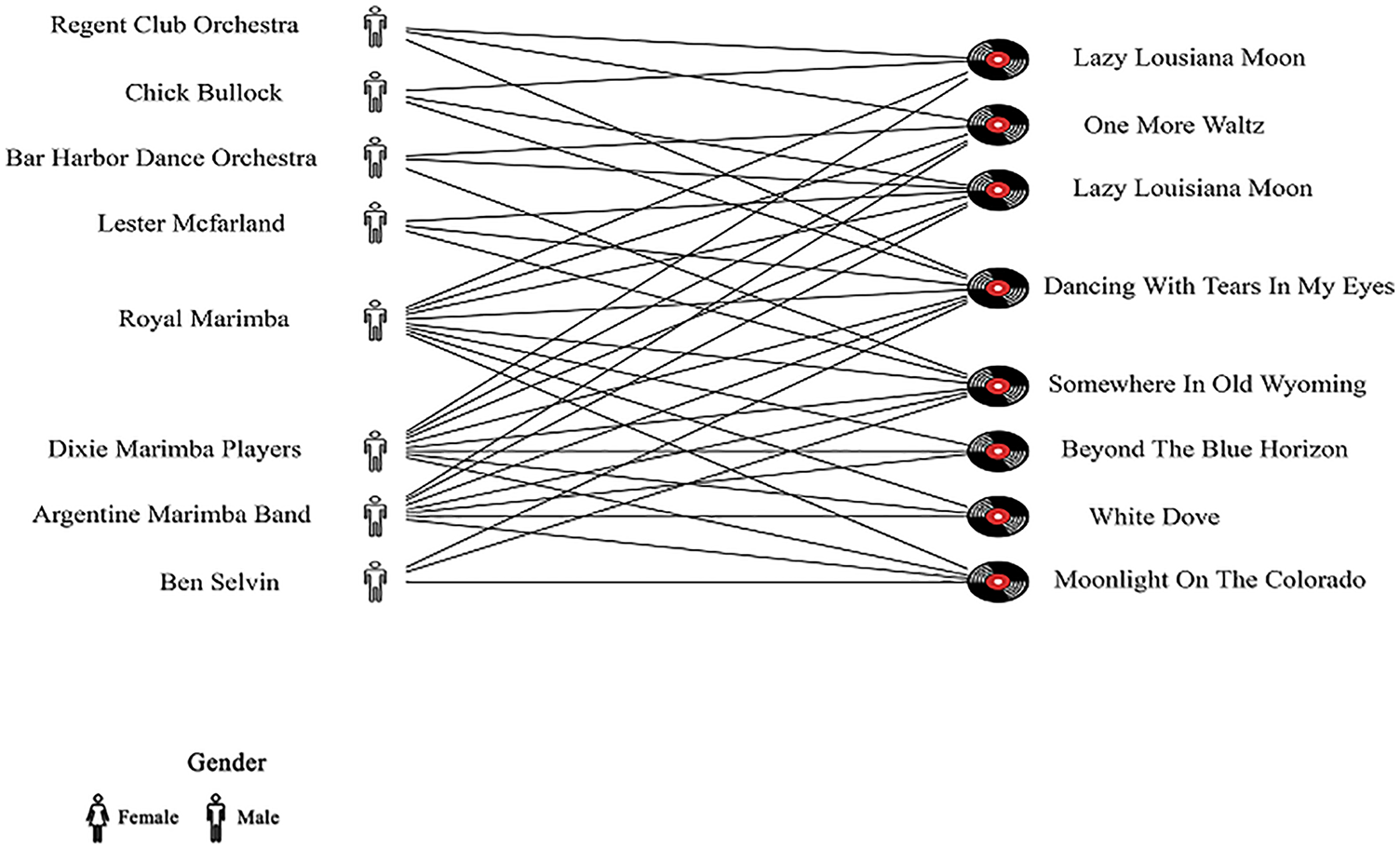
Marimba repertoire community.
Only 27 percent of eligible artists belonged to any repertoire communities, of whom 75 percent belonged to only one. Benny Goodman belonged to the most communities with 13. Thus, the system of repertoire communities was composed mainly of elite musicians sharing repertoires with each other.
Hypotheses 2 and 3 invoke two racial mechanisms shaping repertoire communities, cooptation/appropriation, and identity/channeling. Cooptation and appropriation of black music both involve white musicians recording black songs. I define a song as black-identified if more than 50 percent of previous recordings are by black musicians. (Different thresholds yielded similar results.)
Cooptation/adaptation is defined as the proportion of black-identified songs recorded by whites. Black identification/channeling is defined as the proportion of black recordings accounted for by black-identified songs.
The Social Basis of Repertoire Communities
Typically the relationship between categorical variables can be measured by measures of association that estimate how accurately one variable predicts the other, that is, the extent to which a category with a disproportionate share of cases on one variable will have disproportionate share on another (Agresti 1990). However, such measures are not appropriate here. First, variation is highly skewed. In each decade, a dominant mainstream repertoire community overshadowed all others. Women and racial minorities are grossly under-represented. Most cells in the contingency tables are empty. Thus, measures of association are likely capricious. Second, the statistical assumption of independent categories is violated because many artists belong to multiple communities, companies, and genres. Instead of conventional association measures, a factor will be considered the basis of repertoire community formation when a threshold of artists meets a set criterion (Valente 1996). Using a threshold also has face validity. Musicians would have an intuitive feel for “artists like me” who record “songs like my music” when a repertoire community has a distinct kind of artist, predominance being the threshold. For example, a repertoire community would feel like a jazz repertoire community if, say, half the members were jazz musicians.
Threshold levels are set according to different logics for different independent variables. Company and genre membership differed from race and gender in two ways. First, artists were typically affiliated with multiple companies and genres but only one race or gender. Second, racial and gender domination meant that racial and gender identification was asymmetrical: because so many were white males, a small repertoire community with one non-white or non-male would statistically over-represent minority races or women but would not mark the repertoire community as anything besides white male. Still, because non-whites or non-males were marked cases, fewer than half the members could signify a repertoire community as non-white or non-male. In contrast, it would take a majority of artists to mark a repertoire community as dominated by a company or genre. After ascertaining that different threshold levels offer robust findings about repertoire communities, a threshold of 26 percent (greater than a quarter) was set for race and gender, and 51 percent (majority) for company and genre. Different thresholds yielded comparable results. The thresholds chosen have face validity (they make intuitive sense) and they create variables with high variance (see the appendix).
The strength of intersections is estimated by the odds ratio for shared factors underlying repertoire communities, for example, the extent to which repertoire communities based on genre are also based on gender.
Repertoire Community Highlights
Before examining the basis for repertoire community formation, a selective, brief descriptive overview will give an intuitive sense of how performers and songs clustered together over time.
1900s
In the century’s first decade, seven repertoire communities ranged in size from several with only four artists and four tunes to one with 20 artists and 128 songs. The large mainstream community featured instrumental ensembles performing familiar Christian hymns, old sentimental songs, many of them by Stephen Foster, and patriotic songs or marches. All would have been well known to the small record-buying public, selected by the phonograph and gramophone manufacturers to put their hardware in the best possible light. The most prolific recorder was the anonymous “Band,” whose 525 songs were released mainly on re-issue labels such as Aretino, Leeds & Catlin, and Par-O-Ket, along with Berliner and Zonophone. Many of the songs such as “A Coon Band Contest” and “A Farm Yard Medley” are thankfully long forgotten.
The mainstream repertoire community of marches, sentimental tunes, and hymns was separated into higher order sub-communities. A masculinist repertoire community of march songs formed a biclique that included 22 songs, many composed by “The March King,” John Philip Sousa, recorded by several bands including Sousa’s own band and that of his former trombonist, Arthur Pryor, seen in Figure 3.
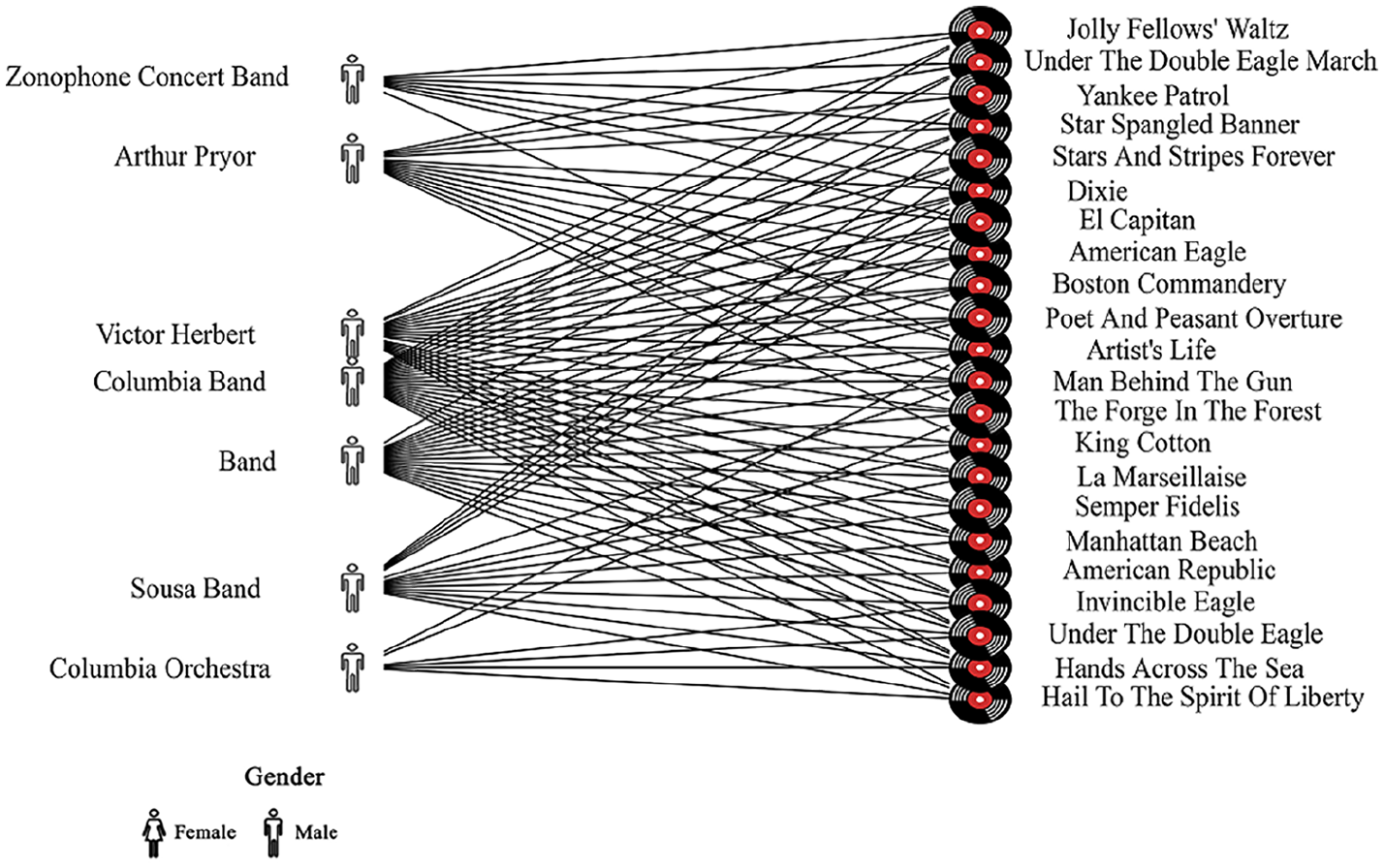
March music repertoire community.
What is surprising about these early repertoire communities is who belonged to none of them, including some of the most prolific musicians of the era. Most notable was Arthur Collins, the second most prolific artist with 513 songs, but few of the songs in the repertoire community. Nor was Billy Murray (289 songs) or Ada Jones (201 songs) included. One possible reason is that these singers were more inclined to release newer, Tin Pan Alley songs than the sentimental or religious songs so common in the repertoire community. 8
1910s
The 1910s were less concentrated in a single overarching mainstream repertoire community, but had two relatively large communities, one of vocal music and one of instrumental music, the primary distinction categorizing sheet music and records. Along with the religious songs, marches, and old sentimental songs common in the previous decade, several repertoire communities featured newer Tin Pan Alley type ditties. In contrast to the earlier masculinist march-based communities, a gender-marked repertoire community seen in Figure 4 was organized around the type of sentimental songs that middle-class white women would be expected to play on their parlor piano. This was the last repertoire community in which white women would occupy as high a proportion for the rest of the half-century.
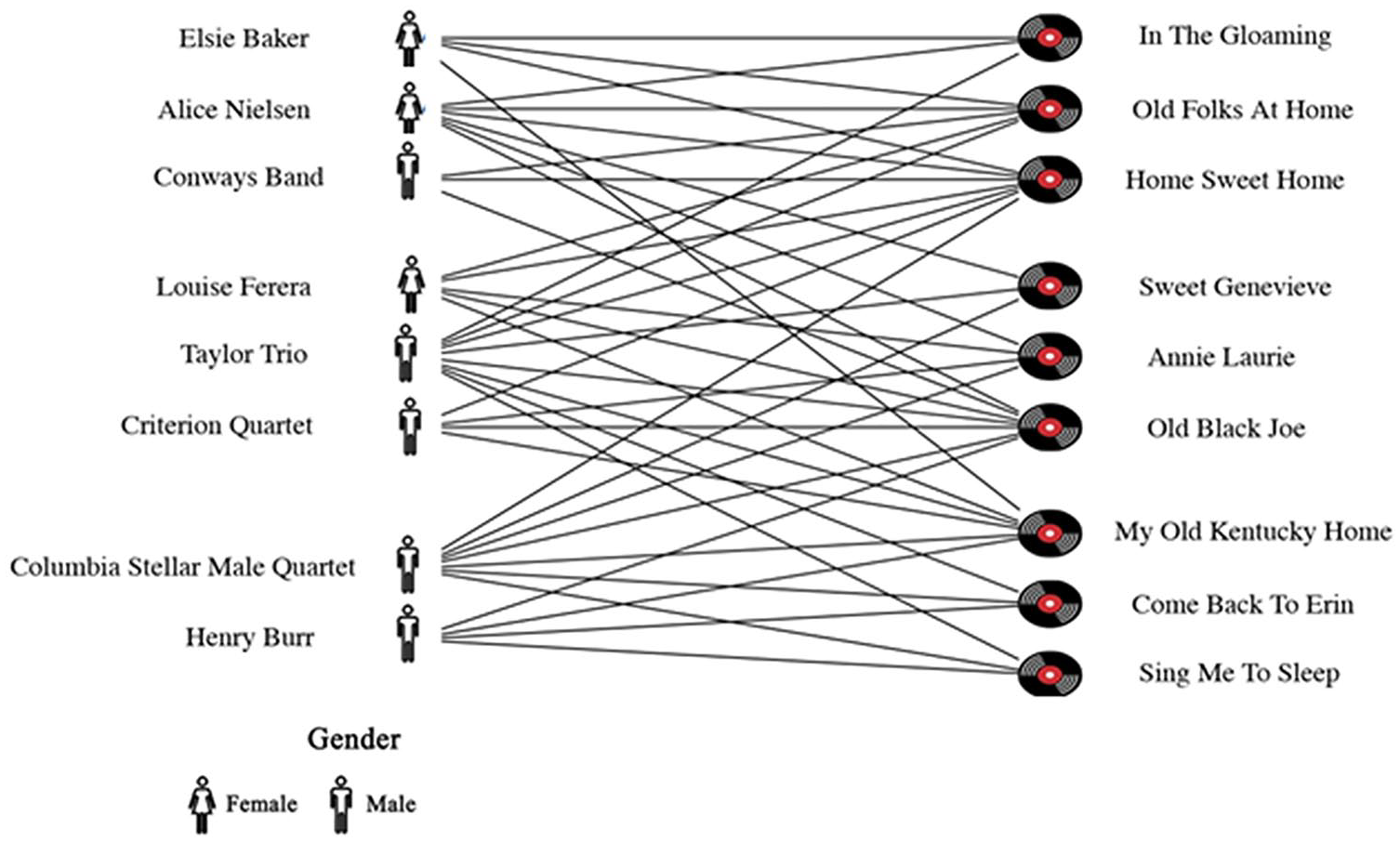
Sentimental mixed gender repertoire community.
1920s
The 1920s features the return of an overarching dominant mainstream in the form of a giant repertoire community with 279 artists and 2,176 songs. Nearly all the most prolific artists belonged to the dominant repertoire community. As the industry matured, the music diversified around mainstream and marginal modes of music. The 10 percent of top artists excluded from the mainstream were all marginal in one form or another, falling into three types, each of which had their own repertoire communities. Homer Rodeheaver and Rev J. M. Gates, the two most prolific outsiders, recorded Christian hymns and sermons. Two other types of prolific artists absent from the mainstream repertoire community were on the two sides of the profound racial cleavage in music—country music and jazz. Prolific “hillbilly” singers Frank Luther, Lester McFarland, and Uncle Dave Macon anchored marginal repertoire communities as did some prolific African American performers including Duke Ellington, Cab Calloway, Count Basie, Clarence Williams, Clara Smith, and Sara Martin.
In the era before country music was categorized with Western music, each formed its own repertoire communities. The second largest non-mainstream repertoire community was a “hillbilly” or country repertoire community. Whereas the hillbilly repertoire community drew singers from the rural south, a Western repertoire community included Western musicians such as Jimmie Rodgers, Gene Autry, and the Texas Rangers doing yodeling songs, railroad songs, and place name songs. This repertoire community, displayed in Figure 5, includes two of the most renowned early Western singers, the “Singing Cowboy” Gene Autry and the “Singing Brakeman” Jimmie Rodgers with a good sprinkling of cowboy and railroad standards.
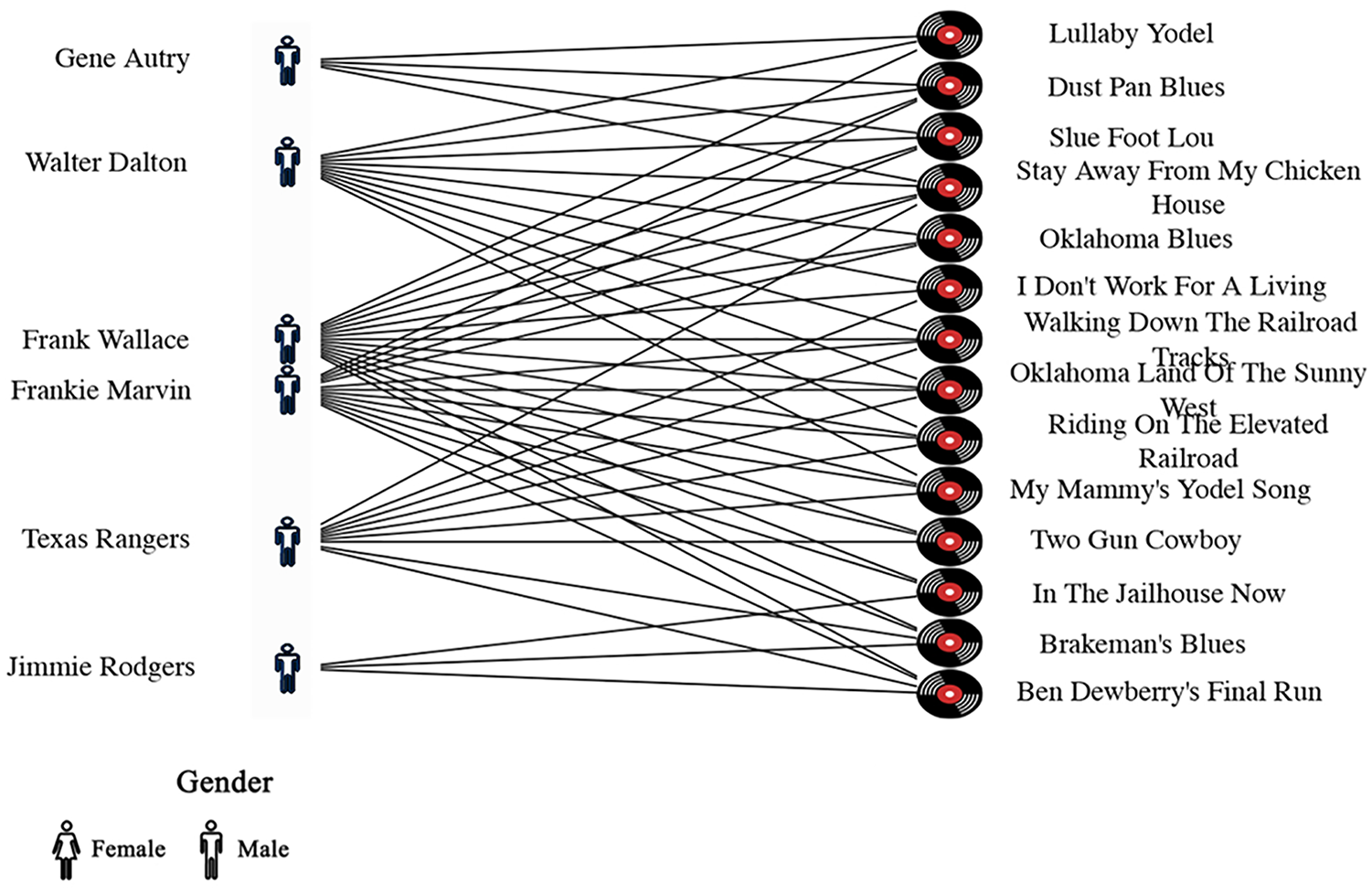
Western repertoire community.
1930s
The Great Depression devastated the music industry, which shriveled into a smaller core, sacrificing marginal musics such as race records, hillbilly music, and ethnic music. The mainstream repertoire community fell from 279 to 212 artists and 2,176 to 622 songs. While a substantial proportion of music labeled jazz had always been “sweet,” in the 1930s the music clustered into its own repertoire community with the likes of Guy Lombardo, Teddy Wilson, Eddy Duchin, and Leo Reisman. At the same time, the decline of overtly racially identified categories created more space for blacks and whites to share repertoires. For example, a racially mixed repertoire community included Western swing trumpeter Clyde McCoy and African Americans Cab Calloway, Duke Ellington, and Ellington’s pseudonymous “Jungle Band” performing mostly songs generally considered black.
As hot jazz evolved into Swing in the 1930s, a racially integrated swing repertoire community included new hits and old songs such as “Tea for Two” and new ones like “Goody” as seen in Figure 6.
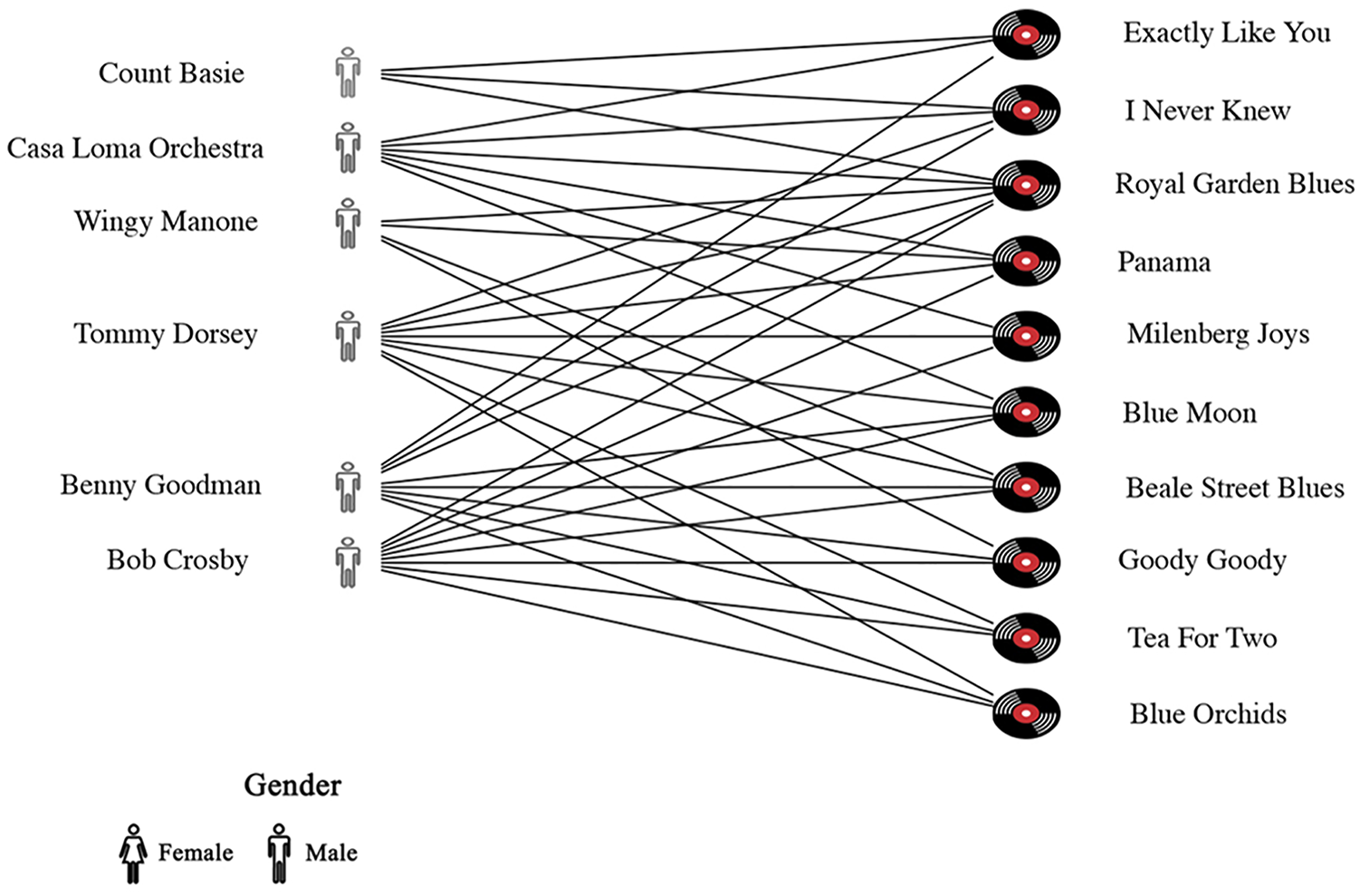
Mostly white swing repertoire community.
Not all repertoire communities were fashionable. Although the local brass bands that dominated small town civic life around the turn of the century had faded, march music continued to sell records, forming its own repertoire community. Although the Sousa Band and its Arthur Pryor spinoff were gone, Figure 7 shows that Sousa’s marches continued to anchor the 1930s march music repertoire community.
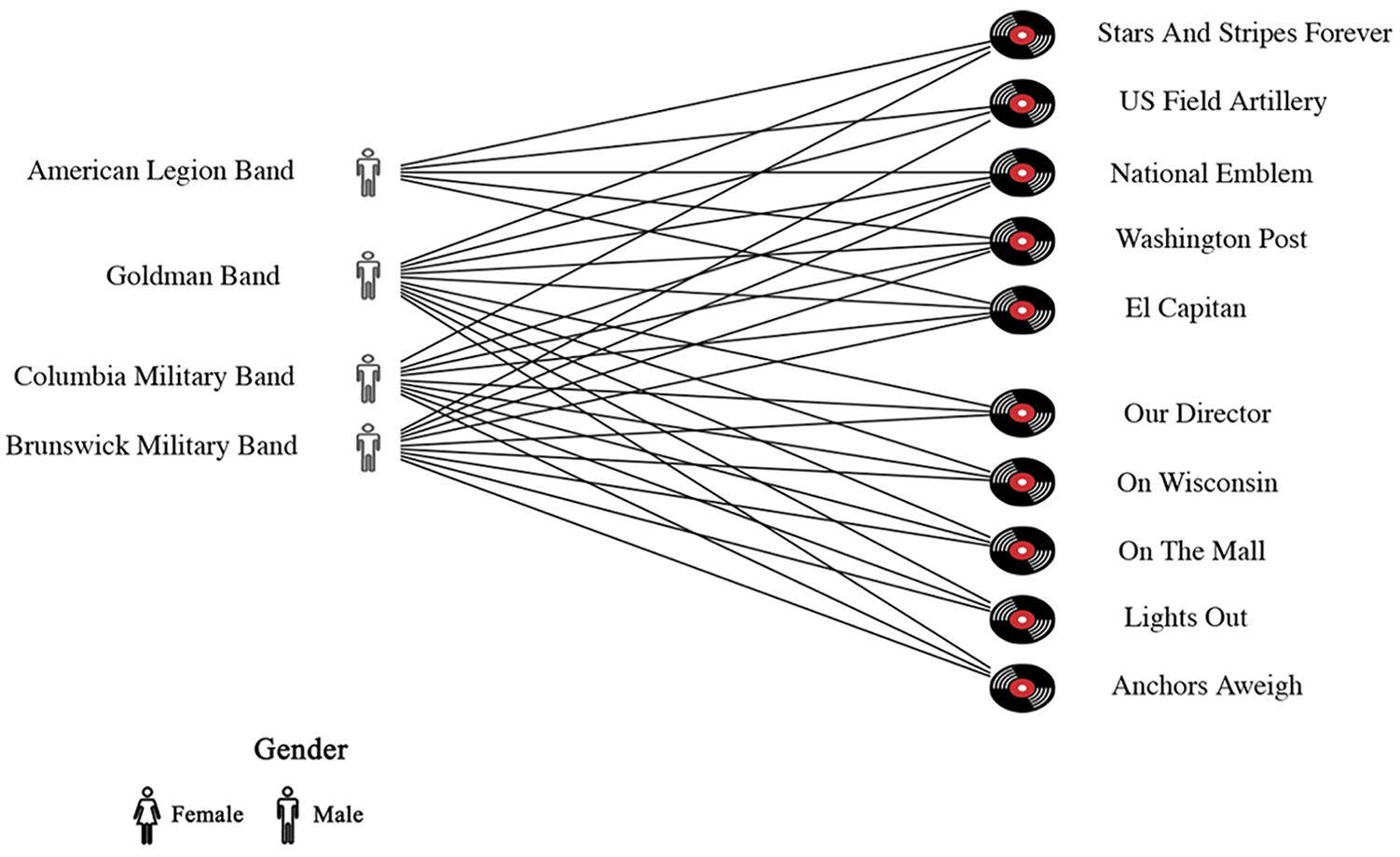
March music repertoire community, 1930s.
1940s
Although World War II ended the Great Depression once and for all, the recording industry continued to struggle, thwarted by a shortage of shellac during the war and the musicians’ strike early, with temporary improvement after the war. Like the 1920s, independent labels proliferated, energizing the resurrection of “race records” as rhythm-and-blues (R&B) and “hillbilly music” as country-and-western (C&W). But the topology of recorded music became less lumpy as the number of artists and songs in repertoire communities continued declining. The most plausible explanation for this decline is radio’s homogenizing influence, especially the rise of major networks. Performers seemed to seek success more by recording songs that were distinctively theirs, drifting away from the standards. That is not to say that standards were abandoned. A racially integrated hot jazz repertoire community recording well-known standards included whites Jimmy Dorsey and Bob Crosby, along with African Americans Sidney Bechet and Louis Armstrong, with venerable hits such as “Muskrat Ramble” and “Baby, Won’t You Please Come Home,” as seen in Figure 8.
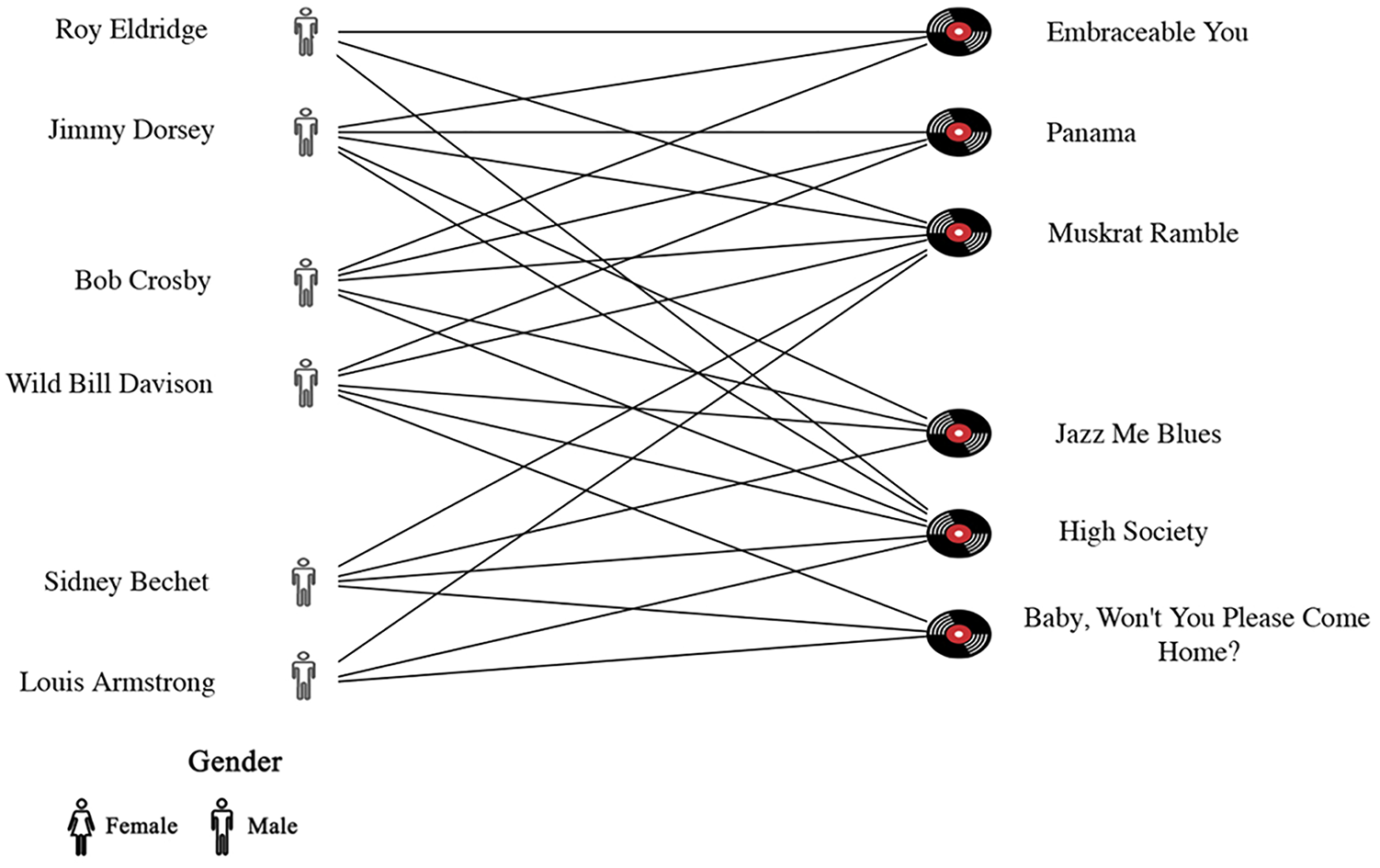
Hot jazz repertoire community.
From its early days, the American record industry had targeted various ethnic communities with specific catalogs, advertisements, and series. By the 1940s, some had entered the mainstream with widely popular artists and songs. The Irish, in particular, contributed cultural memes such as Notre Dame football, Boston Celtics basketball, St. Patrick’s Day, and popular songs. Thus, it is not surprising to see Figure 9 displaying a repertoire community evoking nostalgia with Irish songs such as “Where the River Shannon Flows” or “My Wild Irish Rose.”
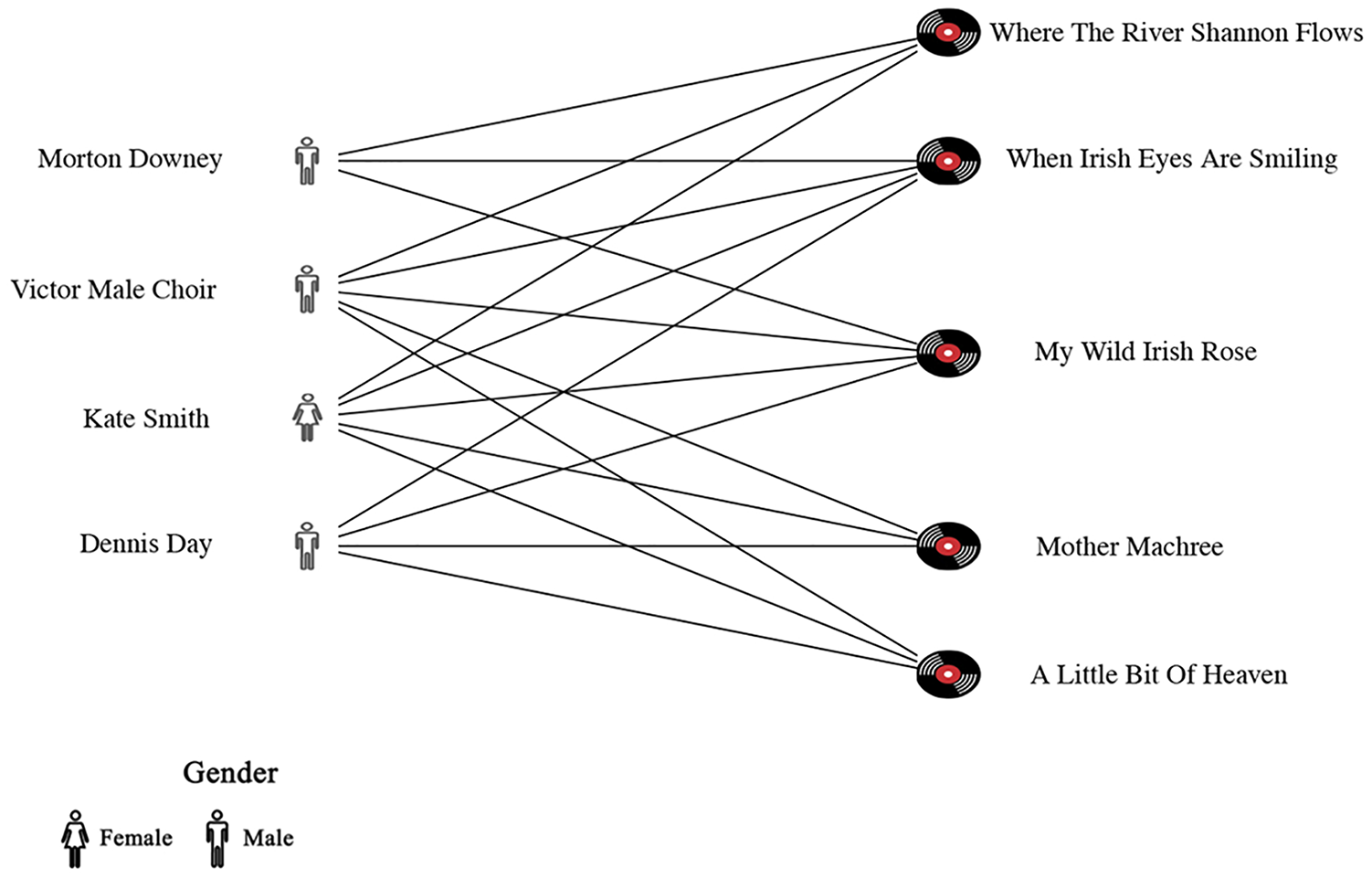
Irish repertoire community.
Explaining Repertoire Communities
Beyond identifying repertoire communities, it is important to make sociological sense by identifying their general social foundations, the theoretically meaningful qualities of the social relations that tie performers together around shared repertoires, revealing how society shapes the musical world and how musical relations permeate society. As noted above, different theories hypothesize different factors as repertoire communities’ social basis. The production of culture perspective suggests that they are shaped by companies and industries. Identity theories of race and gender hypothesize that those identities would shape the topology. Theories of genre hypothesize that the meanings embedded in categorical schema would shape artists’ repertoires.
We now examine the social bases of repertoire communities, that is, the extent to which repertoire communities included a connotative number of artists from a particular company, genre, minority race, or minority gender. By “connotative,” I mean that a repertoire community included enough artists of a particular type that artists and their songs would be associated with a factor, as operationalized by threshold levels. We then examine the interaction among these factors to see how much they reinforced each other.
The changing effect of company or genre membership, race, and gender on repertoire membership can be seen in Figure 10. This figure displays the paper’s main findings about the social bases of repertoire communities. Because more than one factor can exceed its threshold in any single repertoire community, the sum of all factors can exceed 100 percent
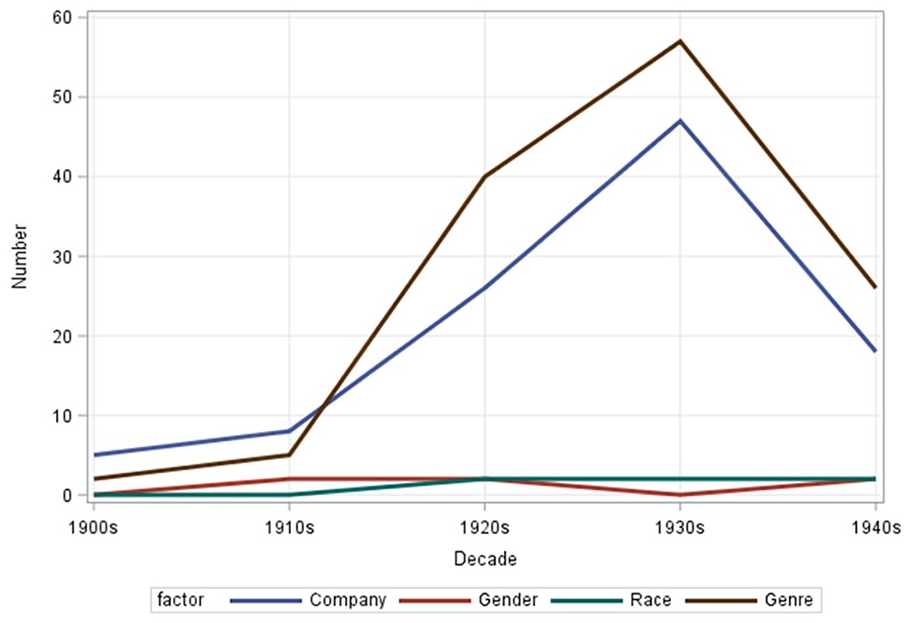
Percentage of repertoire communities in factor exceeds threshold.
Companies and the Production of Culture
The production of culture perspective posits that the social and aesthetic topology of art, music, and related culture is structured through the organizational and economic context. Even if individual artists exercise some autonomy over what they record and may pay little heed to who their fellow artists record for, the production of culture perspective emphasizes record companies’ power to shape repertoires and the effect of the industry’s repertoire topology. This perspective would predict that changes in the industry would affect the extent to which companies were a basis for repertoire communities.
The results show that the curvilinear temporal pattern predicted by Hypothesis 1 was partially supported. Companies did indeed shape repertoire communities, far outpacing the effect of race and gender. However, the expectation that their role would peak in the 1920s was off. The number of company-based repertoire communities continued to grow into the 1930s, even though the number of companies, especially niche companies, dwindled.
Additional analysis offered some clues about how industry and company characteristics might have affected repertoire communities. Perhaps the more companies there were, the more companies would pursue specific niches recording similar performers with overlapping repertoires. Analysis (not detailed here) shows that this was not the case. Alternatively, if musicians were increasingly bound to companies by exclusive recording contracts reducing overlap across companies, repertoire communities might have been confined to specific companies. Analysis (not detailed here) offers no support for that.
Any explanation for why companies formed the basis of repertoire communities would have to account for why company-based communities peaked during the 1930s. The only clue in the data is seen in Figure 1, displaying the yearly total number of songs and performers. Up until the depression, the number of songs and performers were closely paralleled (though on different scales). Then in the 1930s, the number of performers dropped more precipitously than the number of songs, indicating that performers were recording more songs. If performers were recording more songs for companies, it stands to reason that more repertoire communities may be formed within companies. Nonetheless, the role of increased productivity is only suggestive, especially given the many strategies that record companies adopted when conditions were dire enough that some feared the demise of the entire industry.
Thus, the general prediction from the production of culture perspective that companies would be a major factor in the formation of repertoire communities is supported. Of the factors tested here, more repertoire communities were based on shared recording companies than anything other than genre, and far more than race or gender. Further research is needed to credibly identify the mechanisms by which company-based repertoire communities are formed.
Race
Given how deeply racialized American popular music has been, it is surprising that so few repertoire communities were based on minority race. After the fledgling all-white industry of the 1900s, the percentage of race-based communities hovered around 10 percent. The paucity of race-based communities is this study’s most remarkable finding. That is not to say that music was not racialized—the evidence is overwhelming that it was—but that racialization took a form different from repertoire communities.
This finding is consistent with the observation that historically, blacks and whites interacted more deeply in the music art world than in much of American society (Roy and Dowd 2010; Radano 2003; Ward 1998). Blacks participated in repertoire communities at about the same level (8 percent) as their share of the general population (around 10 percent). But the lack of race-based repertoire communities suggests that blacks and whites frequently belonged to the same communities. The puzzle of why so few repertoire communities were based on race cannot be explained in this paper, but perhaps clues can be found by examining the role of appropriation and identity.
Appropriation
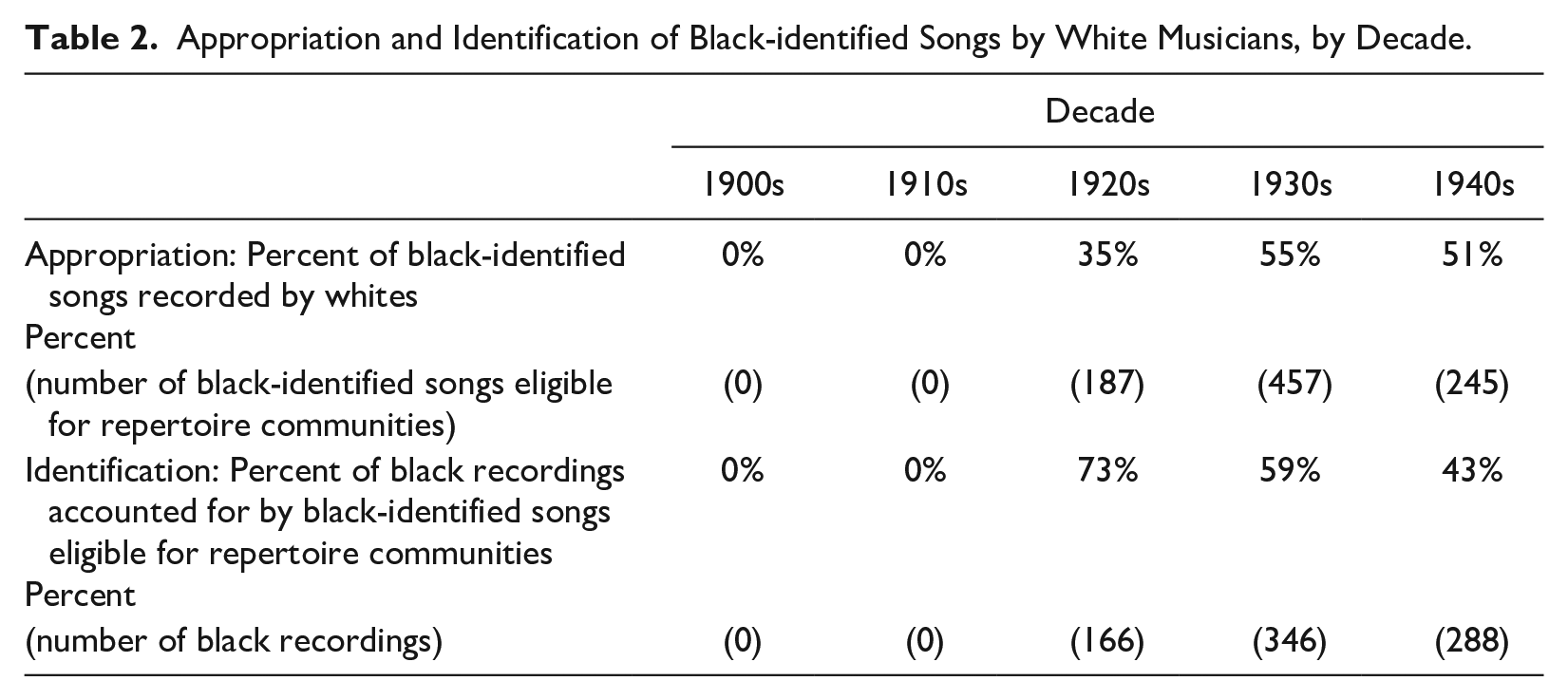
Hypothesis 2 states that white appropriation of black music would depress specifically black repertoire communities. The results are consistent with that hypothesis but do not provide strong evidence for it because there is so little variation in both the number of race-based repertoire communities and the extent of appropriation. Table 2 shows the percentage of black-identified songs that were recorded by whites. The 1900s and 1910s had no black-identified songs eligible for repertoire communities. In the 1920s, over a third (35 percent) of black-identified songs were recorded by whites, mitigating race as a basis for repertoire community formation. These songs included black-associated songs such as “Arkansas Blues,” “Baby Won’t You Please Come Home,” and “Swing Low, Sweet Chariot.” Appropriation rose and remained high in the 1930s, when 55 percent of black-identified songs eligible for repertoire communities were recorded by whites and 51 percent in the 1940s. Of course, the fact that so many black-identified songs were recorded by whites is partly due to the greater number of white musicians. Nonetheless, racial crossover was still greater than one might expect if the world of popular music was as segregated in most of American society. The fact that the proportion of white recordings of black records was sustained throughout the period is more remarkable because the unit of analysis is the racial history of the song at the time of recording, altering the racial identity for subsequent recordings. A white recording could thus potentially push it below the threshold necessary to classify it as black-identified.
Appropriation and Identification of Black-identified Songs by White Musicians, by Decade.
White appropriation was also visible in an impressionistic examination of songs. Black-identified songs widely recorded by whites included commonly considered black songs such as “Sweet Georgia Brown,” “Body and Soul,” or “The Man I Love,” as well as songs rarely considered black such as “After You’ve Gone,” “Star Dust,” or “On the Sunny Side of the Street.” “After You’ve Gone” was recorded only by seven whites until Bessie Smith’s 1927 rendition, after which blacks and whites both embraced it, causing its racial identity to vacillate over the period. A variety of musicians recorded songs previously recorded exclusively by several black musicians, including “sweet jazz” types such as Tommy Dorsey or Harry James, “hot jazz” types such as Gene Krupa or the Casa Loma Band, and even country musicians such as Vernon Dalhart or Jimmie Rodgers. The blues standard “Basin Street Blues” was first recorded by Louis Armstrong in 1928, then by three white musicians, lowering its black identity index to 25 percent, which fell to 13 percent in the late 1940s. Altogether, only 20 percent of the song’s 26 recordings were by African American musicians, although most Americans may think of it as prototypically black music. Thus, the figures reported here may underestimate the extent to which white artists were recording songs understood as black songs.
The fact that whites frequently recorded songs with definite black identity probably depressed the number of repertoire communities based on racial identity, but there is no way to ascertain how much. This is one of the issues that needs either variation over decades or qualitative information on how musicians selected repertoires. The mystery of why so few repertoire communities were based on race is well worth solving.
Identity
Hypothesis 3 predicted an opposite trend, that increasing black identity and channeling would foster black-identified repertoire communities. Like Hypothesis 2, Hypothesis 3 is not supported because there was no secular trend in the proportion of repertoire communities based on a marked race. Unlike Hypotheses 2, because there is a downward trend in the extent to which African Americans recorded black-identified songs, the evidence actually challenges the hypothesis. Surprisingly, given the deepening of black identity in the general society, proportionately fewer African Americans recorded black-identified songs eligible for repertoire communities. As seen in Table 2, when blacks were allowed to record in substantial numbers in the 1920s, three-quarters (73 percent) of the songs they recorded had a black identity. In the following decade, the proportion had fallen to about half (59 percent) and in the 1940s to below half (43 percent).
It is important to remember that the dependent variable here is black-identified repertoire communities, which may be different than racial relations of general recording or pairwise covering. It is clear that when blacks covered songs, they were less likely to cluster with other blacks than were whites. When whites covered songs, 41 percent of the time they were covering songs that had been recorded at least twice, making them eligible for repertoire community membership. But when blacks covered, they were covering twice-recorded songs less than a quarter of the time (24 percent).
Given how strongly racial identity has helped shape the racialization of American popular music, it is important to find evidence that appropriation may have undermined the effect of burgeoning black identity, again complicating the characterization that racial dynamics in popular music operated like the larger segregated society.
One other reason for the paucity of marked-race repertoire communities is that the effect of race may have been refracted through mechanisms that diluted the simple effect of race by itself. One likely candidate would be the effect of genres, which will be examined after we review the effect of gender.
Gender
Figure 10 shows that Hypothesis 4, that the number of gender-based repertoire communities would increase over the period, was not supported. There were barely any gender-based repertoire communities. Although many songs, especially love songs, took a woman’s standpoint, women did not cluster together into repertoire communities. The fact that African Americans comprised a higher proportion than women of artists with enough recordings to join repertoire communities is consistent with the notion that the primary mechanism of musical gendering was exclusion. Thus, race inequality and gender inequality were structured differently, with race inequality structured primarily within the music industry, at least after early exclusion, and gender inequality structured by exclusion from recording altogether, despite some early inclusion.
Besides the paucity of women recording songs, women tended to record the same songs as men. Or inversely men recorded the same songs as women, including songs that would seem to express a woman’s perspective. “The Man I Love,” from George Gershwin’s opera about black life in the south, was recorded by 14 women and 27 men. Most such records with men on the label were would have been instrumental versions such as Artie Shaw’s, or bands with uncredited women vocalists, such as Helen Forrest for Benny Goodman’s Band. In either case, men were shaping the repertoire and taking credit for the performance. As a result, when repertoire communities included apparently women’s songs, they were generally overshadowed by men. For example, a repertoire community in the 1940s included 14 performers of “The Man I Love,” only two of them being women—Dinah Shore and Hazel Scott. Of the six African Americans, only one was a woman—Hazel Scott.
Even the few songs that gave credit to enough women to form repertoire communities were not distinctive to women. Only 4 percent of songs that qualified for repertoire community membership were recorded by enough women to qualify. And 79 percent of those were also recorded by enough men to qualify.
Summarizing race and gender trends, the total number of African American and women performers generally increased, but the number of repertoire communities based on those identities did not keep pace. The most prolific non-white and non-male performers were not charting out their own distinctive repertoires based on each other’s songs, at least not collectively. The surprising finding is that they may well have been recording songs that they learned from other blacks and women, but were apparently not copying those who copied group members. Even during the period when nearly all manufacturers included “race records” in their catalogs, when new genres such as jazz and blues were typified in stark racial and gender terms, repertoire communities generally were surprisingly unmarked by race or gender. This is clearly a topic that demands closer attention.
Genre
Genre established itself as the most consistent basis for repertoire communities, steadily rising from 33 to 90 percent validating Hypothesis 5. In the 1910s, the ragtime craze spawned a repertoire community, as did musicians later labeled as hillbilly musicians. It was during the 1920s that music became widely classified by nominally musical categories such as jazz rather than audience (race records, hillbilly music, children’s music, or ethnic music). The fact that repertoire communities were increasingly organized around genres suggests that repertoire was becoming a basis of genre formation. As the genre system increasingly organized American popular music, genres became identified with specific songs as well as musicians in fostering repertoire communities. While pioneering recording artists such as Billy Murray could record songs as different as “Give My Regards to Broadway” and “A Sprig of Shillalah,” by the 1940s, Glenn Miller and Tommy Dorsey were more inclined to record songs that were explicitly “swing” or “jazz.”
The particular genres on which repertoire communities were based are less notable than the dramatic increase in the total number based on genres. In the 1910s, when only a few repertoire communities were based on genre, the most common were ragtime and religious music. As the genre system became institutionalized in the 1920s, the interchangeable designations, jazz and dance, were the most common repertoire communities, but hillbilly or country music repertoire communities were also common. Despite the popular blues fading in the early decade, only one repertoire community was based on it. Jazz was fused with swing in the 1930s, underlying more repertoire communities than any other genre. A small number were based on country or folk. Swing was the clear favorite in the 1940s, with only a few repertoire communities based on jazz that was not predominantly swing. One might have guessed that these were bebop communities, but they were instead built around pop songs that included country musicians such as Gene Autry or pop singers such as Kate Smith.
Intersections
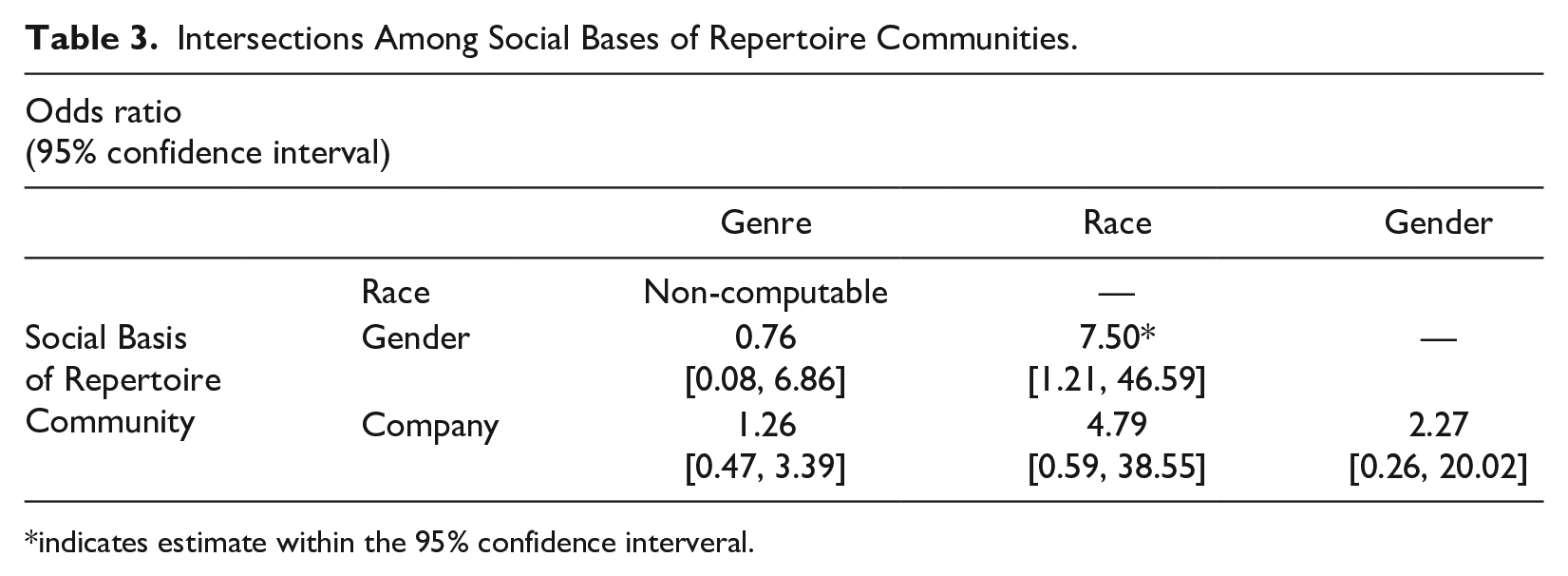
There are too few cases to analyze intersection by decade. For the period, 63 percent of the 150 repertoire communities involved intersections. The organization of production, race, gender, and genres worked through and were mechanisms for the others.
Table 3 shows the strength of intersections among the variables representing the social bases of repertoire communities, operationalized as the odds ratio between variables. Odds ratios greater than 1 indicate a positive interaction, that repertoire communities with one social basis is likely to be stronger on the other. Odds ratios less than 1 indicate a negative interaction, that repertoire communities with one social basis are unlikely to be strong on the other. Because of the variance of the variables, the confidence intervals of the odds ratios are very wide, meaning that substantively meaningful estimates may not be statistically significant. Thus, the findings must be considered suggestive, inviting further research. The results demonstrate genre’s immense importance as a primary mechanism by which social categories operated. The most pervasive intersection was between genre and race, although the odds ratio was not computable. Genre was clearly a mechanism to channel African Americans into racially coded categories. All racially marked repertoire communities were also based on genre, mainly jazz. But jazz was not the only racially marked idiom. Unsurprisingly, repertoire communities based on “Race records” had an even higher proportion of African American musicians, with 85 percent being African American. The replacement of that term by “R&B” in the 1940s did little to change its racialization, with 76 percent of R&B musicians being African American.
Intersections Among Social Bases of Repertoire Communities.
indicates estimate within the 95% confidence interveral.
In contrast, repertoire communities marked by gender were less likely to be coded on genre than were those with no gender marking, although the odds ratio was not statistically significant. This finding is consistent with the notion that gender discrimination was relatively unmediated, that women were excluded merely because they were women. Unlike African Americans, women had no genre paths into the industry.
The only repertoire community intersecting race and genre was blues, the music of black women, seen in a repertoire community that included three black women and one black man. The intersection of race and gender in this repertoire community is also revealed in the other musicians who recorded its songs. Both black and white men outside the repertoire community recorded its songs along with white men, but few white women did so. Thirty-three musicians recorded that community’s songs, including 12 black women, 9 black men, and 9 white men, but only 3 white women. Further intersections can be seen in repertoire communities based on gender. Five of the 19 repertoire communities that had a marked gender basis intersected with race, all also intersecting with genre. Their race intersected with gender only when intersecting with genre, highlighting a difference between race and gender. Race and gender needed genre to intersect with each other.
Conclusion
This paper has made methodological, theoretical, and substantive contributions. Analytically, it has introduced repertoire community as a level of cultural topology between the dyad of individual performers covering each other and the sacralized, codified level of standards and canons. Methodologically, the paper has demonstrated the utility of using bicliques as a method to identify two-mode, overlapping, time-varying local clusters, in contrast with the extensive literature that reduces musical networks to atemporal single-mode, exclusive clusters (partitions). The techniques for identifying communities in networks have become more mature in recent years, adapting to theoretical and substantive characteristics of communities, not just constraints of computational techniques (Fortunato 2010; Kelley et al. 2012). The paper has moved beyond simply identifying communities to investigate their social basis, especially recording company, race, gender, and genre, drawing on social science and musicological theory to identify mechanisms that can explain how the social bases shape repertoire communities. The communities were not bounded, named communities, but communities which the participants and others would have intuited. Theoretically and substantively, the paper investigated the extent to which three types of theory successfully explained the rise of repertoire communities. Results demonstrated that the social organization of production and distribution had an especially important role in shaping repertoire communities in the industry’s early years, before it was fully institutionalized. As the industry matured, genre emerged as the primary factor. The findings support the contention that repertoire communities were a cornerstone by which genres became the dominant categorical system for American popular music.
The most surprising finding was that race and gender played very little role in shaping communities. As explicitly marked subordinate people, black and female artists would be expected to adopt repertoires “like mine” from people “like me.” It was not that blacks were avoiding songs other blacks had recorded. On a dyadic basis, they were homophilous, covering performers of their own race or gender. They were just not clustering. In topological terms, the racial and gender fields were more like plateaus than mountains.
The attempt to clarify the issue by examining mechanisms of racialization yielded only more questions. The historical legacy constructing American popular music as a fusion of African and European roots bequeathed racial (and racist) discourse around “white” and “black” music, even as whites exercised their privileges to record all types of music. Both white appropriation of black music and expressions of black identity in selection of songs were relatively stable from the 1920s on. Jazz, especially, was stigmatized as black, but since the time of minstrelsy, black music had excited white passion for the sensual while constructing a new aesthetic based on authenticity. Apparently, when blacks borrowed repertoire from other blacks, they were attentive to artists “like me,” although the lack of clustering implies that they were less conscious of which artists had recorded songs “like mine,” that is, songs by artists they had previously covered. The fact that more whites covered black-identified songs than blacks did means that the racial identity of songs may have been more encoded in the performance than the song itself.
Women’s patterns evoke different mysteries. In the 1910s, women’s repertoire communities accounted for nearly a quarter of them all. But that was it. The best explanation is that from the 1910s to the 1920s, as the industry exploded, women were left behind. When record companies sold records mainly to sell phonographs, their indifference about who recorded gave women opportunities. When record production became profitable and stars sold records, women were dismissed until the 1940s when they were spread too thin across the standards to form repertoire communities.
As genres became one of the foundational principles of American popular music, it is not surprising that they became the most important bases of repertoire communities. With the replacement of categories based on social identities such as “race records” or “hillbilly music” in the 1920s by musical/social categories such as jazz, swing, R&B, or C&W, performers clustered their repertoires around genres.
Moreover, genres were more likely to shape repertoire communities on their own than within companies. The later the decade, the more that repertoire communities fit conventional histories of genre popularity. For example, jazz music dominated repertoire communities during the 1920s, while swing shaped the most repertoire communities from the 1930s on. Country music and race records shaped repertoire communities most strongly in the 1920s, but tapered off after that. Dance music was strongest in the 1920s and 1930s, although several repertoire communities in the 1940s were based on dance music.
Intersectional analysis revealed that nearly all communities based on race and/or gender intersected with company and/or genre. Companies and especially genres shaped communities on their own, but race and gender did not. Thus, companies and genres were a central mechanism for race and gender much more than vice versa. Such intersections highlight the importance of synthesizing structural analysis as offered by the production of culture perspective with the dynamics of classifying people and their identities as offered by theories of race and gender, along with the dynamics of classifying music as offered by theories of genre. The intersection of race and gender operated through companies and genres. This puts a broader spotlight on what intersection means.
Any sociologist would readily understand that repertoire communities are social as well as aesthetic, that they would be shaped by the organization of production, social categorization of music, race, and gender. But little has been known about the relative role of these factors and how they change over time. The declining role of companies can easily be interpreted, perhaps even predicted by the production of culture perspective, and this paper adds little new to that perspective. However, the findings are more important for the other factors. Insofar as there has been a literature on the relationship of repertoires to genre, it has treated them as tightly bound. Repertoires were assumed to be shaped by genres (Becker and Faulkner 2006; Dowd et al. 2002; Faulkner and Becker 2009). The results here highlight the changing relationship of repertoire and genre. It was not until genre became the primary means of organizing American popular music from the 1920s onward that genre could be a basis of repertoire communities. The results on intersections indicate that genre affiliation was a means by which companies, race, and gender shaped repertoires. Thus, the study of repertoires is not only bolstered by situating them in society but our knowledge of society is deepened by learning about repertoires.
Footnotes
Appendix
Declaration of Conflicting Interests
The author(s) declared no potential conflicts of interest with respect to the research, authorship, and/or publication of this article.
Funding
The author(s) disclosed receipt of the following financial support for the research, authorship, and/or publication of this article: Funding for this research was supplied by the Academic Senate and Division of Social Sciences of the University of California, Los Angeles. It was initiated while a Fellow at the Center for Advanced Studies in Social and Behavioral Sciences at Stanford University.