




Abstract
We explore the relationship between welfare regime and climate policy attitudes. The synergy hypothesis suggests that social and environmental policies can reinforce each other. Thus, more universal and generous welfare state model (i.e., welfare regime) is said to provide especially fertile ground for advancing climate policies. Using multilevel modeling and European Social Survey Round 8 data (including 23 countries in Europe and Israel), we test whether this hypothesis applies at the attitudinal level. Moreover, we hypothesize that country-level political trust predicts support for climate policy instruments. The study focuses on three instruments: fossil fuel taxation, subsidizing renewable energy, and banning energy-inefficient household appliances. The results indicate that welfare regime is significantly related to attitudes toward taxation, but less significantly toward subsidizing and banning. Political trust predicted support for all instruments, but the effect was particularly strong for taxation. The results highlight the importance of welfare structures in climate politics.
Keywords
Introduction
There is a widespread consensus that climate change, which is caused largely by anthropogenic greenhouse gases, is an accumulating problem that must be mitigated. Decreasing CO2 emissions considerably, however, is a demanding task for governments, as the implementation and preservation of effective climate policies is difficult without public support. Moreover, effective climate policies tend to be rather unpopular among the public (Lucas 2017), and without legitimacy from the citizens, even effective policy instruments lose some of their impact (Matti 2015).
According to the synergy hypothesis, the advancement of social and environmental policies can reinforce each other, and welfare states that are more comprehensive and possess coordinated market economies (i.e., relatively strong social interventions to the functioning of the market economy) are inclined to view economic and environmental values as reciprocally strengthening (Dryzek 2008; Gough 2016; Gough and Meadowcroft 2011). In particular, Social Democratic or Nordic welfare states, which constitute a unique regime in terms of their social policy model (see Esping-Andersen 2000; Leão et al. 2018) and capitalism (see Hall 2015), are well equipped to advance ambitious environmental policies. Past empirical tests of the synergy hypothesis by Detlef Jahn (1998, 2014) and Max Koch and Martin Fritz (2014) compared how different welfare state models (i.e., welfare regimes) differ in their realized environmental policies or material outputs. However, Round 8 data of the European Social Survey (ESS) have enabled scholars to study the relationship between welfare and climate policy attitudes (Fritz and Koch 2019) and explore how ideology, sociodemographics, and attitudes toward climate change and energy shape energy policy preferences in various welfare regimes (Marquart-Pyatt et al. 2019).
We aim to take a step forward from the previous studies by investigating prospective reasons for the potential relationship between welfare regime and three climate policy instruments: increasing taxes on fossil fuels, subsidizing renewable energy, and banning the least energy-efficient household appliances. Our research question is as follows:
To answer this question, we employ ESS Round 8 data (ESS 2018) and multilevel regression modeling.
Our study proceeds as follows. First, we briefly highlight differences between the welfare regimes and introduce theoretical discussions on the synergies between welfare state and the eco-state. Based on this, we hypothesize how attitudes toward climate policy might differ between welfare regimes. Next, we propose a mechanism that has received insufficient attention in previous discussions on these synergies: the effect of political trust. We then discuss various climate policy instruments, as well as the ways in which citizens’ support for them might relate to certain welfare structures, particularly the political trust that welfare structures might engender. Finally, we discuss our results in the light of previous studies and conclude by suggesting avenues for future research.
Welfare Regimes and the Eco-state
Although fossil fuels contributed to industrial modernization, economic growth, and the establishment of welfare states, the massive increase in fossil energy consumption also exacerbated environmental problems, most notably climate change (Wijkman and Rockström 2012). Modernization led to assumed control over nature, but it also increased vulnerability to human (i.e., social and institutional) risks and failings (Freudenburg 1993).
Nevertheless, certain scholars identified similarities or synergies between the development of the welfare state and the possible rise of the eco-state (e.g., Gough 2016; Meadowcroft 2005, 2008) The eco-state or environmental state is a model in which environmental protection is an irreducible element of public governance and an unavoidable subject of political discourse (Duit, Feindt, and Meadowcroft 2016). Because eco-states must be built on existing welfare state models, current welfare regimes, with their particular institutions and path dependencies, are likely to influence environmental policies (Gough 2016). The best-known welfare state typology is developed by Gøsta Esping-Andersen (1990, 2000). He argues that welfare regimes are not just the sum of calculable social policies, but institutional ensembles that differ in their social philosophies and histories (Esping-Andersen 1990).
Esping-Andersen (1990) identifies three welfare regimes: Liberal, Conservative, and Social Democratic. An essential difference between these regimes is the standard of decommodification, which Esping-Andersen (1990:37) defined as the “degree to which individuals, or families, can uphold a socially acceptable standard of living independently of market participation.”
In Esping-Andersen’s (1990, 2000, 2015) typology, the Liberal welfare regime is characterized by market solutions to social issues and low decommodification levels. Welfare provision is minimal, and universal transfers and social insurance are modest. Recipients of social benefits are typically means-tested and stigmatized. While market is a dominant welfare provider in the Liberal regime, the Conservative or Continental regime is distinct in that the role of families is emphasized in welfare provision, and performance-based social benefits are linked to occupational status through social insurance. The Continental regime’s decommodification level maintains rather than reduces social inequality. In contrast, the Social Democratic or Nordic regime is a strongly interventionist welfare state that incorporates the principle of universality: Social benefits are directed universally to all citizens. Through its comprehensive welfare coverage, generosity, and high decommodification standard, the regime provides relatively high equality levels and low poverty levels (Esping-Andersen 1990, 2000, 2015). Consequently, tax rates are relatively high in Nordic countries (Sumino 2016).
Deviating from this tripartite typology, numerous later studies have identified additional welfare regimes (e.g., Fenger 2007; Ferrera 1996). Southern European countries form a distinct welfare regime characterized by low levels of social protection and fragmented welfare provision systems that rely strongly on families and voluntary work (Campos-Matos and Kawachi 2015; Ferrera 1996; Leão et al. 2018). In turn, H. J. Menno Fenger (2007) argued that countries of the postsocialist bloc form two distinct welfare regimes: the Former USSR and Post-Communist Europe. The former has relatively low public investments in social programs that are mainly financed through social insurance. The latter resembles the former in terms of social expenditure but is more equal in terms of social welfare and emphasizes taxation as a source of funding for social programs (Campos-Matos and Kawachi 2015; Fenger 2007; Leão et al. 2018). During the period from 2005 to 2014, relative inequalities widened in Post-Communist European regime, whereas they remained steadier in other regimes (Leão et al. 2018).
Despite criticisms of Esping-Andersen’s (1990) study (e.g., Room 2000), his work constitutes a significant milestone in welfare state research (Emmenegger et al. 2015). Although welfare regime typologies are debated, regimes still capture the essential features of countries’ social policy structures (for a review of the regime literature, see Ferragina and Seeleib-Kaiser 2011) and may be helpful for understanding possible synergies between the worlds of welfare and the environment.
Welfare states and the eco-state have several parallels. Both are political solutions to societal developments, both deal with failures that the market or volunteering alone cannot solve, and both are changing the models within which “normal” economic operations work (Meadowcroft 2005, 2008). Ian Gough (2016) argued that a closer integration of the welfare state and the eco-state would require comprehensive, consensual policymaking, which is most straightforward in market economies that are more coordinated.
John S. Dryzek (2008) suggested that Social Democratic welfare states are best equipped to impose effective climate policies because discourse on ecological modernization is most adopted in such states. The idea of ecological modernization is that by fostering technological development and utilizing political instruments, economic growth and environmental protection can progress together and reinforce each other (Spaargaren 2000; Szarka 2012). When the Nordic welfare states were established, social investments in welfare services were seen to have a positive impact on gross domestic product (GDP) growth (Hemerijck 2013). Similarly, the ecological modernization discourse suggests that investments in environmental protection are necessary to advance ecological modernization and economic growth simultaneously (Gough 2016).
Gough (2008) suggested three areas for synergy between social and environmental policies. First, social policies can bridle the possible inequalities caused by environmental reforms. Second, improvements in infrastructure and housing policies could lead to mutually beneficial outcomes in social and ecological sustainability. Third, governments might alter consumer and producer behavior using education and various policy instruments, such as taxation, subvention, and regulation.
Despite these parallels and synergies, welfare states and the eco-state also exhibit fundamental differences. The former are largely creations of working-class movements, whereas the latter is not particularly connected to class structure. Moreover, the financing of welfare states is maintained with economic growth, whereas the eco-state must decouple economic growth and material outputs (Meadowcroft 2005, 2008).
It is also worth noting that the material output of societal development, certain social policies, and more equal income distribution may even be harmful to the environment (Lawrence 2009; Meadowcroft 2008; Ravallion, Heil, and Jalan 2000; Scruggs 1998). The effect of societal affluence on the environment remains controversial. Although Ronald Inglehart (1995) famously argued that environmental concern in wealthier countries arises from postmaterial values, which emerge when economic and physical security improves, he also added that severe pollution—which is common in low-income countries—increases enthusiasm toward environmental protection. Evidence also indicates that environmental consciousness is not just a luxury for the wealthy but a prerequisite for the poor (Martínez-Alier 2003). People living in poorer or environmentally threatened conditions are often more concerned about the environment and more willing to contribute to its protection compared with people in wealthier conditions (Everuss et al. 2017; Fairbrother 2013). Overall, the relationship between economic conditions and environmental attitudes appears to be mixed (Bakaki and Bernauer 2018; Lo 2016; Mayer and Smith 2017).
Studies that compare actual material outputs across welfare regimes indicate that material outputs do not follow regime typology (Jahn 1998, 2014; Koch and Fritz 2014). Certainly, the link between welfare regime and actual material outputs is complex and includes numerous factors in addition to welfare structures.
Nevertheless, our first hypothesis is that, compared with people living under other welfare regimes, people under the Nordic regime are more in favor of taxing fossil fuels at a higher rate, subsidizing renewable energy production, and banning the least energy-efficient household appliances. We summarize our main justifications for the hypothesis as follows. First, environmental policies can pose economic risks to households (e.g., Markandya and Ortiz 2008), and climate policies are arguably easier to accept if there is comprehensive social security. Second, as we propose below, universal and generous public welfare services tend to increase political trust (Kumlin 2004; Shore 2019), which is a significant predictor of support for environmental protection (Fairbrother 2016).
Political Trust and Climate Policy Attitudes
Public attitudes toward societal issues tend to differ among welfare regimes (Larsen 2006; Nagayoshi and Hjerm 2015). According to Stefan Svallfors (2012), attitudes vary among welfare regimes because each has a distinctive institutional framework that poses certain risks and provides certain resources. These preconditions, in turn, generate certain predispositions, such as interpersonal and institutional trust, social values, and beliefs (Svallfors 2012).
Trust levels correlate with economic inequality levels: Citizens in countries that are more equal tend to have more trust in other people and political institutions (Edelman 2016; Newton, Stolle, and Zmerli 2018; Wilkinson and Pickett 2009). Generous welfare spending increases trust in political institutions and other elements of social capital (van Oorschot and Arts 2005). Jennifer Shore (2019) found that social spending on, in particular, working-age adults and families tends to increase political trust. The principle of universality and relatively impartial and objective policy instruments, such as taxation, may at least partially explain why people are more trusting of comprehensive welfare states (Kouvo, Kankainen, and Niemelä 2012; Newton et al. 2018).
A study concerning Sweden indicated that people with personal experience using public welfare services tend to have higher political trust (Kumlin 2004). Crucially, however, it matters whether such welfare services are means-tested or universal. Means-testing increases doubts about fairness and decreases the sense of equal treatment (Kumlin and Rothstein 2005). This indicates that the principle of universalism and generous welfare provision are important reasons for high level of political trust in the Nordic countries (e.g., Listhaug and Ringdal 2008; Torcal 2017).
Political trust forms a link between political context and citizens’ evaluations of it (Norris 1999). Political trust is particularly crucial for supporting reforms that can pose material risks to citizens, as people often lack in-depth knowledge about public affairs. Therefore, when they evaluate the advantageousness of risky reforms, they rely on their political trust and ideological orientation (Rudolph 2017; Trüdinger and Bollow 2011). Elena Pisani (2017) suggested that, at the country level, political trust is related to societies’ stability and the functioning of democracy. Moreover, country-level political trust affects people’s willingness to make economic sacrifices, such as paying higher taxes, for environmental protection (Taniguchi and Marshall 2018). Political trust at the country level appears to be a significant indicator of the sociopolitical context, which has a crucial impact on people’s attitudes and behavior. In low-trust contexts, trusting in political institutions can be costly, and vice versa (Fairbrother, Johansson Sevä, and Kulin 2019). In the context of explaining cross-national divergences in environmental attitudes and action, trust appears to be both an individual and a social phenomenon. Hence, it appears to have an independent contextual-level effect beyond the effects of individual trust (Smith and Mayer 2018).
Although welfare states have addressed many traditional social risks successfully, in their current form, they might be unable to prevent new types of collective risks, such as ecological issues (Giddens 1999). According to Ulrich Beck and Elisabeth Beck-Gernsheim (2001), in contemporary societies where human-manufactured risks are increasing, collective risks are presented as individual risks, and previously trusted institutions fail in providing objective and subjective safety. However, empirical evidence for the hypothesis about individualization of risks remains controversial (Dawson 2010).
If experience indicates that specialized institutions cannot be relied upon to perform their duties, people express more concern in the face of complex risks (Freudenburg 1993). Institutions’ recreancy or institutional failure (Freudenburg 1993) can have a significant effect on individuals’ risk perception and concern, and might lead to corrosive community dynamics and social capital loss spirals (Gill, Ritchie, and Picou 2016; Ritchie, Gill, and Farnham 2013). Perceptions of recreancy are associated with psychosocial stress and feelings of frustration, anger, and hostility (Gill, Picou, and Ritchie 2014). Although much of the risk and recreancy research has rightly stressed recreancy’s negative social aspects (Gill, Picou, and Ritchie 2014; cf. also Cope et al. 2016), feelings such as frustration, anger, and hostility could also be powerful sources of motivation for social action to transform and renew institutions.
Generally, however, trust in political institutions predicts support for environmental protection, whereas mistrust has the opposite effect (Fairbrother 2016, 2017; Harring and Jagers 2013). If people do not trust political institutions, they are less willing to support environmental regulations or to act in an environmentally friendly way (Smith and Mayer 2018). Therefore, the fact that Nordic countries have pioneered the implementation of fuel and carbon taxes (Giddens 2009) could be partially explained by relatively high political trust.
Climate Policy Instruments
In this study, we focus on attitudes toward three climate policy instruments: raising taxes on fossil fuels, subsidizing renewable energy, and banning the least energy-efficient household appliances. These instruments can be classified based on their design type and coercive effects. Taxation and subvention are price-type instruments, whereas banning is a quantity-type regulation instrument. Price-type instruments create incentives to change behavior by affecting prices, whereas quantity-type regulations control quantities of production or pollution; functions may be banned or restricted (Sterner and Robinson 2018). Regarding coerciveness, taxation and banning are “push” instruments aimed at discouraging certain behaviors, whereas subsidization is a “pull” measure aimed at encouraging particular actions (Drews and van den Bergh 2016).
Although it is not always implemented for environmental purposes, fossil fuel taxation has reduced carbon emissions where it has been put into practice (Sterner 2007; Sterner and Robinson 2018). Indeed, such taxation is considered functional and cost-effective (Sterner 2007; Sterner and Köhlin 2015). However, it is likely—at least in the short term—to increase prices and affect those in a vulnerable economic position disproportionately (Hsu 2016; Rausch and Reilly 2015).
Regarding climate policy support, a gap exists between the opinions of experts and the public. Experts prefer taxation, whereas citizens favor subvention and regulation (Lucas 2017). Pull instruments tend to be relatively popular among the public, partly because the cost of subvention is more indirect or hidden for citizens, as compared with taxation (Drews and van den Bergh 2016). According to the low-cost hypothesis, the effects of environmental concern on environmental behaviour decrease (Diekmann and Preisendörfer 2003; Drews and van den Bergh 2016). Whereas taxation is considered as high-cost instrument, subvention and regulation are low-cost instruments (Von Borgstede and Lundqvist 2006). Because the effects of policy instruments on perceived individual freedom relate to their support (Matti 2015), instruments with less noticeable costs are likely to be more popular among the public (Lucas 2017). However, subvention is not typically cost-effective; moreover, it involves uncertainty and therefore poses a higher risk of unwanted outcomes (Goulder and Parry 2008).
Banning the least energy-efficient household appliances is a technology-based regulation. In principle, technology-based standards can reduce certain emissions effectively, but given the diversity of the emission sources, they are unlikely to become central climate policy instruments (Aldy and Stavins 2012). Thomas Sterner and Elisabeth J. Z. Robinson (2018) argue that, compared with taxation, banning is not necessarily more efficient in reducing emissions, as taxation is easier to administer. Like price-type instruments, banning can motivate producers to make environmental improvements. However, unlike taxation, banning does not typically increase tax revenues (Sterner and Robinson 2018).
Overall, no instrument is all-embracing, but different climate policy measures are presumably needed at the same time. For example, taxes are typically more effective when combined with regulation (Thampapillai and Ruth 2019).
Previous studies found that the support for taxes aimed at climate protection has a particularly strong relationship with political trust (Fairbrother 2017; Fairbrother et al. 2019; Harring and Jagers 2013; Kallbekken and Sæælen 2011). Even more generally, supporting policy reforms that include material risks requires political trust (Rudolph 2017; Trüdinger and Bollow 2011).
A policy instrument’s perceived effectiveness (i.e., the evaluation of how it performs the task for which it is implemented) is an appraisal not only of the instrument but also the officials who implement it (Matti 2015). In economically equal and less corrupt countries, people tend to perceive pro-environmental policy instruments as more effective (Harring 2014). Therefore, political trust could influence the support of all three instruments included in our analysis.
This Study
Certain scholars argue that synergy exists between Social Democratic or Nordic welfare regime and the advancement of climate policies (e.g., Dryzek 2008; Gough and Meadowcroft 2011). In accordance with the synergy hypothesis, our research question is as follows:
With this research question in mind, we assess whether synergy occurs between comprehensive welfare regime and favorable attitudes toward climate policies, as well as whether political trust might be a mechanism that underpins these potential synergies.
Our first hypothesis is that, compared with people living in other welfare regimes, people living in the Nordic regime are more in favor of taxing fossil fuels at a higher rate, subsidizing renewable energy production, and banning the least energy-efficient household appliances. Our second hypothesis is that political trust is one mechanism that links welfare regime and climate policy attitudes (e.g., Matti 2015), especially attitudes toward taxation aimed at mitigating climate change (Fairbrother 2017; Harring and Jagers 2013; Kallbekken and Sæælen 2011).
Data
We use Round 8 data from the ESS. The ESS is a prestigious, academically driven cross-national survey collected every 2 years to measure attitudes, behavior, and beliefs in the diverse European nations. Great care is undertaken to ensure representative samples each round (ESS 2017). The data for Round 8 were gathered during 2016 and 2017. They include 23 countries (including European countries and Israel) and 44,387 individual respondents (ESS 2018). Sample sizes by country and welfare regime are shown in Table A1 (Supplemental Material). Table A2 (Supplemental Material) contains descriptive statistics of the variables taken from the ESS data.
To answer our research question, we explored support for three different climate policies, namely, taxation, subvention, and banning. Respondents were asked, “To what extent are you in favor of or against the following policies in [your country] to reduce climate change?” The policies were as follows: (1) increasing taxes on fossil fuels, such as oil, gas, and coal; (2) using public money to subsidize renewable energy such as wind and solar power; and (3) a law banning the sale of the least energy-efficient household appliances. We reversed the original response options to allow for more intuitive interpretation. Hence, in our analyses, the scale is the following: 1 = strongly against, 2 = somewhat against, 3 = neither in favor of nor against, 4 = somewhat in favor, and 5 = strongly in favor. Weighted country means of the dependent variables grouped by welfare regime are presented in Figures A1 to A3 (Supplemental Material).
Our first independent variable at the country level is welfare regime. We use a regime typology (Table A1 of the Supplemental Material) that was compiled on the basis of previous studies (e.g., Esping-Andersen 1990; Fenger 2007) by Inês Campos-Matos and Ichiro Kawachi (2015) and recently utilized by Teresa Leão et al. (2018). Our typology is in line with the Social Democratic, Continental, and Liberal welfare regimes proposed in a review by Emanuele Ferragina and Martin Seeleib-Kaiser (2011). In addition, we locate Israel in the Southern welfare regime, as suggested by John Gal (2010).
Our second country-level independent variable is political trust. Political trust is measured by a sum variable that contains three dimensions: (1) trust in [country]’s parliament, (2) trust in politicians, and (3) trust in political parties (Kestilä-Kekkonen and Söderlund 2016; Listhaug and Ringdal 2008). Each dimension is measured on a scale of 0 = no trust at all to 10 = complete trust. We created a sum variable that measures political trust based on the three variables in question. Cronbach’s alpha for the sum variable is .91, which indicates good internal consistency. As discussed earlier, higher political trust tends to increase support for environmental policies (see Fairbrother 2016, 2017).
At the country level, our control variables are GDP per capita and CO2 emissions per capita. We controlled for countries’ levels of GDP per capita to test whether welfare regime type has a connection with the dependent variables independently of countries’ economic performance. For each country, the GDP per capita information is from 2016 (World Bank 2018).
We also control for each country’s CO2 emissions per capita values from 2016 (Global Carbon Atlas 2018). As the fossil fuel industry can affect policies via lobbying (Sterner and Robinson 2018) and CO2 per capita is likely to reflect the importance of fossil fuels for a country’s economy, it is arguably justified to include this variable in our modeling. 1 To avoid overloading the analysis model, country-level control variables were tested in separate models.
Our individual-level control variables are climate change concern, energy affordability concern, redistribution ideology, subjective income, education, gender, and age. Climate change concern was measured with the question, “How worried are you about climate change?” and energy affordability concern with the question, “How worried are you that energy may be too expensive for many people in [country]?” Both questions were measured on a scale of 1 = not at all worried, 2 = not very worried, 3 = somewhat worried, 4 = very worried, and 5 = extremely worried. By controlling for climate change concern, we can separate the impact of structural factors from individual climate concern. Climate change affects certain parts of Europe more acutely than others (Gough 2008), which could lead to heightened concern about climate change and thus to heightened support for climate policy instruments in the areas of Europe that are most affected. In addition, by taking concern about energy affordability into account, we control for the local circumstances surrounding affordable energy provision, as energy affordability concerns are likely to diminish support for policies that are thought to be costly.
Redistribution ideology was measured with the statement, “The government should take measures to reduce differences in income levels.” For easier interpretation, we inverted the original scale. Thus, the scale is as follows: 1 = disagree strongly, 2 = disagree, 3 = neither agree nor disagree, 4 = agree, and 5 = agree strongly. With this variable, we control for ideology concerning income transfer, which could affect attitudes toward environmental taxation in general. Left–right ideology would also have been a suitable control variable to measure redistribution ideology; however, 13.08 percent of respondents did not place themselves on the left–right scale.
Finally, we control for certain sociodemographic characteristics. Education level was classified in three categories: 1 = primary, 2 = secondary, and 3 = tertiary (i.e., higher education). Our subjective income variable includes four answer categories to the question, “Which of the descriptions [on this card] comes closest to how you feel about your household’s income nowadays?” 1 = living comfortably on present income, 2 = coping on present income, 3 = finding it difficult on present income, and 4 = finding it very difficult on present income. Education level and subjective income, as well as age and gender, are likely to be relevant factors in supporting climate policies. This is partially due to the fact that higher education, secure income, younger age, and female gender typically predict more postmaterial or environmentally friendly values (Inglehart 1995; Inglehart and Norris 2000; Inglehart and Welzel 2005; McCright et al. 2016).
All variables were tested for multicollinearity. Because there was multicollinearity between country-level political trust and individual-level political trust, we used political trust variable only at the country level. The variance inflation factor (VIF) values of all the included variables were under 2.5 (customary cutoff point is 5; Yu, Jiang, and Land 2015).
Multilevel Modeling Method
Multilevel modeling enables the examination of connections between different social contexts and individuals’ attitudes or behaviors (Hox, Moerbeek, and de Schoot 2018). With multilevel methodology, data can be nested in two or more levels. This study contains Level 1 as the individual level, and Level 2 as the country level. We are particularly interested in the relationships between social context—in this case, country-level factors—and individuals’ attitudes toward climate policies.
We begin with an examination of variance at different levels with a null model. The null model measures the level of intraclass correlation (ICC). It is calculated by dividing the variance in Level 2 by the sum of variances in Levels 1 and 2. If the ICC is near zero, this indicates that Level 2 does not have a very significant connection with the dependent variable. A low ICC does not, however, determine that multilevel analysis is inappropriate (Nezlek 2011).
In our analyses, Level 1 variables that are treated as continuous were centered to the group (i.e., country) means. Continuous Level 2 variables were centered to the grand mean, while categorical variables were entered uncentered (see Nezlek 2011). All analyses were weighted using the ESS poststratification weight, 2 which rectifies the sampling and nonresponse biases in the data (ESS 2014), and a weight that equalized different country sample sizes. We formed the latter weight to ensure that each country was represented with the same amount of respondents, while the total number of respondents remained unchanged. This ensures that a larger country sample or greater population size does not overrule any smaller sample or population data, because we are chiefly interested in country-level factors (cf. Dülmer 2018; Skinner and Mason 2012). 3 All analyses were carried out using Stata version 15.1, random intercept models, and maximum likelihood estimation.
Results
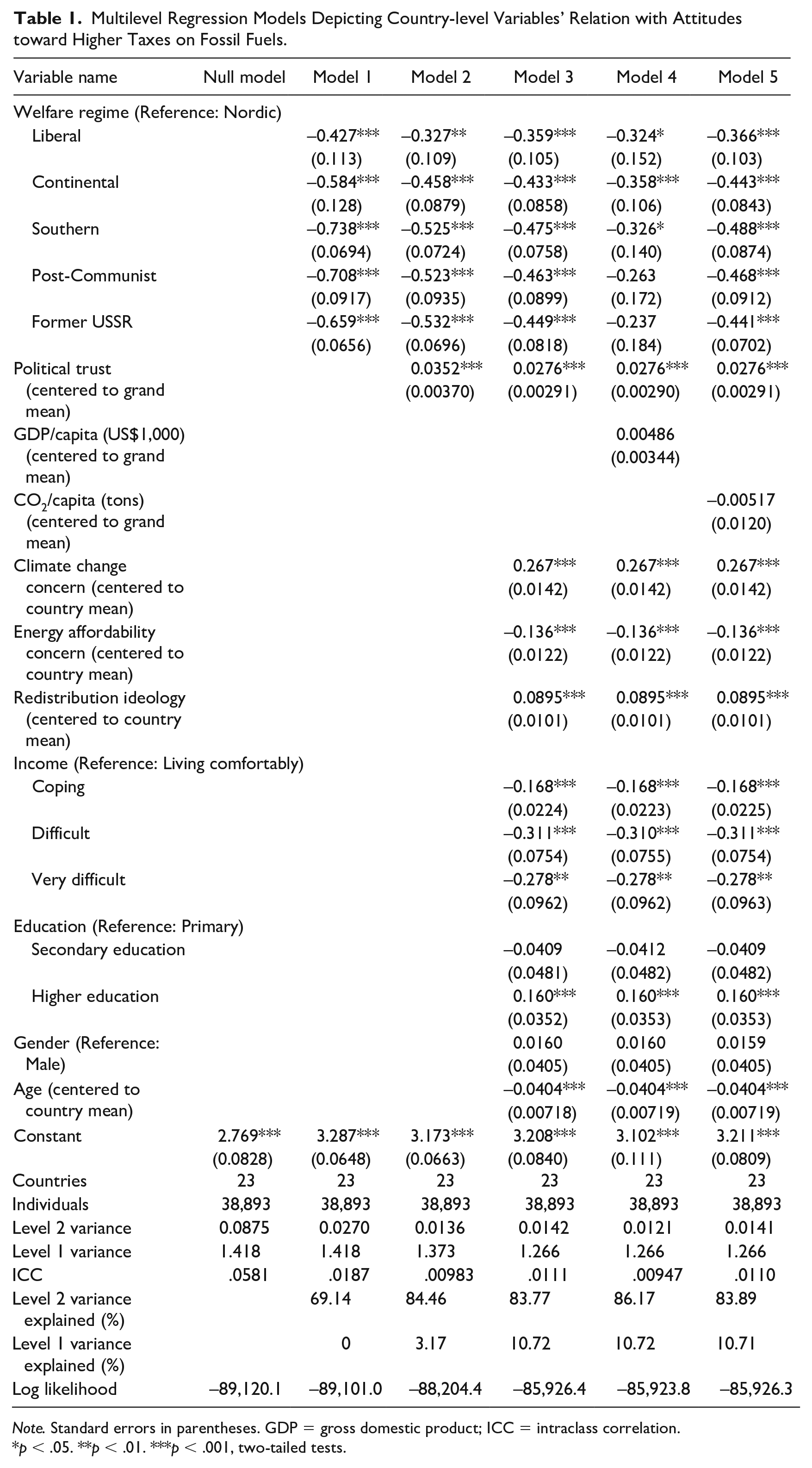
In the following, we present the results from the statistical analysis. Table 1 concerns support for higher fossil fuel taxes. The table includes the null model and five multilevel regression models; all are random intercept models. The null model shows that the ICC was .0581. This means that country-level factors explained 5.81 percent of the dependent variable’s variance (see Hox et al. 2018). The results concerning individual-level factors will be summed up at the end of this section.
Multilevel Regression Models Depicting Country-level Variables’ Relation with Attitudes toward Higher Taxes on Fossil Fuels.
Note. Standard errors in parentheses. GDP = gross domestic product; ICC = intraclass correlation.
p < .05. **p < .01. ***p < .001, two-tailed tests.
Model 1, which includes the welfare regime, explains 69.14 percent of the null model’s country-level variance. This indicates that welfare regime type had a significant connection with attitudes toward fossil fuel taxation. In particular, citizens in the Nordic welfare states were more in favor of the higher fossil tax than respondents in all other regimes.
Model 2 adds country-level political trust to the examination. This model suggests that higher country-level political trust increased support for higher fossil fuel taxation. At the same time, the connection between welfare regime type and support for a higher fossil fuel tax was weaker in all regimes compared with Model 1, but still significant.
The addition of individual-level variables in Model 3 hardly affects the connection between country-level variables and fossil fuel taxation attitudes. After adding per capita GDP to the examination in Model 4, welfare regime type was less significantly connected to attitudes toward fossil fuel taxation, and the difference between Nordic and both postsocialist regime types (Post-Communist and Former USSR) was no longer significant. However, GDP per capita in Model 4 or CO2 emissions per capita in Model 5 were not significantly connected to the dependent variable.
In Models 1 to 5, we can see how people in the Nordic regime are more supportive of higher fossil fuel taxes than people in all other regimes, apart from Model 4, in which the difference between the Nordic and both postsocialist regime types is not statistically significant. Accordingly, the attitudinal differences between the Nordic and both postsocialist bloc’s welfare regimes seem to be related to national economic performances.
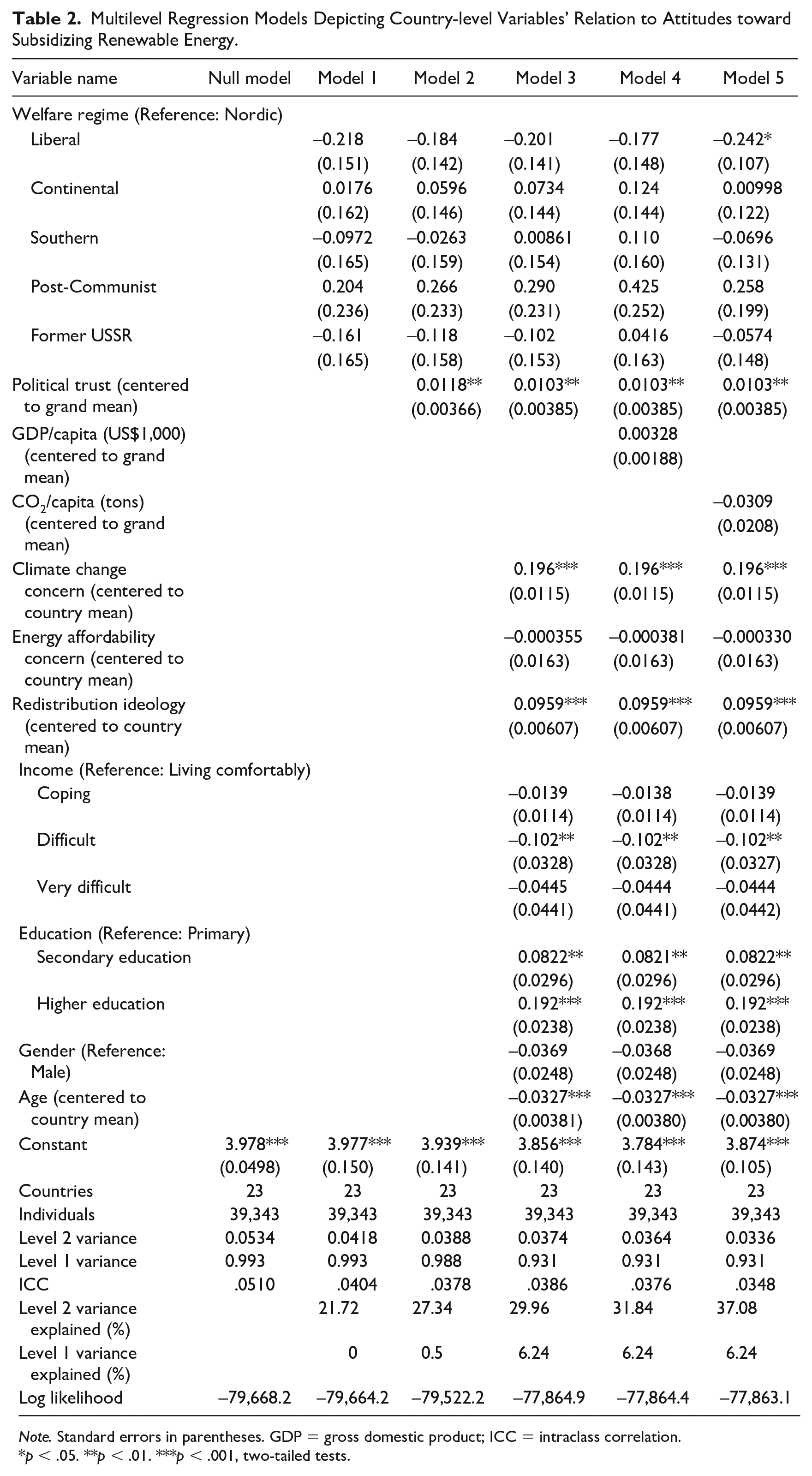
Table 2 explores attitudes toward subsidizing renewable energy. In the null model, the ICC is .051. However, when welfare regime type is added to the analysis (Model 2), the resulting model can explain 21.72 percent of the null model’s country-level variance. This indicates that welfare regime is not a very strong explanatory factor of the dependent variable. Moreover, the difference between the Nordic regime and other regimes is not statistically significant.
Multilevel Regression Models Depicting Country-level Variables’ Relation to Attitudes toward Subsidizing Renewable Energy.
Note. Standard errors in parentheses. GDP = gross domestic product; ICC = intraclass correlation.
p < .05. **p < .01. ***p < .001, two-tailed tests.
Model 2 adds country-level political trust to the analysis, and we find that higher political trust at the country level is connected to more favorable attitudes toward renewable energy policies. The individual-level variables in Model 3 did not significantly change the connection between welfare regime type or political trust and the dependent variable. Neither GDP per capita (in Model 4) nor CO2 emission per capita (in Model 5) were statistically significantly connected to subsidy support. Model 5, however, revealed that compared with the Nordic regime, residents of the Liberal regime were less supportive toward subsidizing when CO2 per capita, political trust, and individual-level variables were included.
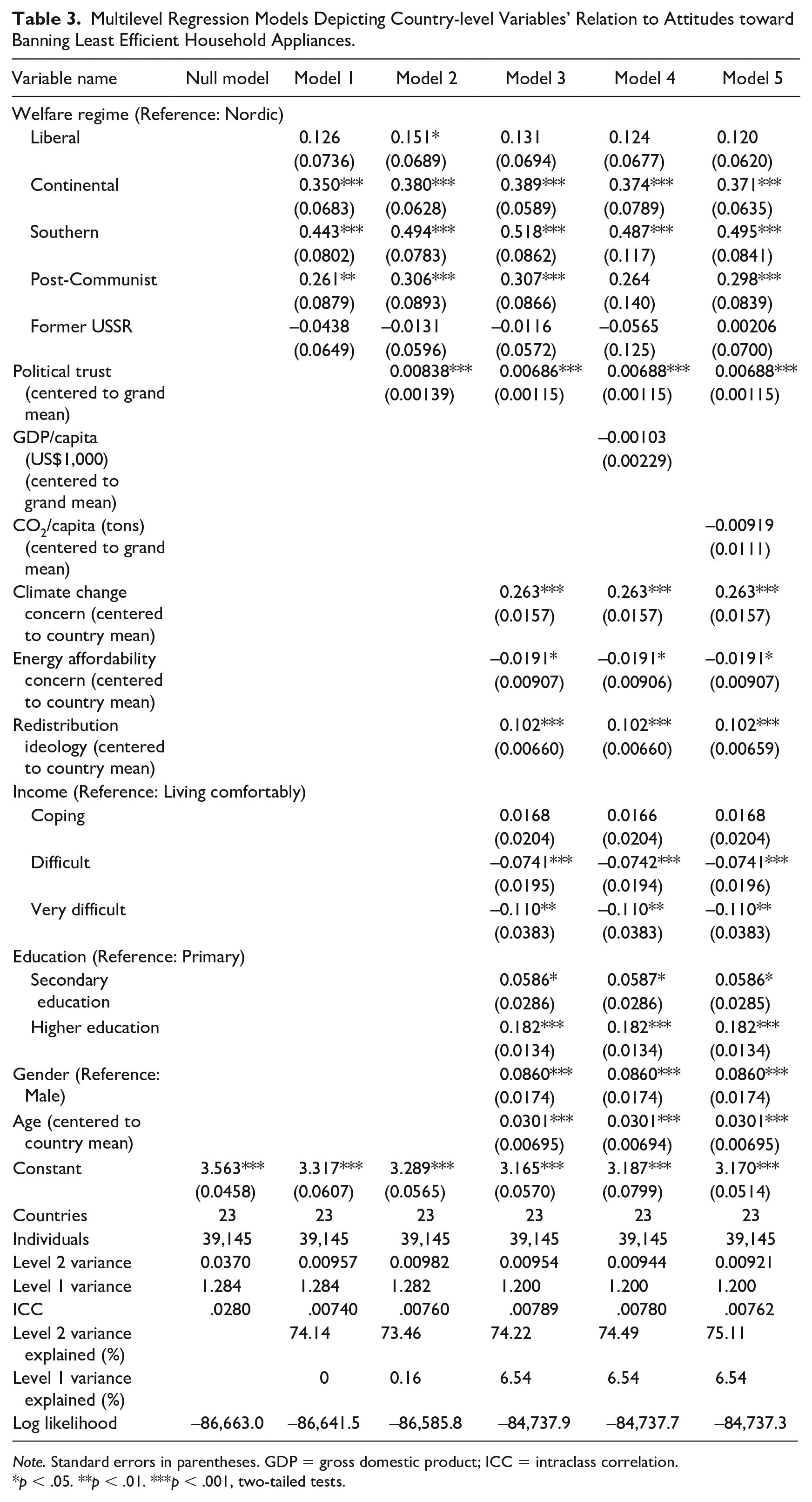
Table 3 presents our results pertaining to attitudes toward banning the least energy-efficient household appliances. The ICC value of the null model, .028, suggests that the variation of attitudes toward banning is not particularly connected to country-level factors. However, when welfare regime type is added to the examination in Model 1, it explains nearly 74.14 percent of the null model’s country-level variance. This indicates that welfare regime type explains most of the relatively small country-level variation.
Multilevel Regression Models Depicting Country-level Variables’ Relation to Attitudes toward Banning Least Efficient Household Appliances.
Note. Standard errors in parentheses. GDP = gross domestic product; ICC = intraclass correlation.
p < .05. **p < .01. ***p < .001, two-tailed tests.
Model 2 adds country-level political trust to the examination. Political trust was connected to more supportive attitudes toward banning but did not particularly change the link between welfare regime type and attitudes.
Compared with the Nordic regime, people in Continental, Southern, and Post-Communist welfare regimes are more in favor of banning in Models 1, 2, 3, and 5; in Model 2, people in Liberal regime were more supportive of banning compared with the Nordic regime, as well. Although in other models people in Post-Communist regime were more in favor of banning, in Model 4—which includes GDP per capita—the difference was not significant. The difference between Nordic and Former USSR welfare regime was insignificant in all models. Neither per capita GDP (Model 4) nor CO2 emissions per capita (Model 5) were significantly linked with the dependent variable.
Tables 1 to 3 also show how individual-level variables are connected to the dependent variables. Greater climate change concern and higher support for redistribution predicted higher support for all the dependent variables as expected. Higher energy affordability concern statistically significantly decreased support for banning and taxation, but not for subvention. Higher subjective income was most consistently connected to support for taxation. Higher education predicted support for all policy instruments. However, the difference between people with primary and secondary education was not significant regarding support for taxation of fossil fuels. Women were more in favor of banning compared with men. Older age predicted support for banning, whereas younger age predicted support for taxation and subvention.
The null models in Tables 1 to 3 indicate that the variance in taxation attitudes was slightly more strongly related to country-level factors than to the variance of attitudes toward subsidizing, and clearly more strongly than banning. Welfare regime clearly explained country-level variances in banning and taxation attitudes better than it explained attitudes toward subvention. Tables 1 to 3 and Figures A1 to A3 (Supplemental Material) show that the differences between the Nordic regime and other regimes were particularly significant when it came to support for increased fossil fuel taxation. People living in Continental and Southern regimes were most supportive toward banning energy-inefficient household appliances, but the differences between the regimes were not particularly substantial. Regarding support for subvention of renewable energy, the differences between the regimes were nearly negligible. Higher political trust at the country level predicted more support for all three climate policy instruments. Hence, it seems that higher country-level political trust is consistently connected to supportive attitudes toward climate policies, but the connection is especially strong when it comes to supporting fossil fuel taxation.
Discussion
Following the synergy hypothesis (e.g., Gough and Meadowcroft 2011), we hypothesized that people living in the Nordic welfare regime would be more in favor of three climate policy instruments: higher taxes on fossil fuels, renewable energy subsidies, and banning the least energy-efficient household appliances. Our analysis indicated that the support for higher fossil fuel tax was especially high in Nordic regime. This finding lends partial support for our first hypothesis with regard to taxation attitudes. However, this was not the case with attitudes toward subsidizing renewable energy or banning energy-inefficient household appliances.
Our second hypothesis was that country-level political trust is an especially relevant predictor of more supportive attitudes toward climate policies (Matti 2015), especially taxation. Our results supported the hypothesis: Political trust predicted higher support for all the studied policy instruments, and the connection was strongest with taxation. The fact that welfare regime type is more strongly related to taxation attitudes than attitudes toward subsidizing or banning appears to be related to the relatively high levels of political trust in Nordic countries (see Listhaug and Ringdal 2008). Higher taxation involves material risks, and support for political reforms that include material risks tend to be positively connected to higher political trust (Rudolph 2017; Trüdinger and Bollow 2011). It seems that when compared with other regimes, recreancy is at lower levels in the Nordic regime. This appears to be a fruitful basis to support policy measures that are perceived as risky, such as fossil fuel taxation.
On the contrary, taxation is not only about tax payments but also about the distribution of tax revenues: If citizens find the distribution fair, they are more supportive of new taxes (Matti 2015). This could be another reason why universal and generous welfare states have typically high political trust (Listhaug and Ringdal 2008; Shore 2019) and supportive attitudes toward higher fossil fuel taxation: People in more universal and generous welfare states may perceive that they get a better value for their tax revenues.
The result that banning and especially subvention were more popular policy instruments than taxation is in line with previous research (Drews and van den Bergh 2016; Lucas 2017). Hence, the attitude gap between experts and the public (Lucas 2017) resonates with our results: Although experts (e.g., Sterner and Köhlin 2015) find that fossil fuel tax is a particularly cost-effective instrument in curbing climate change, it has relatively little support among publics. However, the results of this study suggest that the legitimacy of the tax in question is partially related to welfare regime.
Taxation may be considered a high-cost instrument, as it affects people’s economic situations more tangibly and directly than low-cost climate policies (Von Borgstede and Lundqvist 2006). The result that people who have better subjective economic situations were more supportive of a higher fossil fuel tax is compatible with this argument. Overall, the results suggest that with regard to the legitimacy of high-cost policy instruments such as taxation, welfare structures and political trust are especially relevant factors. The significance of country-level political trust in supporting environmental protection is in line with earlier research (e.g., Fairbrother 2016).
The concern that energy may become unaffordable was linked with lower support for higher fossil fuel taxation and for banning the least energy-efficient household appliances. However, attitudes toward subsidizing renewable energy were not significantly related to concerns about energy affordability. This suggests people may perceive subsidies as a policy that will not directly affect the affordability of energy. Support for reducing income differences was positively connected to supporting all three policy instruments. This implies a synergy between supportive attitudes toward small income differences and stronger environmental legislation. It is possible that if one supports one form of state intervention, such as income redistribution, it is also easier to accept other state interventions such as strong climate policies.
Overall, the results suggest that the Nordic welfare regime provides a more fertile ground to implement higher fossil fuel taxation than other welfare regimes. Indeed, the Nordic countries have been pioneers in implementing fuel or carbon taxes (Giddens 2009). In other regimes, the implementation of higher fossil fuel taxation could be more difficult in terms of gaining legitimacy from the public. Banning and especially subvention are perceived to have a less direct effect on personal economies; hence, these instruments receive more support from the public.
The public legitimacy of a policy instrument improves its impact (Matti 2015). Thus, countries with less comprehensive welfare states could try—at least in the first place—to advance instruments that are considered more legitimate. On the contrary, the possible economic disadvantages that taxes have on household economies could be compensated for (Hsu 2016). The attitudes toward different kinds of compensation opportunities should be studied more in the future.
As a more comprehensive welfare state seems to be related to support for fossil fuel taxation, developing welfare policies can be considered beneficial not only in terms of increasing social and economic equality and well-being but also from a climate policy perspective.
Previous comparative welfare state studies have indicated that attitudes toward, for instance, welfare policies and immigration vary across welfare regimes (Larsen 2006; Nagayoshi and Hjerm 2015). This study complements this earlier research and proposes that comparative sociology is urgently needed to understand how and why climate policies are endorsed or discounted. The study at hand has highlighted one mechanism through which welfare regime is linked with climate policies—namely, political trust. However, political trust alone cannot account for differences between regimes. Adding the level of GDP or CO2 emissions to the equation does not really change the picture. When it comes to relatively high support for fossil fuel taxation in Nordic countries, there are purportedly factors that might explain the phenomena and were not included to this study.
We invite scholars to add to the understanding of the connections between welfare structures and climate policy attitudes. There are presumably different factors that were not included in this analysis but would be important to recognize to understand the formation of climate policy attitudes. For example, the significance of class structure, national culture, or political party system could be examined in future research. A further limitation of this cross-sectional study is that it was fielded at a particular point in time when populism had gained electoral successes and much visibility in the public discourse. Time-series data would give a more credible picture about climate policy attitudes and factors related to them.
As people living in the Nordic welfare regime are most in favor of higher fossil taxes, our results provide partial support for the synergy hypothesis. Nonetheless, even though the Nordic welfare regime with its high levels of political trust may provide an especially good platform for enhancing tax-based climate policies, other welfare state models may still provide good platforms to advance other climate policies. For example, when compared with other regimes, people living in Continental and Southern regimes were most in favor of banning inefficient household appliances. This finding, too, merits further research.
Supplemental Material
sj-pdf-1-spx-10.1177_0731121421990053 – Supplemental material for Is There a Link between Welfare Regime and Attitudes toward Climate Policy Instruments?
Supplemental material, sj-pdf-1-spx-10.1177_0731121421990053 for Is There a Link between Welfare Regime and Attitudes toward Climate Policy Instruments? by Jukka Sivonen and Iida Kukkonen in Sociological Perspectives
Footnotes
Declaration of Conflicting Interests
The author(s) declared no potential conflicts of interest with respect to the research, authorship, and/or publication of this article.
Funding
The author(s) received no financial support for the research, authorship, and/or publication of this article.

Supplemental Material
Supplemental material for this article is available online.
Notes
Author Biographies
References
Supplementary Material
Please find the following supplemental material available below.
For Open Access articles published under a Creative Commons License, all supplemental material carries the same license as the article it is associated with.
For non-Open Access articles published, all supplemental material carries a non-exclusive license, and permission requests for re-use of supplemental material or any part of supplemental material shall be sent directly to the copyright owner as specified in the copyright notice associated with the article.
