



Abstract
In times of cultural omnivorousness, authentic products are highly valued by high-status consumers. The article scrutinizes the social and individual preconditions for attributing hedonic and economic value to authentic products. Taking the concept of cultural capital as a starting point, it argues that cues indicating a product’s authenticity affect taste and price evaluations only if individuals perceive authenticity cues correctly (descriptive beliefs) and regard authenticity as an important product feature (evaluative beliefs). This interplay of descriptive and evaluative beliefs explains the appreciation of authentic products. The model is tested by combining an experimental tasting of apple juice samples with a survey. We find that cues of authenticity causally influence the hedonic evaluation of products only for consumers with both strong descriptive and evaluative beliefs. Attribution of economic value depends on descriptive beliefs only. In addition, such beliefs are socially structured: descriptive beliefs correlate with higher formal education, whereas evaluative beliefs covary with highbrow cultural practices.
Introduction
Sociological research has provided ample evidence that cultural consumption (i.e., consumption of goods and services with primarily aesthetic functions, like arts, clothing, or food) plays a vital role in structuring and reproducing social inequality. In times of cultural democratization and omnivorousness, however, traditional cultural hierarchies have shifted (Peterson and Kern 1996). Recent literature suggests authentic goods and services to be highly relevant for processes of distinction and symbolic boundary making (Carroll 2015; Grazian 2005; Johnston and Baumann 2007; Kovács 2019; Lehman et al. 2019). However, authenticity is not a specific quality inherent to a definable group of products. Rather, it is the result of a social process of meaning attribution based on criteria that are subject to change (Kovács 2019; Lehman et al. 2019; Peterson 2005). Current research on the meanings of authenticity in contemporary cultural discourse and consumer’s understandings consistently finds that goods and services are categorized as “authentic” when they are embedded in specific regional and traditional contexts, produced by nonstandardized methods, and connected to the personality of a not commercially motivated producer (Beverland 2006; Johnston and Baumann 2007; Kovács, Carroll, and Lehman 2014). Given the distinctive value of products categorized as authentic, it is not surprising that research also finds that such products are generally attributed higher value (Hahl, Zuckerman, and Kim 2017; Kovács et al. 2014; Kovács, Carroll, and Lehman 2017; Lehman et al. 2019; O’Connor, Carroll, and Kovács 2017).
Yet, authentic products are not equally appreciated by all social groups. Certain cognitive prerequisites have to be met to understand, classify, and enjoy authentic products. Put differently, following Pierre Bourdieu’s (1977, 1984) theory of taste, a certain stock of cultural capital is required to appreciate authentic products. Cultural capital, in turn, is distributed along the lines of social inequality.
In the present paper, we analytically disentangle the structure of cultural capital needed for the appreciation of foods with authentic meaning. We thereby hope to advance our understanding of the mechanisms underlying product evaluations (Elster 2015; Hedström and Ylikoski 2010). We propose a theoretical model that separates descriptive beliefs from evaluative beliefs about authenticity. This analytical decomposition makes it possible to demonstrate how specific combinations of these two types of beliefs influence the causal effectiveness of socially constructed meanings of authenticity. Moreover, our model shows that individual beliefs about authentic products modulate their inherent appeal, especially the actual taste experience (hedonic value) and their perceived economic worth (economic value). As these beliefs are unequally distributed in society, they operate as components of cultural capital. Hence, our model also contributes to a further development of Bourdieu’s ideas about the role of cultural capital in consumption practices. As Bourdieu (1984:1) prominently noted, a certain stock of cultural capital is needed to reconnect a socially defined taste “with the elementary taste for the flavors of food.”
Empirically, we test the proposed model with a combination of experimental and survey methods. First, we isolate the causal effect of authenticity on product evaluation. We show that higher hedonic and economic valuations of authentic products are not due to the products’ objective or tangible characteristics but are causally attributable to socially constructed meanings attached to them. Second, the combination of experiment and survey is a strength of our design because it allows to explicitly test possible explanations of treatment effects, namely, that certain elements of cultural capital (descriptive and evaluative beliefs about authenticity) are a precondition for the intrinsic appreciation of allegedly authentic products. Third, as participants were recruited from the general population, we are able to analyze the social-structural underpinnings of the descriptive and evaluative beliefs.
The article is structured as follows. In the “Authenticity as a High-status Practice” section, we will briefly outline the theoretical discourse on inequality, culture, and authenticity, and describe the central role of cultural capital therein. In “A Theoretical Model of Product Evaluations, Authenticity, and Social Inequality” section, we will develop our theoretical model specifying the interplay between product characteristics, individual beliefs about authenticity, and social inequality in the process of product evaluation. Subsequently, we will present an experimental study serving as an empirical test of the model. We conducted a tasting of different samples of apple juice, which were labeled as stemming either from a farm estate (authenticity condition) or from a brand producer (inauthenticity condition). We chose apple juice as a kind of a least likely case (Seawright and Gerring 2006). In contrast to culturally consecrated products like music, visual arts, or similarly valued items from the realm of food like wine and haute cuisine, apple juice is a rather mundane and everyday product. Thus, if we can show that our theoretical model works for this rather ordinary product, it should also work for more culturally consecrated objects. While the design of the experiment and the questionnaire will be described in more detail in the “Experimental Study” section, results will be presented in the “Results” section. We will discuss the results and conclude our main argument in the “Discussion” and “Conclusion” sections.
Authenticity as a High-status Practice
Social Inequality, Culture, and Authenticity
At least since the seminal studies of Bourdieu (1984), it is virtually uncontested that the aesthetic differentiation of cultural forms is closely tied to the structure of social inequality. Generally, it is argued that the upper classes tend to engage in highbrow cultural practices representing aesthetic refinement and sophistication (e.g., classical music or haute cuisine), whereas the lower classes tend to engage in lowbrow cultural practices representing ready accessibility and instant gratification (e.g., pop music or convenience food).
In the 1990s, however, Peterson raised reasonable doubts about this rather simple homology and instead proposed the model of cultural omnivorousness (Peterson and Kern 1996). He drew the conclusion that social classes’ cultural tastes do not differ by their “brow-level” but by their ability to appreciate cultural goods and services from diverse “brow-levels,” which he interpreted as cultural inclusiveness, breadth, or openness (cf. Ollivier 2008). This proposition is empirically corroborated, as most studies find that cultural omnivorousness is associated with high levels of education, income, and/or occupational class (e.g., Coulangeon 2013; Katz-Gerro and Jæger 2013; Weingartner and Rössel 2019). Thus, cultural omnivorousness may have replaced highbrow exclusiveness as distinctive cultural signal, at least partially.
The difficulty with distinction through omnivorousness is that it—paradoxically—calls for inclusiveness and exclusiveness at the same time (Johnston and Baumann 2007; Warde, Wright, and Gayo-Cal 2008). Inclusiveness is required to conform to contemporary standards of cultural legitimacy, while also a certain exclusiveness is required to distinguish higher social classes’ overt consumption patterns from those of lower classes. Hence, as Richard A. Peterson and Roger M. Kern (1996) noted early on, omnivorousness does not mean liking “everything indiscriminantly” (p. 904). Instead, distinctive cultural consumption tends to include goods and services from diverse brow levels but still be selective in choosing them (Ollivier 2008; Warde et al. 2008).
As a selection criterion, recent studies suggest authenticity of cultural goods and services (Carroll 2015; Fine 2004; Grazian 2005; Hahl et al. 2017; Johnston and Baumann 2007; Lehman et al. 2019; Michael 2015; Peterson 2005). Authentic products are hence of distinctive value, especially under conditions of cultural omnivorousness. However, authenticity is not a specific quality inherent to certain cultural objects but is ascribed to them in a process of social construction, which is also true for the ascription of cultural value in general (Bourdieu 1996b; Carroll 2015; Kovács 2019; Lehman et al. 2019; Peterson 2005; Salganik, Dodds, and Watts 2006). In accordance with such a view, we are agnostic toward the question of what authenticity “really” is. Instead, we take the social categorization of a product as “authentic” and its related meanings as empirical data. Interestingly, a rather consistent picture has emerged in previous empirical research on the social meanings of authenticity (cf. Carroll 2015). In their analysis of the contemporary American food scene, Josée Johnston and Shyon Baumann (2007) find that those food products are evaluated highly which originate from specific geographies or regions, are manually crafted by simple (nonindustrial) methods, are connected to the personality of a specific producer, and are embedded in historical or ethnocultural traditions. For the case of wine, Michael Beverland (2006) additionally identifies the rejection of commercial motives as sign of authenticity. The latter is also accentuated by Oliver Hahl et al. (2017) when they refer to the “disinterestedness” of producers of authentic goods and services, and by Robert Kreuzbauer and Joshua Keller (2017) when they refer to producers’ agency control and intentions (also see Fine 2004). In general, goods and services in contemporary western societies gain authenticity not through aesthetic qualities (e.g., the gustatory composition of a dish) but through specific methods of production and characteristics of the producer. Note, however, that this is particularly true for the attribution of authenticity in the fields of food and culture, but not necessarily in the case of persons or organizations (Kovács 2019).
Habitus, Cultural Capital, and the Taste for Authenticity
As indicated above, previous empirical research has shown that the consumption of authentic products is more prevalent among higher social strata (Beckert, Rössel, and Schenk 2017; Hahl et al. 2017; Kennedy, Baumann, and Johnston 2019; Michael 2015). According to Bourdieu’s (1977, 1984) theory of taste, this can be explained by unequally distributed sets of “tastes, skills, knowledge, and practices” (Holt 1998:3), which are grounded in a person’s habitus. Habitus denotes a system of stable dispositions guiding perceptions, evaluations, and actions (Bourdieu 1977). Such dispositions, in turn, are shaped by an actor’s position in the social space. Hence, authentic consumption is more prevalent among high-status consumers because they possess the necessary dispositions to understand and appreciate it. When dispositions toward authenticity are systematically linked to higher social status, they constitute a stock of (internalized) cultural capital (Johnston and Baumann 2007; Kennedy et al. 2019).
Clearly, this argument does not imply that members of higher social strata consume authentic products to deliberately distinguish themselves from others. As Omar Lizardo (2014:341) points out, it is important to separate Bourdieu’s theory of taste from functionalist interpretations of cultural consumption as some “account of how persons consciously [. . .] manipulate appearances for the sake of social advantage.” Therefore, analogous to Bourdieu’s idea that the spontaneous accord between a person’s dispositions and an artwork leads to artistic pleasure and aesthetic well-being (Bourdieu and Delsaut 1981), consumers with the appropriate stock of cultural capital should genuinely experience authentic products as more pleasurable, appealing, or emotionally rewarding (Grayson and Martinec 2004). Consequently, higher social strata’s consumption of authentic products should not solely be explained by the signaling of social status (as, for instance, in Zukin 2008) or the countering of possible attributions of inauthenticity (as in Hahl et al. 2017).
In brief, it follows from Bourdieu’s theory that the appreciation of authentic products necessitates a specific stock of cultural capital, grounded in the socially structured dispositions of the habitus. Taking this as a starting point, the present study aims at a better understanding of the operation and the interplay of the dispositions of the habitus in the realm of authenticity. Therefore, in the following section, we “disentangle cultural capital” (Yaish and Katz-Gerro 2012) and develop an empirically testable model of individual beliefs and their association with product evaluations and social inequality. This allows us to arrive at a more fine-grained, individual-based mechanism (Rössel, Schenk, and Weingartner 2017), rendering intelligible the social structuration of hedonic taste experiences (hedonic value) and economic price attributions (economic value) for authentic products.
A Theoretical Model of Product Evaluations, Authenticity, and Social Inequality
Product Evaluation and Frames of Authenticity
Many studies show that people are not very good at evaluating food based solely on their sensory characteristics. For instance, an experimental study with students of oenology found that most of them were not even able to distinguish white from red wine just by taste (Morrot, Brochet, and Dubourdieu 2001). Similarly, expert ratings of wine in blind tastings exhibit only low intercorrelations (Brochet 2001; Cicchetti 2007; Hodgson 2008).
As a consequence, consumers tend to rest their product evaluations upon factors other than tangible/objective features of the product. Studies suggest that expectations and attitudes toward the product, induced by specific product information, play a major role. For instance, Johan Almenberg and Anna Dreber (2011) report higher evaluations of pleasantness for wine samples with higher price labels compared with lower price labels (holding the objective wine quality constant). In a similar line of thought, Michael Siegrist and Marie-Eve Cousin (2009) demonstrate that consumers’ sensory taste experiences of wine samples depend on information about critics’ wine ratings given prior to the tasting. The general idea is that specific product information activates specific beliefs about the product in the consumer and that these beliefs influence product evaluations, independent of objective characteristics.
Following Johnston and Baumann (2007), authenticity is one of the most important frames in contemporary food discourses. Such frames are used by consumers “to derive a ‘correct’ understanding of foods” because they provide “an understanding that legitimates certain foods as high status” (Johnston and Baumann 2007:172). Hence, frames of authenticity should affect the evaluation criteria of products and render authentic products more desirable and positive, irrespective of actual, objective differences between goods. They establish the exclusiveness of certain goods without violating cultural norms of openness and inclusiveness characteristic for omnivorous consumption (Peterson and Kern 1996).
However, to be activated, frames of authenticity need to be related to specific cues, that is, properties of products indicating their authenticity (Grayson and Martinec 2004). Because of authenticity’s socially constructive nature, these cues can be diverse and may change over time. As outlined above, they currently comprise properties such as regionalism, traditionalism, handcraftedness, personality, and a rejection of commercial motives (Beverland 2006; Johnston and Baumann 2007; Kovács et al. 2014). Perceiving such cues serves as relevant product information and thus has—according to contemporary frames of authenticity—a positive effect on product evaluation.
In our experimental study presented below, we investigate taste and price evaluations of different samples of apple juice. In this domain, we assume the relevant cue of authenticity to be the type of manufacturer. Therefore, we contrast apple juice labeled as stemming from a “brand producer” with apple juice labeled as stemming from a “farm estate.” The latter is supposed to be a sign of authenticity because of both its allegedly regional, traditional, and nonindustrial production methods and its personal and noncommercial appearance. Of course, such a cue will only work in societies where the corresponding frame of authenticity is prevalent. We hypothesize the following:
Individual Beliefs as Preconditions for Authenticity Appreciation
H1 needs to be qualified in an important respect. Information about the authenticity of a product is able to influence product evaluations only if consumers actually perceive the respective cues as signs of authenticity. This is in line with psychological models of authenticity attribution, suggesting that consumers iteratively process the perceivable features of products in coordination with their cultural knowledge (Kreuzbauer and Keller 2017; also see Cerulo 2018). In sociological terms, as outlined in Bourdieu’s theory of taste, the spontaneous accord between an individual’s stock of cultural capital and product features gives rise to hedonic pleasure and the inherent appreciation of the product (Bourdieu and Delsaut 1981). To explicate the mechanisms involved in the process of authenticity appreciation, we disentangle two analytical components of this type of cultural capital and specify their interrelation. To do so, we separate descriptive beliefs from evaluative beliefs. In line with Bourdieu’s theory, these beliefs rest on a person’s habitus. They may thus remain implicit or unverbalized in the moment of evaluation, while still being involved in the generation of the appeal of authentic products (Lizardo 2014; Strand and Lizardo 2015).
First, cultural knowledge is part of each individual’s cognitive system of descriptive beliefs about facts and relationships in the external world. Individuals use these cognitive schemata to categorize, organize, and thus understand perceived stimuli (Elster 2015:114ff; Higgins and Bargh 1987; Roese and Sherman 2007). The categorization of products is a fundamental and necessary precondition for making judgments (Heintz 2016). Also Bourdieu (1977, 1984) emphasized the dividing and classifying role of the dispositions of the habitus. In the present application, descriptive beliefs refer to varying perceptions of the information about the type of manufacturer. The latter is able to positively affect taste and price evaluations of apple juice only if consumers believe that farm estates engage in authentic production methods and feature authentic characteristics.
However, perception of cues (i.e., descriptive belief) is not sufficient. Independent of whether consumers perceive a product as authentic or not, they need to have a positive stance toward authenticity more generally. Put differently, authenticity needs to be an important evaluation criterion for consumers. Studies following Bourdieu’s theory of taste commonly understand cultural preferences as an expression of class-specific cultural capital, involved in the formation of judgments and practices (Otte and Rössel 2011; Yaish and Katz-Gerro 2012). Thus, second, assessments of cultural objects rest on each individual’s cognitive system of evaluative beliefs comprising judgments and evaluations of facts and relationships in the external world. In line with theories on attitudes and human values, these schemata are used to rate and hierarchize perceived stimuli (Ajzen and Fishbein 1980; Elster 2015:65ff; Fabrigar, MacDonald, and Wegener 2005).
Moreover, psychological research shows that taste evaluation is influenced by positive affect derived from the confirmation of the consumer’s evaluative beliefs—even on a preconscious level (Haws, Winterich, and Naylor 2014; Lotz, Christandl, and Fetchenhauer 2013). Such emotional reactions also stem from the distinctive meaning of authentic products, that is, their place in the cultural hierarchy of goods under conditions of cultural omnivorousness. When consumers know about the symbolic value of authenticity, consuming authentic products reaffirms their identity as a competent and sophisticated consumer. This way, authenticity information evokes spontaneous emotional reactions, which may blend with the taste experience. This mechanism is also implied by Bourdieu’s explanation of aesthetic pleasure and well-being (Bourdieu and Delsaut 1981). Consumers with a positive evaluative belief about authenticity might experience happiness or even pride when consuming a traditional, handcrafted, or regional product, which spills over to their taste experience and—indirectly—their judgment of the product’s economic value.
Combining the mechanisms based on descriptive and evaluative beliefs, it follows that information about the type of manufacturer positively affects taste and price evaluations of apple juice only if consumers both perceive the farm estate as more authentic and believe authentic production methods and producer characteristics to be important properties for evaluating food, that is, having a positive evaluation of these properties. Both categorization and hierarchization are necessary processes for making comparative judgments (Heintz 2016). Hence, explaining the varying appreciation of authentic products presupposes a detailed understanding of the interplay of the underlying descriptive and evaluative beliefs. Only this disentanglement allows us to uncover the cogs and wheels of cultural capital in authenticity appreciation. We can therefore derive the following, empirically testable hypothesis:
The Social Structuration of Descriptive and Evaluative Beliefs
According to Bourdieu’s (1984) theory of taste, the dispositions of the habitus (i.e., the relevant components of internalized cultural capital) are shaped by an individual’s socially structured living conditions and, more specifically, by socialization processes into specific social institutions and cultural milieus. In the case of authenticity, institutions and milieus imparting (legitimate) cultural knowledge are of key importance. Therefore, we expect descriptive and evaluative beliefs about authenticity to be related to educational background and engagement in highbrow practices (Lizardo 2009; van Hek and Kraaykamp 2013).
First, individuals with higher education are likely to make classed experiences, strengthening their descriptive and evaluative beliefs about authenticity. For one, Bourdieu (1984) has highlighted the educational system as a crucial institution shaping the dispositions of the habitus. By direct instruction (van Hek and Kraaykamp 2013), formal education fosters cultural competences needed to “correctly” decipher cultural symbols, that is, descriptive beliefs. As part of general education in Switzerland, institutions of higher secondary and tertiary schooling teach knowledge of markets, commodity chains, and production techniques, which is likely to strengthen the cognitive link between a farm estate and regional, ecological, and handcrafted production. Apart from the specific institutional context of the school, individuals with higher formal education are also likely to have more experience of class-specific authentic products and their cultural framing in general. Finally, individuals with higher formal education are likely to develop dispositions toward preferring form over function because they experience a greater distance from necessity (Bourdieu 1984). As authentic products gain their specific value through the way they are produced (form) and not through their function to satiate basic needs, these dispositions are likely to manifest themselves in positive evaluative beliefs toward authenticity (EBA; Kennedy et al. 2019). We therefore hypothesize the following:
Second, dispositions are not only formed in institutions of formal education but also informally through cultural practice and overt lifestyles (Bourdieu 1984). We argue that beliefs about authenticity are particularly formed through engagement in highbrow practices, operationally defined as visits to art museums and galleries. Authenticity is an important selection criterion not only in the realm of food but also in the fields of cultural production, including visual art (Fine 2004; Hahl et al. 2017) or music (Grazian 2005). By unconscious social imitation (Lizardo 2009), by direct instruction (van Hek and Kraaykamp 2013), or by habitualization (Strand and Lizardo 2015), individuals partaking in highbrow practices in fields of cultural production are thus likely to develop a general disposition to appropriate objects in terms of authenticity. They acquire knowledge on relevant cues of authenticity (i.e., the descriptive beliefs) and they learn to evaluate objects in terms of authenticity (i.e., evaluative beliefs). The application of similar criteria in different domains of life is very much in line with the notion of an overarching lifestyle (Otte and Rössel 2011). We therefore hypothesize the following:
We summarize our theoretical model of product evaluations, authenticity, and social inequality as follows (Figure 1): Product evaluations (hedonic taste and price) are causally influenced by information about the product (cue of authenticity). However, this effect is moderated by both the individual perception and importance of the product information (cue as sign of authenticity, authenticity as important evaluation criterion; see dashed arrows in Figure 1). Perception and importance, in turn, vary across social-structural groups. As both types of beliefs are socially structured by similar mechanisms, we expect a certain covariation (two-sided dashed arrows in Figure 1). Put differently, the social differentiation of the effect of product information on product evaluation is mediated by the interplay of individual descriptive and evaluative beliefs. In this way, we attempt to uncover the mechanism of Bourdieu’s cultural capital in the appreciation of authentic products.
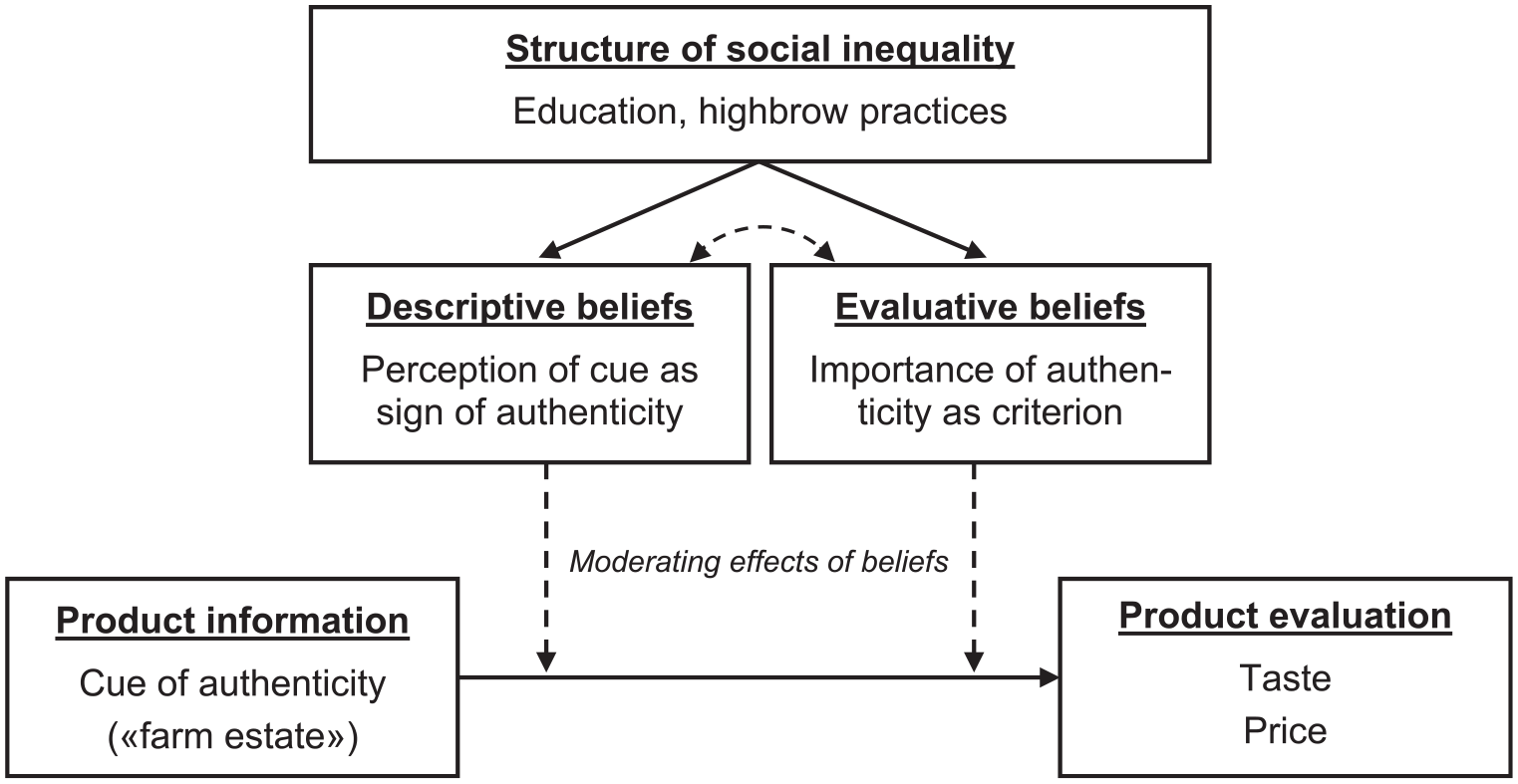
A model of product evaluations, authenticity, and social inequality.
Experimental Study
As authenticity is a topic which is under discussion especially in the sociology of food (Beverland 2006; Carroll 2015; Johnston and Baumann 2007), we located our experimental study in this realm. We conducted an experimental blind tasting of several apple juice samples and measured the hedonic and economic evaluation of each sample. The experiment was accompanied by a survey collecting additional information on participants’ beliefs and social-structural background. As explained above, we consider apple juice a rather mundane type of food and thus a least likely case to find attributions of authenticity. As experimental stimulus, we manipulated the cue indicating an authentic mode of production (farm estate vs. brand producer) while holding the objective properties of the product constant. This cue refers to socially prevalent ideas about authenticity, which could differ historically, between countries or social groups. In this way, we are able to isolate the effect of information about the authenticity of a product. Following the hypotheses formulated above, we tested whether the effect of our experimental stimulus (cue of authenticity) on the experimental outcome (product evaluation) can be explained by referring to participants’ perceptions of the cue of authenticity (descriptive beliefs) and their importance of authenticity for evaluating food (evaluative beliefs). In addition, the social structuration of these beliefs is empirically tested.
Similar experimental examinations are found in the studies of Balázs Kovács et al. (2014), Hahl et al. (2017), and Kieran O’Connor et al. (2017). We extend this research in two respects: Where Hahl et al. (2017) analyzed the actual demand of authentic products (outsider art), we investigate perceived hedonic and economic value of authentic products directly (food). Thus, we can show that consumers value authentic products because information about authenticity modulates the actual hedonic taste experience and the perceived economic worth of food. While this is similar to the studies by Kovács et al. (2014) and O’Connor et al. (2017), they do not further disentangle the mechanism underlying evaluations of authentic products. By combining the experiment with a survey on individual beliefs and social background, we can explain differences in evaluations between social groups by differences in their descriptive and evaluative beliefs. The combination of experiment and survey is a strength of our design because we are able to explicitly test possible moderating explanations of the treatment effects. 1
Location and Sample
We conducted our experiment in fall 2017 and spring 2018 at three different locations in the city of Zurich, Switzerland: at a public science fair (n = 187), in the foyer of a large shopping center (n = 331), and in the foyer of a college building accommodating several social science departments, a private business school, and private companies (n = 152). Participants were therefore recruited from the general population and not from student samples (Henrich, Heine, and Norenzayan 2010). This adds up to a gross sample of 670 participants. After listwise deletion because of missing data, the net sample entering our statistical analyses consisted of 576 participants. As every participant had to evaluate four apple juice samples (within-subject design), we analyzed 2,304 evaluations. For the upcoming regression analyses, the hierarchical structure of the data has been taken into account by computing clustered standard errors with the individuals as clusters. As a robustness check, we also ran fixed-effects models, which came to almost identical results.
Table 1 contains a short description of our sample of participants. In comparison with the overall resident population of the city of Zurich, our sample underrepresents persons with lower educational degrees and overrepresents persons with higher education, especially university degrees. This might be due to the fact that about half of our tastings were conducted in a university setting (science fair, college building). Nevertheless, there is enough variation to estimate meaningful effects of education. Regarding the distribution of gender and age, our sample is quite close to Zurich’s population. Only young (old) participants are slightly overrepresented (underrepresented).
Description of the Experimental Sample.
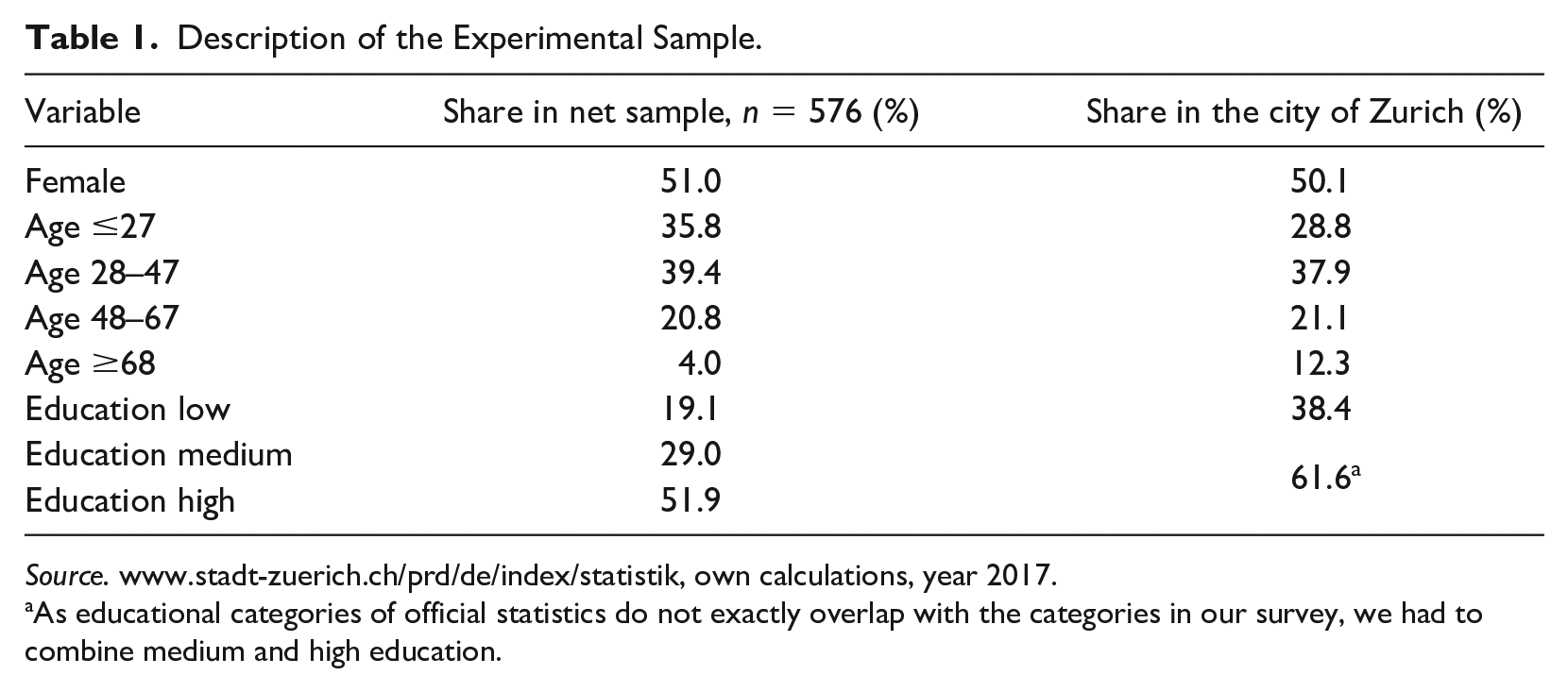
Source. www.stadt-zuerich.ch/prd/de/index/statistik, own calculations, year 2017.
As educational categories of official statistics do not exactly overlap with the categories in our survey, we had to combine medium and high education.
Experimental Procedure and Manipulation
The procedure of the experiment was identical at all three locations. At the beginning, participants were informed about the procedure and assured of anonymity. Then, every participant was asked to evaluate the taste and price (see dependent variables below) of four samples of apple juice, served in transparent, neutral plastic cups. Participants had to enter their evaluations in an online tool via laptops. Thus, their evaluations were not visible to others, which strongly precluded signaling effects in this setting. The same tool was used to answer the subsequent survey questions (see individual beliefs and social-structural background below). Juice samples were evaluated in random order. At the end, participants were dismissed and received a small leaflet with a link to the debriefing homepage. This homepage explained the purpose and procedure of the experiment in detail and was unlocked one week after the experiment. Participants who finished the tasting were therefore unable to explain the exact nature of the experiment to the succeeding participants.
Two of the four samples contained—clearly visible—filtered apple juice, the other two unfiltered apple juice. As unfiltered apple juice is typically thought of to be more natural and less industrially processed and thus to be more authentic, we expected higher evaluations of the unfiltered juice samples. However, as filtered and unfiltered juices differ in their objective qualities, this is not enough to isolate the effect of socially constructed meanings of authenticity. Therefore, we added labels with additional product information to each sample, more precisely, the type of manufacturer as a cue of authenticity. Two samples (one filtered, one unfiltered) received the label “brand producer,” the other two the label “farm estate.” The labels were designed to be as neutral as possible, made up only of black letters on white ground (no pictures, etc.). This results in four samples labeled as follows: (1) filtered, brand producer; (2) filtered, farm estate; (3) unfiltered, brand producer; and (4) unfiltered, farm estate. It needs to be stressed that the two filtered (and unfiltered) samples differed only by the label added to them. Objectively, the juice was identical. Hence, potential effects of the label are causally attributable to the product information given on the label.
Dependent Variables
The first dependent variable is hedonic taste experience. Participants had to rate the taste of each apple juice sample on a 10-point Likert-type scale ranging from 1 (“very bad”) to 10 (“very good”). The second dependent variable is the estimated price per liter. For each juice sample, participants had to indicate 1 of 11 given price categories, ranging from 1 (“less than 0.6 Swiss Francs (CHF)”) to 11 (“more than 4.2 Swiss Francs (CHF)”) (each intermediate category spanned a range of 0.4 Swiss Francs (CHF)). The estimated price is a measure for the economic worth attributed to a product and thus reflects its economic valuation. By looking at both hedonic taste and price, we are able to cover quite a broad spectrum of product evaluations: first, evaluations of very personal sensory experiences and second, rather rational assessments of the market value of products. For every sample, respondents always rated taste first, then its estimated price, right after tasting each sample. We allowed moving back and forth in the questionnaire to avoid ceiling effects in the measurements of the ratings.
Individual Beliefs
According to our model (Figure 1), we expect the effect of the cue of authenticity (label) to be stronger if participants associate meanings of authenticity with the farm estate (descriptive beliefs) and if those meanings are important to them (evaluative beliefs). We measured these two types of beliefs in the survey following the tasting. Measurement of descriptive and evaluative beliefs is closely tied to the empirically reconstructed meanings of authenticity (Beverland 2006; Johnston and Baumann 2007; Kovács et al. 2014), finding that regional, traditional, handcrafted, and personal food is regarded as authentic (see the “Social Inequality, Culture, and Authenticity” section). First, we asked participants to rate on a 5-point Likert-type scale how much they associate “regional production,” “ecological production,” and “handcrafted production” with the farm estate in contrast to the brand producer (1 = “not at all,” 5 = “very strong”). We combined these three statements to a sum index called “descriptive beliefs toward authenticity” (DBA), ranging from 1 to 5, with higher values indicating a more authentic perception of the farm estate (Cronbach’s α = .68). Second, we asked participants to rate on a 5-point Likert-type scale the personal importance of the following properties of food: “connection to regional traditions,” “personality and philosophy of the producer,” and “handcrafted production” (1 = “not important at all,” 5 = “very important”). Again, we calculated a sum index called “evaluative beliefs toward authenticity” ranging from 1 to 5 from the three statements, with higher values indicating a higher importance of authenticity for evaluating food (Cronbach’s α = .74).
Further inspection of the distributions of the two indices of DBA and EBA shows substantial variation (see Table OA1 in the online appendix). For example, just 56 percent of respondents strongly link the farm estate to meanings of authenticity and only 27 percent find criteria of authenticity important. Descriptive and evaluative beliefs about authenticity are thus far from being equally distributed in our sample. This is a precondition for utilizing them as explanatory factors for varying effects of the experimental stimulus (cue of authenticity). Besides, an exploratory factor analysis including all items of both scales confirms that DBA and EBA constitute two discriminative scales (see Table OA2 in the online appendix). In line with that, the correlation between the two sum indices is only moderate (r = .28). Hence, consistent with our theoretical model, descriptive and evaluative beliefs clearly represent analytically separate components of cultural capital.
Social-structural Background
To relate descriptive beliefs and evaluative beliefs to indicators of the social position, participants had to specify in the survey their highest educational degree (1 = “low,” 2 = “medium,” 3 = “high”). 2 In addition, engagement in highbrow practices was measured by the frequency of visits to art museums and galleries (1 = “never,” 2 = “rarely,” 3 = “occasionally,” 4 = “often”). Finally, we asked for gender (0 = “male,” 1 = “female”) and age (1 = “8–27 years,” 2 = “28–47 years,” 3 = “48–67 years,” 4 = “68–97 years”) as control variables.
Results
The main effects of our experimental manipulation, that is, the cue of authenticity on product evaluation, are depicted in Figures 2 and 3 by boxplots together with arithmetic means. Evidently, the two apple juice samples labeled as stemming from a “farm estate” were evaluated substantively higher on average than their “brand producer” counterparts. This effect does not only hold for filtered and unfiltered apple juices but also for taste and price evaluations.
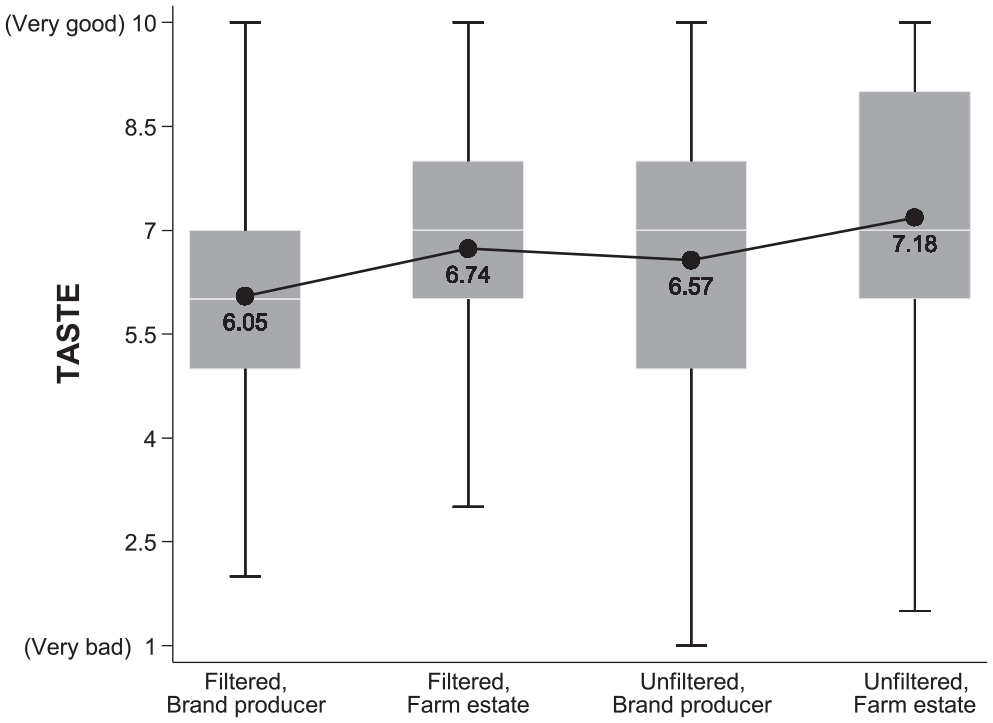
Average taste evaluations of four apple juice samples (boxplots with arithmetic means and whiskers; n = 576).
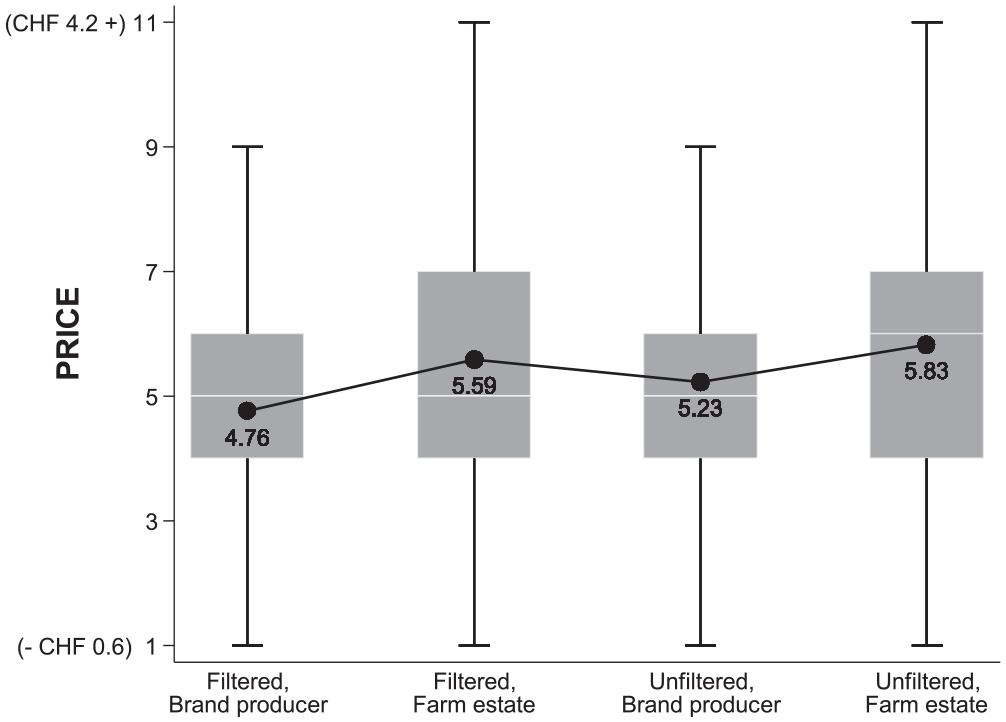
Average price evaluations of four apple juice samples (boxplots with arithmetic means and whiskers; n = 576).
Ordinary least squares (OLS) regressions with clustered standard errors yield significant coefficients at the p < .001 level. They are depicted in the first columns of Figures 4 and 5 (all regression results are presented in Tables OA3 and OA4 in the online appendix). Averaging all participants, the “farm estate” label caused a significant increase in taste evaluation of 0.64 points (on a 1–10 scale) and an increase in price evaluation of 0.73 points (on a 1–11 scale; estimated price increase of CHF 0.29 per liter). This effect is indeed causally attributable to the cue of authenticity because all other factors, especially the objective properties of the apple juice, were held constant. Hence, H1 is fully confirmed.
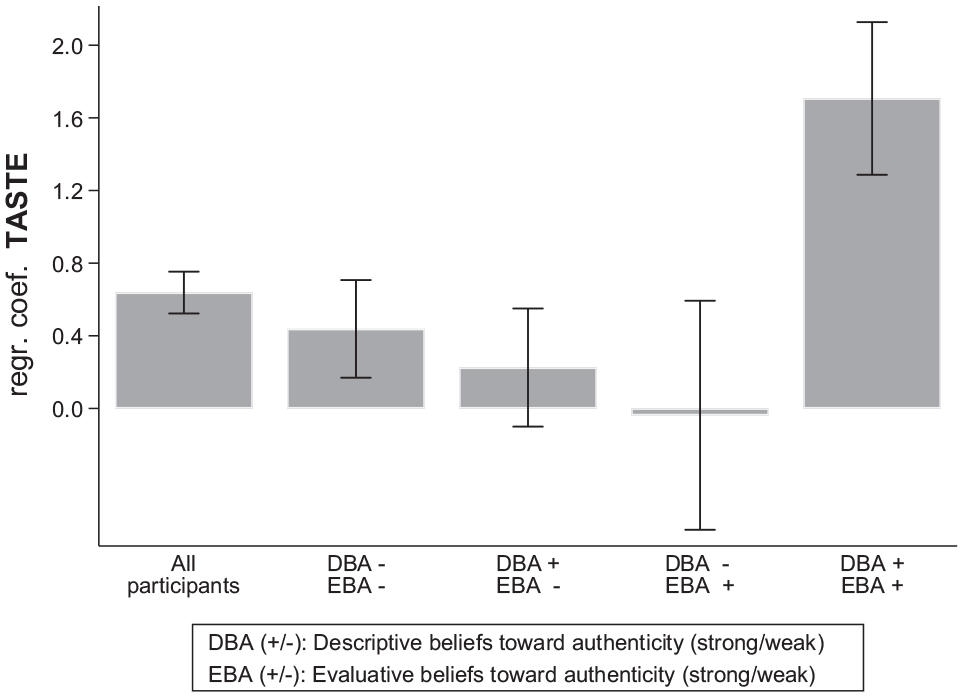
The effect of the “farm estate” label on taste evaluation for different subgroups of the experimental sample (ordinary least squares regression coefficients with robust standard errors; 95 percent confidence interval; n = 2,304).
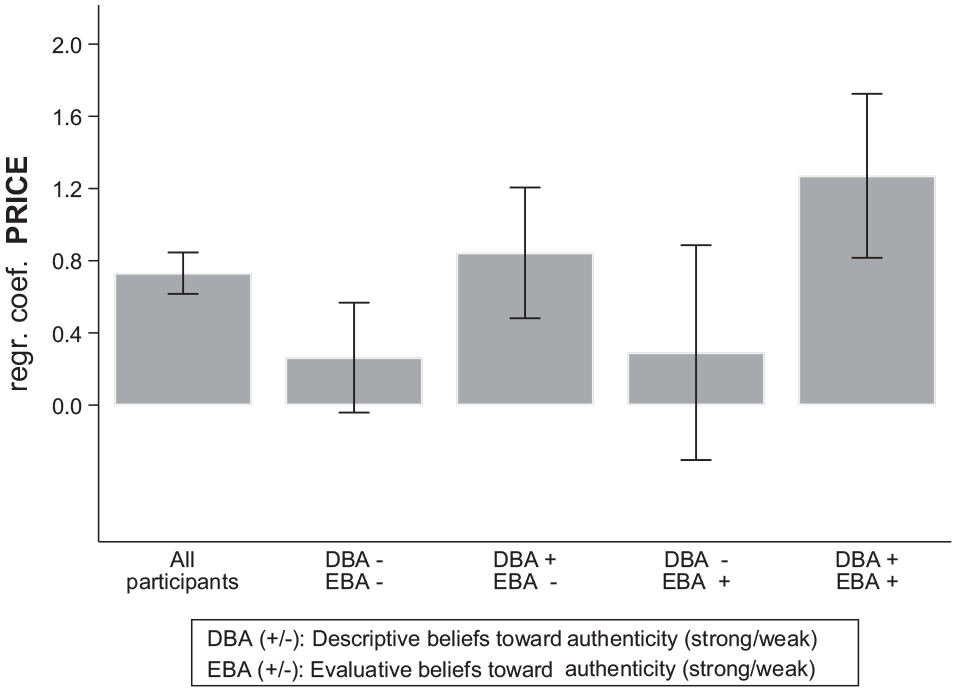
The effect of the “farm estate” label on price evaluation for different subgroups of the experimental sample (ordinary least squares regression coefficients with robust standard errors; 95 percent confidence interval; n = 2,304).
According to our theoretical model (Figure 1), we further hypothesized that the effect depends on the perception and the importance of the authenticity cue, that is, the descriptive and evaluative beliefs as part of respondents’ cultural capital. Therefore, we built a three-way interaction term between descriptive beliefs (DBA), evaluative beliefs (EBA), and the authenticity cue. The full model specification for the two OLS regressions of our measures of product evaluation (taste and price) therefore included three main effects (the authenticity cue, DBA, EBA), their three-way interaction, a 2-way interaction term between DBA and the authenticity cue, a 2-way interaction term between EBA and the authenticity cue, and a 2-way interaction between DBA and EBA. To simplify the presentation of the results, we subdivided the main effect of the “farm estate” label for several subgroups with differing levels of both descriptive beliefs and evaluative beliefs. The results are depicted in columns 2 to 5 of Figures 4 and 5. Looking at taste evaluation in Figure 4, we can see that the effect is by far greatest for participants who rank high in both DBA and EBA. For this group, the “farm estate” label increases taste evaluations by 1.71 points (on a 1–10 scale), a very substantial effect. For all other groups, the effect is considerably lower or even insignificant. The regression coefficient of the three-way interaction term is high (0.22) and significant at the p < .001 level. This result provides strong evidence for a mechanism connecting cues of authenticity with taste evaluations via the combination of descriptive and evaluative beliefs of individuals. Thus, to gain pleasure from an authentic product, individuals need a specifically composed stock of cultural capital. They do not only have to perceive this product as authentic (descriptive beliefs), but they also have to value such authentic products in general (evaluative beliefs). Both types of beliefs are necessary conditions for the sensory appreciation of authentic products.
Looking at price evaluations, then, yields a similar, yet somewhat divergent picture (Figure 5). Again, the effect of the “farm estate” label is greatest for participants who rank high in both descriptive and evaluative beliefs (increase of 1.27 points on a 1–11 scale; estimated price increase of CHF 0.51 per liter). However, the effect is also very high for participants who rank high in descriptive beliefs and low in evaluative beliefs (increase of 0.84 points on a 1–11 scale; estimated price increase of CHF 0.34 per liter). As a result, the coefficient of the three-way interaction term is low (0.04) and not statistically significant in the price regression (p > .50). However, in separate regression models, the two-way interaction between DBA and the authenticity cue is strong (0.27) and significant at the p < .001 level, while the two-way interaction between EBA and the authenticity cue is only weak (0.14) and on a lower level of statistical significance (p < .05). This means that the effect of cues of authenticity on price evaluations is primarily driven by the “correct” perception of these cues and not to the same extent by the individual importance of authenticity. Thus, people apparently know that a product they perceive to be authentic obtains higher market prices, even if they themselves do not value the taste of such authentic products any higher.
Overall, H2 finds rather strong empirical support, particularly in the case of taste evaluations. We were able to show that information about the authenticity of a product positively affects product evaluation only for individuals with the necessary stock of cultural capital, that is, sufficient cultural knowledge about authenticity cues and an internalized appreciation of the cultural value of authenticity.
Finally, we asked whether these individuals exhibit specific social characteristics. Therefore, we computed two separate multivariate regressions, one for the descriptive beliefs (DBA) and one for the evaluative beliefs (EBA), with the social-structural indicators as predictors (Figure 6; Table OA5 in the online appendix). In general, we find a substantial social structuration of descriptive and evaluative beliefs. Regarding our hypotheses, however, results are somewhat mixed. Individuals with higher formal education are more likely to perceive the farm estate as an authentic producer (corroborating H3a), but authenticity is not increasingly important to them (contradicting H3b). In contrast, authenticity is increasingly important for individuals engaged in highbrow practices (corroborating H4b), but they are not more likely to perceive the farm estate as an authentic producer (contradicting H4a). Still, overall, these beliefs are clearly linked to social inequality, which empirically supports the notion that they function as a type of cultural capital (Holt 1998).
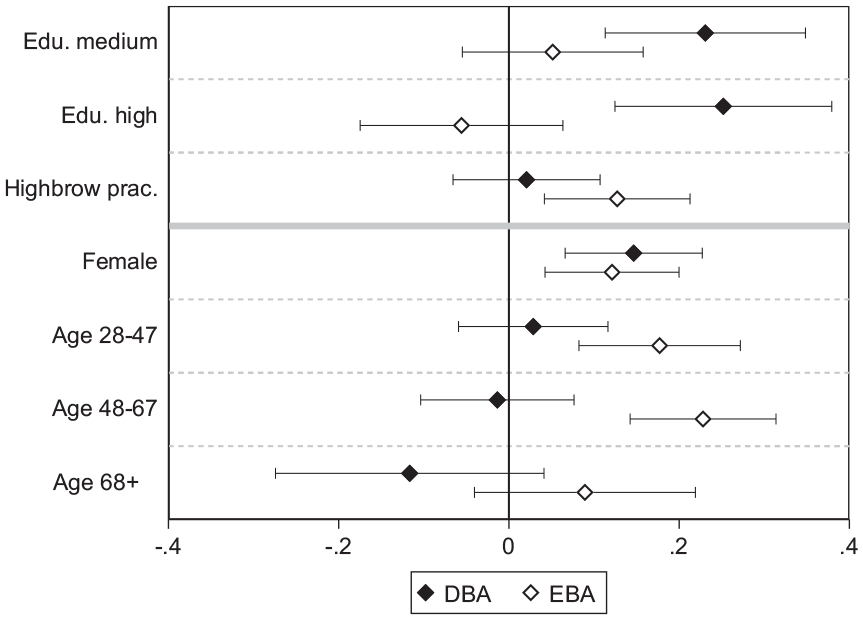
Social-structural correlates of DBA and EBA (standardized ordinary least squares regression coefficients with robust standard errors; 95 percent confidence interval; n = 576).
Beyond our hypotheses, we report the results for age and gender. Interestingly, they are fairly clear for gender: Women rank higher in both descriptive and evaluative beliefs. This is in line with Bourdieu’s later work, where he stressed the role of gender for the structuration of the habitus and social practices alongside social class (Bourdieu 1996a). Moreover, it confirms previous research which found that perceptions, understandings, and evaluations of product information vary along gender as well (Almenberg and Dreber 2011; Cerulo 2018; Lagaert 2018). In contrast, however, Balázs Kovács (2019) found only weak gender effects on the understandings and importance of authenticity. Looking at age groups, authenticity seems to be a more important evaluation criterion for the middle age groups (28–67) compared with the youngest and oldest groups. Perceptions of the authenticity cue, however, do not significantly covary with age.
In sum, we do find substantive correlations between individual beliefs about authenticity and social-structural indicators. However, not all of our theoretical expectations were supported. Gender emerged as a surprisingly salient covariate of the perception and evaluation of authenticity.
Discussion
In general, our empirical results confirm our theoretical model depicted in Figure 1. Information providing cues of authenticity causally influences taste and price evaluations of products. As predicted, this effect depends on both perceptions of the authenticity cue and the importance of authenticity as an evaluation criterion. Hence, descriptive and evaluative beliefs explain the relation between the authenticity cue and hedonic and economic product evaluations. These individual beliefs, in turn, are associated with indicators of social inequality and thus not randomly distributed in society. Hence, our experimental results clearly confirm that specific components of an individual’s cultural capital are necessary for the appreciation of products with socially constructed meanings of authenticity. In times of cultural omnivorousness (Peterson and Kern 1996), frames of authenticity bestow cultural legitimacy on goods (Johnston and Baumann 2007), turning them into means for social distinction without being highbrow snobbish. Formally and culturally higher educated people derive benefits from consuming authentic products in terms of taste and perceived economic value because they possess the cultural capital necessary for their appreciation.
Our experimental setting revealed that certain social groups prefer authentic products because of the enjoyment coming along with them. This enjoyment of tasting products is driven by the interplay of descriptive and evaluative beliefs. We hence shed light on how specific components of cultural capital are connected to the “elementary taste for the flavors of food” (Bourdieu 1984:1). As the tasting was anonymized, it is quite unlikely (although not impossible) that the effects are due to some manipulation of social appearance (Lizardo 2014) or strategic signaling (Hahl et al. 2017; Zukin 2008). We suggest that the pleasure derived from tasting an authentic product is crucial for explaining why the consumption of such products is more prevalent in high-status groups.
Still, we need to qualify the results in several regards. First, there seems to be a difference between taste and price evaluations. For taste evaluations, cues of authenticity are effective only if persons both have a “correct” perception of the cue and attach great importance to authenticity. For price evaluations, a “correct” perception of the cue of authenticity seems to be enough to be effective. There is no additional increase in estimated market value if respondents have a positive attitude toward authenticity. Two related mechanisms might explain this finding. When respondents estimate the market price, they might realize that one’s own preferences are irrelevant because market prices represent an equilibrium of many anonymous consumer decisions. Only the perception of the authenticity cue is relevant because regional, handcrafted, and ecological production implies higher production costs for all suppliers and thus higher prices in equilibrium. Beyond that, taste evaluation might be more strongly influenced by automatic emotional reactions than price evaluation. Taste evaluation involves a deep and mostly unconscious mental processing of complex sensory stimuli on the level of bodily experiences (i.e., tasting). Hence, emotional reactions to the authenticity cue are more likely to blend with the taste experience. Price evaluations, in contrast, are situated on a more conscious or “rational” level and therefore less susceptible to affective responses (Lotz et al. 2013). Future studies should investigate these explanations in more detail by manipulating the route of information processing (deliberative vs. automatic).
Second, although we can confirm many of the predicted correlations between individual beliefs and indicators of social inequality, the overall pattern is not as straightforward as expected. The DBA is only related to formal education, whereas the EBA is only related to engagement in highbrow practices. We furthermore found that the EBA is positively correlated with the middle age groups and that gender is consistently related to both DBA and EBA. Thus, there is still room left to clarify the covariation between indicators of social inequality and beliefs about authenticity.
There are several possible explanations for the absent correlation between formal education and the evaluative beliefs. First, it might simply be the case that direct instruction in educational systems is more relevant for the formation of descriptive beliefs compared with the indirect effect via distance from necessity on evaluative beliefs (Kennedy et al. 2019). Hence, formal education would primarily provide the competences to decipher cues of authenticity in the food domain but not necessarily reinforce the importance of authenticity. Alternatively, it could be that formal education per se is too imprecise to capture processes promoting the evaluative beliefs. Akin to the findings by Aaron Reeves and Robert de Vries (2016), only certain fields of study might foster evaluative beliefs about authenticity. A graduate in food engineering might be skeptical of notions of authenticity, for instance, while an art major might be quite fond of it. This is somewhat supported by the finding that formal education is significantly correlated with art participation, which in turn is significantly correlated with the evaluative beliefs (not presented here). A third option is that cultural change has taken place. Authenticity has become popular in large parts of society and has been heavily used for marketing purposes (Gilmore and Pine 2007). This might have caused a trickle-down effect, especially in an urban population (Zukin 2008). Consequently, authenticity is of similar importance for respondents with various educational backgrounds.
Also absent is the correlation between engagement in highbrow practices and a “correct” perception of the authenticity cue (i.e., descriptive beliefs). Possibly, this is because art participation in galleries and museums—the measurement used here—does not necessarily promote such a competence but is rather restricted to the decoding of artworks (Bourdieu 1984; Bourdieu and Delsaut 1981). Put differently, the relevant cues for the categorization of objects as being authentic might be simply too different in the art world on one hand and the food scene on the other. For instance, being able to categorize Dali’s paintings as surrealism or Duchamp’s sculptures as “objet trouvé” might not be particularly helpful to attribute criteria of authenticity to a certain type of apple juice producer. Nevertheless, socialization in milieus of highbrow culture still fosters a general disposition for paying attention to the authentic qualities of objects. Arguably, abstract evaluation criteria such as “disinterestedness” (Hahl et al. 2017) and the personality of the producer (Fine 2004) are more readily transferable across domains.
Conclusion
Previous research suggests that authentic goods and services are highly relevant for processes of distinction and symbolic boundary making, especially in times of cultural omnivorousness when openness to a broad range of cultural products is socially valued. Informed by Bourdieu’s (1977, 1984) theory of taste, we put forward an individual-based mechanism that explains the social inequality in the appreciation of authenticity by specifying the interplay of corresponding descriptive and evaluative beliefs. By doing so, we were able to disentangle two vital components of the cultural capital needed to inherently appreciate products with authentic meaning.
In an experimental tasting, we found that the labeling of identical samples of apple juice as stemming either from a farm estate or from a brand producer has an independent causal effect on evaluation in terms of hedonic taste and market price. We can therefore conclude that the better evaluation of the “authentic” products is due to the attributed meaning and not the objective product characteristics. Importantly, though, the effect of the authenticity cue is moderated by a specific type of cultural capital. In the case of taste, the authenticity cue is only effective if respondents associate the farm estate with criteria of authenticity (descriptive beliefs) and find such criteria of authenticity to be important for evaluating food (evaluative beliefs). In the case of price, the authenticity cue leads to a higher estimated price only if the descriptive belief is strong, while there is no additional increase through the evaluative belief. Both types of beliefs, in turn, correlate systematically with indicators of social inequality, in particular with formal education and engagement in high-cultural practice, besides age and gender. Consequently, the model provides a mechanism explaining why only specific groups derive benefits in terms of hedonic taste and economic value from consuming products deemed authentic (Grayson and Martinec 2004). The analytical decomposition of cultural capital into descriptive and evaluative beliefs was of key importance for our study. Not only did we find that both types of beliefs make a specific contribution to product evaluation but also their social-structural underpinning differs.
We must note several limitations to our study. First of all, instead of a random sample, we used a convenience sample from an urban, trendsetting population. Authenticity might generally be more important in this group. Moreover, the absence of a random sample from the general population might attenuate our estimates of the social-structural effects. Thus, the distribution of descriptive and evaluative beliefs and the lacking correlation between formal education and importance of authenticity might be particular to the population studied. Future research should investigate the main effect of the authenticity cue as well as the social-structural underpinnings of beliefs about authenticity in other populations and at different points in time.
Second, the tasting experiments were conducted in public locations and not in a laboratory setting. This limited the possibilities to fully control the experimental conditions. Furthermore, we simply measured descriptive and evaluative beliefs instead of randomly assigning values of these beliefs to the participants (Pirlott and MacKinnon 2016). Finally, we are also not able to rule out, that the answers to our survey are partially based on reasoning motivated by the experimental situation (Kunda 1990). Future studies should thus try to replicate our results in laboratory settings and exogenously manipulate the descriptive and evaluative beliefs besides the authenticity cue.
Third, we relied on a study of apple juice, because we assumed a case study of such a mundane product to be a least likely case to find the attribution authenticity. Thus, we expect the explanatory mechanism we postulated to be generalizable to other fields. However, because the attribution of authenticity could vary between different fields, this mechanism should be additionally tested in other areas of authenticity (O’Connor et al. 2017).
Nevertheless, our study concurs with the existing literature that authenticity is an integral part of higher social strata’s cultural consumption in modern western societies. It thus plays a vital role in structuring and reproducing social inequality (Johnston and Baumann 2007; Kennedy et al. 2019). The main contribution of our study is to reveal the modus operandi of cultural capital and its constitutive parts. The identification of an individual-based mechanism behind authenticity appreciation may inspire future studies in cultural consumption and neighboring fields.
Footnotes
Declaration of Conflicting Interests
The author(s) declared no potential conflicts of interest with respect to the research, authorship, and/or publication of this article.
Funding
The author(s) received no financial support for the research, authorship, and/or publication of this article.
Supplemental Material
Supplemental material for this article is available online.