




Abstract
Discursive variations of human rights are typically examined in a cross-national comparison, while usually referring to local arenas as homogeneous particularistic spaces confronting glocal uniform performances of human rights. Using a comparative analysis of six paradigmatic altruistic Israeli nongovernmental organizations (NGOs), and critically reviewing globalization and human rights literature, this study challenges the cross-national-oriented studies and the common analysis of human rights in local settings as a monolithic phenomenon. By mapping the Israeli organizational field of human rights, the study reveals substantial variations in terms of glocal identity, which allow the creation of an analytical framework for contextualizing local diversity. This diversity, as this paper shows, includes distinct models of human rights activities, which were mostly absent or dismissed as inauthentic in research thus far. The paper discusses the importance of future awareness of intranational variations, and the potential contribution this may have to the sociological understanding of current human rights institutions. Finally, the paper concludes by raising awareness to liberal normative assumptions in research, which may lead to the exclusion of alternative social phenomena from inquiry, especially in the case of moral discourses.
Keywords
If one would seek to learn about Israeli politics and the human rights discourse role in it from social science literature, he or she might discover a relatively dichotomous picture. In many studies, the majority of the Israeli society is described in terms of local Jewish ethnicity, religion, and nationality, facing a liberal, globalist, and quite homogeneous discourse of human rights (e.g., Golan and Orr 2012; Gordon and Berkovitch 2007; Mizrachi 2016; Orr 2012; Ram 2013). However, in light of the sociological approach that views human rights as a dynamic scene of negotiation over meanings (O’Byrne 2012), one might ask: Is this description provides a full account of the various local activities operating within the Israeli human rights discourse? And if the local human rights community is indeed more diverse and less dichotomously organized than it was previously seen, what distinguishes the different perspectives in it?
This paper addresses the issue of local diversity, and its particular characteristics, by mapping the Israeli field of human rights nongovernmental organizations (NGOs) and providing a comparative analysis of six paradigmatic Israeli organizations, suggesting an expansion to the scholarly framework of human rights studies. In a critical review of both world society theories (e.g., Boli and Thomas 1999; Meyer et al. 1997) and human rights studies that emphasize glocal encounters (Merry 2006), I show how and why an analysis of human rights discursive variations was previously done primarily in a cross-national comparison and from a moral stance committed to an ideal conception of human rights. These tendencies led to a research disregard for intranational heterogeneity and to a dismissive approach toward alternative human rights performances. Ultimately resting on a model of a rationalized and secular world polity, these kinds of studies have captured only a particular and elite section of organizational activity around the world (Bush 2007).
In fact, current human rights discourses have multiple perceived origins and cultural meanings (Taylor 2016). In China, for instance, human rights discourse varies culturally within the country, whereas the Chinese human rights tradition presents claims of authentic non-Western origins (see Angle and Angle 2002). Likewise, when examining the intranational variety of human rights organizations in Israel, as this study shows, great diversity is revealed. This diversity is reflected at the level of justification and meaning, representing a complex mosaic of interconnectedness between globalism and universalism.
Based on the analysis made in this research, I propose an analytical framework for understanding local dynamic scenes of human rights. Within this framework, local agents can be examined through six dominant axes or parameters: sources of justification, political dependency, reference organizational fields, ethics and goals, attitudes toward the nation-state, and attitudes toward the global space. I suggest that this kind of analysis may deepen our understanding of how glocalization variously works in the intranational arena, while revisiting the notion of translocality (see Robertson 1995).
Other than the theoretical and empirical aspects of it, concerning both globalization and human rights scholars, mapping the domestic arena of human rights with its contested focal points may raise insights regarding the political feasibility of the current human rights project. Originally stemming from a universal justice movement operating within national borders, human rights organizations usually face local challenges. And while it is common to focus on organizations’ challenges to gain public legitimacy external to the rights discourse (see Mizrachi 2016), I suggest that it is no less important to focus on the internal conflicts of the expanding rights community. Drawing on An-Na’im’s call for cross-cultural dialogue to create a broader concept of human rights (An-Na’im 1992), I argue that social research may contribute to this endeavor by revealing intranational variations in the discourse, as more and more groups present distinct visions and claims of authenticity.
Glocalization and the Sociology of Human Rights
Most literature frames the contemporary human rights movement and its ideas as a modern phenomenon, established in the years after World War II with the formulation of the UN Universal Declaration of Human Rights in 1948 (Devine et al. 1999). During the decades since, there has been extensive academic writing on the concept of human rights throughout various disciplines, with a major focus on its universal aspects and global diffusion around various countries (C. J. Beck, Drori, and Meyer 2012; Pollis 2004). For most globalization scholars, resting on the world society approach (Boli and Thomas 1999; Meyer et al. 1997), the human rights idea was seen as a fulfillment of all the new world culture principles, such as secularism, individualism, and global citizenship (Bush 2007).
Following Roland Robertson’s glocalization concept, which emphasized the encounters between interrelated local and global forces (Robertson 1995), social scientists have begun to study the variations in human rights performance around the world. Like many sociological studies on glocalization (see Drori, Höllerer, and Walgenbach 2013), the units of analysis largely remained in terms of nation-states and cross-national comparison. Social studies asked questions regarding the differences between human rights practices across various countries and regimes (e.g., Adeola 2000; Galanter and Krishnan 2000; Kemp and Kfir 2016; Ropp and Sikkink, 1999), the nature of human rights acceptance and adoption across various states (e.g., Abu-Sharkh 2013; C. J. Beck et al. 2012; Greenhill 2010; Hafner-Burton and Tsutsui 2005), the translation of the human rights discourse into different national arenas (Golan and Orr 2012; Levitt and Merry 2009), and so on.
However, these studies rely on problematic assumptions, as they postulate a homogeneous national locality, which collides with a homogeneous global universality. The world society framework’s model of a rationalized and secular world polity led to an imagined condition in which nation-states are the solid representations of localities, as well as agents of the rationalized global culture (Bush 2007). This glocal state thesis, which emphasizes both the global and the local characteristics of the state, often fails to describe inner-state processes and produce a too monolithic picture of the local (Pelkonen 2005). If so, the still-existing research trend of cross-national comparison, one might say, is incompatible with the rather well-established sociological understanding of the nation as a site of active political contestation (Bonikowski 2016) and of the nation-state as a poor representation of the framework in which societies organize in this stage of globalization (U. Beck 2000). Consequently, it is more likely to comprehend a national arena of human rights as a complex dynamic space, instead of a unified entity (Gordon and Berkovitch 2007).
The shortcoming of the cross-national studies of human rights can be explained by their inattentiveness to the notion of translocality, meaning that themes which are considered to be local—namely, nationalism and religion—are in fact interconnected with different remote localities (Robertson 1995), making the glocal encounter much more complex and diverse. The translocality perspective, thus, is helpful in understanding glocal encounters in a less linear way that captures the diverse and contradictory effects of interconnectedness that transcend the boundaries of nation-states (Greiner and Sakdapolrak 2013).
The limitations of sociological research in granting a full account of the social activity in the name of human rights, though, are due not only to a disregard to intranational variations but also to the discipline’s moral commitments. One way out of the narrow interruptive framework of the nation-state was that of the postcolonial and postnational critical sociology approaches, which began looking at the social world beyond national boundaries (Ram 2005). That postnational approach, framed as the post-Zionism in the Israeli context, allowed for a closer look at the social mechanisms shaping political spheres, as well as the heterogeneity of the local arena, which nationalism had attempted to homogenize. However, most of the postnational sociological studies were—and still are—committed to liberal values and grammar (Mizrachi 2016). This commitment is rooted in a strong belief in the presocial autonomous individual (Taylor 1985), often causing tension between empirical and normative aspects of social inquiry (see Abbott 2016).
To illustrate this tension in the research field of human rights, it is useful to mention Michael Burawoy’s explicit call for a recruited public sociology for human rights, implying that defending sociology’s object of inquiry—society—means to actively defend the project of human rights (Burawoy 2006). Thus, it is not surprising that many sociological studies on human rights viewed them almost as a natural principle, one that collides with all unnatural man-made institutions such as nationality and religion. This does not mean these studies were uncritical to human rights institutions or did not analyze them as socially constructed, but rather that they were morally committed to an ideal concept of human rights. Studies of that kind often speak of meaningful human rights principles (Sjoberg, Gill, and Williams 2001), as opposed to a strategic use of human rights language, used for particularistic political goals (see Dudai 2017; Miller 2010; Perugini and Gordon 2015; Shor 2008). It is also quite common, especially in Israel, to criticize mainstream organizations as being not universal enough and inauthentic representations of the human rights discourse (see Rosenberg 2016).
This kind of analysis corresponds with the secular attempt to purify the idea of human rights and the conception of the self-sovereign human that lies at its core (Asad 2003). Regarding religious or nationalist themes as differentiated from pure liberal performances, known as the bias of institutional differentiation, is a result of secular thinking about social order, which reveals its limitation (Bush 2007). This attitude toward true or false representations of the human rights discourse has been recently challenged by the claim that the “binary model has no room for a more complex analysis involving non-polarized actors” (Landes and Steinberg 2018:605). It may also reflect the very problem of sociology of human rights, as part of an empirically driven discipline interested in social particularities (see Hynes et al. 2010).
Growing evidence of nondichotomous relations between human rights and sovereignty (Asad 2003; Levy and Sznaider 2006), and of the particularistic roots of global humanitarianism and human rights regimes (Dromi 2020; Loeffler 2018), calls for a different approach for the study of human rights, which is more locally focused. While globalization has institutionalized the human rights discourse, it has done so also to modern nationalism and the nation-state, making the two phenomena unavoidably interrelated (Sassen 2008). 1
For those reasons, a profound inquiry of diverse human rights discourses is in need, one that takes into account the various translocal particularities that are inherently part of the human rights conversation in a local polity. I examine this description by extracting and understanding the criteria that distinguish between various organizations with diverse perceptions of justice. The picture that arises out of this comparison may represent the current global political struggle better than the common debate between supporters and opponents of the human rights principle.
The case I use to demonstrate and analyze the discursive heterogeneity of human rights discourse at the intranational level is that of the Israeli human rights arena. Israel is a fertile ground for exploring different versions of human rights that are representative and unique at the same time, given the fact that Zionism and the Western human rights movement are historically interconnected, composing a complex relationship based on various moral grounds (Loeffler 2018). As part of the global trend since the mid-1970s, Israel has a developed civil society with many organizations focusing on human rights activities (Gordon 2008; Ram 2013). However, unlike other developed countries, Israel is involved in a long-lasting ethno-national violent conflict in its sovereign and occupied territories, which stands as a major discursive element in local politics. This conflict contributes to ongoing political rift, which ultimately rests on foundations of a deeply divided society (Smooha and Hanf 1992), making local heterogeneity more prominent. This is also the reason why such a vast civil activity in the name of human rights—foreign and local—is taking place within its borders, as the Israeli state is widely seen by many as a gross violator of Palestinians’ human rights.
In addition, cultural processes have challenged the dichotomous distinction between religiosity and secularism in Israeli Judaism in the last decades, creating various intermediate identities (Yonah and Goodman 2004). Jewish tradition itself, as recent research shows, is also characterized by a wide interpretational space containing inherent tension between particularistic and universalistic principles (see Brandes 2013; Geiger 2001; Rosenak 2012). As it seems, there is no much theoretical background to the image of a unified Israeli human rights arena.
Methodology
The core of this study, aimed to map the Israeli human rights arena and to track its internal variations, included the collection of data from local civil society governmental database and a focus on six paradigmatic organizations with a qualitative content analysis of their mission statements. The selected organizations, each of them represents a unique glocal model of human rights, are Amnesty International Israel (AII), B’Tselem, the Association for Civil Rights in Israel (ACRI), Rabbis for Human Rights (RHR), the Jerusalem Institute of Justice (JIJ), and the Institute for Zionist Strategy, operating the Blue and White Human Rights (N.d.) project (referred to hereafter as Blue and White). 2 As initial analysis showed, many kinds of social actors have adopted the use of human rights language as a tool of justice for various political and social agendas. For reasons of representation and delimitation of the field, this study focused on the most general oriented organizations, in terms of target populations and rights.
The sampled organizations, which mainly led by Jewish Israelis, all focus on the human rights of disadvantaged populations, not necessarily within the hegemonic Jewish group. This kind of organization—which can be called altruistic human rights organizations—is distinct from other kinds of organizations, such as the majority group organizations, using the language of human rights to “dominate” (Perugini and Gordon 2015). It is also distinct from another kind of organizations, operating from within minority or indigenous groups to advance human rights for their members (Merry 1992; Tsutsui 2018), which are represented in the Israeli case by Palestinian organizations based in Israel (see Golan and Orr 2012).
Compared with other moral frameworks, the human rights framework is distinguished by its inherent feature of overcoming particular boundaries, which is why altruistic organizations are the nearest representations for the original human rights agenda. Showing diversity in the alleged homogeneous category of “classic” human rights organizations, it was assumed, would support this paper’s main objective of establishing the existence of intranational variation within the accepted framework of human rights. Therefore, a careful examination of the organizational field was made to identify the paradigmatic examples that best reflect these variations.
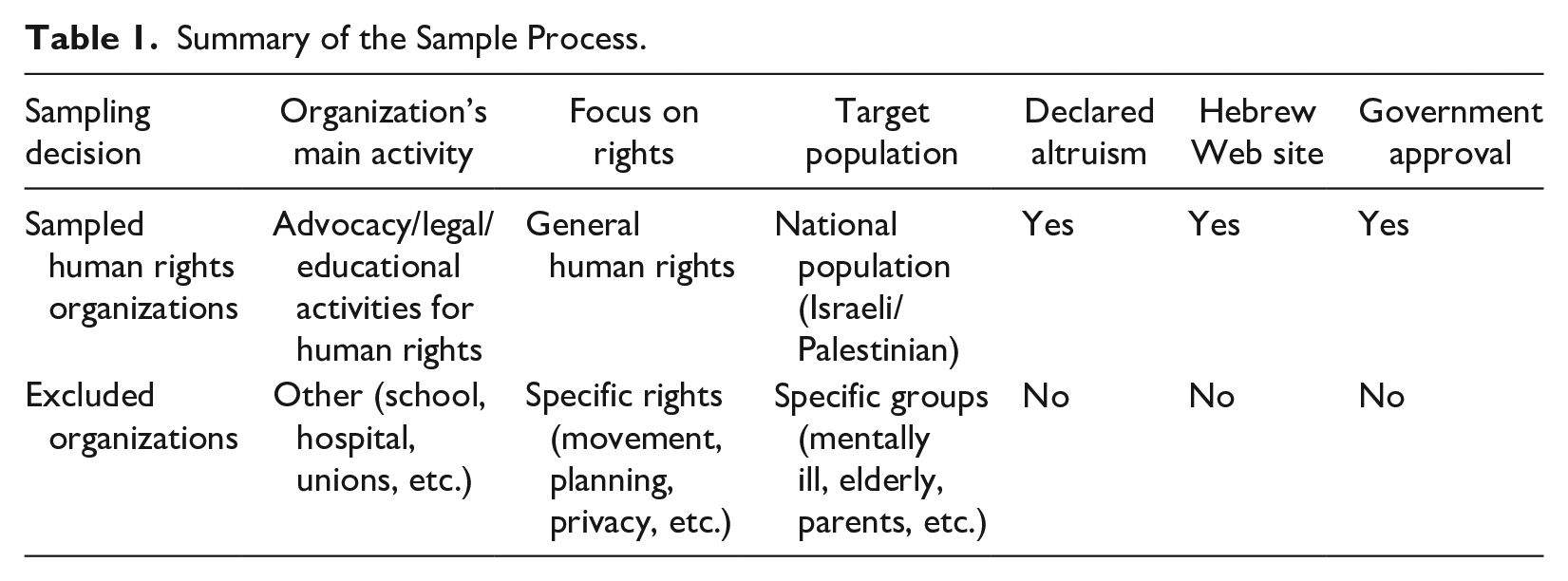
If so, the selective process included an extraction of all NGOs mentioning the phrases human and rights in their name or purposes, from the Israeli Ministry of Justice’s NGOs Web site (also known as guidestar). After reducing all the nonactive organizations and the organizations that do not refer directly to the combined phrase human rights (or close expressions), 58 organizations were found. Out of these, only 10 organizations were coded as altruistic and were found to be extensively using human rights language, setting their main objective as promoting human rights, focusing on general human rights and general collective populations, and maintaining an active Hebrew online Web site, in which the mission statements were available. 3 In addition, six more organizations were found to be using human rights language, which did not appear in the initial database search; out of them, four were coded as matching the selection criteria.
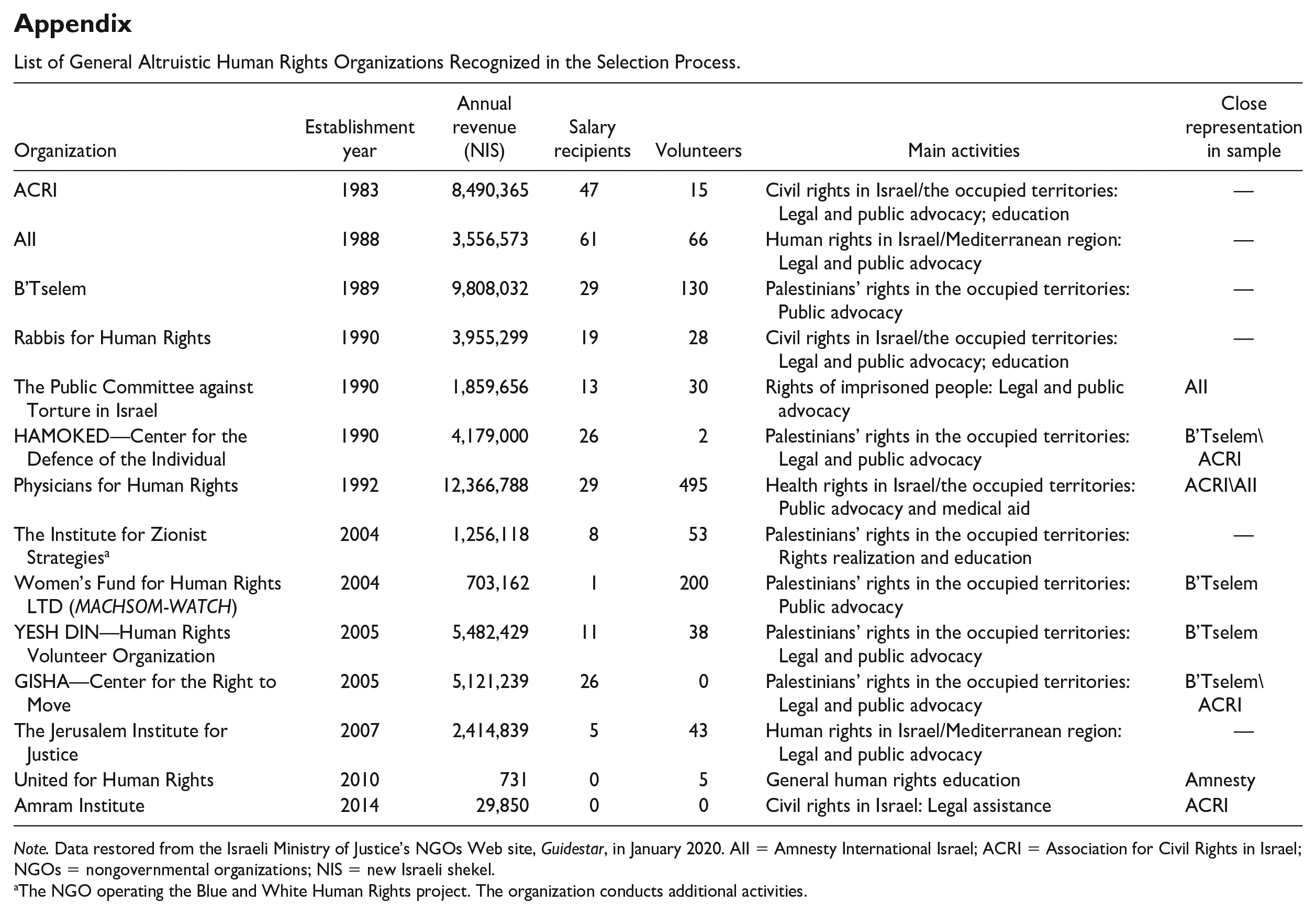
After narrowing down, a total of 14 altruistic human rights organizations, active in the local sphere and focusing on general populations including the occupied territories, were found (see appendix). A preliminary analysis was performed on these organizations, to find distinct patterns of human rights models, in terms of glocal identity. This analysis resulted in the selection of six sampled organizations that most clearly represented these models and the main variations in the discourse, to be further thoroughly examined. A summary of the selection process is outlined in Table 1.
Summary of the Sample Process.
The organizations’ mission statements, collected from the organizations’ official Web sites between the years 2014 and 2015 in their Hebrew version, 4 clearly do not represent all of the organizational aspects of the social actors. Rather, they reflect a unique performative representation, which correlates with this study’s goals. In the study of modern organizations, mission statements are often referred to as proper means of identifying actors’ self-descriptions (Mizrahi-Shtelman and Drori 2020), or as standard means of engagement with the public, representing the organization’s goals and identity as it wants to be seen (Kosmützky 2012). On the backdrop of organizational glocalization, mission statements also share a general dual characteristic of establishing sameness and difference at the same time for the construction of identity (Kosmützky 2012), thus making a suitable object for comparison.
The documents were analyzed via qualitative content analysis approach, used in cases wherein former knowledge is fragmented (Elo and Kyngäs 2008), as in the case of human rights activities, as I suggested previously. This approach refers language as a social tool, and calls for attention to the coding of both the visible and the underlying meanings of text (Cho and Lee 2014), 5 making it especially useful in analyzing semantically dense documents such as mission statements (see Creamer and Ghoston 2013).
The coding process included detection of common features used by the organizations to represent membership in the human rights community (sameness) and of the unique features of each organization establishing its organizational actorhood (difference). This enabled the creation of general themes that the mission statements share, but diversely regard to.
Accordingly, the findings were divided into six categories, based on the coded themes, determined by their generality and frequency in the documents and by their relevance to the glocal story. These categories represent the discursive focal points around which the intranational discourse takes place: sources of justification; political dependency; reference fields; ethics, values, and goals; the nation-state; and the global space. There are, naturally, some overlaps between the categories, yet they represent different aspects of the glocal story in which the local human rights discourse is organized.
To place the discursive variations within a broader organizational context, supplementary data of the size, scope of activity, and funding of the organizations were collected.
Findings
Analysis of the six organizations’ mission statements revealed both heterogeneity and homogeneity in the glocal discourse, enabling the creation of analytical categories. In general, the organizations’ textual performances can be characterized as including universal ethics that transcend ethnic and national boundaries, and caring for the well-being of the national other. 6 A reference to the nation-state was found in each of the documents, while various roles were attributed to it. All of the mission statements had some correspondence with the global discourse of human rights, and all maintained an ethos of apoliticism. On the contrary, a great deal of diversity was found between the organizations in the way they related to their work and their organizational identities. The heterogeneity is manifested in the casting of different content into these common foci. The expression of each characteristic varied among organizations and included references from a wide range of universal and particular notions. The six organizations also differ in size and capital, with a substantial gap between the old and the relatively new ones (see Table 2), perhaps reflecting differences in their rhetoric as well.
Organizational Data.
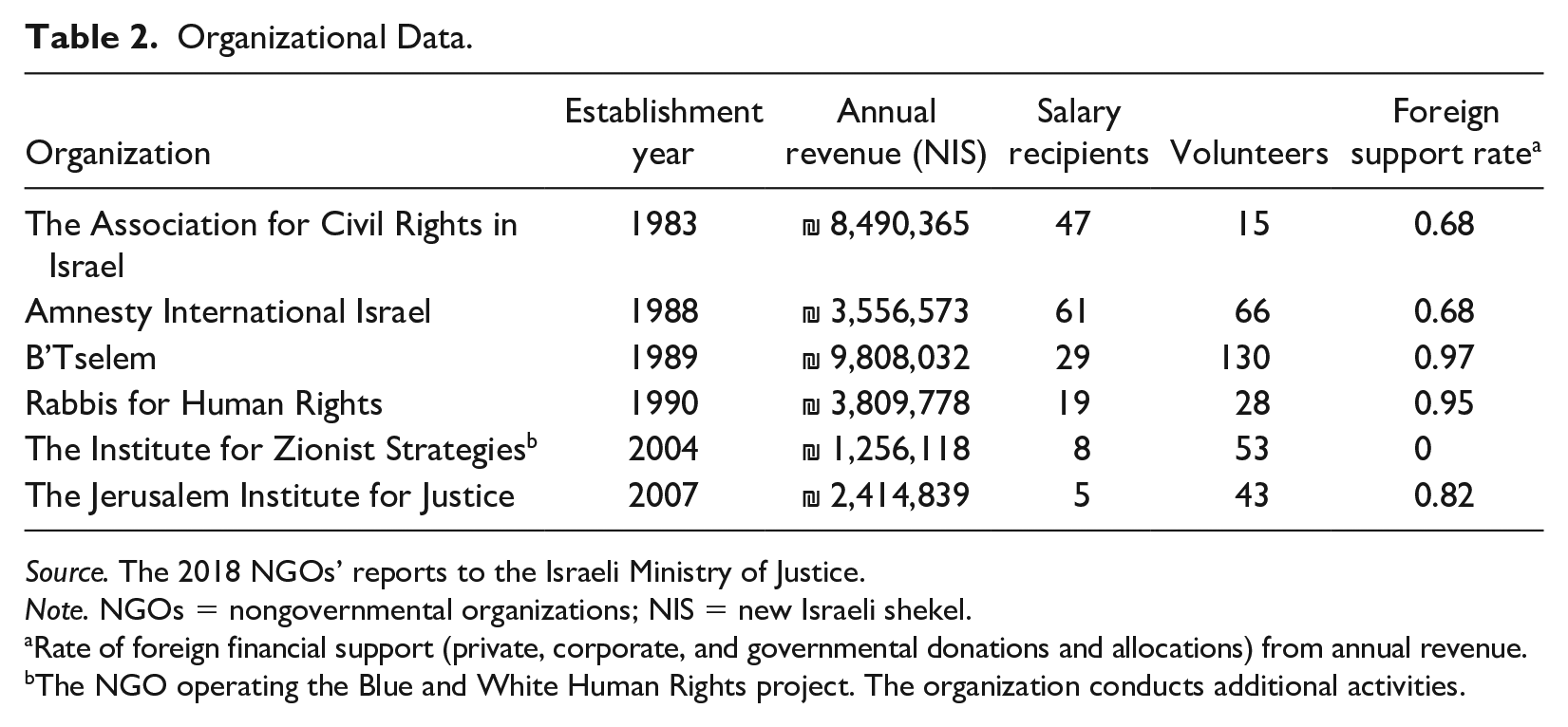
Source. The 2018 NGOs’ reports to the Israeli Ministry of Justice.
Note. NGOs = nongovernmental organizations; NIS = new Israeli shekel.
Rate of foreign financial support (private, corporate, and governmental donations and allocations) from annual revenue.
The NGO operating the Blue and White Human Rights project. The organization conducts additional activities.
Sources of Justification
Each organization mentioned some sources of justification to engage in the field of human rights, which were used to locate the organization in the professional field and in the political space. Although meant for similar purposes, the use of human rights language relied on various legitimacy sources varying from specific to ambiguous, from global to local, and from universal to particular. It seems that organizations that have avoided mentioning a specific source of legitimacy are those who seek to flex the principles of the global discourse, without having to commit to alternative principles of justice.
Although former studies have tended to define a human rights organization mainly by its affirmation of the international human rights law, global treaties, and the UN Declaration of Human Rights (e.g., Berkovitch and Gordon 2008), only some of the organizations in the current sample make use of those as sources of justification in their mission statements. While AII and B’Tselem do refer concretely and solely to these international institutions as legitimacy sources, RHR states that it relies on both “international treaties for Human Rights,” and “the Jewish Humanistic culture” (RHR, N.d., para. 8). RHR is the only organization studied that clearly identifies itself as a Jewish rabbinical organization, stressing the liberal application of the Jewish religion.
Other organizations refer to much more abstract sources of justification and do not rely on any formal legal documentation. ACRI justifies its operation by stating that “Human rights are the basis for a democratic regime and the key to the realization of freedom, dignity and equality that we all deserve” (ACRI, N.d., para. 1), and that civic initiatives are necessary in any state. JIJ does not refer to any particular source as a justification, but states its mission as a general effort “to promote the principles of the rule of law and human rights” (JIJ 2015, para. 1). This ambiguity is not arbitrary, as the organization also mentions its ambivalent relations with the international institutions, performing at the United Nations headquarters on one hand, but demonstrating against the United Nation’s Durban Review Conference (for discriminatory treatment of Israel) on the other.
Blue and White refers extensively to sources of justification for the promotion of human rights, but none of these sources come from international institutions or international human rights law. In its mission statement, the organization refers to three quotes from textual sources, all of which are locally oriented and charged with national and religious meanings: a speech of the right-wing Israeli leader, Menachem Begin; the Israeli Declaration of Independence; and a verse from the Book of Genesis. None of these sources explicitly mention the term human rights, but it can be understood that the organization intends to present an alternative justification source for human rights, one with unique authenticity that is differentiated from the hegemonic global discourse of human rights. In the same way, Blue and White later demonstrates an alternative model for human rights that does not conflict with values of national affiliation.
Political Dependency
Although all the organizations refer to sources of ideological and political legitimacy, apoliticality and independence were common features in all of the mission statements. 7 This is indeed a common practice of many human rights organizations worldwide, and a basic characteristic for any civil society (Hadenius and Uggla 1996), but even this practice is variously realized among the organizations, reflecting various commitments. Differences were evident in the identity of the entity from which the organizations sought to maintain their independence but also in the level of detail of that entity in what can be seen as a unique identification practice for each organization.
Whereas AII declares its independence from “any government, political ideology, economic and religious interests” (AII, N.d., FAQ section, emphasis added), ACRI minimizes its independence by avoiding getting “funding from party or government sources in Israel” (ACRI, N.d., para. 2, emphasis added). B’Tselem mentions its reliance on donations but at the same time emphasizes that its funding comes solely from “foundations in Europe and North America that support human rights activities around the world” (B’Tselem, N.d., para. 3) and from “donations from private individuals in Israel and around the world” (para. 3). In doing so, the organization presents a dependency that is global (Western) and local at once but also limited to certain kinds of political actors.
RHR simply states that it is “not a political party organization” (RHR, N.d., para. 2), representing local independence, and Blue and White allegedly “represents a liberal national perception devoid of political contexts” (Blue and White Human Rights, N.d., para. 3) and a “belief in the moral need [of human rights] regardless of political views” (para. 6). The exception is the JIJ organization, which not only does not declare political independence but also states that it “initiates projects in cooperation with governmental organizations” (JIJ 2015, “Our Goals” section). A declaration of that sort, represents a distinct model of apparatus and commitment for a human rights organization and may imply the foreign objectives to which the organization’s criticism is directed.
Reference Fields
The various organizations also relate themselves to various organizational fields (DiMaggio and Powell 1983) in Israel and around the world for identification. These identifications, however, cannot easily be reduced to local or global ones, as at both levels, organizations relate differently (positive or negative), to a different end (membership or distinctiveness) to actors of varying community orientation (universal or particular). ACRI states that it is notable for being “the largest, oldest and leading human rights organization in Israel” (ACRI, N.d., para. 3), positioning itself as the front actor in the Israeli field of human rights organizations, which was designed from the outset in relation to similar fields in the world. RHR similarly relates itself to the local organizational field but notes that it is “the only organization in Israel that brings the voice of the Jewish tradition in the field of human rights” (RHR, N.d., para. 1) to distinguish itself both in the glocal field of human rights and among Jewish-oriented organizations. By identifying itself as a religious organization that amalgamates various streams in Judaism, and by emphasizing its recognition from rabbinic organizations in various Anglo-Saxon countries, RHR represents the way in which the performances of the human rights discourse can, in turn, globalize particularistic institutional fields such as religion.
Blue and White refers extensively to other organizations but solely as contrasted entities to it. It claims that they are violating particularistic values such as “rejecting the legitimacy of Israel as a Jewish state” (Blue and White Human Rights, N.d., para. 6). The organization seeks to create an “alternative to bodies that defame Israel’s name in the world” (Blue and White Human Rights, N.d., para. 7). Blue and White refers to other local organizations by explicitly stressing their wrong performances in global fields, while suggesting a right way of performing human rights that is more nationally invested. A similar practice for distinguishing itself from other organizations was taken by JIJ, which refers to a local regional space in which “the vast majority of human rights organizations . . . point to the Israeli occupation of the disputed territories as being the most fundamental factor in the violation of human rights in our region” (JIJ 2015, “Our Work” section). In contrast to those organizations, JIJ believes that “exactly the opposite is true” (“Our Work” section). With that statement, it politically positions itself in the most debatable issue in the local field of human rights.
Unlike other organizations, B’Tselem and AII do not relate directly to the local Israeli field of human rights organizations, but only refer to themselves as localities, similar to other localities around the world. This is represented by B’Tselem’s notion of its reliance on international foundations that support “similar organizations worldwide” and AII’s emphasis on its affinity with its international parent organization. In that regard, AII states that Amnesty International has many branches around the world creating “a global community of human rights defenders” (AII, N.d., para. 2). Most organizations (4/6), therefore, seek to differentiate themselves in the local field in terms of seniority or the scope of activity, and religious or national orientation, while each distinction factor implies different attitudes toward the local community. The lack of explicit reference by AII and B’Tselem to other Israeli organizations represents their declared affiliation to nonlocal fields, while their localism serves as the sole distinguishing factor within the global community.
Ethics, Values, and Goals
By directing and framing their activities, goal populations, and concern with human rights, the organizations express their type of ethics and key values. Despite the diversity in the kinds of practices employed by the organizations—including legal activities, educational projects, and political advocacy directed both locally and globally—all organizations describe their aim in terms of engagement with Israeli society and influence on the local human rights conditions. However, differences were found at the level of the organizations’ interests and kind of ethics, reflecting diverse understandings of the human rights project.
AII declares that its goals are “to protect human rights wherever they are violated” (AII, N.d., “FAQ” section). The rights protected by the organization are therefore universal and “are applicable to every man and woman without any distinction” (AII, N.d., “FAQ” section). This statement reflects a truly universal concept of rights “without borders” (AII, N.d., para. 1). Respectively, the organization describes local political issues in the context of global human rights issues and points out their interrelation.
Unlike AII, other organizations are more locally rooted, representing various kinds of particularism. ACRI defines its activities by referring to the sovereign Israeli as responsible, stating that it acts for “individuals and groups in Israeli society . . . wherever the violation of rights is committed by or on behalf of Israeli authorities” (ACRI, N.d., para. 2). Therefore, the organization focuses its activity on a specific population, which is harmed by a specific factor but without other particularistic distinctions. In that context, it is interesting to note the organization’s repeated reference to the collective as part of it, with expressions such as “all of us” and “our rights, which protect us” (ACRI, N.d., paras. 1, 3). It appears that ACRI wishes to express solidarity with the Israeli public based on a particularistic, collective, and civil approach (e.g., Gordon 2008), which combines universal ethics.
RHR also represents a universal human rights position but leaves a gap for particular interpretation when it directs its activities to “promote the rights of the weaker segments of society, to protect the rights of minorities in Israel, and of Palestinians in the Occupied Territories, to prevent gross violations of basic human rights of migrant workers, and so on” (RHR, N.d., para. 6). Finally, the organization notes that its goal is “to warn of any wrong done to any person, based on the belief that man was created in the image of God” (RHR, N.d., para. 7), thereby clarifying that his worldview is universal but one that stems from a particular religious belief.
A different combination of particularistic and universalistic themes in a defined human rights activity is that of B’Tselem, which defines its purpose as such: “to fight human rights violations in the Occupied Territories” (B’Tselem, N.d., para. 1). The organization’s source of justification stems from the “provisions of international law” (B’Tselem, N.d., para. 2), which represent a universal ethical position, whereas the delimitation of activity into a specific territory, as well as a concrete political issue, implies a particular position. The organization claims that it “does not distinguish between Palestinian victims and Israeli victims” but notes that the Palestinians suffer from systematic violations of their rights, and therefore the focus of the activity is directed at them (B’Tselem, N.d., “Questions and Answers” section). The organization also notes that it “does not distinguish between violations committed by the Israeli authorities and those carried out by the Palestinian Authority,” but as an Israeli organization, it focuses on violations committed by the Israeli sovereign (B’Tselem, N.d., “Questions and Answers” section). In other words, B’Tselem seeks to reflect a universal conception of rights as its core values, while also identifying itself as an Israeli organization focusing on a specific population in a specific area and on a local political issue, representing a particular interest and goal.
In another way, JIJ also declares a universalistic point of action but charges it with particular judgment. Like others, the organization aims “to protect the rights of all human beings” in a territorial limit framed as “Israel and in the neighboring territories” (JIJ 2015, para. 1). In the process of victimization of specific groups (e.g., Jacoby 2015), it directs its focus on weak populations and asks to “be the voice of those who have no voice: the victims of the regimes of oppression in the Middle East” (JIJ 2015, para. 1). In the political context of the Middle East, and in the context of the organization’s affiliation with the state of Israel, the main target of the mentioned criticism is clearly the Arab regimes around Israel. Once again, this represents a particular political orientation of the organization’s universalistic ethics.
Similar to that is Blue and White’s commitment to the nation-state and to the Jewish nation. Unlike other organizations, Blue and White explicitly states that alongside the preservation of democratic rights and values, the organization’s goals are to strengthen the Jewish nation-state. Accordingly, its definition of human rights values is vaguer and less formal than others, presented as a matter of “protecting human dignity and liberty” (Blue and White Human Rights, N.d., para. 3). The Jewish sources of the organization’s worldview and its strong devotion to the state are expressed in a dual ethical commitment: universal notion of “rights granted to a person from the moment of birth” (Blue and White Human Rights, N.d., para. 1) on one hand but also an imposing of particular responsibility on Jewish individuals to act to others with hessed. 8 This notion corresponds with the excessive use of the term moral in the organization’s statement, representing a flexible and a more open concept of justice. In addition, human rights are presented in the context of nationhood, as the organization states, “The aspiration to realize the human rights of the Jews is closely intertwined with the demand for the granting of human rights to the population under state control” (Blue and White Human Rights, N.d., para. 2). In other words, Blue and White makes complex combinations of universal rights language with ethno-national discourse, posing an alternative ethic for a human rights discourse.
The Nation-state
In general, all organizations refer to the nation-state in accordance with the global tradition of human rights, as the sovereign entity is responsible for the protection of human rights in its territory. However, the nature of the relationship with the state (i.e., the manner in which it is described as a political entity and the level of commitment toward it) varies significantly between the organizations.
AII mentions the international conventions, according to which the responsibility for protecting human rights rests with local governments and thus refers to the sovereign, again, as a local representation of a global phenomenon. Although the organization declares that the responsibility for protecting human rights is also incumbent upon NGOs, the NGOs’ goal is “to ensure that the state [Israel] complies with its international human rights obligations” (AII, N.d., “FAQ” section). B’Tselem, ACRI, and RHR also claim that Israeli authorities and policy makers are responsible for human rights violations or institutionalized discrimination, and are the targets for their activity. The reference to the state from these organizations is more locally embedded and is directed at local political issues in which the state is involved as a powerful body worthy of criticism. In these three organizations, the activity is limited mainly toward the State of Israel and its violations of human rights, reflecting their local orientation.
In contrast to these organizations, Blue and White and JIJ express a different attitude toward the sovereign Israeli, including a commitment to state bodies and initiated action to protect its worldwide reputation. Blue and White indicates that the organization “seeks to contribute to the prosperity of Israel as the nation-state of the Jewish people” (Blue and White Human Rights, N.d., para. 2). The responsibility for protecting human rights, according to the organization, “lies not only with the government, but mainly with every individual in Israel” (para. 1). In other words, the organization tries to create an alternative normative space in which a moral conception of human rights is the responsibility of the individual and not of the institutions. As noted by the organization, the violations are described as being carried out by IDF (Israel Defense Force) soldiers and not by the authorities themselves, “with the understanding that exceptional events are a natural part that requires treatment by the competent authorities” (Blue and White Human Rights, N.d., para. 8). Thereby, Blue and White seeks to privatize the treatment of human rights violations while protecting the state’s image. The organization does pose certain but very limited responsibility for the authorities, stating that its goals are to “improve the work of the authorities through the use of constructive criticism” (Blue and White Human Rights, N.d., para. 3).
JIJ also expresses a similar attitude toward the state, especially regarding its concern with its public image in the Western world. On one hand, the organization works on behalf of disadvantaged populations that do not receive adequate treatment from the state 9 and, on the other hand, conducts international public campaigns for the Jewish state, primarily to represent an alternative picture of human rights in the region. Its most distinct statement on that matter is that “it is important that Israel is here because it is a democratic state and maintains the value of man” (JIJ 2015, “Our Work” section). In this case, it appears that the integration of human rights activities with the advocacy for the state’s reputation poses an alternative to the popular image of human rights organizations as trying to undermine the nation-state.
As it seems, the sovereign state plays a significant role in each of the local human rights performances, the references to it are located on a wide spectrum, including criticism of the sovereign in a standard universal manner (e.g., AII, N.d.); a concrete reference to the Israeli authority with its unique local characteristics (e.g., ACRI, B’Tselem, RHR); and a commitment to the sovereign state’s good reputation (e.g., JIJ, Blue and White).
The Global Space
Although the references to the global are embedded within the organizations’ attitude toward local issues, and in various ways intertwined with the previous categories, I refer here to the organizations’ explicit reference to the global human rights community, international bodies, and Israel as part of the global space.
The organization most identified with the global movement, AII, refers at length to the global movement of Amnesty International, which it belongs to. The organization also mentions the changes in the international human rights discourse and states that, in accordance with these changes, “the organization has expanded its scope of activities” (AII, N.d., “History” section). In other words, the organization sees itself as closely related to the changing global discourse. At the same time, B’Tselem claims that it has acquired “a place of honor in the international community of human rights organizations” (B’Tselem, N.d., para. 4), whereas RHR notes that it cooperates with similar organizations around the world. ACRI, on the contrary, does not explicitly mention an affinity to the international community but argues that “in any country, at any time, civil initiatives are necessary [. . .] for uncompromising protection of human rights” (ACRI, N.d., para. 1). In other words, the organization treats itself as a local initiative, which is part of a global standard.
In accordance with their shared interest with the nation-state’s reputation, Blue and White and JIJ mention the international community only in the context of the image of the State of Israel regarding human rights issues. Blue and White criticizes “the bodies that defame the name of the State of Israel in the world” (Blue and White Human Rights, N.d., para. 6) and argues that unlike other organizations, it will refrain from “anti-Israeli incitement in the foreign media and in universities abroad” (para. 8). Respectively, the terminology it uses to describe the world is from the point of view of an outsider, by naming the international media as foreign and global academic institutions as being abroad. Similarly, JIJ also engages in international advocacy activities and relates to global institutions, such as the United Nations and the European Union, primarily as outsider observers of human rights issues in the local region. In this arena, particularly in the Anglo-Saxon world, JIJ seeks to emphasize the human rights violations of other countries in the region to improve Israel’s image in comparison with them.
As noted, the organizations use various sources of legitimacy, which represent various approaches to the local and global affinity. AII and B’Tselem commemorate international awards they received for their work. The two organizations also note the informal recognition they receive as a result of their reports, whereas AII refers mainly to international recognition: “Journalists, researchers, governments and the United Nations” (AII, N.d., “FAQ” section). RHR notes that the organization enjoys the support of other rabbinical organizations in North America and the United Kingdom, and thus delineates the organization’s affiliation to the Anglo-Saxon world on one hand and to religious particularism on the other. This can be understood as a challenge to the accepted bond between the global and the universal, whereas the local organization is affiliated with particular religious groups located in other arenas around the world that shape its locality. It may be that the organization’s formulation of its recognition of specific countries from the world (North America and the United Kingdom), as opposed to a vague description of the global, is intended to emphasize an alternative, non-Israeli, locality in which these groups are more legitimate. Either way, this formulation also invites a different examination of the bond between the local and the particular.
Conclusion and Discussion
Four of Israel’s most established and veteran human rights organizations, namely, the ACRI, AII, B’Tselem, and RHR, share a similar approach toward human rights practices and toward the Israeli state as a carrier of blame and responsibility. However, among these organizations, officially founded in the 1980s, variations can be seen regarding justifications and the ideal role of the NGO in the local sphere. At the beginning of the new century, a categorically different kind of Jewish-led altruistic organizations emerged in the Israeli human rights arena, which was much less critical to local authorities, and reflected a change in the conventional justifications and commitments up to that time. I suggest that this kind of organizations, which is represented in this study by the JIJ and the Blue and White Human Rights (N.d.) project (operated by an NGO called the Institute for Zionist Strategies), should be seen as another particularity in the complex history of the Israeli institutional human rights arena. 10
Indeed, the common denominator of the observed human rights organizations represents further evidence of the global isomorphic processes described by world society scholars (DiMaggio and Powell 1983; Meyer et al. 1997) that are reflected in shared mission statement characteristics (Kosmützky 2012). However, this research’s findings demonstrate substantial diversity among organizations, based on deep differences in the organizational identities, not only between various states, as glocalization scholars tend to show (Drori et al. 2013), but also within the intranational arena. By that, this study supports the claim that the glocalization thesis, which is central to many human rights studies (see Golan and Orr 2012), often provides a misleading picture of the nation-state, which is monolithic and too rigid (Pelkonen 2005).
Even when studies in the prism of globalization did focus on local heterogeneity and conflicts, especially in the diverse Israeli society, the political rift was often described as a collection of well-organized contradictions across parallel lines—on one side are local, national, ethnic, and collectivist themes, and on the other side are globalism, postnationalism, citizenship, and individualism (e.g., Mizrachi 2016; Ram 1999). The in-depth inquiry of one glocal social field such as human rights aimed to support the sociological tradition of opposing that sort of binary distinction between the local and the global, in which the latter is framed as modernist, secular, and rational (U. Beck 2000; Berger 1999; Eisenstadt 2000; Robertson 1995).
Accordingly, the findings presented here should be viewed in light of the more general relations between modern Jewish movements, the state of Israel, and global human rights discourse that historically challenged accepted binary modes of local-global and universalism-particularism (see Loeffler 2018). As Judaism may represent the very paradigm of a transnational diasporic culture (Juergensmeyer 2003), the organizations’ statements in this study—which represent distinct models of human rights (see Table 3)—reflected a very complex mosaic of moral meanings.
Summary of Findings: Comparative Perspective on Israeli Human Rights Organization’s Mission Statement.
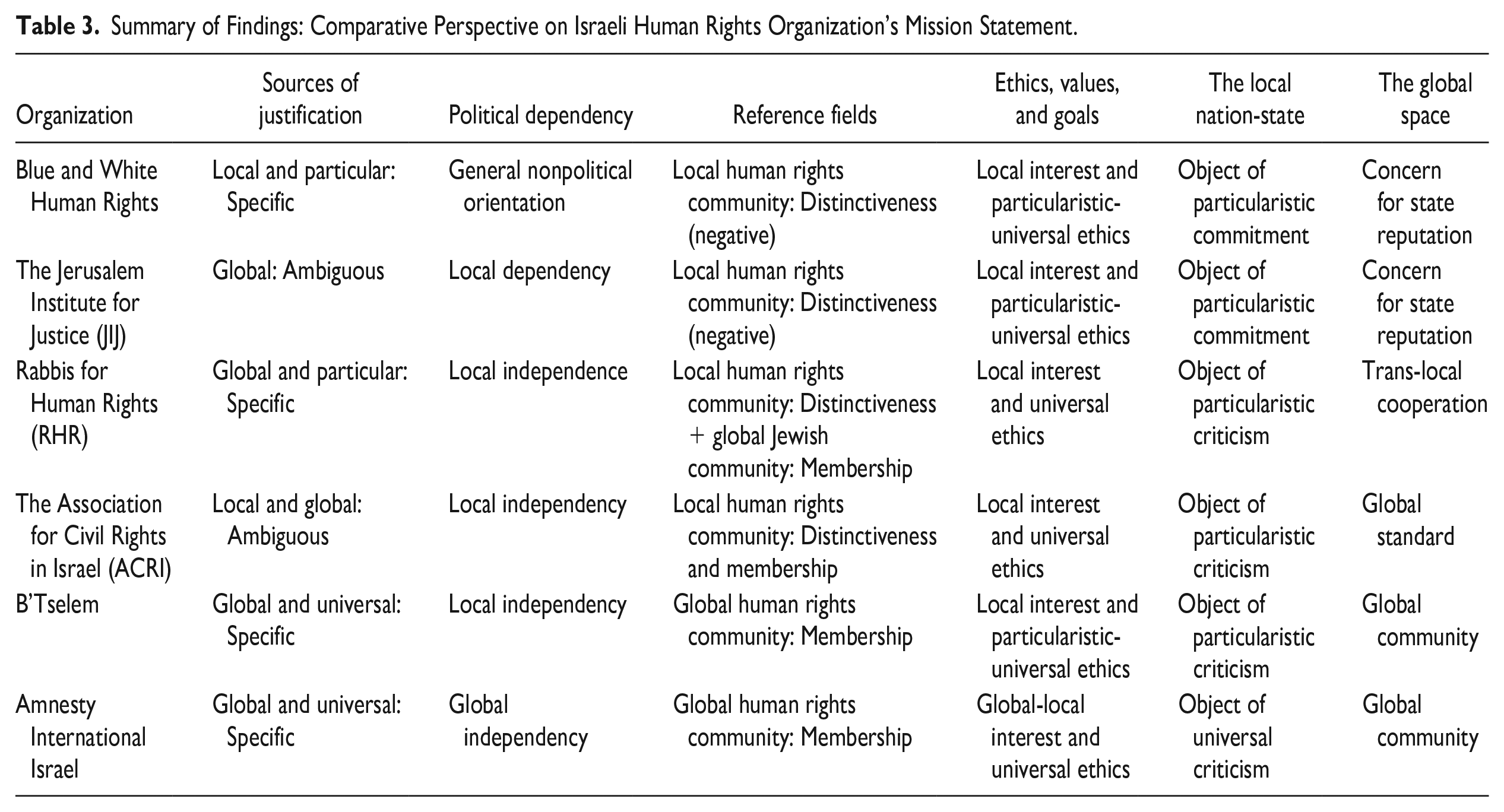
For example, expressions of moral commitments to different communities naturally signify different attitudes toward the two major elements in the glocal discourse, the nation-state and the global sphere. However, each organization represents a kind of subculture, in which a commitment to the Jewish state and religion does not necessarily means particularistic ethics, and a commitment to global institution does not necessarily means a universalistic practice of human rights. In addition, affinities to the global sphere in the mission statement were not in line with what could have been expected from the data on the financial foreign support (see Table 2). For instance, organizations with high-rate foreign support such as RHR (0.95) and JIJ (0.82) did not necessarily express a more universalist rhetoric or global commitments than other organizations such as ACRI and AII (0.68 both). 11 These understandings correlate with the theoretical ongoing effort to distinguish globalism and universalism (see Albrow 1990; Assmann 2010).
Many studies have described variations in the human rights discourse as escaping the original parameters of the human rights idea (Levitt and Merry 2009), distinguishing between genuine human rights and other moral systems (see Beitz 2009), or conceptualized it as a hidden resistance to liberalism in the form of a Trojan horse (e.g., Dudai 2017). In light of the diversity revealed here within the altruistic institutional activity, I am suggesting that an expansion of the human rights scholarly framework should be made. In fact, while former studies focused on cross-national comparison have captured only a small elite section of secular and global organizations in the field of human rights (Bush 2007), the various organizations presented in this intranational analysis do not necessarily adopt western ideological premises nor do they think of the global institutions as the source of authority for human rights (see Taylor 2016). These organizations, it can be said, engage in what Mizrachi calls modular translation, an adjustment of meaning components that involves differentiation between the rights’ norms of conduct and their underlying liberal justifications (Mizrachi 2014).
The six-dimensional analysis suggested here invites further inquiry of human rights, not solely as a unified legal doctrine but as a social concept in which meanings are negotiated and “competing voices contest the ownership of this language” (O’Byrne 2012:831). If human rights are to be seen as an arena of struggles over meaning, the variations that are shown in this paper, reflected in the six categories of comparison, are the content that can be attributed to these struggles. If so, it can be said that the heterogenic discourse in a deeply diverse society such as presented in the case of the Israeli human rights discourse can only be characterized by its points of contestation. The current analysis, therefore, can be offered as a general analysis tool of human rights arenas in different localities. If we partly adopt the Goodstein notion of a critical perspective of diversity (Goodstein 1994), without embracing a concrete concept of justice, this tool can be seen as helpful not only in pointing out the existing variations but also in providing context within which to analyze and interpret these variations.
As long as the human rights discourse would further maintain dominance in global and local politics, it is therefore likely that more and more social actors would present an alternative model for human rights. Due to the ever-changing political atmosphere, it is likely that those actors will gain more social power (see Gordon 2008). These processes may affect the organizations’ apparatus, their legitimacy in local settings, their international relations, and, eventually, the conditions for protecting unprotected humans. Drawing on the anthropological debate on cultural relativism and human rights (see An-Na’im 1992), this paper is merely a call for sociology to engage in the inquiry of the discourse inner debates, with an approach aware of the discipline’s normative biases. Further research on various kinds of human rights activities, that will enable the development of a full organizational typology, is evidently much needed.
Footnotes
Appendix
List of General Altruistic Human Rights Organizations Recognized in the Selection Process.
| Organization | Establishment year | Annual revenue (NIS) | Salary recipients | Volunteers | Main activities | Close representation in sample |
|---|---|---|---|---|---|---|
| ACRI | 1983 | 8,490,365 | 47 | 15 | Civil rights in Israel/the occupied territories: Legal and public advocacy; education | — |
| AII | 1988 | 3,556,573 | 61 | 66 | Human rights in Israel/Mediterranean region: Legal and public advocacy | — |
| B’Tselem | 1989 | 9,808,032 | 29 | 130 | Palestinians’ rights in the occupied territories: Public advocacy | — |
| Rabbis for Human Rights | 1990 | 3,955,299 | 19 | 28 | Civil rights in Israel/the occupied territories: Legal and public advocacy; education | — |
| The Public Committee against Torture in Israel | 1990 | 1,859,656 | 13 | 30 | Rights of imprisoned people: Legal and public advocacy | AII |
| HAMOKED—Center for the Defence of the Individual | 1990 | 4,179,000 | 26 | 2 | Palestinians’ rights in the occupied territories: Legal and public advocacy | B’Tselem\ACRI |
| Physicians for Human Rights | 1992 | 12,366,788 | 29 | 495 | Health rights in Israel/the occupied territories: Public advocacy and medical aid | ACRI\AII |
| The Institute for Zionist Strategies a | 2004 | 1,256,118 | 8 | 53 | Palestinians’ rights in the occupied territories: Rights realization and education | — |
| Women’s Fund for Human Rights LTD (MACHSOM-WATCH) | 2004 | 703,162 | 1 | 200 | Palestinians’ rights in the occupied territories: Public advocacy | B’Tselem |
| YESH DIN—Human Rights Volunteer Organization | 2005 | 5,482,429 | 11 | 38 | Palestinians’ rights in the occupied territories: Legal and public advocacy | B’Tselem |
| GISHA—Center for the Right to Move | 2005 | 5,121,239 | 26 | 0 | Palestinians’ rights in the occupied territories: Legal and public advocacy | B’Tselem\ACRI |
| The Jerusalem Institute for Justice | 2007 | 2,414,839 | 5 | 43 | Human rights in Israel/Mediterranean region: Legal and public advocacy | — |
| United for Human Rights | 2010 | 731 | 0 | 5 | General human rights education | Amnesty |
| Amram Institute | 2014 | 29,850 | 0 | 0 | Civil rights in Israel: Legal assistance | ACRI |
Note. Data restored from the Israeli Ministry of Justice’s NGOs Web site, Guidestar, in January 2020. AII = Amnesty International Israel; ACRI = Association for Civil Rights in Israel; NGOs = nongovernmental organizations; NIS = new Israeli shekel.
The NGO operating the Blue and White Human Rights project. The organization conducts additional activities.
Acknowledgements
The author thanks Gili S. Drori for her helpful remarks and guidance, as well as the participants of The Human Rights and Judaism program at The Israel Democracy Institution. This manuscript was also benefited from the constructive comments of Rafi Grosglik and Yael Berda on early versions of this work, and from the suggestions of Monica Broido and Talia Fisher regarding the later versions.
Declaration of Conflicting Interests
The author(s) declared no potential conflicts of interest with respect to the research, authorship, and/or publication of this article.
Funding
The authors disclosed receipt of the following financial support for the research, authorship, and/or publication of this article: This research was financially supported by the Shaine Center for Research in Social Sciences.
