




Abstract
Conway, Brian. 2014. “Religious Public Discourses and Institutional Structures: A Cross-National Analysis of Catholicism in Chile, Ireland, and Nigeria.” Sociological Perspectives 57(2):149–66. Original doi: 10.1177/0731121414523400.
In the June 2014 issue of Sociological Perspectives, there were some
data discrepancies in the text and Tables 1 and 2. Please find the corrected tables and
data below: Pastoral Letters and Generational Changes in Post–Vatican II Catholic Leadership
Conferences. Signifies total number of pastoral letters in the faith and morals domain in the
time period of the study. Signifies total number of pastoral letters in the social justice domain in the
time period of the study. Percentage of national hierarchy who were members of the hierarchy in 1962 but
not members in 1970, the higher the percentage, the greater the generational
change that took place between 1962 and 1970 (just five years after Vatican II).
This percentage was computed based on historical data about the period of
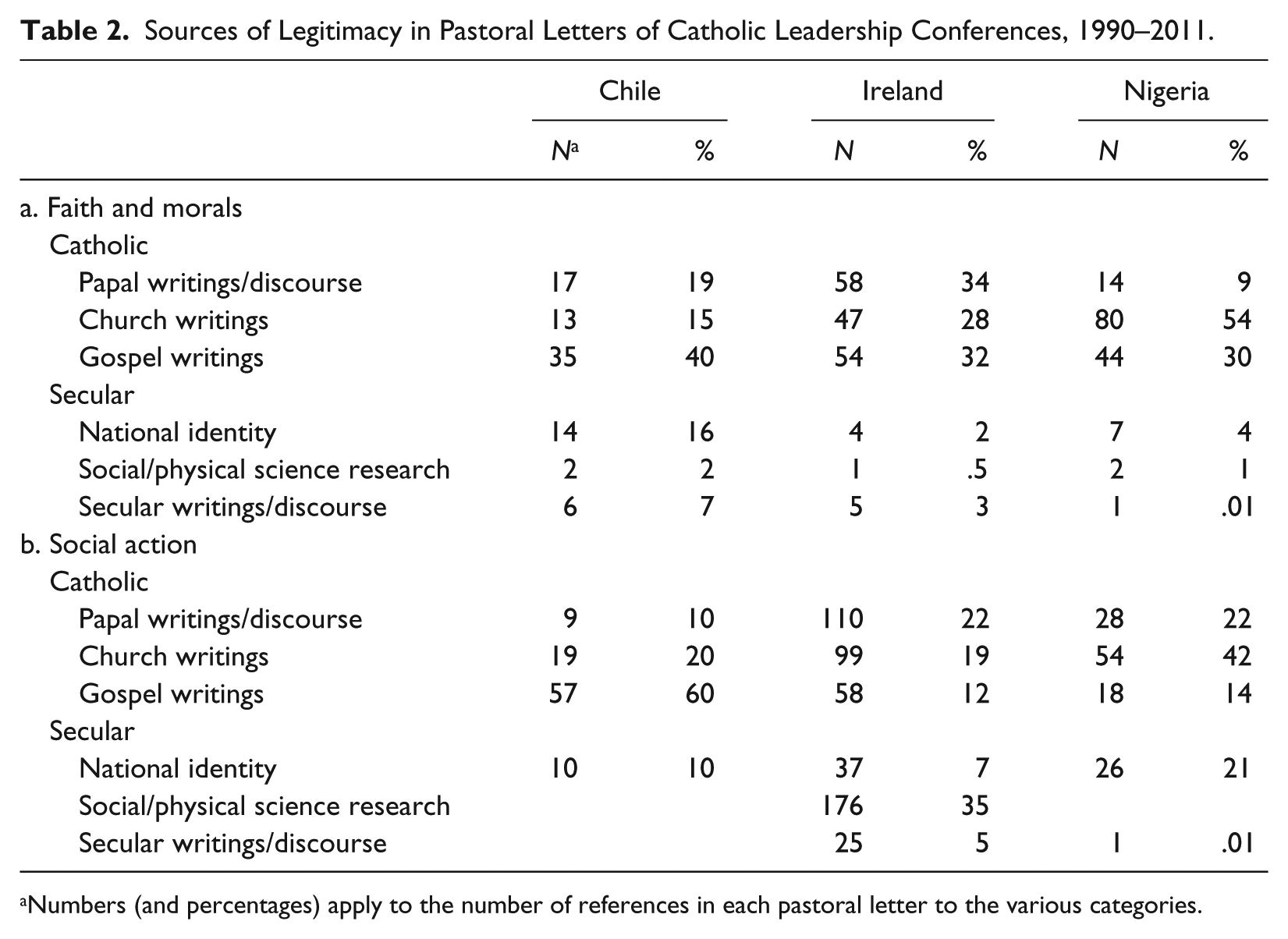
appointment of Catholic prelates. Sources of Legitimacy in Pastoral Letters of Catholic Leadership Conferences,
1990–2011. Numbers (and percentages) apply to the number of references in each pastoral
letter to the various categories.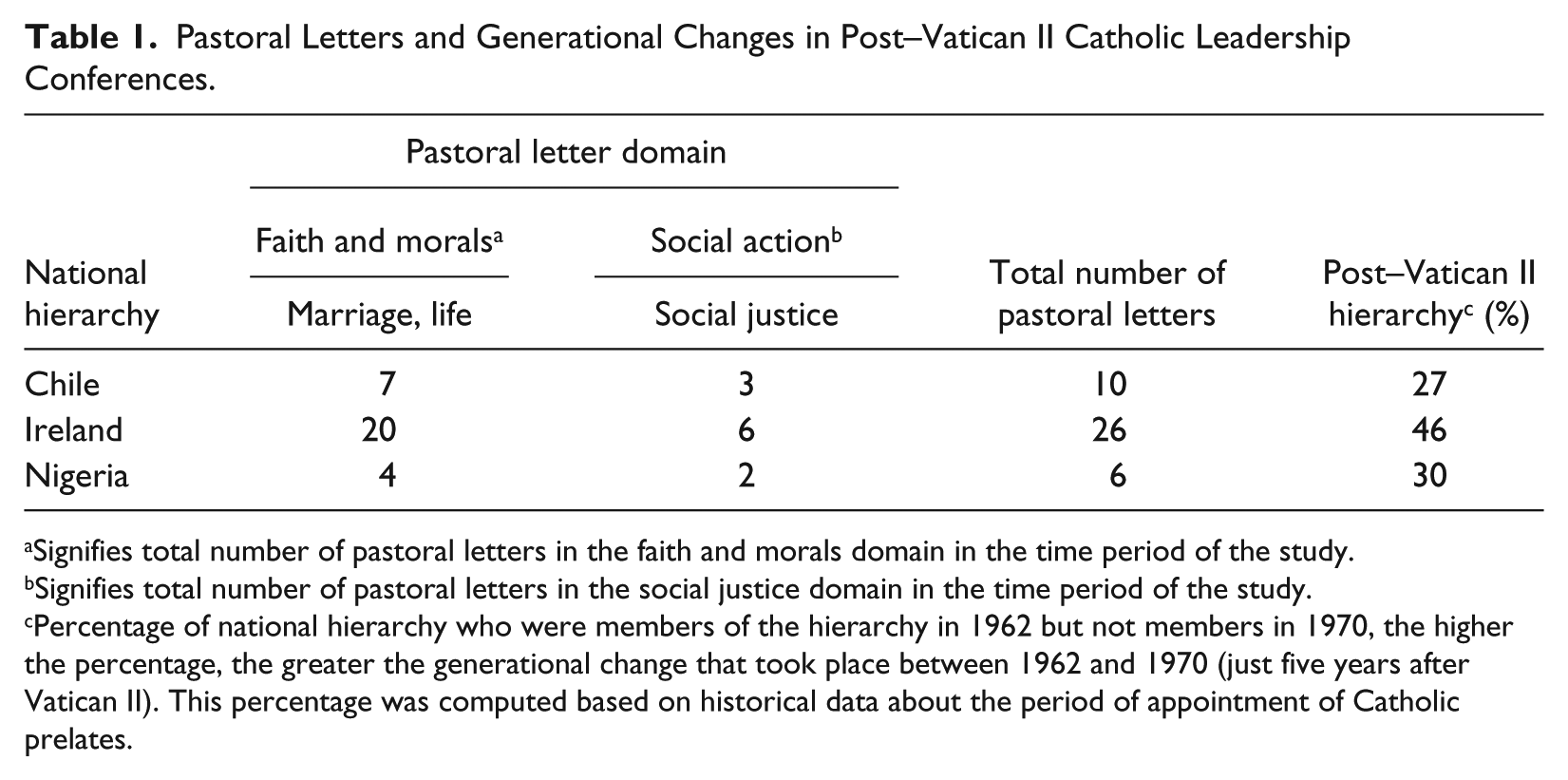
National hierarchy
Pastoral letter domain
Total number of pastoral
letters
Post–Vatican II
hierarchyc (%)
Faith and moralsa
Social actionb
Marriage, life
Social justice
Chile
7
3
10
27
Ireland
20
6
26
46
Nigeria
4
2
6
30
Chile
Ireland
Nigeria
N
a
%
N
%
N
%
a. Faith and morals
Catholic
Papal writings/discourse
17
19
58
34
14
9
Church writings
13
15
47
28
80
54
Gospel writings
35
40
54
32
44
30
Secular
National identity
14
16
4
2
7
4
Social/physical science research
2
2
1
.5
2
1
Secular writings/discourse
6
7
5
3
1
.01
b. Social action
Catholic
Papal writings/discourse
9
10
110
22
28
22
Church writings
19
20
99
19
54
42
Gospel writings
57
60
58
12
18
14
Secular
National identity
10
10
37
7
26
21
Social/physical science research
176
35
Secular writings/discourse
25
5
1
.01
This is despite the fact that—as Table 1 shows—the greatest post–Vatican II generational
personnel shift within the episcopacy took place in the Irish hierarchy, followed by the
Nigerian hierarchy, and then the Chilean hierarchy.
For this content analysis, the full document—ranging in length from 2 to 109 pages, with
an average length of 11, 14, and 25 pages for the Chilean, Irish, and Nigerian pastoral
letters, respectively—was the unit of investigation.
I found that the church in Chile and Nigeria appealed to national identity more than its
counterpart in Ireland (see Table 2)—in Chile, 16 percent of pastoral letters in the faith
and morals category and 10 percent in the social action category made mention of national
identity, compared with 2 and 7 percent, respectively, in the Irish case. In Nigeria, 4
percent of faith and morals and 21 percent of social action pastoral letters invoked
references to national identity.
When the Chilean and Nigerian cases are compared, however, I found that the church in
Nigeria was more likely to mobilize national identity in the social action domain while
the church in Chile was more likely to do so in the faith and morals domain—in Chile, 16
percent of pastoral letters in the faith and morals category and 10 percent in the social
action category invoked national identity compared with 4 and 21 percent, respectively, in
the case of Nigeria.
A total of 47 percent of legitimations by the Irish hierarchy in the social action domain belonged to the secular category compared with 53 percent falling into the Catholic category.
Get full access to this article
View all access options for this article.