



Abstract
Voice--the opportunity to express one's views in the decision-making process--is a central feature of organizational procedures. This study investigates the mental health consequences of the lack of voice at work, or voicelessness, during the first year of the COVID-19 pandemic, a period marked by heightened organizational change and uncertainty. Prior research on procedural justice and mental health has paid limited attention to the specific effect of voice, and few studies have used longitudinal designs that control for unobserved time-stable confounders. Moreover, the mechanisms that link procedural justice to mental health remain underexplored. We address these gaps by assessing the effect of voicelessness on psychological distress and anger using five waves of national longitudinal data of Canadian workers (March 2020 to April 2021) and fixed effects models. We further test whether the sense of mastery and subjective social status (SSS) mediate these relationships. Results show that voicelessness is associated with greater psychological distress and anger, net of time-stable confounders. Mastery functions as a mediator for both outcomes, whereas SSS does not. These findings underscore the importance of organizational efforts to enhance employee voice and identify perceived control as a key mechanism linking voicelessness to mental health.
When people evaluate decisions made by authorities, people care not only about the outcomes, but also the procedures used to reach those outcomes. Procedural justice refers to the fairness in the procedures used to make allocation decisions (Bobocel & Gosse, 2015; Vermunt & Steensma, 2016). In their seminal work on the psychology of procedural justice, Thibaut and Walker (1975) demonstrated that voice––the opportunity to express one's views in the decision-making process––is a central feature of procedures that shape evaluations of procedural justice. Specifically, they found that participants in judicial disputes were more likely to view a process as fair and accept its outcome––even if unfavorable––when procedures gave them the opportunity to present information and evidence of their case. Many studies have replicated the “voice effect”: When decisions are made, people regard procedures that provide opportunities to voice their opinions as more fair compared to procedures that do not grant them such opportunity (Folger, 1977; Folger et al., 1979; Lind et al., 1990; van den Bos et al., 1998; van Prooijen et al., 2002). Because procedures are an omnipresent characteristic of organizations, scholars have examined the effects of voice in the workplace. Research shows that voice shapes attitudes such as job satisfaction and organizational commitment (Colquitt et al., 2001) and even mental health outcomes like depression (Margolis et al., 1974).
In this study, we conceptualize the lack of voice at work––or voicelessness––as a stressor and examine its effects on psychological distress and anger during the first year of the COVID-19 pandemic. During this period of rapid change and uncertainty, the ability to express one's views about work decisions––such as restructuring, layoffs, and remote work––may have been important for mental health. We address three main research gaps. First, much of the literature on procedural justice and mental health use procedural justice scales that combine voice with other procedural features, rendering the question of whether voice has a unique effect on mental health. Second, the use of population-based longitudinal data and methods that account for unobserved time-stable factors remain scarce, and to our knowledge, no national longitudinal study has evaluated the link between voice and mental health during the COVID-19 pandemic. We address these gaps by using five waves of nationally representative longitudinal data of Canadian workers from March 2020 to April 2021 and examine how changes in voicelessness are associated with changes in psychological distress and anger, while using fixed effects models that control for unobserved time-stable confounders. Third, we examine the mechanisms that link voicelessness and mental health. Scholars have recently pointed out a lack of research on the processes that link procedural justice and health (Eib et al., 2018). The identification of mechanisms is important, because such knowledge can aid in the development of interventions that may mitigate or prevent the effects of voicelessness. We address this by integrating perspectives in procedural justice, stress process, and the social determinants of health. Specifically, we draw on the instrumental model of procedural justice and research on perceived control in the stress process to evaluate whether the sense of mastery functions as a mediator in the relationship between voicelessness and mental health. In addition, we draw on the group value model of procedural justice and research on perceived status in the social determinants of health to test whether subjective social status (SSS) also functions as a mediator.
Background
Voicelessness at Work and Mental Health
Work is a central domain of life and a key source of identity and purpose. Authorities at work make decisions about working conditions, compensation, and layoffs that affect workers’ careers and lives. When workers do not have a voice in these decisions, the consequences may not be limited to the immediate outcomes. Specifically, we conceptualize voicelessness as a stressor that has the potential to undermine workers’ psychological well-being. Wheaton and colleagues (2013) define stressors as “conditions of threat, challenge, demands, or structural constraint that, by the very fact of their occurrence or existence, call into question the operating integrity of the organism” (p.300). Voicelessness at work can be conceptualized as a threat, or “the possibility or expectation of potential harm” (Wheaton, 1999, p. 281), because it resembles having little or no influence on authorities who make decisions, thereby increasing uncertainty and the potential for undesirable outcomes (Rousseau et al., 2009; Tepper, 2001). Voicelessness may also resemble a structural constraint, or “a lack of access to opportunity or necessary means to achieve ends” (Wheaton et al., 2013, p. 304), as the inability to express one's views suggests that an avenue for achieving desired outcomes is obstructed. Lastly, as the opportunity to express one's views about work decisions may be constrained to formal organizational channels, voicelessness at work may not be easily altered. This entrenchment suggests that voicelessness at work may be more commonly experienced as chronic as opposed to an acute stressor. Chronic stressors are experienced for a prolonged duration and can powerfully shape mental health outcomes (Pearlin, 1983; Wheaton, 1994).
Empirical evidence is consistent with these ideas and shows that voicelessness at work is associated with poor mental health. In a nationally representative study of American workers, Margolis et al. (1974) observed that voicelessness is associated with greater depression and that this association was among the strongest of the job stressors they examined (e.g., role ambiguity, underutilization, overload, and resource inadequacy). Most studies on procedural justice at work and mental health do not examine voicelessness per se and use procedural justice scales that combine voice with other procedural features, including consistency, bias suppression, accuracy, correctability, and ethicality (Leventhal, 1980). These studies show that procedural (in)justice at work is associated with depressive symptoms and psychological distress (Åhlin et al., 2019; Cloutier et al., 2018; Eib et al., 2018; Elovainio et al., 2002; Kivimaki et al., 2003; Rousseau et al., 2009). The consequences of voicelessness also extend to externalizing outcomes such as anger. As Lind and Tyler (1988, p. 239) hypothesized: “[W]e would expect procedural injustice to be a potent source of anger and dislike with respect to whoever is seen as producing the injustice.” Laboratory studies among students and field studies of workers support this expectation (Barclay et al., 2005; Weiss et al., 1999).
Despite a clear link established in cross-sectional designs, few studies on procedural justice at work and mental health have used longitudinal designs with analytical tools that account for time-stable sources of spuriousness. This is an important consideration because unobserved time-stable factors––such as pre-employment conditions and personality traits––may be associated with both procedural justice and mental health outcomes, creating an upward bias in the estimated effect of procedural justice. To our knowledge, only two longitudinal studies have examined the mental health effects of procedural justice while using techniques that control for unobserved time-stable factors. Drawing on nationally representative panel data of workers in Sweden, for example, Åhlin and colleagues (2019) show that greater procedural justice is associated with lower depression net of time-stable confounders, and that this effect is contemporaneous with no evidence of a lagged effect. Likewise, Oshio and colleagues (2015) document the same association in a panel study of workers in Japan across thirteen firms––but also demonstrate that the fixed-effects estimate that controls for unobserved time-stable factors is diminished by more than 50 percent compared to the pooled OLS estimate that do not control for them. Given how Oshio and colleagues’ (2015) study demonstrates the importance of controlling for unobserved time-stable factors, we follow their approach by using panel data with fixed-effects models. However, our study differs by (1) examining the effect of voicelessness; (2) assessing both psychological distress and anger, and (3) testing whether mastery and SSS function as mediators (as we describe in the following section).
Our study focuses on the effects of voicelessness during the early stages of the COVID-19 pandemic, a period marked by considerable uncertainty about organizational decisions. In Canada, the novel coronavirus started to rapidly infect residents in March 2020. Provincial governments and health authorities urged the public to practice physical distancing, stay home whenever possible, and mandated closures of non-essential businesses (e.g., Government of Ontario, 2020; Public Health Agency of Canada, 2020). The “return to normal” was nowhere in sight: Experts warned of subsequent waves of infection, and it was unknown when a vaccine would be developed, let alone administered to a large segment of the population. Employers had to swiftly adapt and make decisions about closures, layoffs, restructuring, and remote work. Amid this context of change and uncertainty, we hypothesize that it was important for workers to have voice in the decision-making process. While there have been studies on the mental health effects of procedural justice during the pandemic, they have used cross-sectional data of workers in specific occupations. For example, Correia and Almeida (2020) document a link between procedural justice and burnout among nurses and physicians in Portugal, and Ikeda and colleagues (2024) document a link between procedural justice and distress among nursing staff in Japan. Our study advances this work by drawing on national longitudinal data that provide greater generalizability of patterns to the broader working population and controls for unobserved time-stable factors. We test the following hypotheses about the link between voicelessness and mental health before turning to an analysis of potential mediators:
Sense of Mastery as a Mediator
If voicelessness at work undermines mental health, what explains this relationship? Recent scholarship has highlighted a gap in knowledge of the mechanisms that connect procedural justice and health (Eib et al., 2018). We address this gap by examining whether the sense of mastery and subjective social status (SSS) mediate the relationship between voicelessness and mental health.
The sense of mastery refers to “the extent to which one regards one's life chances as being under one's own control in contrast to being fatalistically ruled” (Pearlin & Schooler, 1978, p. 5). Mastery is a core dimension of self-concept and a psychosocial resource that has held a prominent place in mental health frameworks like the Stress Process Model (Pearlin et al., 1981; Pearlin & Bierman, 2013; Turner & Roszell, 1994). Those with high mastery believe that outcomes in their lives are shaped by their own actions, choices, and efforts, rather than external forces such as luck, chance, fate, and powerful others (Pearlin & Schooler, 1978; Ross & Sastry, 1999). The belief in control is empowering and encourages active coping efforts (Ben-Zur, 2002). Consequently, research demonstrates that higher mastery is associated with lower levels of depression, anxiety, and anger (Koltai et al., 2018; Turner et al., 2004; Wheaton, 1980). In their review of the concept, Ross and Mirowsky (2013, p. 379) assert: “[O]f all the beliefs about self and society that might affect distress, belief in control over one's own life may be the most important.”
The belief in control over life outcomes is shaped by objective conditions (Ross & Mirowsky, 2013; Schieman & Narisada, 2014). Exemplary among these are objective conditions of powerlessness, defined as “the separation from important outcomes in one's own life, or an inability to achieve desired ends” (Mirowsky & Ross, 2003, p. 171). Voicelessness is a manifestation of powerlessness. Likewise, the instrumental model of procedural justice stipulates that people value voice because it enhances potential influence over decision makers and therefore potential control over outcomes (Shapiro & Brett, 2005; Thibaut & Walker, 1975). However, to be voiceless means that one does not have a say in the decisions, indicating low control over potential outcomes. Mastery is rooted in the cognitive correspondence between outcomes and the means to achieve them (Ross & Mirowsky, 2013), but voicelessness represents a condition where this correspondence is severed. As a mark of powerlessness, voicelessness should erode one's sense of mastery, which, in turn, should shape mental health. Based on these ideas, we test the following:
Subjective Social Status as a Mediator
Subjective social status refers to one's evaluation of status relative to others in a social hierarchy (Adler et al., 2000; Jackman & Jackman, 1973; Singh-Manoux et al., 2003). The concept is commonly assessed with an item that asks individuals to place themselves on a 10-rung “status ladder,” where those at the top represent the best off (in money, education, and jobs) and those at the bottom represent the worst off (Adler et al., 2000). Similar to the research on the sense of mastery and health, studies document that SSS is associated with better physical and mental health (Adler et al., 2008; Demakakos et al., 2008; Singh-Manoux et al., 2003), although a recent review indicates that more longitudinal analyses that account for unobserved time-stable confounders are needed (Hoebel & Lampert, 2020).
While objective indicators of socioeconomic status predict SSS (Singh-Manoux et al., 2003), studies show that a wider range of position markers are linked with SSS. For example, job qualities such as job control and non-repetitive work are positively associated with SSS (Miyakawa et al., 2012; Nielsen et al., 2015; Singh-Manoux et al., 2003). To our knowledge, the relationship between voice and SSS has not yet been systematically examined. However, the group value model of procedural justice suggests that such a relationship is likely. The model posits that people are attuned to information that communicates their status within groups (such as work organizations), as higher status in a group affirms one's sense of identity, esteem, and respect (Lind & Tyler, 1988; Tyler, 1994). A key source of information about one's status in the group comes from interrelationships with authorities––and this is exemplified with voice. As Shapiro and Brett (2005, p. 162) assert: “The group value model proposes that the opportunity to voice affirms disputants’ status with the decision maker and that such status is important to disputants because it acknowledges that they are valued members of the group whom the decision maker represents (italics added).” Thus, when an employee does not have voice, it implies that they are not a valued member of the organization. According to McLeod (2013), SSS is shaped by social comparison processes (where one stands relative to others) and reflected appraisals (how one perceives others view oneself). Through comparisons with other employees in the organization and reflected appraisals, workers with no voice may feel that they occupy a low status in the organization. As work is a central source of people's identity, this evaluation may ultimately shape one's SSS. Based on these ideas, we propose the following:
Methods
Sample
We use five waves of the Canadian Quality of Work and Economic Life Study (C-QWELS), a national longitudinal study of Canadian workers. The data were collected in cooperation with Angus Reid Forum, a Canadian survey firm that maintains an online national panel of about 65,000 Canadian respondents (www.angusreid.org). The baseline data were collected in March 2020 from 2,528 respondents (43% response rate). The results were weighted by age, gender, education, and region based on distributions of the most recent Canadian Census data to ensure representativeness. We use data from March 2020 and subsequent follow-ups in May 2020 (n = 1,854), August 2020 (n = 1,728), December 2020 (n = 1,565), and April 2021 (n = 1,380). We excluded person-waves that were self-employed and business owners, as the meaning of voice should differ fundamentally among those who manage their businesses themselves compared to regular employees. The final analytical sample consists of 2,119 workers (6,218 person-waves). 1
Focal Measures
Voicelessness
Voicelessness is measured with the following two items: “When decisions are being made, all of the people who will be affected are asked for their ideas” and “Managers make sure that all employees’ concerns are heard before decisions are made.” The response choices were coded: (1) strongly agree, (2) somewhat agree, (3) somewhat disagree, and (4) strongly disagree. The content of these items aligns with the conceptualization of voice as the opportunity to express one's views in the decision-making process (Folger, 1977; Thibaut & Walker, 1975). These items come from the 1997 National Employment Study (NES), a national survey of American workers. These voice items were created to reflect the procedural justice literature's “traditional emphasis on process control or voice (Thibaut & Walker, 1975)” (Clay-Warner et al., 2005, p. 399) and are part of a procedural justice scale that combines voice with other procedural features. This procedural justice scale has been found to shape job satisfaction (Clay-Warner et al., 2005), organizational commitment (Clay-Warner et al., 2005), and depression (Tinney, 2003). We averaged the items to create a voicelessness index, where higher scores indicate more voicelessness (Cronbach's alpha = .81).
Psychological Distress
Psychological distress is measured using five common symptoms of non-specific psychological distress (Kessler et al., 2002). Respondents were asked how often in the past month they had felt “anxious or tense,” “nervous,” “restless or fidgety,” “sad or depressed,” and “hopeless.” The response choices are: (1) none of the time, (2) a little of the time, (3) some of the time, (4) most of the time, and (5) all of the time. We averaged the items to create a psychological distress index, where higher scores indicate greater distress (Cronbach's alpha = .89).
Anger
We use three items to assess anger. Respondents were asked: “In the past month, how often did you..”: “feel annoyed or frustrated,” “feel angry,” and “yell at someone or something.” The response choices are: (1) none of the time, (2) a little of the time, (3) some of the time, (4) most of the time, and (5) all of the time. We averaged the items to create an anger index, where higher scores indicate greater anger (Cronbach's alpha = .79).
Sense of Mastery
Sense of mastery is measured using the following four items from Pearlin and Schooler's (1978) mastery scale: “You have little control over the things that happen to you,” “There is really no way you can solve some of the problems you have,” “You often feel helpless in dealing with problems of life,” and “Sometimes you feel that you are being pushed around in life.” The response choices are: (1) strongly agree, (2) somewhat agree, (3) somewhat disagree, and (4) strongly disagree. We averaged the items to create a mastery index, where higher scores indicate greater mastery (Cronbach's alpha = .85).
Subjective Social status
To assess SSS we use the MacArthur Scale of Subjective Social Status (Adler et al., 2000): “Think of this ladder as representing where people stand in our society. At the top of the ladder (10) are the people who are the best off—those who have the most money, most education, and best jobs. At the bottom of the ladder (1) are the people who are the worst off—who have the least money, least education, and the worst jobs or no jobs. The higher up you are on this ladder, the closer you are to the people at the very top and the lower you are, the closer you are to the people at the very bottom. Where would you place yourself at the present time?” Response choices range from the bottom (1) to the top (10).
Control Measures
We control for the following time-varying variables: Marital status (0 = not married/common-law; 1 = married/common law), work hours (1 = less than 30 h, 2 = 30–39 h, 3 = 40–49 h, 4 = 50 + hours), work status (0 = full-time, 1 = part-time/contract), occupational status (0 = non-professional, 1 = professional), whether the respondent changed jobs (0 = same job, 1 = changed job position with the same employer, 2 = changed employer), whether the respondent was unemployed or not working in the previous wave (0 = working in previous wave, 1 = unemployed or not working in previous wave), job authority, and job autonomy. Job authority is measured with the following item: “Do you supervise or manage other people?” (0 = no, 1 = yes). Job autonomy is measured with the following three items: “I have the freedom to decide what I do on my job, “It is basically my own responsibility to decide how my job gets done,” and “I have a lot of say about what happens on my job.” Response choices range from (1) strongly disagree to (4) strongly agree, and the items were averaged to create a job autonomy index (Cronbach's alpha = .77). 2 All analyses control for survey wave (reference = March 2020). Descriptive statistics are presented in Appendix Table A.
Plan of Analysis
We use fixed-effects regression to test our hypotheses. Fixed-effects regression uses only within-individual variation and adjusts for all time-invariant factors, even if they are unobserved (Allison, 2009). We used the Hausman test to determine whether fixed-effects regression is appropriate. A statistically significant Hausman test demonstrates significant correlation between unmeasured time-stable factors and the predictors in the model and indicates that the fixed-effects regression is preferred over random-effects regression. The test was significant in all models and thus the results from fixed-effects regression are presented.
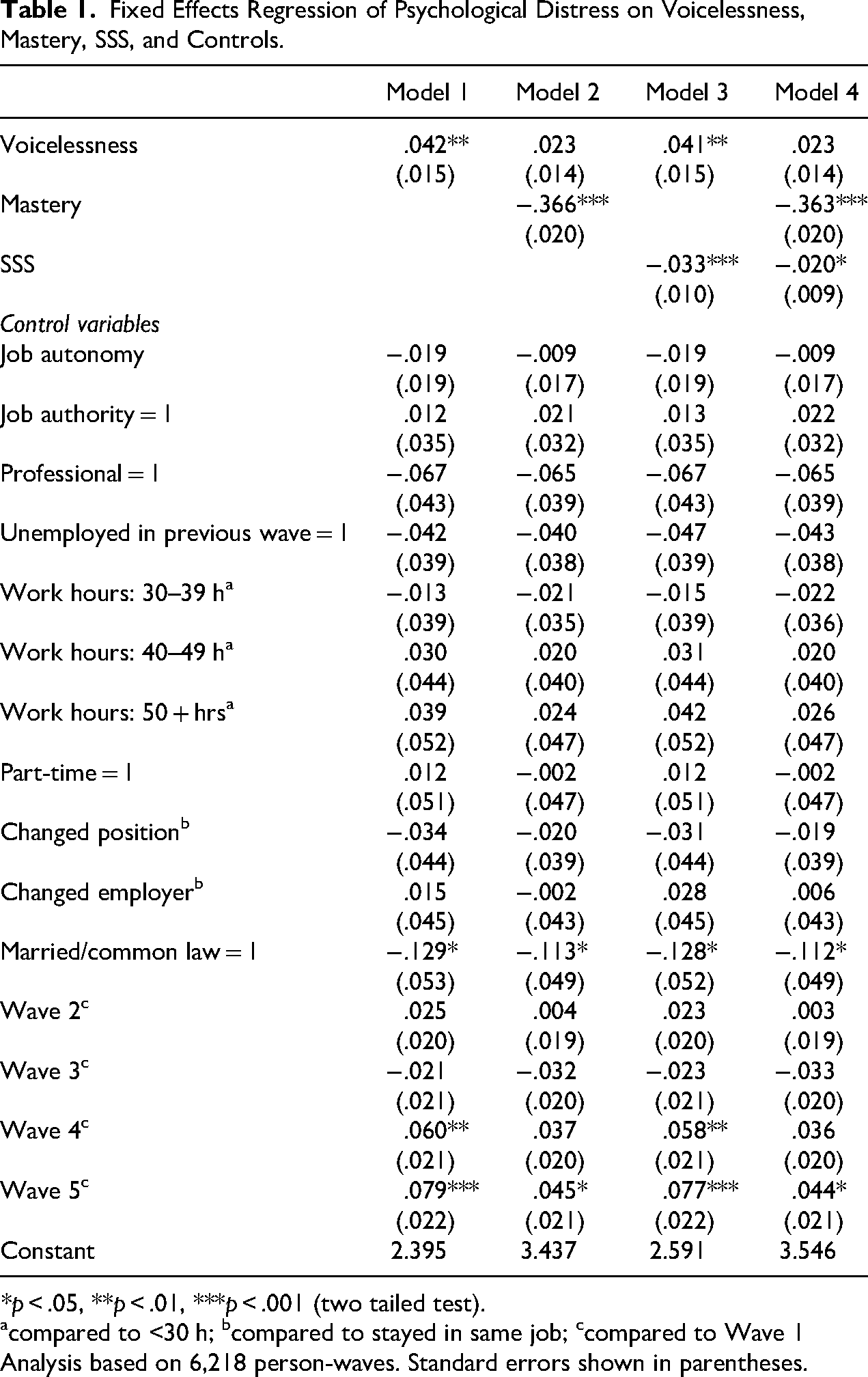
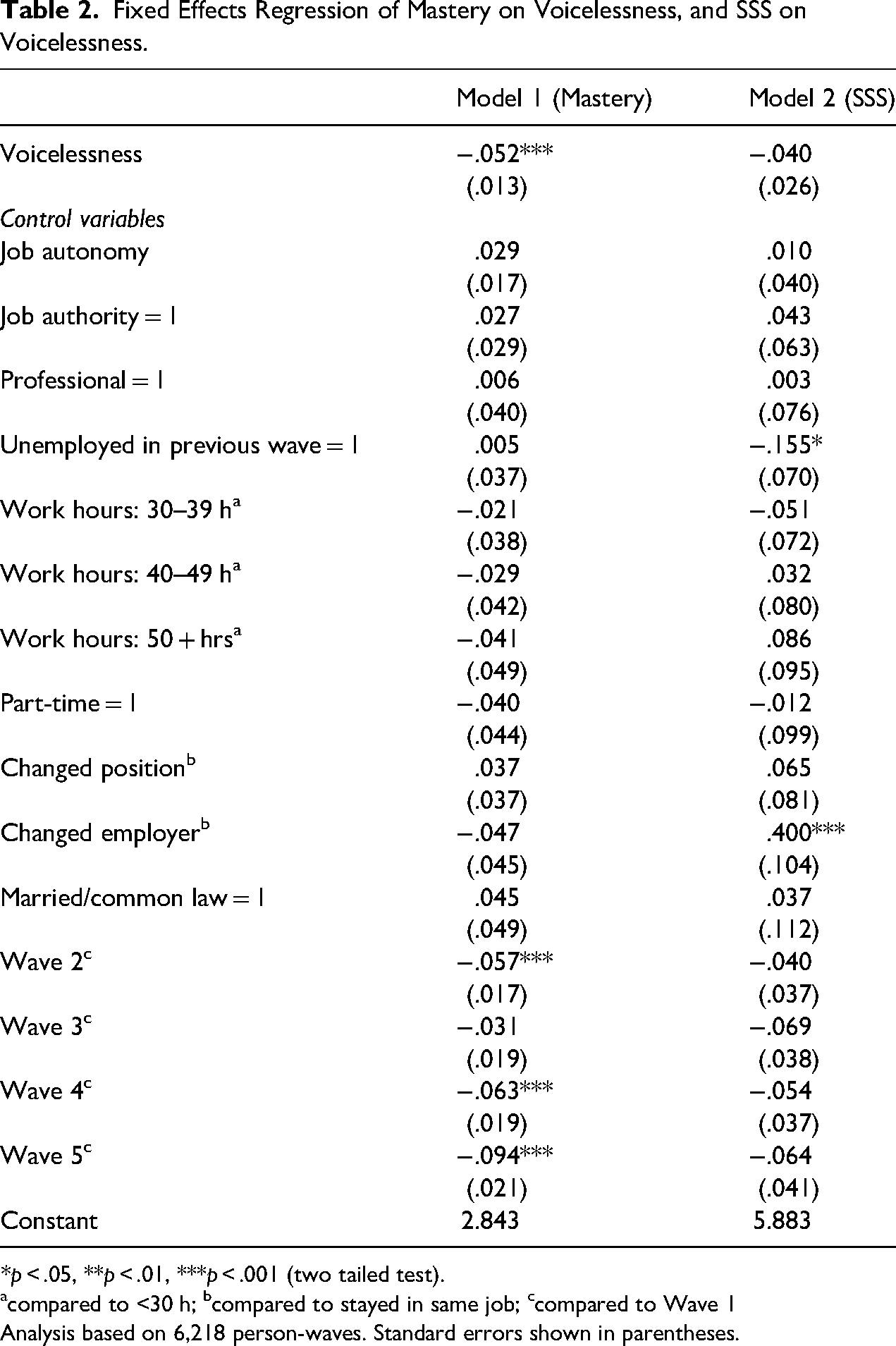
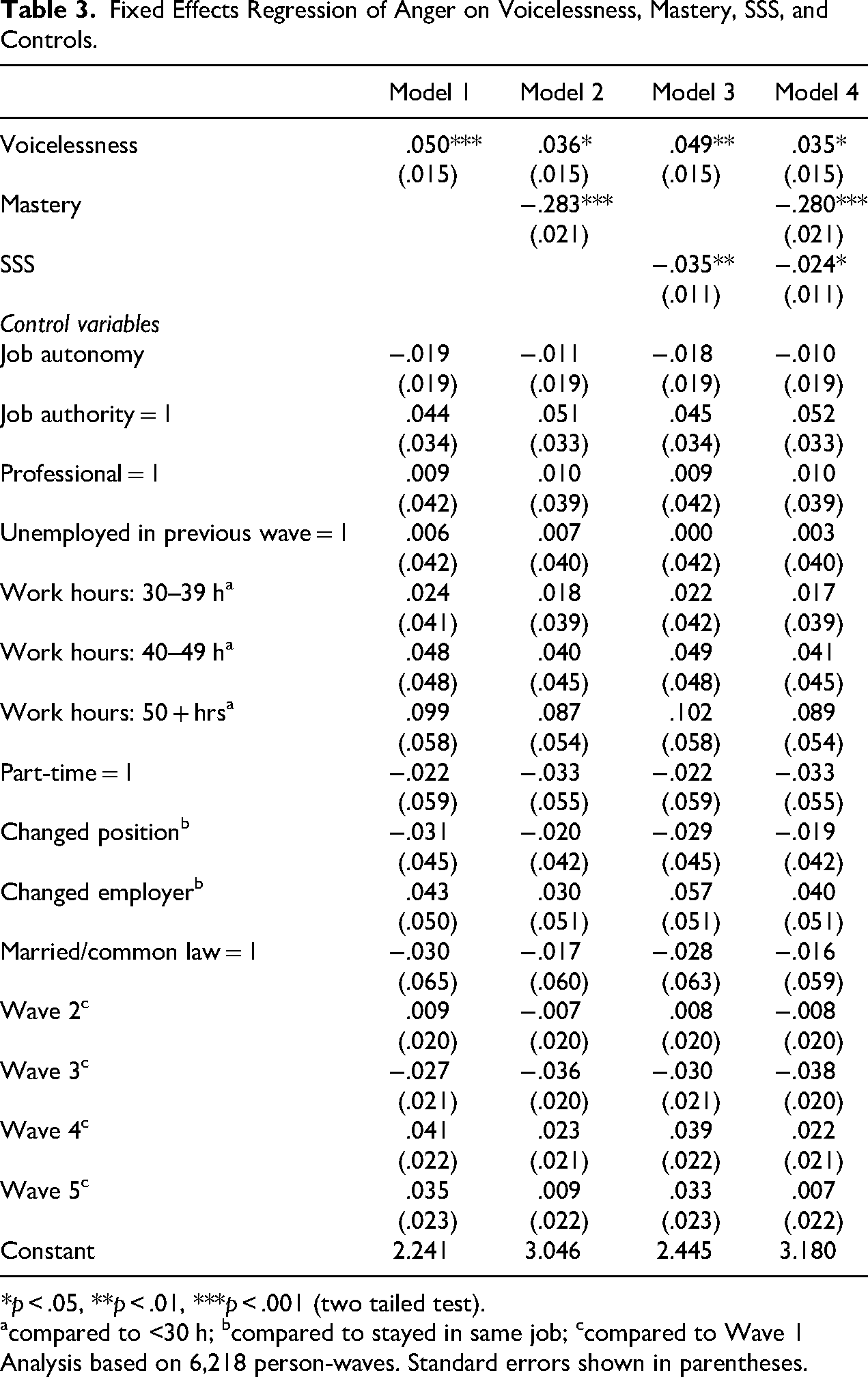
We follow MacKinnon (2008) to test whether mastery and SSS function as mediators. We begin with the analysis of psychological distress in Table 1. In model 1 we assess the focal association between voicelessness and psychological distress, net of controls. Model 2 subsequently adjusts for mastery to assess whether the coefficient for voicelessness is reduced. If the coefficient is reduced, we use the Sobel test to directly test for mediation. This is a test of the indirect effect and is obtained by multiplying (a) the effect of voicelessness on mastery and (b) the effect of mastery on psychological distress, and dividing the product by the joint standard error. Model 3 replaces mastery with SSS. Finally, model 4 includes mastery and SSS simultaneously to assess how they both contribute to the focal association. Table 2 displays regressions of mastery and SSS on voicelessness net of controls; these models identify the effect of voicelessness on the proposed mediators. Finally, Table 3 presents the same analysis for anger as the dependent variable. All analyses were conducted using Stata 18.0.
Fixed Effects Regression of Psychological Distress on Voicelessness, Mastery, SSS, and Controls.
*p < .05, **p < .01, ***p < .001 (two tailed test).
compared to <30 h; bcompared to stayed in same job; ccompared to Wave 1
Analysis based on 6,218 person-waves. Standard errors shown in parentheses.
Fixed Effects Regression of Mastery on Voicelessness, and SSS on Voicelessness.
*p < .05, **p < .01, ***p < .001 (two tailed test).
compared to <30 h; bcompared to stayed in same job; ccompared to Wave 1
Analysis based on 6,218 person-waves. Standard errors shown in parentheses.
Fixed Effects Regression of Anger on Voicelessness, Mastery, SSS, and Controls.
*p < .05, **p < .01, ***p < .001 (two tailed test).
compared to <30 h; bcompared to stayed in same job; ccompared to Wave 1
Analysis based on 6,218 person-waves. Standard errors shown in parentheses.
Results
We begin by examining the relationship between voicelessness and psychological distress in Table 1. In model 1, voicelessness is positively associated with psychological distress (b = .042, SE = .015, p = .004), net of controls. This pattern supports Hypothesis 1A. Model 2 subsequently adds mastery. As expected, mastery is negatively associated with psychological distress (b = −.366, SE = .020, p < .001). Importantly, the addition of mastery reduces the coefficient for voicelessness by 45 percent and is no longer statistically significant. We use the Sobel test to directly test whether mastery functions as a mediator. In Table 2, model 1 indicates that voicelessness is negatively associated with mastery (b = −.052, SE = .013, p < .001). When we multiply (a) the effect of voicelessness on mastery by (b) the effect of mastery on psychological distress, and divide this product by the joint standard error (SE = .005), we obtain a significant Sobel test (Z = 3.951, p < .001). This result supports Hypothesis 2A: Mastery mediates the relationship between voicelessness and psychological distress. The fact that the inclusion of mastery renders the effect of voicelessness statistically insignificant indicates evidence for full mediation.
Next, we examine the mediating role of SSS. In Table 1, model 3 replaces mastery with SSS. As expected, SSS is negatively associated with psychological distress (b = −.033, SE = .010, p < .001). However, the inclusion of SSS reduces the coefficient for voicelessness (b = .041, SE = .015, p = .005) by only 2 percent compared to model 1 that did not include SSS. In Table 2, model 2 shows that voicelessness is not significantly associated with SSS (b = −.040, SE = .026, p = .125). In sum, these results show that voicelessness is not significantly associated with SSS, although SSS is significantly associated with psychological distress. Not surprisingly, the Sobel test is not significant (Z = 1.394, p = .163), indicating that SSS does not function as a mediator in the relationship between voicelessness and distress. Thus, there is no support for Hypothesis 3A. Finally, model 4 adjusts for mastery and SSS simultaneously. As SSS is not a mediator, we observe no difference in the effect of voicelessness on distress between models 2 (adjusted for mastery) and 4 (adjusted for both mastery and SSS).
We present the results for anger in Table 3. Overall, the patterns for anger are similar to those observed for psychological distress. In model 1, voicelessness is positively associated with anger (b = .050, SE = .015, p < .001). This supports Hypothesis 1B. In model 2, we observe that mastery is negatively associated with anger (b = −.283, SE = .021, p < .001). With the inclusion of mastery, the effect of voicelessness on anger is reduced by 28 percent, although it remains statistically significant (b = .036, SE = .015, p = .016). We multiply (a) the effect of voicelessness on mastery by (b) the effect of mastery on anger, and divide the product by the joint standard error (SE = .004), which results in a significant Sobel test (Z = 3.882, p < .001). These patterns provide support for Hypothesis 2B: mastery mediates the relationship between voicelessness and anger.
Finally, we examine the mediating role of SSS. In model 3, SSS is negatively associated with anger (b = −.035, SE = .011, p = .002). However, the inclusion of SSS reduces the coefficient for voicelessness (b = .049, SE = .015, p = .001) by only 2 percent. As mentioned earlier, model 2 in Table 2 show that there is no significant effect of voicelessness on SSS. Together, these results are consistent with the analysis of psychological distress: Voicelessness is not associated with SSS, although SSS is negatively associated with anger. The Sobel test is not significant (Z = 1.376, p = .169), indicating that SSS does not function as a mediator. Hypothesis 3B is therefore not supported. Finally, model 4 adjusts for mastery and SSS simultaneously. Because SSS does not function as a mediator, we observe little difference in the coefficient for voicelessness between models 2 (adjusted for mastery) and 4 (adjusted for both mastery and SSS). 3
Discussion
Workplace authorities make decisions that affect employees working conditions, compensation, and job security. Having the opportunity to voice opinions about how these decisions are made plays a critical role in shaping employee attitudes and well-being. Since Thibaut and Walker (1975), voice has been found to be a key procedural feature that enhances perceptions of procedural fairness and the acceptance of outcomes (Folger, 1977; Folger et al., 1979; Lind et al., 1990; van den Bos et al., 1998; van Prooijen et al., 2002). Beyond these effects, research has documented that voice at work shapes employee attitudes such as job satisfaction and organizational commitment (Colquitt et al., 2001) and mental health outcomes like depression (Margolis et al., 1974). However, much of the literature on procedural justice and mental health has used procedural justice scales that combine voice with other procedural features (Åhlin et al., 2019; Cloutier et al., 2018; Eib et al., 2018; Elovainio et al., 2002; Kivimaki et al., 2003; Rousseau et al., 2009), rendering the question of whether voice has a unique effect on mental health. Furthermore, with the exception of a few studies (Åhlin et al., 2019; Oshio et al., 2015), research that accounts for unobserved time-stable confounders remain scarce. Our first contribution is that we address these gaps by examining the specific relationship between voice and mental health, while using national longitudinal data and analytical techniques that account for unobserved time-stable confounders. Our focus on voice is motivated by the events triggered by the COVID-19 pandemic. Government advisory on physical distancing and mandates of non-essential business closures (e.g., Government of Ontario, 2020; Public Health Agency of Canada, 2020) forced employers to rapidly adapt and make decisions, including those related to restructuring, layoffs, and remote work. In this context, we hypothesized that it was important for workers to have a say in the decision-making process, and that a lack of voice––or voicelessness––may have had consequences for employees’ psychological distress and anger.
Based on analysis of national longitudinal data of Canadian workers from March 2020 to April 2021, the results demonstrate the unique effect of voicelessness on both distress and anger, net of observed time-varying factors and all time-stable factors. The effect sizes of voicelessness were modest, but these should be interpreted with the following factors in mind. First, fixed-effects estimates reflect within-person change over time, net of time-stable characteristics. These estimates are typically smaller in magnitude than between-person associations, but offer stronger causal inference (Allison, 2009). Second, psychological distress and anger are shaped by a wide range of factors. That a single work stressor––voicelessness––shows a significant association with distress and anger, even after accounting for individual fixed effects and time varying controls suggest its importance.
While prior research has documented the effects of voicelessness or procedural justice on employee health, the mechanisms that underlie these relationships are underexplored (Eib et al., 2018). Our second contribution is the integration perspectives in procedural justice, the stress process, and the social determinants of health to assess the sense of mastery and SSS as mediators of the relationship between voicelessness and mental health. The instrumental model of procedural justice stipulates a key link between voice and control: People value voice because it provides them with potential influence over the decision maker and therefore potential control over outcomes (Shapiro & Brett, 2005; Thibaut & Walker, 1975). The stress process literature suggests that voicelessness resembles objective powerlessness, a key determinant of perceived control. Consistent with these ideas, our results indicate that voicelessness erodes employees’ sense of mastery, which in turn, shapes psychological distress and anger. It is noteworthy that mastery fully explains the relationship between voicelessness and psychological distress. Put differently, diminished control over life outcomes is a key explanation of why voicelessness predicts psychological distress.
Our motivation for testing SSS as a mediator stemmed from perspectives in the group value model of procedural justice and the social determinants of health. In contrast to the instrumental model, the group value model posits that people care about voice because it signals that one is a valued member of the group, which enhances one's sense of value and worth (Lind & Tyler, 1988; Shapiro & Brett, 2005). A separate line of research in the social determinants of health has documented that beyond socioeconomic status, a wider range of position markers related to job qualities shape SSS (Miyakawa et al., 2012; Nielsen et al., 2015), which in turn, is a key predictor of health (Singh-Manoux et al., 2003). Based on these ideas and findings, we hypothesized that SSS should mediate the relationship between voicelessness and mental health. Our results did not support this hypothesis. Specifically, voicelessness was not associated with SSS, although SSS was associated negatively with distress and anger. While this was unexpected, one potential reason for the lack of mediation could be in the way that SSS is measured. The item asked respondents to rate themselves on a ladder that represents “where people stand in our society.” Our results indicate that voicelessness is not potent enough to influence perceptions of SSS in general. However, it may be possible that voicelessness is linked with perceived status within one's organization. Future research could consider whether SSS anchored to one's organization rather than the broader society may be more amenable to voicelessness.
Before concluding, study limitations and avenues for future research require discussion. First, fixed-effects regression controls for all time-stable factors, but it does not control for unobserved time-varying factors. Although we have controlled for time-varying factors such as job autonomy, job authority, and occupational changes, there may be other unaccounted factors that may impact the results. Second, fixed-effects regression examines only within-person changes. Although this approach provides stronger causal inference, it does not allow analysis of those who did not change in levels of voicelessness. Thus, one potential question for future research is: What happens to workers who did not experience changes in voicelessness, but experienced a stably high level of voicelessness? Workers who are exposed to a chronically high level of voicelessness may experience significant health consequences. Future research could consider measuring the chronicity of voicelessness and assess its effects on mental as well as physical health.
In the current study, the integration of ideas in procedural justice, stress process, and the social determinants of health led to new hypotheses about the explanatory role of mastery and SSS. Further integration of these perspectives may lead to new hypotheses about how voicelessness shapes mental health. For example, one avenue for future research is the investigation of moderators. We found that voicelessness is positively associated with psychological distress and anger––but these relationships may be contingent on statuses such as education and income. On the one hand, the stress process literature suggests that higher status weakens or “buffers” the effect of voicelessness on health, as higher status individuals generally possess more resources to fend off or manage stressors (Pearlin & Bierman, 2013). On the other hand, the procedural justice literature suggests that higher status may exacerbate the effect of voicelessness. Higher status coupled with the lack of opportunity to express one's views may signal disconfirmation of one's status, generating feelings of disrespect. Prior research using data of MBA students show that the effect of procedural justice on job satisfaction is stronger for those with higher perceived status, due to their greater sense of deservingness for fair procedures (Diekmann et al., 2007). Future research could extend this work by drawing on population-based data and by examining how objective status indicators moderate the effect of voicelessness on mental health.
Future research on voice and mental health could also consider assessing how seriously managers take employees’ voice into account when making decisions. As discussed earlier, voice in the procedural justice literature is conceived as the opportunity to express one's views. Consistent with this conceptualization, the voice items in this study asked participants whether employees are “asked for their ideas” and whether managers make sure that “concerns are heard” when decisions are made. However, it is unclear from these measures how sincere the voice they have been given are. In lab experiments, Folger and colleagues (1979) identified some evidence of a “frustration effect”: When participants were treated inequitably, those who were given voice but were ignored reported slightly lower satisfaction and procedural fairness compared to those who were given no voice in the first place. As Greenberg (2004, p. 186) put it: “[E]mployees who believe that the voice they are offered is insincere (such as would be the case if no one is listening to them) will not be satisfied with the resulting outcomes.” Future population-based studies should consider whether these patterns may be found in the analysis of mental health by examining not only whether workers have a say, but also whether managers take those views seriously.
Finally, it is important to consider the structural and institutional determinants of voice. Although workers strongly support having a say in work-related processes (Kochan et al., 2023), research suggests that voice is unequally distributed across the workforce. A recent study of voice actions, or the extent to which workers provided input to authorities about organizational decisions, shows that non-union members and insecure workers were less likely to exercise voice during the COVID-19 pandemic (Rho et al., 2023). Likewise, the opportunity to express one's views may be stratified along union membership and insecurity, but also along other dimensions such as socioeconomic status, gender, race, and age. As Pearlin (1989, p. 242) observed: “Many stressful experiences…don’t spring out of a vacuum but typically can be traced back to surrounding social structures and people's locations within them.” Paying attention to both the structural determinants and the consequences of voicelessness will enhance our understanding of how social inequalities translate to mental health inequalities.
In conclusion, this study provides the first national longitudinal evidence on the effect of voicelessness on mental health during the COVID-19 pandemic, while controlling for unobserved time-stable confounders. By fusing perspectives in procedural justice, the stress process, and the social determinants of health, our findings show that voicelessness shapes both psychological distress and anger––and highlight the key explanatory role of mastery, but not SSS. The results underscore the importance of ensuring that workers have the opportunity to participate in organizational decision-making, particularly in uncertain times. Future research should examine the conditions that attenuate or exacerbate the effects of voicelessness, and the structural determinants of voicelessness alongside its mental health consequences.
Footnotes
Declaration of Conflicting Interests
The authors declared no potential conflicts of interest with respect to the research, authorship, and/or publication of this article.
Funding
This research is funded by the Social Sciences and Humanities Research Council of Canada (435–2020–1125; PI: Scott Schieman).
