



Abstract
We investigate intersecting wage gaps by gender and nativity by comparing the wages between immigrant women, immigrant men, native women, and native men based on Western German survey data. Adding to the analytical diversity of the field, we do a full comparison of group wages to emphasize the relationality of privilege and disadvantage, and we use a nonparametric matching decomposition that is well suited to address unique group-specific experiences. We find that wage (dis)advantages associated with the dimensions of gender and nativity are nonadditive and result in distinct decomposition patterns for each pairwise comparison. After accounting for substantial group differences in work attachment, individual resources, and occupational segregation, unexplained wage gaps are generally small for comparisons between immigrant women, immigrant men, and native women, but large when either group is compared to native men. This finding suggests that the often presumed “double disadvantage” of immigrant women is rather a “double advantage” of native men.
Wage gaps between women and men and between immigrants and natives have been investigated extensively, but mostly separately in the quantitative literature. On average, results reveal both raw and conditional wage advantages of men compared to women, and of natives compared to immigrants (Algan et al., 2010; Blau & Kahn, 2017). The simple sum of gender and nativity gaps has often been interpreted as a “double disadvantage” for female immigrants who are penalized for being a women and immigrant (Greenman & Xie, 2008). From an intersectional perspective, however, gender and nativity are mutually constitutive (Crenshaw, 1991), so that the wage positions of immigrant women, immigrant men, native women, and native men cannot be inferred from the general wage positions of women, men, immigrants, and natives. A few quantitative studies show that wage (dis)advantages are indeed typically interrelated, so that gender gaps vary by nativity and, vice versa, nativity gaps by gender (Nielsen et al., 2004; Piazzalunga, 2015; Salikutluk et al., 2020). These are important results, but most studies do not harness their full intersectional potential to explore both the irreducible experiences of single groups and the relationality of advantage and disadvantage across groups—either because they focus only on a subset of groups or because they are limited by their methodology.
In this article, we strive to tap this potential by providing a thorough investigation of intersectional wage gaps by gender and nativity using Western German survey data. Germany is an important case because its labor market is strongly and jointly stratified along both dimensions. On one hand, this stratification is the legacy of the nuclear family and male breadwinner model long promoted by West Germany's corporate welfare state (Trappe et al., 2015). On the other hand, Germany experienced high levels of immigration over the past decades, and many immigrants filled low-wage positions with little mobility because of deliberate recruitment and/or limited labor market integration provisions (Germany did not acknowledge to be an “immigration country” before the 2000s; Liebig, 2007). Both processes accompanied the dualization of Germany's labor market, where stable employment with various benefits in the core is flanked by a flexible periphery of atypical and precarious employment in which women and immigrants are overrepresented (Garz, 2013).
In this setting, we add to the analytical diversity with which wage gaps by gender and nativity have been investigated, both in terms of disaggregation as well as in terms of the methodological approach. By pairwise comparing the wages between immigrant women, immigrant men, native women, and native men, we acknowledge the fact that structural underpinnings relate gender and nativity to particular wage positions for each group—and to particular wage gaps for each pair compared. Research suggests that differences in work attachment, individual resources, and occupational segregation represent important mechanisms behind these gaps, but also that the joint effects of mechanisms vary by comparison. Moreover, systematic intersectional differences increase the risk that we observe in each group individuals with characteristics that do not occur in some of the other groups. This situation poses a challenge to the analytic goal of wage comparisons: Estimating the wage gap that remains between groups in the counterfactual situation of them having the same characteristics. In our empirical analysis, we account for this noncomparability and accommodate the joint wage effects of individual characteristics by employing the nonparametric matching decomposition technique proposed by Ñopo (2008). We first match individuals between groups on a set of combined wage determinants (age, marital status, education, labor market experience, part-time employment, and occupation), and then decompose the raw wage gap into (1) gaps due to unmatched characteristics, (2) gaps due to differences in matched characteristics, and (3) remaining, unexplained gaps. Based on our set of matching estimates, we can assess the relational nature of advantage and disadvantage across all groups, and we can explore the heterogeneity in wage gap mechanisms reflected in unmatched characteristics.
Our results advance the current state of research in two important ways. First, we show empirically that the dimensions of gender and nativity intersect in the production of wage (dis)advantages, with decomposition patterns that are specific to each pairwise comparison. Wage gaps are nonadditive, so that raw, explained, and unexplained gender gaps vary by nativity and vice versa, which highlights the importance of separate estimations and full group comparisons. In each decomposition, differences in individual characteristics between groups explain substantial shares of observed wage gaps among the matched, but they also lead to considerable shares of individuals without a comparable counterpart in the respective comparison group. Second, accounting for these differences leaves small unexplained wage gaps for the pairs between immigrant women, immigrant men, and native women, but large unexplained wage gaps remain when these groups are compared to native men. The complete set of pairwise results therefore challenges the assumption of a “double disadvantage” experienced by immigrant women, and rather suggests that native men enjoy a wage “double advantage” in Western Germany.
Theoretical Background
Intersectionality
Intersectionality has become a buzzword far beyond feminist and gender studies (Davis, 2008), but it is far from a unitary theory or framework. We believe it is necessary for our (and any such) work to delineate how it relates to various understandings of intersectionality and intersectional modes of empirical inquiry.
Anthias describes intersectionality as “a heuristic device for understanding boundaries and hierarchies of social life” based on the assumption that “social divisions interrelate in terms of the production of social relations and in terms of people's lives” (Anthias, 2013, p. 4). Socially constructed dimensions of difference—such as gender, race, class, or sexuality (among many others)—are therefore always mutually constituted, and neither separable nor reducible (e.g., Black + lesbian + woman
Following McCall (2005), there are three different methodological approaches to make this relationship explicit, all of which have their specific merits. Anticategorical approaches seek to deconstruct social categories, which are seen as simplistic, difference-(re)-producing fictions of reality. Here, tackling inequality means to question the construction of social boundaries itself. Intracategorical approaches explore the specific identities and experiences of a single group for which various categories intersect. Although social categories usually provide a starting point, such research scrutinizes how existing categorizations (mis-)represent the complexity and diversity of a group's social life. By investigating a group in all its complexity in a specific context, intracategorical approaches help us understand how the multidimensional structure of inequality manifests in lived experiences. In this work, we adopt an intercategorical approach concerned with the relation between intersecting categories. Being focused on multiple groups in a comparative setting, intercategorical approaches naturally lend themselves to the quantitative investigation of social stratification (Spierings, 2012; Misra et al., 2021). However, the analysis of systematic structural inequalities between groups makes (an imperfect and contingent) categorization inevitable. In the following, we distinguish the analytical categories of women and men, immigrants and natives to do a full comparison between the four resulting groups. This does not mean that these categories cause wage inequalities, but that there are structural underpinnings which link gender and nativity as intersecting dimensions of difference to advantaged and disadvantaged wage positions (Fasang & Aisenbrey, 2022).
By considering gender and nativity as two binary dimensions in conjunction, we add to the analytical diversity of the field (Spierings, 2012), but we still risk homogenizing groups and essentializing group differences while obscuring specific privileges and disadvantages which would appear with disaggregation (Anthias, 2013). Of particular concern in this regard is the substantial heterogeneity of the immigrant population in Germany, because labor market opportunities vary between arrival cohorts and origin countries (see Liebig, 2007; Sprengholz et al., 2021, for a detailed discussion). During the labor recruitment phase between the late 1950s and early 1970s, Germany deliberately recruited predominantly male labor for low-wage industry jobs from, for example, Italy, Turkey, and Yugoslavia. After the labor recruitment suspension in 1974 many workers were joined by their family members, who faced particular labor market access restrictions such as waiting periods of different lengths over time. Over the gradual fall of the Iron Curtain around 1990, millions of immigrants from Poland and the former Soviet Union came to Germany, many of which were ethnic Germans who could easily naturalize/regularize and received immediate labor market access. In 1993, asylum regulations were tightened and immigrants from the east started to enter on family reunification grounds, similar to family migrants who continued to immigrate from Turkey. In general, labor migration to Germany entailed little or no restrictions only for members of the European Economic Community (which later became the European Union, EU) and a few other high-income countries. With the gradual eastern enlargement of the EU beginning in the 2000s, a considerable number of workers from Eastern Europe used their freedom of movement to come to Germany, mostly from Poland, Bulgaria and Romania. Finally, over the period of analysis Germany hosts many refugees from, for example, Afghanistan, Iraq, and Syria, who tend to be male and typically face more labor market obstacles than other immigrants (Bevelander, 2011). 1
That being said, accounting for the full heterogeneity of Germany's immigrant population would exceed the complexity that can be feasibly managed in our comparative design. Moreover, sample size limitations prevent us from any reliable disaggregation in the wage decomposition, so that the wage gaps we estimate represent general averages that apply to the full immigrant population. We, therefore, limit the following literature review to the main explanations for wage gaps by gender and nativity in Germany, and discuss if and how the same arguments and mechanisms apply once both dimensions are taken into account. We partly acknowledge the heterogeneity among immigrants by pointing out some theoretical differences between the broad subgroups of EU and non-EU immigrants.
Intersecting Gender and Nativity Wage Gaps
Studies across various geographical settings, including Germany, have shown that, on average, women earn lower wages than men and immigrants earn lower wages than natives, so that typically native men occupy the best and immigrant women the worst position in terms of wages (Algan et al., 2010; Blau & Kahn, 2017; Browne & Misra, 2003; Schieckoff & Sprengholz, 2021). These gaps have been traced back to four main explanations.
The first explanation is differences in work attachment and work experience, which pertains particularly to wage differences between women and men. Due to childbearing and -rearing and the gendered prescription of care work to women, they are more likely to encounter career interruptions and to work part-time to balance paid and unpaid work, both of which can negatively impact wages (Goldin, 2014). Compared to native women, immigrant women (particularly from non-EU countries) may have less opportunities to delegate time away from the household due to higher average fertility and a family formation often delayed until after migration (Milewski, 2007). Women are also more likely to be tied migrants, in which case the male partner's employment tends to take a higher priority (Krieger, 2019). In Germany, non-EU family migrants, who are predominantly female, also faced additional labor market access restrictions until 2004 (Liebig, 2007). Thus, whereas migration disrupts employment trajectories for both women and men, women seem disproportionally affected. When immigrant families come from origins that are more gender-traditional than the reception context, immigrant women's labor market attachment might be further reduced relative to native women and immigrant men—which particularly applies to immigrant women from Turkey, the Middle East, and North Africa in Germany (Fleischmann & Höhne, 2013; Krieger, 2020).
The second main explanation for wage gaps is differences in individual resources. Historically, women's lower educational attainment was an important driver of the gender wage gap in the United States and Europe among natives, but over time women have caught up or even surpassed men in terms of education (Quenzel & Hurrelmann, 2010). Systematic variation in individual resources matters more for nativity wage gaps, because the resources immigrants bring with them in terms of human capital and host-country-specific knowledge are very selective and strongly determined by migration regimes in place (Dustmann & Görlach, 2015; Schieckoff & Sprengholz, 2021). In Germany, the educational attainment of immigrants was much lower compared to natives especially during the labor recruitment phase (1950s−1970s) and the subsequent family reunification period, but for more recent cohorts the share of tertiary degrees is higher among immigrant men and women than among native men and women (Sprengholz et al., 2021). Despite these gains, immigrants’ resources still suffer from the limited transferability of their qualifications and skills across borders: Some skills are no longer required or have to be learned anew (such as language), and particularly non-Western educational credentials might not be recognized, which severely diminishes their value on the highly credentialist German labor market (Basilio et al., 2017; Brücker et al., 2021). Thus, limited or unsuitable resources constrain the wage potential of immigrants, where wage gaps relative to natives are largest directly after arrival and then attenuate over time as more and more resources are acquired (Adsera & Chiswick, 2006; Borjas, 1994). Compared to immigrant men, immigrant women might be disadvantaged in this respect because a lower work attachment limits resource assimilation opportunities.
Occupational segregation is the third main explanation for wage gaps by gender and nativity. Empirical evidence suggests that the processes linking both dimensions to occupational segregation operate largely independently, and that segregation by gender is typically larger than segregation by nativity (Guinea-Martin et al., 2015; Palencia-Esteban & Rio, 2020). That women and men work in different occupations seems to be overwhelmingly caused by gendered socialization and gendered occupational aspirations in conjunction with ideals of self-expression (Levanon & Grusky, 2016). Additionally, gender stereotypes held by employers limit occupational opportunities in gender-atypical occupations (Rice & Barth, 2017). As a result, women tend to enter occupations in the social and care sector (e.g., teachers and nurses). These female-dominated occupations usually offer lower earnings because they are culturally devalued (Busch, 2018; Levanon et al., 2009) and often less well represented by wage-setting institutions (O’Reilly et al., 2015). Men, on the other hand, choose occupations that offer higher wages, such as occupations in the highly unionized manufacturing sector or in science, technological, engineering, or mathematical occupations (Busch, 2013). In terms of vertical occupational segregation, women experience less occupational mobility than men, both because some female-dominated occupations at the low end of the wage distribution provide a sticky floor and because there is a glass-ceiling that keeps male-dominated occupations at the top end of the wage distribution out of women's reach (Arulampalam et al., 2007).
Occupational segregation between immigrants and natives partly follows from the lack of resources that immigrants have at their disposal. Occupations that require a recognized degree or country-specific knowledge, such as being a lawyer or teacher, might not be available to immigrants without extensive retraining, even if they worked in such an occupation before migration (Simon & Steichen, 2014). The same is true for language barriers that close the door to occupations in which communication in the native language is necessary. In terms of social networks, a strong ethnic homophily can create ethnic niche markets with a limited range of available occupations and little mobility (Kalter & Kogan, 2014). Labor market regulations involve occupational closure of rather high-paying occupations (Bol & Weeden, 2015; Stumpf et al., 2020), and national priority regimes in European countries can result in non-EU immigrants being queued for jobs for which there are native or EU immigrant contenders (Liebig, 2007). Thus, the occupational opportunities for a substantial share of migrants are severely constrained. In many cases, the remaining available occupations have low restrictions in terms of qualifications and either require mostly manual labor, such as jobs in construction, cleaning and some personal services, or leverage origin-country-specific skills, or serve an ethnic niche market, such as jobs in the food sector (Schrover et al., 2007). To be sure, immigrants in Germany also work in highly skilled and highly paid occupations, particularly those who come as labor migrants (e.g., from within the EU or as part of the EU's Blue Card scheme from other countries), but the general picture is that immigrants tend to work in occupations that pay comparatively low wages—both because of lower skill requirements and cultural devaluation (Heizmann et al., 2017).
The occupational sorting by both gender and nativity creates the largest wage disadvantages for immigrant women (Palencia-Esteban & Rio, 2020). One important driver is overqualification, because individuals in jobs which do not harness their qualifications generate below-potential wages. The additional occupational constraints that immigrants face in comparison to natives go along with a generally higher risk of overqualification (Kracke & Klug, 2021), but risks are larger for non-EU compared to EU immigrants, and for immigrant women compared to immigrant men throughout Europe (Rubin et al., 2008; Schieckoff & Sprengholz, 2021). One reason for this pattern is that many female-dominated jobs (e.g., teachers, nurses, and social workers) have stricter requirements with regard to country-specific social and communication skills or licenses (Kosyakova et al., 2021).
Finally, after conditioning on work attachment, individual resources, and occupational segregation, wage gaps by gender and/or nativity often remain (Blau & Kahn, 2017; Hofer et al., 2017; Lehmer & Ludsteck, 2011). Further usually unmeasured factors might be responsible for the remaining gaps—such as gendered wage negotiation behavior or differences between immigrants and natives in terms of motivations and long-term career investments (Blau & Kahn, 2017; Sprengholz et al., 2021)—but empirical evidence indicates that discrimination occurs as well. Employers may discriminate against women compared to men, and against immigrants compared to natives, for both taste-based reasons as well as statistical reasons when the (potential) employee's productivity is unknown (Phelps, 1972). Discrimination can affect hiring decisions and promotions (Kübler et al., 2018; Weichselbaumer, 2020; Yap & Konrad, 2009)—and therefore partly works through work experience and occupational attainment—but can also directly affect wages. For example, if women do get promoted, the associated wage gain can be lower than that for men (Booth et al., 2003). Intersectional evidence is still rare, but in terms of hiring discrimination, the general picture points to, if anything, immigrant women being less discriminated against than immigrant men (Andriessen et al., 2012). However, women-specific markers of religion and ethnicity, such as the headscarf, can intensify the discrimination some immigrant women experience (Weichselbaumer, 2020).
Analytical Challenges in Intersectional Wage Gap Analyses
The presented theoretical arguments provide explanations as to why wages are stratified by gender and nativity, and acknowledge the intersectionality of both dimensions. Overall, native men seem to occupy the most favorable position in terms of wages, and immigrant women the least favorable—but the “double disadvantage” that immigrant women seem to experience cannot be reduced to general disadvantages of women and immigrants. Moreover, our brief summary already makes clear that it is not just wage-relevant characteristics (e.g., education and occupation) which vary across (and also within) groups, but also how these characteristics translate into wages. For example, when the same educational attainment has lower wage returns for immigrant women than native women because of discrimination, we know that the observed wage gap cannot be the result of educational differences. This situation calls for wage gap estimations which are explicitly intersectional, and allow to attribute observed wage gaps either to (1) differences between groups in observed individual characteristics or to (2) differences between groups in the wage returns these characteristics generate.
Wage decompositions are a common way of analysis meeting these requirements. Decomposition techniques estimate counterfactual group wages as if the differences in their work attachment, individual resources, and occupational position had been eliminated (e.g., Kitagawa–Blinder–Oaxaca decomposition; Blinder, 1973; Kitagawa, 1955; Oaxaca, 1973). The reduction between raw and conditional wage gaps is the part of the observed wage gap that is “explained” by the differences in wage-predictors between groups. With regard to the gender wage gap, the German statistical office reports for 2018 a raw gap of 20% (among the largest in Europe), of which about two thirds can be explained by an extensive set of predictors (Mischler, 2021). Figures for the nativity wage gap in Germany have been almost exclusively estimated for men and vary between immigrant groups, but by and large the raw gaps range between 10% and 25% with explained shares of 50% and more (Aldashev et al., 2016; Lehmer & Ludsteck, 2011). The scarce international evidence on coinciding gaps suggests that raw as well as explained gender gaps differ by nativity and vice versa (Smith et al., 2000; Nielsen et al., 2004; Piazzalunga, 2015). The remaining part of the raw wage gap is “unexplained” as the wage differences between groups are not accounted for by the considered predictors. That is, even if groups had comparable characteristics, we would observe a wage gap because these characteristics do not generate the same wage returns across groups. Such a case either implies that groups differ in additional unobserved characteristics or that there is (positive or negative) wage discrimination.
However, in practice, group comparability is difficult to establish because intersecting dimensions of advantage and disadvantage can create unique and irreducible group-specific experiences, so that particular combinations of individual characteristics occur in one group but not the other. Such a lack of common support implies a structural noncomparability between groups, which cannot be readily assigned to the dichotomy of explained and unexplained components. Given our theoretical considerations, there is much reason to assume that the sets of wage-determining individual characteristics differ systematically and jointly by gender and nativity.
So, the question arises with whom individuals in one group without comparable observations in the other group should be juxtaposed in terms of wages. This potential problem is commonly neglected, because in the standard, regression-based decompositions comparability is technically established via some level of extrapolation, which might or might not be correct (Strittmatter & Wunsch, 2021). A few international studies illustrate this problem by reporting that a lack of common support between groups accounts for nontrivial shares of both gender wage gaps (Djurdjevic & Radyakin, 2007; Gallardo & Ñopo, 2009) as well as nativity wage gaps (Gallardo & Ñopo, 2009; Nicodemo & Ramos, 2012). Evidence also shows that ignoring common support issues can bias the explained and unexplained parts of the wage gap in either direction (Djurdjevic & Radyakin, 2007; Ñopo, 2008; Strittmatter & Wunsch, 2021). The studies by Nicodemo and Ramos (2012) and Gallardo and Ñopo (2009) further underscore the fact that occupational segregation substantially curtails common support.
We address the theoretical and analytical complexity by employing a wage decomposition technique which uses matching. The main idea behind this approach is that every unique combination of individual wage-relevant characteristics can either be matched across compared groups (comparable individuals observed) or not (no comparable individuals observed). As comparability is ensured among the matched, observed wage gaps can then be decomposed into an explained and unexplained part based on the premise that individuals with the same characteristics should earn the same wages in each group. Conversely, we can also estimate which part of the wage gap stems from unmatched individual characteristics that are exclusive to one of the groups we compare (e.g., top management positions among native men). From our theoretical discussion, we can expect that differences in work attachment matter most for gender wage gaps, that differences in individual resources matter most for nativity wage gaps, and that occupational segregation matters for both. However, it is hard to say how these mechanisms affect wages in combination and the regression based evidence on wage disadvantages by gender and nativity offers little guidance, both because these studies rarely did full group comparisons and because of the methodological differences. It is likely that decomposition results differ once we ensure group comparability and focus on the nonparametric relationships between observed sets of individual characteristics and wages. We, therefore, do not expect a specific structure of disadvantage beforehand and accommodate all possible results using separate pairwise comparisons (Scott & Siltanen, 2017).
Methodology
We use the matching approach proposed by Ñopo (2008) to decompose wage gaps between the four groups of native men, native women, immigrant men, immigrant women.
2
We match each single observation from group A (e.g., immigrant women) to all observations from group B (e.g., native men) who share the same characteristics, where each unique combination of characteristics represents one stratum. This one-to-many exact matching procedure achieves two goals: First, among the matched, the ratio of A to B units in each stratum can be used to create a re-weighted group BA which has the exact same distribution across all strata as group A but retains group B wages. BA allows to estimate the counterfactual wage we would expect when group B had the same characteristics as group A. Second, we learn which observations of groups A and B remain unmatched because they have sets of characteristics not present among both groups. The raw, unadjusted gap D between the average wages W of groups A and B can then be additively decomposed into four parts:





The classic decomposition into explained (DX) and unexplained (D0) components pertains only to the matched sample, whereas DA and DB quantify the effects unmatched individuals have on the wage gap. Compared to a Kitagawa–Blinder–Oaxaca decomposition, the matching procedure has three main advantages. First, exact matching requires no modeling assumptions and estimates the explained (DX) and unexplained (D0) components nonparametrically by directly relating the heterogeneity in observed combinations of characteristics to the observed heterogeneity in wages. Second, because DX and D0 are only estimated on the common support in the matching decomposition, both terms are unaffected by observations who have no counterpart in the comparison group. Third, the matching procedure explicitly highlights common support issues and captures systematic noncomparability as one of the underlying mechanisms of wage gaps in DA and DB, which can then be explored further. These advantages make Ñopo's (2008) matching decomposition technique particularly suitable for intersectional wage gap analyses. However, one major drawback is that exact matching suffers from the curse of dimensionality: The number of characteristics and characteristics’ levels that we can sensibly match on is finite, and unmatched observations can be a mere artifact of insufficient sample size.
Data
Sample
We base our estimations on the German Socio-Economic Panel (SOEP) (2021; see also Goebel et al., 2019), which is a representative longitudinal survey of private households with about 11,000 households and 30,000 persons sampled annually. To obtain a sufficient immigrant sample with the SOEP, we use the years from 2013 to 2019, including the 2013−2017 subsamples M1–M5 that specifically oversampled immigrants and refugees (IAB-SOEP Migration Samples (M1, M2), 2021; IAB-BAMF-SOEP Survey of Refugees (M3–M5), 2021). We define immigrants as persons living in Germany with a foreign country of birth (first-generation immigrants). As natives count native-born persons whose parents were also born in Germany. Second-generation immigrants are, therefore, not part of the sample. We further restrict our sample to individuals in private households, aged 21–60 years, who are employed and not in education, and reside in Western Germany. We could account for the substantial economic differences between Western and Eastern Germany by matching on region, however, as about 90% of immigrants live in the western part, matching would be infeasible given the small eastern sample. After applying all restrictions, we randomly select one observation per individual from the panel between 2013 and 2019. In this way, we include all individuals who have been observed at least once in the analysis period and ensure that the observations we keep are independent. By selecting one observation per individual at random we also minimize potential period effects.
Variables and Matching Specification
We compute the dependent variable of individual hourly gross wages based on inflation-adjusted monthly gross labor earnings in Euro and actual working hours per week. 3 We top- and bottom code both working hours (1–80 hr/week) and wages (1st to 99th percentile) to address implausible values.
We match groups on individual characteristics which reflect the main theoretical mechanisms of work attachment, individual resources, and occupations. We coarsen the respective variables to keep the number of dimensions feasible while retaining sufficient detail. Our matching set includes age (4 categories), marital status (dummy), education (3 categories), labor market experience (3 categories), part-time employment (dummy), and occupation (2-digit ISCO-08; 39 categories) (see Table 1 for specification details). Education and labor market experience represent the most important human capital factors, where education as individual resource is particularly relevant for nativity gaps, and labor market experience as work attachment measure for gender gaps. Marital status and part-time employment capture further differences in work attachment. 4 Matching on age allows us to attend to differences in group life courses, such as the amount of work experience acquired at a given age. By distinguishing 39 occupations, we account for wage effects of occupational segregation. In total, we observe 2,377 strata, each representing a unique combination of considered characteristics in our analysis sample.
Matching Variables and Respective Coarsening by Specification.
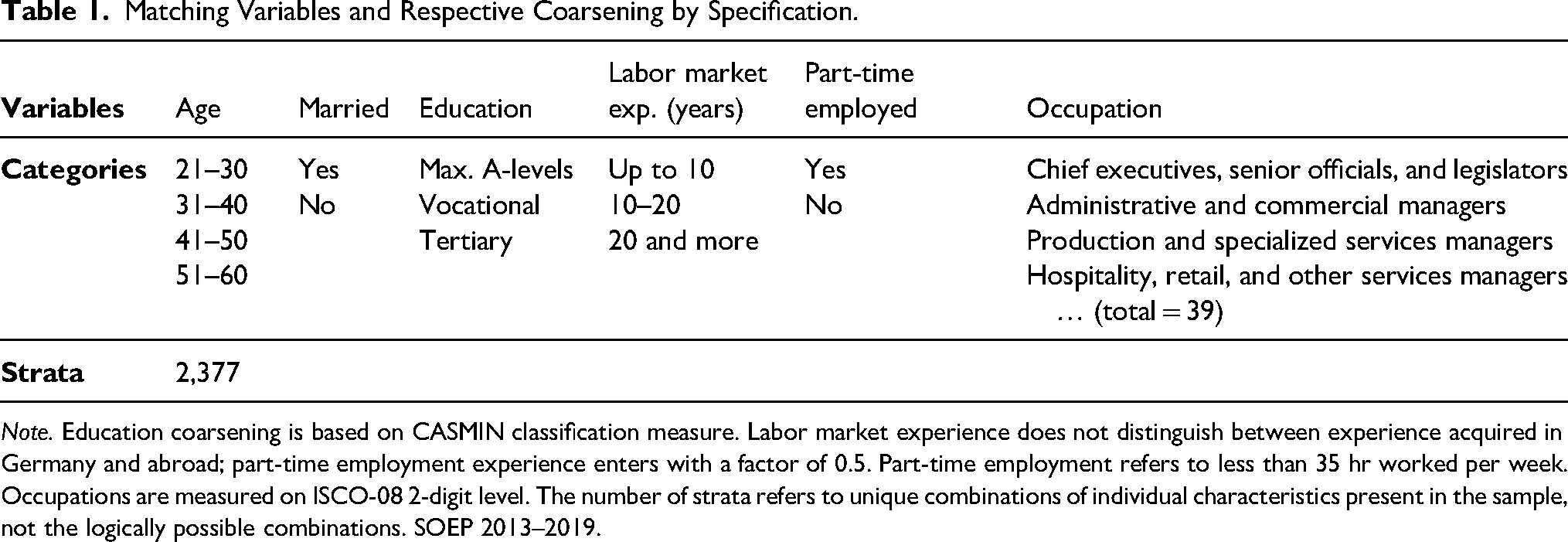
Note. Education coarsening is based on CASMIN classification measure. Labor market experience does not distinguish between experience acquired in Germany and abroad; part-time employment experience enters with a factor of 0.5. Part-time employment refers to less than 35 hr worked per week. Occupations are measured on ISCO-08 2-digit level. The number of strata refers to unique combinations of individual characteristics present in the sample, not the logically possible combinations. SOEP 2013–2019.
Results
Descriptive Statistics
Table 2 provides an overview of the analysis sample of employed individuals across the four subgroups of native men, native women, immigrant men, and immigrant women.
Summary Statistics by Nativity and Gender, Individuals in Employment.
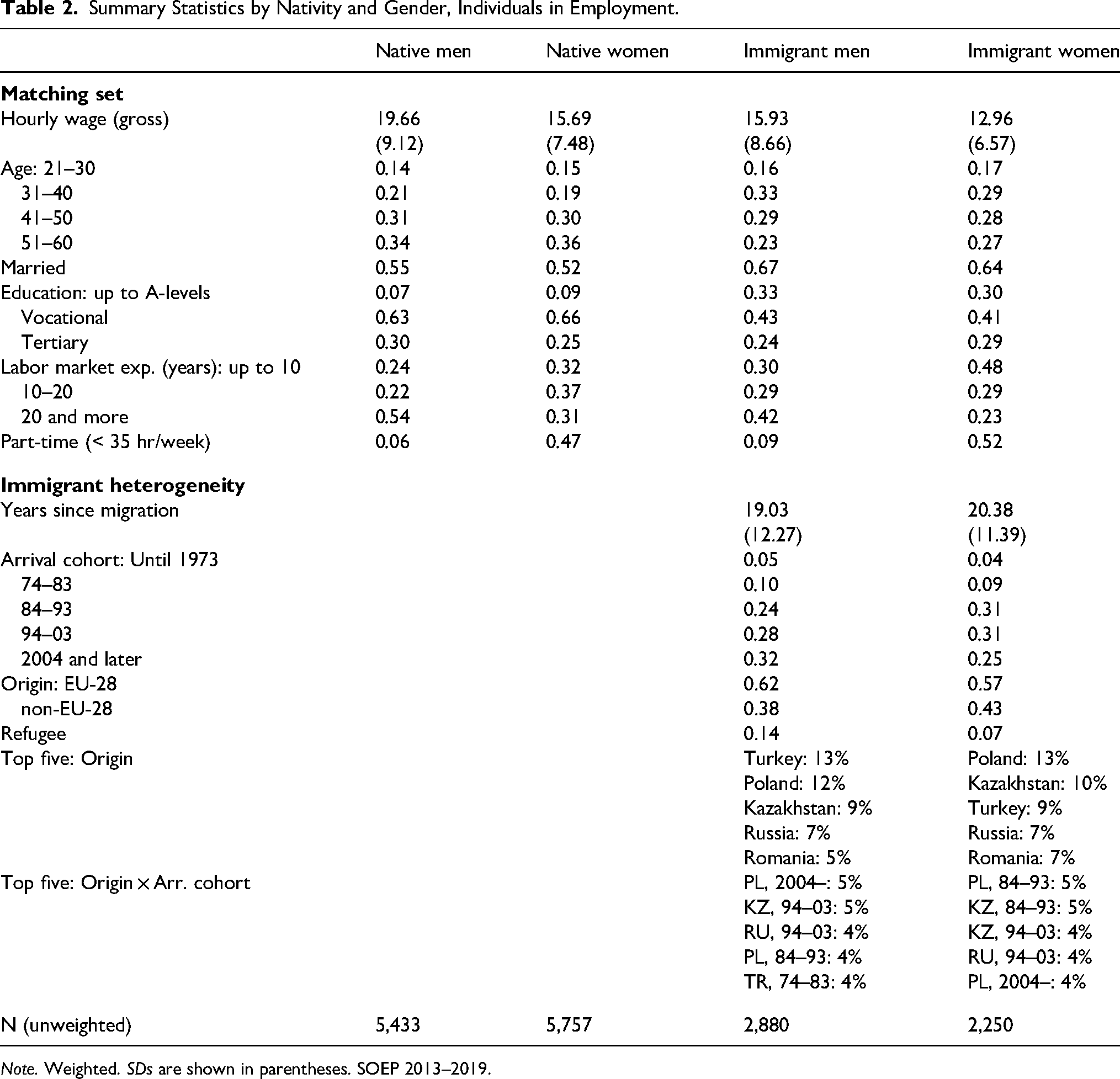
Note. Weighted. SDs are shown in parentheses. SOEP 2013–2019.
Our immigrant sample reflects Germany's diverse immigration history. The majority of immigrant women and men arrived after 1983, and the five most common origin countries of Turkey, Poland, Kazakhstan, Russia, and Romania comprise a little less than half of the sample. 38% of immigrant men and 43% of immigrant women originate from EU-28 countries, so that immigrants are predominantly from countries outside the EU-28.
Turning to differences between immigrant men, immigrant women, native men, and native women, a clear nativity gap can be observed in terms of educational attainment. There is little difference in the share of tertiary qualifications, but immigrants are much more likely to hold up to A-level degrees than natives, whereas the reverse is true for vocational degrees. Women and men differ notably in terms of part-time employment. Among both natives and immigrants, about 50% of women work part-time, but less than 10% of men. Regarding (full-time equivalent) labor market experience, native men clearly have the most experience, with 54% having spent 20 years or more in employment, followed by immigrant men and native women. Immigrant women have the lowest labor market experience, with 48% being employed for less than 10 years. The labor market experience patterns among the employed also reflect general differences in employment rates between groups: 84% of native men are employed compared to 78% of native women, 77% of immigrant men, and 63% of immigrant women (Supplemental Table 1.1). Selective nonemployment could lead to an underestimation of wage inequalities between groups, but our decomposition results remain fairly unaffected by a selection correction (Supplemental Table 2.2). 5
We argued that in addition to differences in work attachment and individual resources, wage gaps are driven by occupational segregation. In our analysis sample, the distribution across occupations indeed varies strongly by gender and nativity (Supplemental Table 1.2). In line with research on occupational sex segregation, managerial and science professions as well as manual labor are much more common among men than women, and women are more likely to work in occupations in health, sales, clerking, teaching, cleaning, and personal care and services. Whereas these gendered patterns are apparent for both immigrants and natives, further segregation by nativity is evident in the overrepresentation of immigrants in construction and manufacturing among men, and in personal care, personal services, and cleaning among women. Coinciding segregation effects create the largest imbalance between native men and immigrant women, for whom the differences in terms of wages are also most pronounced. 16.3% of native men work in the top five paying occupations compared to 4.5% of immigrant women; in the bottom five are 1.3% of native men but 28.1% of immigrant women. The extensive occupational sorting does not just entail wage differences, but likely constrains the comparability between groups, especially when considering occupations in combination with other relevant individual characteristics in the wage gap decomposition.
In light of our theoretical considerations and the group differences in characteristics, it is of little surprise that immigrant women obtain the lowest hourly gross wages (12.96 Euro). The highest earners are native men (19.66 Euro); native women (15.70 Euro) and immigrant men (15.93 Euro) achieve similar wages in between.
Wage gap Decomposition
Table 3 and Figure 1 present the decomposition results for all pairwise comparisons between the four groups. In each comparison made, we defined the group with lower raw wages as group A: Immigrant women are always group A, immigrant men are group A when compared to native men, and native women are group A when compared to native men and immigrant men.
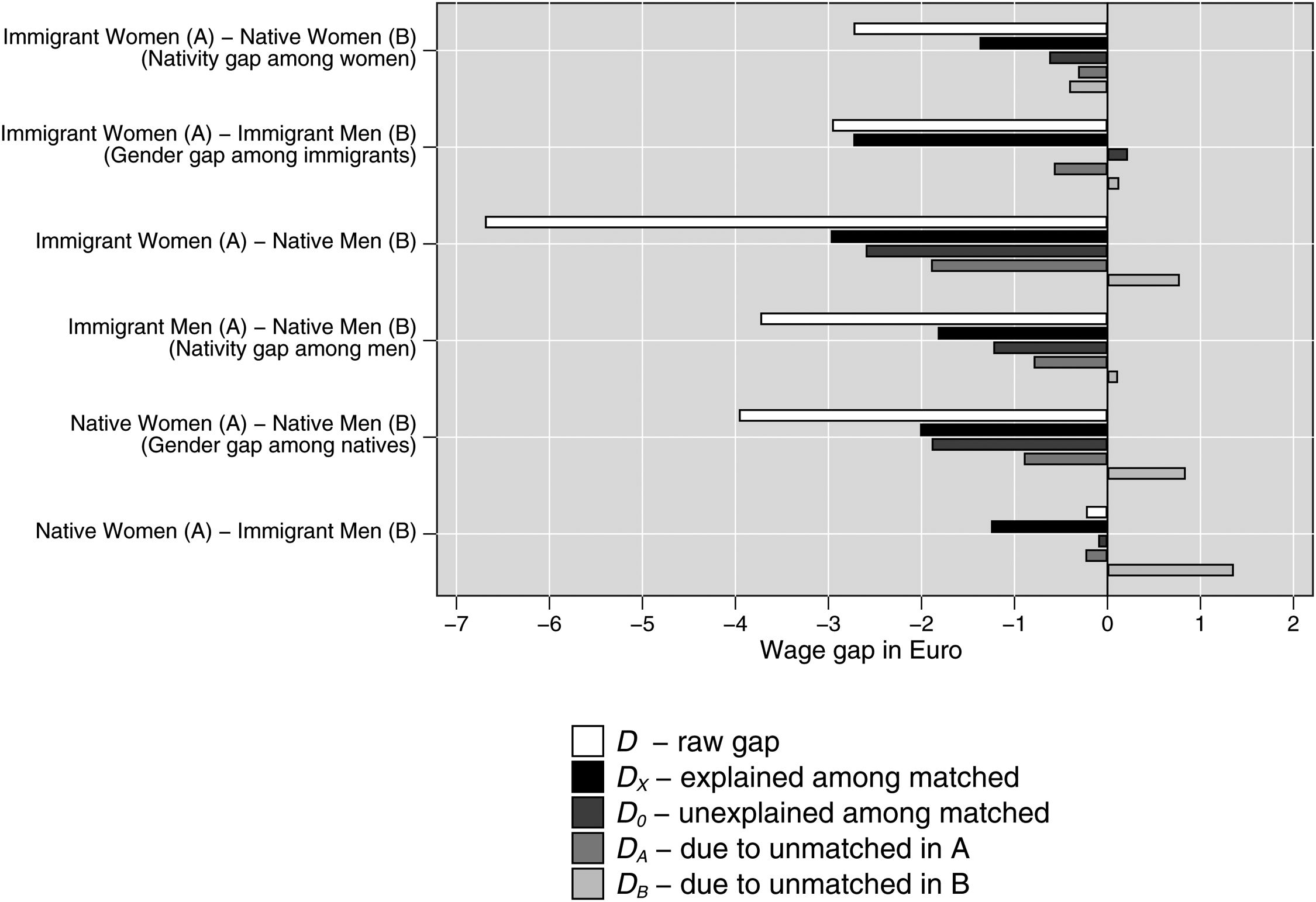
Decomposed Wage Gaps by Comparison.
Matching Decomposition Results by Comparison.
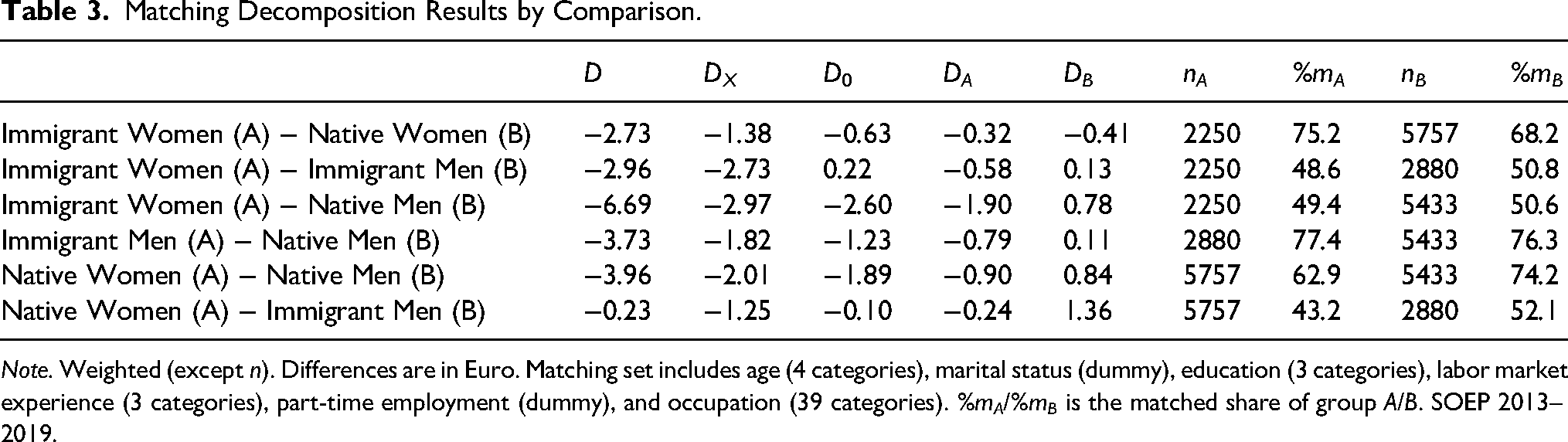
Note. Weighted (except n). Differences are in Euro. Matching set includes age (4 categories), marital status (dummy), education (3 categories), labor market experience (3 categories), part-time employment (dummy), and occupation (39 categories). %mA/%mB is the matched share of group A/B. SOEP 2013–2019.
Confirming our intersectional considerations, the raw wage gaps D are quite heterogeneous in size across comparisons. Women earn less than men, and immigrants earn less than natives, but the gender gap is greater among natives (−3.96 Euro than immigrants (−2.96 Euro), and the nativity gap is greater among men (−3.73 Euro) than women (−2.73 Euro). The wage gap is largest for immigrant women compared to native men where disadvantages seem to coincide (−6.69 Euro), and smallest for native women compared to immigrant men where advantages and disadvantages seem to counteract each other (−0.23 Euro).
Systematic group differences are reflected in the substantial shares of individuals who cannot be matched across groups—between 22.6% and 56.8% (%mA and %mB as shown in Table 3). Common support is particularly low when groups differ by gender, which follows from the pronounced gender differences in part-time employment, labor market experience, and occupations. As unmatched observations could just be an artifact of overspecification relative to the sample size, we tested for common support issues using the 2015 wave of the much larger Microcensus (SOEP n = 16,320, Microcencus n = 152,965). The Microcensus offers no information on labor market experience, so that we matched on a lower number of strata (SOEP: 2,377, Microcensus: 1,725). Despite more observations and less strata, we still observed nontrivial shares of unmatched individuals for each comparison and the same noncomparability patterns (Supplemental Figure S2.1). 6
Unmatched characteristics among one or both of the groups we compare nontrivially contribute to the overall wage gap in each decomposition, which is captured by DA and DB. The overall picture is that comparability issues arise predominantly in the lower parts of the wage distribution among the disadvantaged (A) as well as among the advantaged groups (B), so that characteristics unique to each group tend to pay comparatively less (DA is negative, DB is positive as shown in Figure 1; except for unmatched native women when compared to immigrant women). For example, when comparing immigrant women and native men, both DA and DB are substantial: The comparatively low wages of unmatched immigrant women contribute −1.90 Euro (28.4%), the comparatively low wages of unmatched native men +0.78 (−11.7%) to the overall gap.
In contrast to DA and DB, DX “explains” the wage gap by the different distribution of groups across strata which have common support, because each combination of characteristics is observed in both groups but not equally prevalent. In all cases, these distributional differences explain a considerable share of the raw wage gap (Figure 1). If the matched had equal distributions of characteristics in the compared groups, the wage gap would reduce for all comparisons by between −2.97∕−6.69 = 44.4% (immigrant women vs. native men) and −2.73∕−2.96 = 92.2% (immigrant women vs. immigrant men); the only exception is the comparison between native women and immigrant men, where immigrant men's wage advantage would increase.
The unexplained part D0 of the wage gap remains after all differences in considered individual characteristics between the compared groups are accounted for (after DA, DB, and DX have been subtracted from D; Figure 1). In the counterfactual scenario of common support and identical group characteristics, we estimate negligible unexplained wage gaps between immigrant women and immigrant men (+0.22 Euro) and native women and immigrant men (−0.10 Euro), as well as a moderate unexplained gap between immigrant women and native women (−0.63 Euro; 23.1%). Substantial unexplained gaps remain for all other comparisons: D0 is −1.23 Euro (33.0%) for the nativity gap among men, −1.89 Euro (47.7%) for the gender gap among natives, and −2.60 Euro (38.9%) for the coinciding gap when immigrant women and native men are compared.
Two main results arise from these figures. First, the variation in magnitude of the unexplained part across comparisons is a clear example of the intersectional understanding that social dimensions of difference are mutually constituted. Among natives, women experience a large unexplained disadvantage compared to men, but among immigrants women even experience a small unexplained advantage. Unexplained wage disadvantages of immigrants compared to natives remain for both men and women, but also vary in size. Clearly, any wage (dis)advantages associated with the intersecting dimensions of gender and nativity are nonadditive and have to be estimated for each comparison separately. Second, in terms of relationality, another important point is that unexplained wage gaps are always substantial when one of the comparison groups is native men, but much smaller among the pairs between immigrant women, immigrant men, and native women. It appears that particularly native men enjoy additional wage returns, even when they have the same characteristics as the other groups. 7
In light of the heterogeneity of Germany's immigrant population, we conducted two robustness checks. In separate decompositions for EU and non-EU immigrants (with correspondingly small samples), our cautious results reflect the different labor market opportunities these groups have on the German labor market (Supplemental Tables 2.4 and 2.5). When compared to natives, EU immigrant women and men are more likely to be matched and generally experience smaller disadvantages than non-EU immigrants, both in terms of raw and unexplained wage gaps. Judging from unexplained wage gaps, native German men and EU immigrant men achieve the same wages from the same characteristics, and both have an advantage over EU immigrant women. Non-EU immigrant women are even more disadvantaged compared to native men, but they enjoy a substantial unexplained wage bonus compared to their male compatriots, which drives the small gender advantage we see in the aggregate results. In the second check, we exclude refugees, which mainly results in a better position of immigrant men in terms of raw and unexplained wage gaps relative to the other groups (Supplemental Table 2.6).
Exploring the Mechanisms Behind Wage Gap Components
In the nonparametric matching approach, individual characteristics matter in their observed combination and it is not possible to attribute parts of the raw wage gap directly to single characteristics. Pronounced differences in certain characteristics are still informative because they limit the probability of being matched and/or produce wage differences between and within groups. Unmatched combinations of characteristics in particular are not just a methodological problem of finite samples, and their systematic nature can add to our understanding of the mechanisms behind comparison-specific wage gaps. To disentangle the aggregate picture, we therefore explore to what extent the presented theoretical mechanisms are reflected in each wage gap component. We focus on the comparison between immigrant women (A) and native men (B), for which we observe the largest disparity in individual characteristics and little common support, as well as pronounced wage differences between the unmatched and matched within groups.
First, we explore why unmatched characteristics tend to pay less than matched characteristics among both immigrant women (widening the wage gap by DA = −1.90) and native men (narrowing the wage gap by DB = + 0.78). It might not be surprising that the joint differences in work attachment, individual resources and occupations leave many immigrant women unmatched at the lower end of the (within-group) wage distribution. Notable, however, is that among native men—as the generally advantaged group—unmatched characteristics do not predominantly go along with a place at the top end of the (within-group) wage distribution.
It becomes clear that one of the main drivers of this pattern is occupational segregation when we look at how much each occupation contributes to DA and DB (Figure 2). Among immigrant women, few occupations substantially contribute to DA (solid line), and in all of these occupations unmatched units have mean wages well below the average of the matched sample (bar is negative, line is negative). For cleaners and helpers (second last), the negative bar indicates that the average wage of the 344 unmatched immigrant women working in this occupation is 5.88 Euro lower than the average wage of matched immigrant women across all occupations. The comparatively low wages and the numeric importance of unmatched cleaners and helpers among all immigrant women widen the wage gap by −5.88⋅(344∕2250) = −0.90 Euro (line). Other occupations nontrivially contributing to DA are workers in sales (−0.21 Euro), personal services (−0.16 Euro), and personal care (−0.16 Euro).
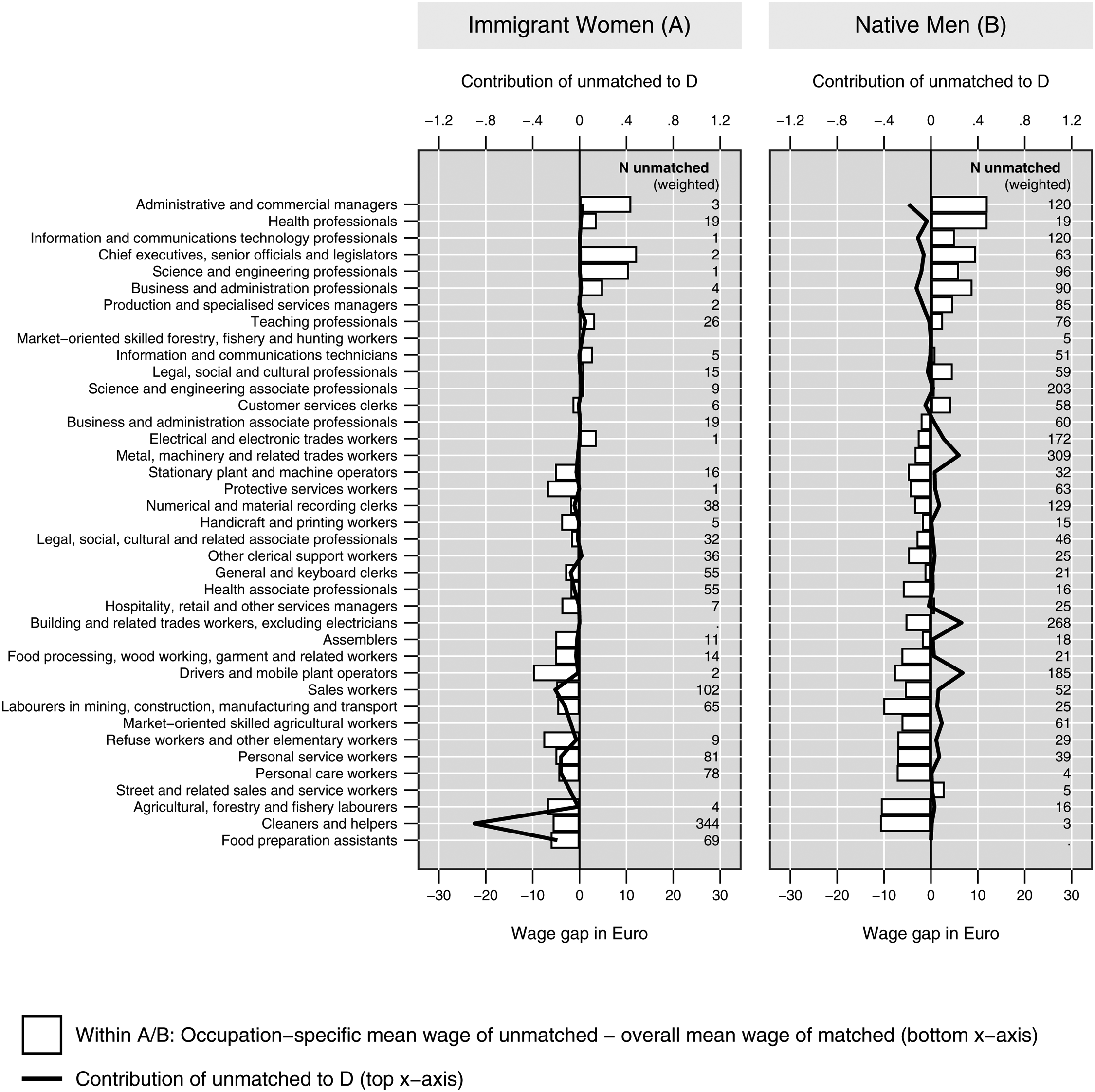
Occupation-specific Contributions of the Unmatched to D, Immigrant Women (A) − Native Men (B).
Among native men, the unmatched in these occupations also have wages below the average wage of the matched (bar is negative), but their small number goes along with little contributions to DB (line is around zero). For example, unmatched cleaners and helpers make 10.86 Euro less than the matched average, but they constitute just a negligible 3∕5433 = 0.06% of native men. Notable contributions to DB are generally more heterogeneous across occupations. We observe that some unmatched native men in the top-paying occupations (e.g., administrative and commercial managers) actually widen the wage gap, because they earn higher wages than matched native men (bars are positive, line is negative). However, the contribution of these occupations to DB is more than offset by the occupations in which unmatched native men earn below-average wages (bars are negative, line is positive), notably drivers and mobile plant operators (+0.27 Euro), building workers (+0.26 Euro), and metal and machinery workers (+0.24 Euro).
Beyond occupational segregation, differences in work-attachment and individual resources are further important mechanisms behind the comparatively low wages of the unmatched (Supplemental Table 3.5). Among immigrant women, gaps are particularly pronounced for education and part-time employment: 45% of unmatched immigrant women have at maximum an A-level degree (matched: 14%) and 70% work part-time (matched: 30%). These differences also correlate with immigrant women's origin, as the share of EU immigrants is higher among the matched (48%) than the unmatched (38%). The origin shares of Turkey and Poland particularly vary by match status, which suggests that immigrant women have a higher similarity to native German men if they are of Polish origin, and a lower similarity if they are of Turkish origin. When looking at native men, the unmatched show substantially lower levels of tertiary education but higher levels of labor market experience than the matched, which adds to the picture of unmatched occupations: The unmatched among native men seem to be predominantly blue collar workers. These unmatched native men still earn higher average wages than immigrant women, but their advantage is smaller, which results in an overall smaller wage gap.
Second, we turn to differences in wage determinants between immigrant women and native men who have been matched, which underlie the explained component DX. The samples of immigrant women and native men naturally become more similar when every individual has at least one matched counterpart, but matched combinations of characteristics are still distinctly distributed among groups—with notable differences in occupations and work attachment. For example, despite the fact that many immigrant women working as cleaners and helpers or personal care workers are unmatched, these low-wage occupations are still more common for matched immigrant women than for matched native men (Supplemental Figure S3.5). Conversely, matched native men are still generally more likely to be found in most of the top-paying occupations (except for health professionals and teaching professionals). Immigrant women also continue to show comparatively low labor market experience and much higher levels of part-time employment than native men among the matched, whereas differences in age, education, and marriage rates are less pronounced (Supplemental Table 3.5).
But why do we still observe a considerable unexplained wage gap of D0 = −2.60 Euro (38.9%) after accounting for all the differences in the matching set between immigrant women and native men? In the third and last step, we briefly discuss a few potential answers. One potential risk in any decomposition is posed by unobserved heterogeneity, so that groups differ in wage-relevant characteristics we do not account for in the matching set. However, when we look at differences in additional observed factors that remain between matched immigrant women and matched and re-weighted native men, there is no clear indication of D0 overestimation due to omitted variable bias (Supplementary Table 3.6). Immigrant women's self-rated German language skills are good or very good in 85% of cases and there is little difference in tenure length at the current firm (immigrant women: 7.0 years, native men: 8.5 years). That native men live with more and younger children in the household potentially reflects selective employment of immigrant women, but a selection adjustment has no substantial effect on D0 (Supplemental Table 2.2 provides decomposition estimates with a selection correction). Reassuringly, by matching on occupation and education we also seem to capture group differences in the shares of individuals who report to be overqualified for their job or to work in an occupation not trained for (Supplemental Table 3.6; immigrant women: 26/34%, native men: 23/35%). Thus, beyond further unobserved factors, part of the unexplained wage gap between immigrant women and native men could stem from (positive and negative) wage discrimination.
Taken together, the group differences in the mutual relatedness of work attachment, individual resources, and occupations represent important mechanisms behind the wage gap between immigrant women and native men. The same is true for all pairwise comparisons, though with different patterns which reflect the idiosyncrasies of specific groups compared (Supplemental material shows corresponding tables and figures). Addressing the inequality in these characteristics would reduce the wage inequality between all groups, but even without any advantage in characteristics native men would sustain substantial wage advantages.
Discussion
This article examined wage gaps jointly by gender and nativity by pairwise comparing the wages between immigrant women, immigrant men, native women, and native men using a matching decomposition on Western German survey data. The most important result of our analysis is that any wage (dis)advantages associated with the intersecting dimensions of gender and nativity were nonadditive and resulted in distinct decomposition patterns for each pairwise comparison. Differences in work attachment (part-time employment, labor market experience), individual resources (education), and occupational segregation made labor market positions unique to each group. Characteristics generally varied to such an extent that a considerable share of individuals could not be matched. The specific support patterns varied across comparisons, but unmatched characteristics typically generated lower wages than matched characteristics. When combinations of characteristics had a match, they were still distinctly distributed between groups. Once we accounted for these differences in wage determinants, negligible unexplained wage gaps remained between immigrant women and immigrant men (+0.22 Euro) and native women and immigrant men (−0.10 Euro), as well as a moderate unexplained gap between immigrant women and native women (−0.63 Euro; 23.1%). Unexplained gaps were substantial, however, for the nativity gap among men (−1.23 Euro, 33.0%), the gender gap among natives (−1.89 Euro, 47.7%), and the gap between immigrant women and native men (−2.60 Euro, 38.9%).
This striking relational pattern in unexplained gaps across comparisons is the second important finding: Unexplained wage gaps were small for the pairs between immigrant women, immigrant men, and native women, but always large when one of the comparison groups was native men. Much emphasis has been placed in the literature on the “double disadvantage” of immigrant women, but in light of all pairwise gaps, it rather appears to be a “double advantage” enjoyed by native men, even when they have the same work attachment, individual resources, and occupations as the other groups.
A detailed exploration of the mechanisms behind the wage gap between immigrant women and native men underscored this interpretation. We found no indications that further group differences not considered in the matching set—such as language proficiency or tenure at the current firm—could account for the substantial unexplained wage advantage native men have over immigrant women. Thus, it seems likely that (positive) discrimination at least partly contributes to the observed wage advantages of native men. However, this is not to say that discrimination would only manifest in different wage returns to the same characteristics. Discrimination could also be the reason why there are group differences in the considered characteristics in the first place, for example, when immigrant women have less opportunities as native men to work in occupations matching their qualification. Any way of technically establishing group comparability can obscure such inequalities, but to the extent that “pre-wage” discrimination induces common support issues, its wage effects become apparent in the matching decomposition.
Conclusion
Our work supports the intersectional argument that there are interrelated structural underpinnings which link gender and nativity to particular wage positions for immigrant women, immigrant men, native women, and native men—and to particular wage gaps between each pair of these groups. The variation in the extent of wage (dis)advantages across comparisons emphasized the relevance of full group comparisons for intersectional research. Unexplained gender gaps varied by nativity and vice versa, refuting the assumption of uniform and additive wage disadvantages for women and immigrants. Thus, if we want to estimate the wage gap between immigrant women and native men, we need to compare these groups and not just add together gender and nativity wage gaps for the full population (Greenman & Xie, 2008). This is not to say that gender and nativity will always intersect in the production of wage (dis)advantages in other contexts, but this is a question which has to be answered by rigorous intersectional theorizing and analysis (Misra et al., 2021).
We also made the case that intersectional groups might differ systematically to the extent that combinations of individual characteristics are not present across compared groups. As such a lack of common supports poses a challenge to the estimation of wage gaps, we used a matching technique proposed by Ñopo (2008) that first matched the individuals between groups on a set of wage determinants, and then decomposed the raw wage gap into (1) gaps due to unmatched characteristics, (2) gaps due to differences in matched characteristics, and (3) remaining, unexplained gaps. Extending applications of this technique focused on decomposition bias due to lacking common support (Djurdjevic & Radyakin, 2007; Ñopo, 2008; Strittmatter & Wunsch, 2021), we highlight that systematically unmatched characteristics also carry substantive meaning in the explanation of wage gaps. We observed limited and varying common support between groups in the SOEP analysis sample and the much larger Microcensus, so that unmatched combinations of characteristics were unlikely to be just a methodological artifact of overspecification in the matching. A close examination of unmatched observations highlighted, for example, the important role of occupational segregation for wage gaps, in line with the studies of Nicodemo & Ramos (2012) and Gallardo and Ñopo (2009). In this case, the lack of common support suggested strong closure mechanisms (e.g., access restrictions to certain occupations) as a form of “pre-wage” discrimination. We therefore encourage researchers to check for common support and to explore what it means that particular individuals cannot be matched between groups, especially in light of potentially unique group-specific experiences where several dimensions of (dis)advantage intersect.
From a policy perspective, observing a wage “double advantage” of native men rather than a “double disadvantage” of immigrant women is a point in case that attention is too often diverted from privileges of dominant groups to supposed deficits of marginalized groups (Fasang & Aisenbrey, 2022; Sprague, 2005). Many native men still benefit from exclusive labor market positions and from exclusive wage returns, their careers built around the notions of a male breadwinner and native precedence. Thus, policies aiming to reduce wage inequalities by gender and nativity in Germany need to acknowledge that the native male labor market experience is enabled by the disadvantage of others and that native men's privilege should not be the benchmark for individual labor market success. For instance, care obligations are the main driver for compositional differences in labor market experience between women and men, and these obligations do not go away by promoting the native male default of uninterrupted full-time employment as an ideal for women's careers. Another example are the excessive wage premiums native men generate from occupational licensing at the expense of immigrants’ access to these occupations, as illustrated by the wage convergence between immigrants and natives in crafts to which access was opened in 2004 (Runst, 2018). These examples again highlight that wage gaps are the result of two distinct but interrelated components—differences between groups in their characteristics and differences in wage returns for these characteristics—both of which provide policy levers to reduce wage inequalities. Generally, because of their interrelatedness, curbing the privileges or mitigating the disadvantages of specific groups will have an impact on other groups, and the justness of policies can only be safeguarded by adopting an intersectional perspective.
Some limitations of our work should be addressed by further research. A potential problem in any wage decomposition is selection into employment. Adjusting for the variation in employment rates across groups (native men having the highest and immigrant women the lowest) changed little in our results, but there are various alternative methods to account for selection into employment (e.g., Blau et al., 2021, for the gender wage gap). Any such adjustment, however, relies on assumptions about the selection processes involved, and the heterogeneity in our decomposition results suggests that these assumptions might not hold across comparisons. More research is necessary to assess potential intersectionality in the selection into employment (Neal, 2004).
Another limitation is that intersectional wage inequalities are not exhausted in the joint consideration of binary dimensions of gender and nativity. In particular, we glossed over most of the heterogeneity in our immigrant sample and just pointed to some suggestive differences in our results when we distinguished EU from non-EU immigrants or excluded refugees. Immigrants arrive with varying resources, are subject to varying immigration regulations, and face varying discrimination—all of which affect their labor market position and wages (Schieckoff & Sprengholz, 2021). Incorporating further heterogeneity, however, also means that comparability issues are more likely to arise and that we approach the limits to the complexity we can productively handle in a comparative setting. We therefore need extended data collection of migration and labor market related information in Germany to conduct further intercategorical analyses which can map structural inequalities to some of that heterogeneity. Higher levels of disaggregation benefit from intracategorical research which explores in detail the experiences of particular intersectional groups and, thus, scrutinizes the (contingency of) categories we work with.
In conclusion, this article emphasized that gender and nativity are mutually constitutive in the production of social relations, and these relations are reflected in wage inequalities. Wage decomposition studies need to attend to this intersectionality in terms of disaggregation and methodological approach. Our pairwise matching approach did not just avoid potential bias due to a lack of common support, but offered a more nuanced perspective on the commonalities and differences between groups, and the relational wage (dis)advantages immigrant women, immigrant men, native women and native men experience in Germany.
Supplemental Material
sj-pdf-1-wox-10.1177_07308884221141100 - Supplemental material for Intersections and Commonalities: Using Matching to Decompose Wage Gaps by Gender and Nativity in Germany
Supplemental material, sj-pdf-1-wox-10.1177_07308884221141100 for Intersections and Commonalities: Using Matching to Decompose Wage Gaps by Gender and Nativity in Germany by Maximilian Sprengholz and Maik Hamjediers in Work and Occupations
Footnotes
Acknowledgments
The authors are indebted to Zerrin Salikutluk, Anette Fasang, Johannes Giesecke, Eileen Peters, and Carla Rowold for their valuable feedback. We also thank the DFG research group Female Employment After Migration for comments on earlier versions of this manuscript.
Data Availability Statement
The datasets used in this project are not publicly available due to privacy regulations, but can be obtained by signing a data user agreement with the respective publishers (see Supplemental Material).
Declaration of Conflicting Interests
The author(s) declared no potential conflicts of interest with respect to the research, authorship, and/or publication of this article.
Funding
The author(s) disclosed receipt of the following financial support for the research, authorship, and/or publication of this article: This work was supported by the Deutsche Forschungsgemeinschaft (grant number 403158126).

Supplemental Material
Supplemental material available at https://doi.org/10.5281/zenodo.7290701 contains information about data access, all code necessary to replicate the results, and supplemental results referenced in this manuscript.
Notes
Author Biographies
References
Supplementary Material
Please find the following supplemental material available below.
For Open Access articles published under a Creative Commons License, all supplemental material carries the same license as the article it is associated with.
For non-Open Access articles published, all supplemental material carries a non-exclusive license, and permission requests for re-use of supplemental material or any part of supplemental material shall be sent directly to the copyright owner as specified in the copyright notice associated with the article.
