



Abstract
What kinds of ties do agricultural and oil and gas workers form in the field, and how do they use them later on? Why do they use them differently? Scholarship highlights how weak ties can link people to valuable information, while strong ties can be critical for day-to-day survival. Yet many mechanisms affect how workers form and use social networks over time and space. Drawing on 60 interviews and observations with agricultural and oilfield workers in Texas, I examine how both groups form strong ties of fictive kinship when living together in the field far from home—pooling resources, sharing reproductive labor, and using the discourse of family to describe these relationships. Then I examine how they use these ties very differently later in practice. Oilfield workers often use their fictive kin ties to move up and around the industry across space, time, and companies: amplifying ties. In contrast, agricultural workers renew the same strong ties for survival from season to season, maintaining cyclical ties. The comparison highlights how industry mobility ladders, tempos, and geographies affect how workers can use their networks in practice. While both agricultural and oilfield workers become fictive kin in situations of intense proximity, structural differences give their networks unequal reach.
Each July, Tomás 1 travels with long-term compañeros to work in corn detasseling in rural Indiana. “When we go [to work] we always go together”, heading north from the Rio Grande Valley borderlands of Brownsville, Texas—Matamoros, Mexico. Many have traveled hundreds of miles together by shared van or bus for decades, following seasonal work across the United States. In Indiana’s detasseling belt, most stay in run-down motels along remote state highways. Muddy clothing hangs to dry along banisters, shoes baking in the sun outside hotel doors. Workers frequently pool together resources; “in our free time we would grill a chicken together.” As Julio, another worker, puts it, “If we go together, we become a family”: strong ties cohere in temporary, ramshackle homes. Yet those familial bonds recede upon returning home to blood kin: “And when we get back, we return like family. And what happened over there in the other state, it stays over there, because here we’re already back in our home.”
Elsewhere in Texas, field-based oil and gas workers room together in mobile trailers aside wellheads or in man camps, often for weeks at a time. Driving west along state highways and Farm-to-Market roads into the Permian Basin, the landscape is barren of wildlife, broken up by the occasional mesquite bush, oil derrick, and gas flare. Small towns crop up every 30 or 60 miles, their bustle or silence a barometer of the machinations of the global market. To get to well-sites off state highways tens of miles from town, or across snaking dirt roads near hubs like Midland, Odessa, and Pecos (pronounced “Pay-Cuss”), workers often haul it five or ten hours across the state in trucks. Many share reproductive labor. Andrew, a former Measurement-While-Drilling (MWD) fieldhand, notes, “It’s kind of this untold, unwritten rule if somebody makes dinner, and then there’s enough for everybody and you partake in some of that, then you just signed yourself up for doing dishes.” They also use familial metaphors to describe the bonds they form. “It’s like a brotherhood”, says Manny, a 36-year-old operations manager. Sergio, a service manager, notes, “I see [the guys I work with] as family … they were there for me when everything happened with my [family].”
What kinds of ties do workers form in the field, and how do they use those ties later on? Drawing on 60 interviews and observations with oilfield and agricultural workers in Texas, I show how both groups forge strong ties of fictive kinship in the field to get through weeks and months away from home; however, they mobilize these ties differently following the work period. Farmworkers lean on fictive kin in the field, return home to blood family, and repeat the next season. They lean on these cyclical ties from season to season, using them as lateral links to seasonal jobs for survival, without upward pathways. In contrast, oilfield workers leverage strong bonds formed in the field as ladders up and across industry hierarchies as they disperse across space, time and companies. These amplifying ties can link workers to dynamic opportunities and help buffer them in downturns.
Why do agricultural and oilfield workers use their ties so differently? Both groups form strong ties of fictive kinship far from home. Yet respective industry tempos, geographies, and hierarchies form scope conditions for how workers can use these ties later on. The comparison shows how both situational and structural contexts matter for how workers form networks and how they use them in practice.
Dynamic Ties in Practice: Beyond Network Structure
Strong, Weak, Dynamic: Time and Space in the Flow of Interactions
Granovetter’s (1973) seminal article defines the “strength” of an interpersonal tie as “a (probably linear) combination of the amount of time, the emotional intensity, the intimacy (mutual confiding), and the reciprocal services which characterize the tie” (p. 1361). Weak ties can bridge social distance, linking people to valuable new information and resources (e.g., Dominguez & Watkins, 2003) without reciprocal obligation and sometimes facilitating new opportunities. By contrast, strong ties are more accessible because they emerge from and facilitate interaction (Granovetter, 1983).
Yet, social interaction is complex and contextual. As Granovetter himself (1979, c.f. Small, 2017, p. 155) noted, many ties do not fit clearly into the strong/weak taxonomy. Trust-rich strong ties can be crucial for successful economic interactions (Aral & Van Alstyne, 2011; Hansen, 1999; Sosa, 2011; Uzzi, 1996); emotional intensity can facilitate social capital (Adler & Kwon, 2002; Levin & Cross, 2004; Levine, 2013; Marsden & Campbell, 1984). People may, for a range of reasons, confide in weak ties (Small, 2017). And certain characteristics of ties cemented on one occasion may be mobilized for a different purpose as contexts shift. Elastic ties can offer support while remaining fluid and emotionally distant (Torres, 2019). Dormant ties formed in one situation later provide the “efficiency and novelty” of weak ties alongside the “trust and shared perspective” of strong ties (Levin et al., 2011). Meanwhile, collaborative ties leverage a shared work history (duration) to later support moves across companies (Godechot, 2014, pp. 29–30).
In short, our networks, and the characteristics of their constituent ties, are dynamic. Many networks are comprised neither of strong nor of weak ties strictly speaking, but of ties with some elements of each, that people mobilize differently over time and space. This suggests a need to look beyond network structure (e.g., whether a tie is strong, weak, etc.) and to instead examine networks in practice, as Mario Small (2017) emphasizes: how do people use networks across situations, over the “stream of interactions” (p. 176)?
Put differently, time and space are critical scope conditions (Small, 2017, p. 155) for how people form and activate their ties in practice. People may mobilize their networks spontaneously or in response to the behavior of others. While, as Granovetter posited, people have finite time, and so it can be more efficient to develop interconnected strong ties, space matters too: people interact with others as they move across it (Small, 2017, p. 155). Interactions are affected by where and when we find ourselves with others, and people often spend long periods of time in certain places—e.g., those working for long periods far from home. Sometimes, as Small (2017) finds, temporal and spatial proximity sets the stage (along with other factors) for people to confide in weaker ties “because they were there” (p. 109). And sometimes, as I show below, workers thrown into intense temporal and spatial proximity may form similar close ties, but then mobilize them very differently across diverging structural contexts.
Trust, Reciprocity, and Gendered Metaphors of Fictive Kinship
Scholars have found that strong, reciprocal ties can be critical for survival among poor communities (Levine, 2013; Mazelis, 2017). In her landmark study, All Our Kin, Carol Stack (1975) defines fictive kinship as “the smallest, organized, durable network of kin and non-kin who interact daily, providing domestic needs of children and assuring their survival. 2 The fictive kin Stack observed exchanged basic resources to survive severe economic hardship, sometimes maintaining those bonds for life (pp. 28, 59). However, Stack and others found that reciprocity can also be a burden, restricting mobility (Domínguez & Watkins, 2003; Newman, 1999, Nelson, 2000; Stack, 1975, p. 43).
Fictive kinship requires trust, which people learn to embrace or avoid through experience (Levine, 2013, p. 16). The current context of neoliberal capitalism, welfare retrenchment, cultural individualism, and the intersection of poverty and racism often corresponds to frequent distrust and the avoidance—or inability to sustain—reciprocal ties (Desmond, 2012; Mazelis, 2015; Offer, 2012; Raudenbush, 2016; Smith, 2010). Despite these barriers, poor people still draw on ties to survive. Some may exchange limited resources despite distrust (Raudenbush, 2016). Desmond (2012) identifies disposable ties of intense intimacy, frequent time together, and reciprocal resource exchange that are ultimately “brittle”, prone to breaking apart in the face of chaos (p. 1311). Despite their transient nature, disposable ties involve restricted resource exchange and hinder mobility. On the other hand, Mazelis (2017) finds sustainable ties linking poor people able to meet reciprocity norms with an antipoverty, poor peoples’ organization. Though these ties are not vehicles out of individual poverty, they can provide critical long-term support (p. 17).
Trust and distrust work at the micro-level as people draw on multiple frames to make sense of and approach social action (Raudenbush, 2016), using ties differently across situations (Small, 2017). People may draw on each other for support in situations of crisis, only for structured disadvantage to push them apart (Desmond, 2012). In other words, situational dynamics matter, but they are situated in cultural and structural social environments (Bell, 2016). Both situation and structure affect how people use their networks over space and time.
Taken together, the work on fictive kinship and dynamic ties shows that how people form and use their networks depends in part on when and where they interact and in part on structural constraints. Against many odds, poor people come together to survive; structures of trustworthiness may emerge despite the countervailing forces working against them. Thus, contra Stack, restricted mobility seems to be a product of limited opportunity, not fictive kinship or its reciprocity norms (Levine, 2013; Mazelis, 2015, 2017; Offer, 2012; Smith, 2010).
Existing research largely focuses on fictive kinship among poor people, often women. This novel comparison of how two groups of men with different resources form and later draw on strong, reciprocal ties of fictive kinship provides an opportunity to investigate some key mechanisms of network practice. The literature on dynamic ties shows that people can mobilize strong ties for a variety of ends. How might people enmeshed in networks of fictive kin with more resources, more avenues for mobility, be able to leverage those ties, compared to the very disadvantaged?
As a description of strong ties of reciprocity, fictive kinship is also a discourse. Metaphor can reflect or impose meaning on “events, organizational practices, and social relations” (Ollilainen & Calasanti, 2007); it can define, reframe, highlight, or mask experience (Lakoff & Johnson, 1980). Thus, family metaphors can both reinforce and challenge gendered cultural frameworks. On the one hand, the language of fictive kinship may express a more expansive understanding of “family” that incorporates extended and blended families, non-traditional relationships and unions, people who live together, and other evolving forms (Ollier-Malaterre et al., 2019). Comparing peers to family can mark reciprocity and a sense of equality (e.g., Mazelis, 2017, p. 146; Stack, 1975). In the work context, familial metaphors can also reflect traditional gendered labor divisions, reinforce heterosexuality, normalize unequal power dynamics, and justify women’s greater emotional labor (Ollilaienen & Calasanti, 2007). Beyond familial metaphors, other forms of gendered discourse within occupational fields can function in exclusionary ways. For example, Miller (2004) found that “frontier masculinity” discourse excluded women from oil and gas networks—networks that, other scholars have found, are a critical mechanism of gender inequality in oil and gas work (Kilanski, 2015; Miller, 2004; O’Shaughnessy, 2011; Williams, 2018a, 2018b; Williams et al., 2012, 2014).
Unequal Reach: Cyclical and Amplifying Ties
Network analysis often focuses on finding the formal structure of relational data rather than uncovering why those relationships are structured as such, such that “social content is distilled away from social structure” (Krippner, 2001, p. 797; see also Burawoy, 2017 fn 9, cf Fligstein & Dauter, 2007; Thompson, 2004 ). This article examines how people form ties in the situation of the field, and how they later use those ties differently, identifying some of the mechanisms of their unequal reach. This responds to Krippner’s (2001) call to investigate how social networks are created, reproduced, and transformed, by shifting focus to how people use their ties, differently, in practice (Small, 2017) across situations.
Below, I examine how the situational (the interactions among workers in the field) and the structural (workers’ resources and the tempos, geographies, and hierarchies of each labor process) affect how each group forms and uses their ties. Here, I sketch out the contribution demonstrated empirically in the findings that follow: how situational and structural factors intersect to affect social networks, and specifically how industry hierarchies, time and space provide scope conditions for how workers can use their ties.
As Goffman (1983) shows, while our doings are all situated in a social structure, and much of interaction is “merely situated” (people employ norms and conventions created elsewhere), interactions also contain “the situational”: what can only occur within face-to-face meetings (p. 3). Illuminating Goffman’s point that social structure still contains space for a world to be constituted within an interaction, many agricultural and oilfield workers bond as fictive kin, living and working side by side in the field —a critical juncture in the interaction stream (Small, 2017).
Goffman writes, further, that “Whatever is distinctive to face-to-face interaction is likely to be relatively circumscribed in space and most certainly in time” (p. 3). However, the rhythms of each industry’s work process re-structure the space and time configurations of networks, bringing workers together for certain periods, and affecting their later movements—and consequently where their networks can take them. Circumscribed in space and time, fictive kinship is constituted in the situation of the field, as workers live side by side. Yet how they use those ties beyond the motel, barracks, trailer, and man-camp is affected by structural contexts, including industry opportunity structures, tempos and geographies (when and where work happens), and workers’ resources. As Bourdieu (1989) writes, “the truth of any interaction is never entirely to be found within the interaction as it avails itself of observation” ( p. 16). Beyond the situation of the field, workers use these ties differently.
After becoming fictive kin, oilfield workers disperse to other jobs. The ties formed in the field can help them reach new industry opportunities—higher wages and positions — over space and time: amplifying ties. In contrast, agricultural workers continue migrating together to low-wage, temporary jobs season to season, renewing cyclical ties. Several mechanisms at the individual and labor process levels shed light on these differences in how workers use fictive kin ties in practice (Figure 1).
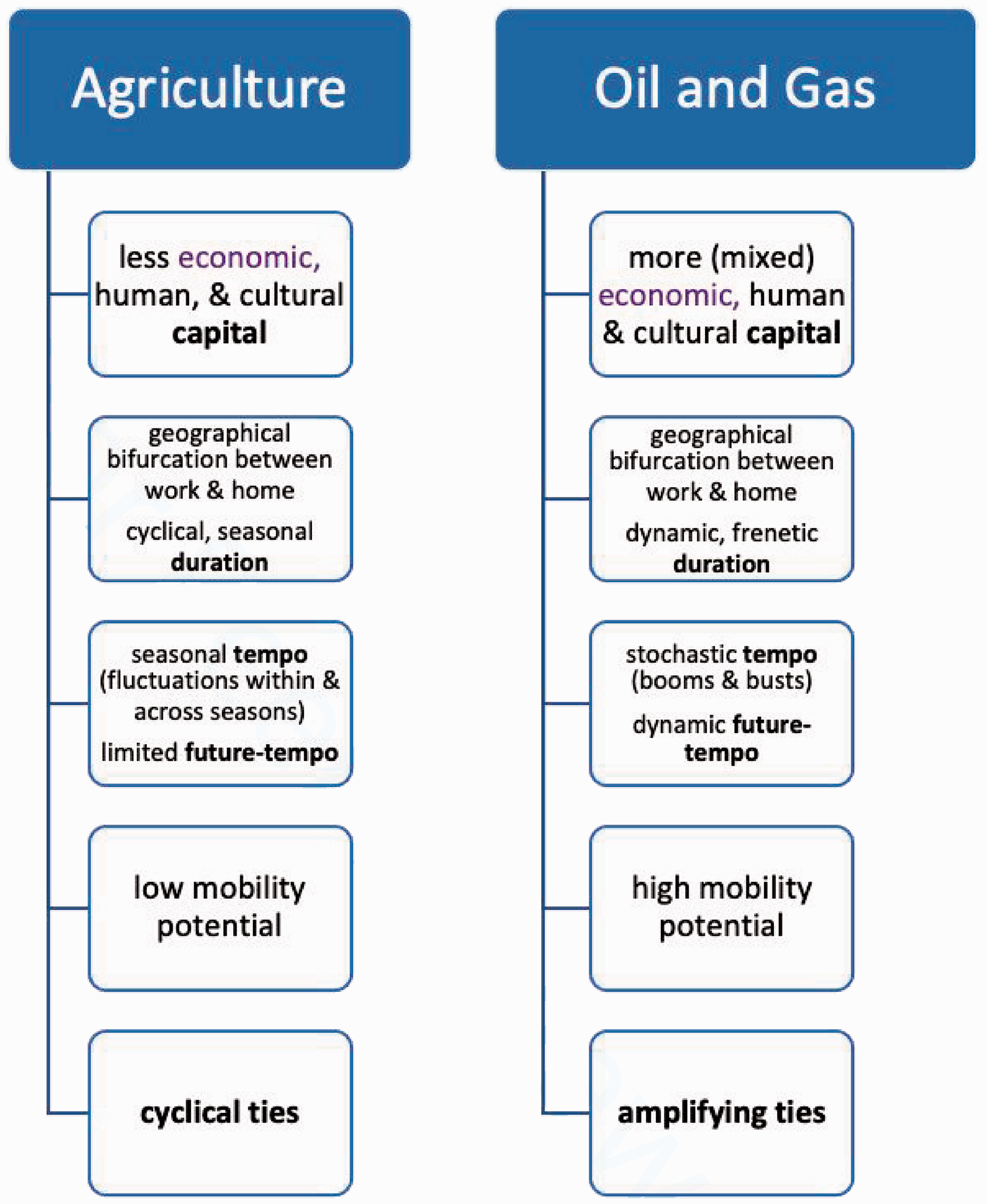
Diagram of Key Structural Characteristics and Corresponding Ties.
On the individual level, the two groups have varying economic, human, and cultural capital. The agricultural workers in this study are extremely poor and lack access to stable work in the borderlands, a space of geographical inequality (Chávez, 2016). While many oilfield workers in the sample come from working class backgrounds, they speak English and have at least a high school education or GED and sometimes a college degree (Figure 2). The economic disparity is evident in worker transportation, with all but one agricultural worker respondent carpooling or taking the bus and oilfield workers spending long hours driving, most in heavy-duty trucks, across the state.
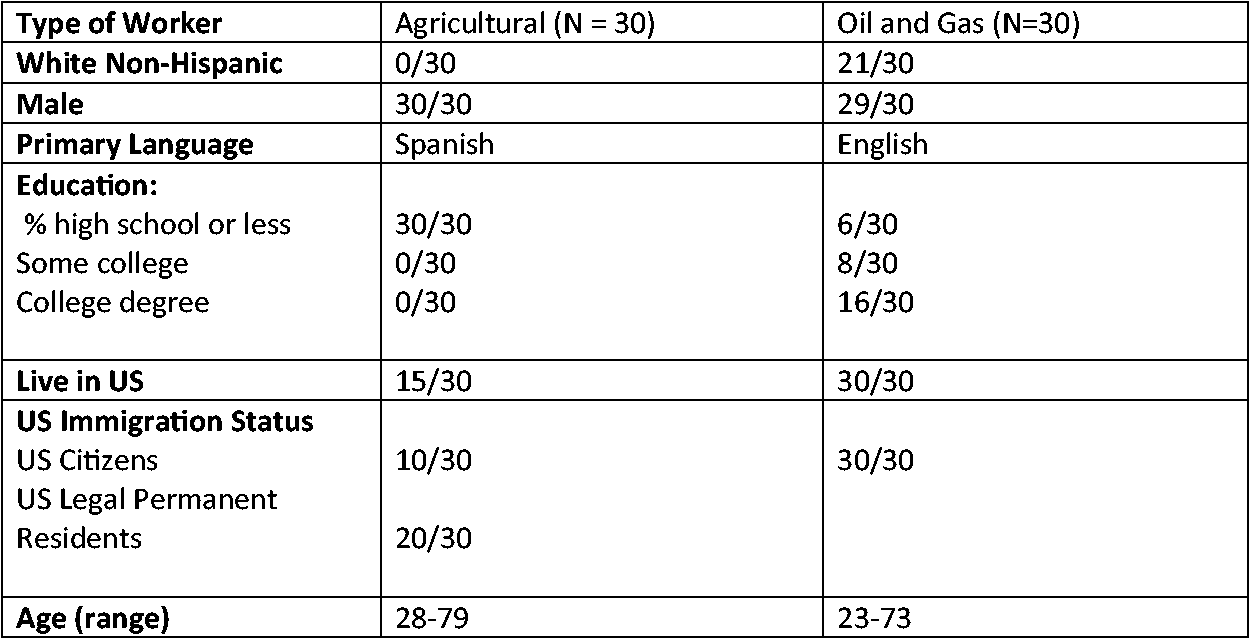
Descriptive Statistics, Agricultural and Oilfield Worker Interviews.
Yet these differences in individual capital, which affect workers’ ability to get into these industries, are compounded by disparate mobility potential. Oilfield workers exist in a somewhat liminal space in society: those from working class backgrounds can eventually earn a salary normally limited to the higher educated. Liam, a drilling engineer, describes this paradox: If you look at the oil industry, it's typically this conservative, still ultra-right-wing almost like hold out industry. But then you look at how the employees are actually paid in it, and we've actually got some of the most fair pay scales of any industry and it's an odd thing, you normally think of capitalism and the worker bees getting screwed over, but then you look at the workers and they're actually getting paid fair wages, you're like “Okay, well.”
The temporal and spatial dimensions of the labor process provide scope conditions for workers to mobilize their ties down the road. Time is one determinant of the strength of a tie (Granovetter, 1973). Two dimensions of time clearly influence tie strength. First, workers who spend a longer duration of time together will develop more intimacy and stronger ties. Agricultural workers re-activate ties from season to season. Meanwhile, oilfield workers live and work together for less predictable durations, frequently moving to another rig with different workers, changing companies, and suffering layoffs. Thus, oilfield workers will often separate from peers for indefinite durations following an intense period of work, fanning out across space and companies. As they do so, strong ties can come to function more like weak ties: they become potential ladders to work, as trust and shared perspective can endure with dormancy or distance (Levin et al., 2011). In contrast, agricultural workers re-activate strong ties cyclically, spending significant durations together from season to season..
A second salient temporal dimension is how far into the future ties can be activated and for what purpose—what we might call their future-tempo. Agricultural workers re-activate strong ties first, at home between jobs at the local bus station, and second, cycling from crop to crop together. This limits their future-tempo because they tend to connect to the same peers with limited opportunities, drawing on those ties for seasonal work. In contrast, oilfield workers work with a peer for a given duration but often part ways for different opportunities as time goes on. They may use that tie months or years down the road to pursue a new position or connect their peer to one. With this dynamic future-tempo, the ties amplify in reach, connecting workers to new opportunities.
The spatial proximity of workers in the field makes it possible for them to become fictive kin. Later, the spatial dispersion of oilfield workers helps them connect each other to complementary information, amplifying the utility of their networks for supporting their movement up industry mobility ladders. In contrast, the strong ties of agricultural workers renew seasonally, helping workers connect to, and cycle through, low wage work together. 3
Methods and Data
Fieldwork, Sample, and Industry Structure
This article is based on six months of fieldwork in Texas, including 60 interviews and observations. These data are part of a larger project investigating how workers confront unstable work schedules and unsettled landscapes of work. The comparison between agricultural and oilfield workers revealed parallels in how workers form communities in the field, and differences in how they mobilize those networks in practice.
I interviewed 30 Mexican-origin agricultural workers in the border city of Brownsville, Texas, in Spanish, the native and preferred language of these respondents. I interviewed 18 workers in June and July 2015, recruited through existing contacts from past advocacy, snowball sampling, and in-person at the Brownsville bus station. In summer 2016 I conducted group discussions with five workers, loosely modeled after Dodson et al.’s ‘interpretive focus groups’ (Dodson & Schmalzbauer, 2005; Dodson et al., 2007)—seeking to involve participants in interpretation and revision and to disrupt to the extent possible power hierarchies. Sharing preliminary findings and getting input from workers, I became more confident in key themes emerging from interview analysis, including social network practices. In September 2018 I interviewed 12 more workers. I conducted participant observation in and around the Brownsville bus station and gained context from a previous trip speaking with workers at motels and trailers in the Indiana corn belt.
All 30 interviewees have legal permanent residency or U.S. citizenship. Around half reside in Brownsville off-season, while half live in neighboring Matamoros, Mexico, often to stretch earnings further or stay together with family without U.S. legal status. Most report annual salaries between $5,000 and $15,000. Ages range from 28 to 79. Most have a primary school education, a few some secondary school. The older age and legal status of this group aligns with the Texas migrant stream, which tends to be older and more documented than others (Figure 2).
The structure of agricultural labor has changed little for long-term workers over decades, despite global transformations and the local transformation of agriculture in the Rio Grande Valley post-NAFTA. Agricultural labor is typically organized through Farm Labor Contractors (FLCs) who recruit workers before each season, often at the downtown bus station or through networks. Growers outsource payment, housing, and transportation to work states to FLCs, who are often at odds with workers: they are incentivized to fill grower contracts, while workers bear the risk of uncertain crops and over-recruitment. Frequent housing, transport, and wage violations are well-documented (Farmworker Justice, 2013; Kandel & Donato, 2009).
In October and November 2018, I interviewed 30 oilfield workers across Texas, traveling around the Permian Basin of west Texas, the Eagleford Shale Play in south Texas, Dallas-Fort Worth, San Antonio, Houston, and Austin. To recruit workers, I attended professional meetings and an industry conference; reached out via social media, email and telephone to workers and firms; and snowball sampled from all those directions. I interviewed workers at cafés, restaurants, offices, or on-location. Several times, I went out in small groups with workers and talked more informally about their experiences at their invitation.
My sample includes workers who confront unstable work rhythms with significant experience working in the field, often hours from home. 16 have a bachelor’s degree in engineering or another field, 8 attended some college, and 6 have a high school diploma or GED with no college. Ages range from 23 to 73 (Figure 2). Workers report fluctuating salaries—for many, six-figure salaries at some point and unemployment at another. Many started at the bottom, gained expertise in a specialization (e.g., workover operations, flowback, “fishing” repairs), and rose in the ranks, often across companies.
I interviewed service company employees and company men, most in drilling and completions. To drill and complete a given well or well pad, operators (e.g., Shell, ConocoPhillips, and smaller companies) hire numerous service companies (sometimes large companies like Halliburton and Baker Hughes, but often small ones). In downturns, operators stop drilling and completing new wells; service company workers are among the first to lose work. Many move frequently across companies and positions. Low entry barriers and volatility encourage a “life as a project” career approach (Barley & Kunda, 2006) epitomized by the “company man.” Hired by operators through consulting firms, company men—also called field supervisors or consultants—oversee well-side operations (e.g., fracking, workover operations, etc.) They form individual LLCs, a literal “company of one” (Lane, 2011), generally after acquiring considerable field expertise and connections. Earning up to $2,000 a day, they must pay their own taxes and benefits and can go for long spells without work.
My sample includes one-third company men and two thirds employees in drilling and completions (including conventional and fracturing). These specialized service company workers and company men likely have more mobility than general laborers on the rig like roughnecks and roustabouts. Nonetheless, most in my sample recount starting near the bottom—especially those without college degrees—and working up. Sampling across education levels and work positions was pragmatic given industry complexity, workers’ movements across jobs, and recruitment challenges. It was theoretically generative, providing a range of retrospective accounts of workers moving to different opportunities across space, time, and industry hierarchies, while also confronting downturns.
I did not target recruitment by gender. However, reflecting industry patterns, both samples are all men with the exception of one woman drilling engineer. While some women do both kinds of work, and the Rio Grande Valley has a significant history of family agricultural migration (Griffith & Kissam 1995; Villagrán, 2019), each sector is heavily dominated by men. The comparison allows insight into communities formed among men in isolation, within two industries associated with men and masculinity. When oilfield respondents described the (few) women in the field, they often emphasized their exceptional qualities and ability to “hold their own,” as Errol put it when describing a woman Equipment Operator he had worked with in a man camp. This is suggestive, in light of literature finding networks are one crucial mechanism of women’s exclusion from this industry (Kilanski, 2015; Miller, 2004; Williams et al., 2012, 2014), but beyond the scope of my data.
Methodological Approach and Limitations
Interviews were semi-structured with a closing survey instrument for basic demographic information. I followed a theoretical sampling strategy, relying on logical rather than statistical inference (Small, 2009): identifying processes recurring within and across interviews and cases, I established logical hypotheses. Prior connections to the Brownsville-Matamoros community facilitated access to agricultural workers. In contrast, a lack of prior relationships in the oil and gas industry made recruitment more challenging, leading to the multi-pronged sampling strategy described above.
I developed the argument through “abductive reasoning”, an iterative process between inductive data analysis and engagement with background knowledge and literature (Timmermans & Tavory, 2012). I transcribed the interviews and coded them in Atlas TI, systematically coding oilfield worker interviews in English and agricultural worker interviews in Spanish and translating selected quotes into English at the last stage. First, I coded the agricultural worker fieldnotes (which have detailed descriptions of interviews and observations) inductively by hand, gathered those codes and organized them around key themes. Then I coded the agricultural worker interviews and discussion groups, starting with the existing codes and adding more codes inductively (Miles et al., 2013). Through this analysis, the theme of fictive kinship emerged as a pattern. When I later interviewed oilfield workers, respondents described living in the field in strikingly similar language, but seemed to use those ties differently later on. After coding the oilfield worker fieldnotes inductively, I coded oilfield worker interviews systematically alongside agricultural worker interviews, again adding inductive codes as new themes came to light. At this round, patterns of fictive kinship emerged across both cases along with different ways of using these ties. I developed and revised the argument in a back-and-forth between the data, related literature, and conversations and reflections generated through academic workshops.
One limitation is the focus on dynamic social networks without a longitudinal research design. However, this analysis aims to uncover a set of converging and diverging processes, not make strong claims about particular outcomes. Each individual has a unique context, their trajectories affected by many mechanisms beyond those at focus here. In any case, the data partially compensate in several ways. First, workers’ retrospective accounts of their work histories reflect the patterns I call cyclical and amplifying ties. Second, observations provide some triangulation. For example, meeting with Doug, Rob, and Kevin (the former two company men, the latter a service company worker), I heard a steady stream of jokes and accounts of cooking together and acting like family in the field. I also learned that Rob and Doug worked for one frack service company, then went on different paths. They reunited a couple years later, when Rob connected Doug to their current company. In contrast, I observed what I call cyclical ties when agricultural workers reunited many mornings at the bus station, sometimes planning departures together.
Further, a wide age range in each sample provides a rough proxy for longitudinal data in light of what Abbott (2005) calls “the historicality of the individual”: the “sheer mass of the experience that individuals carry forward in time” (p. 3). As people move through the years, they carry in their memories and bodies “the present residue of past cohort experience” (p. 3). Many workers have labor histories stretching back decades. Agricultural workers are older overall, their experience ranging from 5 years to decades. Meanwhile, oilfield workers comprise an experienced and less experienced cohort: 17 have more than 10 years of industry experience, of whom 8 have more than 20 and several more than 40 years. The patterns of fictive kinship and cyclical and amplifying ties emerged across both cohorts.
Work Contexts: Geographical Isolation and Temporal Instability
Both oilfield and agricultural workers confront geographical isolation and unstable work tempos. Agricultural workers labor in rural fields in the U.S. Midwest and South, geographically remote from their borderlands home, physically and culturally secluded in rural regions (Balderrama and Molina II, 2009). 52-year-old Eliseo notes that while some contractors take them to buy groceries, elsewhere “you have to look for someone to bring you and pay them ten, fifteen dollars so they’ll take you to the store.” When Celestino worked in South Carolina, Louisiana, and Mississippi “the jobs were always isolated from the towns. Sometimes they would bring us by bus, and sometimes we’d get a ride.” Oscar lived in barracks in Iowa where “the smaller store was 15 miles away. The big store was 50 miles. We were up in the mountains … very isolated” and had to pay for a ride.
Weeks and months away disrupt workers’ home lives. As Tomás notes, “it’s a sacrifice to go so far and leave our family 3, 4, 5 months alone.” “It’s tough”, Anselmo reflects, “without my family. Thinking ‘how are they eating’, ‘how are they doing’, ‘is there anything left for them.’” Antonio hates leaving his aging mother: “What’s tough for me is to be way out there, far away, and sometimes my mom gets sick … then I get more stressed.” Workers also may experience cultural challenges or flat out racism. 66-year-old José recalls, of Alabama nursery work, “I liked the job, it was fine. It was just that—there is a lot of discrimination there.” Some got cold treatment shopping at local Walmarts. “When you go in to buy groceries, they [turn up] their nose, they make a face at you … we try to speak English, but we can’t speak well,” says Eliseo.
Workers face persistent economic instability, related to the temporal instability of agricultural work. Most depend on seasonal earnings to survive between seasons, yet they cannot count on a stable paycheck. Crop conditions, weather, and the idiosyncrasies of contractors and growers make earnings unpredictable (Griesbach, 2020). Many struggle to get by during the first weeks; some rely on a small advance. At the start of a three-month nursery job in Ohio, Carlos explains, “they lend us money … the first week gets held back … you need money to get groceries.”
Substandard living and working conditions and wage violations can exacerbate economic precarity. Oscar recalls getting robbed of wages for acres of corn he detasseled in Indiana. “We were there for 5 weeks and later [the contractor] had us stuck there for a week … we had no food, no ride”, until a local non-profit helped them. Another season, Alfonso fell sick packing corn in Iowa for Monsanto. He told the contractor he thought he had pneumonia, but they refused him care, no nurse was in the fields despite a contractual guarantee, “And the town was tiny … the closest [hospital] was 45 miles away.” Desperate, he returned to Brownsville: “I had a horrible cough that wouldn’t go away, and my wife took me to the hospital. They told me I had had a stroke.” 4
Oilfield workers also often work in geographically remote areas. Todd, a drilling engineer, recalled a frack operation in Pecos in the Permian Basin. “At that time, there was hardly anything there,” so he and his co-workers stayed in a “little mobile home thing. Like a single wide” next to the work site, far from town. Unlike most agricultural workers, oilfield workers control their own transportation; almost everyone I interviewed owned a pick-up truck. Still, being away is challenging. With his drill crew drilling a well-pad (a series of adjacent wells in sequence), Joe, who was an MWD fieldhand in the Permian, did not see his girlfriend for months: “you can’t go home, unless you live there, which no one lives out there really.” Most commute for weeks or months from places like San Antonio, Houston, or elsewhere, Joe notes, because “In Midland-Odessa, it’s like living in LA. It’s that expensive and you live in the desert … it doesn’t pay to live out there.” Also, shifting production centers and hot spots make long-term work locations less predictable; fluctuating prices in oilfield towns reflect these boom-bust transformations of space.
Workers also endure disruptions to home life, working far from loved ones at unstable tempos. Sergio recalls, “I've missed birthdays, I've missed Thanksgiving, Christmases. When you work in the oilfield … those days are just another day.” As his kids grow, “I'm not going to be there for the first touchdown pass, or the honor roll awards ceremony.” Doug, a frack company man, spends more time with his oilfield family than with his blood family. “I have 2 kids, 15 and 17 … I basically see ‘em 5 days every 2 weeks, right? A little bit tough, a lot of stuff through the phone … you miss competitions … all that stuff.” Another company man, Richard, notes how especially if you have a significant other or anything and kids being away for so long … can create issues so I think that’s the biggest challenge … not only working longhours, but being away from the family is a very challenging part of being in the oil field. It’s not for everybody.
Many field workers in drilling and completions are “on call” around the clock. Some work a “hitch” of two weeks on, two weeks off or three weeks on, one week off. However, directional drilling crews (including directional drillers and MWD fieldhands I interviewed) and some company men have no set schedule. Drilling fieldhands follow “rig time,” drilling a well over a month or more—depending on what problems crop up “downhole”—then moving on to the next. As James recalls: sometimes … I would be on a job for 28 days and they would say, "Okay, you've got two days off but it's going to take you two days to get home and we need you back in two days. So, there were times that I just stayed away from home for like 60, 70 days. A high level of anxiety from that …
The oilfield worker interviews suggest less cultural estrangement compared to the agricultural workers, likely a reflection of their relative cultural capital as English speaking workers born in the US. My sample includes 9 self-identifying Hispanic, African American, and Asian workers and 21 white workers. Several white workers in management lamented a dearth of ethno-racial diversity at their level, while those working for larger multinationals described some international and gender diversity. Living together in the field, some describe within-group cultural conflicts, such as regional ones, as discussed below.
Agricultural work varies with the crop rhythms, preceding and ignoring socially constructed boundaries of industrial work (Thompson, 1967); workers take on significant seasonal risk. Oilfield work similarly defies social constructions of a “work day”, re-constructing temporal boundaries to “rig time” and other extractionrhythms of under-specified duration. Unstable work tempos across geographically far-flung work places set the stage for fictive kinship in the field.
Hitched Together: Becoming Fictive Kin
Reciprocity: Pooling Resources and Breaking Bread Together
Agricultural workers pool resources and lean on each other to get by in temporary homes. Carlos and his compañeros divide household labor working several months at a nursery in Ohio: “3 of us [from the Valley] … put our food in the same refrigerator and buy food together. The first week always is the greatest cost … The next week, we make a list and refill what is missing.” They also share time costs: Say I’m going to make lunch. I get up early … I make lunch for myself, for you and for the other person … another one of the 3 has to make [dinner]. Then the next day, the person who didn’t do anything … has to wash the dishes and everything.
In a follow-up chat, Juan, Tomás, and Danilo put these reciprocity norms into comic relief: Tomás: Juan’s a good cook. Interviewer [to Juan]: you are? Juan: Yes, well whatever you want, a molé … I: A molé! Juan: It’s all true, I can cook whatever. We’re all good cooks … Tomás: Taquitos, soups, yeah. Danilo: I wash the dishes Tomás: [laughing] Juan: That one [to Danilo] washes the dishes, yes. Tomás: He washes the dishes. I: That’s good. He washes the dishes, what do you do? [to Tomás] Tomás: I eat the food.
To nourish their bodies, workers engineer workarounds. Tomás and other workers “cook secretly” with an electric frying pan in their motel room. “We come up with tricks”, Julio says. Cooking with the electric saucepan in the motel room, “we get a wet towel and cover [the smoke detector] and then we put the saucepan on.” Eliseo adds, “And if there’s no refrigerator, we buy bologna [and cheese] and put it where the air conditioner is cold.” Juan, too, recalls using an electric saucepan since “they didn’t give you a chance [to cook] because it was a hotel.” While others ate sandwiches, “We would cook chicken, meat … I would buy tortillas and heat them in the pan. We would make eggs … ”, overcoming obstacles to “cook very flavorfully.” Eliseo calls these innovative strategies to meet basic needs “ingeniar”: invent, devise, or come up with solutions. Meanwhile, Anselmo, Silvio, and others grill outside when they can. Carlos worked in corn packing in Iowa, staying 4 to a room with no cooking implements. “So we said, ‘We’re going to buy a barbecue grill.’ … And we bought the grill, and most of us … turned on the coal outside and we cooked everything out there, to be able to eat hot.” For Anselmo, cooking outside is preferable when living in trailer housing which often “has holes, it has rats, it has ants, and the bathroom is right next to [the cooking area].” Here, Anselmo describes the decrepit, inhumane conditions workers sometimes endure.
Not everyone practices reciprocity, and conflict is inevitable. It can be easier to keep food separate, Tomás notes, to avoid arguments around some eating too much. While Tomás sometimes makes sandwiches to save money, “some men … want MEAT”, and will make a barbacoa if they can. Oscar describes “times that I do and times that I don’t” share food expenses, but notes that when someone cooks they invite others to partake. Ubalde explains the challenges around reciprocity when pooling groceries: there’s always some brother who will say, ‘let’s go and buy food … he comes to the store and says, ‘I barely eat.’ But then he’s bought a 24 pack of Budweiser … [later] he says, ‘just give me a little piece’ … and the next day, ‘Give me two eggs.’ And ‘give me a little milk.’ And I’m like, we went to the store, why didn’t you buy milk.
Trading household labor is for some a gender reversal from home. Carlos shares, “It’s not so easy because first of all, you leave your family. Second, you have to get up super early to make lunch … later, during the weekend or in the middle of the week, you run around doing laundry and all that. It’s difficult. For a person, a man, it’s difficult. It’s only in el norte.” In emphasizing that reproductive work is challenging “for a [] man”, Carlos suggests that workers do gender (West & Zimmerman, 1987) differently in the field, as often the women in their families do much of the household labor back home. At the same time, many frame their work in the fields as sacrifice for family, reinforcing their gendered role as breadwinners. Others—namely, several with grown kids no longer married or living with their spouse—in contrast do this household labor on their own back in the Valley.
Oilfield workers also pool labor and eat together in the field. Sergio describes a typical day with “the guys”: waking up together and working out, moving through the work day, returning home. “After our meeting is done, I go back to the trailer, I take a shower. Usually one of the guys are cooking. We’ll sit around and we’ll eat dinner and tell jokes.” Cooking and eating together becomes a way of bonding. Speaking at an oilfield tavern, Kevin, Doug, and Rob connect cooking with acting like family: Kevin: I think my co-workers … I mean, even with these guys. You become more of a family than your own family at home, most of the time. Doug: You spend more time with this family than you would your own family, for sure. Kevin: I mean, hell, I was his chef for—how long? … A little more than a year? I: What kind of stuff did you cook? Rob: Aw, here we go. Kevin [laughing]: What didn’t we cook, was the question. Doug: have you seen Breaking Bad? [Kevin and Rob laugh] Kevin: we’ve done everything from crawfish boils to, uh, étouffées I: Étouffées? Kevin: Yup. From scratch. I: that’s impressive Kevin: The pasta … or the King Ranch chicken Rob: Those are good too Rob: The vegetable with the buttery nuts Kevin: Aww, the acorn squash Rob: Yeah.
However, personality differences can lead to conflict. For James, who worked in directional drilling, relationships go one way or another: “ … you're living in small quarters with people that you didn't know before. You either bond with them, and you become really good friends, or you just hate each other.” There’s no “middle ground” because “proximity is always gonna cause one reaction or the other in my opinion”: closeness or estrangement.
Andrew recalls a challenging night-shift Directional Driller (DD) while he was an MWD fieldhand, living with his crew in a trailer: he was a pain in the ass. He was from East Texas, he was a good ol’ boy, he was very ‘I’m a man, and I don’t do women’s stuff.’ He would cook food, right? But he didn’t wash a single fuckin’ dish.
A frack supervisor, Errol, notes frictions around different regional oilfield cultures. While he likes Louisiana, I hate West Texas. Different people there, with different personalities in that area. That is an old oilfield structure basin over there … it's different mentalities, versus the Eagle Ford, or the Fayetteville in Arkansas … a lot of newly developed areas, the people are learning, versus the Permian, it's old, so you got a lot of stubborn people over there.
Despite frictions, strong bonds form among those close together, and workers may share resources across industry hierarchies. Frank, another service company supervisor, asserts harmony in the chaos: “you learn to co-exist. Everybody’s got different personalities. Everybody’s got their own glitches.” He continues, If you don’t have food or you have a short month, or if you’re a little broke, you mighthave went home and spent way too much money having fun, take a vacation on acruise,whatever you did, you come back, that guy is going to help you out. He’s not going to let you starve … Nobody out here would do that.
I interview Billy in his work trailer during a midafternoon lull, other workers occasionally streaming in and out. He shows me a small adjacent work room with two computers and ports where he and his Directional Driller, Raúl, sit side by side for 12 hour “tours” (industry term for shift, pronounced “tower”). Billy values cleanliness and requires the same of his housemates. “I'm a solitary person so I, in this job I have the opportunity at 6:00 in the evening go back there and lock myself in the bedroom and watch TV, and not be a nuisance to other people.” Despite this “solitary” self-description, Billy invites me out later that evening with him and Raúl to talk about work. Throughout our conversation in a crowded bar, Billy and Raúl exchange a constant stream of inside jokes, reflect on the best and worst places to go out—this establishment has crappy fries, I learn—and reminisce about the past. It strikes me that after living together and spending 12 hours daily side by side, they choose more time together.
Getting to Be like Family
Sharing and pooling resources, feeding each other, many identify as family. Agricultural workers articulate this fictive kinship when describing day-to-day life during work seasons. Tomás recounts how when working in corn in Indiana, T: I would cut their hair, I would go and cut their hair. I: You? T: Yes. [laughing] I: Cutting the others’ hair? T: Over there, yes [laughs] … I had brought a machine from here. Since it had been awhile, I cut my own hair, and — ‘Eh! Cut mine too.’ And I started to cut their hair, as though we were family. Eliseo: We have to take care of each other. Julio: Always, over there. Eliseo: To see each other as brothers.
Workers’ stories of surviving intense hardship evidence this hitching together. For example, Apolinario got ill with 7 others in Iowa after working for hours with little water. When the contractor ran them off the job, fearing a lawsuit, they found a way home together: “When I got sick one of my friends helped me eat, because I was in such bad shape.” Later on, he jokes in an interaction with a peer, Nicolás: “I’ve gone to work in the north with him, we stay in the same room [and pool food] and he snores real bad”, Apolinario finishes to Nicolás’ good-natured protest. The commingling of harsh survival stories alongside this banter reflects the potential for fictive kin to provide levity alongside reciprocity. Such stories reinforce Smith’s (2010) point that poor people may accomplish fictive kinship despite deep structural marginality.
Oilfield workers use familial metaphors that reflect bonds spanning across industry hierarchies and boom-bust rhythms. Dennis recalls an old co-worker popping up at his new company: I’m like, Oh, yeah, I remember you [laughing]. We lived together for two years on the rig, right? I remember like combing your hair and putting it in a Mohawk so you could ride a motorcycle … you actually do build a pretty tight camaraderie or whatever it’s called.And also some guys that you can’t stand. You don’t never want to see again, too. [laugh].
Like agricultural workers, many oilfield workers live and work side by side for intensive periods. Errol notes, “You spend more of your time with those guys than you do with your family. You learn a lot about them … A lot comes out when you're spending 15, 16, 17 hours a day with a guy.” Of a co-worker, he adds we created a bond because we spent … countless time on the phone with each other, showing up to work, loading up chemicals and working one-on-one together … So it almost don't even become a work relationship no more. It becomes almost like a brotherhood incertain situations, you know? Honestly, you gotta develop a bond and some type of brotherhood, because those are the guys that are gonna take care of you … we work around a lot of hazards … you’ve gotta make sure that you got people watching your back that are gonna intervene if you’re doing something wrong that could potentially kill you.
The hierarchy can limit bonding in the field. Todd recalls, “You get people that hate each other, and you get these people that really like each other … Well I was a little different, because I was the guy in charge, so everybody hated me because I was the one telling everybody what to do.” John’s relationship changed with others when he moved from field engineer to company man. As an engineer he would often go out with the crew of mostly frack hands: “there's a lot of bonding and you get to know each other.” Now, he sticks with the other company man on-site, since “you're the boss, and so, you gotta be careful about that … sometimes you grab a bite to eat or have a beer, but you don't make a regular thing out of it. You gotta maintain some distance there.” Todd and John took care to maintain social boundaries, attenuating bonds.
Others articulate strong bonds across hierarchies, likening subordinates to a younger sibling or child. Christian says mentorship is his favorite thing about the job: “The ability to take someone who has no knowledge, no skillset, no nothing, and come and work with me as team members. I can teach him a craft that he can make six figures at and provide for his family for the rest of his life. That’s what I call the Oprah moments and that’s what I chase.” Frank notes, “I’ve got a couple guys right now that are out there, they’ve never done oilfields in their life … but I get to go out there and teach them, man.” Spending long periods away from family is hard, “But here, these are my family, too.”
Workers draw on other family metaphors alongside “brother.” Frank compares living in the field with marriage. “It’s almost like having a wife but no homosexuality. No, I’m just kidding.” Here, Frank emphasizes the gender reversal of coordinating with another man as though he is your wife, but simultaneously enforces heteronormativity. In strikingly similarity, Dennis notes, “You’ve got to get along with who you’re working with … it’s almost like a marriage.” Highlighting the importance of hierarchy to the social order of specialized field work, Dennis later employs another simile. If the strong bond with the person you live and work with as a directional hand is like a marriage, the relationship between the (MWD or DD) coordinator and his fieldhands is like a baby-sitter and his charges: “‘So and so won’t do the dishes. So and so won’t sweep … the coordinator is almost like a babysitter.” Here, Dennis draws on another (implicitly) gendered metaphor of fictive kinship to describe the management relationship.
The brother, the wife, and the baby-sitter: these varied metaphors connote fictive kinship across hierarchies. They play on gendered constructions of masculinity pervading the industry and reinforced by some respondents. Agricultural workers describe a norm of reciprocity and pooling among equals—often in solidarity against exploitative contractors and growers. Meanwhile, some oilfield workers emphasize solidarity across hierarchies, while others describe how hierarchy attenuates intimacy. Among both groups, practices of fictive kinship to some degree subvert normative gender roles in the provisional “home” of the field, even as workers may also enforce boundaries around gender and sexuality.
Some oilfield workers describe the field as a reversal of societal norms or constraints, aligning with Foucault (1984) idea of “heterotopia—a place for society’s “undesirables”, a microcosm of a larger world, or a space where things happen out of sight. Dennis notes the melding of people in the oilfields: “One guy could be a—alligator hunter from Louisiana, another guy’s a Canadian that’s 65 years old and retired. You’ve got a 25-year old kid from Austin … it’s all just really random and different people stuck together.” John conveys a similar heterogeneity, but emphasizes the field as a place that can absorb misfits: you meet the type of people you wouldn't meet at the day to day … most of them are good, hard workers … but, on the other hand, they're slightly different, you know, they're kind of like outcasts of society … people from all over that just converge to do thiswork.
Unequal Reach: Cyclical and Amplifying Ties
Cyclical Ties: Renewing and Strengthening
Borderlands agricultural workers renew strong ties of fictive kinship over years and decades of seasonal work. These ties link workers to seasonal opportunities but, with little mobility in low-wage farm labor, do not tend to connect workers to more stable or lucrative positions.
Workers regularly congregate outside the Brownsville bus station, seeking local day labor and connecting to seasonal work throughout the U.S. Julio, 56, explains, “there we get together to have dialogue with our compañeros … we exchange commentaries,” learning “whose offer is the best, who behaved badly” among the contractors. They learn about jobs from peers, the local bargain newspaper, or directly from contractors.
The space where the bus station now stands is a long-running hub where some have gathered to work across decades. Celestino recalls, in the mid-1990s, meeting downtown at a place called Café Loaces. Workers would “get together to drink coffee and to talk there” at 5 am after walking over from Matamoros on foot, in the heyday of local agricultural production, and contractors would recruit them for local farm work. Tomás also mentions Café Loaces as a “point of reunion … before they built the bus station,” as do Juan, Danilo, and Epifanio: “By Loaces … we would gather. Over there in what’s now the … Central bus station.” Here Epifanio links this past with the present bus station connecting them to long-distance jobs: “We stop there … right now we’re already signed up to go to Iowa in July” for detasseling. The bus station is a space where many have convened for decades, reactivating cyclical ties.
The cyclicality of ties is reflected in workers’ accounts of migrating and rooming with their peers. José almost always goes with the same people “because they already know me … we’ve been working together for years, and know how to live together.” Carlos says of his peers in corn packing and detasseling, “almost all of us are friends.” For Alfonso, “It’s usually the same people that go every year,” folks he has known for more than 10 years. Traveling with close peers eases the burden of distance from family. Celestino notes, “there’s harmony with my compañeros.”
Not all workers describe cyclical ties, and not everyone uses them in the same ways. 70-year-old Leonardo travels with different people each year and uses personal connections to contractors and employers—though he prefers working with people he knows. Even workers who often migrate with close compañeros make their own ultimate judgments about where to work. “It can differ”, Danilo says. Per Juan, “sometimes you’ll go with one person, sometimes with another.”
Nonetheless, most workers prefer to travel with close peers for smoother living. Per Anselmo, “we always go away to work with the compañeros who sign up,” a group of 4 who room together. For Eliseo, the season is “better with the compañeros I already know. Because you travel more to your taste, and we’re all in agreement with the living situation.” In a follow-up discussion with Julio—the two claim decades traveling together—Eliseo describes the process: E: When we get there, we all choose who we will stay in the room with. So ‘so-and-so, so-and-so, so-and-so. I: so and so E: [The contractor will say] ‘I want 4 here, 4 over there, you and you and you. Those of uswho know each other, like him and I’ [indicating Julio] J: Yes. E: So everyone fits together and gets along, and the season goes smoothly.
Many workers use nicknames, or apodos, to refer to fictive kin. Stack’s (1975) respondents adopted nicknames for each other, reflecting kin-like intimacy. Agricultural workers describe a constellation of nicknames evolving over years and decades of seasonal work. Anselmo notes that “we’ve all got nicknames … so often you don’t even remember someone’s actual name. Many will go up to someone and ask, ‘Eh, so-and-so [fulano de tal]?” Nicolás stresses how “We all use nicknames.” As Apolinario puts it, “almost everyone is known by nicknames, almost nobody goes by their name.” Some label workers’ traits, like how a person eats (‘la piraña’) or their appearance; others are of forgotten origin (‘Tejas’). In between seasons, workers return to their families, while maintaining some contact—for example, if Apolinario does not show up at the bus station, Nicolas says he will call him in Matamoros to see how he’s doing. But “we have our families” and do not generally get together there, instead meeting at the Brownsville bus station.
Cyclical ties help workers navigate the many challenges of working far from home and withstand economic precarity; they reflect sustainable, sometimes decades-long relationships: bonds that ebb and flow over seasons, but are critical to surviving adversity. In this way they represent a significant and perhaps novel example of reciprocal ties of fictive kinship: recurring across space and time, meeting workers’ needs from season to season. Yet like the ties among others who face tremendous economic hardship and discrimination, cyclical ties generally do not provide links out of poverty.
Amplifying Ties: Fanning Out and Moving Up
Strong bonds forged in the field can provide a leg up for oilfield workers, as Andrew explains: A: It was kind of nice having some times when you were away for long periods, having this group, you’re away from your family … you become good friends. You spend a lot of time talking about random stuff. You can forge some pretty strong bonds there. I: Yeah, I could see that. A: And that’s one of the things … if one guy ends up moving and moving along, right, it’s very important in this business that if you see a guy that’s on the track to be able to go up, you sync with him. Like ‘Dude, you’re goin’ places,’ and if they see that they’re goin’ places and they see that you’re a good guy … I’ve got guys that I’ve worked with at several different companies, that I’ve told them flat out, if there’s ever a time whenI can hire you, the interview process is over, like it doesn’t exist. I’m just gonna call youup and say, ‘Hey dude, this is what I’ve got. Do you want it?’ And I know I’ve got guys that would do the same thing for me … I can bring this guy on and he’s gonna be lights out. He may not be the best person in the industry, but I know he’s gonna work his ass off.
As oilfield workers frequently fan out across new spaces and companies, they can connect their fictive kin ties to new information and opportunities. According to Victor, the more geographically dispersed his ties with former colleagues, the more potential leads. “Some live all over Texas. Colorado, Dallas, everywhere. It helps out though, because we need jobs … people see me work so you can call them up for a job, they’ll give you a job, or they’ll refer you. They know somewhere is hiring. It’s just good to have a lot of friends in the oilfield.” Unlike the agricultural workers, who generally migrate seasonally from a shared borderlands base to similar areas, oilfield workers go to homes and jobs across the state and beyond. Having lived together and worked side by side, they can vouch for each other in future work orbits, years later. Say, Victor explains, a “brother” from an earlier field job is working for a certain company: say they’re doing good and they pay pretty good, so you get his number. You haven’t talked to him in a long time. Get his numbers and call him up, ‘Hey. I heard you’reworking over there for that company.’ He’s like, ‘Yeah, man, we’re busy.’ ‘Are they hiring?’ ‘You know what, I think they are hiring [service specialty], you know what I’m saying?’ so, ‘let me talk to my boss for you.’ There you go. The boss will call you that day. ‘You looking for a job?’ ‘Yeah.’
Amplifying ties form in an industry that by its temporal and spatial organization disperses people while also requiring personal trust. Doug says, “The oilfield’s actually very, very small. It’s a big world but a very small community.” Similarly, Sergio notes, “The oilfield is such a small world … when you do a certain type of job, you meet people all day, every day from different companies. And someone knows you, or you know someone that they know, things like that. That’s how it works.” The “small world” reflects how workers might run into people in their networks multiple times as they chase opportunities over space and time, and how they use amplifying ties, with their trust and radiating power, to chase those opportunities: “Like hey man, I know this guy that’s at [company], and he wants to come over here and work. Bring him.”
Younger and older cohorts recounted moving up the occupational ladder—in contrast to agricultural workers, who generally lacked upward pathways regardless of “hard work.” Christian, a service company president, started as a shop hand at a yard, “put myself in the field to learn it and by the end I was regional manager … you live and breathe it, that’s the only way to really learn how to do it.” Jim, a service company president in his late 50 s with over 40 years in the industry, worked up from the lowest position in his specialization, weathering industry turns and long periods away from home. “I guess my dad had taught me you know, work hard and you'll succeed … Well that kind of instilled into me a thought process well, ‘I don't have a degree so that means I have to work harder than the next guy that has a degree.’” Now making over 250k a year, Jim says “it is a very good industry … for a lot of people like myself that haven’t had the ability or … whereabouts to go to college and get a degree.” Sergio echoes Jim: “I think I've done all right for myself. You know I only have a GED? I didn't graduate high school, I just got a GED. Right now I'm able to make six figures a year and it's just from coming up from the bottom to now.” Some, like the company men, choose to continue in the field, while others eventually transition to the office for a more stable lifestyle. In these instances, amplifying ties may support a path out of the field that the agricultural workers generally do not have, regardless of the significant effort and skill they bring to their work.
The trajectories of the company men illustrate how ties forged in the field can support workers’ upward mobility. Most worked for years in the field, gaining technical expertise and connections. John started his LLC after meeting someone from a frack consulting company while working on location. When Richard branched out on his own, contacts from previous field work were critical for business. “I’m involved with multiple pumps at the moment. So I’ve been staying pretty busy actually.” He adds, “I’m very surprised because it’s a hard industry, there’s a lot of consultants that are looking for work at the moment, but I’ve been fortunate to build relationships … that I was able to maintain contact with and continue working through multiple consulting firms.” Ronald explains that while the work can be unstable (“there is no schedule. I’ll be hanging around and wait for a call”), he draws on rapport developed with various customers, “And they call me direct, they don’t call [the firm].” As in other industries with mobility ladders, but perhaps particularly in the volatile oilfields, ties forged in the field are critical for accessing work and for getting ahead—connecting workers across time and space.
Conclusion
What kinds of ties do agricultural and oilfield workers form in the field? How do they use those ties down the road? And what are some of the mechanisms behind the differences? Both groups form strong ties of fictive kinship in the face of social isolation and, for agricultural workers, material hardship in the field. They engage in reciprocal resource exchange, breaking bread together and using familial metaphors that sometimes reinforce, elsewhere subvert, gender norms (Ollilainen & Calasanti, 2007). However, across distinct market tempos, geographies, and hierarchies, agricultural and oilfield workers use their fictive kin ties very differently in practice. Cyclical ties among agricultural workers are continuously renewed, from season to season and when workers reunite at the bus station and live together across seasonal work sites. Amplifying ties among oilfield workers transform after workers disperse over space, time, and industry hierarchies, often providing pathways to better opportunities in a volatile industry.
This analysis of cyclical and amplifying ties contributes to work investigating the dynamism of social networks, in both how they are structured and in how people use them in practice (Small, 2017). The structure of the labor process—e.g. its temporal and spatial dimensions, industry mobility ladders or lack thereof—provides scope conditions for how workers form ties and how they (later) deploy them. In any moment, what we see is a snapshot of a tie in a particular situation in time and space. As others have shown (Desmond, 2012; Torres, 2019), a tie may take one form at one point and transform—even break—in another. Both situation and structure affect network formation and practice. Being in the field enables workers to form strong ties of fictive kinship. Yet how workers ultimately use those networks later on depends on a number of (structural) factors beyond that situation. This article has shown how within an industry with mobility ladders, workers with access to these networks can use them to make moves—so long as there are positions to move into, given the volatility of the oil and gas industry.
The article also contributes to the trust literature, examining how people develop strong ties of fictive kinship that can be remarkably resilient under challenging conditions (Mazelis, 2017) and showing how, given the right conditions, strong, trust-rich ties can be important for facilitating opportunity (Godechot, 2014; Levin et al., 2011). For oilfield workers, dynamic opportunity ladders within a labor process that disperses workers over time, space, and companies set the stage for the strong ties forged in the field to become such amplifiers.
This analysis meets a call to analyze not just the structure of social networks but the underlying mechanisms that explain those network structures (Burawoy, 2017, fn 9; Krippner, 2001; cf. Fligstein & Dauter, 2007) and, perhaps more importantly, the mechanisms that affect network practice. Mechanisms I’ve pointed to include: the market tempo of the industry, its spatial configurations, industry mobility ladders (or lack thereof), and workers’ relative resources. Rather than only capturing the formal structure of a given social network in one particular moment, cyclical and amplifying ties depict two dynamic sets of network practices over a broader lifespan. Cyclical captures how workers continue to renew strong ties of fictive kin from season to season, at least as long as they depend on their fictive kin for survival and solidarity in the field; and amplifying references the extended power that similarly formed ties can acquire when workers can pursue dynamic opportunities across space, companies, and time, even with profound instability. This builds on research 1) uncovering the dynamism of social networks (McGuire & Bielby, 2016) and 2) showing how the social resources of network alters affect what those networks can do for people (Pedulla & Pager, 2019). Future work might continue investigating how labor process dynamics alongside workers’ resources constrain and enable how workers can use their social networks, focusing on the role of industry temporal and spatial dynamics and mobility ladders in networks’ unequal reach.
The article, and its central comparison, also challenges several causal assumptions underlying some social networks scholarship. Rather than weak ties leading to more opportunity, it shows how contexts of opportunity can make strong ties take on the efficiency and novelty characteristics of weak ties while retaining the trust and shared perspective qualities of strong ties (aligning with Levin et al., 2011) over time and space. Oil and gas appears to be one sector where those with access to these ties—at least during solid market times—in fact can move up, though the question of who has access is crucial. And rather than fictive kinship constraining mobility due to network alters’ reciprocal obligations (Stack, 1975), economic marginality and a lack of opportunity structure in the labor process can lock workers into low wage work, even as strong ties are critical for economic survival. While cyclical ties do not generally provide ladders for agricultural workers, the fact that many confronting tremendous poverty and other forms of marginalization maintain and renew these strong, reciprocal ties from season to season—sometimes over decades—is itself an accomplishment (Mazelis, 2017; Smith, 2010).
Thus, like other work suggests, a tie does not promote mobility by virtue of being weak. Rather, opportunities for social mobility—structured within industries and accessed through the social networks that link individuals across them—can make strong ties function as ladders or rays, amplifying new information and opportunity. Structural conditions—including individuals’ resources, industry mobility ladders, and the spatial and temporal dimensions of the labor process—all play a role in whether these ties become amplifiers, break apart, remain cyclical, or take some other shape in practice.
Amplifying and cyclical ties, then, form across workers’ respective structural contexts; these distinct kinds of ties may then contribute to divergent outcomes. Perhaps one byproduct of amplifying ties is how many oilfield workers move on from the field, into less chaotic office work more conductive to family life. Workers who remain committed to the field (which generally pays more than the office for more specialized workers) either consciously coordinate with family or attribute failed marriages, at least in part, to the cost of working away—showing how working in the field has a cost. Regardless, amplifying ties can help oilfield workers obtain a lucrative career in the industry. “Hard work” can help workers move up, but only in the right industry, with the right networks, and when the market allows it. Agricultural workers also experience the hardship of being away from family, and the challenges of often brutal work and work conditions, but find few paths out of the field.
This article is unable to examine the degree to which these networks and the broader structure of work within each industry exclude women. My agricultural worker sample is all men, and my oil and gas sample is all men except for one woman respondent. As some workers themselves acknowledged, the dynamics of living together in the field are very different for migrant families compared to men migrating alone (see Balderrama and Molina II 2009); some mentioned working with women who migrated with family members, but described them staying in separate quarters except where conditions were very bad with large groups stuck in the same barracks. My sample does not allow me to examine these women’s experiences, which are likely very different. And while this article uncovered how oilfield workers can leverage strong ties formed in the field to opportunities, my data do not allow me to examine whether and how women are excluded from these networks.
However, recent research has found social networks play a crucial role in excluding women from oil and gas work (Kilanski, 2015; Williams et al., 2012, 2014). For example, Kilanski (2015) finds evidence that the “dominant” masculinity in oilfield work relates to women’s overt and ad hoc exclusion. Some women were “pushed out” after their companies only moved men out of the field and into less demanding positions (pp. 145–146), and women lacked access to informal connections and networking spaces less experienced men used to get hired into the field (pp. 153–154). Williams et al. (2012) and Miller (2004) identify networks as a crucial organizational mechanism of women’s exclusion from the industry. Networks may shut workers out as often as they open doors—with a lack of racial and ethnic diversity, particularly at higher levels, also in need of systematic investigation (Williams et al., 2014). While I am unable to investigate how gender intersects with race and ethnicity and other factors to affect social network formation and practice, these are important questions for future research.
The analysis does find evidence that familial metaphors in the workplace may sometimes reinforce and at other times subvert gender norms in the workplace (Ollilainen & Calasanti, 2007). In her study of women engineers in Calgary’s oilfields, Miller (2004) finds that masculine cultural frameworks around the “frontier myth” justified gender inequality and the gendered segregation of labor. And Williams (2018a) highlights how work-family balance discourse in oil and gas reinforced traditional gender roles and conventional family arrangements. Agricultural work has also been culturally associated with masculinity and men (Smyth et al., 2018). This article raises interesting questions about how cultural constructions of gender and gendered labor may be challenged in all-men field settings, and how the absence of women within these spaces may affect such discourses and the relationships underlying them. Future research might examine these questions, and focus more on women’s experiences in the field.
The paper reinforces the general point that structural inequality, which sorts people in particular places over time, deeply constrains how people can use their networks. When people are brought together into close proximity, they may behave in similar and often surprising ways (Small, 2017). Perhaps not surprisingly, this article found that people stuck together in close quarters over a span of time often form tight communities. And yet, how those ties transform beyond the field is clearly affected by a range of structural conditions. It is not enough to just look at the structure of the network to understand how people access resources, information, and opportunity. We should also examine the broader social context in which networks are embedded and the resources people bring to them across an evolving set of situations (Small, 2017). Future research might continue interrogating the role of the spatial and temporal dynamics of the labor process in both how workers form networks, and what those networks can do for them.
Footnotes
Acknowledgements
The author wishes to thank, first and foremost, the 60 workers who generously shared their experiences with me. The author further thanks Gil Eyal, Adam Reich, Van Tran, Jens Beckert, and the three anonymous reviewers at Work and Occupations for their extremely helpful and constructive comments. This paper also benefitted from comments provided by participants in the 2019 Economic Sociology Summer Workshop at Columbia University and the 2020 ASA conference.
Declaration of Conflicting Interests
The author declared no potential conflicts of interest with respect to the research, authorship, and/or publication of this article.
Funding
The author(s) disclosed receipt of the following financial support for the research, authorship, and/or publication of this article: The author received financial support from Columbia University and the Columbia University Department of Sociology.
