



Abstract
While the gig economy has expanded rapidly in the last decade, few have studied the psychological ramifications of working for an online labor platform. Guided by classical and modern theories of work and alienation, we investigate whether engagement in platform work is associated with an increased sense of powerlessness and isolation. We analyze data from two national surveys of workers from the Canadian Quality of Work and Economic Life Study in September 2019 (N = 2,460) and March 2020 (N = 2,469). Analyses reveal greater levels of powerlessness and loneliness among platform workers—a pattern that is not fully explained by their higher levels of financial strain. Additional analyses of platform activity reveal that rideshare driving is more strongly associated with powerlessness and isolation than engagement in online crowdwork. We interpret our findings in light of platform firms’ use of algorithmic control and distancing strategies that may undermine worker autonomy and social connection.
The growth of flexible, short-term contracts and freelance work—signature features of the gig economy—has sparked debate about the implications of these temporary work arrangements for worker autonomy and well-being (De Stefano, 2016; Sundararajan, 2016). Central to the gig economy is an on-demand labor model, often referred to as platform work, which has been popularized by firms like Uber and Fiverr, and that has spread widely across economic sectors, impacting jobs in transportation, care work and professional services (Farrell & Greig, 2016; Jeon et al., 2019). The flexibility afforded by this labor model has led some to see platform work as a foundation for personal growth (D’Cruz & Noronha, 2016), while others have decried the degree to which the algorithmic nature of platform work undermines worker autonomy and individuality (Anwar & Graham, 2021; Woodcock, 2020). Others still point to important variation in platform workers’ motives and work conditions that may shape whether this flexibility is experienced as exploitive or empowering (Griesbach et al., 2019; Schor et al., 2020).
These debates have resonance with larger questions of the psychological consequences of work that have a long history in social sciences, particularly in studies that relate the nature of work to the origins of alienation. Although alienation is a multifaceted concept (Chiaburu et al., 2014; Seeman, 1991), a common theme in the study of alienation is that it represents psychological estrangement from self or others (Schacht, 2013), which may in turn have substantial adverse effects for well-being (e.g., Mirowsky & Ross, 2003). Much research has tied the structure of work to consequences for individual alienation (Blauner, 1964; Chiaburu et al., 2014; Hodson, 1996), and in the current study we use this body of research as a basis to argue that the organization of platform work presents ideal work conditions for fostering a sense of personal estrangement and isolation, as captured by perceptions of powerlessness and loneliness. While the nature and skill requirements of platform work vary widely, we outline a sociotechnical system of platform work that combines algorithmic control and distancing strategies to constrain workers’ autonomy and their ability to develop meaningful social connections.
To test these arguments, we pool data from two national cross-sectional studies of working Canadians: the 2019 and 2020 Canadian Quality of Work and Economic Life Studies (C-QWELS I and II). We show that platform workers report greater levels of powerlessness and loneliness, and this association cannot be fully explained by platform workers’ vulnerability to financial difficulties. We also find some evidence for socioeconomic and platform activity contingencies in the associations between platform work and powerlessness and loneliness. These contingencies may reflect status-based heterogeneity in platform workers’ skill levels, in turn differentiating consequences for alienation. In summary, the gig economy is growing (Jeon et al., 2019), but there has been little empirical study of the social-psychological ramifications of participation in this economy. The current article therefore makes an important contribution by linking participation in the gig economy to classical concerns regarding the social-psychological effects of work, and showing that participation in the gig economy may have deleterious consequences for workers in the form of increased alienation. In the following sections we briefly review alienation scholarship, before outlining its relevance to the organization and social psychological impacts of platform work.
Background
The context of work plays a substantial role in the study of the foundations of alienation, stretching back to the classical origins of the concept of alienation. Marx identified the fundamental sources of alienation in the conditions of labor (Mendelson, 2012). Alienating conditions of labor could be seen as structural arrangements in which workers were deprived of control over the means of production and defined by the surplus value of their labor (Comninel, 2019, p. 14). The consequence of these structural arrangements was that workers experienced multiple forms of estrangement. An individual was “estranged from the product of his labor, from his life-activity” (Marx & Engels, 1844/2009, p. 78), and estrangement from the products of one’s activities in turn lead to an estrangement from self (Swain, 2012). The division of individuals from the product of their labor not only divided individuals from themselves, but from others as well, as the estrangement of individuals from themselves also “means that one man is estranged from another” (Marx & Engels, 1844/2009, p. 78). From this perspective, in being reduced to service of the larger machinery of production, individuals are denied the experience of collective efforts involved in production (Burkitt, 2019). The focus of alienation on estrangement from the product of our labor and others has continued into more modern conceptualizations, which argue that “at a fundamental level, alienation refers to distancing or detachment from others or things” (Chiaburu et al., 2014, p. 25).
Modern research on work and alienation is heavily influenced by Seeman’s (1959) emphasis on a sense of powerlessness as a key manifestation of alienation from self and object. Powerlessness fits well into a general understanding of estrangement from objects and self because powerlessness represents a perceived disconnect between individuals’ personal actions and what happens in their life (Ross et al., 2001). A vast literature on social structure and personality has revealed paid work characteristics that are associated with powerlessness, including routine work, job insecurity, and closely supervised work with limited job discretion (Glavin, 2013; Kohn & Schooler, 1983; Ross & Mirowsky, 1992; Schieman & Plickert, 2008). These patterns lend support to Marx’s argument that alienation reflects wage laborers’ lack of control over the means of production, while also supporting the view of powerlessness as a learned expectation that is influenced by social-structural arrangements over the life course (Ross & Sastry, 1999; Schieman & Narisada, 2014)
Yet, an emphasis on powerlessness overlooks the Marxian inclusion of isolation as a key manifestation of the alienating conditions of labor. Social isolation was also included in Seeman’s (1959) framework of forms of alienation, with Seeman (1991) eventually identifying loneliness as a central component of social isolation. This emphasis on loneliness as a form of alienation has been echoed by others as well (Schacht, 2013), but the ties between loneliness and alienation have not often been appreciated in recent studies of loneliness. Instead, loneliness is often framed as “perceived social isolation” (S. Cacioppo et al., 2014, p. 2), and defined in terms of the sense of deficiency in connection to and fulfillment from others (De Jong-Gierveld et al., 2018; Hughes et al., 2004). Yet, as this definition shows, loneliness expresses the feeling of estrangement from others, and therefore encompasses Marx’s and subsequent emphases on separation from others as a key form of alienation.
With the noteworthy exception of Rogers (1995) study of worker isolation and alienation in the temporary help industry, recent research on work and loneliness is not typically framed within the context of alienation. Indeed, empirical examination of workplace factors associated with loneliness is itself scarce (Ozcelik & Barsade, 2018). Rarely is perceived isolation examined as a form of worker estrangement, and beyond the work of Rogers (1995), we are unaware of research examining how these perceptions are shaped by the structural characteristics of paid work arrangements.
As we describe below, platform work in the gig economy not only fits the conditions of work delineated in previous research that foment perceptions of powerlessness and social isolation, but platform gig work presents ideal conditions for powerlessness and loneliness as manifestations of alienation.
The Gig Economy and Its Relation to Alienation
Gig workers represent a small but growing segment of the workforce, with some studies estimating that as many as twenty-percent of the working population in North America have participated in the gig economy at some point (Angus Reid, 2019; Bracha & Burke, 2019; Glavin & Schieman, 2021). The label of gig work broadly describes temporary employment that is compensated on a piece-rate basis (Jeon et al., 2019), but the bulk of recent scholarly and public attention has focused on platform gig work, in which intermediary firms use a combination of cloud-based and geolocation technologies to coordinate and match workers with clients and customers (Vallas & Schor, 2020). Despite ongoing controversies over their legal classification, platform workers are normally considered independent contractors that choose when and how much they work.
Two forms of platform work—location-based on-demand work and online crowdwork—have grown rapidly since the 2009 Great Recession (Corporaal & Lehdonvirta, 2017; Jeon et al., 2019). Location-based on-demand work captures geographically constrained person-to-person services including delivery and transportation, home maintenance, and care work (Ravenelle, 2019). Online crowdwork, in contrast, is performed remotely, ranging from skilled professional freelancing services, (e.g. graphic design, computer programing etc.) to less skilled ‘microtasks’ such as data entry and image classification (Berg, 2016). Although research estimating the prevalence of platform work is nascent, Canadian estimates suggest that participation in the platform economy grew 140 percent between 2008 and 2016 (Jeon et al., 2019).
The considerable range of activities performed by platform workers, especially among online crowdworkers, means that their skill levels and occupational backgrounds vary widely. Nonetheless, we argue that there are similarities in the organization of work across online labor platforms that allow us to make generalizations about platform workers’ vulnerability to alienation. Specifically, we suggest that the organization of platform work fosters alienation through its tendency to challenge workers’ autonomy and their ability to maintain satisfactory work relationships.
Our analysis of the organization of platform work follows in the path of classic workplace research, including Blauner’s (1964) seminal Alienation and Freedom and Hodson’s (1996) extension. Both studies underscore the role of workplace technologies in constraining opportunities for meaningful work and worker solidarity—highlighting, in particular, the stifling work conditions resulting from the rationalization of production through assembly-line technologies. We adopt a similar sociotechnical lens to analyze the potential of platform work to undermine worker autonomy and social connection. In doing so, we draw from recent research describing how platform firms use digital surveillance and algorithmic control to coordinate a service-based labor process (Andrejevic, 2019; De Stefano, 2016; Morgan & Nelligan, 2018).
Since workplace technologies are embedded within broader logics of control (Hodson, 1996; Orlikowski, 1992), we also consider how platform firms’ use of digital technologies are situated within an intermediated labor model.1 Platform firms position themselves as an intermediary between workers and customers/clients, which requires them to relinquish some control over worker evaluation and scheduling (Vallas & Schor, 2020). They instead use other tools to shape worker behaviour—including digital surveillance, gamification and customer/client evaluations. All of these are integrated as part of an algorithmic control system that allows power to remain centralized even with a spatially distributed workforce (Kornberger et al., 2017). In the following sections, we discuss these strategies in more detail, and how they combine with the intermediated nature of platform work to challenge worker autonomy and social connection.
Platform Work and Powerlessness
Most research on the workplace determinants of powerlessness focus on workers that are engaged at a single, central site of employment. The intermediated and spatially distributed nature of platform work, however, requires firms to find alternative strategies of worker observation and control (Vallas & Schor, 2020). Rideshare and delivery platforms, for example, use geolocation technologies to collect detailed data on driving behaviours and trip transactions, while many online freelancing platforms record workers’ screens and keystrokes in an effort to ensure worker productivity (Calo & Rosenblat, 2017; Wood et al., 2019). These surveillance efforts allow platform firms to continuously monitor workers’ behaviours, leading some to compare this ‘intensification of measurement’ to the organization of work in call centres that has been linked to reduced worker autonomy and high rates of burnout (Shalla, 1997; Taylor & Bain, 1999; Woodcock, 2020).
Platform firms also rely on customer evaluations to track and shape worker behavior. The importance of such evaluations is not unique to platform work, with a growing body of ‘service triangle’ scholarship documenting employers’ use of customers as an indirect mechanism to control front-line service workers (Korczynski, 2009; Lopez, 2010; Subramanian & Suquet, 2018; Vermeerbergen et al., 2021). Nonetheless, the impact of customer evaluations is intensified by online labor platforms, since worker ratings are analyzed and used by an algorithmic control system to make decisions involving the allocation of future assignments as well as employee retention (Griesbach et al., 2019). Workers are well aware of the role that software algorithms play in shaping their success on a platform, and often expend considerable effort in order to pacify these ‘digital supervisors’ (Bucher et al., 2021; Woodcock, 2020). Rideshare drivers, for example, can face automatic temporary dismissal if their average customer review rating falls below a certain decimal threshold, leading some drivers to go to great lengths—such as offering bottles of water and snacks—to keep their ratings up (Jamil, 2020). These actions could be construed as entrepreneurial, but given the penalties imposed on drivers with low ratings, such behaviours are better described as coerced (De Stefano, 2016).
Algorithmic control systems often incorporate ‘gamification’ principles to facilitate other more subtle techniques of influencing worker behavior. Ethnographic workplace studies have long revealed how firms generate consent through autonomous learning games and systems of ‘responsible autonomy’ (Burawoy, 1982; Friedman, 2000; Sallaz, 2015). Platform firms are no different in this regard. Uber, for example, encourages drivers to keeping working with nudge messages and awards enticing them to take additional trips to reach income targets (Gandini, 2019). While these ‘soft’ control strategies may create the initial appearance of worker choice and opportunity, many workers express skepticism or fatigue in the face of these incentive systems, viewing them instead as a pressure to remain constantly available for work (Rosenblat & Stark, 2016). Platform workers may be technically free to choose their schedules or even switch platforms (Occhiuto, 2017); however, intense competition for assignments means that it is often customer demand that instead dictates a worker’s schedule (Shapiro, 2018). The gamic elements of platform work along with market-pressures therefore contribute to a pace and temporal rhythm of work that is often outside of the control of workers.
Platform workers’ ability to choose between assignments is further hindered by a lack of transparency about available jobs (Rosenblat & Stark, 2016). Rideshare and delivery drivers, for example, are free to accept or reject an assignment, but because they are often deprived information about the destination of the assignment until after they accept it, their ability to make informed scheduling decisions is limited (Woodcock, 2020). This incomplete picture about work assignments extends to other information asymmetries involving the software algorithms that determine client/customer matching and task compensation. The underlying logic involving how these decisions are made is rarely fully transparent to the worker, nor are updates that the firm makes to the system rules, further serving to instill a sense of arbitrariness and uncertainty among workers (Griesbach et al., 2019).
Thus, even if platform work might superficially appear entrepreneurial and agentic, beneath this facade is a substantially impaired action, subject to extensive levels of monitoring and evaluation, and with only limited control over meaningful work and scheduling decisions (Woodcock & Waters, 2018). While monitoring and evaluation are not unique to online labor platforms, their integration into an algorithmic control system intensifies their impact in constraining worker autonomy, allowing platform firms to manage a distributed and disparate workforce. We therefore expect to observe greater levels of powerlessness among those participating in platform work. Hypothesis 1: Platform work should be associated with higher levels of powerlessness.
Platform Work and Loneliness
Similar to temporary agency work, which has been argued to reproduce the labor market vulnerability of disadvantaged groups of workers (Rogers, 1995), the organization of platform work structurally separates workers, while also distancing workers from clients and customers. This distancing ensures the primacy of the platform’s position as intermediary (Vallas & Schor, 2020), much in the same way that temporary staffing agencies seek to prevent clients from directly hiring temporary workers (Elcioglu, 2010). These conditions may also deprive platform workers of meaningful social connections, though, making the workers particularly vulnerable to estrangement from others in the labor process.
Sociologists and organizational researchers have long considered the workplace as a key setting for forging social connections and a sense of belonging (Jahoda, 1982; Mayo, 1949; Neal & Seeman, 1964; Whyte, 1957). Platform workers, however, generally operate outside the boundaries of traditional organizational environments, which means they have fewer opportunities for work-related social encounters and the chance to participate in broader work-based communities. Crowdwork platforms are particularly prone to fomenting isolation because work assignments are performed entirely remotely and most require little contact with clients or other workers. The limited interaction among freelancers is often in part because of the intense competition for assignments on freelancing platforms (Anwar & Graham, 2021), while platform firms may also prohibit workers from directly contacting clients outside of the platform interface (Wood et al., 2019).
Rideshare drivers and other platform workers involved in person-to-person services conceivably have the greatest opportunity for customer interaction; yet, these encounters are often fleeting or involve strained, performative interactions due to the importance of receiving positive reviews (De Stefano, 2016; Möhlmann & Henfridsson, 2019). As an Uber driver described his experience, “Uber is ‘lone wolf’ kind of work. You get in your car and you start driving. You don’t have anyone to talk to about it” (quoted in Bowles, 2016). Similarly, in-store shoppers that fill grocery orders made via an online platform such as Instacart may have little contact with other store employees, given their status as independent contractors (Howcroft et al., 2019; Kessler, 2018).
In the face of these challenges, some research has noted the efforts of workers to establish meaningful work relationships through online forums and mobile chat applications (Gray & Suri, 2019). While such efforts may somewhat ameliorate the isolated nature of platform work, their online nature may nevertheless constrain the extent that platform workers are able to develop enduring social connections—at least in comparison to those in more traditional employment arrangements. Based on these arguments, we expect that participation in platform work should be influential in creating a sense of social isolation. Hypothesis 2: Platform work should be associated with higher levels of loneliness.
Financial Strain as an Alternative Explanation
Our arguments thus far have adopted a structural interpretation of the origins of self-estrangement among platform workers; yet, we acknowledge that there are alternative explanations beyond the organization of platform work that may account for platform workers’ vulnerability to alienation and that warrant consideration. Chief among these is stressful financial circumstances that challenge workers’ powerlessness and, to a lesser extent, loneliness (Fokkema et al., 2012; Mirowsky & Ross, 2003). Financial strain is especially prominent because it is a key experience that connects structural conditions of inequality to individual experiences, as the experience of financial strain can “condemn people to a grinding life of uncertainty and fear” (Pearlin, 1999, p. 399). Financial strain therefore directly connects to a loss of a sense of control, and a lack of financial resources can also inhibit social interactions and lead to a sense of separation that can enhance loneliness.
With regard to the hypothesized association between platform work and alienation, financial strain may operate in one of two ways. First, there is emerging evidence that many workers pursue platform work out of financial necessity (Kessler, 2018)—a possibility that is supported by a wider nonstandard work literature, which reveals that insufficient wage work opportunities motivate many transitions into self-employment (Glavin et al., 2019). Financial difficulties may therefore operate as a confounding factor that precedes and predicts the experience of alienation and the decision to become a platform worker, creating a spurious association between our focal independent variable and outcome.
Alternatively, rather than confounding our hypothesized focal association, financial strain may be a competing mechanism to our proposed structure of platform work argument. As a precarious nonstandard work arrangement, reports of low pay and unpredictable hours are common among platform workers (Berg, 2016). An extensive literature on nonstandard work arrangements has demonstrated how these conditions are detrimental for worker well-being, in part through their tendency to exacerbate financial hardship (Gevaert et al., 2021; Inanc, 2020; Kalleberg, 2018). The prospect that these conditions lead to financial strain among platform workers may mean that any revealed association between platform work and alienation may not be spurious but instead ‘redundant.’ A concept within the elaboration model, redundancy represents a condition that occurs when the influence of a focal independent variable on an outcome variable overlaps substantially with the influence of another independent variable. As Aneshensel (2012, p. 227) describes, an association is redundant when it: “[d]oes not represent a solitary explanation of the dependent variable but is providing the same information that is provided by the other independent variable.” Establishing the existence of redundancy requires the researcher to statistically control for the alternative proposed mechanism. In light of these possibilities, we include financial strain as a control variable in our analyses. Observing an association between platform work and powerlessness/loneliness after adjusting for financial strain would consequently strengthen our argument for a causal association due to the organization of platform work.
Education Contingencies
While algorithmic control and distancing strategies tend to be ubiquitous across platform firms, the work activities and socioeconomic backgrounds of platform workers are quite diverse (Jeon et al., 2019). It is possible that within this diversity we may see variation in platform workers’ susceptibility to alienation. Platform workers’ varying educational attainment is especially salient in this regard, since education is a marker of socioeconomic status linked to an array of personal and occupational resources that may buffer the negative impacts of platform work (Mirowsky & Ross, 2003). We therefore consider whether the hypothesized relationships between platform work and powerlessness and loneliness vary due to workers’ formal education.
We suggest two explanations for why education might shape platform workers’ experiences of alienation. First, educational attainment fosters a variety of cognitive abilities and coping skills that have been demonstrated to buffer individuals from an array of social stressors (Mirowsky & Ross, 2003; Schieman & Plickert, 2008). These same traits and skills may also help platform workers to resist efforts to control and isolate them. Wood and colleagues (2019) describe, for example, the technological workarounds used by skilled remote platform workers to evade digital surveillance techniques of the platform. Relatedly, Petriglieri et al. (2019) suggest that professional freelancers are often keenly aware of the social isolation posed by their work, and actively seek out healthy routines and workspaces that offer opportunities for social interaction. Such coping strategies may therefore ameliorate the impact of platform work on perceived powerlessness and isolation. Second, better educated workers are more likely to work in higher-skilled, creative occupations that have historically been most successful in avoiding employer monitoring and control (Edwards, 1979; Zuboff, 1988). Professional workers also tend to have access to occupational communities of practice that can offer social support and a sense of identity and belongingness (Adler et al., 2008; Schwartz, 2018). Greater educational attainment should therefore tend to sort individuals into platform work with more autonomy and less isolation. Based on these ideas, we make the following prediction: Hypothesis 3: The association between platform work and powerlessness and loneliness should be weaker among those with higher education.
Methods
Sample
We analyze two waves of data collected as part of the Canadian Quality of Work and Economic Life Study (C-QWELS), which conducted national surveys in 2019 and 2020 to examine social conditions and well-being among working Canadians. Data were gathered by the study authors in cooperation with the Angus Reid Forum, a Canadian national survey research firm that maintains an ongoing national panel of Canadian respondents.2 The C-QWELS I was gathered from September 19th to September 24th, 2019, and was an online survey conducted among a representative sample of 2,524 working Canadians. The response rate was 42%. Results were statistically weighted according to the most current education, age, gender and region Census data to ensure a sample representative of working Canadians. The C-QWELS II was conducted from March 17th to March 23rd, 2020 with another nationally representative sample of 2,530 working Canadians. The response rate was 43%, and responses were similarly weighted. To test our hypotheses, we pool both samples and include a binary indicator that reflects the wave in which the respondents participated. Of the 5,054 total respondents, 4,929 are retained in the pooled analytic sample (2019 Sample = 2,460; 2020 Sample = 2,469), a retention rate of over 97%, suggesting little bias due to listwise deletion.
Focal Measures
Powerlessness
We assess perceptions of powerlessness using four items from Pearlin and Schooler’s (1978) mastery scale: “You have little control over the things that happen to you,” “There is really no way you can solve some of the problems you have,” “You often feel helpless in dealing with problems of life,” and “Sometimes you feel that you are being pushed around in life.” Response choices ranged from strongly agree (1) to strongly disagree (4). Following previous approaches to measuring powerlessness (see Ross et al., 2001), responses were reverse coded and averaged so that higher scores reflect a greater sense of powerlessness (C-QWELS I and II Cronbach’s alphas= .83).
Loneliness
Loneliness was adapted from a validated three-item scale designed for use in surveys (Hughes et al., 2004). Respondents were asked about the frequency of the following in the past month: (a) “Feel like you lacked companionship,” (b) “Feel left out,” and (c) “Feel isolated from other people?” Response categories were: all of the time (1), most of the time (2), some of the time (3), a little of the time (4), and none of the time (5). All responses were coded so that higher values indicated more frequent experiences. Loneliness was measured as the mean of responses to these three questions (C-QWEL I and II Cronbach’s alphas= .84, .80).
Platform Work Engagement
We contrast those that are currently participating in platform work with nonplatform workers engaged in permanent and temporary wagework and self-employment. Participation in platform work was assessed with the following question: “Do you currently engage in the “gig economy”? In other words, do you ever undertake freelance work (for pay) using an app-based service company (like Uber, Lyft, Airbnb, UpWork, Task Rabbit or Skip the Dishes)?” Respondents who indicated “yes” were coded as platform workers (1) versus (0) for those reporting no platform work. We contrast platform workers (the omitted reference group) with nonplatform workers in the following employment arrangements: permanent wageworkers, temporary wageworkers, independent contractors, and self-employed business owners. Our measure of platform work engagement does not distinguish between those who perform platform work as their primary job from those who use it as a secondary source of income—a distinction that some suggest is important in shaping individuals’ experiences working for an online platform (Schor et al., 2020). We therefore include in our analyses a measure of whether respondents work more than one job to capture multiple jobholding. Responses were indicated by a dichotomous variable in which the higher value (1) represented “multiple jobholder” versus single jobholder (0). Adjusting for multiple jobholding does not allow us to identify primary and secondary platform workers, but it does allow us to rule out the potential confounding influence of holding several jobs on our focal associations between platform work and powerlessness/loneliness.
Rideshare and Online Crowdwork
In addition to assessing general platform work engagement, we examine recent participation in two popular types of online labor platforms: rideshare services and online crowdwork services. Respondents were asked if they had engaged in either of the two following activities in the last month: “Driving for a ride-sharing service like Uber or Lyft” and “Getting paid to complete tasks online through websites such as Amazon Mechanical Turk, Fiverr or similar sites (examples of such tasks include, but are not limited to, editing documents, reviewing resumes, writing songs, creating graphic designs, rating pictures).” Based on responses to these questions, we created two dichotomous variables for ‘rideshare driving’ and ‘online crowdwork,’ both of which were coded (1) for “yes’ responses and (0) for the absence of the activity in the last month.
Education is dummy-coded as respondents with a university degree or higher (1) versus all other respondents (0). Additional analyses (not presented) tested an education measure that also differentiated graduate degree holders from university degree holders. These analyses produced similar results as those presented in the paper. We retain the binary education measure since this avoids low cell sizes when we investigate a platform work-by-education interaction term as part of our test of hypothesis 3.
Financial strain is assessed with three items. Respondents were asked: “how often did you have trouble paying the bills” and “how often did you not have enough money to buy food, clothes, or other things your household needed.” Response choices are coded: “never” (1), “rarely” (2), “sometimes” (3), “often” (4), and “very often” (5). A third item asked: “How do your finances usually work out by the end of the month?” Response choices are coded: “a lot of money left over” (1), “a little money left over” (2), “just enough to make ends meet” (3), and “barely enough to get by” (4), and “not enough to make ends meet” (5). Responses from the three items summed and averaged; higher scores indicate more financial strain (C-QWELS I and II Cronbach’s alphas=.85 and .84).
Controls
We include controls for a number of demographic characteristics and employment conditions that are standard controls when examining the effects of employment. Occupational class was measured using a five-category classification— service, professional, clerical, and laborer and other occupation—with service as reference, while work hours for all jobs was included as a continuous measure. Respondents’ household income for the year prior to the interview is modelled with a series of dummy categories: from $25,000 or less (the reference category) to $150,000 and higher. Age is modeled as a continuous variable. Gender is coded as (1) for men and (0) for women. Racial and ethnic minority status is typically measured in Canada using the designation of “visible minority” (Little, 2016). To capture visible minority status respondents were asked: “Would you say you are a member of a visible minority here in Canada (in terms of your ethnicity/race)?” Responses were indicated by a dichotomous variable in which the higher value indicated “visible minority.” Marital status was indicated by a dummy variable for cohabitating and married individuals (1), and contrast with “single” respondents (0). A dummy variable is also used to indicate presence of children, with reports of one or more children in the household (1) contrasted to those with no children (0).
Plan of Analysis
We follow a three-step approach in our analytical strategy. We first provide information on the pooled analytical sample and the separate September and March samples, before presenting a bivariate breakdown of selected social characteristics of platform workers. We report these bivariate results since there are few studies that examine platform work in the general working population. We then conduct multivariate analyses with OLS regression to test our focal hypotheses. Table 1 reports descriptive statistics for all measures in the multivariate analyses. Tables 2 and 3 present bivariate analyses that illustrate the social distribution of platform workers and associations between platform work and focal outcomes. Table 4 presents results from OLS regression analyses with powerlessness and loneliness regressed on platform work participation and controls (model 1). We then adjust for respondents’ financial difficulties (model 2). Finally, we test a platform work x university degree interaction (model 3) to investigate whether the association between platform work and powerlessness/loneliness is contingent on respondents’ education level. Table 5 replicates the analyses presented in models 1 and 2 of Table 4, but with two measures of platform-specific activity (rideshare driving and online crowdwork) replacing the global measure of platform work participation.
Descriptive Statistics on Variables by Study (Weighted).
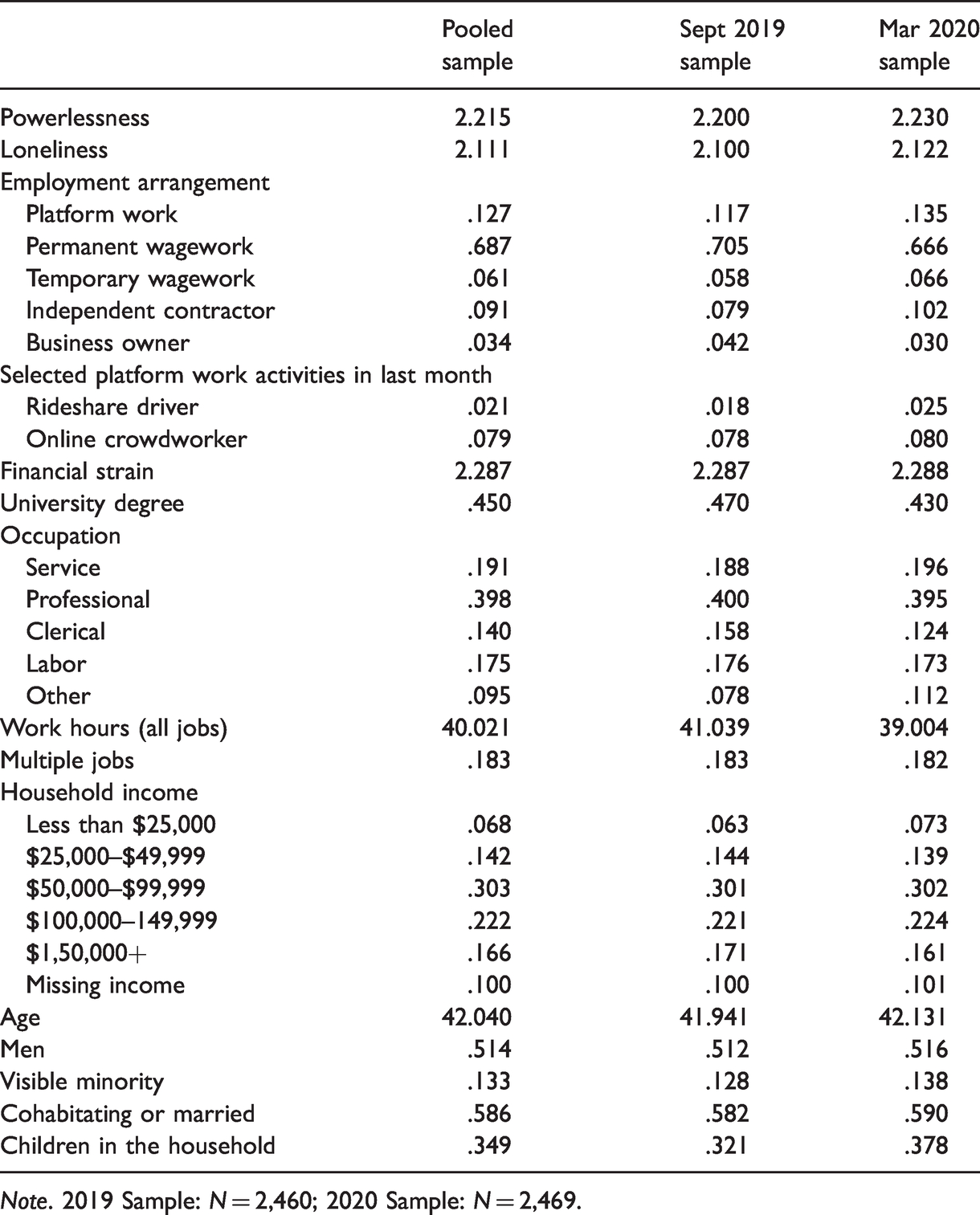
Note. 2019 Sample: N = 2,460; 2020 Sample: N = 2,469.
Bivariate Breakdown of Platform Work Engagement.
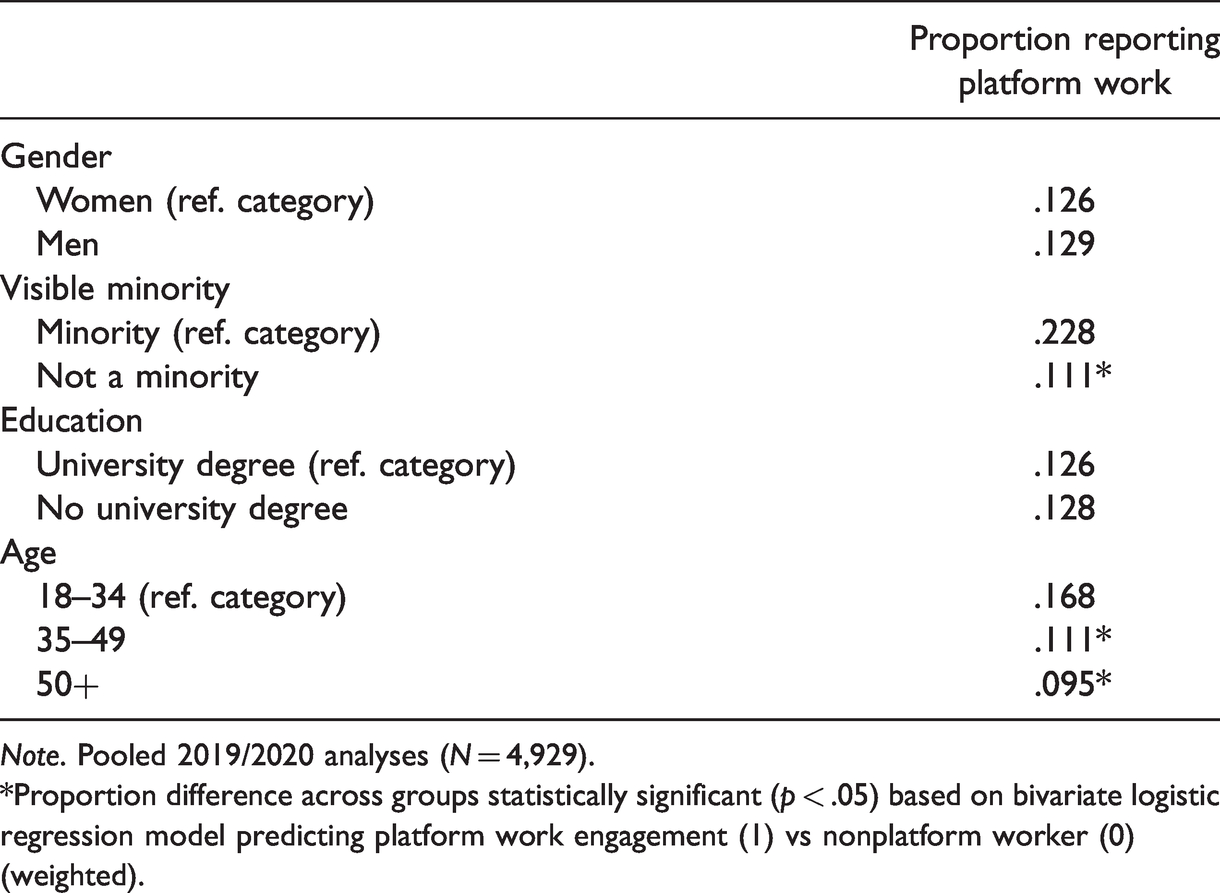
Note. Pooled 2019/2020 analyses (N = 4,929).
*Proportion difference across groups statistically significant (p < .05) based on bivariate logistic regression model predicting platform work engagement (1) vs nonplatform worker (0) (weighted).
Mean Comparisons of Focal Measures by Employment Arrangement.
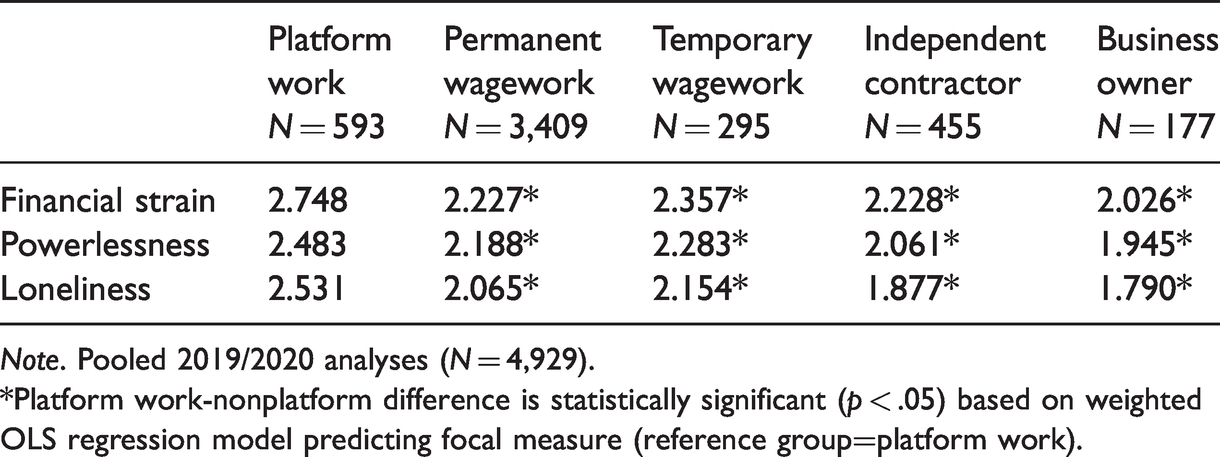
Note. Pooled 2019/2020 analyses (N = 4,929).
*Platform work-nonplatform difference is statistically significant (p < .05) based on weighted OLS regression model predicting focal measure (reference group=platform work).
OLS Regression Analyses of Powerlessness and Loneliness.
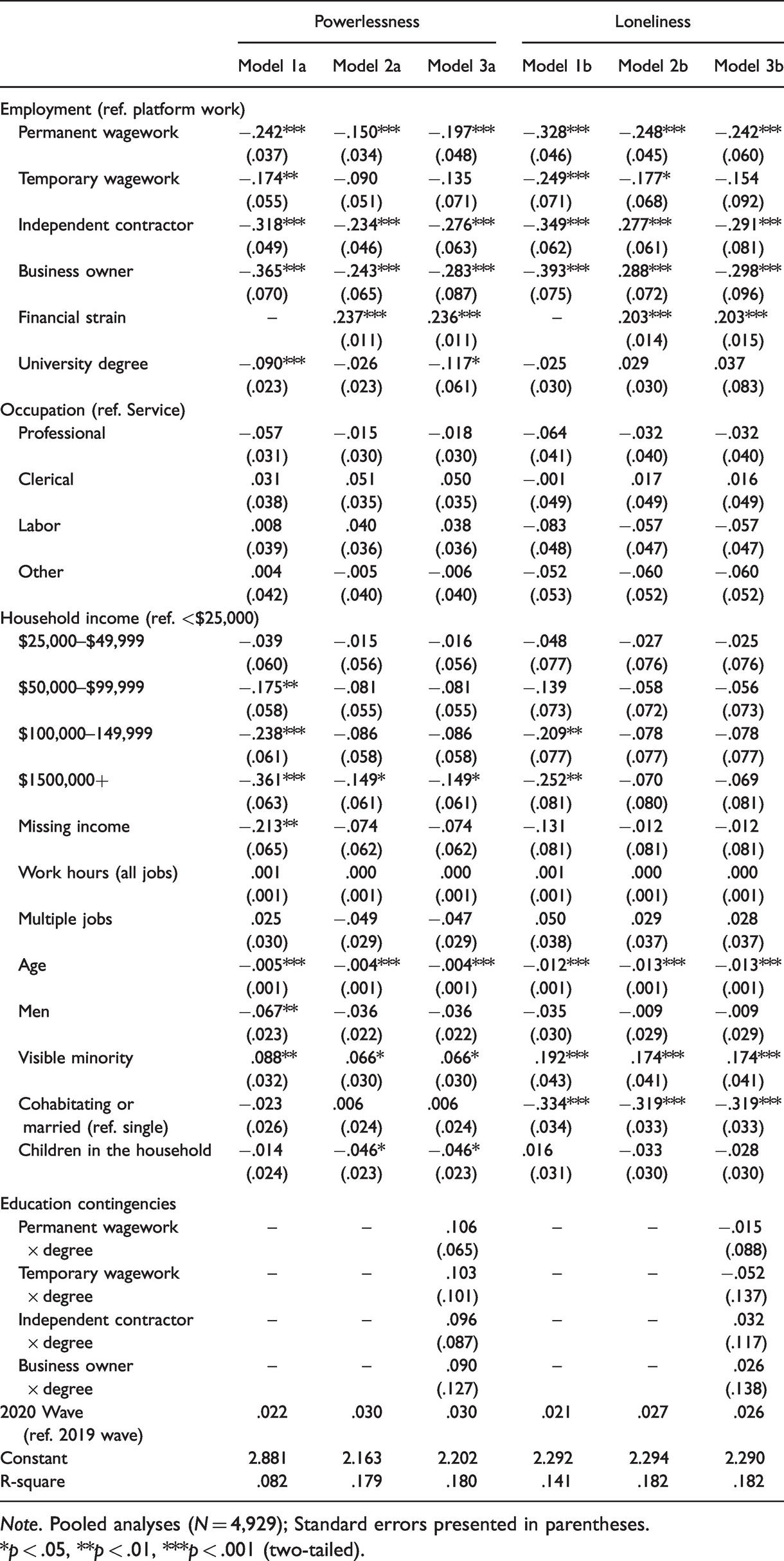
Note. Pooled analyses (N = 4,929); Standard errors presented in parentheses.
*p < .05, **p < .01, ***p < .001 (two-tailed).
OLS Regression Analyses of Powerlessness and Loneliness on Ridesharing Driving and Online Crowdwork Activities (Selected Regression Coefficients Presented).
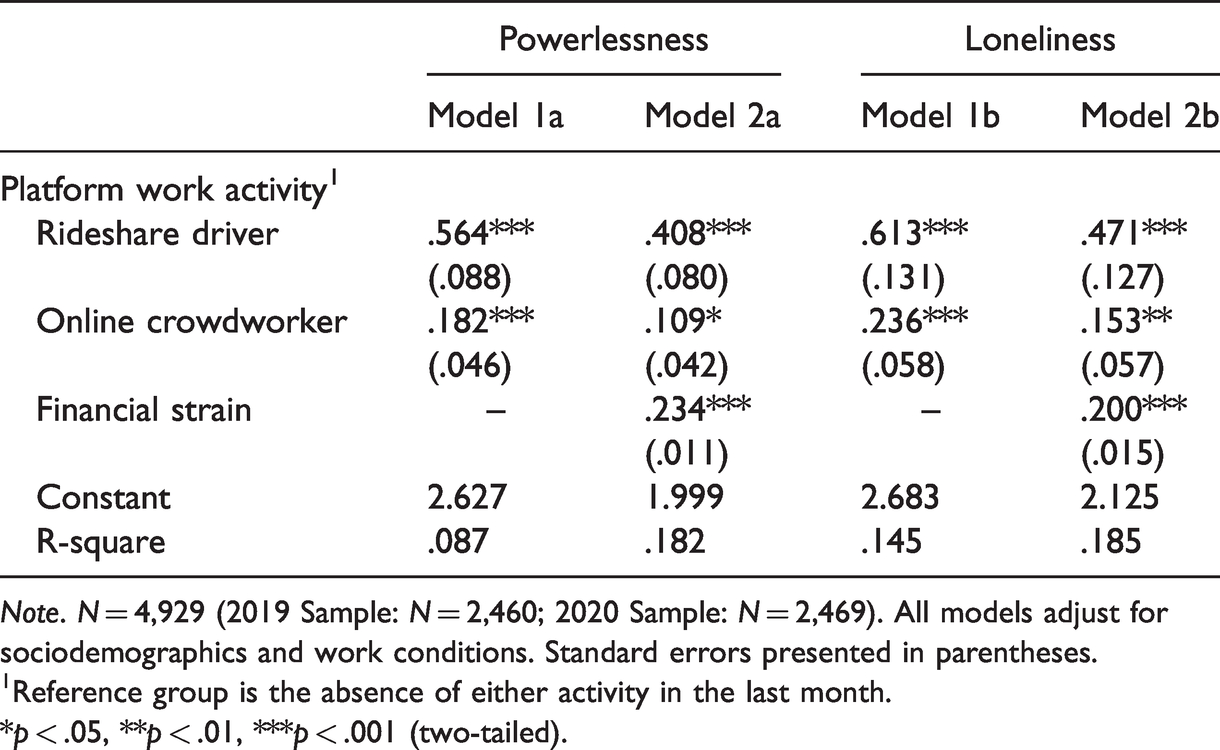
Note. N = 4,929 (2019 Sample: N = 2,460; 2020 Sample: N = 2,469). All models adjust for sociodemographics and work conditions. Standard errors presented in parentheses.
1Reference group is the absence of either activity in the last month.
*p < .05, **p < .01, ***p < .001 (two-tailed).
Results
Descriptives and Bivariate Analyses
Table 1 presents weighted descriptive statistics for focal measures and controls for the pooled and separate March/September samples. There are few noteworthy differences across the samples. The prevalence of platform work in March (13.5%) was slightly higher than in September (11.7%), although this difference was not statistically significant. Across the two samples, then, approximately 1 in 8 Canadians report that they are currently engaged in platform work. Regarding specific platform work activities, participation in online crowdwork was approximately four times more common than rideshare driving. Table 2 presents social status comparisons of general engagement in platform work, based on the pooled September/March samples. Visible minorities and younger workers are more likely to report platform work, but we find no evidence of significant gender or education differences in platform work enagegment. These patterns were consistent across September 2019 and March 2020 samples (not presented).
Table 3 presents a bivariate comparison of platform workers’ and nonplatform workers’ reported levels of financial strain, and their perceptions of powerlessness and loneliness for the pooled September/March samples. Compared to nonplatform workers in wagework and self-employment, platform workers report statistically significant higher levels of financial strain, loneliness and powerlessness. The largest worker discrepancy for powerlessness and loneliness exists between platform workers and independent contractors. Presenting these differences as semi-standardized differences—represented in units of standard deviation of powerlessness/loneliness—can aid interpretation of their magnitude. The powerlessness semi-standardized difference between platform work and independent contractors was .58, indicating more than half of a standardized deviation increase in powerlessness for platform workers—a substantial difference—while the loneliness difference across platform workers and independent contractors was similarly large (semi-standardized difference of .68).
When we compare platform workers to nonplatform workers in permanent wagework, the powerlessness and loneliness differences are smaller but still substantial (semi-standardized differences of .40 and .50 respectively). To illustrate the relative size of these powerlessness differences, we compare them to the powerlessness difference between those who hold a university degree and those with less than a degree—since education is an established and strong predictor of powerlessness (Mirowsky & Ross, 2003). Expressed as a semi-standardized difference, the platform work-permanent wagework difference in powerlessness (.40) is 2.4 times larger than the difference between university degree and nondegree holders (.17). As with the previous results, these patterns are consistent across the September 2019 and March 2020 samples.
Multivariate Results
Table 4 reports results from OLS regression analyses of powerlessness and loneliness. Since the results of these analyses are similar across samples, we present findings from the pooled September/March samples, highlighting any noteworthy differences. Model 1a reveals evidence of a statistically significant positive association between platform work and powerlessness, adjusting for control measures. Platform workers report statistically significant higher levels of powerlessness than nonplatform workers in permanent wagework, temporary wagework, and those that are self-employed. The largest difference in powerlessness exists between platform workers and business owners. In contrast, platform workers’ powerlessness levels are closest to those in temporary wagework, although the difference remains fairly substantial. Model 2a includes a measure of respondents’ financial difficulties to investigate if the greater perceptions of powerlessness among platform workers is in part or fully due to their underlying economic circumstances. Higher levels of financial strain are significantly associated with a greater sense of powerlessness. Furthermore, the platform work powerlessness differences observed in model 1a are reduced, although they remain significant, with the exception of the platform work-temporary wagework difference, which is no longer statistically significant. Despite the weakened platform work-powerlessness association after adjusting for financial strain, the standardized differences in powerlessness between platform and nonplatform workers (excluding temporary wageworkers) remain substantial, varying between .22 and .32. The majority of the tendency for platform workers to report higher powerlessness is therefore not explained by their greater vulnerability to financial strain—indicating support for hypothesis 1. The patterns revealed in models 1a and 1 b were consistent in separate analyses (not shown) of the September 2019 and March 2020 samples.
In model 3a of Table 4, we test a series of ‘employment arrangement x university degree’ interactions to examine whether the association between platform work and powerlessness varies by respondent’s education level. In the pooled sample, none of the interactions are statistically significant, indicating no support for hypothesis 3; however, individual analyses of the separate September 2019 and March 2020 samples reveal mixed findings. While in the September 2019 sample we find no evidence of any statistically significant ‘employment x university degree’ interaction, the ‘permanent wagework x university degree’ interaction coefficient is statistically significant in the March 2020 sample. Specifically, the higher levels of powerlessness experienced by platform workers, relative to permanent wageworkers, exists only among those without a university degree. Since the education contingency is limited to the March sample, we therefore find only partial support for hypothesis three.
Results for the analyses of loneliness are similar to results for powerlessness, with the exception of model 3 results. Model 1b in Table 4 reveals that platform workers report statistically significant higher levels of loneliness compared to workers in permanent and temporary wagework, and the self-employed. In model 2b, the inclusion of financial strain weakens the magnitude of the loneliness differences between platform and nonplatform workers by approximately 25 percent; however, the differences remain statistically significant. Moreover, the standardized platform-nonplatform worker differences in loneliness remain strong, varying between .2 and .3. As with powerlessness, financial strain is associated with higher loneliness, but only accounts for only a minority of the platform work-loneliness association. Thus, beyond their exposure to more financial difficulties, platform workers exhibit higher levels of loneliness—providing support for hypothesis 2. In model 3, the coefficient for the ‘employment arrangement x university degree’ interaction reveals no support for education contingencies in the underlying platform work-loneliness association (hypothesis 3); this is the case for both individual September 2019 and March 2020 samples. In contrast to the results for powerlessness, then, we observe no evidence that the association between participation in platform work and loneliness differs based on holding a university degree.
Supplementary Analyses: Selected Platform Work Activities
The previous analyses that reveal an association between platform work engagement and powerlessness/loneliness rely on a global measure of platform work that does not distinguish the activities of platform workers. To address this issue, we examine whether recent participation in two popular types of online labor platforms—rideshare driving and online crowdwork—is associated with powerlessness and loneliness. Models 1a and 1b of Table 5 present selected OLS regression results of powerlessness and loneliness regressed on rideshare driving and online crowdwork, adjusting for sociodemographics and work conditions (full analyses available on request). Rideshare drivers and online crowdworkers both report statistically significant higher levels of powerlessness and loneliness compared to workers not performing these activities, although the powerlessness/loneliness difference is considerably larger among rideshare drivers. Furthermore, models 2a and 2 b reveal that the associations between rideshare driving and online crowdwork and powerlessness/loneliness remain statistically significant after adjusting for financial strain. These results therefore support the findings from Table 4 that are based on a general measure of platform work engagement; however, they also suggest that the consequences of platform work for powerlessness and loneliness may vary depending on the activity and specific online platform in which workers are engaged.
Discussion
The structure and social-psychological consequences of work are perennial areas of interest in sociology, stretching back to Marx's discussion of the consequences of industrialization for alienation. The expanding nature of the gig economy through platform work draws attention to the relevance of these classical ideas to modern forms of work, and the degree to which the structure of platform-mediated gig work enhances alienation. Guided by Marx’s theory of alienation and emerging qualitative accounts from platform workers, we leveraged two nationally representative samples of Canadians to examine potential psychosocial inequities between platform workers and more traditional workers—an investigation, which, to our knowledge, is the first of its kind.
Approximately one in eight Canadians workers in the pooled C-QWELS samples reported recent participation in platform work, a participation rate that is considerably larger compared to previous Canadian research on the issue. Participation in platform work was higher among younger workers and visible minorities. Compared to workers in nonplatform work arrangements, platform workers reported more financial hardship, and greater experiences of powerlessness and loneliness—providing initial support for hypotheses 1 and 2.
Multivariate analyses also supported our prediction that platform workers would experience higher levels of powerlessness and loneliness than those in wagework and other instances of self-employment. Furthermore, with the exception of temporary wageworkers, the greater economic hardship reported by platform workers did not principally explain these associations. We also investigated possible socioeconomic contingencies in the association between platform work and alienation—positing that platform workers with more formal education would experience fewer negative consequences. We find limited support for this prediction in one of the study samples for powerlessness. Finally, in supplementary analyses we examined two specific types of platform work—rideshare driving and online crowdwork—and found that while both activities were associated with higher powerlessness and loneliness, rideshare drivers reported the highest levels of personal estrangement and isolation.
Conclusion
Marx’s theory of alienation linked the human condition to the structural conditions of capitalist labor. Marx's theorizing on the consequences of working conditions for alienation has in particular served to link the structural conditions of work to perceptions of powerlessness (Mirowsky & Ross, 2003). There are, of course, noteworthy differences that distinguish the experiences of platform laborers from workers during the capitalist industrialization period described by Marx. Platform workers rarely have direct contact with their employer, and they have considerably more latitude over when and for how long they work than early industrial wage laborers. Nevertheless, as a perpetually insecure workforce that can be easily replaced by a plentiful reserve army of labor, we believe a Marxian analysis remains relevant and insightful to the study of platform work.
In considering how platform work might foster an increased sense of powerlessness, we underscored the role of algorithmic control in allowing platform firms to manage a distributed and disparate workforce. While some hail platform firms’ cloud and geolocation technologies as an innovative fount of individual agency, our empirical evidence instead highlights their potentially demoralizing nature, in which individual agency is undermined by an algorithm that must be satiated, and the monitoring of efficiency and customer satisfaction serves to routinize labor and homogenize individual action. Like any firm control strategy, these surveillance efforts are not always successful, and the potential for worker resistance should therefore not be discounted (Edwards, 1979). Several researchers have documented, for example, the efforts of rideshare drivers and online crowdworkers to game algorithmic control systems or avoid monitoring entirely (Newlands, 2021; Wood et al., 2019). Despite this, our results suggest that for many platform workers, these strategies may be insufficient for retaining a sense of agency. We surmise that this is in part because of the pervasive and opaque nature of algorithmic work processes that make meaningful resistance challenging for the majority of platform workers. Future quantitative research should investigate these possibilities and the extent that platform workers experience more extensive and intrusive monitoring compared to workers outside the gig economy.
In positioning algorithmic control as a potential mechanism that links platform work to worker powerlessness, we question depictions of this line of work as entrepreneurial. Instead, we see the psychosocial outcomes of platform work more closely adhering to those experienced under tightly monitored temporary agency work. As a precarious nonstandard employment arrangement, agency work has been linked to reduced worker autonomy and poorer mental health (Elcioglu, 2010; Hünefeld et al., 2020; Rogers, 1995). However, in contrast to the relatively limited reach of staffing agencies, platform firms are theoretically able to access a much wider range of workers, due to algorithmic control systems that enable them to automate or delegate key supervisory and administrative functions (Vallas & Schor, 2020). The potential psychosocial implications of this proliferating labor model are therefore considerable.
Our findings also suggest that platform firms, as labor market intermediaries, constrain workers’ opportunities for social connection. Platform workers in the C-QWEL studies were more vulnerable to loneliness—a pattern that speaks to a broader debate about the consequences of both remote work and the eroding social contract between organizations and workers. The themes of social isolation in Marx's writings have been less emphasized in sociologically-oriented psychology than those of powerlessness, but our findings underscore how modern labor conditions may deter communal work in favor of isolation under the guise of individuation. Such isolation has been argued to serve larger structural purposes by preventing collective action against structures of exploitation, but it also harms the worker by creating a greater sense of psychological separation in the form of loneliness. Loneliness, in turn, has been linked to numerous adverse health effects (Cacioppo & Cacioppo, 2014). These findings therefore illustrate how the structure of the contemporary gig economy can have adverse consequences for the well-being of individual workers through not simply the direct experience of work, but also the damaging psychological residue this structure leaves behind.
In setting out the theoretical basis for our predictions, we focused on common organizational and technological characteristics of platform firms that we expected would undermine worker autonomy and social interaction. However, there is, of course, variation in the activities and skill levels of platform workers that may alter their experiences of autonomy and social connection (Gray & Suri, 2019; Schor et al., 2020). We found some support for this argument in our results: evidence of a socioeconomic contingency in the association between platform work participation and powerlessness in one of the study samples, and stronger associations with powerlessness and loneliness among rideshare drivers compared to online crowdworkers. The weaker association between online crowdwork and powerlessness may reflect the ability of certain groups of online freelancers with in-demand skills to resist the control efforts of platform firms—an explanation that is consistent with the revealed socioeconomic contingency between general platform work participation and powerlessness. Alternatively, rideshare drivers’ higher levels of powerlessness relative to online crowdworkers may be due to cross-platform variation in the extent that platform firms seek to control workers (Griesbach et al., 2019). Nevertheless, it is worth underscoring that both groups of platform workers reported higher levels of powerlessness and loneliness compared to workers not performing these activities. Future research should look for more evidence of possible platform differences in workers’ vulnerability to powerlessness and isolation by examining participation across a wider range of platforms.
There are several limitations to this research that should be noted. Our ability to infer conclusions about causal relationships between platform work and powerlessness and loneliness are constrained by the cross-sectional nature of the C-QWELS samples. Further longitudinal research is necessary to identify the appropriate temporal sequencing between participation in platform work and experiences of alienation, since it is possible the individuals who feel powerless and isolated seek out this form of employment. Relatedly, qualitative research probing the life histories of platform workers could be valuable in illuminating individuals’ biographical pathways into the gig economy. While researchers have considered how financial hardship may push some into platform work (Ravenelle, 2019), we are unaware of any research that examines whether personality traits, such as mastery and sociability, shape attitudes about the desirability of this line of work. Further research on this issue is therefore warranted.
A further limitation is that we propose structural characteristics common to platform work to explain its association with powerlessness and loneliness, but we do not directly test these as mediating mechanisms in the association. While we believe the theorized mechanisms put forth are consistent with existing qualitative accounts of platform work, future research should incorporate measures of platform workers’ perceived autonomy as well as the quality and quantity of their social interactions on the job. We also lack information on the extent that workers rely on online labor platforms as their primary income source—preventing us from examining whether dependency on platform employment influences ones’ susceptibility to powerlessness and loneliness. Given that workers pursue platform work for a range of reasons (Schor et al., 2020), there may be worker variation in the extent that they are able to resist challenges to their autonomy. Future research should therefore develop new measures to assess platform dependency and platform-specific participation. Finally, future studies should investigate whether these findings hold outside of the Canadian context. Given ongoing legal battles over the employment status of gig workers and the broader regulation of platform firms, it is possible that regional variations may exist regarding the rights and working conditions of platform workers—differences that may have implications for their mental health and social relationships.
Footnotes
Declaration of Conflicting Interests
The authors declared no potential conflicts of interest with respect to the research, authorship, and/or publication of this article.
Funding
The authors disclosed receipt of the following financial support for the research, authorship, and/or publication of this article: This research is funded by the University of Toronto COVID-19 Action Initiative 2020 and Tri-Council Bridge (Scott Schieman, PI).
