




Abstract
This essay places the work of the art historian TJ Clark in relation to the social and political philosophy of Gillian Rose. It develops an interpretation of the ideas that inform his art history, and of the ways in which they inform his advocacy of a ‘tragic’ approach to what he calls ‘Left’ politics. The latter approach is intended to avoid the dangers that Clark takes to be inherent in the Left's classical focus on shaping the social conditions of the future. The essay shows that Rose's philosophy is also sensitive to such concerns, and that it echoes aspects of Clark's position. In her work, however, this does not come at the cost of abandoning an orientation to the future. These points are developed via a discussion of the two writers’ respective conceptions of modernity, and via a consideration of their differing readings of two paintings by Nicolas Poussin.
Introduction 1
Since the early 1970s, TJ Clark has produced an extraordinarily rich set of contributions to the field of art history. His work is commonly associated with the ‘social history of art’: an approach that foregrounds art's relations to the social contexts in which it was made and received, and which he has consistently used to draw contemporary political significance from the art of the past. This has involved a sophisticated methodology, which Clark casts as a form of ‘materialism’. Over the past two decades, that methodology appears to have grown into a broader philosophical outlook, insofar as his art-historical work has come to employ a set of connected ideas about human existence, history and social life that stem from that ‘materialist’ perspective. This body of ideas remains largely unexamined, not least because it is almost entirely interwoven with his analyses of artworks, but it merits critical discussion. In this essay, I try to add to the few attempts that have been made to reconstruct and evaluate it. 2 But rather than focussing solely on Clark, I place his work here in critical dialogue with the social philosophy of Gillian Rose.
Rose’s work, I hope to show, can help to highlight some of the primary merits and problems within Clark’s ideas, and may also point towards means of developing them further. Much of this will centre around their respective views concerning modernity, temporality, and political change. Clark’s perspective is informed by a highly critical conception of the forms of social life engendered by capitalist modernity, but also by deep scepticism towards classical anti-capitalist projects that would remedy such problems by pursuing visions of a markedly different and better future. The past failures of such projects, and the nature of our current context, lead him to advocate a much more restrained focus on the present. Rose’s work is informed by similar concerns, but her position, I shall argue, is preferable to Clark’s. Where he actively warns against setting out to shape the future, she derives a future-oriented politics from attending to the same kinds of issues that prompt his scepticism. The critical comparison that I conduct here is thus meant to serve not only as a means of appraising Clark’s ideas: it is also intended to foreground the significance of these aspects of Rose’s work. As I hope to indicate, Rose’s maxim, ‘Keep your mind in hell, and despair not’ (Rose 2011: 1) – a phrase that perhaps encapsulates much of her philosophy – affords a far less melancholic response than that offered by Clark.
Tragic humanism and the ‘Left’
Clark can be understood as advancing a form of humanism, insofar as he draws ethical and political claims from a conception of the fundamental nature of human life. 3 The perspective that this affords is ‘tragic’, to use his own term: value and significance are located in human efforts not despite of, but rather because of their susceptibility to failure (e.g. ‘Tragedy is about greatness come to nothing. But that is why it is not depressing’ (Clark, 2018: 242)). This view has a very broad scope. The flawed projects that it addresses are not just those of individuals, but include grand political struggles, and their failures encompass disaster, violence and war. This produces a very sober and sombre vision of the human condition; but because a sense of flawed ‘greatness’ is found within that condition, 4 Clark develops, on this basis, a solidaristic ethics and a similarly ‘tragic’ politics that would ‘operate with a sense of the horror and danger built into human affairs’ (2018: 245).
Clark is particularly concerned to recommend that politics to what he calls the ‘Left’. His most overt expression of that recommendation was made in 2012, in a piece titled ‘For a Left with no future’ (later republished as the coda to his Heaven on Earth of 2018). Its title works in two senses: the ‘Left’ is defunct and has no viable future in its current form; if it is to rectify that problem, it must recognise the tragic condition sketched above, and adopt a different temporality. Temporality is important here because he sees the Left as having been captivated, throughout its past, by the pursuit of a utopian future.
Clark's ‘Left’ is a rather nebulous category (albeit one that he places himself within). It is clearly not reducible to the purportedly left-wing elements of modern parliamentary politics, or indeed to liberal and left-of-centre cultural attitudes. Instead, it concerns an older, and much bolder, political project: a ‘project of opposition to the present order of things (and to the present forms of opposition to those things)’ (Clark, 2009: 80) that has, classically, taken the form of a drive towards the transformation and emancipation of collective social life through ‘root-and-branch opposition to capitalism’ (Clark, 2018: 238). In his view, this classical, anti-capitalist iteration of the Left is dead in the water: it has been disabled and discredited by its own past, and it now finds itself faced with a version of capitalism that encompasses the entire globe. Distancing himself from his own early revolutionary affiliations (Clark was a member of the Situationist International (SI) during the late 1960s, and subsequently of its UK-based anarchist offshoot, King Mob), he thus argues that the Left's politics must be revised. Rather than basing itself around the pursuit of a future condition in which the world's ills might be resolved, it should recognise that no such resolution is available. Moreover, acknowledging our tragic susceptibility to failure ought also to give pause to any new attempt to forcibly impose the good life upon the world. In place of its classical orientation towards a redemptive future, the Left should now take its bearings from the inadequacies of contemporary social life, and from the limitations and errors of its own past projects. 5
Rose, I think, can help us to evaluate these claims. Before her untimely death in 1995, she produced a body of work that echoes Clark's emphases on the need to attend to past and present sociopolitical failings. It also accords with, and can help to develop, his wariness towards the positing of redemptive and utopian political ideals. But Rose does all this without relying on a conception of human nature (I take this to be a virtue; as Clark himself admits, ‘those last two words have traditionally made the Left wince’ (Clark, 2018: 244)), and without abandoning an orientation to the future, or indeed rejecting modernity. The latter two concerns are both integral to Clark's position.
I try to characterise Clark's conception of modernity below, but suffice it to say here that he sees it, primarily, as the social and cultural context generated by the historical imbrication of capitalism, science, technology, consumerism and modern politics. He is a romantic of sorts, and he argues for an outright break with modernity's social relations and their intrinsic problems; the classical Left, he holds, has been far too closely tied to it. Rose, on the other hand, has a more expansive and philosophical conception of modernity. It effectively encompasses Clark's own, and it stems from her idiosyncratic reading of Hegel. She sees it as the predicament posed by the historical emergence of a post-Enlightenment social context in which the norms and commitments that structure our lives can be understood, philosophically, as mutable historical constructions; as a context in which merely ‘given’ forms of authority can seem arbitrary, and require justification. 6 Such justification cannot be assumed and imposed. In her account, it can only be generated from working through, and from trying to correct, the flaws and limitations of those constructions. This echoes elements of Clark's recommendations towards the Left, given that he too warns against such imposition and advocates learning from past errors. But the correspondence only goes so far: Clark's recommendations are tied to an apparent desire for an outright break with modernity's forms of subjectivity and social relations, and any such break seems suspect when viewed from Rose's position. This is because it would amount to evading the ongoing and necessarily future-oriented task of working through and addressing modernity's errors. Ironically, when seen from her perspective, such evasion risks similar mistakes to those that Clark attributes to the classical Left (i.e. a failure to truly work through past mistakes).
In consequence, their politics of time also differs. For Clark, the Left's focus on the future is a fundamentally modern trope. Modernity, in his view, is characterised by a constant and purportedly progressive impetus towards the future. This invites disregard for our tragic condition, and courts disaster; hence his desire for a genuinely different politics, and his call for the Left to turn to realistic, reformist and short-term concerns. Capitalism, he holds, must be accepted, at least for now (‘The question of capitalism … has to be bracketed. It cannot be made political. The Left should turn its attention to what can’ (Clark, 2018: 239)). ‘Left’ politics should be ‘present-centred, non-prophetic’ and ‘disenchanted’: it should ‘not … look forward’ (Clark, 2018: 241–2), and its classical orientation towards the future should be dismissed.
I am a great admirer of Clark's work, but his pragmatic reformism and hostility to modernity sit very awkwardly together, and I take his rejection of the future to be a great mistake. Disenchantment, reformism and scepticism towards utopia may all be eminently sensible, but given the host of environmental, political and economic crises that loom on our collective horizon, surely any contemporary iteration of a viable ‘Left’ – and certainly any iteration of a solidaristic humanism – ought to be fundamentally concerned with the future. Rose, I think, offers a better approach in this regard: one that can accommodate many of Clark's ideas whilst avoiding some of their difficulties. As I try to show below, she builds something akin to Clark's ‘tragic’ attention to failure, and his wariness towards imposed ideals, into a conception of the modern condition itself (thus avoiding his reliance on a human condition); and because she sees modernity as corrigible, if also perpetually flawed, she also avoids turning away from the future. ‘Freedom … must be first sought out and won; and that by an incalculable medial discipline of the intellectual and moral powers’ (Hegel, 2005a: 40–1). For Rose, the ‘medial discipline’ of working through modernity's broken social relations and forms of subjectivity – of engaging, as she puts it, in ‘the struggle for recognition in its changing configurations of misrecognition’ (2017: 67) – requires a historical process, and thus a drive towards the future.
So, in sum, I shall argue: (a) that despite the undoubted merits of Clark's art-historical writings, his rejection of modernity and of a politics orientated towards the future are mistakes; and (b) that Rose's work can accommodate many of Clark's concerns whilst avoiding those mistakes. I end the essay with (c) some brief and supplementary remarks concerning the possibility of approaching Clark's politicised art history through a more Rosean framework.
Clark's ideas are treated here at some remove from the art-historical studies in which they developed. But to avoid drifting away from art history altogether, I include two short discussions of paintings by Poussin. These are Landscape with a Man Killed by a Snake (1648), on display in London's National Gallery, and Landscape with the Ashes of Phocion (also 1648), which hangs in Liverpool's Walker Gallery. Clark treats the former at length in The Sight of Death (2006), and Rose employs the latter in her Mourning Becomes the Law (1996). I use the former to illustrate Clark's tragic humanism, and the latter to depict aspects of Rose's philosophy.
Art as agon
I shall begin, then, by trying to trace the ideas attributed to Clark above – those concerning tragedy, temporality, the fate of the Left, and modernity – back to their origins in his art-historical work. This requires some comments on the political importance that he attributes to visual imagery.
Clark's materialism is not just an ontological claim about the primacy of matter. He is instead much closer to the Marxian historical materialist contention that human thought, action and potential are always both enabled and constrained by the social formations and relations of a given time. His approach thus involves treating the artwork, as he puts it, as ‘something produced’: as a ‘material and historical object, tugged and shaped by a field of conflicting voices, practices, wishes, perspectives and powers’ (Clark, 2008: 3–4, emphasis in the original). But Clark differs from the tradition somewhat, because he places great emphasis on the role that visual imagery plays in relations of production.
Forms of social life, he points out, can be both reinforced and challenged through the ways in which they are represented by and to their participants. His art history attends to this, but, in doing so, it situates artworks within ‘actual struggles for power over images and power through images’ (Clark, 2008: 6, emphasis in the original). This follows from the great stress that he places on the importance of the non-verbal character of ‘imaging’, and of ‘visual communication’ more generally. ‘[I]maging’, he writes, is one of the great means by which human subjects have proposed (always fitfully, and against the grain) accounts of human suffering and aspiration that the powerful have not been able to turn immediately, or even wholly and irrevocably, to their purposes. (2007: 178)
Or again: ‘imaging’ is a potential means of ‘imagining otherwise’ (Clark, 2008: 18), and of pushing – however tacitly, and in however limited a manner – against the ways in which ‘words define the limits of the known’ (Clark, 2007: 178).
Clark thus seems to link language to the patterns of thinking proper to any given social context, and holds that visual art, despite being shaped and constrained by these patterns, may also have the capacity to test them. I take him to hold that, because images are non-verbal, they may contain and articulate possibilities and sensibilities that cannot be entirely captured by the discourse of a given moment. They involve a form of non-verbal mentation: a mode of thought that lies ‘at the edge of the verbal’, and which is ‘never out of discourse's clutches’ (Clark, 2007: 179), but which still holds the capacity to counter ‘discourse’ to some degree by enabling a different kind of thought (e.g. while discussing a Giotto, he writes that it evokes ‘that moment of suspension in everyday life, entirely commonplace and recurrent, when something half-enters the world as we understand it and puts our world-picture to the test’ (Clark, 2018: 70)). 7
On this basis, Clark's social-historical approach treats art and its traditions as ‘double-edged phenomena’ (2008: 2), and the artwork ‘as an agon not an icon’ (6). On the one hand, traditions of artistic representation involve ‘tremendous exclusions of other imaginings of the world’ (Clark, 2008: 2), which reflect the power relations of the social actors that produce them; yet on the other, because visual art is located at the edge of ‘the verbal’, the works themselves may contain faint, recoverable traces of the dimensions and range of social life excluded by the ‘discourse’ of the context in which they were produced, and indeed by that of our own present. Clark's social history of art thus offers something akin to ideology critique. 8 It uses art to look for a ‘thought-world's moments of true discontinuity’, and thereby for ‘moments at which a wider or deeper dimension of our history can sometimes put in an appearance’ (Clark, 2019b): for a sense of human possibility, which on this view is always instantiated within, and limited by, material social relations, but which can also exceed them.
Touches of anthropomorphism can be found here: Visual images were, for a start, made in the past with limited and intractable physical means. An oil painting or a lost-wax bronze are pathetic, vulnerable, proud things. They bear the mark of individual or collective effort … The best oils and bronzes are full of a sense of – a positive reflection on – their own mere thinglikeness and vulnerability (as well as exultation in the thinglikeness and vulnerability overcome). In a word, they are human. They spell out the limits of human imagination and practice. (Clark, 2008: 17, emphasis in the original)
Like human agents, artworks, for Clark, overcome mere ‘thinglikeness’ through the ways in which their physical existence is shaped by the work of the mind; yet it seems that neither agents nor artworks are ever wholly ensconced within the discourse and ways of making sense that mind produces. They remain rooted in the material, and thus, on his view, in that which discourse speaks about and shapes, but never fully or finally encompasses. I shall contend below that Clark treats this somewhat ineffable sense of materiality as grounds for opposition to, and departure from, modernity's patterns of thinking and forms of social life. First, however, we should look at his understanding of modernity, and at the concerns that inform ‘For a Left with no future’.
Farewell to an idea
Clark presents modernity as a condition that has emerged from the slow growth of science, reason and technology from the late Renaissance onwards. It is marked by an increased sense of historical change, and of the world's mutability, but also of contingency, and of society's subjection to blind, impersonal forces. The slow weakening of traditional forms of normative authority (nature, crown, religion, etc.) is coupled here to the growing jostle and anomie of the cities, and to life's dependencies on the calculations and abstractions of the market. 9 Its driving force has been the progressive attainment of the social good, but this good has been envisaged in a host of different and often destructive ways (freedom and justice, but also control over nature, colonisation, the New Man, the rationalisation of social life, the growth of capital, etc.).
Clark's consequent scepticism towards modernity's promises might seem to place him close to Jean-François Lyotard et al., but he is too tied to materialism and to elements of Marxism to be fully on board with ‘postmodernism’. Modernity and its problems are wedded, for Clark, to the development of capitalism, and he takes the latter to have produced atomised, disaffected masses, subjected, today, to both material and existential poverty: to the thinned social fabric of neoliberalism in the metropoles, to exploited and ravaged states elsewhere, and to the general subordination of all to what Clark calls the ‘spectacle’ of commodified happiness. These views, together with his art-historical attention to social class, might seem to lend support to the common description of Clark as a ‘Marxist’ writer. But that label doesn’t quite fit either. This is because Clark, as indicated earlier, sees modernity as a catastrophe that the ‘Left’ has failed to confront. In his view, the Left has, historically, echoed modernity's primary characteristics and dynamics: it has advocated and undertaken future-oriented efforts of progressive social transformation, guided by visions of technologically and bureaucratically facilitated utopias and steered by enlightened vanguards.
That charge came to the fore in his Farewell to an Idea (Clark, 1999a). He argued there that both the modernist art and socialisms of the 20th century failed because they were too closely interwoven with modernity, and did not envisage or provide viable alternatives to it (a modernist propaganda board by El Lissitzky provides a suitably bleak example: ‘The Workbenches of the Depots and Factories are Waiting for You. Let us Move Production Forward’ (Clark, 1999a: 228–9)). 10 Having distanced himself in that book from ‘early twentieth-century messianism’ (Clark, 1999a: 7), Clark's work then became marked by a search for intellectual resources that might form the basis for a genuine alternative to modernity's social relations, 11 and thus for a new form of socialism (‘if that's what we shall persist in calling it’ (Clark, 2006a: 240)): one that would not echo modernity's constant push towards a promised future. I take this to amount to a search for a means of exit from, or at least total opposition to, modernity: he has spoken of ‘opposition to modernity’, seeks an ‘antithesis to modern life’ (Clark, 2006a: 240–1), and contends that ‘effective resistance has to be framed in terms that challenge the whole texture of modernity’ (Retort, 12 2006: 189).
This search has led him to draw on conservative and aristocratic critics of modern life (Heidegger to some degree, and Nietzsche in particular, despite Clark's explicit distaste for their politics), and to study artworks produced prior to, and at the inception of, the modern period. 13 But most importantly, it has led to the interest in tragedy and the tacit humanism that I outlined earlier: for if modernity is characterised by a constant, progressive pursuit of a future in which our present ills might be resolved, it can be countered by attending to death, failure and the disasters produced by that pursuit. And with that in view, I shall now pause and try to summarise by turning to one of Poussin's landscapes.
The running man
Clark's The Sight of Death is a book-length study of two paintings by Poussin: Landscape with a Calm (1651), and Landscape with a Man Killed by a Snake (hereafter Snake) (Figure 1), both of which were on display during his stay at the Getty in 2000. It is composed from the diary entries that he made whilst visiting those paintings on an almost daily basis. As the book progresses, Snake takes centre stage, and Clark becomes increasingly involved in drawing out ethical and political ideas from the image. I cannot possibly do justice to its subtleties, so I shall simply focus on its general theme: balance.
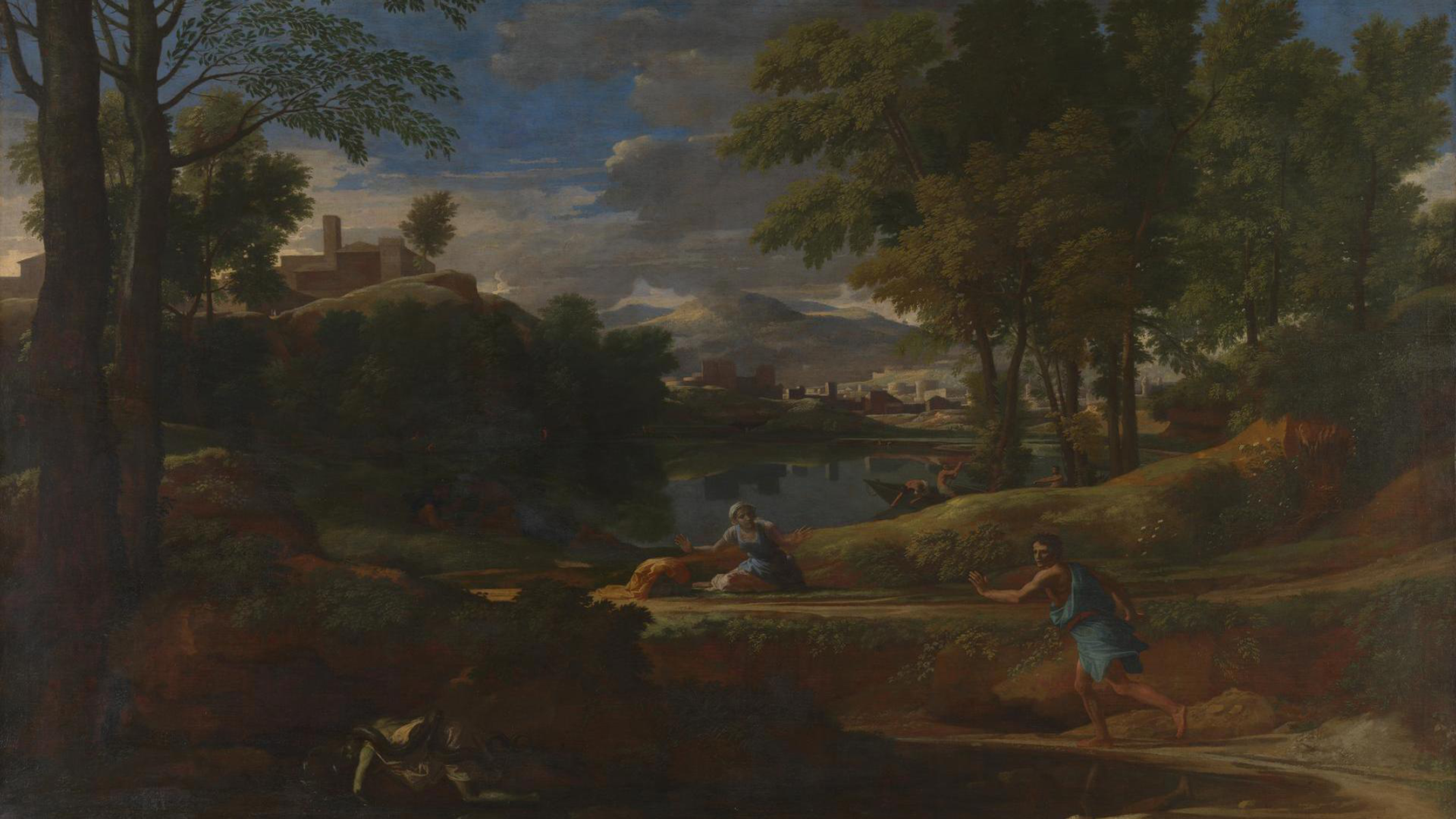
Nicolas Poussin, Landscape with a Man Killed by a Snake.
Clark attends to many examples of balance throughout the book (between individual marks and the painting's overall space, its horizontals and verticals, darkness and light, etc.), and thereby builds the claim that the painting balances human life and sociality against nature and mortality. He holds that much of the painting's success follows from the extent to which it gives death its full due. But although mortality is accorded real gravity, its weight is countered (‘the snake is deadly, the stream chilling, but not the morning that makes them visible’ (Clark, 2006a: 195)); this ‘isn’t a picture where darkness is winning’ (190). Its subject, he proposes, ‘is the nature of Nature, and the place of the human within it’ (184), and its answer, to quote his ventriloquisation, is that one can have ‘ “confidence in the world”, snakes and all’ (195).
Clark treats this stoic message in terms of a further balancing act between the verbal and the non-verbal. He develops a great deal from the running man's hand-signal, and from the developing awareness amongst the people in the background. The human figures are beginning to engage in communication. The snake, meanwhile, is linked to the material and non-verbal: to death, failure and that which interrupts and ruptures our ways of making sense. And although the man is running towards ‘the world of signs’, and into language, ‘he has not quite escaped from the dark foreground’ (Clark, 2006a: 106) of dumb nature, and he cannot take his eyes off ‘the particular form in which the world rears up in front of him [i.e. the indeterminate form of the snake], looking like nothing anyone can say’ (Clark, 2006a: 150–1). This is developed in a lecture on the painting: [Is the distance between the man's outstretched fingers and the woman's] just great enough to register – to be a metaphor of – everything that human sign-language cannot cross, cannot contain? … [Is] the running man still essentially in the snake's world? … Or does the partial mirroring of hand-signals on either side of the gap between him and the woman produce just enough of reciprocity and bind him already back into language? (Clark, 2002: 141–2)
The running man is poised on the brink of a world of discourse and social life – a world of solidarity and sociality that is beginning to respond to the tragedy that he reports – but with one foot in the dangerous, potentially disruptive realm of material nature and human mortality that he eyes so attentively. He thus serves as a figure for a new, tragic politics. Snake, Clark claims, indicates the characteristics of a ‘new socialism’ that would differ from its predecessors: a socialism that would be more materialist, insofar as it ‘starts from misfortune, pain and death’, rather than from redemptive visions of the future, and which recognises that ‘affliction and monstrosity … are always the true face of utopia’ (2006a: 240). And with that in mind, let us now return to Clark's ‘For a Left with no future’.
Abstention from futurity
As noted, that essay was republished in 2018 as the coda to Clark's Heaven on Earth. That book is concerned with religion, both broadly and narrowly construed, and it is shaped by the view that contemporary modernity is swamped by quasi-religious images of promised future happiness. Social life is lured ever-onwards by the dangling carrots of the commodity's next-best-thing; religion, traditionally conceived, continues to play a palliative function; religious revolutionaries – prominent at the time the book was written – pursue visions of a redeemed and mended world; secular radicals of varied political stripes present their own visions of the future. Clark treats all these phenomena under the same ‘religious’ rubric, insofar as they all answer present inadequacies with the promise of better conditions to come. In response, the book discusses a series of paintings by Giotto, Breughel, Poussin and Veronese. He contends that their representations of the divine contain traces of a concern with the human and the earthly, and that they thereby point, tacitly, towards locating the value and significance attributed to the heavenly within a more flawed and mundane human reality. Notes ‘questioning the reality of heaven’ are thereby detected in historical art ‘steeped in the view of the world it puts into question’ (Clark, 2018: 17), offering views pertinent to the modern world's captivation with its own various forms of ‘religion’.
‘For a Left with no future’ should be set against this backdrop (Clark writes that the essay was ‘written as the elements of [Heaven on Earth] began to coalesce’, and that it ‘gives a glimpse of the politics underlying [that book's] whole project’ (2018: 22)). It presents the argument outlined earlier: the Left has no viable future in its familiar forms, and it should reject all forms of eschatology. It should recognise that human life can never be perfected, and should find a new, wiser and more moderate value in that lack of perfection. 14 The ‘heaven’ of a perfected communism, and any Messianic notion of redemptive and cleansing revolution, must be abandoned: ‘Left politics’ should be ‘transposed into a tragic key’ (Clark, 2018: 242). So, where does this leave us?
Despite the romantic current in Clark's thought, he rejects any ‘fantasy of Going Back’ (Retort, 2006: 208) to an imagined pre-modern world of tradition, community and authentic meaning (that way lies romanticism's darker side). Yet, in effect, he also rejects going forward, because he thinks that renewed attempts to steer a course towards a socialist future would involve repeating the problems of the past: namely, a blithe disregard for human failings, driven by yet another attempt to establish the good life. Hence his claim that ‘any re-thinking of human possibility has no choice’ today ‘but to re-imagine time itself’ (Clark, 2018: 236); and this, for Clark, means ‘abstention from futurity’ (258).
The result is a position that seems, paradoxically, both too demanding and too mild. At times, it seems to set the inordinate Nietzschean challenge of developing alternative forms of subjectivity and sociality to those engendered by modernity; at others, it constitutes a present-centred reformism that has disappointed Clark's more radical readers. 15
That tension is held in abeyance to some extent by Clark's emphasis on preparatory work (e.g. ‘The Left has a long way to go even to lay the groundwork of such a project’ (Retort, 2006: 185)), and by the sheer scale of his demand for moderacy: [It is] wrong to assume that moderacy in politics, if we mean by this a politics of small steps, bleak wisdom, concrete proposals, disdain for grand promises, a sense of the hardness of even the least ‘improvement’, is not revolutionary – assuming this last word has any descriptive force left. … A politics actually directed, step by step, failure by failure, to preventing the tiger [of political violence and destruction] from charging out would be the most moderate and revolutionary there has ever been. (Clark, 2018: 253)
I’m not sure that this works, because Clark's reformism sits so strangely with his hostility to modernity. 16 And regardless of whether we foreground Clark's emphasis on reform or rupture, we are still left with a politics that turns away from the future. As indicated earlier, that is surely the last thing that the Left, or indeed anyone else, should do. So, with that in mind, let us now turn to Rose.
Paradise for a sect
Rose's work was shaped by her critical response to anglophone academia's captivation, during the 1980s and 1990s, by ‘postmodern’ theory, and the attendant view that the 20th century's disasters had thoroughly invalidated the promises of modernity and Enlightenment reason. For her, to put it crudely, the latter judgement presupposed the very values and reason that it would contest. This led her to develop a difficult and balanced stance, based around a much more nuanced conception of modernity.
Rose's notion of modernity is not easily reducible to a sociological picture of capitalist society and culture (as appears to be the case with Clark to some degree). It is, instead, the broader predicament of finding ourselves in a world wherein the norms that shape our subjectivities and social relations seem increasingly to be mutable constructions. Their mutability does not make them dispensable; this is not a condition that one can simply position oneself ‘outside’ or ‘against’, because any such positioning would be articulated by elements of that which it would contest. Consequently, when seen through Rose's work, Clark's opposition to modernity should be treated with some scepticism.
There are, however, strong similarities. Like Clark, Rose was wary of unexamined political ideals. In her view, critical attention must be paid to their social origins, so as to avoid confusing the desires of a particular faction for the needs of the social whole. Such a confusion could result, to borrow Clark's phrasing, in ‘ “paradise for a sect” (meaning hell for everyone else)’ (2018: 23). And like Clark, Rose emphasised the need to attend to social misrecognitions, mistakes and political disasters – to the tragic, in effect – in order to try to learn from them, and to avoid repeating them. Uncritically accepting the norms and values that operate within contemporary society risks perpetuating its past and present injustices; thus, any politics that based itself upon them without interrogating them would be off to a bad start. If it did not first engage in ‘investigating its own implication and configuration’ within modern society's divided social practices and flawed forms of subjectivity, it could result in the ‘imposition of ideals’, and the assertion of ‘imaginary communities’ (Rose, 1992: xi–xii), that only echo and deepen the divisions and flaws from which it arose. Rose is close, then, to Clark's worries about the politics of the historical Left; yet, when seen from her perspective, the comparatively reactive and immediate departure suggested by his desire for a full ‘antithesis to modern life’ risks missing, as she puts it, ‘the recognition of our ineluctable grounding in the norms of the emotional and political culture’ (Rose, 1997: 54) that produced those problems in the first place. His position would then be exposed to much the same problem that he warns against.
In pursuit of the absolute
In Hegel Contra Sociology, the foundation for much of her subsequent work, Rose called for a ‘critical Marxism’ (Rose, 2009: 235): a development of Marx's thought capable of identifying and avoiding Marxism's past errors. 17 According to her somewhat questionable characterisation, classical Marxism's ability to address ideological phenomena was hampered by rigid and deterministic notions of the relation between economic base and cultural superstructure: it treated the economic as primary, and as determining the cultural and the ideological; it presented itself as possessing a correct understanding of the ways in which that base generates ideological distortions; and, in doing so, it conveniently positioned itself ‘outside’ the confusions and misrepresentations of modern culture, effacing its need to address its own susceptibility to them. Marxism thus required a more critical ‘comprehension of the conditions [i.e. the subjective and ideological conditions, and not just the economic and political conditions] of revolutionary practice’ (Rose, 2009: 235). Rose responded to that requirement with a decidedly novel (and, from a scholarly perspective, rather dubious) interpretation of Hegel.
On a traditional reading, Hegel's philosophy set out a vast, cathedral-like metaphysics, in which universality and particularity are united at the cosmic scale via a logic that purports to grasp the rational structure of all being. Rose re-engineered this daunting edifice into a means of diagnosing the absence of unity between social forms of universality and particularity within modernity. The most familiar instance of that lack of unity is anomie, the disjuncture between the individual and the social, but Rose boldly extends this motif to encompass a host of further, associated tensions in modern life (e.g. between subjective values and social norms; moral sentiment and institutional law; personal faith and impersonal reason; all are seen as examples of a fundamental rupture between social particularity and universality).
The result is a Hegel whose philosophy does not express a condition of resolved unity, or announce a triumphant historical conclusion, as is traditionally supposed. Instead, Rose's idiosyncratic Hegel diagnoses perpetual breaks and failures, and sets out an ongoing predicament in which subjectivity and society are never in harmony, and in which flawed and fragmentary constructions are constantly ‘arising out of, and … falling back into, the ambitions and the tensions, the utopianism and the violence, the reason and the muddle’ (Rose, 1997: 34) of collective life. We are close, then, to Clark's tragic sensibility. Yet although Rose might give us a ‘tragic’ reading of Hegel, it has ‘comic’ dimensions too, because it retains a sense of onward progression, and a (vexed) notion of resolution. 18
Rose's ‘open’ reading of Hegel's project does not come at the cost of rejecting its ostensible capstone: the notorious Hegelian ‘absolute’. Indeed, she was adamant that ‘Hegel's philosophy has no social import if the absolute is banished or suppressed’ (Rose, 2009: 45). Hegel's absolute is being – all being – understood as a rationally structured and self-determining whole. His philosophy purports to afford the completed comprehension of that whole, or at least of its fundamental features. But in Rose's remodelled version, ‘the absolute’ stands for the resolution and cohesion of modern society's fractured elements, and it lies in the future; albeit a future that is implicit within the disunity of the present, insofar as it can only be identified through an effort to see the present as composed of a set of disjointed and clashing pieces that intimate and imply an absent whole.
That re-working of the absolute rests upon her interpretation of Hegel's notion of speculative unity. In Hegel, the latter is an achieved identity between different elements that does not efface, but rather retains their difference, and which enables his philosophy's grand cosmic monism. But in Rose, such unity is only implicit. Speculative unity, in her work, becomes the identification of what she calls ‘diremptions’: broken pieces that can only be seen as such on the basis of their implicit, but currently absent, unity. This then means that to ‘think the absolute’ (Rose, 2009: 218) (or, in effect: to try to identify and pursue the common good) requires identifying these ‘diremptions’, and thereby engaging with the divisions and flaws that mark modern society. 19 And because those flaws are located not just within society's socio-economic structures (a mistake that she attributes to classical Marxism), but in culture, ideology and subjectivity itself, the pursuit of the common good must involve a critical examination of the ways in which the values and dispositions that inform such a political project are themselves shaped by, and implicated within, the very divisions that it would resolve. Social critique must then involve self-critique.
So, where Clark's tragic attention to human failure is meant to turn us away from modernity, and from a constant drive towards the future, Rose takes a rather different view. Rather than rooting such failures, like Clark, within a timeless human condition, she cast them as intrinsic to the flawed and clashing dynamics of modernity itself; and because she presents this as a predicament that cannot be evaded or abandoned – we are obliged to work through it, and must try to pick up and mend its continually breaking pieces – her work effectively presents something very similar to Clark's tragic attitude as an apposite means of traversing modernity, rather than of countering it. The modern subject, so reviled by Heidegger and his followers for its hubris, thus becomes an inherently self-critical figure: one who makes mistakes, for whom things go wrong, who constantly discovers its own faults and failings, yet who still persists in the pain of staking itself, with the courage to initiate action and the commitment to go on and on, learning from those mistakes and risking new ventures. (Rose, 2017: 10)
The broken middle
In her later work, Rose argued that we need to locate ourselves within what she calls ‘the broken middle’. This is her term of art for the ‘dirempted’ condition of modern society's forms of universality and particularity, and her point is that we ought to inhabit and recognise their diremption rather than effacing it. For Rose, if we were to seize immediately on one whilst neglecting the other, thinking it to offer a solution to this condition (an impersonal rationality that disregards subjectivity, perhaps, or the prioritisation of identity and feeling over sociality and reason), we would fall prey to illusions of unification that would only reinforce the fractures from which they arise. And, as we have seen, there can be no easy exit from this condition, or from the labour that it involves. A (Hegelian) unity that does not force either the particular or the universal under the authority of the other is what is required; but, for Rose, this is always an implicit future goal.
These concerns can be developed by looking at an extended metaphor employed in her Mourning Becomes the Law (Rose, 1997). It is about a series of cities, each of which echo dimensions of the modern condition. The first, Old Athens, is ‘the city of rational politics’ (Rose, 1997: 21). It corresponds to abstract universality, Enlightenment and the rule of law. But its rule lacks a firm basis in the subjectivities of its inhabitants and seems imposed upon them. This prompts a flight towards a second city, in which particularity takes precedent. This is New Jerusalem: a postmodern city in which the rule of law is to be dissolved into an ‘imaginary community’ dedicated ‘to difference’ and ‘otherness’ (Rose, 1997: 21). Rose's point is that such an attempted exit runs the risks posed by trying to leave the broken middle. There can be no justice without law, no discernment without reason, and the ‘pilgrims’ who leave for this new and romantic city may ‘carry along in their souls’ (21) unexamined elements of that which they would leave behind. Their exit thus courts ‘violence … masquerading as love’ (36).
My suggestion, then, is that Rose's warnings about the ‘new ethics’ of New Jerusalem pertain to Clark's ‘new socialism’; and given that the latter was introduced via Snake, we might now consider her alternative by looking at another of Poussin's tragic landscapes: Liverpool's Landscape with the Ashes of Phocion (Figure 2, hereafter Phocion), which she discusses in Mourning Becomes the Law.
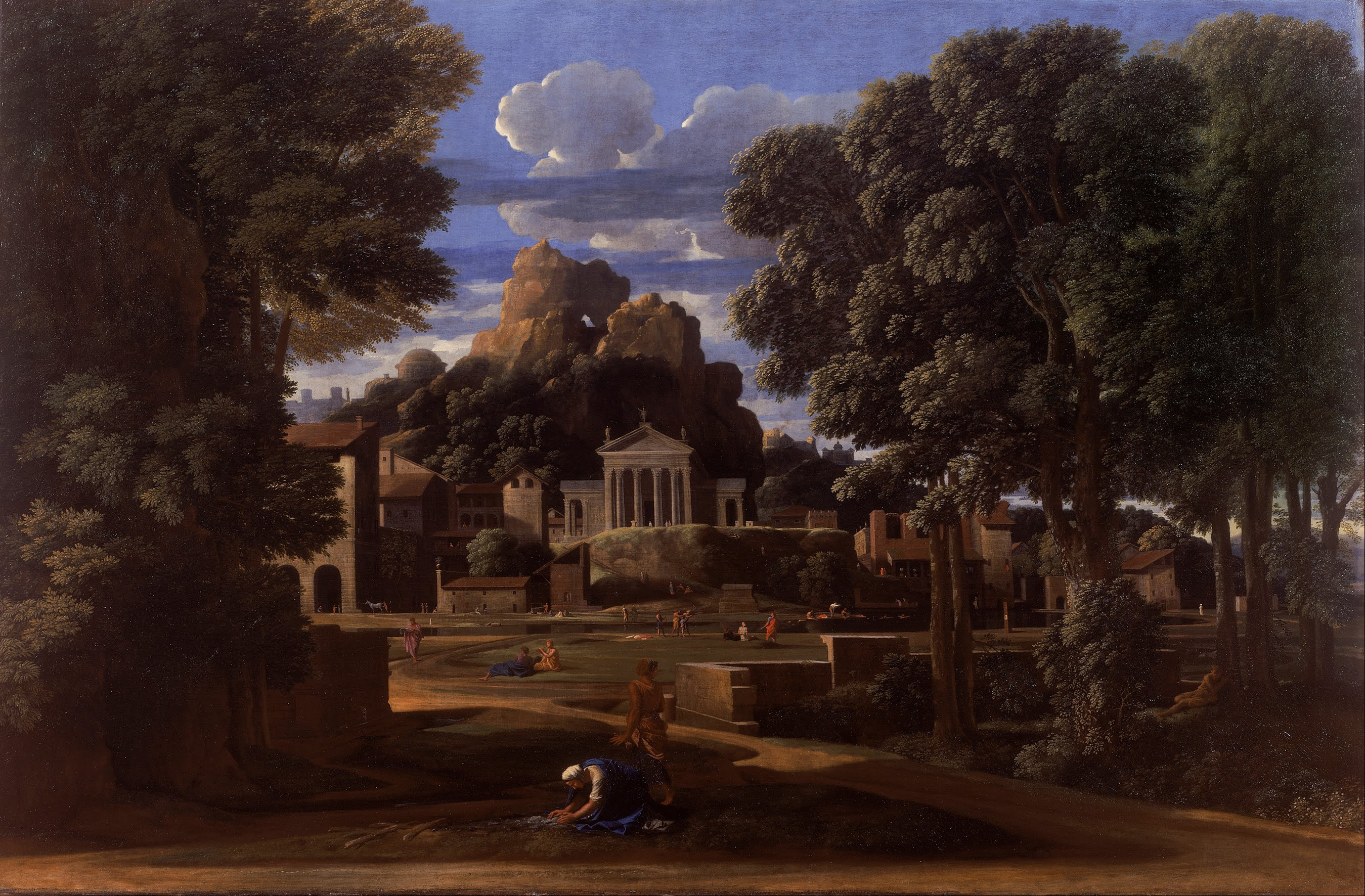
Nicolas Poussin, Landscape with the Ashes of Phocion.
Phocion's wife
Phocion, an Athenian statesman and general described by Plutarch, has been falsely accused of treason and executed. His burial in Athens has been forbidden, and his body has been burned outside the city in disgrace. Poussin's painting shows his wife secretly gathering his ashes, so that they might receive proper burial, while her companion keeps watch. In the background, the complex and varied life of the city plays on.
Rose begins her interpretation by rejecting the view that the painting simply praises interpersonal love and condemns arbitrary power (such a reading would praise subjectivity and particularity over cold, impersonal, universal law). Instead, she sees the two women as conducting, out of love, an ‘act of political justice’; and because this act of justice is set against the backdrop of the city's ordered architecture, it underscores the injustice of the law enforced by the city's current managers. The act only makes sense as such when understood in the light of what is absent: namely, an adequation of universal law to particular subjectivities. The painting thus provides Rose with an illustration of the drama of the broken middle. It does not show a defiant or despairing exit from an unjust social system, but rather an attempt to put things right; an effort that responds to, and which takes steps towards altering, the normative order that it takes place within.
These points can be developed by noting aspects of the image that Rose does not mention. The efforts shown are not free from injustice and may end in failure: the wife's companion is surely a slave, and they are watched by a spy hidden in the trees at the bottom right. And social life itself is clearly uneven: people walk, talk and play, but much of the city is in shadow, and there is a lone melancholic by the lakeside on the right. But none of this makes the act itself any less right. The sky can be glimpsed through the gap in the rocks that loom over the city, and the image is hopeful, overall.
Now, Clark says that Snake also evokes a ‘putting to rights’ (2006a: 139). In doing so, he points to the levelling hands of the seated woman in the centre of that painting, to the incipient communication between the figures, and to their growing collective response to the death in the foreground. For him, as we have seen, this suggests a humanism that could attend to tragedy rather than effacing it, and which could thereby lead the Left away from the utopian lures of modernity. Yet Phocion, in Rose's reading, shows something rather different. Here, it is the collective life of the (modern) city itself, qua the broken middle, that is tragic, and orientation to the future, qua the absolute, is intrinsic to the politics depicted (after all, ‘putting to rights’, like politics itself, is a necessarily future-oriented activity).
Could Snake be reconsidered in this vein? Clark claims that Snake's events take place at ‘daybreak’ (2006a: 79): the running man has discovered something terrible that took place during the night, and the new day will see the people respond. But it is summer in the painting, and the sun is not high, so it must be very early in the morning; and although the woman with her washing and the fishermen may suit this time of day, the reclining men and the distant strollers by the lake's shore are, as Clark admits, an awkward fit. 20 Would evening make more sense? ‘The owl of Minerva takes its flight only when the shades of night are gathering’ (Hegel, 2005b: xxi). In Rose's work, Hegelian wisdom is, in large part, an awareness of complicity and failure. If the events shown were located at the end of the day – and if the corpse has gone unnoticed and assumed its pallor throughout the course of that day – then the running man might be reporting a gross oversight, a failure in the community's shared social relations, that needs to be rectified.
Corrigible constructions
What, finally, of Clark's emphasis on the non-verbal? An adequate response would require an essay of its own, but suffice it to say here that there is no space for the ineffable in Rose's philosophy (and more tentatively: I am not certain that the work of a skilled critic such as Clark must rely quite so heavily on the idea that visual art eludes linguistic articulation). 21 Her Hegelianism commits her to the idea that, in principle, all that is, is intelligible, and at least potentially articulable. Indeed, she had no time for any realm of total, sublime ineffability, 22 and saw Heidegger's susceptibility to Nazism's illusory ‘offer [of] a way out’ (Rose, 2017: 79) as a correlate of his desire to reach such a realm of primordial potential. Moreover, no such effort is required; we are not trapped within a ‘discourse’. On her view, the norms and values that structure modernity are a constant, ongoing construction: the ‘reason and muddle’ referred to above characterises a constant process of revision and reconstruction prompted by their gaps, breakdowns and failures. And this, it might be added, means that any particular conception of ‘human nature’ must be just another corrigible construction.
I hope that the foregoing has served to indicate that Rose's philosophy may offer a means of reframing themes within Clark's tragic politics, and of thereby circumventing some of the latter's more troublesome elements: namely, his invocation of human nature and his rejection of modernity and its future. In addition, I hope that the preceding discussions have also served to indicate the potential salience of Rose's social philosophy, and its conception of modernity, as means of thinking about the future politically. It is, after all, a philosophy that demands hope in dark times (‘Keep your mind in hell, and despair not’ (Rose, 2011: 1)). But as a brief addendum, I shall propose that there may also be space in her philosophy for something akin to Clark's social history of art.
Soul, city and spectacle
I mentioned above that Rose recast Hegel's speculative unity as a condition of ‘diremption’: as the identification of absent but implicit unities. The primary example in her account is his claim that ‘religion and the foundation of the state are one and the same thing’ (Rose, 2009: 51). For Hegel, they are ‘one and the same’ because they both actualise the absolute. 23 Parsed through Rose's reformulation of Hegel, however, it means that they are both parts of a broken social whole, each of which is shaped by, and symptomatic of, that very brokenness. Understanding them in this light can illuminate that condition and point towards its potential rectification.
She treats ‘the state’ as the social norms that structure society, and ‘religion’ as the subjective hopes, aspirations and moral sentiments of society's inhabitants (both have the same ‘foundation’, because both arise from and articulate social conduct). Both are flawed due to their lack of unity with each other. The normative structures of the ‘state’ can seem arbitrary and imposed upon the subjectivities that operate within them; ‘religion’ contains subjectively pertinent hopes and visions of the unification between ‘soul’ and ‘city’ that this social condition lacks, but it locates its solutions in images of a realm beyond the present. 24 This ‘diremption’ needs to be negotiated, because if elements of one or the other were seized upon immediately, and framed as the solution to this division, the result would be terror on the one hand, and fanaticism on the other.
Such worries about potential zeal and tyranny are very close to Clark's views in Heaven on Earth (remembering here his worries about messianic revolutionary fervour). We might now add that that book, and Clark's broader wariness towards the pursuit of revolutionary futures, seems at least partly informed by his departure from his own early ultra-left militancy.
During the late 1960s, Clark was, briefly, a member of the Situationist International: a group whose initial avant-garde ideas concerning the unification of art and life had developed, by the 1960s, into an unabashedly revolutionary and utopian drive towards radical social change. Clark's ‘For a Left with no future’ is full of critical allusions to Situationist ideas, techniques and ambitions, and it is hard not to read that text without seeing him addressing his own past. But this line of influence is not solely negative. His work has remained informed by Situationist themes, chief amongst which is the group's concept of ‘spectacle’.
Clark's notion of spectacle differs from the original version, which was developed by Guy Debord, the SI's primary theorist. It was used to address modern society's panoply of depictions and models of a supposed good life, and the patterns of social existence engendered by their acceptance. It has often been conflated with capitalist visual culture, but that is a very crude misreading. Debord's position is broadly Lukácsian: we are ‘spectators’, and exist within a ‘spectacular society’, not just because we are immersed in a particular kind of visual imagery, but because the norms and roles that structure our lives are prescribed by an effectively autonomous economy. Modern society, in his view, is marked by a merely ‘contemplative’ relation to its own historical existence, because the human subjects that inhabit and compose it have become participants in a grand performance shaped to suit the needs of capital. As in Lukács, human subjects are thus in thrall to the results of their own alienated objective activity – a condition that must be rectified through the creation, via revolution, of a condition of subject-object unity – and, as is arguably also the case in Lukács, this is supported by a re-working of Hegel, in which attaining the absolute becomes figured as the actualisation of such revolutionary praxis. Historical time, and thus the future, would then become a collectively self-conscious and self-determinate creation: 25 we would become the authors of our own collective historical existence, rather than merely capital's actors.
Now, what could be more modern, in Clark's sense, than this? And in that same vein, we should note that there are deep flaws in Debord's vision of revolution. As I have argued elsewhere, 26 despite its many overlooked virtues, his peculiarly existential and avant-garde version of Hegelian Marxism comes close, at times, to prescribing a kind of holy war. It is utterly uncompromising in its commitment to the destruction of all forms of hierarchy and alienated power, and it advocates embracing, and identifying with, the ‘negative’ and destructive passage of time itself. Once again: it is hard not to read ‘For a Left with no future’ as Clark working through his past relationship with such militant views.
Clark's own notion of spectacle is much more modest and visual-cultural. It concerns modern capitalism's relentless promotion and imposition, via primarily visual forms, of patterns of subjectivity, action and interaction that suit the needs of the commodity. It thus names ‘the submission of more and more facets of human sociability … to a constant barrage of images, instructions, logos, false promises, virtual realities’ and ‘miniature happiness-motifs’ (Retort, 2006: 19–20). This ‘barrage’ regulates and maintains the thinned and weakened form of collective social life that Clark identifies with capitalist modernity. We saw earlier that he holds that ‘imaging’ contains resources that can push against the ‘discourse’ that holds forms of life in place. But spectacular imagery ‘is designed not to be looked at closely, or with sustained attention’; for if it was, it ‘would not do its work’ of ‘selling, of confirming and enforcing approximate – marketable – visualisations of the good life, of achieved satisfaction, of individual fulfilment’ (Clark, 2006b). It tends to close down, rather than open up, a broader sense of human possibility. Hence, once again, the political importance of art history: in such a context, it has become increasingly important to find and maintain ways of attending to richer and more sophisticated imagery, and of accessing the forms of thinking and past forms of social life that they articulate and express. 27
Debord's Lukácsian use of Hegel has thus been stripped out of Clark's version of spectacle, leaving us with a much milder model: one that is focussed on visual culture, and on the latter's impoverishment, rather than on social structures and revolution. And in losing Debord's Hegelian Marxism, Clark also loses the concept's connection to historical time and the creation of the future. Now, we have seen that Rose may be able to remedy some of Clark's problems through her own Hegelian focus on collective historical life. So, might her work be able to incorporate something akin to the concept of spectacle's critique of modern life and culture that retains something of Debord's emphasis on historical agency, but whilst avoiding his messianism?
If one was to pursue this whilst retaining a Lukácsian focus on the failings of modern social relations, then Rose’s Hegelianism might offer a means of approaching some of the predicaments posed by a ‘historical society that refuses history’ (Debord, 2004: 79), i.e. by modern capitalist society’s apparent inability to address its own bleak future. But if we remain focussed, for now, on Clark and art history, another, less ambitious, approach becomes possible.
Rose placed great emphasis on the importance of cultural representation. ‘Politics’, as she put it in a characteristically arch formulation, ‘requires representation, the critique of representation, and the critique of the critique of representation’ (Rose, 1997: 62). This surely encompasses Clark's social history of art, given its engagement with past and present ideological formations; and because her work advocates tracing the ‘deformations’ of modern culture and subjectivity back to their roots in socio-economic activity, it may be able to encompass his notion of spectacle too. Revealing the paucity of contemporary spectacular culture by treating it, in Rose's terms, as another flawed iteration of the broken dynamic between ‘soul’ and ‘city’ (i.e. as a set of inadequate and palliative ‘religious’ presentations of promised happiness that occlude their bases in an equally flawed ‘state’ of socio-economic and normative structures) – and doing so, moreover, via an approach to art history that emphasises the ‘tragic’ in its sensitivity to failure and error – would, I think, be in keeping with both their projects. When seen in these Rosean terms, overcoming a society of ‘spectacle’ through pursuing the absolute would then not be a chiliastic condition of revolutionary praxis, as in Debord, but rather an ongoing, future-oriented and chiefly cultural and educative effort towards conceiving the common good by attending to its past and present absences and flawed representations.
There are certainly grounds for such a move in Rose's association of the task of thinking the absolute with education (broadly construed), 28 and in her emphasis on the importance of institutions as forms of social mediation (‘education’ and ‘the universities’, amongst others, were cast as ‘institutions of the middle’ (2017: 48)). And if art history can assist the ‘critique of representation’ within a culture dominated by the distractions of Clark's spectacle, then so too can other areas of the humanities. To speak very generally: it is hard to envisage a recognisable form of collective life that is not articulated by questions and claims concerning what should be believed, what should be done and why. Together, the humanities provide means of considering how previous social formations have posed, answered, mishandled and ignored such questions, and of looking at the ways in which the commitments that they shaped have played out, collided and failed. A ‘tragic’ (or indeed tragi-comic) view of historical life, afforded by a politically engaged, philosophically informed and interdisciplinary approach to the humanities, might then be an integral component of any viable collective orientation to the future, insofar as it involves learning how to live well (or less badly) together. Rephrasing Clark's tragic politics in Rose's terms might offer a step towards such a view.
Footnotes
Declaration of conflicting interests
The author declared no potential conflicts of interest with respect to the research, authorship and/or publication of this article.
Funding
The author received no financial support for the research, authorship and/or publication of this article.