




Abstract
A 21st-century growth in prevalence of extreme right-wing nationalism and social conservatism in Australia, Europe, and America, in certain respects belies the positive impacts of online, new, and alternative forms of global media. Cross-national forms of ‘far-right activism’ are unconfined to their host nations; individuals and organisations campaign on the basis of ethno-cultural separatism, while capitalising on internet-based affordances for communication and ideological cross-fertilisation. Right-wing revolutionary ideas disseminated in this media, to this end, embody politico-cultural aims that can only be understood with attention to their philosophical underpinnings. Drawing on a dataset of articles from the pseudo-news websites, XYZ and The Unshackled, this paper investigates the representation of different rightist political philosophical traditions in contemporary Australia-based far-right media. A critical discourse and content analysis reveal XYZ and TU’s engagement with various traditions, from Nietzsche and the Conservative Revolution, to the European New Right and neo-Nazism.
Introduction
A 21st-century growth in prevalence of extreme right-wing nationalism and social conservatism in Australia, Europe, and America in certain respects belies the positive impacts of online, new, and alternative forms of global media. Cross-national forms of ‘far-right activism’ are no longer relatively confined to their host nations; individuals and organisations campaign on the basis of ethno-cultural separatism, while capitalising on internet-based affordances for communication and ideological cross-fertilisation. Right-wing revolutionary ideas disseminated in this media, to this end, embody politico-cultural aims that can only be understood with attention to their philosophical underpinnings. As recent investigations by Beiner (2018), Sparrow (2018), and Pisiou (2015) have shown, members of the American Alt-Right, Australian Patriots, and European Identitarians have recently looked to the historical Conservative Revolutionaries, contemporary proponents of quasi-Eurasianism, 1 and the European New Right (ENR) as paradigmatic models to inform their own political futures.
With attention to its philosophical associations, in this paper we investigate Australian far-right pseudo-news media by analysing content from the websites ‘XYZ’ and ‘The Unshackled’. Our emphasis on alternative media that emulate journalistic news media apparatus, through their incorporation of editorial boards, reference to newsrooms, and stated juxtaposition against allegedly corrupt mainstream news sources, is motivated by several conditions. Significantly, these sites are underexplored in academia and journalism, relative to burgeoning explorations of far-right philosophy and activism on more mainstream social media such as Twitter, Facebook, YouTube, and Tumblr, as well as the less traditional platforms of 4Chan, 8Chan, Reddit, and Gab (Hawley, 2017). Moreover, one of the sites under focus in our analysis, The Unshackled (TU), was formerly verified by the Google search engine as a ‘News’ outlet, despite its primary function of promoting far-right propaganda, extending as our analysis shows towards implicit if not explicit incitements of political violence. This listing recognition, alongside respective engagements with XYZ and TU on the part of Australian politicians, more ‘mainstream’ news media, and far-right activist leaders, as well as commenting facilities XYZ and TU moderators provide on alternative (often more closed and covert) social media platforms such as Gab, BitChute, and Telegram render these sites important paradigm-setters (Fleming, 2020). By virtue of these factors, and XYZ and TU’s propagandised coverage of political events in Australia, we argue that these sites work to facilitate the entry of far-right discourse into more mainstream political venues – including racist (in particular anti-Semitic and Islamophobic), heterosexist, and ableist discourse – while also contributing to an ideological environment within Australia and internationally conducive to far-right political violence.
XYZ and The Unshackled
Editors describe XYZ as an ‘independent media organisation focused on principles of classical liberalism and cultural libertarianism’, seeking ‘Western restoration’ and promoting ‘free expression, free markets, free assembly etc. against cultural authoritarians, particularly those on the left who demand safe spaces for the marginalised’ (Hiscox, 2015). The platform name reflects editors’ dissatisfaction with Australia’s national broadcaster, the Australian Broadcasting Corporation (ABC), and other mainstream media, and as of November 2020 it had 13,531 Facebook likes, 938 Twitter followers, roughly 1,000 Gab followers, and 21,500 YouTube subscribers, with an accumulated 52,803 views on YouTube across 31 videos. The XYZ editor-in-chief and prominent contributor to the site is David Hiscox. In a podcast with Adam Piggott called ‘Pushing Rubber’ (2019), Hiscox described himself as a ‘nationalist’ and stated his primary objective in establishing XYZ was ‘redpilling white men about race’ to advocate for the establishment of a ‘white’ ethno-state (Piggott, 2019). Other primary contributors to XYZ include Ryan Fletcher (also known as ‘Fashy Fletcher’ on YouTube), who in December was reportedly raided and questioned by police regarding an Offence of Serious Religious Vilification and Incitement (Fletcher, 2020), and David Hilton (author of the blog ‘End Times Herald’) (XYZ, 2020a), who sometimes goes by the pseudonym Moses Apostaticus. Hilton also previously authored a host of other mostly short-lived ultra-nationalist far-right online blogs, including ‘civilisation.net’, ‘follyofreason.org’, ‘mosesapostaticus.com’, ‘restoringaustralia.net’, and ‘tradnash.net’.
In December 2019 the XYZ site explicitly referred to the American Alt-Right platform Breitbart News in its mission statement, stating that its authors, like those of XYZ, ‘boldly defend free expression, free markets, and free assembly against cultural authoritarians’ (XYZ, 2019). The religion of Islam is also on the platform currently labelled a ‘existential threat’ that ‘has reawakened and declared war on us’, while ‘now is a critical time to fight for the values and virtues of Western Civilisation’ (Hiscox, 2015). XYZ editors stipulate their opposition to the contemporary far-right conspiracy target of ‘Cultural Marxism’, which refers historically both to the anti-Semitic trope of Kulturbolshewismus (Cultural Bolshevism) from Nazi Germany (Busbridge et al., 2020), and a wider 20th-century European targeting of ‘Judeo-Bolshevism’, promoted before the Second World War by Nazis and fascists across Europe, but also by nationalists, Christians, and others who opposed what they portrayed as an economic threat and threat of anti-traditionalist ideological degradation posed by Jewish people, as ‘borderless enemies’ (Hanebrink, 2018). Cultural Marxism is described on XYZ as a school of thought ‘which seeks to bring about socialism by attacking political, cultural, social and religious norms and institutions – dismantling our national identity and the foundations of Western civilisation’ (Hiscox, 2015).
XYZ made national news in June 2020 for running a supposedly ‘satirical’ news article fallaciously reporting that Waleed Aly, the Australian media personality and co-host of Channel Ten’s popular news and current affairs talk show, The Project, had applauded a fictional, racially motivated assault against a ‘white teenage girl’ by an ‘African gang’ in Melbourne (XYZ, 2020b). The article, mistaken as factual by some and exploited for propaganda by others, led to Aly’s public trolling and abuse, as well as his name trending on Twitter, and directly preceded the removal of XYZ’s Facebook page by administrators.
The Unshackled (or ‘TU’ in our analysis) also promotes right-wing nationalistic narratives of ‘civilizationism’, and is described by moderators as a ‘fast-growing alternative News Media Outlet’ seeking to ‘uphold and protect what made western civilization great, those ideas from conservative and libertarian and various other centre-right schools of thought’ (The Unshackled, 2020a). As of December 2020, TU had a significant Facebook following of 22,347 accounts, which had grown rapidly over the previous 12 months (TU’s ‘like’ count was only 312 in December 2019). While TU has fewer Twitter followers (n = 1072) than XYZ, the platform has a slightly larger Gab following of approximately 1,100, and a significantly more popular YouTube channel; although on YouTube TU had only approximately 7,870 subscribers in December 2020, its channel had an accumulated 1,358,494 views. The TU founder and editor-in-chief, Tim Wilms, unsuccessfully ran as a candidate for the right-wing Liberal Democratic Party in Australia in 2013 (AEC, 2013), and he also writes for the Australian branch of the conservative magazine The Spectator (Rhodes and Bloom, 2017).
Recalling the classical liberal capitalist orientation of XYZ, the stated mission of TU writers is to ‘protect free thinking and free markets’ (The Unshackled, 2019a). TU editors pledge to target socialist and leftist traditions they describe as a ‘Red Menace’ (The Unshackled, 2019a), echoing XYZ’s targeting of ‘Cultural Marxism’ – while articles on both sites refer to the Cultural Marxism conspiracy. Other ‘enemies’ TU cites include the ‘progressive left, social justice warriors, and the bearers of so-called political correctness and identity politics’, who are collectively portrayed as harbingers of politico-cultural ‘totalitarianism’ (The Unshackled, 2019a). Unlike XYZ, TU moderators also seemingly target neoliberalism, professing to ‘tackle the corrupt ideologies within the right-wing that have led to parasitic institutions such as crony capitalism which has ruined the reputation and meaning of the original free market capitalism’ (The Unshackled, 2019a).
TU’s political engagements in the first half of 2020 included contributors’ repeated disparaging coverage of Black Lives Matter protests around Australia in June, which opposed disproportionate representation of Indigenous people in Australia’s criminal justice system, including in racialised policing and Indigenous deaths in custody (Langton, 2020), and referenced institutional racism highlighted by the Black Lives Matter movement internationally. In mid-2020, writers for TU also promoted anti-vaccination, ‘anti-5G’, and COVID-19 ‘plandemic’ conspiracy demonstrations in Australia (The Unshackled, 2020b). Organised through a Facebook campaign titled ‘Wake Up Australia! Millions March Against Mandatory Vaccinations’, the largest ‘anti-lockdown’ rallies in May 2020 opposed demonstrators’ perceived loss of personal and economic liberties as a result of societal lockdowns, imposed to curb the spread of the COVID-19 ‘coronavirus’ global pandemic, which had led to the deaths of at least 1.5 million people internationally by December 2020, just 12 months after the first case of COVID-19 was reported. As a part of TU and XYZ’s promotion of opposition to lockdown, they also exploited a domestic and international political environment characterised by the significant growth in prevalence of the far-right conspiracy theory of QAnon (Busbridge et al., 2020). Two central figures of the largest Melbourne-based anti-lockdown demonstration in May 2020, Raphael Fernandez and Fanos Panayides, were invited on episodes of ‘Wilms Front’ (WilmsFront, 2020a) – a YouTube series and podcast hosted by Tim Wilms, the editor-in-chief of TU.
These events occurred within a context in which politicians belonging to the current federal government in Australia, the Liberal-National Coalition, elected to participate in interviews on ‘Wilms Front’. Former Liberal Party MP turned Independent Craig Kelly appeared in an episode published 28 May 2020 to discuss his scepticism about the necessity for the closure of businesses and services in Australia’s COVID-19 lockdowns, while also criticising policy measures proposed to reduce Australia’s significant contribution through carbon emissions to global warming (WilmsFront, 2020b). Liberal National Party of Queensland and National Party federal member George Christensen also featured in an episode published 30 September 2020, agitating against COVID-19 lockdowns and satirising (with Wilms) the portrayal of The Unshackled and Wilms himself in various Australian news media as associated with neo-Nazi activism (WilmsFront, 2020c).
XYZ and TU’s discernible engagements with far-right politics in Australia are demonstrated by their platforming of actors who express neo-Nazi views, and their production of anti-Semitic, racist, and other discriminatory open-access media content, further to their more politically violent expressions on closed and covert platforms. Although the object of this article is not to explore media beyond XYZ and TU’s more public displays, one example of these sites platforming far-right activists includes an event in which their editors collaborated to produce an online ‘conference’, broadcast on YouTube and uploaded to BitChute (linked to via the XYZ website) between 29 June and 3 July 2020. Through the event, they aimed to ‘showcase nationalist leaders, thinkers, and Australian alternative media’ (XYZ, 2020c), with speeches delivered by Australian far-right activists including: James Fox Higgins, Mark Moncrieff, Adam Piggott, and Thomas Sewell, the latter of which founded the Lads Society and its so-called political wing, the ‘National Socialist Network’ (Ross, 2020). Also featured at the conference was Blair Cottrell, who has been convicted of offences related to arson, assault, trafficking testosterone, and inciting serious contempt for Muslims, and who, infamously, extensively quotes Adolf Hitler, declaring that there should be a copy of Mein Kampf issued to ‘every student’ in ‘every classroom and every school’ in Australia (Fleming, 2015). Further to Cottrell’s ‘advice to young men’ to read Adolf Hitler in his presentation at the June–July 2020 conference, other listed categories of discussion among presenters ranged from ‘The Core Principles of the Worldview’ (referring to Sewell’s talk on ‘National Socialism’), ‘Western Arts and Culture’, ‘Traditionalism’, ‘Christianity’, and ‘Black Lives Matter’ (XYZ, 2020c).
Further indicating aspects of XYZ and TU’s associations with the wider Australian far-right political field, since March 2019, moderators have collaborated in an ongoing ‘super alt-media livestream every week’ podcast called ‘The Uncuckables’, allegedly named as such ‘because unlike many mainstream media alleged conservative personalities we could not be cucked’ (The Uncuckables, 2020). Via this podcast, on websites, and in their other audio-visual media, XYZ and TU extensively interview and editorialise in favour of high-profile far-right activists who have been convicted of offences of racial and religious vilification, including Blair Cottrell, Thomas Sewell, and Neil Erikson. Both sites also formerly served as a semi-official campaigning arm of former Australian Senator Fraser Anning in the run-up to the country’s May 2019 federal election, after Anning’s delivery of his ‘final solution’ maiden speech in the Australian Parliament (delivered on 14 August 2018), 2 his employment of neo-Nazi activists from the Lads Society, and statements Anning made referring to ‘Muslim immigration’ as causative in the massacre of 51 Muslim worshippers at two mosques in Christchurch, New Zealand, on 15 March 2019 by Brenton Tarrant, an Australian neo-fascist (Baker, 2019).
To explore XYZ and TU’s engagements with political philosophical traditions that were far-right at their inception, or that have since become integrated into far-right-wing politicking, this paper outlines a critical discourse and content analysis of articles published on their websites. On the basis of an initial scoping exercise, a key supposition from which our analysis began was that the articles in question would integrate ‘Nietzschean’ philosophical traditions, characteristic of Friedrich Nietzsche’s original works, to a greater extent than would articles published by mainstream news websites. We suggested that in XYZ and TU this would entail engagement with Conservative Revolutionary themes, articulated, for example, in the works of Evola, Schmitt, Heidegger, and Junger. While there was evidence to support such influences on these sites, our discourse analysis also revealed that ENR ideas deriving from Alain de Benoist and to a lesser extent former ENR proponent Guillaume Faye (who left the movement and died on 7 March 2019) were also reflected in XYZ and TU articles. Explicit neo-Nazi themes were furthermore evident, expressed in XYZ and TU writers’ evocation of ‘National Socialist’ ideology characteristic of Rosenberg and Schmalenbach and, consistent with neo-Nazi thematics in contemporary Australian far-right media, their engagement with the politicking and propagandising of Adolf Hitler himself (Sparrow, 2018; Richards, 2019a).
These findings about the Australian far-right incorporating multiple philosophical elements were consistent with researchers’ long-held recognition that fascism and neo-fascism are highly syncretic (Woods, 1996; Griffin, 2013), while contemporary online expressions of fascism and the far-right tend to feature aspects of ‘pastiche’ and ‘bricolage’, disparate elements are combined together to form new meaning, incorporative of far-right symbolism. As Pisiou (2015) elaborates, such methods often constitute an interpolation of both leftist and rightist propaganda and ideological techniques, facilitating a process whereby divergent political traditions and tactics become associated with far-right narratives and their ‘brand names’. While the ENR tradition of emulating some tactics of left-wing activists, including in particular the French (and then international) cultural revolution of 1968, was apparent, research for this article suggests that the pastiche or bricolage effect in the case of Australian far-right pseudo-news sites, perhaps to a greater extent than other examples of international far-right media (see Richards, 2019b), features a wide array of diverse and sometimes contradictory right-wing philosophical positions. This is, moreover, likely the case precisely given the anti-knowledge context for the propagandised pseudo-news venues in which these far-right philosophical ideas are interpolated. This investigation therefore attempts to chart the broad strokes of a new research agenda, and it may be useful in shedding preliminary light on influential online media that has been to this point virtually unexplored in critical and strategic scholarship, or from a political philosophical perspective.
Our account of far-right philosophies in the pseudo-news media under examination proceeds in five parts. After this introduction, we provide a brief synopsis of some of the political philosophical ideas in focus, including a discussion of relevant influences on the Australian far-right, from Nietzsche and the Conservative Revolution to the ENR. The subsequent section explains our method of data collection, and initial findings from a quantitative analysis, before the next part of the article elaborates preliminary insights from a qualitative exploration of articles in our dataset. Concluding comments then sketch out some limitations for the study, and insights for future possible research directions.
Analytical framework
Through attention to XYZ and TU media we sought to investigate significant and emergent engagements on the part of far-right actors in Australia with philosophical traditions deriving from the Conservative Revolution and Nazi Germany. Although our analysis commenced with a search for Nietzschean terms and ideas, Nietzsche was not assumed as consistently foundational to each of the differentiated and intersectional rightist philosophies that in different dimensions proved relevant to the analysis. Our initial terms of reference were derived from Ronald Beiner’s (2018) Dangerous Minds: Nietzsche, Heidegger, and the Return of the Far Right and György Lukács’ (1952) chapter, ‘Nietzsche as Founder of Irrationalism in the Imperialist Period’, in The Destruction of Reason.
It is useful to briefly explicate characteristics of Nietzsche’s work that were interpreted as important in the analysis, given their influence on the Conservative Revolutionary philosophies of Evola, Schmitt, Heidegger, Junger and others. Conservative Revolutionary themes relevant to our analysis were these philosophers’ contention that the individualism of liberalism is atomising, liberty is licentious, dynamism is destructive of a people or community (or Volk), tolerance is weakness, faith in discussion is rudderless, and cultural openness is nihilistic (Lukács, 1952). Also relevant is their cultural critique of ‘modernity’, predicated on it being a harbinger of liberalism, where socialism is importantly seen as a variant of liberalism, not a real opponent of it: Heidegger could talk in 1940–1 in The Black Notebooks of ‘English Bolshevism’ (Krell, 2015), for instance. Certain of these thinkers also appealed to some non- or pre-rational grounds for social order, incorporating the Virtues (or values) of public life, community, and the Nietzsche-esque ‘will to power’, Heideggerian Being, providence or destiny, blood or race, and ‘history’ (Beiner, 2018). Conservative Revolutionaries more broadly argued that the individual with her or his reason is without lasting substance and needs to find orientation in some religious, cultural, or historical grounds. Like the ENR, they promoted metapolitics, wherein liberty, equality and fraternity are rarely criticised directly but rather through their cultural, ostensibly non-political grounds, including, for example, their commentary on nihilism (Woods, 1996). Their philosophy of history then is radically pessimistic and eschatological, grounded in the ‘decline of the Occident’, or ‘the West’, and a perceived ‘loss of meaning of being’. It is often tied to some particular ‘fall’ event, with authors variously citing the philosophies of Plato, Descartes, Galileo, Newton, William of Ockham, the advent of Christianity, and the advent of Protestantism. The tradition sometimes comprises a form of Christianity and also, in its Nietzschean aspect, a form of paganism (Beiner, 2018).
In our analysis, the ideology of the European New Right (ENR), developed significantly through the work of Alain de Benoist, shares a number of similarities with some of the other traditions in focus. Originating as a rejoinder to the ‘68ers’, its proponents foreground the importance of metapolitical action and cultural transformation prior to and alongside political campaigns for revolutionary change. In its anti-capitalist dimensions, influential figures within the ENR have criticised the contemporary ‘decadence’ of former leftists working now in prominent neoliberal institutions across Europe (De Benoist and Champetier, 2000). They have also opposed far-right political institutions (sometimes perhaps questionably denoted ‘populist’), such as the National Front, for not connecting the problem of globalised neoliberal capital accumulation with the frequent far-right target of globalised migration. As Bar-On (2007) explains, despite its intellectual elitism, the ENR is sometimes hailed for its political distinction from other rightist traditions, including through its alleged, though ultimately unsubstantiated, promotion of ‘feminism, paganism, federalism, pro-Third World solidarity, anti-imperialism, anti-totalitarianism, anti-racism and the valorisation of the “right to difference”’ (Tonini, 2003–4 in Bar-On, 2007: 12). On a practical level, several of these ideas find expression in the ENR’s contemporary opposition to the US-led ‘war on terror’, its endorsement of ‘ethno-cultural pluralism’, and the effort to forge (perhaps by counter-cultural means at first) land-based ‘bloc’ alternatives to US-led Atlanticism (Faye, 2011).
Evidence of ‘neo-Nazism’ in our analysis includes Conservative Revolutionary or German reactionary influences, perhaps to a greater extent than the ENR. It features a specific and explicit emphasis on ‘race’ and ‘racial purity’, extending to eugenicism, often combined with an overt anti-Semitism, and willingness to consider Christianity and modern forms of monotheistic religion as ‘essentially Jewish’ (Moses, 2007). In the German Nazi leadership, and presently in some neo-Nazi actors’ expressed views, there exists, at times, a willingness to take Hitler’s ‘conscience is a Jewish invention’ to its ultimate conclusion; that is, restoring cultural or historical destiny or greatness in Nietzschean terms, ‘beyond Good and Evil’ (Nietzsche, 1909).
Method
Data for this research was sourced from the far-right pseudo-news sites TU and XYZ, as well as the mainstream online news site of The Guardian: Australia – all of which publish articles in the public domain. Information was extracted from these websites using web scraping, via the software OutWit Hub Pro. In order to create the first sample of content, metadata relating to article title, author, publication date and keywords was scraped from all archived articles of both TU and XYZ. The articles were then ordered chronologically and those published within a 12-month time frame (July 2018–July 2019) were isolated and scraped for text content, forming the first sample. This sample size was 1,757 articles, with 908 articles extracted from TU and 849 extracted from XYZ.
The second sample of The Guardian news content was created by navigating The Guardian: Australia ‘Politics’ archives and collecting metadata as well as text content from a random sample of 2,000 articles published during the same 12-month time frame. Our supposition was that XYZ and TU use words that reflect rightist political philosophies more than a mainstream news outlet like The Guardian. Confirming this would demonstrate that TU and XYZ engage with qualitatively different philosophical traditions than mainstream international-Australian news media, and that this in turn might reflect their positionality as ‘far-right’.
We started from a list of 58 written word signifiers of right-wing political philosophies outlined in the breakdown of the method below. We then calculated the average presence of each of these words in articles published in TU, XYZ, and The Guardian. All words that had an average count less than 0.001 per article were initially removed from the initial list. Then, we conducted one-way Analysis of Variance tests (ANOVA) to examine differences in the average number of these words per article between the outlets.
Qualitative critical discourse and content methods, supported by quantitative insights, were next used to analyse articles across TU and XYZ collectively that featured the greatest statistical prevalence of ‘philosophy’-related words, including those on our list. The critical discourse analysis of statements by XYZ and TU authors was concerned with addressing ‘opaque as well as transparent relationships of dominance, discrimination, power and control as manifested in language’ (Wodak and Meyer, 2009: 10). The documentary-content aspect of the investigation emphasised the ‘frame of orientation’ (Bohnsack, 2010) in which discursive statements were communicated, both to their intended likely audience and with respect to their contemporary (often Australian) socio-political commentary to which they relate.
Analysis
Words that were removed from our list given that they occurred infrequently in TU and XYZ, and therefore did not appear to carry a particularly meaningful philosophical significance, were: Marxian, master morality, castes, ruling caste, aristocracy, great politics, grosse politik, rank order, ressentiment, warrior spirit, homogeneous, and parliamentarianism.
We then ran one-way ANOVA to detect significant differences in the average use of the remaining words between TU, XYZ and The Guardian. This revealed that the following words appeared with a similar average count per article across the three outlets, or were more used in The Guardian relative to XYZ and TU: liberalism, bourgeois, bourgeoisie, breeding, rank, force, will, will to power, degeneration, weakness, weak, resentment, ressentiment, war, battle, liberalism, liberal, democracy, superficial, dominant, power, powerful, self-destruction, and sacred. A preliminary qualitative analysis then revealed there to be no significant difference between the average use of these words in TU and XYZ compared with The Guardian, suggesting that they are common English-language words and potentially do not act as noteworthy signifiers for any distinct political philosophical tradition.
There were 22 words shown to appear significantly more frequently in TU and XYZ, relative to The Guardian: socialism, Marx, Marxism, Marxist, Cultural Marxism, Cultural Marxist, race, master, mastery, slaves, slavery, hierarchy, degeneracy, degenerate, decadence, decadent, nihilism, homogeneity, democratic, noble, barbarian, divine. Table 1 indicates the average count of each word or word category per article in each of the examined outlets.
Frequencies of right-wing political philosophical word signifiers.
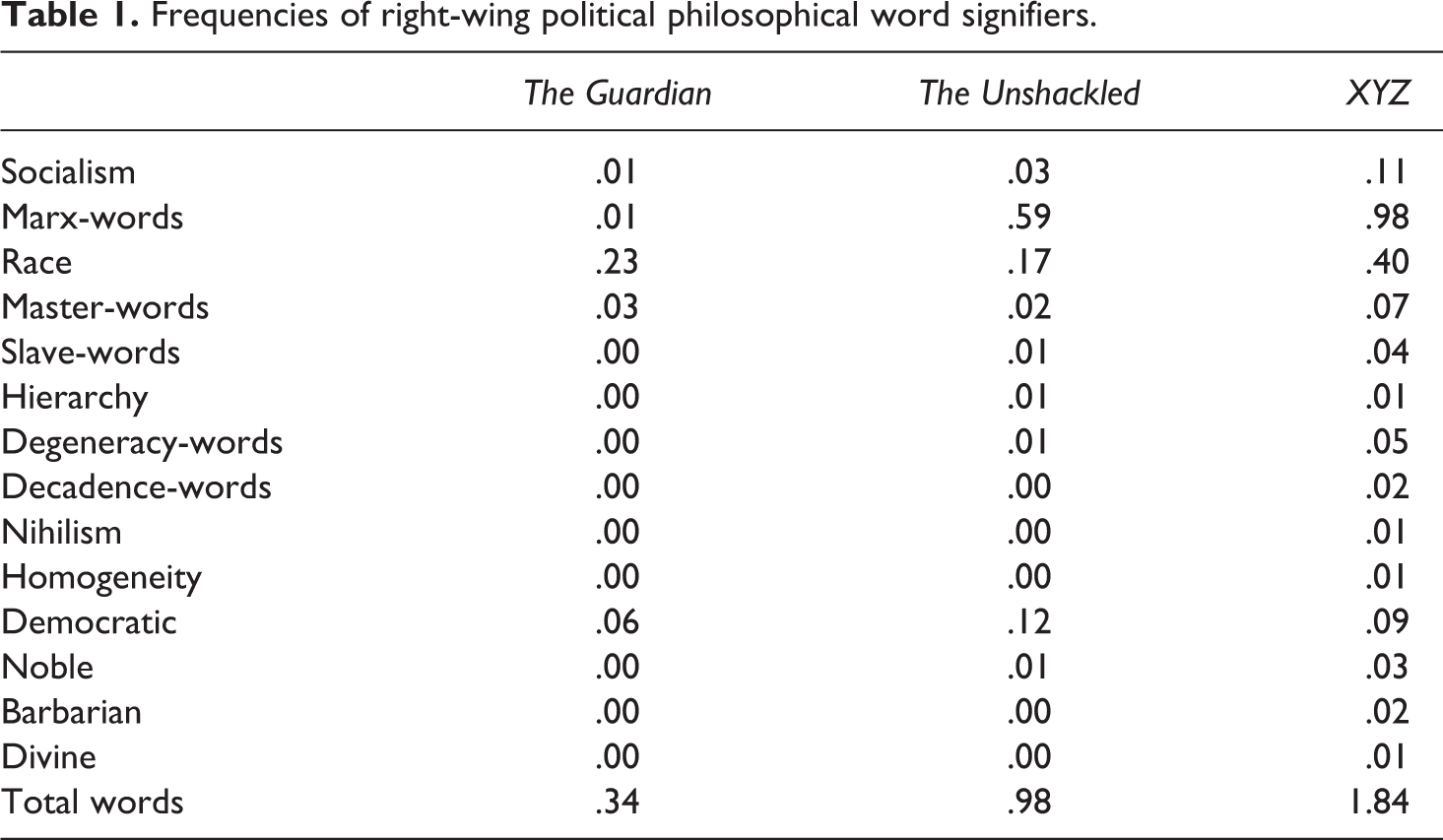
As shown in the table, there was an overwhelming prevalence of ‘Marx’ and Marx-related words relative to others that appeared regularly in the examined articles from our list. This represented a possible limitation regarding the subject of our analysis, given that the 39 final articles we examined using qualitative methods were likely to feature a greater prevalence of Marx-related words (such as ‘Cultural Marxism’), to the potential neglect of those that were less frequent in terms of their occurrence but that were nevertheless more unique and demonstrative of explicit far-right philosophical currents, such as, for instance, ‘degeneracy’ or ‘decadence’.
Despite this, and another potential reductive dimension to the research related to our distinct focus on Nietzsche at the outset, the analysis of the articles in question revealed significant insights about prevalent themes that recurrently featured in TU and XYZ articles, whether these thematic references were intentional on the part of authors or broadly (and significantly) reflect a wider milieu of ideological-philosophical tropes extant in contemporary online far-right media-spheres. Correspondingly, from an inductive analytical perspective, these articles and the wider data set might be said to reveal the relevance of rightist philosophical traditions in such far-right media beyond Nietzsche, including those discussed in our analytical framework. In terms of our dataset, the titles of the articles and their author, date of publication, and source are set out in the Table 2.
Articles with the highest frequency count of signifiers.
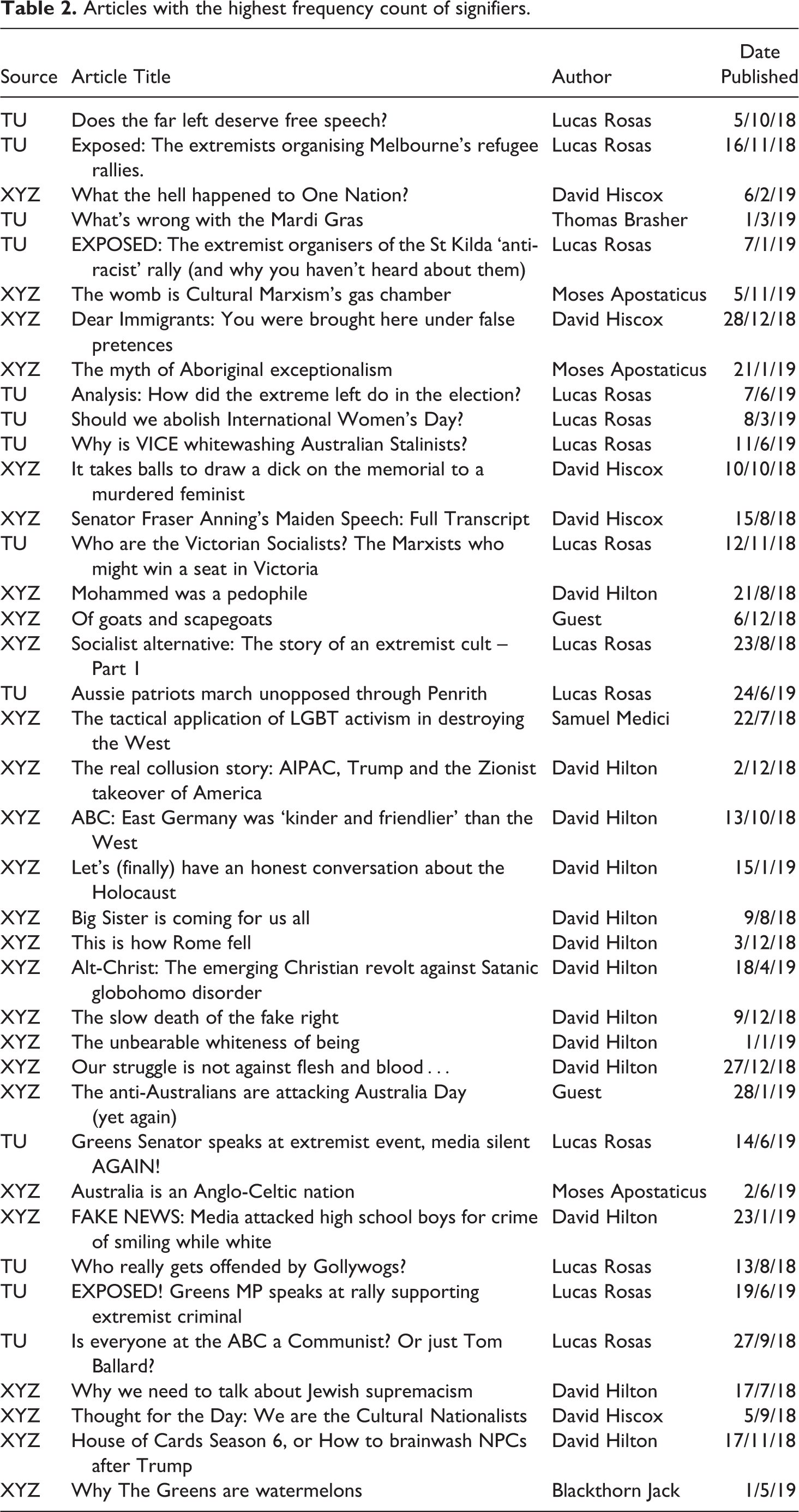
We began the qualitative component of the analysis by entering the data from our complete dataset of 1,757 articles from XYZ and TU combined (excluding The Guardian articles) into NVivo (v.12 for Mac). On the basis of inductive inferences drawn about the diverse and syncretic nature of different right-wing political philosophical traditions signposted in the articles, they were coded in NVivo for cross-sectional criteria related to Nietzsche, neo-Nazism, the Conservative Revolution, and ENR traditions. We analyse several noteworthy trends below, drawing on purposively sampled exemplars from the list of 39, and also from the wider dataset.
Enlightenment and modernity
Several Nietzschean ideas were apparent in the articles, though they were not always discussed using the terminology in our list of signifiers. With this in mind, an explicit engagement with aspects of Nietzsche’s philosophical perspective was XYZ and TU writers’ persistent and relatively consistent condemnation of the perceived superficiality and mundanity of modern Western societies. The writers engaged with ideas of ‘degeneracy’, ‘decadence’, and ‘degenerating’ societies, which were often associated in their reasoning with 20th-century ‘liberal’ cultures’ inspiration from (perceived) egalitarian traditions of the Enlightenment (17th to 18th centuries).
Several articles by David Hilton, for instance, paradoxically associate Rousseau and some other Enlightenment thinkers’ supposed ‘radical egalitarianism’, as well as their ‘materialism’, with the promotion of institutional, civil religion. ‘Alt-Christ: The emerging Christian revolt against Satanic globohomo disorder’ features the statement: ‘the children of men and women…went on to abandon the moral law of God and replace it with nihilistic hedonism and superficial materialism’ (XYZ, 18/04/19). ‘The myth of Aboriginal exceptionalism’ by ‘Moses Apostaticus’ (a pseudonym for David Hilton) pejoratively associates Rousseau’s ideas on religion with undesirable aspects of early modern capitalism: What Marx was to the Russian Revolution of 1917, Rousseau was to the French Revolution of the 1790’s. Like Marx, he was a parasite who never worked an honest day in his life. He was an expert at leeching off his aristocratic buddies, and wrote a series of treatises which blamed the evils of property and civilisation for the corruption of man. He wrote these while living in the lap of luxury with the aristocratic women he seduced. Rousseau’s main thesis was a corruption of the Christian Biblical narrative. Original Sin in Rousseau’s mythology was the development of property. This alienated man from each other and began our corruption. (XYZ, 21/1/19)
Several XYZ and TU writers’ related comments on the ‘degeneration’ of modern societies might in another aspect be said to recall Nietzsche’s well-known assertion in Human, All Too Human (1910) that ‘modern democracy is the historical form of the decay of the State’. In TU articles specifically, modern democracy is (questionably) associated with a homogenous tradition of left-wing democratic campaigning, including in particular through authors’ criticism of a political campaign to change the date of ‘Australia Day’ from the 26th of January. In context, the campaign is related to the fact that the date commemorates the arrival of the first fleet of British settlers to New South Wales in 1788 and the commencement of the genocide and colonial dispossession of Indigenous people.
A TU author who goes by ‘Lucas Rosas’ characterises Australia Day as: ‘the time of year when the degenerate dregs of our inner cities and university humanities campuses crawl out from underneath their Australia-hating rocks to march down the street screaming about how much more enlightened they are than the rest of us’ (‘75% of Australians support the date of Australia Day’; TU, 16/1/2019). Later in this article, ‘degeneration’ is rhetorically referred to in anti-elitist terms, with alleged culprits described: ‘these people all talk only to each other, listen only to each other and socialise only with each other. They are the nobles at Versailles chatting over champagne flutes about this year’s fashions in lace oblivious to us peasants toiling outside to maintain their cosseted existence. So enjoy your Australia day fellow peasants’ (TU, 16/1/19). Reflecting a wider, contemporary and Nietzsche-inspired hostility toward the perceived ‘decadence’ of (social) liberals and socialists on the part of the far-right, referred to collectively as bourgeoise descendants of the Enlightenment, in another TU article titled ‘Watch: Twin SJW Retail Store Meltdowns’, Tim Wilms describes ‘Australia Day’: As the regressive left degenerates even further, their lead footsoldiers, the social justice warriors are not only taking their twisted social re-engineering to new extremes, but are now having public meltdowns against anyone who does not 100% adhere to their ‘enlightened’ worldview. (TU, 30/12/18)
Conservatism and late modern capitalism
Extending a focus on political economy, across the dataset several articles propagandised on the basis of neoliberal exploitation, with writers associating the deleterious products of late modern capitalism with Western (il)liberal societies’ perceived tendencies toward ‘nihilism’. Here, the philosophical roots of XYZ and TU writers’ rejection of both bourgeois consumerism (in some cases ‘liberalism’), as well as socialism and Marxism, can be illuminated by Lukács’ (1952) elaboration of Nietzsche’s political-economic position. As Lukács identified Nietzsche’s judgment that: ‘self-seeking is [undesirably] feared as “the devil incarnate”’ (The Wanderer and His Shadow in Lukács, 1952), with similar reasoning, several XYZ and TU writers connected their perspectives on ‘modern depravity’ (Lukács, 1952) with consumerism, commodification, and ‘decadence’, while at the same time promoting an embrace of social Darwinist, capitalistic competition. While such competition is paradoxically foundational to inegalitarianism in 21st-century neoliberal societies, in the articles it is also juxtaposed against the condemned traditions of ‘communism’, ‘socialism’, and ‘Marxism’. In one XYZ article, ‘Grand solar minimum: Global temperatures are plummeting’, Hilton warns ‘young’ readers to acquire gold or silver, move to regional towns, and acquire debt-free property (if they can), also writing: Even non-Christians can feel that the warm and sunny period of economic expansion and accompanying decadence after World War II is coming to an end. People are becoming repulsed by the nihilism, narcissism and decadence of the last fifty years. We are literally being frozen out of our degeneracy, right as it spirals out of control. It’s always the cold that ends the corruption. (XYZ, 24/5/19) A vanguard of intellectuals and apparatchiks who seek to use the force of the state to cement their power, forever. And they cloak it in the rhetoric of a cult of equality, positioning themselves as the moral leaders of society while they crush it under their effete, pedicured heels. (XYZ, 13/10/18) This is what three thousand years of Western civilisation has culminated in. Unity in hedonism. Purpose through consumption. A cult of meaningless libertinism and nihilistic individualism. Fuck that. We are bigger than that. Nobler than that…If we stop listening, the mind control stops working. Then we can get started burning this nigger woodpile to the ground. (XYZ, 27/08/18)
Eugenicism and the will to power
Overtly racist and eugenicist Conservative Revolutionary influences on XYZ and TU media also extend beyond Nietzsche. In their Evolian, quasi-spiritual dimensions, some articles’ promotion of social Darwinist ‘natural hierarchies’ endorse capitalistic competition, while again also condemning so-called social ‘degeneracy’. Such comment in XYZ and TU articles might be understood to recall what Lukács (1952) referred to as a Nietzsche-inspired ‘imperialist glorification of the bad instincts’. As Lukács’ excerpt from Thus Spoke Zarathustra (Nietzsche, 2008 [1885]) to describe Nietzsche’s elevation of brutality, competition, anti-equality, and the discovery of primal and mythical essence, demonstrates: Beasts of prey and the primeval forest show that depravity can be very healthy and works wonders for the body. Were the predatory species beset by inner torments, they would have become stunted and degenerate long ago. The dog (which moans and whines so much) is a degenerate predator, and so is the cat. Innumerable good-natured, depressed people are the living proof that kindliness is connected with a lessening of vital powers: their feelings of anxiety predominate and govern their organisms. (Lukács, 1952)
Again further to Nietzsche’s ideas, several articles in TU also feature a Nietzschean–Heideggerian ‘Hellenophile rhetoric’ (Beiner, 2018: 105), predicated on spirituality and radical traditionalism, often entailing signposting of contemporary sovereign tensions (typically in an interwar context). Deriving from Conservative Revolutionary philosophy, such a fetishisation of Greek (and Nordic and Roman) mythology is, in fact, widely recognised within many contemporary cross-national far-right movements (Beiner, 2018). Reflecting this trend, one article that draws on Greek myths to advocate ‘banning the Mardi Gras and other similar public displays’, titled ‘The degenerate Mardi Gras’, was authored by ‘Australian Meditations’, a now-defunct Facebook page run by Stefan Eracleous, a former member and treasurer of the Young Liberals at The University of Melbourne (Fleming, 2019). The article states: Perhaps we can learn from the Greek hero Heracles, who when fighting the Hydra, a multi-headed snake, would cauterize the open stumps in order to ensure the Hydra did not grow two more heads in its place…Revenge politics has manifested itself throughout history, whether it be France’s treatment of Germany post WWI, or the animosity between the Tutsis and the Hutus. Hence we must learn from these mistakes and not allow the gay mafia to ‘avenge’ the historical injustices the gays have faced. (TU, 2/3/19)
Left-wing intellectualism and academia
XYZ and TU’s target of politico-cultural progressivism is also sometimes extended to criticism of 20th-century left-wing intellectualism and academia, featuring frequent and erroneous conflation of disparate intellectual traditions such as ‘neo-Marxism’ and ‘postmodernism’. The neo-Marxist Frankfurt School of Critical Theory is often associated with the intellectual-ideological tradition of French deconstructionism, also sometimes combined with XYZ and TU authors’ ideological pivot on opposition to the generation of ‘1968ers’. This refers to the Gramscian and Marxist student, labour, and activist movement leaders who rose to prominence in the May 1968 Paris cultural revolution uprising against capitalism, consumerism, and oppressive and conservative governance structures within the country, and who inspired similar movements around the world. In this aspect, XYZ and TU comments on impactful left-wing political campaigns could to an extent be said to reflect the ENR’s longstanding imitation, incorporation, and repurposing of the ‘68ers’ counter-cultural metapolitical tactics and ideas. This, moreover, demonstrates aspects of bricolage and pastiche, but also a syncretism characteristic of contemporary and historical (neo-)fascist groups (Richards, 2019b; see De Benoist and Champetier, 2000; Willinger, 2013). XYZ and TU’s observance of left-wing movements, however, is often coarse grained and anti-intellectual, dissimilar to that of influential ENR thinkers and activists. This is particularly the case in articles that seek to engage a propagandised reading of what writers refer to as ‘Cultural Marxism’.
As mentioned earlier, Cultural Marxism signifies the historical anti-Semitic narratives of Cultural Bolshevism (Kulturbolshewismus) and Judeo-Bolshevism. The mention of Cultural Marxism in XYZ and TU articles is often correspondingly connected to the historical emergence of Frankfurt School theory in the Weimar Republic (1918–33). This context for the development of Critical Theory, reflecting the wider progressivist political sentiments of its time, is arguably suggested by XYZ and TU writers to have provided the catalyst for the implied justified rise to power and prevalence of the German Nazi Party in the years before the Second World War II. Such an argument is directly expressed, for example, in a passage of Thomas Brasher’s (aka ‘Thomas Hopper’) ‘What’s wrong with the Mardi Gras’. Where research from the White Rose Society network has revealed Brasher’s personal pronouncements on ‘ethno-nationalism’ and his extensive associations with Australian neo-Nazi activism (Whiterosesociety, 2018), in this article Brasher states: Cultural Marxism, academically often known as ‘critical theory’, evolved out of the Frankfurt school. The Frankfurt school was established in Weimar Germany by left-wing intellectuals who wished to see a radical change in the way that society was structured. The Frankfurt school has produced various academic works, critically deconstructing the values that Nationalists and Conservatives hold, and often offered perverted and chaotic solutions that usually mirrored or complimented the political ideology of Marxism in response. Within these works, existed ‘solutions’ to the nuclear family and traditional values. Marxists often perceive such societal norms to be evil and oppressive and offer radical solutions that absolve the individual of most responsibilities and morals. (TU, 1/3/19) Jewish intellectuals of the inter-war Frankfurt School took refuge at Columbia University in New York and UC Berkeley before and after World War II and applied the theories they had developed in Germany to the USA. These intellectuals were part of a radical milieu which, agitated by the (New York Jewish banker-funded) fall of Russia to Bolshevism in 1917, had expected the entire world to quickly succumb to the delights of communism. When it didn’t happen, they reached a consensus that the barriers to their global utopia were the Western family, Christian morality and the strength of white men. They set about to destroy each of these barriers, in order to bring about the ultimate world revolution and the final utopia Marx had prophesied…These Western Marxist intellectuals convinced generations of university students that the patriarchal Western family leads to fascism, that sexual repression and the subjugation of women causes tyranny, that traditional Western political and cultural forms were too ‘closed’ and led to totalitarianism, and that monogamy and chaste marriage cause neurosis and injustice. This, along with the bilge of the French deconstructionists, was the poisoned well from which the hippies drank deep, and which then fueled the ‘68 student rebellions on campus and the takeover of our education systems by the postmodern neo-Marxists. (XYZ, 15/1/19) Concerned conservative Australians must understand that giving countless concessions to these ‘progressive’ movements will not calm them down…Conservative Australians must imbue themselves with a revolutionary spirit like the Marxists have. We must regain a sense of mission, with a clear end goal in mind…Instead of a parade celebrating the sexualisation and degeneration of traditional society, we should offer festivals and events that highlight our national unity, love of country and commitment to tradition. (TU, 1/3/19) Since the Second World War the globalist left has scored victory after victory after victory against the nationalist right. With the ‘68 revolution, the utopian universalists took control of the culture, then extended their control over education, the media, entertainment and politics. All of those spheres are now utterly dominated by neo-Marxist apparatchiks for globohomo idealism. (‘Mohammed was a pedophile’, XYZ, 21/8/18)
Ethno-cultural reasoning and the war on terror
A further theme of some TU and XYZ articles reminiscent of de Benoist’s contribution to the ENR is anger expressed at the social and economic sequelae of the US-led ‘global war on terror’ after the 11 September 2001 attacks on the Washington Pentagon and New York World Trade Center (9/11). A 2005 paper by de Benoist, published in the ENR journal, Eléments, for instance, drew on neo-Marxist writer Giorgio Agamben to argue that the suspension of the rule of law in the ‘war on terror’ serves as an indication of ‘soft totalitarianism’, whereby extra-judicial surveillance, securitisation, and imprisonment, motivated by liberal democratic materialism over ‘spiritual visions and duties’, represents a ‘microcosm for what Euro-American societies will become in the near future’ (Bar-On, 2007: 94–5). Indeed, despite the anti-Muslim racism replete in TU and XYZ articles and across their wider media – the contemporary ideological-cultural provenance of which arguably lies in the ‘war on terror’ itself – certain TU and XYZ article passages discuss US foreign policy in critical terms. Echoing the civilisational and land-based tropes of the ENR, such articles tend furthermore to incorporate a wider rejection of Anglo-Atlanticist globalisation, with forewarning about the future potential impacts of US political-economic imperialism. David Hilton’s anti-Semitic diatribe, ‘Why we need to talk about Jewish supremacism’, for example, criticises US policy drawing on an originally left-wing ‘bombs-for-democracy’ concept, but also, inconsistent with its leftist meaning, conceptualised by way of racist slurs: Although Trump is showing clearly his intention to repair relations with Russia, his administration is also making it clear that Russian client state Iran is in the crosshairs of the same Zionist bombs-for-democracy brigade who brought the world the delights of the ‘war on terror’ in Afghanistan, Iraq, Libya, Syria and pretty much everywhere else with auto-combusting hajjis funded by our deep state best mate Saudi Arabia. (XYZ, 17/7/18) Ever since 9/11, and America’s war on terror against Israel’s neighbours began. You know, the war that created the exploding rapefugee crisis in the first place. Oops. I forgot. You can’t say that. It’s hatespeech. What isn’t hatespeech though is attacking Muslims. That’s pretty much the business model these days for anyone in the alt-media who wants a sizeable platform and the money, fame and status that come with it. (XYZ, 16/3/19) We must also be honest enough to finally face who engineered the ‘war on terror’ and mass immigration in the first place. We must begin to notice which group is behind the anti-white ideology of organisations like Soros’ Open Society Foundation. (XYZ, 14/11/18)
Reflecting the societal contexts of reception for these ideas in Australia, the editor of XYZ, David Hiscox, enthusiastically endorsed former Senator Fraser Anning’s August 2018 ‘Final Solution’ speech in the Australian Parliament. In this speech, Anning directly cited Gramsci’s ideas on metapolitics, and the (originally US) ‘white flight’ narrative that crime and social disruption was introduced to ‘poorer inner-urban [read: ‘black’] areas’ through immigration, leading to ‘self-segregation’, stating further: ‘ethno-cultural diversity – which is known to undermine social cohesion – has been allowed to rise to dangerous levels in many suburbs’ (‘Senator Fraser Anning’s Maiden Speech: Full Transcript’, XYZ, 15/8/19). In ‘Australia is an Anglo-Celtic nation’, Apostaticus (i.e. Hilton) also wrote, ‘the extent to which a nation is ethnically homogenous is the extent to which its future is guaranteed. The Kurds and Jews are evidence of this. Miscegenation is death’, while ‘by the time of the Second World War, Australia was well on its way to achieving ethnic homogeneity. This, always, should be the goal of a nation’ (2/6/19).
Neo-Nazism and conspiracy
Philosophical connections between XYZ and TU media and traditions from the Conservative Revolution to the post-1980s ENR coalesce in ways that are intersectional with broad far-right activist tendencies toward neo-Nazism, despite the fact that ENR and ultra-conservative far-right political actors might not all unproblematically be described as proponents of a German Nazi-style regime, or always intellectually derivative of neo-Nazi principles. As demonstrated, though, by the XYZ and TU platforms’ engagement with right-wing politicians and far-right activists, and their coverage in mainstream media, the couching of neo-Nazi attitudes and ideology in other rightist traditions, also framed with a veneer of pseudo-intellectual legitimacy as pseudo-news, works to facilitate the entry of such ideas into more mainstream political venues.
One such example of these attitudes in XYZ analogises ‘The Holocaust’, meaning the genocide of six million European Jewish people in the Second World War, with the author’s critical views on contemporary reproductive rights for women. Titled ‘The womb is Cultural Marxism’s gas chamber’, excerpts include: ‘in many ways, this focus on racial and cultural identity is an inversion of the Nazi form of Marxism. Instead of death camps though, our holocaust occurs in abortion centres and hospitals’, and: I don’t hate the women and men who have murdered their babies, just as I wouldn’t hate a former Stasi officer who tortured Christians or a former Dachau guard who starved and incinerated Jews. Their burden is great, and I know it is not for me to judge anyone…I hate the toxic cult of envy, resentment and death they joined that led them to such dark places, and I abhor the priestly class of intellectuals, academics and artists who spread it. (XYZ, Moses Apostaticus, 5/11/18)
As mentioned earlier, a ‘neo-Nazi’ vein of propaganda in XYZ and TU articles has elsewhere combined anti-Semitism, hatred of feminism, and radical traditionalism with the ‘white genocide’ conspiracy theory. One TU article referred to Associate Professor in Security Studies Christine Fair’s Twitter-based commentary on the trial of then-Supreme Court Nominee in the US, Brett Kavanaugh, and a Washington Post piece Fair authored on the issue. About Fair’s opposition to Kavanaugh’s nomination, Jack Reidy for TU wrote: The article continues you-go-girling her degenerate behaviour in this fashion, including a heroic portrayal of the time she threw such a fit over sharing a gym with Richard Spencer that she got his membership cancelled, and the time she swore at and called German Police sexist Nazis for making her dispose of her liquid deodorant. (‘US Professor: White GOP Senators “deserve miserable deaths”, “Feed them to swine”’, 4/10/18) The reality is, the ‘little Jews’ are just as much a victim of this thing as we are. Maybe more. There are even Jews who are working hard to try and expose it to us goyim. They liked the Christian West. They’re what Churchill called nationalist Jews. Our enemies are the enemies of all humanity. Whatever they are doing to us white Christians now is simply happening to us first. They’ve been bombing and brutalising the Muslims for decades too, and once the West has disappeared under a demographic mudslide the same will happen to East Asia. These people won’t stop until all the world has been ground to dust under their heel. They’ve been planning this for a very, very long time. So if our enemies are not ‘the Jews’, who are they? Your answer will depend on your perspective and your belief system. My own belief system is Biblical Christianity, so that’s where my answer to that question begins and ends. Most people, if pressed on the question, would respond with something like ‘the cabal’. (XYZ, 1/1/19) The lying media is still pushing the ‘St Kilda Nazis’ meme hard. Like, really hard…I’m not going to deny that six million Jews were systematically rounded up and murdered by the SS during World War II. That’s crazy talk. Only crazy people do that. The kinds of people who end up shooting up synagogues and black churches. You can meet lots of these crazy people online, if you look. They’ll present you with all sorts of contradictions, counterfactuals and pieces of evidence that are just crazy. They’ll tell you things like there is no chemical residue left from the massive use of Zyklon B which would have been required to carry out the Holocaust, that the gas chambers themselves were poorly designed for the purpose and that each gas chamber would have had to have been aired out for 24 hours after each extermination, that the size of the crematoria was massively insufficient to incinerate millions of corpses, that official numbers at individual camps have been revised down without a corresponding reduction away from the number of six million, and that before-and-after census data of numbers of Jews in Europe don’t add up, among other things. But I’m not going to touch on any of that. After all, I’m not crazy. (XYZ, 15/1/19)
While there is insufficient space to comprehensively account for the material in question, or the different authors producing this content for these sites, Fletcher provides an illustrative case in point. As mentioned earlier, Fletcher was recently apparently raided by Victoria Police regarding an offence of religious vilification and incitement (Fletcher, 2020), and writes and produces memes (or cartoons) for XYZ, also distributed on more closed platforms such as Gab, calling for the murder of Jewish people. Extensive examples documented by the Executive Council of Australian Jewry (ECAJ) in their ‘Report on Antisemitism in Australia 2019’ demonstrate Fletcher’s Gab posts, including, on 10 February 2019, ‘This #WhiteGenocide is a product of the subversive hand of the #Jew, and these kikes must be physically removed!’, on 22 May 2019, ‘The #Jews are a verminous race of parasites hellbent on snuffing out the originators of the #occident (i.e. #White people)…’, and on 12 January 2019, ‘We should be getting White goys geared up to get gassing in real life! Games are gay!’ (Nathan, 2019: 123–4). The ECAJ also documented Fletcher’s violent statements on XYZ, including, among other examples: ‘Jews have been expelled, exiled, pogromed and shoahed throughout their history, and like cockroaches and mic/rat plagues they always seem to return. Here’s to the return of the extermination’ (Nathan, 2019: 126). After the Australian Brenton Tarrant’s murder of 51 Muslims at two mosques in Christchurch on 15 March 2019, Fletcher was also recognised as posting two images to Gab glorifying both those murders, and the murder of 11 people in a Pittsburgh synagogue shooting on 11 October 2018 by accused man Robert Bowers (Nathan, 2019: 110). He also echoed a statement Bowers made on Gab before the attack of ‘screw your optics, I’m going in’ in a Gab post on 2 December 2018, stating: ‘I think its about time to say “fuck your optics I’m going in”’ (Nathan, 2019: 123).
Concluding comments
While this paper has not therefore accounted for the limits of violent content on XYZ or TU, it has identified some prevalent political philosophical themes across XYZ and TU articles that provide context for other hateful and discriminatory ones, and that feature more in Australian far-right pseudo-news websites relative to the mainstream news media site of The Guardian. Although Nietzsche’s writings have been interpreted in leftist ways by Foucault, Deleuze, and other post-structuralists, the list of Nietzschean signifiers revealed their usage to communicate various rightist tropes in XYZ and TU media, in the context of other ENR, Conservative Revolutionary, and neo-Nazi traditions.
It is also important to recognise that despite the detectability of Nietzscheanism in some XYZ and TU articles, this may not reflect the conscious ‘philosophical’ intentions of the writers. Evidence of far-right philosophical tropes evoked in these sites largely exists by way of their incorporation of online trailings. In cross-national far-right online environments, Nietzschean themes including ones not emphasised here, such as the ‘Will to Power’ in the context of white men as ‘Übermensch’ – or the super-man capable through might and will of imposing his own values above Christian or other normative societal moralities – function as superficial but persistent narrative devices to promote far-right and neo-fascist belief systems.
In other ways, however, Nietzsche was perhaps not the most detectable influence on articles examined here. Although the articles incorporated ‘Nietzschean’ signifiers, Nietzsche was an avowed atheist, and the radical traditionalism and promotion of a very selective interpretation of early modern Christianity informed significant XYZ articles, including specifically David Hilton’s contributions. The various political philosophical ideas communicated therefore do not characterise a consistent or unitary perspective on the part of the different actors who create content for these platforms or are involved in Australian far-right activism more broadly; indeed, despite their demonstrated exploitation of Nietzschean terms, and ENR and Conservative Revolutionary themes, the sites promote anti-knowledge politics and are not intellectually or ideologically coherent.
Drawing on the ideas and insights set out in this study, then, future research might extend on the quantitative or qualitative frames of analysis, reflecting too on the wider framework of far-right political movements. Such an investigation could shed further light on the philosophical undercurrents of the activism, political expression, and violence that, for supporters, render the political philosophical tropes underwriting different forms of far-right media convincing.
Further research might also attend to the manner in which far-right discourse and ideas enter and influence ideas permissible in more mainstream political settings – or at least those settings most vulnerable to the co-optation of far-right elements. It is correspondingly important to understand in context how this ‘mainstreaming’ occurs in offline as well as online spaces, including through XYZ and TU’s engagement with Australian professional politics, their host of LNP Members for Parliament in interview, and contributors’ political activities, such as the former Young Liberal Stefan Eracleous’ authorship of ‘Australian Meditations’.
These sites therefore operate within a broader online–offline ecosystem, entailing both XYZ and TU’s attempts to locate their websites within news media and political networks, operating at the same time across alternative social media sites. On the homepage of its website, TU features links to social media profiles on Facebook, Twitter, YouTube, and Instagram, as well as to the alternative social media (or ‘alt-tech’) platforms of Minds, Gab, BitChute, and Telegram. XYZ links exclusively to its Facebook, Twitter and YouTube; however, both TU and XYZ have a branded and sizeable presence on alt-tech platforms ranging from BitChute to Discord, DTube, Gab, MeWe, Minds, Patreon, SubscribeStar, and Telegram. Further research might seek to understand how such multi-layered networks have the potential to facilitate the entry of readers into far-right online media environments. Pseudo-news apparatus imitative of mainstream news media, incorporating ‘topical’ satire, opinion pieces, and current affairs updates, moreover, further facilitate this entry by providing XYZ and TU a pseudo-intellectual and professional veneer of journalistic legitimacy. While audiences engaged with this content can become directed toward more closed and covert platforms such as Gab, contributors to XYZ and TU can here be seen to advocate for explicit acts of political violence.
Footnotes
Acknowledgement
The authors thank Matthew Sharpe for his suggestions and advice on the political philosophies in question.
Funding
The author(s) disclosed receipt of the following financial support for the research, authorship, and/or publication of this article: The Alfred Deakin Institute paid for RA work and the open access fee.