




Abstract
This paper situates Günther Anders’s diagnosis of a shift in the modes of human self-production from hermeneutic and educational practices to techno-scientific interventions in the broader context of observations concerning posthumanism and biopolitics (e.g. Peter Sloterdijk, Giorgio Agamben). It proposes to reframe the problem of human self-production within the philosophy of media and traces a common anti-hermeneutic trajectory to which both technoscientific transhumanism and certain strands of posthumanism belong, insofar as they are based on an ontology that exclusively considers causally effective agency. With Anders and Martin Heidegger it is argued that such a focus on agency neglects the dimension of meaning that irreducibly guides technoscientific interventions. The paper claims that, with regard to the escalating dynamics both of human enhancement and of the Anthropocene, neither a truly critical theoretical stance nor a practical subversion is possible without taking the horizons of meaning into account that drive these dynamics. The last section sketches an outline of the complex interrelations of humans, technologies and meaning that cannot be mapped in terms of causally effective agency.
Keywords
Introduction
In his early essays in philosophical anthropology, Günther Anders treats the question of a definition of the human in a decisively anti-essentialist and apparently paradoxical manner: ‘artificiality is the nature of man and his essence is instability’ (Anders, 2009: 279). For Anders, the ‘instability of man in relation to himself’ means that humans necessarily need to ‘make’ and ‘produce’ themselves; in short, this lack of essence drives human self-formation or self-production. In this essay, 1 I pursue the question: why, considering this anti-essentialist anthropology, which even preceded French Existentialism, did Anders become such a harsh critic of the self-made man in his later work? This will allow me to situate Anders’s work vis-a-vis some emerging tropes in posthumanism and in the larger context of the current techno-scientific state of human self-production.
A tentative answer could be found in the fact that Anders was among the first to detect a fundamental change in the practices of human self-formation. The circumstance that utterly different, technological practices of human self-production were proliferating had hardly been taken into account in philosophical literature by the time Anders wrote the first volume of The Obsolescence of Human Beings. Particularly in the German-speaking world, the issue had scarcely been debated before Peter Sloterdijk (2009) caused a stir when he demanded Rules for the Human Zoo in his Elmau speech, not even 20 years ago. Whilst insisting that humanism had been discredited in the political catastrophes of the 20th century, Sloterdijk proposes that it might ‘simply no longer’ be possible ‘to pose the question of the constraint and formation of mankind by theories of civilizing and upbringing’ (p. 20) and goes on to anticipate ‘a space in which the unavoidable battle over the direction of man-breeding would begin’ (p. 22). As soon as the technological means for an active shaping of the human are developed, Sloterdijk claims, people begin to look bad if they still, as in their earlier period of innocence, allow a higher power, whether it is the gods, chance, or other people, to act in their stead, as they might have in earlier periods when they had no alternative. Because abstaining or omitting will eventually be insufficient, it will become necessary in the future to formulate a codex of anthropotechnology and to confront this fact actively. (p. 24)
In parallel to these pragmatic attempts to remake the human, we can observe the rise of attempts to re-fashion our understanding of the relations between humans and nonhumans, e.g. in the humanities or in science studies. Ever since Donna Haraway’s early work on the cyborg (cf. Haraway, 1991), who, in face of the dissolving boundaries between humans, animals and machines, embraces new possibilities of connection and association, this figure became an increasingly popular point of reference, taken up by several posthumanist authors who attempt to establish alternative logics that challenge the capitalist and military dynamics of enhancement and optimization.
Yet, as I argue in this piece, such approaches do not necessarily provide a real alternative, if their conceptions of distributed and hybrid agency remain too strongly indebted to the techno-scientific stance; in particular to its exclusive focus on causa efficiens. In this case, and in the light of Anders’s notion of human obsolescence, such theories can be read as symptoms, rather than analyses, of the developments under consideration. The technological self-production of the human cannot be evaluated with regard to its teleological openness or closure, if one does not consider the openness or closure of the horizons of meaning that guide this self-production. The emphasis on agency, however, belongs to an anti-hermeneutic trajectory that neglects the question of meaning. Relying both on Günther Anders and his former teacher Martin Heidegger, my contribution claims the indispensability of a hermeneutic approach which also takes into consideration horizons of meaning – horizons into which technological artifacts are embedded as well as horizons that are established by those artifacts.
Anders’s work has been used in several critical accounts of recent technologies of human self-production (cf. e.g. Babich, 2013; Hauskeller, 2014; Müller, 2016). What my contribution aims to add to these substantial inquiries is an exploration of the anti-hermeneutic tendencies at work both in the technologies under consideration as well as in certain strands of contemporary posthumanist literature. The first section, returning to Sloterdijk’s lecture, shows that human self-production can be rephrased as a problem of mediality. Section two presents Martin Heidegger’s re-interpretation of pro-duction as mediality and links it to the technoscientific regime of accessibility as it is described by Heidegger and Anders. Section three provides a reading of certain positions within contemporary posthumanist theory that seeks to foreground that they share a concept of agency with this technoscientific regime. This focus on agency, I suggest, is symptomatic of an anti-hermeneutic trajectory in certain strands of posthumanist thought and in the technoscientific interventions to which this essay relates them. The last section sketches how the practices of human self-production could by reconstructed in a non-anti-hermeneutic manner.
I (Post)humanism as an effect of media
When retrospectively analyzing the debate raised by Sloterdijk’s Elmau speech, Konrad Paul Liessmann deems that because of its ideological misdirection due to inappropriate moral anxiety, a veritable opportunity was missed to discuss the real issue at stake: What are the parameters, according to which we construct the human? And how can these conceptions of the human be reflectively retraced? (Liessmann, 2012: 47, my translation)
According to Sloterdijk, to gloss his core idea, humanism coincides with literate and literary culture. It belongs to a phase in history when the practices of human self-formation were dominated by the manifold media apparatuses/dispositifs of alphabetic writing. Humanism, Sloterdijk claims, ‘is telecommunication in the medium of print (Schrift) to underwrite friendship. That which has been known since the days of Cicero as humanism is in the narrowest and widest senses a consequence of literacy’ (Sloterdijk, 2009: 12).
Sloterdijk views this phase of literacy/humanism as being located between two periods of ‘breeding’. The prehumanistic phase is archaic and pre-literate: sedentarism was established by means of the simultaneous breeding of humans, domestic animals and crop plants. The posthumanist phase is anthropotechnological and post-literary: here modern advanced technology re-addresses the human as the new object of its interventions. Sloterdijk explicitly emphasizes the post-literary dimension of the recent demise of humanism: Because of the formation of mass culture through the media – radio in the First World War and television after 1945, and even more through the contemporary web revolution – the coexistence of people in the present societies has been established on new foundations. These are, as it can uncontrovertibly be shown, clearly postliterary, postepistolary, and thus posthumanistic. (Sloterdijk, 2009: 14) Above all, however, from now on the question of how a person can become a true or real human being becomes unavoidably a media question, if we understand by media the means of communion and communication by which human beings attain to that which they can and will become. (Sloterdijk, 2009: 16)
As cultural theorist Karin Harrasser has emphasized, Sloterdijk’s point here is not to celebrate the plasticity of the body by technological means, but ‘to reconsider humanism and its genuine anthropotechnologies against the backdrop of more direct interventions into the body and increased technological capabilities’ (Harrasser, 2013: 86, my translation). Due to technological progress, humanistic education as a way of human self-construction loses its relevance amidst the ever-extending resources of anthropotechnology. Sloterdijk observes the ‘transition from humanist cultural techniques (of writing and reading as self-formation) towards technological measures in a more narrow sense in the long course of modernity’ (Harrasser, 2013: 86, my translation). As I will argue in what follows, ‘more narrow’ should here be understood in a quite literal manner.
II Intervention, production, mediality
The transition discussed above is paralleled by a transformation in the existential-epistemological domain, that, according to Martin Heidegger, is initiated in the modern age and intensifies under the reign of techno-science: Science shifts from theoria in the sense of observing (Be-trachten) to a striving (Trachten) that is interested in knowledge only with regard to the options it might grant for manipulating reality or intervening into it (cf. Heidegger, 1977: 163–9). Due to this striving for possibilities of intervention, technology cannot be conceived of as applied science. Quite the opposite, it is technology, i.e. the ambition of making a causally effective (bewirkend) intervention, which for Heidegger precedes science and defines in advance the scope and direction of scientific interest (Heidegger, 1977: 21–3). Correspondingly, reality transforms into that which the German word ‘Wirklichkeit’, according to Heidegger, etymologically points to: the ‘interacting network’ (Gewirk; Heidegger, 1977: 168) of causes and effects (Wirkungen). In the techno-scientific access to reality, all relations between entities collapse into the cause-effect relationships of causa efficiens. Within this framework, only that from which a clearly determinable, i.e. quantitatively-empirically demonstrable effect originates, can claim to be real.
Are we really confronted with a levelling here, or is this just an unproven assertion by Heidegger? What would a non-levelled, alternative conception of reality be like? In his essay on technology, Heidegger reminds us of the four Aristotelian causes which, in addition to the effective cause, also entail the causa materialis, causa formalis and causa finalis. He uses the example of a silver chalice to illustrate how it is not only the silver smith’s effective interventions in the real that contribute to the existence of the chalice, but also the material used (hyle), the shape into which the material is modeled (eidos or morphe) and the purpose the chalice is supposed to serve (telos, cf. Heidegger, 1977: 6–9). Heidegger tries to show that production is the horizon of this extended taxonomy of causes. The main idea, however, is that this ancient Greek metaphysics of production already paved the way to the techno-scientific access to reality. For this metaphysics itself is already overshadowed by a decisive levelling that consists in reducing production to manufacturing. Against this, Heidegger tries to broaden the scope of notion of production by interpreting it as of pro-duction (with a hyphen) or bringing-forth. Pro-duction in this broad sense means bringing into presence or making accessible (cf. Heidegger, 1977: 9–11). The actual physical manufacturing of a product is only one option in a vast array of modes of making-present. Whether a thinking of pro-duction in this broad sense ever took place historically remains irrelevant for Heidegger. His concern is the tracing of an irreducible, historically variable mediality that in each instance makes entities accessible for humans in a specific manner. Pro-duction as mediality is not confined to actual, effective intervention into the real in the service of material production; it is but one of innumerable different ways of making something accessible. 3
This idea of a historically variable mediality provides a framework that is applicable also for analyzing the different modes in which human self-production unfolds. The question how the human is produced is revealed in its full scope as the question of how the human is made accessible, or becomes accessible, to itself, and thus turns out to be even wider than the question concerning (anthropo)technology. A history of the medialty of the pro-duction of humanity based on Heidegger, however, converges with Sloterdijk’s media-historical attribution of humanism in one point: both authors observe that in the technoscientific age the production of the human is conducted as an actual intervention and thus in the mode of manufacture. For Heidegger, this is the evident consequence of the fact that this age is utterly unable to apprehend other modes of production in the first place. The confinement of that which is real, existent and relevant to that which is capable of effective causation or being effected defines the scope of what humans are able to think and do, to aspire and desire in the technoscientific regime of accessibility. Heidegger’s so-called history of being provides a historical genealogy of different regimes of accessibility, i.e. of different historical pre-conditions that an entity has to fulfill for being taken into account as an entity; for being considered as existent in the first place. In the technoscientific regime – in what Heidegger calls enframing (Gestell) – these preconditions comprise potentially utilizable, quantifiable causally effective agency. Also Anders, although he disassociated himself in many regards from his former teacher Heidegger, repeatedly takes up precisely this idea of historically varying regimes of accessibility: ‘Quite like the national socialist “life not worthy of living”, there are entities not worthy of existing. In short: Being a resource is criterium existendi, being is being a resource – this is the fundamental thesis of industrialism’ (Anders, 2002: 33, my translation). And like Heidegger, Anders acknowledges implications of this regime of accessibility for human comportment, including scientific inquiry: ‘Not only are we obliged to exploit everything that is exploitable, but also to detect the exploitability that is supposed to be latent in every entity (including humans). Thus the task of contemporary science is no longer to find the hidden essence or regularity of the world or of things, but to discover their secret exploitability’ (Anders, 2002: 32, my translation). Therefore, only that is real which has some measurable effect.
III The technoscientific immanence of agency
My claim is that certain approaches in posthumanism and new materialism are based on a conception of agency that remains too strongly indebted to this technoscientific regime of accessibility to reach the sphere where a subversion of the technological, military or capitalist dynamics of enhancement becomes thinkable. However, this is precisely the aim of many authors in those traditions: Haraway proposes a redefinition of the relation between nature and culture such that ‘the one can no longer be the resource for appropriation or incorporation by the other’ (Haraway, 1991: 151) – a concern that has recognizable affinities with Heidegger’s diagnosis of enframing, i.e. of the tendency to make entities disposable, as the problematic trait of modern technology. 4 Karen Barad addresses ‘the possibilities and accountability entailed in reconfiguring material-discursive apparatuses of bodily production’ (Barad, 2003: 827) and Rosi Braidotti strives to emphasize ‘the liberatory and transgressive potential of these technologies, against the predatory forces that attempt to index them yet again onto a centralized, white, male, heterosexual, Eurocentric, capital-owning, standardized vision of the subject’ (Braidotti, 2006: 33). What these authors have in common is the strategy of re-attributing agency to nonhuman entities that have not been conceived as subjects before, thereby challenging the divide between object and subject, nature and culture. The acknowledgement of hitherto marginalized agents is expected to contribute to a subversion of established logics and teleologies of technoscience.
Generally speaking, transcending the human/nonhuman divide that shapes much of the western tradition of thought confronts these posthumanisms with the complex methodological problem of developing a unified vocabulary that is homogenously applicable to humans as well as to nonhumans. One way to approach this is by conceptualizing both human and nonhuman entities as agents. Then the challenge is to integrate an emphatically political understanding of acting as, for example, in Hannah Arendt, as well as plainly physical processes of causal effect. Here the risk is a levelling to the lowest common denominator, according to which all agency is somehow conceivable as a causally effected–effecting occurrence. 5 In this case we end up with an ontology that remains immanent to the techno-scientific regime of accessibility (in the sense that I have glossed it above). Then the only subversive goals that remain are concerned with the redistribution of effective agency, without any chance to challenge this regime as such. In this section I will trace indebtedness to a technoscientific conception of agency from Haraway, who remains quite aware of the risks at stake, to Barad and Braidotti, where the problematic effects of this debt, as I will argue, unfold quite clearly.
Donna Haraway’s ‘Cyborg Manifesto’ was an essential text for the development of posthumanist thought. In particular, the claim of breaching boundaries between human, animal and machine was highly influential. Observe that this claim can be read in two ways: On the one hand it can refer to the interconnectedness and reciprocal dependency of humans, animals and machines, while on the other, it can mean that they are actually not different. The first aspect has been prominently developed in Haraway’s more recent writings. I am concerned here with the second aspect and its debt to a techno-scientific metaphysics of causally effective agency: The plausibility of the claim that humans and machines are actually not different (anymore) rests upon solely taking into consideration a homogenously applicable conception of agency. According to Haraway ‘[o]ur machines are disturbingly lively, and we ourselves frighteningly inert’ (Haraway, 1991: 152). The blurring of the distinctions is justified by the fact that machines have become more agile and flexible players than us on the exclusive field of agency. Haraway’s diagnosis that technological progress has led to a situation where machines actually seem to possess more agency than humans had been anticipated by Anders already in the 1950s, when he states that humans, ‘the “living ones”, are rigid and “unfree”. “Dead things”, on the other hand, are dynamic and “free”. Humans […] as natural products, as born bodies, […] are too emphatically defined to keep up with the daily changing world of machines’ (Anders, 2016: 39). So Anders agrees that the boundary between humans and machines is dissolving, as machines appear to be more lively and active than us. Yet for Anders, taking machines as the measure that humans have to live up to is ‘the extreme perversion of supply and demand’ (Anders, 2016: 40). Promethean shame (this is also the title of the text where Anders deals with human engineering) consists precisely in accepting the machines’ agency and flexibility as the standard that our own bodies have to live up to. Haraway, in contrast, does not express reservations against accepting this criterion of machinic agency. The strategy for critical intervention is clearly mapped out within her framework: it is all about assuming agency. With regard to theory of science, Haraway demands ‘that the object of knowledge be pictured as an actor and agent, not a screen or a ground or a resource’ (Haraway, 1991: 198). Also concerning feminist theory she claims: ‘the “body” is an agent, not a resource’ (Haraway, 1991: 200). My aim here is not to criticize these claims or to invalidate them, but to highlight that throughout different domains, emancipation is equated here with assuming the status of an agent. However, if the focus on agency leads to a disregard of the horizons of meaning that, according to the hermeneutic outlined above, guide action, and of the regimes of accessibility that provide the criterion for agency, the aspired subversive potential might be lost. 6
Without doubt, on a methodological level, Haraway is rather sensitive to the dimension of meaning. She presents technoscience as ‘a mutation in historical narrative’ (Haraway, 1997: 3) and classifies the practices employed by technoscience as ‘material-semiotic’ (Haraway, 1997: 11). She considers entities like the ‘chip, seed or gene’ as ‘simultaneously literal and figurative’. The displacement at work in figurativity is expected to ‘trouble identifications and certainties’ and to ‘make us swerve from literal-mindedness’. Not by coincidence, her Cyborg Manifesto is presented as a myth. And yet, the emphasis on agency seems to attract literal-minded readings. 7 Probably against Haraway’s own intentions, the Cyborg Manifesto marks a significant subordination of ‘theory’ to the technoscientific regime of accessibility: the deconstruction of natural or organic identities, hitherto considered a theoretical, conceptual enterprise (Derrida) or a matter of performance and iteration (Butler), becomes to an increasing extent realizable solely by means of technoscientific intervention -- by the actual rebuilding of organisms as cyborgs. 8 The transformation and displacement of meanings is superseded by causally effective transformation.
While this might be just a tendency in Haraway, literal-mindedness prevails quite clearly in the agential realism developed by Karen Barad. Barad’s early stated aim is understanding ‘material-discursive practices’ (Barad, 2003: 810) in such a way that the concept of discourse is not restricted to the human. Accordingly, ‘discursive practices’ are ‘specific material (re)configurings of the world through which local determinations of boundaries, properties, and meanings are differentially enacted’ (pp. 820ff.). Discourses, according to this definition, are ‘agential’ and ‘causal intra-actions’ (p. 821), where intra-action, in contrast to interaction, precedes the intra-acting entities (cf. p. 815). Intra-action is supposed to serve as an explanation for ‘how matter comes to matter’ (p. 801). Against an understanding of matter as passive and shaped by culture, Barad claims that matter is ‘an active participant in the world’s becoming, in its “ongoing intra-activity”’ (p. 803). As Caroline Braunmühl (2017) has shown in a substantial feminist, pathocentric critique, Barad’s approach rests upon an uninterrogated devaluation of passivity. I agree with Braunmühl’s observation that the supremacy of agency seems indebted in a problematic way ‘to the liberal notion of “merit” and its flipside: the notion of “life unworthy of life’” (p. 234). As observed in the last section, where I quoted Anders’s allusion to the life unworthy of living, agency and being a resource do not exclude each other. Rather, the capability to causally affect things is precisely what makes an entity count as a resource.
Relying on Heidegger’s genealogy of regimes of accessibility, we can situate Barad more comprehensively within a trajectory that to an increasing degree identifies reality with effect and that encompasses different political and economic systems. My point in this context is not primarily to address the ethical implications of the devaluation of passivity, but to show that this trajectory might be viewed as decisively anti-hermeneutic: since she provides a generically posthumanist approach to the agency of all matter in the physical world, and since she explicitly excludes language in her conception of discourse (cf. Barad, 2003: 819), we are confronted with a thorough neglect of meaning and of concepts. 9 Barad proposes a homogenous, ‘flat’ ontology that disregards whether or how human beings, in their comportment, respond to language and meaning in a specific way that the intra-action of matter, on a general basis, cannot account for. For example, it is hard to conceive how Barad’s own all-too-human participation in all-too-linguistic discourses 10 might be accounted for in terms of intra-acting matter. More generally speaking, the trajectory that I address as anti-hermeneutic tends to discard any traditional notion of politics. The gesture of rejecting the traditional domain of politics is particularly notable in Rosi Braidotti.
While Barad goes beyond humanism by widening the notion of the discursive up to the point where none of its traditional meanings remain, Braidotti’s posthumanism focuses on zoë, ‘the generative vitality of non- or pre-human or animal life’ (Braidotti, 2006: 37), and welcomes the displacement of the border that separates it from bios, human political/discursive life. The ancient Greek distinction of bios and zoë was prominently discussed by Giorgio Agamben, who conceives ‘the caesura and articulation between human and animal’ as central to the process of anthropogenesis. According to Agamben, this caesura that ‘passes first of all within man’ (Agamben, 2004: 79, my emphasis) became re-articulated in a drastically new way in the biopolitics of modernity, with the concentration camp as its paradigm: Insofar as its inhabitants were stripped of every political status and wholly reduced to bare life, the camp was also the most absolute biopolitical space ever to have been realized, in which power confronts nothing but pure life, without any mediation. (Agamben, 1998: 171) As the deportees to Auschwitz no longer had a name nor a nationality, and were by then only the numbers that had been tattooed on their arm, so the contemporary citizens […] are defined by nothing other than their biometrical data and, ultimately […] their DNA. (Agamben, 2011: 52)
While the reduction to zoë, for Agamben, who takes up considerations by Arendt, Benjamin and Foucault, implies the absolute annihilation of political life, Braidotti conceives their opposition differently. Identifying the logos constitutive for bios with phallogocentrism, she defines zoë as comprising the forms of life that have traditionally been excluded from rationality: the female, ‘the animal, the native, the alien, the infantile, the insane, the other’ (Braidotti, 2002: 16). Braidotti does not try to free logos from the narrow confinement to phallogocentric rationality but dismisses logos altogether. 11 Her solidarity belongs to zoë and thus to these forms of life which are excluded from logos. Therefore, Braidotti positively evaluates the fact that techno-scientific access to life addresses human as well as nonhuman life not as bios but as zoë: there is ‘a trans-species proximity, which bio-technologies bring out and exploit cleverly’ (Braidotti, 2002: 15). While she perceives the bio-techno-capitalist commodification of zoë as problematic, she still celebrates technoscience for bringing about the displacement of the human (cf. Braidotti, 2013: 63ff.) and the overcoming of anthropocentrism. Her ethics are entirely focused on zoë, promoting the unfolding and intensification of vitality and affect. Even though this intensification and increase is supposed to be limited in a way that ensures the sustainability of life, Braidotti’s vitality is no less anti-hermeneutic than Barad’s intra-active matter. But does a non-anthropocentric stance necessarily imply affirming the techno-scientific reduction of bios to zoë? Does it go without saying that any conception of the human that distinguishes it from the causality of intra-active matter or from the vitality of zoë is straightforwardly anthropocentric? Is it impossible to appreciate bios as human exposure to logos without subscribing to metaphysical humanism? 12 Is it so evident that, in the Anthropocene, abandoning any distinction of the human testifies to the ethical superiority of a theory? To address these questions, I turn again to the thought of Anders.
IV Anthropocene or Euro-/technocene?
Anders, too, strives to overcome anthropocentrism: The idea that the single species ‘human’ can be opposed to thousands upon thousands of immensely different animal species and types is simply an anthropocentric delusion of grandeur. (Anders, 2016: 89) [P]recisely as the multiple threats to our species intensify, we affirm various modes of ‘post-humanism’ that deny the specific scars human beings have inscribed on the planet (as though we could simply abandon the destructiveness of our species and become one with a connected, ecological and creative world). Rather than celebrating or affirming a post-human world, where man no longer deludes himself with regard to his primacy or distinction, and rather than asserting the joyous truth of ecology where life is finally understood as one vast, self-furthering interconnected organic whole, we should perhaps take note of the violent distinction of the human. (Colebrook, 2012) The collective that today is characterized with terms such as ‘humanity,’ and whose influence on Earth is described as ‘anthropogenic,’ consists mainly of agents who have, in less than one century, appropriated the technologies developed in Europe. (Sloterdijk, 2015: 328)
The violence derives from the human’s lock-in within this specific regime of accessibility, blocking all other possibilities of relating to entities but as exploitable causally effective resources. It is a violence that turns not only against the planet and the human’s cohabitants, but also against the human itself: techno-scientific intervention into the body seems to be the only remaining mode of human self-production. Hence all the ambitions of technological optimization and enhancement via self-tracking, pharmacological enhancement and implants. Also for Braidotti it is clear that the formation of new forms of subjectivity is a question of technological intervention: ‘A posthuman theory of the subject emerges, therefore, as an empirical project that aims at experimenting with what contemporary, bio-technologically mediated bodies are capable of doing’ (Braidotti, 2013: 61). The only remaining option for (post)human comportment seems to be cyborg agency.
From this perspective, the shift to technological modes of human self-production does not enrich the possibilities of what it can mean to be human but, on the contrary, tends to constrict them.
14
It should be observed that Anders sharply disavows what today is called bioconservativism: Far be it from me […] to regard the form (eidos) or morphological fixedness of existing ‘species’ (the ‘human’ species included) as ‘sacrosanct’ or ‘good’ just because they are as they are […]. All the more so, because nature itself is clearly open to mutation and does not seem to place any great value on the permanence of species. (Anders, 2016: 48)
I would like to suggest that in Anders – just as in Heidegger – freedom is not to be understood as self-determination. Freedom is not the property of a supposedly autonomous human subject. Rather, it forms a counter-concept to the lock-in in one exclusive regime of accessibility and the horizons of meaning it entails. We are free (though not autonomous) if we are exposed to variable horizons of meaning. 15 Accordingly, if effectuating intervention is the only means of self-transformation we are able to consider, this is a restriction of freedom caused by the disregard of the sphere of meaning. As soon as we take zoë as the paradigm also for human life, this sphere slips from sight. Both in technoscientific transhumanism and in anti-hermeneutic posthumanist theory, the human is not taken into consideration as a being that is exposed to and responding to historically variable horizons of meaning that are inextricably bound to language. Thus, paradoxically, precisely the supposedly transgressive technoscientific transformation of the human might erase the human indefiniteness emphasized by Anders. It might do so by unconditionally surrendering to the inter-active network of causally effective matter, and thus by totally abolishing the sphere of meaning.
V From agency to meaning: Opening up perspectives
In accordance with the basic stance of technoscience, anti-hermeneutic posthumanisms and new materialisms tend to reduce reality to an inter- or, by now, intra-acting network of causes and effects. Both human and nonhuman beings are only taken into account as causally effective agents – not without consequences for the scope and direction of critical interventions that operate on this basis. What has been accepted from the outset is the limitation of human self-production to operations that effectively intervene into the body. Anders addresses precisely this point: The ‘theory of the body’ has thus been replaced by a specific ‘praxis’, by a ‘physiotechnology’ (if this analogy to ‘psychotechnology’ is permitted). Not, however, a ‘physiotechnology’ of the kind we already know from medicine, but rather a new revolutionary technology intent on toppling and abolishing the presiding ‘regime’ of physis as such. The aim of this technology is to shape from the ‘existing state’ of the body radically new ones. (Anders, 2016: 42) Following a famous pattern, its maxim could be described thus: ‘It is not enough to interpret the body in various ways, one must also change it.’ And this needs to be done again everyday and each time to fit the specifications of the machine in question. (Anders, 2016: 42)
Heidegger, in his reply to Thesis 11, stresses that every plan for changing reality – or, we can add, every plan for changing the body – already is based on an interpretation of this reality (cf. Wisser, 1977) or this body. Sure enough, this is not an interpretation that we could choose as sovereign subjects in the way humanism imagines, but an interpretation that is historically variable and that arises from a framework of meaning significantly co-shaped by our artifacts, technologies and media. In advance of any surgical or technological intervention, in advance of every actual agency, the difference made by any technology is located in the way it pro-duces, i.e. brings into presence and awareness, the human body as something that is supposed to be adapted to the possibilities of this technology.
Both Anders and Heidegger thus posit a relevance of meaning that is irreducible. This meaning is bypassed by ontologies that exclusively consider agency or vitality. This has problematic consequences with regard to the thinking of both humans and nonhumans. Human comportment becomes reduced to acting, and acting again to causally effective intervention. This is restrictive in two regards: (a) On the one hand, other modes of acting that do not result in some demonstratable effect slip from view. It remains even more unthinkable that human comportment does not need to become manifest in any act; that it can remain restrained or passive (cf. the substantial elaborations on passivity in Busch, 2013), e.g. in situations of what the Greeks called schole (from which our word ‘school’ derives), in contemplation or also in exhaustion, and that precisely here an essential repository of resistance against optimization and enhancement might be found.
(b) On the other hand, and on a more fundamental level, a specific trait of human action is ignored: that our mode of being human is subject to historically variable regimes of accessibility, from which the meaning arises that, in its plurality, guides all genuinely human action. For the human, in all its comportment, responds to a specific, historically situated horizon of meaning. The question concerning the openness or teleological closedness of practices of human self-production thus leads to the question concerning the mutability or ossification of the meaning that guides these practices. 16 This question, decisive for the possibility of subverting the teleology of technological optimization of the human body as well as for the chance to restrain the destruction we are exerting on the planet, remains out of reach in the technoscientific paradigm of agency.
Just like human relatedness to meaning remains invisible within this paradigm, so does the involvement of artifacts in meaning since they are solely under considerations as agents as well. This reduction is also problematic in two ways. (c) Firstly, the artifact is only acknowledged to the degree it acts, i.e. it intervenes effectively into reality. This has substantial consequences for the practices of human self-formation. Practices are taken into consideration only to the extent that they involve artifacts operating causally on the human: be it manipulations of genetic code, psychoactive substances whose effects have been technoscientifically attested, or the technological implants of cyborgs. Thus, precisely those means of self-formation that Anders considers to be legitimate, namely the processes of education (cf. Anders, 2002: 23), remain out of sight: paradigmatic artifacts of humanism like books and works of art do not qualify as eligible means of human self-formation any more.
Quite in line with the argument developed here, Bernard Stiegler has criticized that Foucault’s analysis in Discipline and Punish reduces the school system to a disciplinary system, thereby ignoring the pharmacological and organological dimensions of writing (cf. Stiegler, 2010: 120ff.). To me, the ‘total inattention to the process of grammatization’ Stiegler (2010: 123) ascribes to Foucault seems to be due to the anti-hermeneutic approach of Discipline and Punish, which is mainly concerned with the physiological question of the production of docile bodies, thereby neglecting the dimension of meaning that is addressed in Foucault’s later works on the hermeneutics of the self. An analysis that is sensitive to meaning could show how the school system, by enabling humans to read and write, enables vast transformations of their selves and of the horizons of meaning they are exposed to. However, those transformations are not the effect of any causally effective intervention into the human body.
Along the same lines, Heidegger points out that works of art may enact a transformation of our selves precisely by transforming our understanding of reality. The established regime of accessibility that we are subjected to is shattered as the work of art brings something into sight that does not meet the criteria for existence within that regime. ‘What went before is refuted in its exclusive actuality by the work.’ Heidegger emphasizes that ‘the work in no way affects hitherto existing beings by causal connections. The working of the work does not consist in taking effect of a cause’ (Heidegger, 2008: 197). And precisely therefore, such self-transformations cannot be accounted for in the anti-hermeneutic trajectory. That a practice like reading a book can result in a massive shift of the way reality becomes accessible, and hence in a reconfiguration of the meaning that the human agent responds to, remains invisible.
(d) For, secondly, it is ignored, that any artifact – a book no less than a quantified self app – participates in shaping regimes of accessibility, and accordingly also of the meaning that guides human action (cf. Beinsteiner, 2017c, for an account based on Heidegger and Foucault). 17 Anders thus calls for the development of scientific disciplines like thing psychology (cf. Anders, 2002: 60) or psychology of technology that map the ways human beings become conditioned by the technologies they use. Beyond the basic insight that every tool demands being used (cf. Anders, 2002: 427), Anders provides also concrete examples of how artifacts shape human comportment, e.g. cars transform their drivers into ruthless car racing addicts. Since drivers become deaf to the appeal for solidarity, ‘[t]here is probably no thing that has done more irreversible damage to the labour movement (Arbeiterbewegung) than the automobile’ (Anders, 2002: 465, my translation). Whether one agrees with this harsh assessment of the social effects of cars 18 or not, the point it aims to illustrate is that technologies mediate our access to ourselves and to reality. By means of such mediation, they also co-establish historical regimes of accessibility and meaning. Beyond their functioning as causally effective agents, technological artifacts thus entertain complex interrelations with the sphere of meaning.
Neither humans nor technologies thus can be properly understood exclusively in terms of their causally effective agency. Figure 1 provides a schematic overview of the fourfold aspects of meaning involved in human-technology relations discussed above.
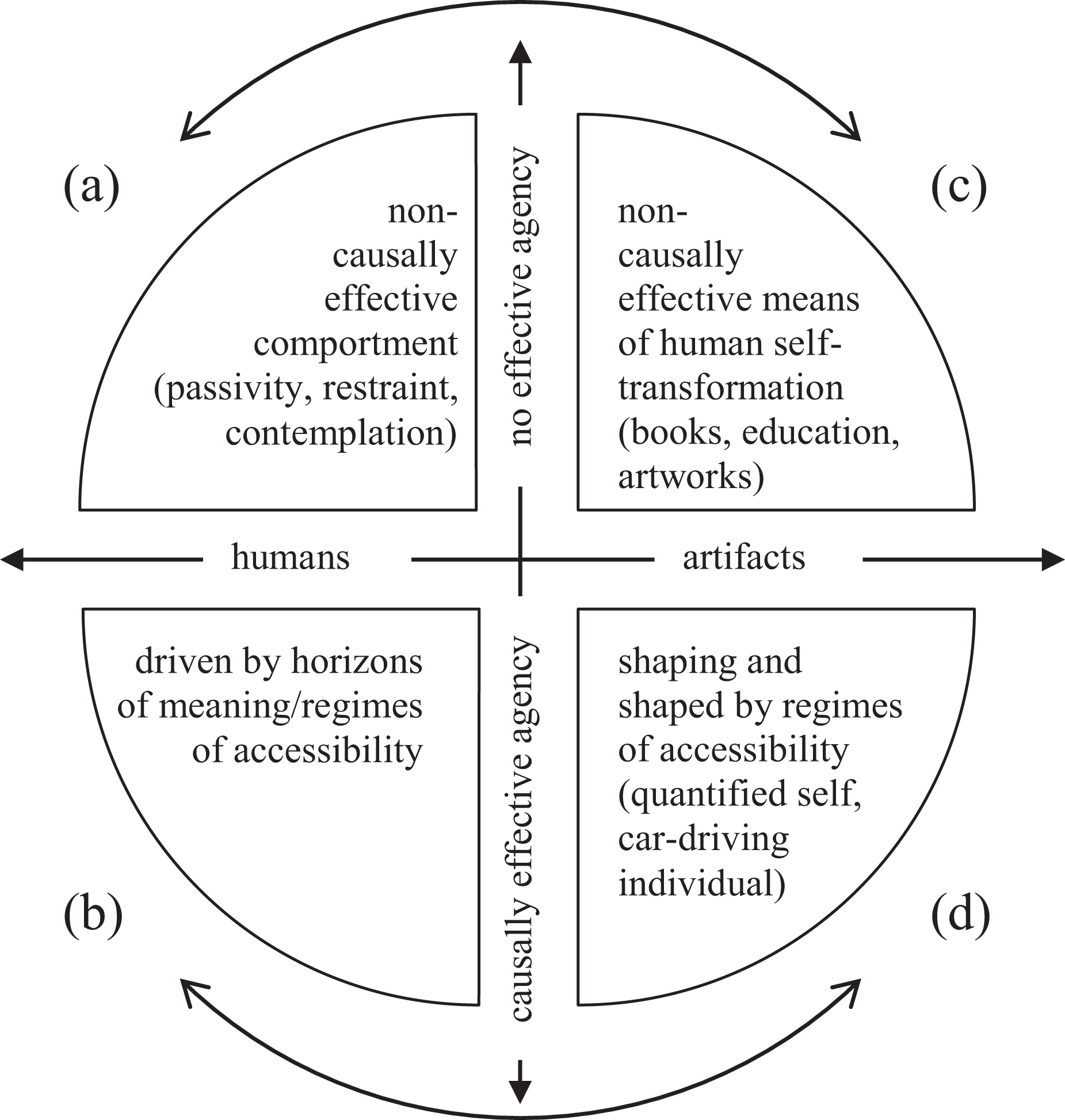
What is not taken into account in the anti-hermeneutic trajectory.
Because of the manifold relations of both humans and nonhumans to the sphere of meaning, it is insufficient to approach the question of human technological self-production within a theoretical framework that portrays the human as part of a distributed network of intra-active matter or generative vitality. The relevance of technological artifacts cannot be reduced to their technoscientifically induced agency, their efficere, but concerns the unfolding of the horizons of meaning which precede all aspirations to effect and provide them with guidance and direction. 19 The question whether our practices of technological self-production can be detached from the teleology of optimization cannot even be asked, before the meaning is taken into account that establishes this teleology. The destruction of the earth cannot be confined without challenging the horizons of meaning that drive it. Thus, alluding again to Thesis 11, Anders’s motto of the second volume of The Obsolescense of Human Beings phrases a passionate objection to the anti-hermeneutic trajectory and asserts the irreducibility of meaning in the age of posthuman technoscientific agency: ‘It is not enough to change the world. That is what we do anyway. And to a great extent, it even happens without our involvement. We also need to interpret this change – in order to change it’ (Anders, 2002: 5, my translation). The openness of the future depends upon humans not surrendering to the anti-hermeneutic trajectory.
Footnotes
Funding
The author(s) received no financial support for the research, authorship, and/or publication of this article.