




Abstract

Introduction
Mental health problems arising from climate change are an increasing concern, with a growing literature focusing on eco-anxiety (i.e., climate-related anxiety) and eco-depression (i.e., climate-related grief or depression). 1 Research on adults demonstrates that women and gender-diverse individuals may be disproportionately impacted by climate-related distress, 2 highlighting the need for applying a sex and gender lens when examining climate-related mental health. Few studies have examined these associations among youth, who may be especially affected by concerns about their future amidst reports of climate change. 3 Pre-existing mental health concerns have been shown to be associated with eco-depression and eco-anxiety 3 making it important to control for the effects of these underlying conditions. We examined the associations of sex, gender and psychological distress with eco-anxiety and eco-depression using a survey of mental health and drug use in Ontario-based youth.
Methods
We completed a secondary analysis of the 2021 Ontario Student Drug Use and Health Survey, a recurring survey of students in grades 7 to 12 (aged 11–19). 4 The study received approval from relevant school boards and the Centre for Addiction Mental Health Research Ethics Board; parents provided written consent.
Primary outcomes of eco-anxiety and eco-depression were measured with single items, both with Likert response scaling (5-point and 4-point, respectively). Sex-assigned-at-birth was self-reported as male or female. Gender identity was categorized as cisgender boy, cisgender girl, and gender diverse. The Kessler 6-item Psychological Distress scale 5 was used to identify psychological distress, with a cut-off score of ≥8 considered moderate to serious distress.
Statistical Analysis
Eco-depression and eco-anxiety were examined across sex-assigned-at-birth using Mann–Whitney tests and by sex and gender controlling for psychological distress using analysis of variances, with post-hoc Bonferroni-corrected pairwise t-tests using JASP. As a small number of gender-diverse students fell in the “little distress” category, an analysis of covariance was used to examine the effect of gender while controlling for psychological distress as a continuous variable for both eco-depression and eco-anxiety.
Results
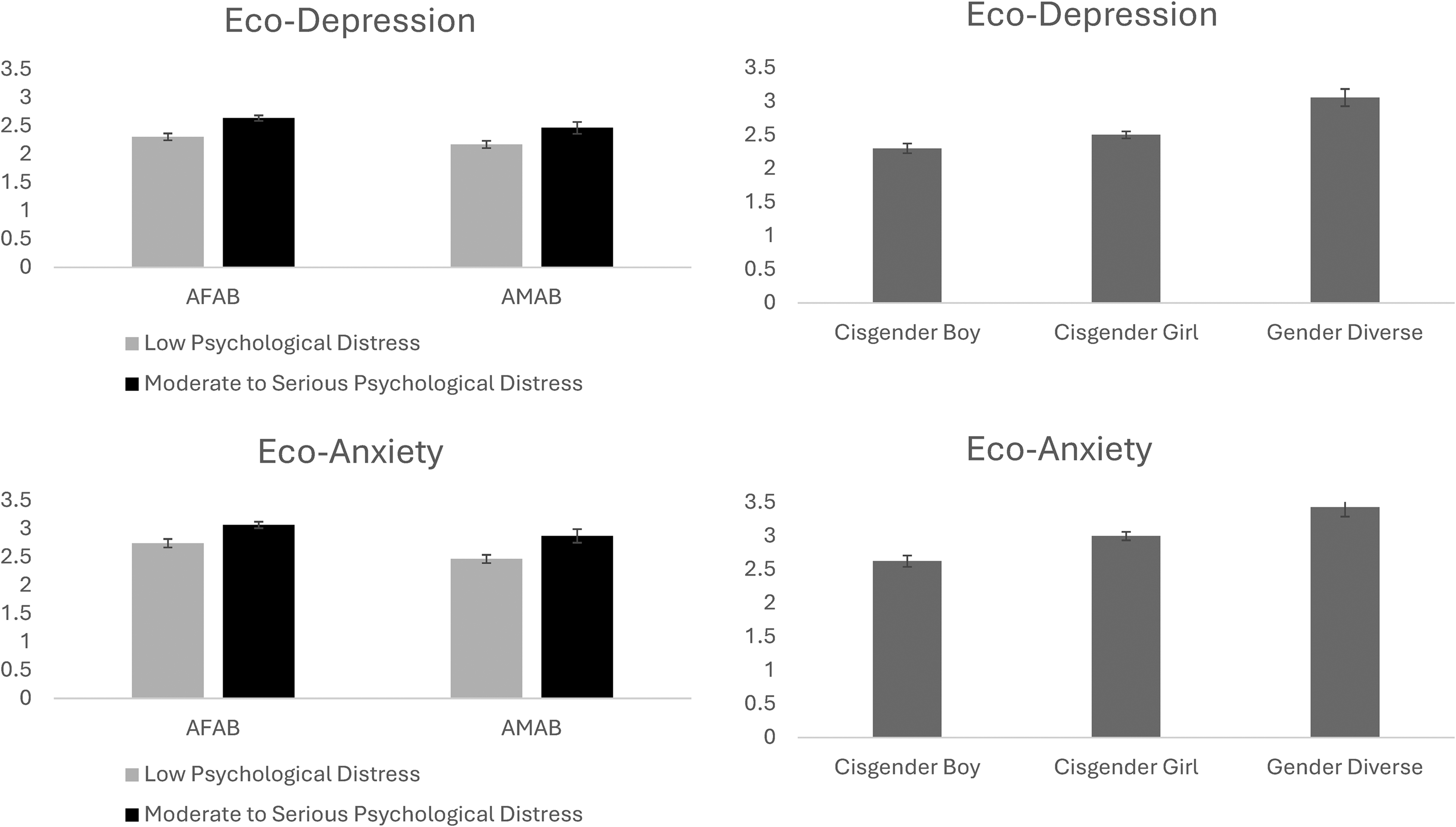
Comparisons of eco-depression and eco-anxiety across (a) sex-assigned-at-birth and psychological distress and (b) gender identity.
Discussion
Consistent with findings in adults, important sex and gender differences in eco-anxiety and eco-depression were found among youth, with AFAB, gender diverse, and cisgender girls more likely to report high levels of eco-anxiety and eco-depression than AMAB, cisgender boys and girls, and cisgender boys, respectively. 2 Youth reporting higher psychological distress 3 were more likely to experience eco-anxiety and eco-depression. However, when psychological distress was accounted for, gender-diverse youth endorsed more eco-depression and eco-anxiety, suggesting that baseline psychological distress alone did not explain differences in eco-related mental health concerns across gender.
Conclusions
Gender-diverse youth and youth AFAB may be especially likely to experience eco-depression and eco-anxiety. Future research would benefit from youth engagement in better-understanding predictors of eco-distress and exploring eco-resilience intervention models 3 in youth, as well as more thoroughly operationalizing youth eco-depression and eco-anxiety.
Footnotes
Acknowledgements
We acknowledge the Institute for Social Research at York University for administering the data collection. The OSDUHS is a longstanding CAMH initiative funded in part by CAMH and several provincial agencies.
Data Availability
The dataset is available under a data sharing agreement by contacting osduhs@camh.ca.
Declaration of Conflicting Interests
The authors declared no potential conflicts of interest with respect to the research, authorship, and/or publication of this article.
Funding
The authors received no financial support for the research, authorship, and/or publication of this article.
