




Abstract
Objectives
To describe screen time levels and determine their association with socioemotional and behavioural difficulties among preschool-aged First Nations, Métis, and Inuit children.
Method
Data were taken from the Aboriginal Children's Survey, a nationally representative survey of 2–5-year-old Indigenous children in Canada. Socioemotional and behavioural difficulties were defined using parent/guardian reports on the Strengths and Difficulties Questionnaire. Multiple linear regression analyses were conducted separately for First Nations, Métis, and Inuit participants, and statistically adjusted for child age, child sex, and parent/guardian education. Statistical significance was set at P < 0.002 to adjust for multiple comparisons.
Results
Of these 2–5-year-old children (mean [M] = 3.57 years) 3,085 were First Nations (53.5%), 2,430 Métis (39.2%), and 990 Inuit (7.3%). Screen time exposure was high among First Nations (M = 2 h and 58 min/day, standard deviation [SD] = 1.89), Métis (M = 2 h and 50 min [SD = 1.83]), and Inuit children (M = 3 h and 25 min [SD = 2.20]), with 79.7% exceeding recommended guidelines (>1 h/day). After adjusting for confounders, screen time was associated with more socioemotional and behavioural difficulties among First Nations (total difficulties β = 0.15 [95% CI, 0.12 to 0.19]) and Métis (β = 0.16 [95% CI, 0.12 to 0.20]) but not Inuit children (β = 0.12 [95% CI, 0.01 to 0.23]).
Conclusions
Screen time exposure is high among Indigenous children in Canada, and is associated with more socioemotional and behavioural difficulties among First Nations and Métis children. Contributing factors could include enduring colonialism that resulted in family dissolution, lack of positive parental role models, and disproportionate socioeconomic disadvantage. Predictors of poor well-being should continue to be identified to develop targets for intervention to optimize the health and development of Indigenous children.
Introduction
The brain develops rapidly during early childhood 1 and can be impacted by screen use. Screen time in preschool-aged children is associated with deficits in cognitive,2–5 socioemotional,5,6 and behavioural domains.5,7–9 Given these adverse effects, the World Health Organization, 10 along with pediatric societies and other organizations from around the world (e.g., USA, 11 Canada, 12 and Australia 13 ) recommend that children aged 2 to 5 years limit screen time to 1 h per day. However, up to 65% of children in this age group exceed these guidelines, 14 a situation that worsened during the COVID-19 pandemic. 15
Indigenous children in Canada (i.e., First Nations, Métis, and Inuit) continue to be exposed to the enduring effects of colonialism,16,17 where a history of EuroChristian dominance, control, and assimilation contribute to present-day health (e.g., obesity)18,19 and social disparities (e.g., lower socioeconomic status and parental education). 20 In general population samples, these health and socioeconomic risk factors are associated with both screen time21,22 and socioemotional and behavioural difficulties.23,24 Despite these risks, little is known about screen time use and its putative associations with socioemotional and behavioural difficulties among Indigenous preschool-aged children in Canada. Data from the United States suggest that preschool-aged Indigenous children are exposed to high levels of screen time (up to 5.5 h of TV and/or computer games per day [5 h and 30 min/day]).25–29 However, studies have relied on small,27,28 less than representative samples,25–29 or only assessed a single screen device.28,29 To our knowledge, no studies have examined associations between screen time and socioemotional and behavioural difficulties among Indigenous children in any country.
Examining these associations in Indigenous children is important for several reasons. First, individuals ≤14 years old are the fastest-growing Indigenous demographic group in Canada, comprising up to 30% of the population (compared to just 16.4% of non-Indigenous individuals). 30 Second, Indigenous children are more likely to live in larger households (i.e., ≥4 children) 31 and so are more likely to be exposed to screen time, and potentially developmentally less appropriate content in the presence of their older siblings. 32 Third, in many Indigenous cultures, children are encouraged to learn through experimentation and exploration. 33 More time spent on sedentary screen time could reduce exposure to traditional childrearing and hinder the transgenerational transmission of cultural parenting practices and culturally relevant activities. Indeed, connection to culture (i.e., time spent on traditional land, participation in outdoor activities, or learning an Indigenous language) is fundamental to many definitions of Indigenous well-being. 16 Finally, investing in this young, rapidly growing, disadvantaged population may not only have substantial benefits for children, families, and society, but is a critical step towards social justice. The United Nations Declaration on the Rights of Indigenous Peoples affirms the human rights of Indigenous peoples including their right to improve, restore, and maintain health. 34
Given existing knowledge gaps on screen time use among Indigenous children, the objectives of this study were to: (1) describe screen time use among 2–5-year-old First Nations, Métis, and Inuit children, and (2) examine associations between screen time and socioemotional and behavioural difficulties.
Methods
Given that this was a secondary analysis of a Statistics Canada survey, this study was exempt from an institutional review board approval. All data were vetted by deemed employees of Statistics Canada.
Study Design
This study used data from The Aboriginal Children's Survey (ACS), a nationally representative cross-sectional survey examining the development of First Nations, Métis, and Inuit children under 6 years of age (by October 31, 2006) living off-reserve in Canada. 35 In 2006, 75% of Indigenous individuals lived off-reserve. 36 The ACS was conducted between October 2006 and March 2007. Examining screen time levels during this period can lay the foundation for future researchers to better understand trends in screen exposure over time, especially among Indigenous children where data are severely limited. Moreover, by using data from a nationally representative survey, which contains the most recent data on the health and well-being of preschool-aged Indigenous children, study results can accurately reflect population health and guide resource allocation and intervention development.
The sampling frame consisted of children under 6 who were identified as Indigenous (First Nations, Métis, or Inuit, and/or had Indigenous ancestors, and/or were a Status First Nations, and/or had First Nations band membership) by their parent/guardian on the 2006 Canadian Census. 35 Children living on-reserve or in institutions were not eligible. Of the 17,472 children identified, 14,170 had parents/guardians return completed surveys (81.1% response rate). 35 Telephone interviews were conducted unless participants lived in the Northwest Territories (except Yellowknife), Labrador, or Inuit communities (where in-person interviews were conducted).
Measures
Exposure
Screen time was assessed using parent/guardian reports on 2 open-ended questions: “On average, about how many hours per day does [the child] watch TV/videos/DVDs?” and “On average, about how many hours per day does [the child] play computer/video games?” Responses were summed to calculate the total daily screen time (hours/day). These methods are consistent with other studies conducted in young children, 37 including the Canadian Health Measures Survey (a nationally representative survey) which established if Canadian preschool children were meeting national screen time recommendations. 38 We examined screen time as a continuous variable.
Outcome
Parents/guardians also completed the 2–4-year-old version of the Strengths and Difficulties Questionnaire (SDQ) for their children. The SDQ measures socioemotional and behavioural difficulties in children over the past 6 months and consists of 5 subscales: emotional difficulties, conduct problems, hyperactivity/inattention, peer relationship problems, and prosocial behaviour. The first 4 subscales are summed to create a “Total Difficulties” scale. Higher scores are indicative of greater problems, except for the prosocial subscale where higher scores represent more prosocial behaviour. The 2–4-year-old version of the SDQ has satisfactory reliability for emotional,39–43 conduct,39–43 hyperactivity/inattention,39–43 and prosocial behaviour subscales.39–43 The peer relationship scale performs less well but is still satisfactory.39–43 The SDQ has been validated and found reliable among Indigenous children in Canada 44 and Australia. 45
Among this sample of Indigenous children, internal reliability is satisfactory (>0.70) for all subscales among First Nations and Métis, with the peer subscale approaching the reliability cut-off (ρ = 0.61) and (ρ = 0.62), respectively. 44 Internal reliability for Inuit participants is generally lower but is at or near the cut-off for all scales with the exception of the peer subscale (ρ = 0.57). 44 The ρ statistic is analogous to Cronbach's alpha (which is a measure of internal consistency) although provides a more accurate reliability estimate since it does not assume that a factor contributes equal variance to its pertinent items. 44 The ρ statistic is interpreted identically to Cronbach's alpha where ρ > 0.70 suggests satisfactory internal reliability. Since valid clinical cut-points have not been established for this population, continuous scores were used in this study.
Statistical Analysis
Chi-square analyses (categorical data) and a 1-way analysis of variance (continuous data) were used to examine differences in sociodemographic characteristics and screen time between First Nations, Métis, and Inuit participants. Post hoc analyses were conducted if statistically significant differences were found. Separate unadjusted linear regressions for First Nations, Métis, and Inuit children were used to examine the associations between screen time and socioemotional and behavioural difficulties. Standardized coefficients were used by transforming the variables contained in our study to z-scores prior to conducting the regressions. Directed acyclic graphs (DAGs) were used to understand the role of potential confounders. The online software platform “DAGitty” was used to create the DAG (Figure 1). 46 Models were adjusted for child age, child sex, and parent/guardian education as potential confounders. To examine the interaction effect of screen time and child sex on socioemotional and behavioural difficulties, a multiplicative term of screen time and child sex was included in the models. To adjust for multiple comparisons, we used the Bonferroni correction (6 pairwise comparisons across 3 groups; 6 multiplied by 3 = 18 tests [0.05/18], therefore adjusted P < 0.002). All statistical analyses were conducted using SPSS (Version 26). Participants who were missing screen time and/or SDQ data were not included in the analyses. Missing data for most sociodemographic variables ranged from 0.5% to 3.4%. The exception was the SDQ (up to 7.5% for First Nations, 6.5% for Métis, and 20.7% for Inuit). Standardized weights were applied to the sample size to represent the size of the Indigenous population, as well as adjust for nonresponse. 35 All data were vetted by Statistics Canada personnel and cell counts <10 were not released. For Supplemental Table S1, where the study sample versus all observations were compared, only weighted frequencies were authorized for release by the Statistics Canada personnel (see Supplemental Information).
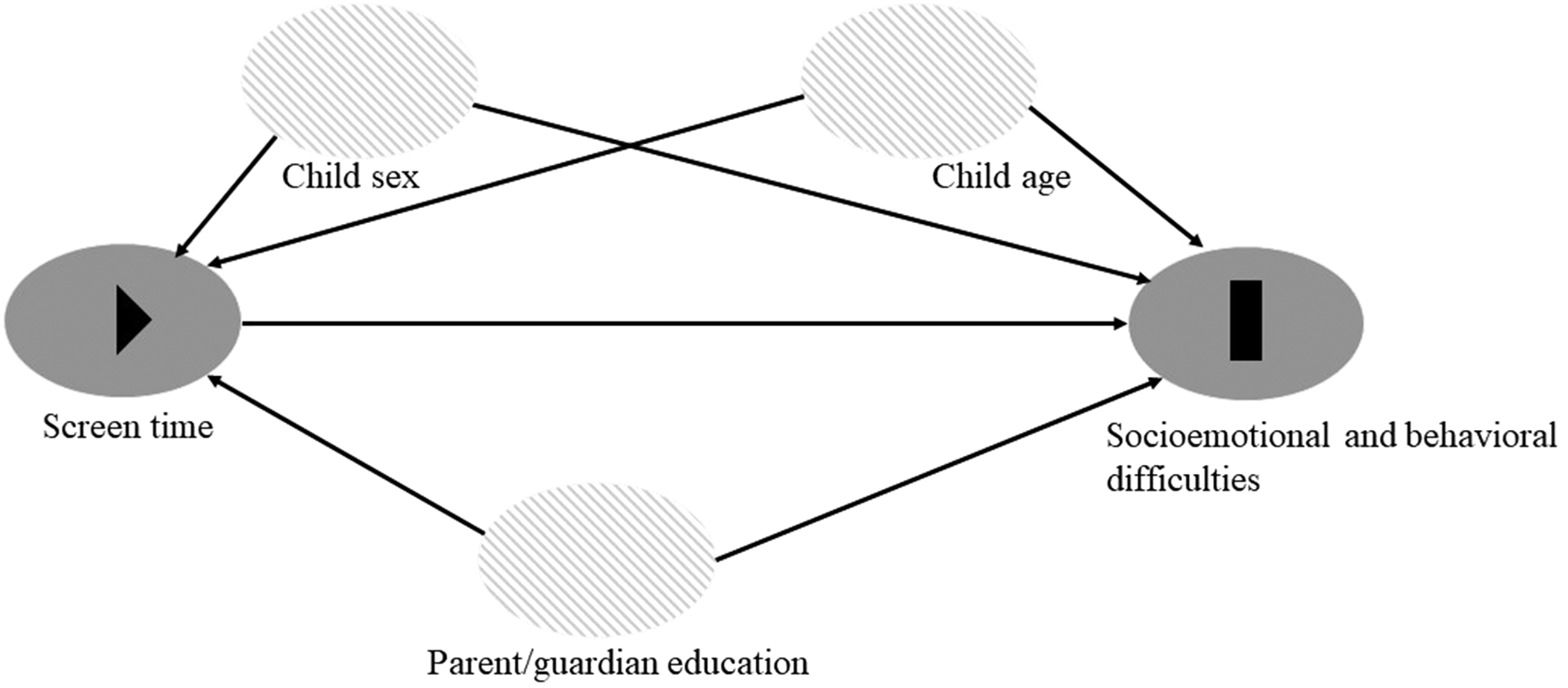
Directed acyclic graph for screen time and socioemotional and behavioural difficulties. The circle with a triangle is the exposure (screen time) and the circle with a rectangle is the outcome (socioemotional and behavioural difficulties). The circles with hatched lines represent confounding as they are associated with the exposure and outcome and do not lie on the causal pathway.
Results
Of the 14,170 children (<6 years old) in the study, Indigenous identity was reported for 70.8% of children and 72.1% of them were aged 2–5 years. A total of 6,505 children aged 2–5 years old (M = 3.57, 48.8% female) had complete screen time data and at least 1 complete SDQ scale of which 3,085 were First Nations (53.5%), 2,430 were Métis (39.2%), and 990 were Inuit (7.3%). When compared against all 2–5-year-old children with an Indigenous identity in the ACS, our sample was older and more likely to have a parent/guardian with at least a college degree (see the Supplemental Information). Sociodemographic characteristics are presented in Table 1 by Indigenous group. No statistically significant differences in child age and sex existed between First Nations, Métis, and Inuit participants. Mothers were the most common parent/guardian informant (75.1% of cases), followed by fathers (19.0%), and grandparents/aunt/uncle/cousin/sibling/teacher/other relative/other nonrelative (4.0%). Compared with First Nations parents/guardians, Inuit parents/guardians were more likely to have self-reported good/fair/poor health and fewer years of education while Métis parents/guardians were more likely to report more education.
Characteristics of First Nations, Métis, and Inuit Children With Complete Screen Time Data From the Aboriginal Children's Survey.
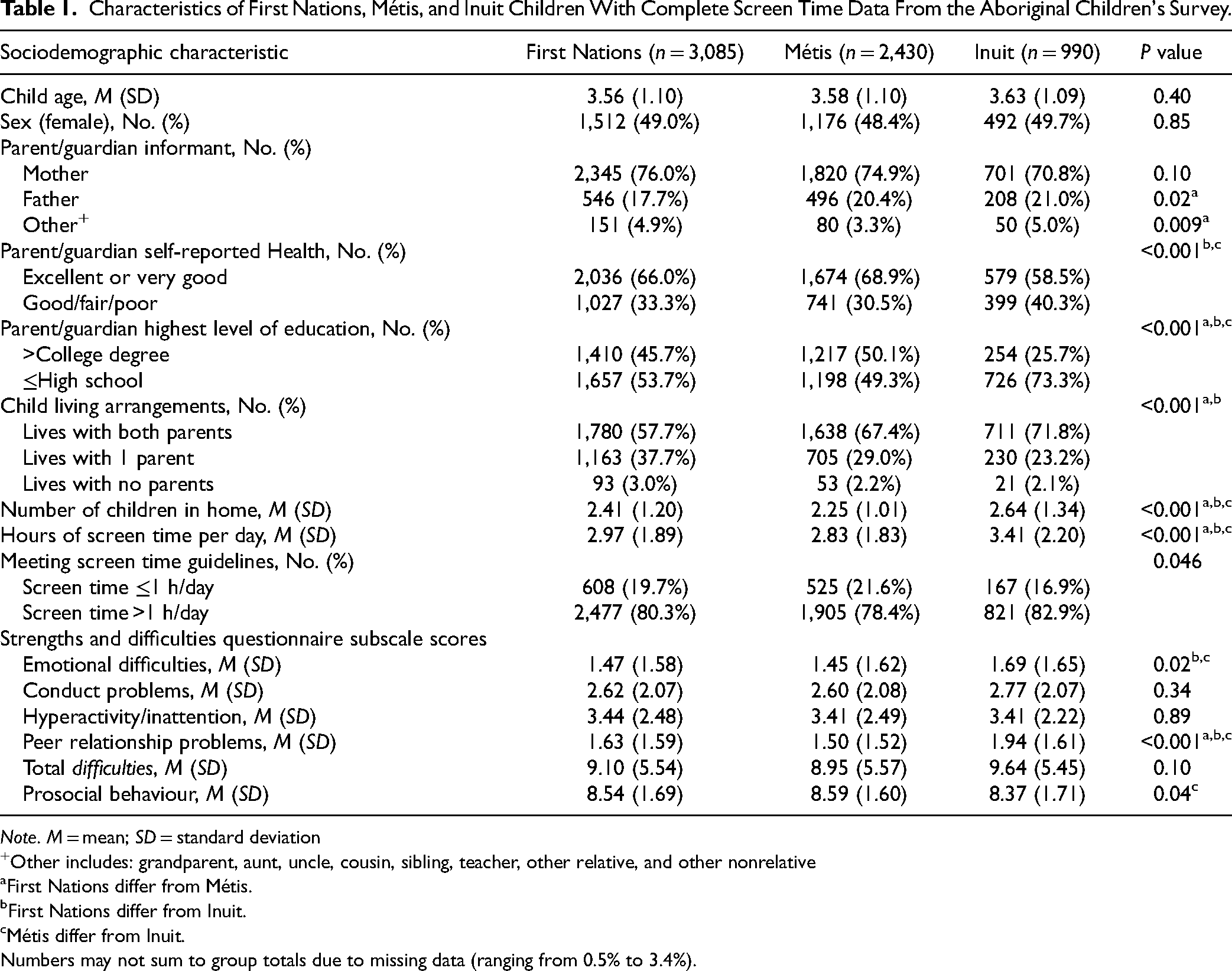
Note. M = mean; SD = standard deviation
+Other includes: grandparent, aunt, uncle, cousin, sibling, teacher, other relative, and other nonrelative
First Nations differ from Métis.
First Nations differ from Inuit.
Métis differ from Inuit.
Numbers may not sum to group totals due to missing data (ranging from 0.5% to 3.4%).
Inuit children were exposed to more screen time (M = 3.41 [3 h and 25 min], SD = 2.20, range = 0–16 h) than First Nations (M = 2.97 [2 h and 58 min], SD = 1.89, range = 0–18 h) and Métis children (M = 2.83 [2 h and 50 min], SD = 1.83, range = 0–18 h) and First Nations children had more screen time exposure than Métis children (P < 0.001). More Inuit children (82.9%) were also more likely to exceed 1 h Canadian screen time guidelines 12 compared to First Nations (80.3%) and Métis children (78.4%), however, this difference was not statistically significant after testing for multiple comparisons.
Inuit children had higher scores on the emotional difficulties subscale (M = 1.69, SD = 1.65) than First Nations (M = 1.47, SD = 1.58) and Métis (M = 1.45, SD = 1.62; P = 0.02) children, and lower scores on the prosocial behaviour subscale (M = 8.37, SD = 1.71) than Métis (M = 8.59, SD = 1.60; P = 0.04) children. Inuit children also had more peer relationship problems (M = 1.94, SD = 1.61) than First Nations children (M = 1.63, SD = 1.59), who had more peer relationship problems than Métis children (M = 1.50, SD = 1.52; P < 0.001).
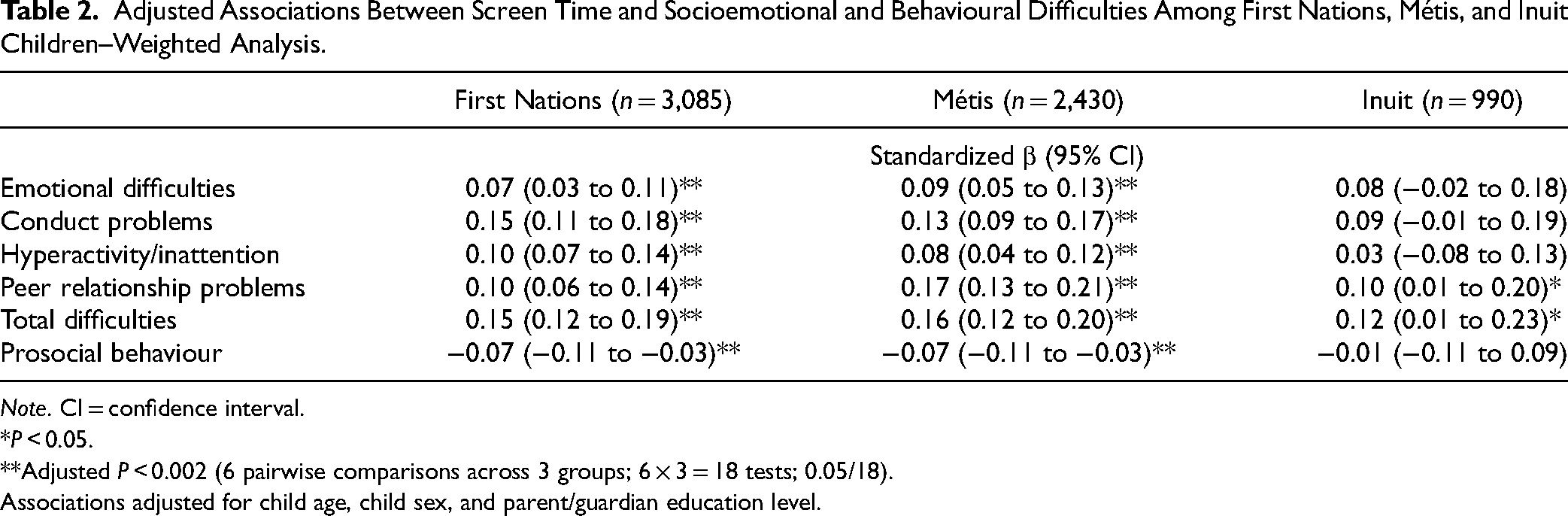
In unadjusted analyses, screen time was associated with more socioemotional and behavioural difficulties for First Nations and Métis children (see Supplemental Information). Among First Nations children, each hour of screen time was associated with more emotional difficulties (β = 0.08; 95% CI, 0.05 to 0.12), conduct problems (β = 0.16; 95% CI, 0.13 to 0.20), hyperactivity/inattention (β = 0.12; 95% CI, 0.08 to 0.15), peer relationship problems (β = 0.12; 95% CI, 0.08 to 0.16), and total difficulties (β = 0.18; 95% CI, 0.14 to 0.21), and lower levels of prosocial behaviour (β = −0.07; 95% CI, −0.10 to −0.03). These associations remained statistically significant after adjusting for potential confounders (Table 2).
Adjusted Associations Between Screen Time and Socioemotional and Behavioural Difficulties Among First Nations, Métis, and Inuit Children–Weighted Analysis.
Note. CI = confidence interval.
*P < 0.05.
**Adjusted P < 0.002 (6 pairwise comparisons across 3 groups; 6 × 3 = 18 tests; 0.05/18).
Associations adjusted for child age, child sex, and parent/guardian education level.
Among Métis children, each hour of screen time was associated with higher levels of emotional difficulties (β = 0.09; 95% CI, 0.05 to 0.13), conduct problems (β = 0.14; 95% CI, 0.10 to 0.18), hyperactivity/inattention (β = 0.09; 95% CI, 0.05 to 0.13), peer relationship problems (β = 0.18; 95% CI, 0.14 to 0.22), and total difficulties (β = 0.17; 95% CI, 0.13 to 0.21), and lower levels of prosocial behaviour (β = −0.07; 95% CI, −0.11 to −0.03). Associations remained statistically significant after adjustment for confounders (Table 2).
For Inuit children, screen time was not associated with any socioemotional and behavioural outcomes in unadjusted or adjusted analyses using the adjusted P value.
In the adjusted models, child sex did not moderate the association between screen time and socioemotional and behavioural difficulties for First Nations, Métis, or Inuit children using the adjusted P value (see Supplemental Information).
Discussion
In this nationally representative sample of preschool-aged First Nations, Métis, and Inuit children living in Canada, we found that 79.7% exceeded screen time recommendations (>1 h/day), and that screen time was associated with higher levels of socioemotional and behavioural difficulties in First Nations and Métis, but not Inuit, children.
This study observed high levels of screen exposure among Indigenous children (2 h and 58 min for First Nations, 2 h and 50 min for Métis, and 3 h and 25 min for Inuit). A study of 424 American Indian children (M = 5.8 years old) living on-reservation in the USA reported 2.60 h of TV/computer time per day (2 h and 36 min/day), 25 while another study of 3–4-year-old American Indian children (n = 581) reported 1.60 h/day (1 h and 36 min/day) and 2.22 h/day (2 h and 13 min/day) among boys and girls, respectively. 26 These studies may have reported lower screen time than ours due to differences in location (i.e., on-reservation with access to more traditional outdoor activities) 47 and/or measurement (i.e., measured only weekday screen time resulting in underestimates).
The findings of our study also support previous findings that preschool-aged Indigenous children are exposed to more screen time than their non-Indigenous peers. Data from a nationally representative study of non-Indigenous participants showed that 3.5-year-old Canadian children (n = 803) reported 1.90 h of screen time per day (1 h and 54 min/day). 38 Other studies of preschool-aged children in the USA, 48 Netherlands, 49 Ireland, 50 and Australia 51 also suggest that non-Indigenous children are exposed to less screen time. Our estimates of 80%, 78%, and 83% of First Nations, Métis, and Inuit children exceeding the 1 h daily screen time recommendation, respectively, are also higher than global (64.4%) 14 and Canadian (75.6%) 38 estimates of non-Indigenous 2–5-year-old children exceeding these guidelines. One exception to these findings comes from a nationally representative study conducted in the UK (n = 11,014), where researchers reported that 81.1% of 5-year-old children were exposed to at least 1 h of screen time per day. 7 However, this study contained an older sample and purposefully oversampled ethnic minorities and those of a lower socioeconomic status. 7
Why First Nations, Métis, and Inuit preschool-aged children may have more screen exposure than their non-Indigenous peers is not known. However, colonial policies (e.g., Indian Residential Schools and The Sixties Scoop) that resulted in the dissolution of family units and abuse exposure stripped many Indigenous individuals of the opportunity to form trusting relationships with adults, which may have affected their capacity to foster the development of their children when they became parents. 16 Cultural differences in parenting styles may also contribute. Many Indigenous cultures grant autonomy to children from a young age and encourage child-directed learning, 52 and so parents may be less likely to intervene when children are using screens. Third, Inuit children (who had the highest screen time) are exposed to harsh weather and have limited access to outdoor recreational facilities, which can restrict the time spent outdoors and contribute to higher screen time. 47 Finally, it could be that Indigenous children disproportionately experience structural disadvantages that are associated with increased screen exposure including lower socioeconomic status, 20 single-parent status, 53 and lower parental education. 20
Consistent with studies of non-Indigenous samples, we also observed that screen time was associated with socioemotional and behavioural difficulties among First Nations and Métis children. 54 For example, more than 1 h of screen time per day predicted higher levels of externalizing and internalizing difficulties among 3-year-old non-Indigenous Canadian children (n = 539). 55 Multiple other studies have reported associations between screen time and socioemotional and behavioural difficulties in young children (<7 years old).5–9,56 However, our observed effect sizes were small. These are consistent with other studies linking screen time and behaviour in young children including for hyperactivity/inattention (standardized β = 0.02), 49 conduct (standardized β = 0.09), 57 and externalizing (standardized β = 0.03) 49 problems.
It is unclear why screen time is associated with more socioemotional and behavioural difficulties among First Nations and Métis children. First, it could be that more time spent watching TV and/or playing video games leaves less time for developmentally important activities which would otherwise contribute to healthy child development. 58 Indigenous children may be particularly at risk for these outcomes because they are less likely to attend daycare which provides important opportunities for developmental activities. 59 Second, since these children were living off-reserve, parents may have had less access to kin. In many Indigenous cultures, parents rely on extended family members to partake in childrearing. 52 Lack of support may put additional stressors on parents who may not have been modelled positive parenting behaviour due to assimilation policies that resulted in family separation. Therefore, Indigenous children may not have additional caregivers to buffer any potential negative relationships with their parents which could lead to poorer socioemotional and behavioural development. Third, traditional Indigenous parenting practices may also contribute as many Indigenous cultures believe in child-directed learning. Child-directed learning can foster independence, nurture positive interpersonal relationships, and teach children to live within societies. However, this parenting style has also been shown to be associated with higher screen time and externalizing issues in children.60,61
No statistically significant associations were observed between screen time and socioemotional and behavioural difficulties among Inuit children. While the reasons are unknown, Inuit cultural practices could play a role. Traditional Inuit parenting practices follow the process of “Inunnguiniq” (the making of a human being) where community support in childrearing is a central tenet. 62 Having support through kinship networks could be associated with positive screen time environments (e.g., co-viewing), which can positively influence the relationship between screen time and socioemotional and behavioural difficulties. 63 Such supports and cultural connection may be more readily accessible to Inuit families compared to First Nations and Métis families living off-reserve since historically, Inuit were the last group in Canada to be subjected to the federal government's assimilation policies. 64 Today, many Inuit individuals retain their cultural practices and teachings. For instance, 65.2% of Inuit children (≤14 years old) can speak an Indigenous language compared to 15.8% of First Nations and 1.0% of their Métis peers. 65
Consistent with other studies, we found that child sex did not moderate the association between screen time and socioemotional and behavioural difficulties among First Nations, Métis, and Inuit children.4,7
These findings can help raise awareness among healthcare professionals, educators, and parents that Indigenous children may be exposed to high levels of screen time. Additionally, this work could support individuals and organizations advocating for a reduction in screen time and initiatives aimed at optimizing the well-being of Indigenous children. This study can serve as the foundation for future researchers to measure changes in screen time use over time by using more contemporary surveys. For example, the 2022 Indigenous Peoples Survey is a more recent assessment of screen time in 2–5-year-old Indigenous children living off-reserve and survey results will be available in 2024.
Limitations
This study has several limitations. First, it was a cross-sectional study and so causal associations between screen time and child socioemotional and behavioural difficulties cannot be drawn. Second, the quality of screen time was not assessed as educational TV/computer time may have positive effects on child development.2,66 Third, our effect sizes were small suggesting they are only meaningful at the population level. Fourth, we did not assess potential mediators and so mechanisms were not explored. Fifth, while our study provides an important baseline for screen time among Indigenous children, we do not have data from the past 15 years and so present-day screen time use among Indigenous children remains unknown. Indeed, the use of mobile devices (e.g., smartphones and tablets) has increased in the past decade among children 8 years and younger. 67 Despite this, contemporary studies suggest that television viewing, not smartphone or tablet use, remains the largest contributor to screen exposure among preschool-aged children.68–70 Finally, while we used screen time measurements consistent with other nationally representative studies, there exist other measures (e.g., standardized questionnaires and 24 h diary log).
Conclusion
Using the largest, nationally representative sample of First Nations, Métis, and Inuit preschool-aged children living in Canada, our study found that Indigenous children (especially Inuit children) have high screen time use and that nearly 4 out of 5 exceed the 1 h daily screen time recommendation. These data also suggest that screen time was associated with higher levels of socioemotional and behavioural difficulties among First Nations and Métis children. Future research is needed to establish causal associations between screen time and socioemotional and behavioural difficulties and explore mechanisms underlying these associations.
Supplemental Material
sj-docx-1-cpa-10.1177_07067437231223333 - Supplemental material for Screen Time and Socioemotional and Behavioural Difficulties Among Indigenous Children in Canada
Supplemental material, sj-docx-1-cpa-10.1177_07067437231223333 for Screen Time and Socioemotional and Behavioural Difficulties Among Indigenous Children in Canada by Sawayra Owais, Maria B. Ospina, Camron Ford, Troy Hill, Calan D. Savoy and Ryan Van Lieshout in The Canadian Journal of Psychiatry
Footnotes
Data Access
Deidentified individual participant data will not be made available.
Acknowledgments
None.
Declaration of Conflicting Interests
The authors declared no potential conflicts of interest with respect to the research, authorship, and/or publication of this article.
Funding
The authors received no financial support for the research, authorship, and/or publication of this article.

Supplemental Material
Supplemental material for this article is available online.
References
Supplementary Material
Please find the following supplemental material available below.
For Open Access articles published under a Creative Commons License, all supplemental material carries the same license as the article it is associated with.
For non-Open Access articles published, all supplemental material carries a non-exclusive license, and permission requests for re-use of supplemental material or any part of supplemental material shall be sent directly to the copyright owner as specified in the copyright notice associated with the article.
